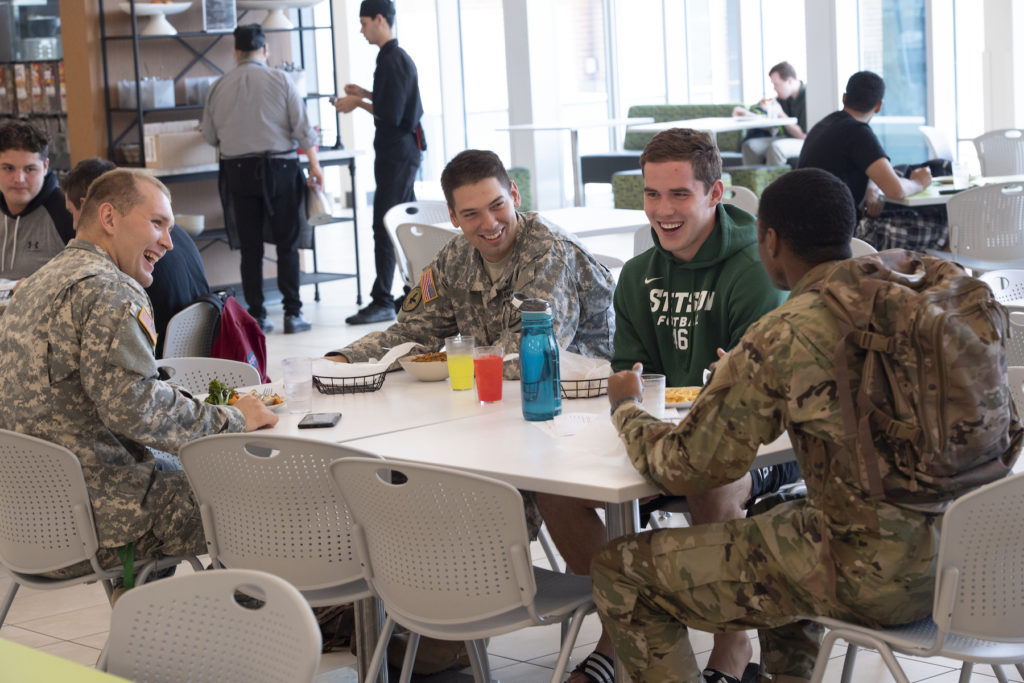
Colleges can support military-affiliated students through peer connections and community.
SDI Productions/Getty Images
Approximately 5 percent of all undergraduate learners are active-duty military, reservists, National Guard or veterans, but many systems within colleges aren’t set up to accommodate their needs.
A November research brief from the Center for Higher Education Policy and Practice outlines some of the barriers to military students’ success while they’re enrolled and offers strategies to improve their college experiences. The report draws on interviews with students, recent graduates, higher education faculty and staff, policy experts, and past research.
Clearly outline program costs and the support services available to military-connected learners. Colleges should also share data on military student enrollment, completion and job outcomes, such as on a dedicated military-student web page.
Streamline credit transfer policies using the American Council on Education’s Military Guide as a starting point for military experience. Providing quality transfer advising can also ensure maximum allowable credits are awarded for prior service and can explain how a major program may increase or decrease transferred credits.
Provide financial aid counseling for military-connected students so they know the benefits available for them at federal, state and institutional levels. The college should also allocate dollars in the case of benefit delays or work with appropriate offices to expedite funds.
Create peer mentorship programs to connect incoming students with currently enrolled military learners who have similar lived experiences. Affinity groups on campus, such as the Student Veterans of America, can also instill a sense of belonging.
Offer professional development training for faculty and staff to be culturally competent about military-specific needs. Green Zone Ally Training is one example that helps higher education professionals support veterans on campus.
Offer flexible courses that accommodate active-duty service members and their families, who may be navigating deployments or relocations. These could include online classes or competency-based education.
Establish policies for service-related disruptions including deadline extensions, rescheduling exams or alternative-format course materials to mitigate disruptions to students’ academic timelines.
Provide accessibility across systems so veterans with disabilities gain equitable access to resources. In instances when accommodations are needed, creating a streamlined process to qualify for accommodations through the disability services office ensures veterans can access all resources.
Create partnerships with external agencies who also support military-connected individuals, such as Veterans Service Organizations and the local Veterans Affairs office.
Connect students with career coaches who can translate their military experience and training into the civilian workforce as well as liaise between veteran-friendly employers and students. Some military-connected students may need additional advice on how professional demeanor and formality expectations vary in the civilian workforce, the report noted.
Expand access to co-op programs and internships that are tailored to military learners and career exploration opportunities. Military-focused career events can make the match between veteran-friendly organizations and future employees.
Track career outcomes for military-affiliated students and align offerings with labor market opportunities.
How does your college or university provide specialized resources to military-affiliated students? Tell us more here.
An estimated 820,000 students in higher education are military-affiliated, including current and former active-duty service members and their families. These students are more likely to be first-generation or parenting students and often hold competing priorities while pursuing a degree, which can put them at risk of stopping out.
A Nov. 4 webinar by the American Council on Education solicited insights from former and current service members on their experiences navigating higher education and how campuses can improve supports.
“Veterans are not a monolith; they don’t want pity or lower bars,” said Roman Ortega, chief executive officer and founder of Global Integrity Consulting and a member of the Army Reserve. “They want colleges to treat them like they’re mission-driven adults and to remove the friction that keeps them from showing what they already know how to do.”
Veterans shared four key themes that could enhance military-affiliated students’ college experience.
College Navigation
About two-thirds of student veterans are first-generation college students, according to data from Student Veterans of America. First-generation students, in general, often lack cultural capital and insight into the bureaucracy of higher education; for former service members, college can be even more mystifying. Effective advising can make a difference, veterans said during the webinar.
“I was enrolled at Northern Illinois University. I didn’t know what to do or where to go,” Ortega said. “I saw a sign for Army ROTC; I walked right into the office and I said, ‘Hey, I really don’t know what I’m doing here, I don’t know where any of my classes are, I don’t know how to be advised on any of this. They said, ‘Hey, we’ll help you out.’”
Bringing in other military-affiliated students can be one way to boost engagement; several veterans mentioned they enrolled in higher education because of positive peer pressure from other service members.
“I didn’t even know what questions to ask. I just knew my peers were going and I wanted to be a part of that,” said Lola Howard, an Air Force veteran and doctoral student at Columbia Southern University.
Not every branch of the military looks at continuing education in the same way, which can have an impact on participation, veterans noted. “The Air Force, the Navy very much culturally encourage continued education in the service,” noted Lukas Simianer, an Army veteran and chief executive officer and founder of VetClaims.ai. “If you would have told the commander of Fort Bragg that you were going to go to college, they would have laughed.”
The University of Texas, San Antonio, has a dedicated first-year seminar for student veterans, which helps them establish a sense of belonging early in their college career and provides them with personalized assistance in obtaining credit for military service.
Credit for Prior Learning
Military-affiliated students often enroll in higher education with a wealth of experiences that can translate directly into course learning outcomes. ACE and other organizations have worked to streamline credit for prior learning offerings through the joint service transcript, which can help make college more accessible and affordable for veterans.
“It was very clear what the equivalent courses were that were off of my degree plan,” said Jonny Coreson, a Navy veteran and director of workforce strategy at the Learning Economy Foundation. “It was an opportunity to see that I had few courses [left] to attain an associate’s degree, but I literally had to see it.”
However, not every student veteran is eligible for or benefits from CPL in the same way, Simianer said.
“Be prepared that some of your veterans who have arguably had some of the hardest deployments, hardest service life, most wear and tear on their bodies, they may have the most courses to fulfill,” Simianer said. “Being really good at handling a machine gun does not really translate [to degree programs].”
Flexibility
Active-duty service members can experience frequent change as part of their service, including deployment or relocation. Student veterans are also often more likely to be parenting students or working, and these competing priorities can make pursuing a degree more challenging.
Creating a safe space for students to share their obstacles to success can mitigate disruptions to learning.
“As a student, it was important for me to communicate up front what was going on with my life, with my counselor, with my faculty, staff,” Howard said. “There were times that my house is being packed up and I’m trying to finish an eight-page paper and I just had to let my professor know, ‘I’m going from this time zone to that time zone—I’m just asking for a little flexibility.’”
Resource Hubs
Some colleges have created dedicated spaces on campus to centralize resources and connect military students with one another. Simianer, an older student who had won a Purple Heart and was diagnosed with post-traumatic stress disorder, remembers looking at his peers and feeling like he couldn’t relate to traditional students. But getting connected to his college’s student veteran hub changed that.
“Having a place where I could be, where the humor we had would fly or the conversations you needed to have could happen, is the most powerful thing that I am grateful for,” Simianer said. “I would not have continued an education, probably, if I would not have had that at the beginning.”
Javier Marin, a Marine Corps veteran and consultant at Vantage Point Consulting, said his college’s student veteran hub was particularly impactful because it connected him to staff.
“I found that the hardest part wasn’t the academics; it was having a good support system,” Marin said. “You’re working, you’re going to school, you’re being a parent, you have a mortgage—everything that goes along with transitioning and navigating that space without your old support system, which was the military.”
How does your campus seek to improve the college experience for military affiliated students? Tell us more.
President Donald Trump extended the invitation to all colleges after initial rejections from institutions that objected to provisions in the compact that would limit academic freedom.
The compact would require universities to suppress criticism of conservatives on campus, cap international enrollment at 15 percent, freeze tuition, overhaul admissions and hiring practices, and make various other changes in return for preferential treatment on federal research funding.
Now Valley Forge, a private two-year college in Pennsylvania, wants in on the compact.
“Participation in the Compact would provide valuable opportunities for collaboration, shared learning, and continuous improvement. We are particularly eager to contribute to discussions on leadership education, student resilience, and pathways from two-year programs to four-year institutions,” officials wrote to the Education Department. “These are areas in which Valley Forge has developed effective practices and measurable outcomes that could benefit peer institutions.”
Universities in the initial invitation were all research-focused, and the appeal from U.S. Education Secretary Linda McMahon emphasized the benefits of signing on, which would include “allowance for increased overhead payments where feasible, substantial and meaningful federal grants, and other federal partnerships.”
It is unclear how Valley Forge, which does not have a research focus, would benefit. The college is also much smaller than the first invitees, enrolling 86 students in fall 2023, according to federal data.
Valley Forge is now the third institution to publicly express interest in signing the compact since the invitation was expanded, following Grand Canyon University and New College of Florida.
As a college president, I see the promise of higher education fulfilled every day. Many students at my institution, Whittier College, are the first in their families to attend a university. Some are parents or military veterans who have already served in the workforce and are returning to school to gain new skills, widen their perspectives and improve their job prospects.
These students are the future of our communities. We will rely on them to fill critical roles in health care, education, science, entrepreneurship and public service. They are also the students who stand to lose the most under the proposed fiscal year 2026 federal budget, and those who were already bracing for impact from the “One Big Beautiful Bill” cuts, including to the health care coverage many of them count on.
The drive with which these extraordinary students — both traditionally college-aged and older — pursue their degrees, often while juggling caregiving commitments or other responsibilities, never fails to inspire me.
Related: Interested in innovations in higher education? Subscribe to our free biweekly higher education newsletter.
We do not yet know the precise contours of the spending provisions Congress will consider once funding from a continuing resolution expires at the end of September. Yet we expect they will take their cues from the president’s proposed budget, which slashes support for students and parents and especially hammers those already struggling to improve their lives by earning a college degree, with cuts to education, health and housing that could take effect as early as October 1.
That budget would mean lowering the maximum Pell Grant award from $7,395 to $5,710, reversing a decade of progress. For the nearly half of Whittier students who received Pell Grants last year, this rollback would profoundly jeopardize their chances of finishing school.
So would the proposal to severely restrict Federal Work-Study, which supports a third of Whittier students according to our most recent internal analysis, and to eliminate the Supplemental Educational Opportunity Grant, which more than 16 percent of our student body relies upon. In addition, this budget would impose a cap on Direct PLUS Loans for Parents, which would impact roughly 60 percent of our parent borrowers. It would also do away with the Direct PLUS Loans for Graduates program.
These programs are lifelines, not just for our students but for students all across the country. They fuel social mobility and prosperity by making education a force for advancement through personal work ethic rather than a way to rack up debt.
If enacted, these proposed cuts would gut the support system that has enabled millions of low-income students to earn a college degree.
Higher education is a bridge. To cross it and achieve their full potential, students from all walks of life must have access to the support and resources colleges provide, whether through partnerships with local high schools or with professional gateway programs in engineering, accounting, business, nursing, physical therapy and more. Yet, to access these invaluable programs, they must be enrolled. How will they reach such heights if they suddenly can’t afford to advance their studies?
The harm I’ve described doesn’t stop with cuts to financial aid, loans and services. Proposed reductions also target research funding for NASA, NIH and the National Science Foundation. One frozen NASA grant has already led to the loss of paid student research fellowships at Whittier, a setback not just in dollars but in momentum for students building real-world skills, networks and résumés.
These research opportunities often enable talented first-generation students to connect their classroom learning to career pathways, opening the door to graduate school, lab technician roles and futures in STEM fields. We’ve seen how federal funding has supported student projects in everything from climate data analysis to environmental health.
Stripping away support for hands-on research undermines the federal government’s own calls for colleges like ours to better prepare students for the workforce by dismantling the very mechanisms that make such preparation possible.
It’s particularly disheartening that these changes will disproportionately hurt those students who are working the hardest to achieve their objectives, who have done everything right and have the most to lose from this lack of investment in the future.
The preservation and strengthening of Pell, Work-Study, Supplemental Educational Opportunity grants and federal loan programs is not a partisan issue. It is a moral and economic imperative for a nation that has long been proud to be a land of opportunity.
Let’s build a system for strivers that opens doors instead of slamming them shut.
Let’s recommit to higher education as a public good. Today’s students are willing to work hard to deserve our continuing belief in them.
Kristine E. Dillon is the president of Whittier College in California.
The Hechinger Report provides in-depth, fact-based, unbiased reporting on education that is free to all readers. But that doesn’t mean it’s free to produce. Our work keeps educators and the public informed about pressing issues at schools and on campuses throughout the country. We tell the whole story, even when the details are inconvenient. Help us keep doing that.
Join our zero2eight Substack community for more discussion about the latest news in early care and education. Sign up now.
The U.S. military faced a new threat to national security toward the end of the 20th century. This threat affected the recruitment and retention of our nation’s armed forces, reducing their capacity to defend the denizens of the United States and our interests overseas.
The threat wasn’t the Cold War; it wasn’t tension in the Middle East; and it wasn’t international or domestic terrorism.
The threat was a lack of affordable, accessible, high-quality child care.
The makeup of the armed forces changed following the shift from a national draft to an all-volunteer military after the war in Vietnam. More service members had families in the late 1970s and 1980s — many of them with young children. And many more of those families included two working parents than in previous decades.
The child care crisis faced by the military 40 to 50 years ago was similar to the one civilians face today. More families with working parents increased the demand for child care. Thousands of children languished on waitlists, forcing families to consider forms of supervision that lacked consistent standards for safety, teacher training, student/teacher ratios, and curricula. Teachers were poorly compensated, and turnover was high.
Back then, as now, parents couldn’t afford the fees necessary to cover the costs of addressing these challenges, and limited public investment wasn’t enough to fill the gap.
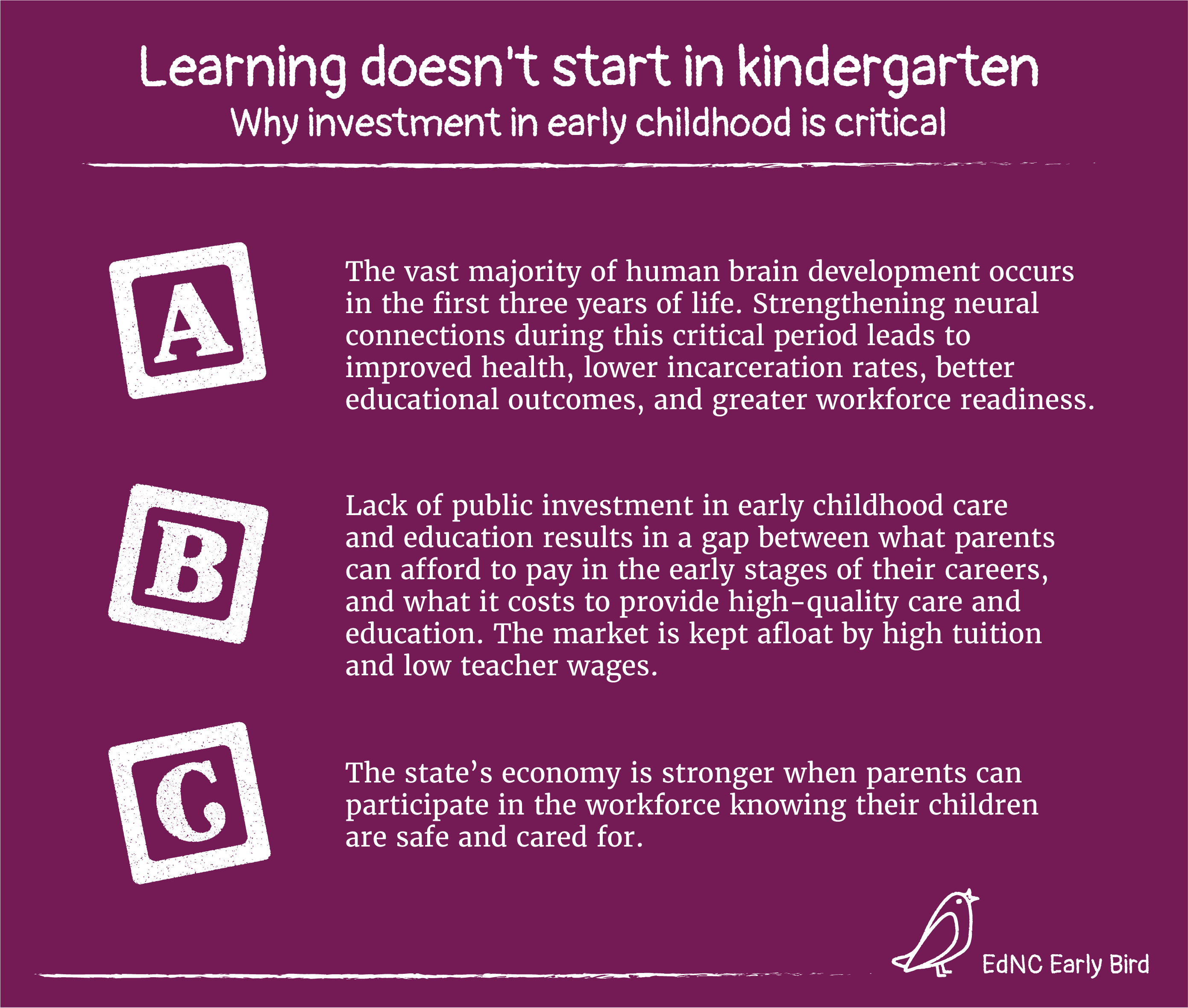
Graphic by Lanie Sorrow
Because the child care crisis was seen as a threat to the collective future of Americans, elected officials took action. Congress passed the Military Child Care Act of 1989, which put a priority on affordability, accessibility, and quality in child care for service members.
With the end of child care stabilization efforts that were undertaken during the pandemic, North Carolinians now face a similar threat to our own collective future. The military’s approach offers lessons for where we can go from here, in our communities and across our state.
An experiment in universal child care
The Military Child Care Act wasn’t the first time the military had taken the lead on child care. During World War II, women entered the workforce in massive numbers, filling the roles of men who were drafted to serve in the military. This raised the question of who would care for children when both parents were working outside the home to defend American interests.
Congress responded with the Lanham Act of 1940, creating a nationwide, universal child care system to support working families with children through age 12. Federal grants were issued to communities that demonstrated their need for child care related to parents working in the defense industry.
The program distributed $1.4 billion (in 2025 dollars) between 1943 and 1946 to more than 600 communities in 47 states. The grants could be used to build and maintain child care facilities, train and compensate teachers, and provide meals to students.
In his 2017 analysis of the Lanham Act’s outcomes for mothers and children, Chris M. Herbst, of Arizona State University’s School of Public Affairs, found that “the Lanham Act increased maternal employment several years after the program was dismantled.”
An image of Rosie the Riveter from a 1943 issue of the magazine Hygeia (published by the American Medical Association) demonstrating the need for child care.
Herbst also found that “children exposed to the program were more likely to be employed, to have higher earnings, and to be less likely to receive cash assistance as adults.”
One lesson Herbst took from his research was that the Lanham Act was successful because of the broad support it received from parents, advocates for education and women, and employers. He noted: “Each group was committed to its success because something larger was at stake.”
Today’s military-operated child care model
While the Lanham Act was a short-lived national experiment that hasn’t received much study, the military’s child care program since adoption of the Military Child Care Act of 1989 has become a widely acclaimed model for publicly subsidized early care and learning, serving about 200,000 children each year.
Four categories of child care are available through military-operated child care programs: Child Development Centers (CDCs), Family Child Care (FCC), 24/7 Centers, and School Aged Care (SAC). The official military child care website describes each program type:
Child Development Centers (CDCs) — CDCs provide child care services for infants, pretoddlers, toddlers, and preschoolers. They operate Monday through Friday during standard work hours, and depending on the location offer full-day, part-day, and hourly care.
Family Child Care (FCC) — Family child care is provided by qualified child care professionals in their homes. Designed for infants through school agers, each FCC provider determines what care they offer, which may include full-day, part-day, school year, summer camp, 24/7, and extended care.
24/7 Centers — 24/7 Centers provide child care for infants through school age children in a home-like setting during both traditional and non-traditional hours on a regular basis. The program is designed to support watch standers or shift workers who work rotating or non-traditional schedules (i.e., evenings, overnights, and weekends).
School Aged Care (SAC) — School age care is facility-based care for children from the start of kindergarten through the end of the summer after seventh grade. This program type operates Monday through Friday during standard work hours. SAC programs provide both School Year Care and Summer Camp.
Requirements for military-operated child care programs are typically more stringent than state requirements. For one thing, they must be accredited by one of the following: National Association for the Education of Young Children (NAEYC), National Early Childhood Program Accreditation (NECPA), the Council on Accreditation (COA), or the National Accreditation Commission (NAC).
For context, the requirements for licensed child care in North Carolina are relatively stringent compared with other states, but still fall below the requirements for NAEYC accreditation, which is widely recognized as the national standard. Only 110 programs in our state are NAEYC-accredited — many of which are Head Start or military-operated programs — out of about 5,300 total state-licensed programs.
Military-operated child care programs offer families hourly, part-day, full-day, extended, or overnight care, plus afterschool and summer programs.
The maximum rate is on par with the national average for civilian child care in 2023, meaning that almost every family using military-operated child care programs is paying less than the national average for typically higher-quality early care and learning.
The Department of Defense budgeted about $1.8 billion for child care in 2024 — about 0.2% of its $841.4 billion total budget.
Military child care in North Carolina
In addition to military-operated child care programs, service members may be eligible for Military Child Care in Your Neighborhood (MCCYN), a fee assistance program for families who can’t access military-operated child care. MCCYN pays a portion of the cost of enrolling children in early care and learning programs that meet the military’s high-quality standards in their community.
North Carolina is one of 19 locations where military families may be eligible for MCCYN-PLUS, which expands the MCCYN program to child care programs that participate in state or local Quality Rating and Improvement Systems (QRIS) in places where nationally accredited care is not available.
Both programs rely on the availability of high-quality child care in civilian communities. That’s a challenge in North Carolina, which was already facing a child care shortage before the pandemic. Our state has lost almost 6% of licensed child care programs since February 2020, with more expected to close because stabilization grants have ended.
According to the NC Military Affairs Commission, there are 12 military bases and more than 130,000 active-duty military members in North Carolina, giving us the fourth-largest active-duty military population in the nation.
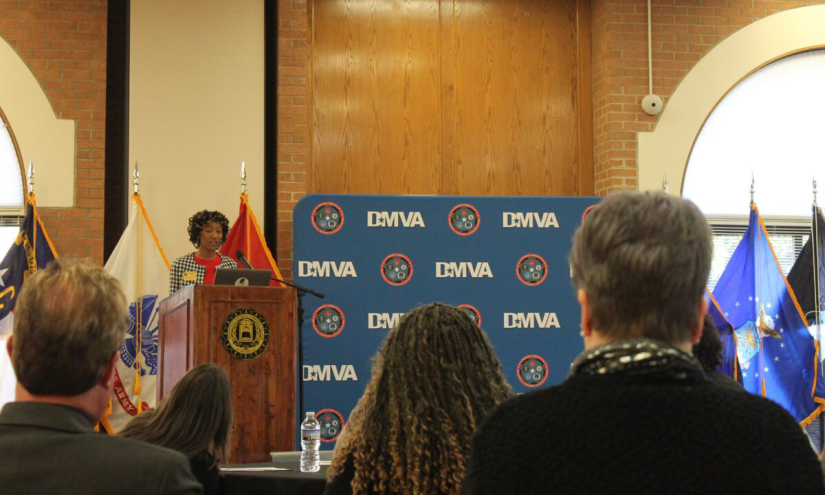
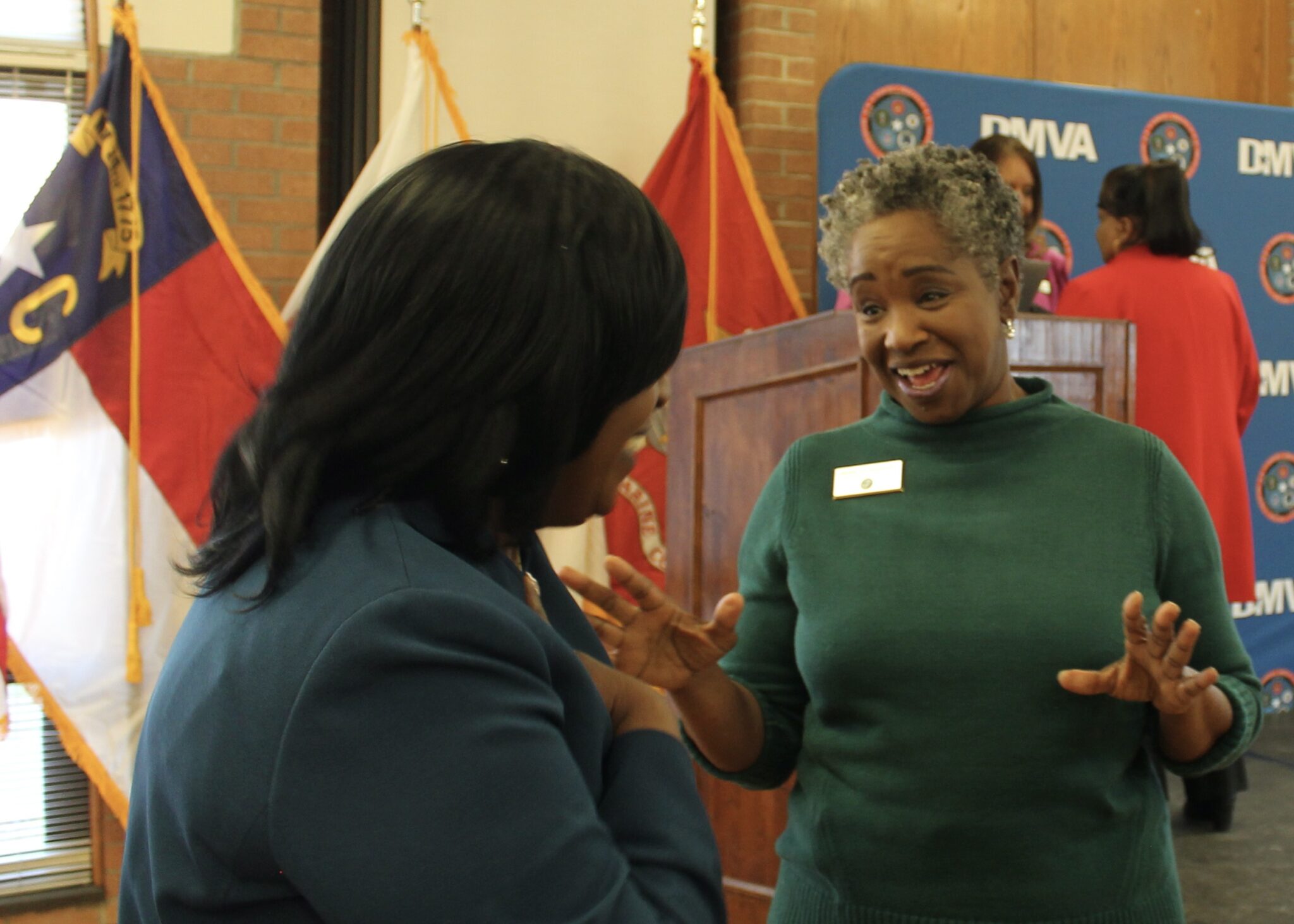
In January 2025, Fayetteville Technical Community College hosted the state’s first N.C. Military Community Childcare Summit, organized by the North Carolina Department of Military and Veteran Affairs (NCDMVA) to discuss the problem that military communities are having with access to community-based child care.
The first N.C. Military Community Childcare Summit in January 2025.( Katie Dukes/EdNC)
The summit culminated in a screening of Take Care, a documentary about North Carolina’s child care crisis produced by the state Department of Health and Human Services and featuring EdNC’s early childhood reporter, Liz Bell.
The issues of spouse resilience and child care are inextricably linked for Angie Mullennix, who works for The Honor Foundation at Fort Bragg, helping members of the U.S. Special Operations Forces (SOF) transition to careers in the private sector after their military service.
Mullennix served in the U.S. Army for four years after high school and has previously worked for the Department of Public Instruction as the state military liaison. Her husband recently retired from the SOF himself. They have two teenage children.
“If you look at the number of military spouses in North Carolina who have degrees and credentials and could be in the workforce, from nurses to lawyers, lots of them are staying at home,” Mullennix said.
“A big reason why about 40% of (military) spouses do not work is because of child care not being available to them,” Mullennix said, noting that lack of child care is also a barrier to workforce participation among the civilian population.
When Mullennix’s children were under the age of 5, she used hourly child care on base, which was available at no cost when her husband was away on assignment.
“You ask any parent in the world, I don’t care who they are, there’s nothing more important than their child’s safety — then their education,” Mullennix said. “And yet, the two things we think are the most important, we put (their providers) at the lowest pay and ask them to do quality care.”
That’s what sets military child care apart from civilian early care and learning for Mullennix: high quality standards and higher pay for early childhood educators, including benefits. She sees lessons in this for North Carolina.
“You gotta pay them to keep them, there’s no secret behind that,” Mullennix said. “If you pay them high, you can also set the standards really high.”
And because workforce participation — and military readiness — is directly tied to the accessibility and affordability of high-quality child care, not investing in it threatens our collective future.
“North Carolina, or any state that doesn’t offer child care, is shooting itself in the foot,” Mullennix said.
Lessons from military child care
Policymakers at every level who are seeking to end the child care crisis can learn much from the military child care model. One report on the topic offers these lessons:
Do not be daunted by the task. It is possible to take a woefully inadequate child care system and dramatically improve it.
Recognize and acknowledge the seriousness of the child care problem and the consequences of inaction.
Improve quality by establishing and enforcing comprehensive standards, assisting providers in becoming accredited, and enhancing provider compensation and training.
Keep parent fees affordable through subsidies.
Expand the availability of all kinds of care by continually assessing unmet need and taking concrete action steps to address it.
Commit the resources necessary to get the job done.
Both agreed these are the right takeaways for policymakers across North Carolina to consider.
Lesson 1: Do not be daunted by the task
Gale Perry said the top lesson for her is: “Start where you are, know that change is possible, and have a goal post in mind.”
She pointed out that the military’s goal wasn’t a fully publicly funded child care system. It was a system that acknowledged Americans’ values around the role of parents in raising young children — and paying for their care and education. But also that their employers and the government “have a role in offsetting that cost, so that we can ensure that child care is quality, and it is stable, and that the families can actually afford it.”
Smith said there was no “silver bullet” when she and her colleagues were tasked with solving the military’s child care crisis in the 1990s — and there isn’t one for the civilian child care crisis today.
We had to redo the standards, we had to look at the workforce, we had to look at the health and safety issues, we had to look at the fees and how we could bring those fees down. We had to look at the infrastructure of all of it. We’ve got to start thinking about the interconnectedness of all of these things if we’re going to be successful in this country.
Smith said people think that because she worked for the secretary of defense, “I could just tell all the bases what to do, and that would magically happen, which is so not true. It wasn’t just like we could give an order and everybody jumped.”
She said you just have to start where you are, and move up.
Lesson 2: Acknowledge the seriousness of the problem and the consequences of inaction
“The military understood very early the link between people getting to work and child care,” Smith said.
As the military shifted away from relying on conscription and became a more welcoming workplace for women, the need for child care became evident. Smith described working on a base where children were routinely left in cars when their parents were unexpectedly called into work.
“So (military leaders) really got the connection to their guys going to work very quickly, and I think that we still haven’t all understood that in this country,” Smith said, though she notes businesses have started making that connection since the pandemic.
“The other thing the military understood was that a pilot is every bit as important as the mechanic who works on the plane, and so they invest in all of their people,” Smith said.
She and her team had to design a program that worked for everyone, or it wouldn’t work for anyone.
Lesson 3: Improve quality
Smith said quality was of critical importance when she was designing the military’s child care system in the 1990s, especially after child abuse and neglect scandals that came to light in the 1980s.
She and her team studied the child care standards of all 50 states and created a set of military standards that fell squarely in the middle. Then they set about training the 22,000 early childhood educators they already had — most of whom were military spouses — to meet those standards.
That was a six-month training program. Then there was an 18-month training to get them to move beyond those standards toward national accreditation. They hired highly qualified trainers to work with educators at each site.
“And if you didn’t do it, guess what? You’re fired!” Smith said.
There was an incentive to participate in the training, beyond keeping their jobs — higher compensation.
“Maybe some were grumpy about it, but we didn’t have to fire people,” Smith said.
North Carolina already has some tools in place to help educators advance their education and improve their compensation, specifically through the WAGE$ and TEACH programs — both of which were highlighted in the report that identified these lessons.
“(The military) realized they had to get serious about quality and quality standards. And I would say that’s a lesson for us now, particularly in a climate that is deregulatory,” Gale Perry said. “And while I’m for sensible regulatory reform, I think we have to be really thoughtful about not wanting stacks of child deaths in child care sitting on a desk waiting to be investigated.”
Lesson 4: Keep parent fees affordable through subsidies
Smith said that while designing the military’s child care program, she and her team figured out that there was no way parents could afford the actual cost of high-quality child care. So they set up a subsidized system that would provide a 50% match — on average — to parents’ fees, paid directly to child care programs.
“We had to, on average, match parent fees dollar-for-dollar, with the higher-income people paying more and the lower-income paying less,” Smith said. “So a major, for example, would pay two-thirds of the cost, and a private would pay one-third, but the average was 50/50.”
Smith pointed out that we’re already subsidizing child care in ways that are hidden — through the public benefits and social programs that early childhood educators often rely on because of low compensation, and through lack of workforce participation.
Lesson 5: Expand the availability of all kinds of care
Gale Perry said the military’s model really stands out to her for its ability to assess unmet needs and take action to improve.
“In the early 2000s when there were the wars in Iraq and Afghanistan, there were a lot of deployments of National Guard and Reserve who did not live on post and did not have access to on-post child care,” Gale Perry said. “That is really when the military got in the business of thinking about, how do we help build capacity and make child care accessible for military families off post?”
That’s when the MCCYN came about, subsidizing high-quality early care and learning in a broader array of settings in the communities where service members live.
Smith said that the Military Child Care Act was originally targeted toward child care centers, but she recalls briefing the assistant secretary of defense on the potential effects of that strategy when they were designing the system:
I remember saying we need to apply all of this to family child care, to school-aged care, to part-day preschools, because if we don’t, all the parents are going to have a demand on these centers that we can’t meet, right? Because if you lower the cost in the centers and you improve the quality, why would somebody go to another place when they get it cheaper and better over here?
She made the case for educators in every setting getting the same access to training and the same level of compensation, because that’s what would work best for everyone.
“Everything applies to everybody,” Smith said. “And I think that was one of the smartest policy decisions we made.”
Lesson 6: Commit the resources necessary to get the job done
“There was this perception that we just had a lot of money and we threw it at” child care, Smith said. But that wasn’t the case.
“When they passed the Military Child Care Act, it didn’t come with an appropriation,” Gale Perry said. “So they had to fight equally hard for the funding, and a lot of the funding actually ended up coming from local base commanders making the decision to invest in child care.”
Now the military submits a budget request to Congress each year, and depends on those appropriations.
For state and local policymakers seeking to solve the civilian child care crisis without public investment, the woman credited with solving the military’s own child care crisis 35 years ago has a message.
“It’s gonna cost. There’s no way it doesn’t cost,” Smith said.
United States Military Academy at West Point Students for Fair Admissions (SFFA) announced this week that it has reached a settlement agreement with the U.S. Department of Justice that will permanently end the consideration of race and ethnicity in admissions at the United States Military Academy at West Point and the United States Air Force Academy.
The agreement, approved at the highest levels of the Department of Defense, establishes four key requirements for both academies: applying no consideration of race or ethnicity in admissions decisions, maintaining no race-based goals or quotas, shielding race and ethnicity information from admissions personnel, and training staff to adhere to merit-only standards.
The policies will take effect immediately and apply to all future admissions cycles, according to the settlement terms.
The settlement represents a significant policy reversal from the Biden administration’s previous position defending race-conscious admissions at military service academies. Earlier this year, under President Trump’s Executive Order 14185, the Department of Defense determined that race-based admissions at military academies are not justified by military necessity and do not advance national security, cohesion, or readiness.
The Department formally abandoned its earlier position that a “compelling national security interest in a diverse officer corps” justified race-based policies, marking a sharp departure from decades of military diversity initiatives.
The agreement follows SFFA’s earlier litigation against the U.S. Naval Academy, where the organization successfully challenged similar race-conscious admissions practices.
Under the settlement terms, litigation against West Point and the Air Force Academy will be dismissed with prejudice, with each side bearing its own legal costs. The agreement preserves SFFA’s right to challenge any future changes to these policies.
“This is an historic day for the principle of equal treatment under the law at our nation’s military academies,” said Edward Blum, president of SFFA. “Together with the Naval Academy case earlier this year, this agreement ensures that America’s critically important military service academies will admit future officers based solely on merit, not skin color or ancestry.”
The settlement comes amid ongoing national debates over affirmative action policies following the Supreme Court’s 2023 decision in Students for Fair Admissions v. Harvard, which effectively ended race-conscious admissions at civilian colleges and universities.
Military service academies had previously been considered potentially exempt from that ruling due to national security considerations and the unique mission of training military officers. However, the Trump administration’s policy shift has eliminated that distinction.
The agreement affects two of the nation’s most prestigious military institutions. West Point, founded in 1802, and the Air Force Academy, established in 1954, collectively graduate approximately 2,000 new military officers annually.
The Department of Defense now says that “consideration of race and ethnicity in admissions at the MSAs does not promote military cohesiveness, lethality, recruitment, retention, or legitimacy; national security; or any other governmental interest.”
Saul Loeb/AFP/Getty Images
Students for Fair Admissions, the organization that successfully fought to end race-conscious admissions practices, settled with two military academies that were exempted from the 2023 Supreme Court ruling that ended affirmative action, The New York Times reported.
The Supreme Court ruled two years ago that military academies could continue to practice race-conscious admissions due to “potentially distinct interests” at such institutions. SFFA then sued, arguing such practices should be struck down. But on Monday, SFFA dropped its lawsuits against the U.S. Military Academy at West Point and the United States Air Force Academy.
As part of the agreement, the Department of Defense, which oversees military service academies, will no longer consider race and ethnicity in admissions, according to settlement details, which emphasize recruiting and promoting individuals based on merit alone. That settlement also backed away from the notion that it has an interest in a diverse office corps.
“The Department of Defense has determined, based on the military’s experience and expertise—and after reviewing the relevant evidence—that the consideration of race and ethnicity in admissions at the MSAs does not promote military cohesiveness, lethality, recruitment, retention, or legitimacy; national security; or any other governmental interest,” part of the settlement between SFFA and the Department of Defense reads. “The United States no longer believes that the challenged practices are justified by a ‘compelling national security interest in a diverse officer corps.’”
Additionally, if an applicant lists race or ethnicity on an application, “no one with responsibility over admissions can see, access or consider” that information prior to a decision being made.
The publication of the Strategic Defence Review (SDR) in early June 2025 emphasised a whole-of-society approach to defence and recognised the importance of societal engagement and resilience-building.
But there was also an element of missed opportunity – the review should also have been a moment to highlight the role of the network of 19 regional military education committees (MECs) which exist to foster good relations between universities and the armed forces, and their associated university service units (USUs).
Although universities were prominently featured in the SDR, the focus was narrowly confined to their ability to serve as a talent pipeline and to provide technology to support “warfighting” and “lethality”.
What’s missing is a more engaged understanding of the broader value universities provide for defence, particularly the role of MECs in fostering this relationship, building on Haldane’s earlier vision of a civic university with strong links to the armed forces.
We see a need to outline a broad vision for MECs that builds on the SDR but also looks beyond it, offering a future-focused perspective for leaders in the armed forces and academia.
Universities and civil-military relations
Universities play a crucial – though often overlooked – role at the interface of civil-military relations. Our graduates are the officers of the future, and with seven per cent of UK households including a veteran, and over 180,000 currently serving, many of our students’ university experiences are inherently shaped by military life, whether as part of service families or as future personnel.
Established as part of the Haldane Reforms of the armed forces in 1908, MECs were initially created to ensure that officer cadets received a balanced education, combining academic study with military training.
Today, MECs are a vital bridge between two distinct worlds: academia and the military. They offer a unique forum where these cultures meet, enabling universities to better understand the particular pressures facing students in university service units and students from service families, while helping the military appreciate the academic environment through the eyes of those teaching their officer cadets.
Military education committees and the student experience
MECs support students serving in university service units by helping them navigate the dual demands of academic study and armed forces activities. These officer cadets face unique pressures and challenges, but also gain valuable opportunities for skills development, leadership training, and even paid experiences through social and sporting activities including overseas trips and training deployments. For those interested in an armed forces career, scholarships are available which provide a crucial route to higher education, often for those who would otherwise find it financially prohibitive.
A recent commentary from the Royal United Services Institute underscores the importance of these activities, particularly the role of the University Officer Training Corps (UOTCs) in the British Army’s officer training pipeline. The authors warn against proposals to centralise all training at the Royal Military Academy Sandhurst, which they argue would undermine the historical and practical value of UOTCs as springboards for leadership and national resilience. They argue that UOTCs are vital for building the skills and networks needed for future mobilisations and for sustaining the Army Reserve’s capacity.
This vital role underscores how the meeting of minds facilitated by MECs is more than just symbolic. In practical terms, MECs bring together universities and university service units for events ranging from Remembrance Sunday commemorations, to officer cadet-led debates on topical issues, to high-profile guest lectures, like Newcastle’s annual defence lecture.
It has also helped bridge defence and the lecture hall. For example, through the Hacking 4 MoD module, facilitated by the Common Mission Project, where students tackle real-world challenges set by the Ministry of Defence. To date, this is run in over 20 universities across the UK, and is often led by MEC members, whose insights into defence make it easier for academics with no military background to teach and engage confidently in this space to better support students.
Pluralism, oversight, and civic values
The relationship between academic and the military is not without its critics. Some argue that engagement with the armed forces risks the militarisation of academic spaces, threatening academic freedom and raising ethical concerns.
Yet universities have never been entirely “de-militarised” spaces. The concept of the “military-university nexus” is useful here in that it challenges any simplistic binary between civilian and military spheres, requiring us to consider each relationship on its own merits.
MECs provide essential civilian oversight of USUs, establishing lines of communication that build trust and mutual understanding. As autonomous institutions, universities thrive on debate and competing viewpoints – this pluralism is vital if they are to remain places of innovation and critical thought.
Challenges and opportunities ahead
Looking to the future, MECs face the challenge of adapting to a rapidly changing educational and geopolitical landscape – one in which the UK will increasingly rely on societal resilience, whether to counter misinformation or respond to threats against NATO allies. Universities therefore have a crucial role in national security, not as talent pipelines alone, but as civic institutions producing future leaders, both civilian and military.
The national security landscape outlined in the SDR echoes Haldane’s idea of a “nation in arms”, fostering closer ties between the army and society to mobilise civilian resources during wartime.
The risk of the SDR, however, is that it frames universities too narrowly, as talent pipelines supporting STEM innovation in service of “lethality”, rather than recognising the wider civic contribution they make. In a democracy, we expect the armed forces to reflect the society they serve, in both composition and leadership values. Tomorrow’s officers are shaped in part by their university experiences – ignoring this reality is a missed opportunity.
Moreover, the emphasis in the SDR on AI, cyber warfare, and space defence requires a re-evaluation of MECs and their engagement with USUs. This sits alongside a broader shift from civic universities to a more regionally-engaged model – globally connected but rooted in local innovation and committed to addressing societal challenges. Universities and their respective MECs will need to foster adaptability and technological literacy, preparing students and staff for non-conventional challenges, whether in warfare or not.
Diversity and inclusive leadership
Taking a whole society approach to defence, MECs will need to redouble their efforts to champion inclusivity and diversity, fostering lesson-sharing between universities and USUs.
The armed forces struggle to be representative of the society they serve – with a level of ambition set for 30 per cent intake of women by 2030 (currently at 11.6%) and only incremental improvement in ethnic minority representation (currently 15.3 per cent).
Many USUs in contract already achieve or approach gender balance, though challenges remain in recruiting ethnic minority cadets, and translating the gender balance into those who chose to go through the full officer selection process. That said, MECs need to focus efforts to ensure the offer from USUs is inclusive, addressing barriers to participation and creating welcoming environments for all. At the Northumbrian Universities Military Education Committee, for example, we have a standing agenda item for USUs to report on the status of women within their units. This has led to several collaborations between university colleagues and their military counterparts to tackle the issue head-on.
The civic role, reimagined
The civic role of universities in supporting societal resilience – essential for an effective defence, through fostering informed debate, critical thinking, and understanding – is too important to lose. MECs remain central to this mission, ensuring that universities continue to be spaces of pluralism and partnership, bridging military and academic worlds for the benefit of both.
As universities reimagine their civic role, it is crucial that engagement with the armed forces remains anchored in inclusivity and democratic values, rather than reduced to recruitment pipelines or simply extracting STEM expertise in service of “lethality”. MECs have a key role in this, bringing together academic and military leaders to create spaces for reimagining civil-military partnerships – championing diversity, civic leadership, and mutual understanding in all areas of their work.
Every few years, they pack up their lives, move across states—or oceans—and start over. New schools, new systems, new expectations.
For military learners, this isn’t a study abroad adventure or a career move; it’s a way of life. Yet while their reality is defined by mobility, too many of our systems in higher education still assume stability.
Military learners make up about five percent of the undergraduate population—roughly 820,000 students nationwide. But they aren’t a monolith. They’re active-duty service members juggling college coursework with operational demands like exercises, surprise inspections, and even deployments. They’re veterans navigating civilian life, often in isolation, and often while supporting a family. They’re National Guard and reserve members wearing multiple hats that opposing forces demand they change on command. And they’re spouses and dependents navigating new colleges, mid-degree or mid-semester, again and again, with each relocation.
Their stories are different, but the friction points are the same: staying on track academically while managing a life defined by mobility.
Unlike traditional students, military learners don’t choose when or where they go—on orders, deployments, or other permanent or temporary service-related relocations. And each move can derail progress. Credits don’t transfer, residency rules reset, tuition costs spike, and financial aid doesn’t always follow the same logic. These students bring resilience, discipline, and lived experience into our classrooms, but higher education hasn’t fully adjusted to meet them where they are.
The transfer tangle and financial aid maze
One of the biggest hurdles is transfer credit. While articulation agreements—formal arrangements for transferring credits between institutions—do exist, they often don’t reflect the realities of military learners, especially when it comes to military training or nontraditional learning experiences. Some accumulate credits from multiple institutions, only to be told their new school won’t accept them.
The result? Lost time, lost money, and unnecessary frustration.
Add to that the patchwork of residency rules. Even when learners are stationed in a state under military orders, they may not qualify for in-state tuition. While states like Virginia and Florida have implemented inclusive policies, others continue to lag, turning mobility into a penalty as well as a reality.
Financial aid adds another layer of complexity. Programs like tuition assistance and the GI Bill are essential, but they often fall short. Tuition assistance differs by branch and may not cover full tuition at private or out-of-state schools. The Post-9/11 GI Bill is a powerful benefit, but its eligibility rules and transfer limitations don’t always align with the unpredictable, stop-and-go nature of military life.
What states and institutions are doing right
There are promising models to build on. In Ohio, Military Transfer Assurance Guides standardize how public institutions accept military training as credit. Texas and New York offer additional tuition support for veterans, while Florida helps cover housing and textbook costs when GI Bill payments lapse between terms.
That’s not charity—that’s what equity looks like. When institutions commit, military learners succeed.
The power and promise of credit for prior learning
Credit for prior learning (CPL) may be one of the most powerful—and underused—tools to support military learners, who bring extensive work and life experience to their postsecondary studies that can be translated into credit.
CPL recognizes that learning happens outside the classroom: through military training, job experience, CLEP exams, or portfolio assessments. When applied effectively, it can shorten the path to graduation, reduce student debt, and boost confidence for learners who’ve already mastered real-world skills.
Tools like ACE’s Military Guide help institutions apply CPL consistently and responsibly. But here’s the problem: CPL isn’t consistently communicated, awarded, or valued. In some cases, it’s limited to elective credits rather than core degree requirements, undermining its purpose.
CPL isn’t just about transfer and awarding credit; it’s also about unlocking opportunity. Validated learning can, and should, play a role in admissions, satisfying prerequisites, waiving introductory or duplicative coursework, and advising military learners on the path that is best for them. When institutions fully embrace the broader utility of CPL, they open more doors for military learners to engage meaningfully with higher education from the very start of their journeys.
To change that, institutions need more than buy-in—they need system-wide strategies. CPL should be central to transfer reform conversations, especially when supporting learners who are older, more experienced, and balancing school with work or caregiving.
The role of advising and ecosystem support
Too often, military learners don’t get the tailored advice they need. On-base education centers can be vital entry points, but they need stronger bridges to campus advising teams who understand military culture, CPL, and transfer systems. Institutions sometimes resist broader CPL use over concerns about revenue loss or academic rigor, while students are left unaware of opportunities due to poor communication or advising gaps. Aligning on-base education centers with well-trained campus advisors is one step forward; improving internal communication across departments is another.
Student Veterans of America’s Success Hub, which includes the SVA Advising Center, supports all service members, veterans, and their families in making informed decisions about higher education opportunities and meaningful careers through the use of AI, success coaches, and expertise where the military, veterans, and higher education intersect.
Organizations like NACADA are doing the work to improve professional development in this area, but we need deeper, sustained collaboration. Cross-sector partnerships between colleges, employers, and the U.S. Department of Defense are where real impact happens.
Military learners aren’t asking for special treatment. They ask for systems to make sense for the lives they actually lead. With the right policy changes, institutional commitments, and collaborative frameworks, we can turn mobility from a barrier into a bridge.
But we also need better data, better pathways, and a better understanding of what success looks like for these students—not just access, but degree completion and career readiness. Military learners aren’t an exception. They are the future of an inclusive, prepared, and resilient workforce.
It’s time higher education met these students where they are because they’re already leading the way.
If you have any questions or comments about this blog post, please contact us.
For more than seven years, we have been waiting to obtain information
from the US Department of Defense (DOD) about schools that prey upon servicemembers using DOD Tuition Assistance to further their college aspirations. And we have done it at our peril, repeatedly taking flak from people in DC.
Those who follow the higher education business know the names of the bad actors, some that are still in business (like the University of Phoenix and Colorado Tech) and some that have closed (like ITT Tech and the Art Institutes). Others have morphed into arms of state universities (Kaplan University becoming Purdue University Global and Ashford University becoming University of Arizona Global).
Accountability was supposed to happen during the Obama administration (with Executive Order 13607) but those rules were not fully implemented. Under the first Trump administration, these safeguards were largely ignored, and bad actor schools faced no penalties.
Some of these scandals were reported in the
media, and have been forgotten.
On April 1, 2025 we were again supposed to receive information about these bad actor schools, and the DOD officials who were complicit. It didn’t happen. That FOIA (22-1203) which was initiated in July 2022 is now scheduled for a reply on July 3, 2025, three years from the original submission.
Previous FOIAs from 2019 also came up with no information. And requests for information in 2017 from DOD officials were met with harassment from other parties.
The only thing we can be grateful for is that DOD continues to communicate with us.