There are a lot of transnational associations of universities out there. Some are meant to advance specific political goals, like the European Universities Association. Others exist simply to support their members without engaging in lobbying or political work, such as the African Association of Universities, whose former president, Ernest Aryeetey, was a guest on the show last year.
But the oldest of all these associations is the International Association of Universities (IAU), based in Paris and created by UNESCO in 1950. I had the pleasure of attending their annual meeting in Tokyo last November—a unique opportunity to see global higher education, in all its glorious diversity, reflected in a single room.
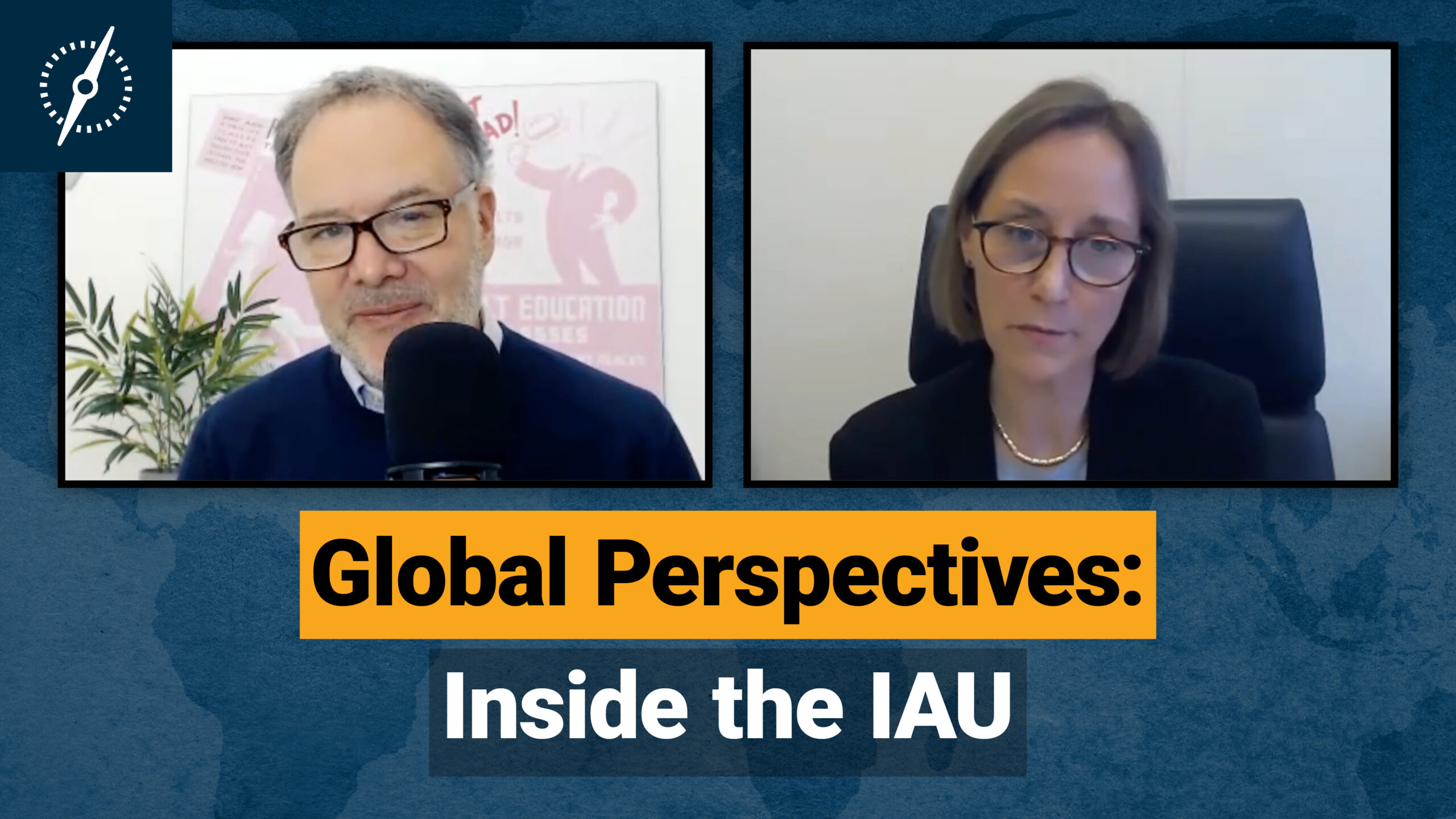
While I was there, I asked their Secretary-General, Hilligje Van’t Land, to join us on the show. Graciously, she agreed, leading to today’s podcast.
My chat with Hilligje revolved mainly around two issues. First, the state of global higher education—spoiler: it’s been better. And second, the challenges of maintaining an association across a membership spanning over 100 countries.
How do you keep an organization relevant across institutions with such different capacity levels, facing such different problems in vastly different external environments? And at the global level, can universities even be considered a single community?
Hilligje, who has one of the most interesting vantage points in global higher education, brings sharp insights to these big questions. And so, without further ado, let’s turn it over to Hilligje.
The World of Higher Education Podcast
Episode 3.23 | Connecting Universities in a Divided World: International Association of Universities’ Mission
Transcript
Alex Usher (AU): Hilligje, I’m not sure all our viewers, listeners, or readers are familiar with the history of the International Association of Universities. I know it was founded in 1950, but how has it evolved since then? And what does your membership look like geographically?
Hilligje Van’t Land (HVL): Yes, well, my name is indeed HVL, and I’m the Secretary-General of this wonderful organization, the International Association of Universities.
As you mentioned, it was founded in 1950 under the auspices of UNESCO, and its secretariat is based in Paris. I point that out because it’s one of the most common questions I get—where are you based?
At the same time, we represent a truly global higher education community, with universities from 130 countries across five continents.
How has it evolved over time? In the beginning, the association was largely led by universities from the Global North, working to rebuild the world after World War II on a foundation of shared values—values that would help create peace among people through higher education. And today, that vision still underpins much of what we do. Our goal is to bring together voices from around the world to collaboratively shape a collective vision of what universities can stand for, ultimately helping societies develop toward something better.
So what does our membership look like? We have 600 engaged members who contribute financially to the association, and it’s an incredibly diverse group of universities spanning all five continents. That diversity is central to our mission—not just representing one group, but bringing together many perspectives.
AU: We often think of university associations in terms of rectors’ conferences, where their primary job is to lobby—whether at a national level or through organizations like the European Universities Association. The International Association of Universities (IAU) obviously doesn’t have that kind of function. So is it more about universities speaking to each other? What exactly is its role in the global higher education ecosystem? Who is it speaking to beyond just its membership?
HVL: That’s a very good question—sorry if my English stumbles sometimes!
Indeed, we are a truly global association of universities, but without a specific regional or local resonance. For example, the European Universities Association engages with the European Commission, the Arab Association of Universities works closely with ministries across the Arab world, and American universities are involved in national-level associations that influence policy, like the Association of American Universities (AAU). In Africa, university associations work closely with the African Union.
Our role is to bring these voices together, encouraging universities to collaborate globally in ways that contribute to transforming the world. From where we sit, we advocate to the United Nations and UNESCO, influencing policy decisions within global agenda-setting bodies affiliated with UNESCO.
Right now, we are approaching the end of the UN Agenda 2030. A new global agenda will have to be developed because we are far from achieving the current goals. Yet, those goals have played a crucial role in bringing universities together around essential topics. As we look ahead, universities worldwide will help shape this next agenda, ensuring higher education continues to be a key driver of global progress.
AU: One thing that struck me when I attended your meeting in Tokyo last November—an amazing gathering, by the way—was how difficult it must be to create an institutional agenda that speaks to universities from such different parts of the world. How can I put it? Institutions in Australia, Indonesia, and Somalia—where I think you even had a delegate from Somaliland—are all dealing with vastly different domestic challenges. Given that universities are so deeply embedded in their national contexts, how do you find themes that resonate across all of them? How do you create a common agenda that works for everyone?
HVL: It’s both a challenge and an opportunity, Alex.
When institutions are deeply embedded in their national dynamics, it can be difficult to see beyond them. But without looking outward, how can they truly make the case for what they do? Staying in an echo chamber or only engaging in national-level discussions limits the ability to develop informed policies. That’s why bringing in diverse voices from the global higher education community is so important—it enriches conversations at institutional, national, and regional levels.
The agenda we co-develop with our board is then put to the IAU membership every four years for discussion at the global level. Are these the right topics to focus on? Yes or no? From there, a strategy is developed, and universities engage by seizing opportunities for responsible and meaningful internationalization.
For example, universities rally around themes like fair and inclusive leadership, the role of higher education in sustainable development, and, since COVID, the global conversation on digital transformation in higher education. A major focus now is open science and AI—how do these shape the future of universities?
And while institutions may come from Somaliland, Ghana, Colombia, Reykjavik, or Paris, they often grapple with similar questions. University rectors and policymakers worldwide are asking themselves the same things. By facilitating global leadership meetings, we create spaces where these shared concerns resonate and where new perspectives can emerge.
AU: You’ve mentioned the three big areas that IAU works in—sustainability, internationalization, and digital transformation. You also have those large surveys and studies that go out every couple of years. How do you engage institutions in these areas? What are universities doing in each of these three areas with IAU, and what are they getting out of it?
HVL: Fair and inclusive internationalization—one of the key topics that resonates strongly, even within the name International Association of Universities—translates into at least 10 different ways for universities to engage.
For example, just yesterday, we hosted a webinar on what responsible internationalization means today. Does it mean closing borders and fencing off countries that are perceived as threats to our intellectual work? Or, on the contrary, is responsible internationalization an opportunity to connect universities globally around key topics and foster international research collaborations? These collaborations are critical for addressing global challenges like climate change and crises in their many forms.
So, these discussions are one way we engage institutions. We also offer a service called HEIAS (Higher Education Internationalization Strategies Advisory Service), which helps universities refine their internationalization approaches.
Additionally, we maintain a network of internationalization associations, including NAFSA in the U.S., EAIE in Europe, and the African Association for Internationalization. By bringing these voices together, we co-develop statements that universities can adopt, ensuring that key topics remain at the forefront of global discussions.
On sustainability, we created the Global Cluster on Higher Education and Research for Sustainable Development. This initiative invites universities worldwide to champion specific Sustainable Development Goals (SDGs) while ensuring their projects remain interconnected. The goal is not to work in silos but to collaborate and co-create solutions to pressing challenges—whether water issues, gender inequality, or unsustainable urban development.
These efforts lead to research projects, joint initiatives, and meaningful impact across the global higher education community.
AU: Hilligje, you held that meeting in Tokyo last November, which I mentioned earlier. What do you think were some of the main takeaways from that event? What did you learn about how universities are coping with the challenges of the 2020s?
HVL: The 2020s—universities are coping with everything that comes their way, I would say.
One of the major takeaways was something you might not expect: the theme itself—University Values for the Future in a Changing World. When planning the conference, we had many discussions with the program committee. People said, We need to talk about AI. We need to talk about sustainability. We have to discuss the financial sustainability of universities because that’s what institutions are struggling with.
And I said—many organizations are already tackling these topics specifically. Let’s focus on values. Where do values stand today? What values do we need to cultivate to build a meaningful, impactful higher education system for the future?
As you saw at the conference, we had an unusually large group of university leaders attending—more than in previous years. We brought together leadership from universities worldwide to discuss the values they stand for, each from their own unique perspectives.
What this told me is that IAU has a unique opportunity to rally around topics that other organizations aren’t addressing. And these conversations are essential.
We received a lot of feedback—messages and even letters—from participants saying these discussions were eye-opening. They allowed universities to develop new collaborations, whether by inviting each other to campuses or by looking at institutional challenges through a different lens.
So the key takeaway? These conversations are crucial if we want to shape the future of higher education differently. Of course, IAU will continue to address the pressing issues on universities’ daily agendas, but leaders are also craving more space for these deeper discussions—discussions that are vital yet often overlooked.
AU: At the meeting, one session in particular stood out to me—the one led by Fanta Aw from NAFSA in the United States. A lot of participants from North America, Australia, and other OECD countries came in very concerned about university values, feeling that they were under threat. This was just a week or two after the U.S. elections, so people were thinking about issues like that, as well as the rise of movements like Alternative für Deutschland in Germany and what these political shifts could mean for universities.
What struck me, though, was the response from universities in other parts of the world—particularly in Asia and Africa. It wasn’t outright pushback, but more of a gentle chiding. Their message was, We live with these challenges all the time. From IAU’s perspective, that’s just another example of how institutions come from vastly different contexts. How do you bridge these experiences within IAU? How do you ensure that both perspectives are heard?
HVL: Well, those perspectives were very much present on that panel, and the discussion continued long after the session ended.
It’s important to recognize that these challenges aren’t confined to a single region or a divide between so-called “developed” and “developing” countries. In fact, I’d like to discard that terminology altogether—many of the countries we traditionally label as developing have advanced in ways that often surpass others.
The key takeaway is that these conversations are essential. Just because one university or country is newly experiencing pressures from policymakers, threats to academic freedom, or restrictions on institutional autonomy doesn’t mean these issues are new globally. For some institutions, this is an everyday reality.
But these challenges must be debated openly. If the future of higher education is one without institutional autonomy and academic freedom, what kind of education system are we building? What happens if governments dictate which topics can be discussed on campus, replace rectors at will, or shut down academic departments based on political agendas?
These issues need to be confronted head-on. From these discussions, the conversation must be taken further—to the United Nations, to UNESCO policymaking forums, and to global decision-makers. If we don’t address them now, the future could be even bleaker than it already appears in many parts of the world.
AU: A couple of weeks ago, we had American author Ben Wildavsky on the show. Of course, he wrote The Great Brain Race 15 years ago, and we invited him to discuss that book because it presented such an optimistic view of higher education—one where globalization would bring everyone closer together.
But looking around the world today, I find myself questioning the future of globalization and internationalization. IAU is deeply tied to a version of internationalization—maybe not the one Ben was promoting, but still a vision of global academic collaboration. If globalization really does roll back over the next four or five years, what do you see as IAU’s role?
HVL: Globalization is a complex phenomenon, with many facets—and it’s often questioned because it brings challenges alongside opportunities. Increasingly, it also comes with fear.
What IAU fosters, however, is global cooperation. Cooperation starts at the institutional level, extends to national and regional levels, and then reaches the global stage. But cooperation is never a given—it must be nurtured carefully, strategically, and consistently.
Just yesterday, during our Futures of Higher Education webinar series—which now includes 75 recorded sessions available on our website—we hosted Ayesha Maikundi, the new Vice Chancellor of the University of Abuja. She was asked about responsible internationalization and what globalization means today.
She raised an important point: We send the best and brightest into the world, but they rarely come back. Some return as expats, contributing to higher education in their home countries occasionally, but not in a sustained way. The challenge of brain drain remains significant.
While brain gain and brain circulation are often discussed—though, of course, brains don’t literally circulate on their own—the real issue is ensuring meaningful global academic connections. Different models have been used over time, but we need to continuously rethink how we facilitate these exchanges.
For example, not every system is easy to engage with—Nigeria, as Ayesha noted, presents logistical challenges. But beyond that, there are many places around the world that remain overlooked, not because they lack value, but because we fail to recognize them as worthy academic destinations.
That’s why global collaboration and mobility must be continuously worked on—strategically, deliberately, and persistently—to strengthen the international higher education ecosystem.
AU: Beyond issues like globalization and state intrusion into university decision-making, from your vantage point, what are the other major trends shaping higher education globally today? Are we seeing a convergence of concerns at the university level? In other words, are institutions becoming more similar—more isomorphic, so to speak? Or, at a global level, are we seeing more diversification among institutions?
HVL: Universities are institutions with many, many faces.
There are certainly harmonization processes underway in different parts of the world. In Europe, for instance, you have the European Higher Education Area and the Bologna Process, along with ministerial meetings aimed at creating greater alignment among institutions.
But the goal isn’t to make every university the same. In Europe, the aim is to embrace diversity while fostering better dialogue and collaboration across institutions. A similar trend is slowly emerging in Asia as well.
Now, if you look at the United States—it’s technically one country, but in reality, it has so many states, so many systems, and so many different kinds of universities within those systems. That diversity is significant.
This is why, right from IAU’s founding in 1950, we began developing the World Higher Education Database. At the time, it included just 50 universities. Today, we track and document over 21,000 institutions worldwide, mapping entire higher education systems in order to foster better understanding and appreciation of their differences.
In the end, this work also feeds into UNESCO’s Global Convention on the Recognition of Higher Education Qualifications, which aims to improve system compatibility. Harmonization is important in the sense that it allows students and scholars to navigate different systems more easily and become true global citizens.
If systems are entirely disconnected—with different academic calendars, study periods, and structures—it creates barriers. So yes, harmonization is happening, but there is no one-size-fits-all model. Universities will remain distinct, and that’s the beauty of it.
AU: So, maintaining harmonization while preserving diversity—that could be one of the major global trends over the next 15 to 20 years. How do you see IAU evolving over the next 10 to 15 years as sustainability, internationalization, and digital transformation continue to accelerate? Will you stick with these three focus areas, or do you anticipate new priorities emerging? And will new ways for institutions to collaborate globally develop as well?
HVL: I’m convinced that this will remain a movable feast, to borrow a phrase—because universities are never static. Their interests and priorities evolve over time.
We host International Conferences annually, but every four years, we hold a General Conference where we elect a new board and bring together the global higher education community to define our next strategic plan.
Right now, we have four priority areas—though leadership is a major focus as well. These priorities may shift over time, as they have in the past. While the core mission remains, new challenges continue to emerge.
For instance, we need to address the massification of higher education, as more people around the world seek university degrees. We must also consider the commodification of higher education, which is becoming an increasing concern. At the same time, there is a strong push for skills-based education, which we try to balance by advocating for the continued importance of the humanities.
Another tension that remains unresolved is collaboration versus competition—how universities navigate national interests while engaging in global partnerships. The rise of digital education also raises new questions about what it means to be a university in a rapidly changing world.
In terms of IAU’s membership, we currently have 600 institutions that financially support our vision and mission. But many more universities align with our values and participate in our initiatives.
Looking ahead 10 years, where do I see IAU? Well, in an ideal world, I’d love to see 21,000 universities as members—creating a truly global dialogue, not just about the future of higher education, but about how universities shape society itself.
Because ultimately, we’re not just looking inward—we’re asking what universities contribute to the world.
AU: Hilligje, thank you so much for joining us today.
HVL: You’re welcome.AU: And before we wrap up, I’d like to thank our excellent producers, Tiffany MacLennan and Sam Pufek, as well as you—our viewers, readers, and listeners—for tuning in. If you have any questions or comments about today’s episode, please reach out to us at [email protected]. And don’t forget to subscribe to our YouTube channel so you never miss an episode of The World of Higher Education. Join us next week when our guest will be Dendev Badarch, a professor at the Mongolian University of Science and Technology. He’ll be with us to discuss the future of higher education in Mongolia. Bye for now.
*This podcast transcript was generated using an AI transcription service with limited editing. Please forgive any errors made through this service. Please note, the views and opinions expressed in each episode are those of the individual contributors, and do not necessarily reflect those of the podcast host and team, or our sponsors.
This episode is sponsored by Studiosity. Student success, at scale – with an evidence-based ROI of 4.4x return for universities and colleges. Because Studiosity is AI for Learning — not corrections – to develop critical thinking, agency, and retention — empowering educators with learning insight. For future-ready graduates — and for future-ready institutions. Learn more at studiosity.com.