Tag: Money

  • The Year the Money Ran Out: Global Higher Ed Review

    The Year the Money Ran Out: Global Higher Ed Review

    Hello everyone, and welcome to the World of Higher Education podcast. I’m Tiffany MacLennan, and if you’re a faithful listener, you know what it means when I’m the one opening the episode—this week, our guest is AU.

    We’re doing a year in review, looking at some of the global higher education stories that stood out in 2024—from massification to private higher education, from Trump’s international impact to the most interesting stories overall. But I’ll pass it over to Alex.


    The World of Higher Education Podcast
    Episode 3.35 | The Year the Money Ran Out: Global Higher Ed Review

    Transcript

    Tiffany MacLennan (TM): Alex, you’re usually the one asking the questions, but today you’re in our hot seat.

    Alex Usher (AU): It’s technically the same seat I’m always in.

    TM: Fair point. But today, you’re in the question seat. Let’s start with the global elephant in the room.

    Last week, we talked at length with Brendan Cantwell about the domestic effects of Donald Trump’s education policies. But what impacts are we seeing internationally? Are any countries or institutions actively trying to capitalize on the chaos in the U.S.? And if so, how serious are those efforts to poach talent and build their reputations?

    AU: There are lots of countries that think they’re in a position to capitalize on it—but almost none of them are serious.

    The question is: where is the real destruction happening in the United States? Where is the greatest danger? And the answer is in research funding. NIH funding is going to be down by a third next year. NSF funding is going to be down by more than 50%. So it’s the scientists working in STEM and health—those with the best labs in the world—who are suddenly without money to run programs.

    But what are they supposed to do? Are there alternatives to labs of that scale? Are there alternatives to the perks of being a top STEM or health researcher at an American university?

    Places like Ireland—well, Ireland has no research culture to speak of. The idea that Ireland is going to step in and be competitive? Or the Czech Republic? Or India, which keeps talking about this being their moment? Come on. Be serious. That’s not what’s happening here.

    There might be an exodus—but it’s more likely to be to industry than to other countries. It’s not clear to me that there will be a global redistribution of this talent.

    Now, the one group that might move abroad? Social scientists and humanities scholars. And you’ve already seen that happening—especially here in Toronto. The University of Toronto has picked up three or four high-profile American scholars just in the last little while.

    Why? Because you don’t need to build them labs. The American lead in research came from the enormous amounts of money spent on infrastructure: research hospitals, labs—facilities that were world-class, even in unlikely places. Birmingham, Alabama, for example, has 25 square blocks of cutting-edge health research infrastructure. How? Because America spent money on research like no one else.

    But they’re not doing that anymore. So I think a lot of that scientific talent just… disappears. It’s lost to academia, and it’s not coming back. And over the long term, that’s a real problem for the global economy.

    TM: Sticking with the American theme, are there other countries that have been taking, well, I hesitate to say lessons, but have been adopting policies inspired by the U.S. since Donald Trump came to power? Or has it gone the other way—more like a cautionary tale of what not to do if you want to strengthen your education sector?

    AU: I think the arrival of MAGA really made a lot of people around the world realize that, actually, having talented researchers in charge of things isn’t such a bad idea.

    We saw that reflected in elections—in Canada, in Australia—where center-left governments that were thought to be in trouble suddenly pulled off wins. Same thing in Romania.

    The one exception seems to be Poland. But even there, I’m not sure the culture war side of things was ever as intense as it was in the United States. In fact, the U.S. isn’t even the originator of a lot of this stuff—it’s Hungary. Viktor Orbán’s government is the model. The Project 2025 crew in the U.S. has made it pretty clear: they want American universities to look more like Hungarian ones.

    And the Hungarian Minister of Higher Education has been holding press conferences around the world, claiming that everyone’s looking at Hungary as a model.

    So, there’s definitely been a shift—America is moving closer to the Hungarian approach. But I don’t think anyone else is following them. Even in Poland, where there’s been political change, the opposition still controls the parliament, so it’s not clear anything dramatic will happen there either.

    So no—I don’t think we’re seeing widespread imitation of U.S. education policy right now. Doesn’t mean it couldn’t happen—but we’re not there yet.

    TM: One thing we’ve seen a lot of this year is talk—and action—around the massification of higher education. What countries do you think have made some of the most interesting moves in expanding access? And on the flip side, are there any countries that are hitting their capacity?

    AU: Everyone who’s making progress is also hitting their capacity. That’s the key thing. Massification isn’t just a matter of saying, “Hey, let’s build a new school here or there.” Usually, you’re playing catch-up with demand.

    The really interesting case for me is Uzbekistan. Over the past decade, the number of students has increased fivefold—going from about 200,000 to over a million. I’m not sure any country in the world has moved that fast before. That growth is driven by a booming population, rising wealth, and—crucially—a government that’s willing to try a wide range of strategies: working with domestic public institutions, domestic private institutions, international partners—whatever works. It’s very much a “throw spaghetti at the wall and see what sticks” approach.

    Dubai is another case. It’s up 30% this year, largely driven by international students. That’s a different kind of massification, but still significant.

    Then there’s Africa, where we’re seeing a lot of countries running into capacity issues. They’ve promised access to education, but they’re struggling to deliver. Nigeria is a standout—it opened 200 new universities this year. Egypt is another big one. And we’re starting to see it in Kenya, Tanzania, Ghana—places that have reached the level of economic development where demand for higher education takes off.

    But here’s the catch: it’s not always clear that universal access is a good idea from a public policy standpoint. At certain stages of economic development, you can support 70% participation rates. At others, you’re doing well to sustain 20%. It really depends where you are.

    And these are often countries with weak tax systems—low public revenue. So how do you fund it all? That’s a major challenge.

    What we’re seeing in many places is governments making big promises around massification—and now struggling to keep them. I think that tension—between rising demand and limited capacity—is going to be a major story in higher education for at least the next three or four years.

    TM: I think that leads nicely into my next question: what’s the role of private higher education in all of this?

    Private institutions have been popping up more and more, and the conversation around them has only grown. Sometimes they’re filling important gaps, and sometimes they’re creating problems. But this year, we also saw some pretty major regulatory moves—governments trying to reassert control over what’s become a booming sector.

    Do you see this as part of a broader shift? And what do you think it means for the future of private higher education?

    AU: I don’t see a big shift in private education in less industrialized countries. What you’re seeing there is more a case of the public sector being exhausted—it simply can’t keep up with demand. So private providers show up to fill the gap.

    The question is whether governments are regulating those providers in a way that ensures they contribute meaningfully to the economy, or if they’re just allowing bottom-feeders to flourish. And a lot of places struggle to get that balance right.

    That said, there are some positive examples. Malaysia, for instance, has done a pretty good job over the years of managing its private higher education sector. It’s a model that other countries could learn from.

    But I think the really interesting development is the growth of private higher education in Europe.

    Look at Spain—tuition is relatively cheap, yet 25% of the system is now private. France has free tuition, but still, 25% of its system is private. In Germany, where tuition is also free, the private share is approaching 20%.

    It’s a different kind of issue. Strong public systems can ossify—they stop adapting, stop responding to new needs. In Europe, there’s very little pressure on public universities to align with labor market demand. And rising labor costs can mean that public universities can’t actually serve as many students as they’d like.

    France is a good example. It’s one of the few countries in Europe where student numbers are still growing significantly. But the government isn’t giving public universities more money to serve those students. So students leave—they say, “This isn’t a quality education,” and they go elsewhere. Often, that means going to private institutions.

    We had a guest on the show at one point who offered a really interesting perspective on what private higher education can bring to the table. And I think that’s the fascinating part: you’d expect the private sector boom to be happening in a place like the U.S., with its freewheeling market. But it’s not. The big story right now is in Europe.

    TM: Are there any countries that are doing private higher education particularly well right now? What would you say is the “good” private higher ed story of the year?

    AU: That’s a tough one, because these things take years to really play out. But I’d say France and Germany might be success stories. They’ve managed to keep their top-tier public institutions intact while still allowing space for experimentation in the private sector.

    There are probably some good stories in Asia that we just don’t know enough about yet. And there are always reliable examples—like Tecnológico de Monterrey in Mexico, which I think is one of the most innovative institutions in the Americas.

    But I wouldn’t say there’s anything dramatically different about this year that marks a turning point. That said, I do think we need to start paying more attention to the private sector in a way we haven’t since the explosion of private higher education in Eastern Europe after the fall of the Berlin Wall.

    Back then, governments looked around and said, “Okay, we need to do something.” Their public universities—especially in the social sciences—were completely discredited after decades of Marxist orthodoxy. So they let the private sector grow rapidly, and then had to figure out how to rein it in over time.

    Some countries managed that fairly well. Romania and Poland, for instance, have built reasonably strong systems for regulating private higher education—though not without some painful moments. Romania in particular had some pretty chaotic years. If you look up Spiru Haret University, you’ll get a sense of just how bad it can get when you completely let the market rip.

    But now there are decent examples that other regions—especially Africa and Central Asia—can look to. These are areas where private education is going to be increasingly important in absorbing new demand.

    The real question is: how do you translate those lessons from one context to another?

    TM: Alex, when it comes to the least good stories of the year, it felt like the headlines were all the same: there’s no money. Budget cuts. Doom and gloom.

    What crisis stood out to you the most this year, and what made it different from what we’ve seen in other countries?

    AU: Well, I think Argentina probably tops the list. Since President Milei came into power, universities have seen their purchasing power drop by about 60%. It’s a huge hit.

    When Milei took office, inflation was already high, and his plan to fix it was to cut public spending—across the board. That meant universities had to absorb the remaining inflation, with no additional support to help cushion the blow. And on top of that, Milei sees universities as hotbeds of communism, so there’s no political will to help.

    It’s been brutal. So that’s probably the number one crisis just in terms of scale.

    Kenya is another big one. The country has been really ambitious about expanding access—opening new universities and growing the system. But they haven’t followed through with adequate funding. The idea was that students would pick up some of the slack financially, but it turns out most Kenyan families just aren’t wealthy enough to make that work.

    They tried to fill the gap with student loans, but the system couldn’t support it. And now there’s blame being placed on the funding formula. But the issue isn’t the formula—it’s the total amount of money being put into the system.

    There’s a common confusion: some people understand that a funding formula is about dividing money between institutions. Others mistakenly think it dictates how much money the government gives in total. Kenya’s leadership seems to have conflated the two—and that’s a real problem.

    Then you’ve got developed countries. In the UK, there have been lots of program closures. France has institutions running deficits. Canada has had its fair share of issues, and even in the U.S., problems were mounting before Trump came back into the picture.

    We’ve almost forgotten the extent to which international students were propping things up. They helped institutions on the way up, and they’re now accelerating the downturn. That’s been a global issue.

    And I know people are tired of hearing me say this, but here’s the core issue: around the world, we’ve built higher education systems that are bigger and more generous than anyone actually wants to pay for—whether through taxes or tuition.

    So yeah, we’ve created some great systems. But nobody wants to fund them. And that’s the underlying story. It shows up in different ways depending on the country, but it’s the same problem everywhere.

    TM: Do you think we’re heading into an era of global higher ed austerity, or are there some places that are bucking the trend?

    AU: It depends on what you mean by “austerity.”

    Take Nigeria or Egypt, for example—the issue there isn’t that they’re spending less on higher education. The issue is that demand is growing so fast that public universities simply can’t keep up. You see similar dynamics in much of the Middle East, across Africa, to some extent in Brazil, and in Central Asia. It’s not about cuts—it’s about the gap between what’s needed and what’s possible.

    Then you have a different set of challenges in places with more mature systems—places that already have high participation rates. There, the problem is maintaining funding levels while demographics start to decline. That’s the situation in Japan, Korea, Taiwan, and parts of Europe. The question becomes: can you sustain your system when there are fewer students?

    And then there’s a third category—countries that are still growing, but where governments just don’t want to spend more on higher education. That’s Canada, the United States, and the UK. Those systems aren’t necessarily shrinking, but they’re certainly under strain because of political choices.

    But keep in mind—those are also among the richest countries in the world, with some of the best-funded universities to begin with.

    In a way, what’s happening internationally mirrors what we saw in Canada with the province of Alberta. For many years, Alberta had post-secondary funding that was 40 to 50% above the national average. Then it started to come down toward the mean.

    I think that’s what we’re seeing globally now. Countries like the UK, U.S., and Canada—whose systems were well above the OECD average in terms of funding—are being pulled back toward that average.

    To us, it might feel like austerity. But if you’re in a country like Greece or Lithuania, and you look at how much money is still in the Canadian or UK system, you’d probably say, “I wish I had your problems.”

    So I’d say we’re seeing three different dynamics at play—not a single, uniform trend.

    TM:  One of the most fun things about working at HESA is that we get to read cool stories for a good chunk of the time. What was the coolest or most unexpected higher education story you came across this year?

    AU: I think my favorite was the story out of Vietnam National University’s business school. Someone there clearly read one of those studies claiming that taller people make more successful business leaders—you know, that there’s a correlation between CEO pay and height or something like that.

    Same idea applies to politicians, right? Taller politicians tend to beat shorter ones. Canada, incidentally, has a lot of short politicians right now. Anyway, I digress.

    At VNU in Hanoi, someone apparently took that research seriously enough that they instituted a minimum height requirement for admission to the business school. That was easily my favorite ridiculous higher ed story of the year—just completely ludicrous.

    There were others, too. Just the other day I saw a job posting at a university in China where credential inflation has gotten so bad that the director of the canteen position required a doctorate. That one stood out. And yet, people say there’s no unemployment problem in China…

    Now, in terms of more serious or long-term developments, one story that really caught my attention is about Cintana. They’re using an Arizona State University–approved curriculum and opening franchises across Asia. They’ve had some real success recently in Pakistan and Central Asia, and they’re now moving into South Asia as well.

    If that model takes off, it could significantly shape how countries in those regions expand access to higher education. That’s definitely one to watch.

    And of course, there’s the gradual integration of AI into universities—which is having all sorts of different effects. Those aren’t headline-grabbing curiosities like the Vietnam height requirement, but they’re the developments we’ll still be talking about in a few years.

    TM: That leads perfectly into my last question for you. What’s one trend or change we should be watching in the 2025–26 academic year? One globally, and one locally?

    AU: Globally, it’s always going to come back to the fact that nobody wants to pay for higher education. That’s the obvious answer.

    And I don’t mean that people in theory don’t want to support higher ed. It’s just that the actual amount required to run higher education systems at their current scale and quality is more than governments or individuals are willing to pay—through taxes or tuition.

    So I think in much of the Northern Hemisphere, you’re going to see governments asking: How do we make higher education cheaper? How do we make it leaner? How do we make it less staff-intensive? Not everyone’s going to like those conversations, but that’s going to be the dominant trend in many places.

    Not everywhere—Germany’s finances are still okay—but broadly, we’re heading into a global recession. Trump’s policies are playing a role in triggering that downturn. So even in countries where governments are willing to support higher education, they may not be able to.

    That means we’re going to see more cuts across the board. And for countries like Kenya and Nigeria—where demand continues to grow but capacity can’t keep up—it’s not going to get any easier.

    Unfortunately, a lot of the conversation next year will be about how to make ends meet.

    And then there’s what I call the “Moneyball” question in American science. U.S. science—particularly through agencies like NIH and NSF—has been the motor of global innovation. And with the huge cuts now underway, the whole world—not just the U.S.—stands to lose.

    In Moneyball, there’s that moment where Brad Pitt’s character says, “You keep saying we’re trying to replace Isringhausen. We can’t replace Isringhausen. But maybe we can recreate him statistically in the aggregate.”

    That’s the mindset we need. If all the stuff that was going to be done through NIH and NSF can’t happen anymore, we need to ask: How can we recreate that collective innovation engine in the abstract? Across Horizon Europe, Canada’s granting councils, the Australian Research Council, Japan—everyone. How do we come together and keep global science moving?

    That, I think, could be the most interesting story of the year—if people have the imagination to make it happen.

    TM: Alex, thanks for joining us today.

    AU: Thanks—I like being on this side. So much less work on this side of the microphone. Appreciate it.

    TM: And that’s it from us. Thank you to our co-producer, Sam Pufek, to Alex Usher, our host, and to you, our listeners, for joining us week after week. Next year, we won’t be back with video, but we will be in your inboxes and podcast feeds every week. Over the summer, feel free to reach out with topic ideas at [email protected]—and we’ll see you in September.

    *This podcast transcript was generated using an AI transcription service with limited editing. Please forgive any errors made through this service. Please note, the views and opinions expressed in each episode are those of the individual contributors, and do not necessarily reflect those of the podcast host and team, or our sponsors.

    This episode is sponsored by KnowMeQ. ArchieCPL is the first AI-enabled tool that massively streamlines credit for prior learning evaluation. Toronto based KnowMeQ makes ethical AI tools that boost and bottom line, achieving new efficiencies in higher ed and workforce upskilling. 

    Source link

  • The government's money, the government's rules?

    The government's money, the government's rules?

    Our guests today signed onto a statement by a group of 18 law
    professors who opposed the Trump administration’s funding threats
    at Columbia on free speech and academic freedom grounds. Since
    then, Northwestern, Cornell, Princeton, Harvard, and…

    Source link

  • Indiana First Lady to Raise Money for Dolly Parton’s Library Program – The 74

    Indiana First Lady to Raise Money for Dolly Parton’s Library Program – The 74


    Get stories like this delivered straight to your inbox. Sign up for The 74 Newsletter

    After slashing a popular reading program from the budget, Gov. Mike Braun said Friday he asked First Lady Maureen Braun to spearhead an initiative to keep Dolly Parton’s Imagination Library in Indiana.

    “She has agreed and she will work with philanthropic partners and in consultation with state leadership to identify funding opportunities for the book distribution program,” the governor said in a news release.

    The program gifts free, high quality, age-appropriate books to children from birth to age five on a monthly basis, regardless of family income.

    Former Gov. Eric Holcomb included a statewide expansion of the program in his 2023 legislative agenda. The General Assembly earmarked $6 million for the program in the state’s last biennial budget — $2 million in the first year and $4 million in the second — to ensure that all Hoosier kids qualify to receive free books.

    But when Gov. Braun prepared his budget proposal in January he discontinued the funding as part of an overall effort to rein in state spending.

    “I am honored to lead this work to help ensure our youngest Hoosiers have as much exposure as possible to books and learning,” said First Lady Maureen Braun. “Indiana has many strong community partners and I am confident we will collaborate on a solution that grows children’s love of reading.”

    Jeff Conyers, president of The Dollywood Foundation, said he appreciates Braun’s commitment to early childhood literacy.

    “The Imagination Library brings the joy of reading to over 125,000 Hoosier children each month in all 92 counties across the state, and we are encouraged by Governor and First Lady Braun’s support to ensure its future in Indiana. We look forward to working with the Governor and First Lady, state leaders, and Local Program Partners to keep books in the hands of Indiana’s youngest learners and strengthen this foundation for a lifetime of success,” he said.

    Indiana Capital Chronicle is part of States Newsroom, a nonprofit news network supported by grants and a coalition of donors as a 501c(3) public charity. Indiana Capital Chronicle maintains editorial independence. Contact Editor Niki Kelly for questions: [email protected].


    Get stories like these delivered straight to your inbox. Sign up for The 74 Newsletter

    Source link

  • Higher Education Inquirer : Michael Burry’s Warning: Get Out! (Money Notes)

    Higher Education Inquirer : Michael Burry’s Warning: Get Out! (Money Notes)

    Michael Burry, the legendary investor who predicted the 2008 crash, just made his biggest bearish bet ever – a staggering $1.6 billion against the U.S. stock market. He’s not just talking about a crash anymore; he’s putting his money where his mouth is. Even more shocking? He’s completely exited his U.S. positions and is betting big on China.


    Source link

  • Higher education institutions have invested time, effort and money in level 7 apprenticeships

    Higher education institutions have invested time, effort and money in level 7 apprenticeships

    Many readers might have had an experience along the following lines. You’re on a call, in a meeting, at an event – and someone just happens to let slip that they are doing a postgraduate apprenticeship through their work.

    Questions bubble up: isn’t this person someone in a position to fund their own studies? Or perhaps: don’t they already have a master’s degree? You might even be thinking: your manager really lets you duck out of work for training so often?

    Now this is pure anecdote – and forgive me if it’s not quite as frequent as I’m assuming – but it’s proved to be a pretty powerful one as debates over apprenticeships have percolated in the press and in the back of policymakers’ minds for the last few years. Allied with controversies over supposed “MBA apprenticeships” (or more recently, MBA top-ups and management training for senior executives), it’s led fairly directly to where we are now.

    The government has announced that “a significant number” of level 7 apprenticeships will be removed from levy eligibility in England. The accompanying enjoinder for employers to fund them by other means (if they so choose) is likely the death knell for most of the affected courses, given that without the incentive of levy spending they will largely look like ungainly, over-regulated and rather long bits of exec ed.

    Now we still don’t know exactly what decision the government is going to take. And Labour’s moves here do have other motivations – the policy intention is to stop employers spending their allowances on (older, already qualified) existing staff, and therefore give them a free hand to take on younger apprentices at lower levels, including with so-called “foundation apprenticeships”, though there is zero detail on how this shift in employer training priorities is expected to come about.

    But still – if this was the only priority, money could have come from elsewhere. The fact remains that level 7 apprenticeships have various black marks hanging over them, whether or not justified, which have made them a safe target to go after. Is it really a good use of taxpayers’ money to fund long and expensive courses of what is overwhelmingly in-work training?

    Whose fund is it anyway?

    A big part of the issue, however, is this sense that the levy is really “taxpayers’ money”. It isn’t – it’s half a per cent of an employer’s annual pay bill, assuming said pay bill is £3m or more. Alison Wolf’s recent report for the Social Market Foundation vividly spells out the issue here – employers have become hyper-aware of what they “owe” and are incentivised to spend it as fast as they can, a perverse incentive of the current system which has made level 7 programmes more attractive than policymakers assumed.

    Much of Labour’s current skills policies have their genesis in a period when employers were not successfully deploying their own levy contributions, and there was a question of how better to direct underspends. This is very much not where we are now. And there are many employers who are not well set-up to pivot to entry-level apprenticeships (think solicitors, for example), or who are stressing their own workforce’s need for higher-level upskilling and pursuing productivity gains rather than a larger headcount.

    It could be that the non-apprenticeship part of the growth and skills levy will help square this circle – employers will be able to invest in shorter, possibly more useful workforce training this way, rather than running headlong towards level 7 programmes as the only game in town. The problem is that the government has gone very quiet about this, and we have no sense of what kind of courses will be in scope here.

    And much like with the employer national insurance rise, it doesn’t seem to have been thought through how publicly-funded bodies are meant to respond here – NHS trusts and local councils being big users of the apprenticeship levy, by dint of their size. If the government doesn’t want them spending their levy funds on this type of provision, is it asking them to spend cash from elsewhere in their budgets?

    Caught in the middle

    Stuck between employers’ wishes and government’s aims (or the imagined taxpayer investment) are those education and training providers who have poured resources into making higher-level apprenticeships work. And when we’re talking about level 7 qualifications, it’s universities that have done a lot of the running.

    If you had said a decade ago that many if not most universities would be founding and scaling up teams dedicated to reaching out to employers, thinking about training needs, even coordinating levy transfers across partners and supply chains (as the Edge Foundation’s recent research found) – well, it would have sounded like something dreamed up by a think tank, a laudable ambition unlikely to ever come true. And yet, here we are.

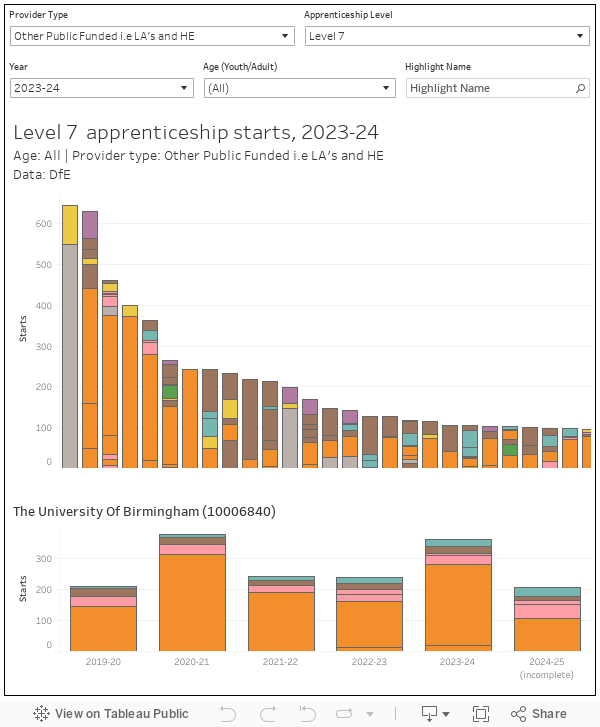
    The Department for Education and Skills England may decide to limit only a couple of standards – as the chart below shows, simply scrapping the Accountancy and Taxation Professional and Senior Leader standards would dramatically change the landscape (though we’d likely be back in the same position in a few years having a similar conversation about the Senior People Professional and Systems Thinking Practitioner ones).

    But once the government starts taking a pick-and-mix approach to standards (as opposed to letting a properly independent arms-length body do so), it opens the door to it happening again and again. If there is a substantial defunding of level 7 apprenticeship standards, expect the next few years to see targets on the back of others, even at level 6 – and an accompanying disincentive for universities to keep pressing ahead seeking out partnerships with employers.

    The removal from levy eligibility of standards that currently have a high uptake will have an immediate impact on those providers invested in them. Below, DK has charted apprenticeship starts by higher education institution (and a few other public bodies as they are lumped together in the DfE data, though as you may have noticed above some for-profit universities appear in the private sector category instead).

    The default view in this chart shows level 7 starts in 2023–24, broken down by standards, so that you can plumb the impact on different providers of different approaches to defunding. And if you’re getting nervous about what else Skills England might fancy doing once it’s finally got the level 7 announcement out of the way, you can look at provision at other levels too.

    Source link

  • Universities want more money upfront. DfE wants proof students are really there

    Universities want more money upfront. DfE wants proof students are really there

    When students get their student maintenance loans, they get the first instalment a lot earlier than their university gets the corresponding tuition fee payment.

    That might help explain the curious case of disparities between pulldown – but there’s a sound theory to it. Students without savings could face a cashflow issue if it was any other way.

    It’s becoming a problem for universities too. The Office for Students’ (OfS) financial sustainability update report highlights low liquidity levels in the sector – especially during certain points in the annual cycle.

    That matters because universities have to meet minimum liquidity requirements in the registration conditions in England. A failure to maintain those levels can also impact “going concern” status and breach some lending covenants.

    In the past, cash flow imbalances tended to be offset by other income sources, borrowing, or cross-subsidies, such as from international student fees.

    But given how universities operate and the demands on cash before those SLC payments come in, there is in some providers a disproportionate reliance on arrears payments from SLC-funded students compared to other funding sources.

    For non-SLC funded students, universities typically charge fees upfront (or at least in front-loaded advance instalments) or get payments for stuff like government-funded apprenticeships monthly. Research funding streams also match payments to incurred costs.

    But the SLC’s payment profile for undergrads is 25:25:50 – so universities face significant upfront costs in the first two terms and then wait longer than standard 30-day payment terms to receive funds, forcing them to bridge the gap using other resources.

    So the University Alliance has a proposal – switch those payments to 40:40:20 to improve the sector’s funding position:

    Even if the move was phased first to 33:33:33 and then to 40:40:20 it would have an immediate impact on the current situation which has been adversely impacted by the previous administration’s approach to international student recruitment through restrictive visa policies.

    The current system is going to have to undergo change anyway, given the potential implications of the LLE. I note in passing that one of the most common student leader manifesto goals this year is better, less front-loaded instalments – surely the principle (and the issue in terms of cashflow) cuts both ways.

    But UA’s proposal might not land in quite the way intended – partly because the Student Loans Company is under pressure to increase yield.

    Leakage

    DfE’s “Tailored Review” of the Student Loans Company back in July 2019 talked of the rapidly increasing size of the student loan book, and the increasing importance and value of having a robust, well-resourced and effective repayment strategy which actively seeks to maximise yield.

    That said that the SLC is hamstrung by IT systems which do not “adequately facilitate the use of smart diagnostics for effective modelling, proactive use of data analytics and more precise customer segmentation” to minimise repayment leakage:

    Indeed, unverified customers account for c. £7bn of uncollected repayments (although many of these would not be in a position to repay)

    September’s SLC board minutes noted that its CEO had been along to DfE’s Audit and Risk Committee, where the department led an item on the student finance loan book, with an emphasis on its “scale and yield potential”.

    And its newly published Business Plan for 2024-25 says it will work with partners in DfE to progress proposals to “improve repayment customer verification rates”, “improve data quality to increase verification and yield” and look at options to apply stronger sanctions to customers not adhering to the terms and conditions of their student finance repayments.

    Some of that is about the SLC’s systems – but one of the problems noted in the National Audit Office’s report into franchising is that there is often “insufficient evidence” that students are attending and engaging with their courses:

    In determining a student’s eligibility for loan payments, and before making payments, SLC uses lead providers’ data to confirm students’ attendance. Lead providers self-assure their own data… there is no effective standard against which to measure student engagement, which attendance helps demonstrate, and there is no legal or generally accepted definition of attendance. Providers themselves determine whether students are meaningfully engaged with their course.

    So in a set of circumstances where the NAO and the Public Accounts Committee (PAC) are already worried about attendance and engagement, and providers are worried about their own cashflow, it seems unlikely that DfE is going to be receptive of a proposal to give providers more of the money early – especially if, in the case of franchised provision, it can’t just claw it back from the lead provider if there’s a problem like the Applied Business Academy.

    As we noted back in October, the government’s response to the NAO and the PAC was that it published guidance on attendance management in May, against which providers can be held to account “in relation to the release of SLC tuition fee payments”.

    That said that there is an “understanding and acceptance” across the sector that providers should have in place published attendance and engagement policies, so that students understand the commitment expected of them and the respective process a provider follows if attendance expectations are not met.

    It also said that in any circumstance where a provider does not have a published policy, the department “expects” that one will exist from the 2024-25 academic year – but it’s pretty clear talking to people around the country that that goal hasn’t been meaningfully met in large parts of the sector, at least in terms of a policy that both covers home students and is “auditable”.

    And part of the difficulty there is what is or isn’t meant by “attendance”.

    Attending isn’t always in person

    The Attendance Management guidance says:

    Attendance means participation in a course by a student, including, but not limited to, teaching face-to-face or blended study, in line with a provider’s published attendance policy. A provider should communicate its policy to a student and have an auditable process in place to support the action it may take when a student does not meet attendance expectations.

    It goes on to say that providers have flexibility to ensure every student engages with a course, and that the student and/or the course may require greater or less attendance than another due to circumstances or content.

    SLC told me that there is no difference between “attendance” and “engagement” – the definition of “attendance” for student finance purposes is active and ongoing engagement. Crucially, it said that “attendance” doesn’t have to mean “in person”, or “studying on campus”.

    But the conflation of “attendance” and “engagement” doesn’t seem to apply when a course is designed and designated. Noting that “blended learning” combines traditional classroom teaching with online learning and independent study, it says that there has been some confusion as to whether these courses should be coded as distance learning courses:

    Courses of any teaching method are distance learning if the students only attend occasionally, for example once a term. If students attend regularly, for example once a week, and follow a structured timetable, the course is not distance learning and you should not add it to CMS as such.

    That paragraph draws a clear distinction between attendance and engagement. Its two scenarios also appear to draw a distinction between (physical) attendance and “engagement”:

    • Scenario 1: Thomas is studying a BA Hons in sports coaching. His course hours are 30 weeks online study including lectures and tutorials, 2 days per week physical attendance at sports academy, 6 days per year attendance at university. As Thomas needs to attend the sports academy regularly rather than occasionally, this is an in-attendance course.
    • Scenario 2: Kate is studying an HND in Musical Theatre. Her course hours are 30 weeks online study including lectures and tutorials, 3 days per year (1 day per term) attendance at college. As Kate only needs to attend college occasionally rather than regularly, this is a distance learning course.

    The difference between Scenario 2 and the patterns of attendance being seen by many providers around the country this term is that in that scenario, the course is designed not to include regular physical attendance.

    A two-stage process

    SLC told me that whether it’s distance or in-person, engagement on a course is required and confirmation of that engagement is therefore required for SLC to make a fee loan payment on the student’s behalf.

    Ongoing engagement is not part of the definition of in-person or distance learning. That distinction relates to the attributes of the course that is supplied by the provider, as to whether the course has elements of in-person learning or if the student is not required to be in-person.

    But the obvious question is as follows. Notwithstanding codified exemptions for disabled students, if a course is designed as blended, would an acceptable “attendance management” policy for a course of that sort allow a student to engage all term, but only occasionally physically attend?

    If yes, and Kate’s HND wasn’t designed as blended, and her mate Kathy was on a course that was designed as blended, that would seem to mean that they could both have exactly the same attendance and engagement pattern, but Kathy would get a maintenance loan while Kate wouldn’t.

    If, on the other hand, a course was designed as blended and requiring regular in-person attendance, and SLC would expect an attendance/engagement policy to enforce that regular in-person attendance, there’s plenty of providers right now falling foul of those expectations.

    So you end up with three categories:

    1. Providers who’ve never really had a proper policy on any of this for home students – let alone enforce one – beyond noticing if a student doesn’t submit what can often be end-of-year summative assessment.
    2. Providers who designed a course as blended where students are in reality engaging in a “distance learning” kind of way – which, while confirming engagement in accordance with the rules, seems hugely unjust to tens of thousands of OU students if nothing else.
    3. Providers who are heavily auditing and requiring physical attendance – partly to achieve parity with international students – at just the point that students are struggling to attend in-person given wider demands on their time.

    It may well be the case that SLC is stuck with the definitions it has – which in part date back to the Teaching and Higher Education Act 1998.

    But if it’s the case that it’s OK for an attendance policy to not actually require regular in-person attendance, it’s hard to believe that whatever size and shaped-problem that DfE and the SLC have with student loan fraud is going to get anything other than worse.

    And in the end, this all comes back to an old problem – not knowing what’s going on underneath headline non-continuation.

    How far in?

    Remember those risks that OfS identified in its insight brief on subcontracting:

    • Data of extremely poor quality has been submitted in relation to students at some subcontractual partnerships, leading to payments being made to, and on behalf of, students who are not genuinely entitled to them.
    • Delivery partners have lacked clear attendance policies, making it almost impossible for lead providers to submit accurate data to the OfS and the SLC in relation to these students.
    • Students have been encouraged to register for courses that they do not genuinely intend to study, to access public funding through maintenance loans. In some cases, students have withdrawn from courses shortly after receiving these funds; in others there are grounds to doubt that they are continuing to study, despite their termly attendance being confirmed.

    Whether we’re looking at a select group of partnerships as OfS published data on last week or directly taught provision, while we know what percentage of UG students don’t make it to the second year, we don’t know what proportion:

    • Got instalment 1 of the maintenance loan but didn’t get as far as “engaging” enough for the provider to claim instalment 1 of the tuition fee loan (they don’t show up at all in non-continuation)
    • Engaged enough to enable the provider to claim instalment 1 but not enough to enable the provider to claim instalment 2 (and what proportion of them claimed maintenance instalment 2)
    • Engaged enough to enable the provider to claim instalment 2 but not enough to enable the provider to claim instalment 3 (and what proportion of them claimed maintenance instalment 3)
    • Engaged enough to enable the provider to claim instalment 3 but then failed and was withdrawn
    • Engaged enough to enable the provider to claim instalment 3 and was eligible to progress but then self-withdrew
    • And we don’t know any of the above for subsequent years of study.

    In many ways, what we have here is (yet) another iteration of the stretch involved in a single level playing field. There have been endless tales down the years of Russell Group alumni not really “engaging” at all for entire years, and in some cases entire degree courses – only to pull it out of the bag at the end. It’s an adult environment, after all.

    On the other hand, with another part of the sector now under close scrutiny over ghost students of differing definitions – just as the FE sector saw scandals over in the 90s – it doesn’t feel like that kind of legend is to be allowed.

    In terms of the cashflow thing, if DfE and the SLC are going to push more of the money upfront, they’re surely going to want to know the percentages and numbers in each of the above categories.

    And the accuracy of those percentages and numbers involves providers being sure about “enough” engagement – in an auditable way across the diversity of programmes and reasonable adjustments – to tick the box in the data return to SLC three times a year.

    It does feel like there’s some distance to go on all of that as it stands.

    Source link

  • Money and Vibes | HESA

    Money and Vibes | HESA

    As I mentioned yesterday, I recently spent some time at the International Association of Universities’ (IAU) annual meeting in Tokyo earlier this month. It’s tough to organize a meaningful international meeting about what you might call the “hard” issues in university management (resources, budget allocations, management styles) because these vary so much from one part of the world to another, and so the program tends to be taken up with more universalist themes like “values.” 

    The interesting thing about values was the divide in the room(s) about how insecure everyone felt about them. The white folks in the room spoke a lot about “challenging times,” which was mostly code for “holy crap, not Trump again, won’t we ever get out of this authoritarian populist nightmare?” But interestingly, the Africans in particular were not really interested in this discussion. They deal with strong-arming governments nearly all the time, and so there was a slight edge of “wake up, times are always challenging” to some of their interventions. 

    I’ll spare you the blow-by-blow, but something occurred to me as I listened to the various sessions: “vibes” are really the way that universities keep score of their successes, collectively at any rate. Sure, it’s nice that governments give them money—and they are bloody expensive to run—but what really matters is whether they are loved and respected. 

    For an empiricist like me, this is really annoying. I can measure investments and can compare them from one university or one country to another. But vibes? Very difficult to measure. Hard even to come up with a definition that makes sense across countries: in Canada we do measure how much the public “trusts” universities, but in other countries the vibes are much more directly about their ability to accept new students, or whether they are helping the country advance economically.

    But what the hell? Let’s give it a try!

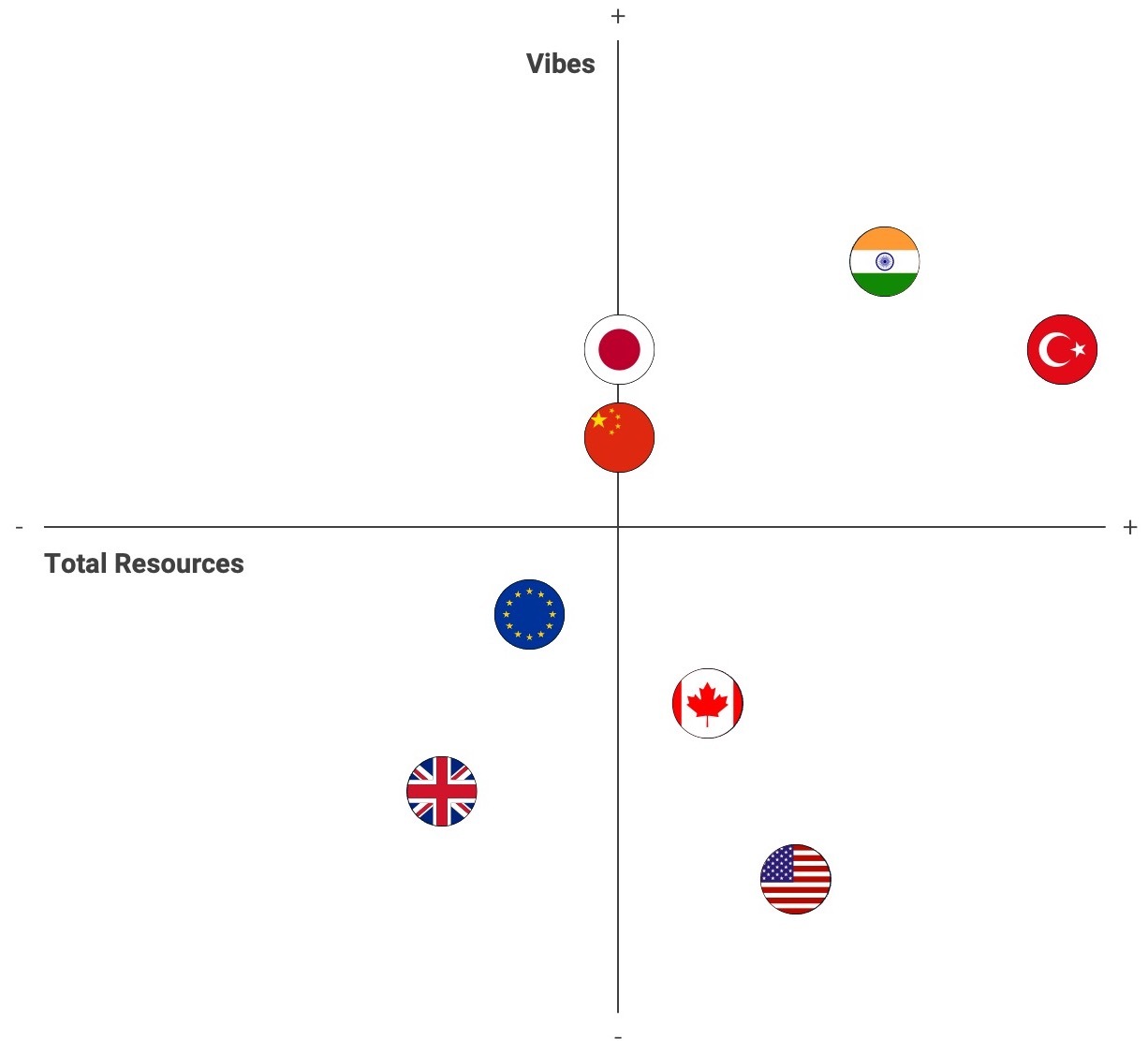
    Below is a 2×2 (it’s not social science unless there is a 2×2!) that shows change in both total financial resources and vibes over the past five years in various countries. Data for the money axis is from my own records and analysis (you can see some of it back here from the talk I gave in Helsinki a couple of months ago), while data on the vibes axis is totally made up, based on my own observations. I’d be happy to discuss a better way to operationalize and measure this axis, but for the moment let’s just say this attempt to visualize how universities are faring is illustrative rather than in any way definitive and move on to the exercise itself

    (If you’d like to argue for a specific source of information for various countries, or just argue my choice of placement of a particular country on the vibes scale, get in touch!)

    What you can see plainly from Figure 1 is that higher education systems occupy one of three quadrants. There’s the one where both money and vibes are changing for the better (Turkey, India), one where money is going up but vibes are going down (the USA), and places where both money and vibes are headed in the wrong direction (the UK). 

    What we don’t see, really, are any countries in the top left quadrant where vibes are going up but money is going down. And I think what that tells you is that good vibes are not absolutely required in order for universities to receive new money, but they make it a whole heck of a lot easier. Which is of course why university Presidents are so concerned with public opinion.

    Anyways, this is all pretty theoretical. But I think it points to the possibility that perhaps measuring public sentiment about universities in consistent ways across countries might yield some interesting insights into the determinants of public funding. And in any event, if vibes are the way that universities measure their own success, shouldn’t we try to measure that in the same way we measure institutional finances?

    Source link