Tag: months

  • What Higher Ed Learned From 12 Months of Trump 2.0

    What Higher Ed Learned From 12 Months of Trump 2.0

    College leaders return to campus this term appearing steady and resolved. After a year of tumult, they remain vigilant about more attacks from Washington but are ready to refocus on the other crises knocking at their doors—million-dollar deficits, declining enrollments and AI’s disruption. And now that higher ed has gone through nearly 12 months of Trump 2.0, it’s learned a few things.

    First, we now know that nothing is sacred. Funding for cancer research? Canceled. Support for colleges serving low-income students? Chopped. Due process? Passed over. The sector was caught off guard by the administration’s creativity in its attacks last year, and colleges should continue to expect the unexpected. But in an interview before Christmas, Education Secretary Linda McMahon told Breitbart that her department would “shift a little bit away from higher education” in 2026 and focus more on K–12 reform.

    The year didn’t just teach colleges what to expect—it also showed them how to respond. And we’ve seen that fighting back works. Harvard is holding firm against the administration’s pressure to strike a deal and has not publicly conceded anything (though rumors abound an agreement is nigh). George Mason University president Gregory Washington came out swinging when the Department of Education accused him of implementing “unlawful DEI policies” on his campus. That’s a sharp contrast to University of Virginia president Jim Ryan, who resigned in June after the Department of Justice’s successful bid to topple him. So far, Washington remains in his post, with unanimous support from his board, campus community and state lawmakers. And in a collective act of defiance, the nine institutions initially invited to sign the White House’s “Compact for Academic Excellence in Higher Education” declined without repercussion.

    Leaders have also woken up to the fact that visibility matters. At the Council for Independent Colleges’ Presidents Institute in Orlando, Fla., this week, presidents seemed ready to play offense. They spoke with a newfound political savviness about recruiting board members and alumni to do advocacy work, hiring in-house government relations professionals and spending more time on the Hill. “We all let our guard down on government relations in the lead-up to 2025,” one president said. “Being able to brand yourself in D.C. is now a necessity, not a luxury.”

    At times the administration has appeared sloppy, sending “unauthorized” letters, issuing threats and never following up, or publishing typo-ridden mandates. But beyond the culture-war accusations that colleges are factories of woke indoctrination, it’s clear the government is serious about wanting to effect change in higher ed. Cost transparency, graduate outcomes and greater emphasis on workforce training are all sound policy issues lawmakers are pursuing through legislation.

    Whether or not McMahon follows through on her intention to shift focus away from higher ed, the fallout from 2025 persists. We’ll be looking to see how college budgets weather new loan caps for graduate courses and the loss of international students impacted by stricter visa requirements—or turned off by the country’s hostile environment.

    In December, Education under secretary Nicholas Kent vowed to “fix” accreditation. The administration’s unofficial playbook, Project 2025, suggests that could mean more accreditors, including states authorizing their own accrediting agencies, or ending mandatory accreditation to access federal financial aid. Congress will continue to apply pressure on the sector to lower the cost of college and improve transparency regarding fees and tuition. Meanwhile, negotiated rule making has begun on the accountability measures mandated by the One Big Beautiful Bill Act. And will colleges take responsibility for their role in the loss of public trust in their institutions?

    We shouldn’t normalize the lasting harm the Trump administration has done to institutional independence, minoritized students and scientific research in just 12 months. And there is a risk that more is coming. But after surviving a dizzying year of attacks, the sector will face its challenges a little wiser and more informed.

    Sara Custer is editor in chief at Inside Higher Ed.

    Source link

  • L.A. Schools Telehealth Vendor Waited 8 Months to Report Breach – The 74

    L.A. Schools Telehealth Vendor Waited 8 Months to Report Breach – The 74

    School (in)Security is our biweekly briefing on the latest school safety news, vetted by Mark KeierleberSubscribe here.

    It’s another hot summer Friday and another day with news about a data breach — this one jeopardizing both student health and campus safety data.

    And once again, the development is unfolding in the country’s second-largest school district.

    Kokomo Solutions, which the Los Angeles district contracts with to provide telehealth services to students during the school day and to track campus safety threats, disclosed a data breach after it discovered an “unauthorized third party” on its computer network. The discovery happened in December 2024, but the notice to the California attorney general’s office wasn’t made until Aug. 5.  

    It’s the latest in a series of data privacy incidents affecting L.A. schools, including a high-profile 2022 ransomware attack exposing students’ sensitive mental health records and last year’s collapse of a much-lauded $6 million artificial intelligence chatbot project. 


    In the news

    Students at the center of Trump’s D.C. police takeover: In an unprecedented federal power grab, the Trump administration’s seizure of the D.C. police department and National Guard deployment is designed to target several vulnerable groups — including kids. | NPR

    • The move comes at a time when crime in the nation’s capital is on the decline. But a deep-dive from June explores how the district’s failure to prevent student absences has contributed to “the biggest youth crime surge in a generation.” | The Washington Post
    • Here’s what young people have to say about Trump’s D.C. takeover. | NBC 4
    • City police will roll out a youth-specific curfew Friday in the Navy Yard neighborhood. | Fox 5

    A new Ohio law requires school districts to implement basic cybersecurity measures in response to heightened cyberattacks. What the law doesn’t do, however, is provide any money to carry out the new mandate. | WBNS 

    News in Trump’s immigration crackdown: A federal judge in Minnesota has released from immigration detention a nursing 25-year-old mother, allowing her to return to her children as her case works its way through the court. | The Minnesota Star Tribune 

    • The Trump administration has revived one of its most controversial immigration policies from the president’s first term: Separating families. | The New York Times
    • Federal immigration officials quizzed an Idaho school resource officer about an unaccompanied migrant student, part of a broader national effort to conduct “welfare checks” on immigrant youth who came to the U.S. without their parents. | InvestigateWest
    • Leading Oklahoma Republican lawmakers have partnered with the Trump administration in a lawsuit challenging a state law allowing undocumented students to receive in-state college tuition. | InsideHigherEd
    • Los Angeles community members have organized to create protective perimeters around the city’s campuses after immigration agents reportedly drew their guns on a student outside a high school. | Los Angeles Times
      • The district announced new bus routes designed to improve student safety while commuting to school during heightened immigration enforcement. | NBC 4
    • The nonprofit Southwest Key, which for years has been the federal government’s largest provider of shelters for unaccompanied migrant children, has laid off thousands in Texas and Arizona after losing federal grants. The Trump administration dropped a lawsuit in March over allegations the nonprofit subjected migrant children to widespread sexual abuse. | ABC 15
    • A Texas court blocked the state attorney general’s request to depose and question a nun who leads Catholic Charities of the Rio Grande Valley, one of the largest migrant aid groups in the region. | The Texas Tribune
    Sign-up for the School (in)Security newsletter.

    Get the most critical news and information about students’ rights, safety and well-being delivered straight to your inbox.

    Microphone-equipped sensors installed in school bathrooms to crack down on student vaping could be hacked, researchers revealed, and turned into secret listening devices. | Wired

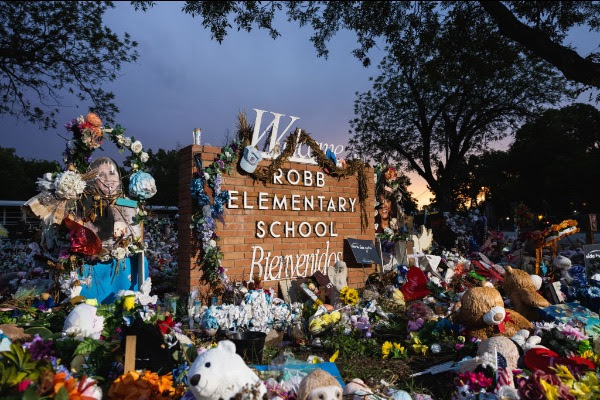
    ‘These are innocent children, sir’: New video of the delayed police response to the 2022 mass school shooting in Uvalde, Texas, shows the campus police chief attempting to negotiate with the gunman for more than 30 minutes. | The New York Times

    Kansas schools have become the latest target in the Trump administration’s campaign against districts that permit transgender students to participate in school athletics. | KCTV

    • The Loudoun County, Virginia, school board has refused to comply with an Education Department order to end a policy allowing transgender students to use restroom facilities that match their gender identity. | LoudounNow 
    • The Education Department’s Office for Civil Rights has opened an investigation into allegations the Baltimore school district ignored antisemetic harassment by students and educators. | The Baltimore Banner

    Lots of drills — little evidence: A congressionally mandated report finds that active shooter drills vary widely across the country — making it difficult to understand their effect on mental and emotional health. | National Academies of Sciences, Engineering, and Medicine

    A federal judge has blocked a new Arkansas law requiring that public schools display the Ten Commandments in all classrooms. It’s the second state Ten Commandments law to be halted this year. | Axios 

    ICYMI: I did a deep-dive into the far-right Christian nationalists behind more than two dozen state Ten Commandments-in-schools bills nationally — each of which are inherently identical. | The 74

    Is Texas up next? Civil rights groups will ask a judge on Friday to prevent a similar law from going into effect. | Houston Chronicle


    ICYMI @The74

    Despite Court Order, Education Department’s Civil Rights Staff Still On Leave

    ‘So Many Threats to Kids’: ICE Fear Grips Los Angeles at Start of New School Year


    Emotional Support

    Don’t sleep on this Bloomberg feature into “Doodlemania” — the billion-dollar industry for hypoallergenic (and floofy!) designer pups.


    Get stories like these delivered straight to your inbox. Sign up for The 74 Newsletter

    Source link

  • AGB leader resigns abruptly after six months

    AGB leader resigns abruptly after six months

    Less than a year into the job, Framroze Virjee is out as president and CEO of the Association of Governing Boards of Universities and Colleges.

    Virjee retired, a decision that was effective Saturday, according to an email from Ross Mugler, chair of AGB’s Board of Directors, who has been tapped as acting president and CEO.

    “Fram shared that after working diligently to further the organization’s mission, he determined that the president/CEO role at AGB did not align operationally with his personal and professional goals, and he decided to step down from the organization. The AGB Board of Directors accepted his resignation and offered its appreciation for his accomplishments during his tenure,” Mugler wrote in a Monday email.

    In a message to AGB staff, Virjee wrote, “This was a difficult decision and not one that I made casually, but instead only after careful consideration and thought. As I leave AGB, I remain committed to its mission of supporting excellence in board governance and leadership and remain dedicated to the value of higher education in the lives of students, our communities, and our nation.”

    Virjee, president emeritus of California State University, Fullerton, formally started in mid-August after his predecessor, former AGB president and CEO Henry Stoever, resigned amid plagiarism allegations in late 2023.

    AGB did not respond to a request for comment from Inside Higher Ed on Monday about Virjee’s sudden exit, but the organization’s website has been updated to reflect the leadership change.

    “As a result of this announcement, I have agreed to serve as acting president and CEO while the AGB Board of Directors finalizes details regarding new leadership,” Mugler wrote Monday.

    Mugler recently retired as commissioner of the revenue for Hampton, Va., a post he held for more than three decades. Mugler has been on AGB’s board since 2018 and was appointed five times to Old Dominion University’s Board of Visitors.

    Source link

  • Income-driven repayment applications on hold for three months

    Income-driven repayment applications on hold for three months

    Student loan borrowers won’t be able to apply for income-driven repayment plans for at least three months, The Washington Post reported.

    The Post obtained a memo sent last week from the Department of Education to student loan servicers directing them to stop processing all income-driven repayment and consolidation applications until at least May. The memo offers more clarity on how the department plans to proceed after a federal appeals court blocked the department from implementing a new income-driven repayment option for borrowers put in place by the Biden administration. That injunction also implicated parts of other income-driven repayment plans.

    Up until this point, all that student aid experts knew was that the department had disabled new online applications. Now, they know that all existing applications have also been included in the freeze.

    The application freeze is a problem for some borrowers who rely on income-driven repayment plans for more affordable payments and to avoid default. Under the plans, borrowers’ monthly payments are based on their disposable income and other factors, and after 20 to 25 years of payment, the remaining balance would be forgiven. But now, millions of borrowers no longer have access to IDR and are left with only the most expensive loan repayment options.   

    Scott Buchanan, executive director of the Student Loan Servicing Alliance, a trade group for loan servicers, told the Post that “there is a lot to clean up.”

    “We will be working for [the Office of Federal Student Aid] to implement that transition once courts clear things up and bring some finality so borrowers can have certainty and confidence in their options now and in the future,” Buchanan said.

    The Education Department has said the pause is necessary under the U.S. Court of Appeals for the Eighth Circuit ruling, but paper applications for loan consolidation will be allowed. 

    “A federal Circuit Court of Appeals issued an injunction preventing the U.S. Department of Education from implementing the SAVE Plan and parts of other income-driven repayment (IDR) plans,” a department spokesperson said. So “The department is reviewing repayment applications to conform with the Eighth Circuit’s ruling.” 

    But legal experts on federal loans have told Inside Higher Ed taking down the applications entirely is not necessary. As the department noted in its statement, the injunction only declares “parts” of the IDR plans—such as the end-of-program loan forgiveness—illegal. It does not ban the use of lessened monthly payments.

    Source link

  • Report card: Accord recommendations 12 months on

    Report card: Accord recommendations 12 months on

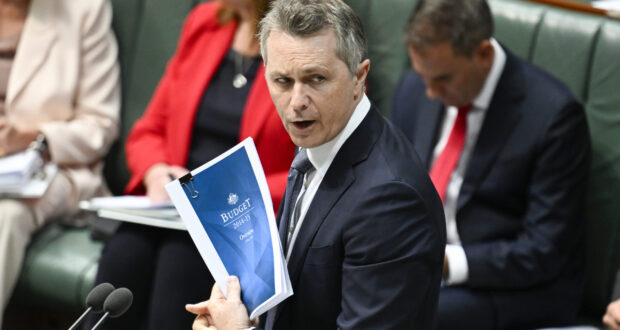
    Education Minister Jason Clare handed down the final report in February 2024. Picture: Martin Ollman

    The 408-page Universities Accord document has shaped the past year of university reform discussions. The document includes 47 recommendations that are expected to take up to 25 years to implement.

    Please login below to view content or subscribe now.

    Membership Login

    Source link

  • DHS Extends I-9 Flexibility Guidance Another Four Months – CUPA-HR

    DHS Extends I-9 Flexibility Guidance Another Four Months – CUPA-HR

    by CUPA-HR | December 17, 2021

    On December 15, the Department of Homeland Security (DHS) announced a further extension of the flexibilities on Form I-9 compliance requirements that was initially granted last year. The guidance, which was slated to expire on December 31, 2021, has been extended through April 30, 2022.

    The guidance will continue to allow for remote inspection of Form I-9 documents in situations where employees work exclusively in a remote setting due to COVID-19-related precautions. For employees who physically report to work at a company location on any regular, consistent or predictable basis, employers are required to use standard I-9 procedures.

    Earlier this week, CUPA-HR and 11 other higher education associations sent a letter to United States Citizenship and Immigration Services (USCIS) Director Ur Jaddou asking for this additional extension in light of the uncertainty posed by the Omicron variant and encouraging DHS to announce the extension on or before December 17, 2021.

    CUPA-HR is grateful for DHS’s swift response and will be submitting comments in response to DHS’s Request for Public Input on document examination practices for Form I-9.


    Source link