Tag: national

  • National Student Ombudsman legislation passed, leader announced

    National Student Ombudsman legislation passed, leader announced

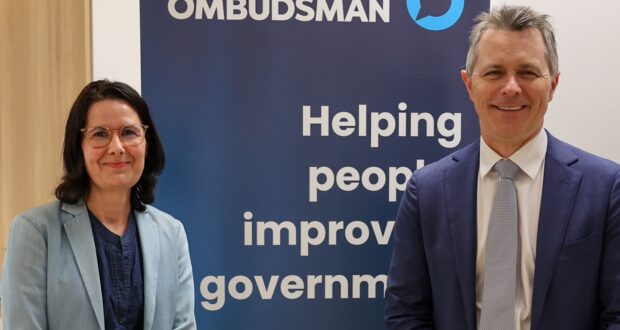
    The new independent National Student Ombudsman will be led by Sarah Bendall (L), pictured with Jason Clare, in an image posted to social media on November 29, 2024. Picture: Facebook

    A highly experienced lawyer has been appointed to lead the anticipated university watchdog and complaints function, after the legislation passed in the last sitting week of parliament.

    Please login below to view content or subscribe now.

    Membership Login

    Source link

  • Let’s Learn About Telehealth (Sessions from the National Telehealth Conference)

    Let’s Learn About Telehealth (Sessions from the National Telehealth Conference)

    In May, I was pleased to see the Health Resources and Services Administration (HRSA) offer a virtual Telehealth Conference. I am always on the lookout for good professional development opportunities, so I signed up. 

    My schedule had a conflict on that day and I was unable to attend, BUT they posted videos of the sessions online. I was so excited and I could not wait to block time on my schedule, grab some lunch, and listen to the sessions.

    You can listen to the sessions as well!

    Here is a list of the sessions and the video links:

    Leaders from the U.S. Department of Health and Human Services will discuss priorities and highlight key efforts across the Department to expand access to telehealth services.

    Providers and experts will discuss telehealth’s key role in access to behavioral health services as well as the integration of behavioral and physical health services, especially for those in underserved communities.

    This session will discuss ongoing efforts to facilitate access to inter-state telehealth services through HRSA’s Licensure Portability Grant Program.  Through this program, HRSA provides support to the Federation of State Medical Boards and the Association of State and Provincial Psychology Boards.  Participants will learn about current options to address licensure portability reform and have an opportunity to provide feedback.

    This session will discuss key policy and infrastructure issues at the state and federal level needed to ensure continued access to telehealth beyond the COVID-19 public health emergency.

    This session will discuss key considerations for integrating telehealth in various medical settings.  Participants will learn of current models and provide input on ways to address challenges and barriers.

    This session will provide an overview of Federal efforts and resources to improve access to broadband, which is a key component to the delivery of telehealth services as well as other social determinants of health.

    This session will discuss current efforts to assist providers in using telehealth and considerations for training the workforce for tomorrow. Issues to be discussed will include provider-to-provider mentoring, developing telehealth curriculum for providers and addressing burnout.

    This session will provide participants with an opportunity to learn more about the HRSA supported Telehealth Resource Centers including their work and expertise in assisting providers with implementing telehealth services.

    This session will discuss leveraging telehealth technology in addressing and treating COVID-19.

    Experts will discuss the key telehealth issues and priorities identified by their stakeholders and how those telehealth issues may evolve beyond the pandemic.

    Check out the sessions. Which session was your favorite?

    ***

    Check out my book – Retaining College Students Using Technology: A Guidebook for Student Affairs and Academic Affairs Professionals.

    Remember to order copies for your team as well!


    Thanks for visiting! 


    Sincerely,


    Dr. Jennifer T. Edwards
    Professor of Communication

    Executive Director of the Texas Social Media Research Institute & Rural Communication Institute

    Source link

  • National Women’s History Month: Past and Present Higher Ed HR Trailblazers – CUPA-HR

    National Women’s History Month: Past and Present Higher Ed HR Trailblazers – CUPA-HR

    by CUPA-HR | March 2, 2022

    National Women’s History Month celebrates the contributions and achievements women have made throughout U.S. history. CUPA-HR is fortunate to have had many smart and dedicated women serve on its national, regional and chapter boards and on various committees. In addition to providing leadership at work, they have volunteered their time and shared their know-how — lighting the way for other women in the field.

    To celebrate the month, we’re spotlighting some of the many leaders who have transformed higher ed HR and CUPA-HR. Sure to inspire, these articles and podcast episodes offer unique perspectives of higher ed HR, career journeys, struggles, successes and everything in between.

    Looking Back to Move Forward

    Blazing a Trail: Women Who Paved the Way in Higher Ed HR, from a 2014 issue of Higher Ed HR Magazine, features five CUPA-HR leaders who began their higher ed HR careers in a very different era — when HR was still “personnel,” men dominated the profession and the nature of the work was strictly focused on policies and procedures. These women rose to leadership positions, not only in their departments, but across their institutions. Read about their challenges, their regrets, their successes and a few war stories to boot.

    More Stories That Inspire

    CUPA-HR Conversations: Higher Ed HR Turns 75 Podcast features higher ed HR leaders and past CUPA-HR national board chairs who have left their mark on both the association and the profession.

    • In Episode 2: Growing Through Change, Allison Vaillancourt reflects on some professional advice she received from a CUPA-HR peer that changed her entire approach to HR and helped advance her career and secure several leadership positions.
    • Lynn Bynum shares how CUPA-HR helped her make the transition from the corporate world to higher ed HR, and Lauren Turner offers insights into how HR can become a recognized leader within the institution and help others become better leaders in Episode 4: Model Behavior.
    • Jane Federowicz reflects on her unexpected path to HR, starting out as her institution’s accountant and ending up being asked to create an HR department, in Episode 6: When Opportunity Knocks.
    • In Episode 7: Lifelong Learning, Barbara Carroll dives into some experiences she never thought she would have as an HR leader, including serving on CUPA-HR’s Public Policy Committee and providing a higher ed perspective to a room full of senators and congressional representatives, and Linda Lulli discusses the importance of being a lifelong learner in the HR profession and how to be adaptable and resilient.

    Time-Out With Tammi & Tyler is a podcast that explores how higher ed HR careers evolve by interviewing professionals at the top of their HR game, sharing advice they would give professionals climbing the higher ed HR ladder.

    • In Episode 1, Donna Popovich offers advice for early-career professionals.
    • Sheraine Gilliam walks through her story of persistence, networking and how to turn negative situations into opportunities for growth in Episode 3.
    • In Episode 5, Clarity White describes how her Wildfire program experience helped advance her HR career.

    Related resources:

    21-Day Challenge: Focus on Women (First two weeks of the challenge)


    Source link

  • National College Players Association Files Charges Seeking Employee Status for Student-Athletes – CUPA-HR

    National College Players Association Files Charges Seeking Employee Status for Student-Athletes – CUPA-HR

    by CUPA-HR | February 17, 2022

    On February 8, the National College Players Association (NCPA), an advocacy association for college athletes, filed unfair labor practice charges with the National Labor Relations Board (NLRB) against the University of Southern California, the University of California, Los Angeles (UCLA), the Pac-12 Conference and the National Collegiate Athletic Association (NCAA).

    The charges allege that the employers have violated the National Labor Relations Act (NLRA) by “repeatedly misclassifying employees as ‘student-athlete’ nonemployees” and “by maintaining unlawful rules and policies in its handbook, including restricting communications with third parties.” The charges mark the launch of the NCPA’s #JforJustice campaign and aim “to affirm college athlete employee status for every [Football Bowl Subdivision (FBS)] football player and Division I basketball player at every public and private university in the nation,” per an NCPA statement.

    This is the latest development regarding issues surrounding employment status of student-athletes since NLRB General Counsel Abruzzo issued a memorandum last September stating her position that student-athletes are employees under the NLRA and are therefore afforded all statutory protections as prescribed under the law. In that memo, Abruzzo stated that it was her intent to “educate the public, especially Players at Academic Institutions, colleges and universities, athletic conferences and the NCAA” about her position in future appropriate cases.

    The NCPA charges potentially provide Abruzzo with a case she can present to the NLRB to consider granting collective bargaining rights to college athletes. In 2015, the last time the NLRB considered the issue, it declined to assert jurisdiction over Northwestern football players, as doing so “would not promote labor stability [because the] board does not have jurisdiction over state-run colleges and universities” that make up the majority of the FBS. The NCPA charge seeks to overcome this jurisdictional obstacle by including the privately-held Pac-12 and NCAA as joint employers of UCLA’s athletes — a theory of liability Abruzzo said she would consider applying in appropriate circumstances.

    Now that the charges have been filed, an NLRB regional director will review the case and determine whether formal action should be taken and presented to an administrative law judge, which would preside over a trial and issue a decision that could ultimately be taken up by the five-member board.

    CUPA-HR will be paying close attention to this case and provide members updates as it progresses.


    Source link

  • Student loans: what counts as expenditure in national accounts

    Student loans: what counts as expenditure in national accounts

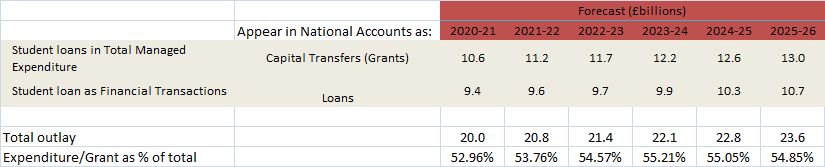
    Economic & Fiscal Outlook, Office for Budgetary Responsibility (March 2021), adapted from Tables 3.14 & 3.26

    I have constructed the table above from forecasts for Total Managed Expenditure and Financial Transactions taken from the Office for Budgetary Responsibility’s latest publication (it accompanied Wednesday’s Budget).

    It shows how newly issued student loans are now split into two components for the purposes of presentation in the National Accounts. The portion of loans that are expected to be repaid are classed as “financial transactions”, while the portion expected to be written off is recorded as capital expenditure. The latter scores in “public sector investment”, which was adopted as a new fiscal target prior to the pandemic (net investment cannot exceed 3% of national income), though the rules are currently under review.

    We can see that student loan outlay is expected to reach £20billion in the year to March 2021, rising to £23.6billion in five years’ time.
    The majority of new outlay is now expected to be written off and that share rises over the forecast period.
    By 2025/26 repayments on all existing loans are projected to re000000000000000ach nearly £5billion per year. (This figure has improved since the sale programme for post-2012 loans was abandoned, since the treasury now gets the receipts that would have gone to private purchasers).

    As mentioned in recent posts on here, the Department for Education only currently has an allocation of £4billion to cover the capital transfer / grant element of new loans and so it has to be granted large additional budgetary supplements each year. This situation has dragged on as the planned spending review has been postponed. We can now expect developments in the Autumn.


    Source link