
The Trump administration has all but axed the U.S. Department of Education’s statistical research arm — the National Center for Education Statistics — sparing only a handful of employees who are left without department staff needed to analyze education data.
“They didn’t just RIF a few people, they deleted the agency for all intents and purposes,” said an NCES employee of more than a decade who was part of the massive March 11 layoffs.
The loss of over a hundred Institute of Education Sciences employees — including almost all of the NCES staff — comes as part of sweeping cuts to the Education Department that left the federal agency with only half of its workforce. NCES, which traces its existence to an 1867 law establishing a federal statistical agency to collect, analyze and report education data, has been tasked with research and analysis on everything from graduation rates and student outcomes to teacher and principal development.
Overall, NCES research tracked the condition of education in the nation, including gaps in achievement and resources for underserved students. During the pandemic, the unit closely analyzed trends in school resources and educator and student mental health.
Perhaps most notably, NCES oversaw and ensured the quality of the Nation’s Report Card, along with other key student outcome studies. School and college leaders rely on such NCES research to improve student performance, and its findings often help inform federal and state policymakers on funding decisions.
Now, those caught in the latest wave of the administration’s cuts are warning that their haphazard nature will lead to a decline in the quality of assessments and data overseen by NCES. Longtime NCES employees report being fired at a moment’s notice and abruptly losing access to years — sometimes decades — of work, with no communication from the administration about how to offboard so as to preserve and pass on critical information.
“A lot of institutional knowledge is going to be lost,” said another former NCES employee who worked closely on the Nation’s Report Card. This employee and the others who spoke to K-12 Dive asked to remain anonymous for fear that identification could affect their severance terms.
NAEP and international assessment employees impacted
Although NCES employees are nearly all gone, many of NCES’ functions they previously carried out are congressionally mandated, meaning they will still need to be done. That includes portions of the National Assessment of Educational Progress, commonly known as the Nation’s Report Card.
The required parts include: reading and math assessments in 4th and 8th grade, long-term trend assessments for 9, 13 and 17-years-olds, and 12th grade reading and math assessments. The long-term assessment for 17-year-olds was last administered in 2012, having been canceled during the pandemic, and again for this spring due to what the Education Department cited as funding issues.
Other portions of the federal test such as science, U.S. history and civics are optional.
The federally mandated assessment has often served as a yardstick for student performance in various subjects, most notably reading and math. Following the pandemic, it helped educators understand which subject areas students struggled in the most during and following school closures.
“Despite spending hundreds of millions in taxpayer funds annually, IES has failed to effectively fulfill its mandate to identify best practices and new approaches that improve educational outcomes and close achievement gaps for students.”

Madi Biedermann
U.S. Department of Education’s Deputy Assistant Secretary for Communications
Congress also mandates that student performance be compared on an international level, a requirement usually fulfilled by the Program for International Student Assessment, or PISA.
The latest round of PISA testing was expected to begin by the end of March. Plus, the main NAEP for grades 4, 8 and 12 was supposed to begin early next year — preparation for which was set to begin this summer, according to former NCES employees.
The Education Department, in a March 13 statement emailed to sister publication Higher Ed Dive, said, “IES employees impacted by the reduction in force conducted none of the research related to NAEP, the College Scorecard, and IPEDS.”
“That work is all done through contracts that are still maintained by the Department,” said Madi Biedermann, deputy assistant secretary for communications at the department, in the statement.
Some NCES contracts that were terminated as part of the $900 million in federal contract cuts have been revived, those laid off said. Just prior to being let go, employees were in the throes of reestablishing contractual relationships and systems required to carry out some congressionally mandated assessments.
The laid-off employees refuted the department’s assertion that those who were fired “conducted none of the research related to NAEP.” Instead, they say, the employees were tasked with ensuring the quality of both the research collection and the post-collection analysis.
Meaning: Some of the contracts for required assessments were canceled, then revived, and then in the process of being reestablished by NCES employees — who were then fired and blocked from accessing the technology systems they say they needed to pass on their knowledge and thereby maintain assessment quality.
One of the former employees K-12 Dive spoke with described the situation as “chaotic” and said the handful of remaining employees are “overwhelmed.”
“It can’t function in the current state it’s in,” said the employee who had worked on NAEP. “The Nation’s Report Card is not going to be the gold star that it has been.”
Department restructuring on the horizon
The administration takes a different view.
“Despite spending hundreds of millions in taxpayer funds annually, IES has failed to effectively fulfill its mandate to identify best practices and new approaches that improve educational outcomes and close achievement gaps for students,” said Biedermann in the emailed statement.
Biedermann said the administration plans to restructure IES in the coming months “with input from existing leadership and expert stakeholders so that the Institute provides states with more useful data to improve student outcomes while maintaining rigorous scientific integrity and cost effectiveness.”
One of NCES’ longtime leaders, Peggy Carr, was appointed commissioner for NCES by the Biden administration in 2021 after serving as associate commissioner for assessment for over two decades. As such Carr has been the leading voice on the Nation’s Report Card in recent years.
Carr was put on administrative leave in February, in the lead-up to the Trump administration’s staffing cuts. Her position remains within the department, according to an organizational chart provided by the department to AFGE Local 252, a union representing a majority of the workers laid off, on March 11 just prior to the layoffs. The chart shows both remaining positions and shuttered departments.
The Education Department and its human resources office did not respond to multiple requests from K-12 Dive on the status of Carr’s employment.
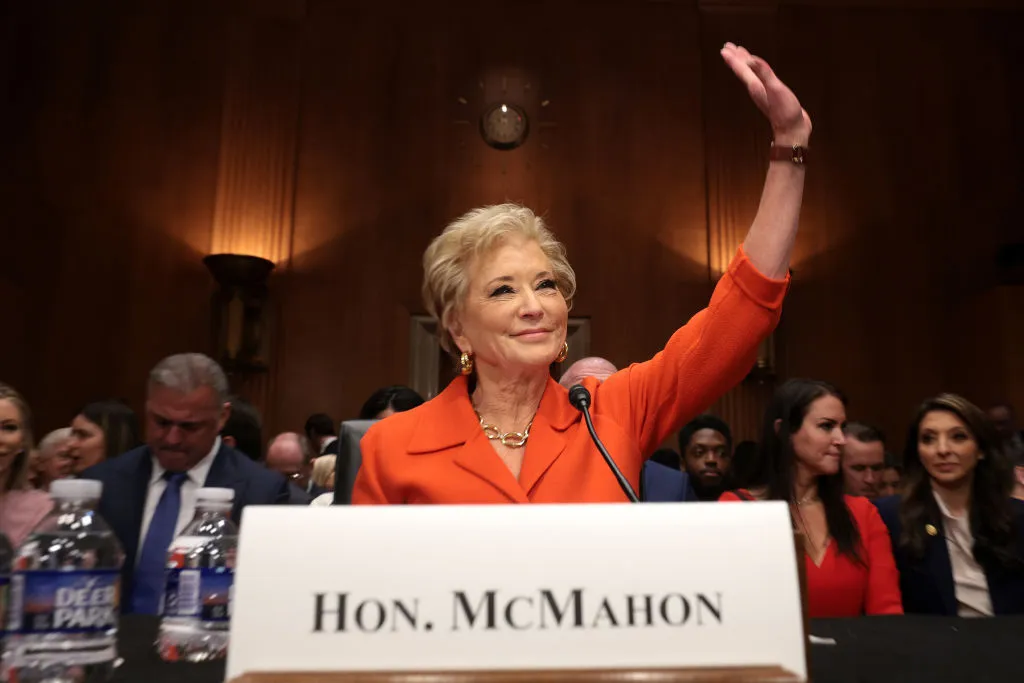
The department under Education Secretary Linda McMahon, who was confirmed by the Senate on March 3, has undergone massive employee and contract cuts, including sending the National Center for Education Statistics to near extinction.
Win McNamee via Getty Images
Prior to the cuts that laid off nearly her entire department, Carr was spearheading the modernization of NAEP, including the remote proctoring and administration catapulted forward by the pandemic. The department had already field-tested online administration in the past few years and was on track to remotely administer the assessment by 2026.
Such a transition requires research like bridge studies — which allow older assessment results to be compared to newer versions of the test — and analyses overseen by the kind of NCES employees who are now laid off, NCES assessment experts have said.
“From what I know, they’ve cut that out because the new administration wants to do the bare minimum,” said the NCES employee familiar with NAEP. “I think they want to do everything barebones.”
‘Everybody relies on NAEP data’
The department said in a March 14 letter to education stakeholders that, “These reductions are strategic cuts to offices and programs that will not directly impact students and families but rather empower states and localities.”
However, educators and researchers disagree with the department’s take and are shocked by the loss of half of the Education Department staff and nearly all of NCES.
The National Council on Teacher Quality — which includes district and state policymakers along with former teachers — warned that states are “likely to weaken or abandon commitments to maintaining high standards for student learning and accountability for student outcomes” as a result of the federal layoffs.
“Without NAEP, we will not know to what extent children in Massachusetts are reaching the same standards of performance as children in Mississippi,” the council said in a March 11 statement following the reduction in force.
The council is also worried about the loss of NCES research on the teacher workforce, which states rely on to identify the extent of their supply and demand.
“It’s our own quiet act of patriotism to put out objective data.”
In an open letter to Secretary of Education Linda McMahon prior to the March 11 firings, William Bennett, education secretary under President Ronald Reagan, and Chester Finn, who served at the department under Reagan as an assistant secretary, highlighted NAEP’s importance.
The assessment is still “the single most important activity” of the department and serves as the “primary gauge by which we know how American education is doing, both nationally and in the states to which you rightly seek to restore its control,” wrote Bennett and Finn, both of whom are conservatives who served under a Republican president who also wanted to shut down the Education Department.
Still, they decried any move to do away with NCES’ flagship product: the Nation’s Report Card.
“You alluded to NAEP data during your confirmation hearing,” they told McMahon, and Trump “deploys it when referencing the shortcomings of U.S. schools.”
“Everybody relies on NAEP data, and its governing board’s standards have become the criteria by which states gauge whether their own standards are rigorous enough,” Bennett and Finn said.
That’s partly what’s taken many — including NCES employees themselves — by surprise: The statistical center and its data have long been considered a nonpartisan source of critical information by which administrations could measure whether their policies were effective.
“No matter what side you’re on, it’s absolutely essential,” a laid-off employee said. “It’s our own quiet act of patriotism to put out objective data.”