
Tag: negotiate

  • George Mason University’s board looks to negotiate with Trump administration

    George Mason University’s board looks to negotiate with Trump administration

    This audio is auto-generated. Please let us know if you have feedback.

    Dive Brief:

    • George Mason University’s governing board said late last week that it wants to negotiate with the Trump administration to resolve allegations that it violated civil rights law. 
    • In late August, the U.S. Department of Education alleged that George Mason has illegally used race and other protected characteristics in hiring and promotions, a conclusion reached just six weeks after the agency announced a probe into the university. 
    • An attorney for university President Gregory Washington, who is at the center of the probe, has repudiated the agency’s allegations, describing them as “a legal fiction.” Washington’s attorney will also be involved in talks with the Education Department, according to the board’s statement.

    Dive Insight:

    Over a period of weeks this summer, the Trump administration ramped up pressure on George Mason. The departments of Education and Justice opened at least four probes between them into the university, often citing comment from Washington in support of diversity initiatives.

    Washington’s attorney, Douglas Gansler, took the Education Department to task for how quickly it determined George Mason violated the law.

    “It is glaringly apparent that the OCR investigation process has been cut short, and ‘findings’ have been made in spite of a very incomplete fact-finding process, including only two interviews with university academic deans,” Gansler wrote.

    The attorney also described some of the evidence cited by the Education Department as “gross mischaracterizations of statements made by Dr. Washington” that didn’t lead to policy changes. 

    For example, when the Education Department concluded that George Mason violated civil rights law, it linked to a statement Washington made in 2021 in support of having faculty reflect the diversity of the student body and broader community. The department took the statement as expressing “support for racial preferencing” in hiring. 

    But, as Gansler highlighted, Washington specifically said in the statement that the diversity principles he was promoting were “not code for establishing a quota system.”

    Gansler also warned the university’s board against requiring Washington to apologize, which was among the demands made by the Education Department. The lawyer pointed out that such an apology could open the university up to liability.

    Through all of this, George Mason’s board of visitors — headed by Charles Stimson, who holds leadership positions at The Heritage Foundation, a right-wing think tank — has been relatively quiet. 

    To represent it in dealings with the Trump administration, the board hired Torridon Law, which was co-founded by William Barr, formerly U.S. attorney general during the first Trump administration. The firm also has several prominent Republican lawyers on staff. 

    In July, the university’s chapter of the American Association of University Professors voted no confidence in the board and called its response to the Trump administration’s actions to that point “inadequate and deeply troubling.”

    And yet, in August — at a meeting that the AAUP chapter warned could set the stage for Washington’s ouster — George Mason’s board voted to give the leader a raise

    Since then, Democrat members of a Virginia Senate committee have blocked six appointees to George Mason’s board picked by the state’s Republican governor, Glenn Youngkin. The move has left the board of visitors without a quorum for conducting official business. 

    In announcing plans to negotiate with the Education Department, the board said Friday that it “remains committed to ensuring that George Mason complies with all federal civil rights law and remains hopeful that a favorable resolution can be reached.”

    George Mason is just the latest in an expanding set of colleges targeted by the Trump administration over allegations related to racial preferencing, campus antisemitism and policies supporting transgender student athletes. 

    Some universities, including Columbia and Brown, have paid hefty sums to settle allegations and have at least some of their federal research funding restored. The administration is also seeking some $500 million from Harvard University and $1 billion from the University of California, Los Angeles.
    Source link

  • $584M on the line as University of California agrees to negotiate with Trump administration

    $584M on the line as University of California agrees to negotiate with Trump administration

    This audio is auto-generated. Please let us know if you have feedback.

    Dive Brief: 

    • The University of California system agreed this week to enter negotiations with the Trump administration in an attempt to have $584 million in suspended federal funding restored to the University of California, Los Angeles. 
    • The funding cut came after the U.S. Department of Justice alleged last week that UCLA broke civil rights law by not doing enough to protect Jewish and Israeli students from harassment. The agency also launched a probe into whether the UC system discriminates against employees by allowing an antisemitic, hostile work environment. 
    • In announcing the negotiations Wednesday, UC President James Milliken called the UCLA cuts “a death knell for innovative work” and pushed back on the Trump administration’s justification for the revoked funding. These cuts do nothing to address antisemitism,” he said. “Moreover, the extensive work that UCLA and the entire University of California have taken to combat antisemitism has apparently been ignored.” 

    Dive Insight: 

    Many of the Justice Department’s allegations against UCLA stem from a pro-Palestinian encampment erected on its campus in the spring 2024 term. 

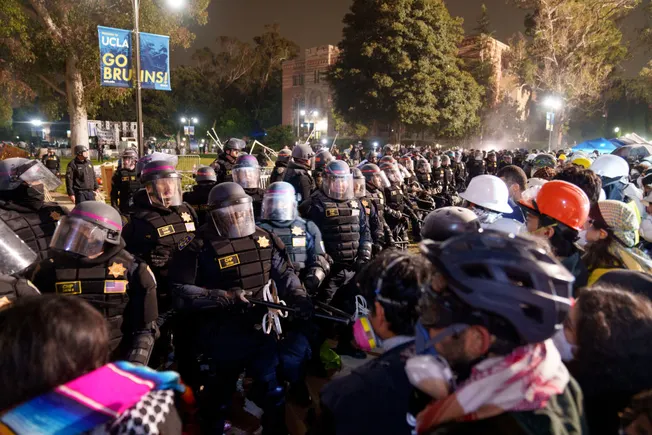
    University leaders allowed the encampment to remain for nearly a week, citing a need to balance safety with free speech protections. They ultimately asked the Los Angeles Police Department to clear the encampment following a violent night in which counterprotesters attempted to tear down the encampment’s barricades, launched fireworks into it and hit pro-Palestinian demonstrators with sticks and other objects. 

    The pro-Palestinian protesters at times fought back, though video footage from the night shows few instances of them initiating confrontations, according to reporting from The New York Times. When police arrived — hours after violence first broke out — they didn’t step in immediately. 

    According to the Justice Department, at least 11 complaints were filed with UCLA alleging that students experienced discrimination based on race, religion or national origin from encampment protesters. 

    The agency also cited a UCLA task force report that found some encampment protesters formed human blockades to stop people — including students wearing the Star of David or those who refused to denounce Zionism — from freely moving throughout Royce Quad. 

    Milliken noted in his statement that UCLA has taken several steps since then to tighten campus protest policies and combat antisemitism. The university instituted a systemwide ban on encampments and launched a campus initiative in March to fight antisemitism, including through training and an improved system for handling complaints. 

    UCLA also agreed last month to pay $6 million to settle a lawsuit brought by three Jewish students and a Jewish professor who alleged the university violated their civil rights by allowing the encampment protesters to impede their access to the campus. Over one-third of the settlement payment will go toward organizations that fight antisemitism, The Associated Press reported. 

    Meanwhile, the university is facing a separate lawsuit brought by about three dozen pro-Palestinian students, faculty and others who allege that UCLA’s leaders didn’t protect them from the counterprotesters and failed to uphold their right to free expression. The lawsuit also names the counterprotesters as defendants. 

    Their lawsuit says UCLA police merely “stood and watched” for hours while counterprotesters “ruthlessly attacked” the encampment demonstrators, alleging the group broke their bones, burned their eyes with chemicals, and hit them with metal rods and other weapons. 

    The next day, the LAPD and the California Highway Patrol cleared the encampment at the request of university leaders. According to the lawsuit, law enforcement hurled flashbangs, shot powerful kinetic impact projectiles at peoples’ heads and faces, and used excessive physical force against and falsely arrested students, faculty, and concerned community members.” 

    Police arrested over 200 people while clearing the encampment. Those detained faced “invasive searches, false arrests, sexual assaults, and prolonged detentions,” and hijab-wearers were forced to remove their head coverings “infringing on their religious practices,” the lawsuit alleged.

    The pro-Palestinian plaintiffs suing UCLA are seeking damages and for the judge to declare the clearing of the encampment illegal, among other measures.

    Source link