

Tag: neighborhood

  • The Experts in My Neighborhood – Teaching in Higher Ed

    The Experts in My Neighborhood – Teaching in Higher Ed

    This post is one of many, related to my participation in  Harold Jarche’s Personal Knowledge Mastery workshop.

    The topic of how expertise is no longer valued today is often discussed. I realize that I am walking through well-trodden pathways, as I bring it up in these reflections on experts today. In The Death of Expertise: The Campaign Against Established Knowledge and Why it Matters, Tom Nichols writes:

    These are dangerous times. Never have so many people had access to so much knowledge, and yet been so resistant to learning anything.

    In today’s post, I want to think less about the societal and educational concerns I have about the death of expertise and more about how I might continue to attempt to inculcate habits that can keep me from dying that same death, myself. Part of that practice involves finding and curating many experts to help shape my thinking, over time.

    PKM Roles from Harold Jarche

    For this topic, Jarche invites us to use a map of personal knowledge mastery (PKM) roles to determine where we currently reside and where we would like to go, in terms of our PKM practice. He offers this graphic as part of his Finding Perpetual Beta book:
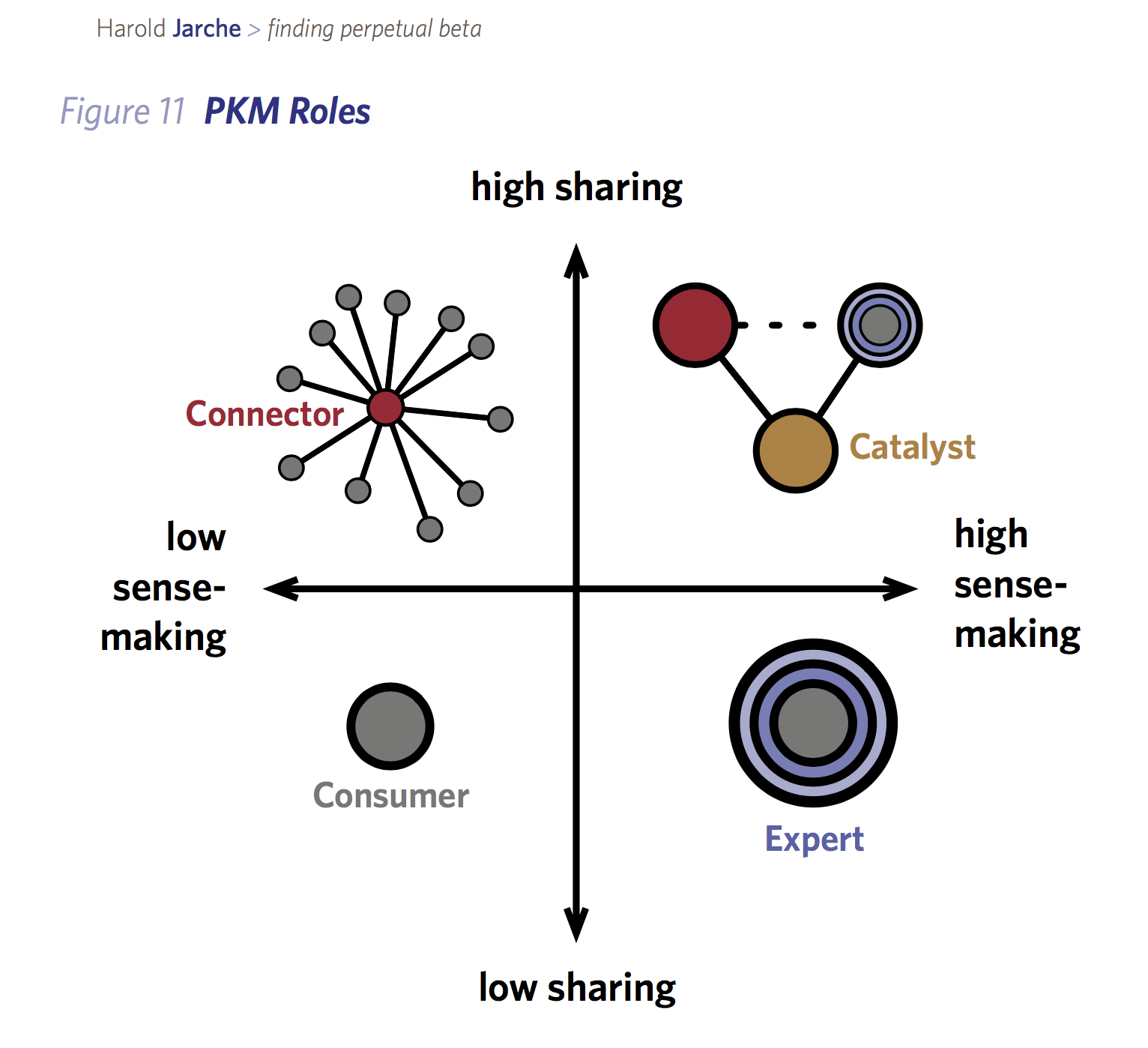
    On the Y axis, we can sort ourselves into doing high or low amounts of sharing. As I wrote previously, my likelihood of sharing is in direct relation to the topic I’m exploring. However, as Jarche recommended social bookmarking as one way of sharing, perhaps I was selling myself short when I categorized myself as not likely to share anything overly controversial. I have over 35 thousand digital bookmarks on Raindrop.io and add around 10-20 daily. However, I’m more likely to be categorized as highly visible sharing in terms of the Teaching in Higher Ed podcast and the topics I write about on the Teaching in Higher Ed blog.

    On the X axis, our activities are plotted on a continuum more toward high or low sense-making. A prior workshop participant of Jarche’s wrote:

    We must make SENSE of everything we find, and that includes prioritising–recognising what is useful now, what will be useful later, and what may not be useful.

    Given my propensity for saving gazillions of bookmarks and carefully tagging them for future use, combined with my streak of weekly podcast episodes airing since June of 2014, when it comes to teaching and learning, I’m doing a lot of sense-making on the regular.

    These are the (NEW) Experts in My Neighborhood

    Taking inspiration from Sesame Street’s People in Your Neighborhood and from Jarche’s activity related to experts, I offer the following notes on experts. When I searched for people within teaching and learning on Mastodon, I found that I was already following a lot of them. I decided to then look at who people I already follow are following:

    • Ethan Zuckerman – UMass Amherst, Global Voices, Berkman Klein Center. Formerly MIT Media Lab, Geekcorps, Tripod.com
    • Sarah T. Roberts, Ph.D. – Professor, researcher, writer, teacher. I care about content moderation, digital labor, the state of the world. I like animals and synthesizers and games. On the internet since 1993. Mac user since they came out. I like old computers and OSes. I love cooking. Siouxsie is my queen.
      • I was intrigued by her having written a content moderation book called Behind the Screen. I know enough about content moderation to know that I know pretty much nothing about content moderation.
      • She hasn’t posted in a long while, so I’m not sure how much I’ll regularly have ongoing opportunities to see what she’s currently exploring or otherwise working on

    Other Things I Noticed

    As I was exploring who people I follow are connected with on Mastodon, I noticed that you can have multiple pinned posts, unlike other social media I’ve used. Many people have an introduction post pinned to the top of their posts, yet also have other things they want to have front and center. One big advantage to Bluesky to me has been the prevalence of starter packs. The main Mastodon account mentioned an upcoming feature involving “packs” around twenty days ago, but said that they’re not sure what they’ll call the feature.

    Sometimes, scrolling through social media can be depressing. I decided that the next time I’m getting down on Mastodon, I should just check out what’s happening on the compostodon hashtag. It may be the most hopeful hashtag ever.

    The Biggest Delight From the Experience

    Another person who was new to me as an expert on Mastodon was JA Westenberg. According to JA Westenberg’s bio, Joan is a tech writer, angel investor, CMO, Founder. A succinct goal is also included on the about page of JoanWestenberg.com:

    My goal: to think in public.

    As I was winding down my time doing some sensemaking related to experts, I came across a video from Westenberg that was eerily similar to what Jarche has been stressing about us making PKM a practice. I can’t retrace my steps for how I came across Joan’s video on Mastodon, but a video thumbnail quickly caught my eye. Why You Should Write Every Day (Even if You’re Not a Writer) captured my imagination immediately, as I started watching. In addition to the video, there’s a written article of the same title posted, as well.

    As I continue to pursue learning through the PKM workshop, I’m blogging more frequently than I may ever have (at least in the last decade for sure). Reading through Joan’s reactions to the excuses we make when we don’t commit to writing resonate hard. We think we don’t have time. How about realizing we’re not writing War and Peace, Joan teases, gently. Too many of us get the stinking thinking that we don’t have anything good to say or that this comes naturally to people who are more talented and articulate than we are. Joan writes:

    Writing every day is less about becoming someone who writes, and more about becoming someone who thinks.

    Before I conclude this post, I want to be sure to stress the importance I’m gleaning of not thinking of individual experts as the way to practice PKM. Rather, it is through engaging with a community of experts that we will experience the deepest learning. A.J. Jacobs stresses that we should heed his advice:

    Thou shalt pay heed to experts (plural) but be skeptical of any one expert (singular)

    By cultivating many experts whose potential disagreements may help us cultivate a more nuanced perspective on complex topics. When we seek to learn in the complex domain, the importance of intentionality, intellectual humility, and curiosity becomes even more crucial. Having access to a network of experts helps us navigate complexity more effectively.

    Source link

  • Snitch hotlines for ‘offensive’ speech were a nightmare on campus — and now they’re coming to a neighborhood near you

    Snitch hotlines for ‘offensive’ speech were a nightmare on campus — and now they’re coming to a neighborhood near you

    We know the term “Orwellian” gets thrown around a lot these days. But if a government entity dedicated to investigating and even reeducating Americans for protected speech doesn’t deserve the label, nothing does.

    This step towards the Stasi isn’t hypothetical, either. It’s real. The governing bodies in question are called bias reporting systems, and the odds are they’re already chilling free expression on a campus near you. What’s worse, they aren’t staying there — now municipalities and states are using them, too.

    In this explainer, we’ll break down what bias reporting systems are, how they’ve spread beyond campus, and why they’re a threat to free speech.

    What are bias reporting systems?

    If you’ve been on campus in the last decade, you’ve likely heard of bias reporting systems — or, as they’re sometimes called, bias response teams. Their structure and terminology vary, but FIRE defines a campus bias reporting system as any system that provides:

    1. a formal or explicit process for or solicitation of
    2. reports from students, faculty, staff, or the community
    3. concerning offensive conduct or speech that is protected by the First Amendment or principles of expressive or academic freedom.

    Bias reporting systems generally solicit reports of bias against identity characteristics widely found in anti-discrimination laws. Western Washington University, for example, defines a “bias incident” as “language or an action that demonstrates bias against an individual or group of people based on actual or perceived race, color, creed, religion, national origin, sex, gender identity or expression, disability, sexual orientation, age, or veteran status.” Some systems also invite reports of bias against traits like “intellectual perspective,” “political expression,” and “political belief,” or have a catch-all provision for any other allegedly biased speech.

    Many colleges have bias response teams that consist not only of administrators but law enforcement. They often investigate complaints and summon accused students and faculty to meetings.

    The ability to speak freely is core to our democracy. Any system or protocol that stifles or inhibits free expression is antithetical to the principles and ideals of our institutions of higher education and our republic. 

    You might be wondering, “Don’t civil rights laws already cover this sort of thing?” Well, not quite. Bias reporting systems cover way more expressive ground than civil rights laws do, which puts these systems at odds with First Amendment protections. They generally define “bias” in such broad or vague terms that it could be applied to basically anything the complainant doesn’t like, including protected speech. This is doubly so when a school includes that vague and subjective word “hate” as another form of language or behavior worth reporting.

    That’s a problem at public colleges, which are bound by the First Amendment, and also at private colleges that voluntarily adopt First Amendment-like standards. Bias reporting systems completely ignore the fact that “hate speech” has no legal definition, and that unless a given expression clearly falls into one of the clearly-defined categories of unprotected speech, like true threats or incitement to immediate violence, it is almost certainly protected by the First Amendment. This remains so regardless of how anyone might feel about the speech itself.

    Bias Response Team Report 2017

    Reports

    The posture taken by many Bias Response Teams is likely to create profound risks to freedom of expression and academic freedom on campus.


    Read More

    These initiatives incentivize and in many cases encourage people to report each other for disfavored expression. As you can imagine, these systems often lead to unconstitutional infringements on protected student and faculty speech and chill expression on campus.

    For example, after the University of California, San Diego received bias incident reports about a student humor publication that satirized “safe spaces,” administrators asked the university’s lawyer to “think creatively” about how to address the newspaper, which they felt “crosse[d] the ‘free speech’ line.” And at Connecticut College, pro-Palestinian students were reported for flyers mimicking Israeli eviction notices to Palestinians, prompting an investigation by a dean.

    These are just a couple of instances where bias reporting systems have crossed the line. Sadly, there are plenty more, spanning FIRE’s research and commentary going back as far as 2016 — and none of them are good news.

    Sound Orwellian enough for you yet? Wait until you hear how bias reporting systems work off campus.

    Bias reporting systems have graduated from campus into everyday life

    Exporting campus bias reporting systems to wider society is a disastrous idea. No state should be employing de facto speech police. But of course, that hasn’t stopped state and city governments from trying.

    Bias reporting systems have been popping up in one form or another across more than a dozen state and city municipalities in the last four years, usually consisting of an online portal or telephone number where citizens are encouraged to submit reports.

    If you’re thinking this is just like the hate crime hotlines that many states have had for years, there is one important difference: namely, the word “crime.” While the new bias reporting systems will similarly accept reports of criminal acts, they also actively solicit reports of speech and behavior that are not only not crimes, but also First Amendment-protected expression.

    They know this, too.

    Vermont state police protocol, for instance, describes the information it compiles as being on “biased but protected speech.” This raises the obvious question of why the police are concerning themselves with Americans lawfully exercising their fundamental rights, and opens the door to police responses that violate those rights.

    Wherever they’ve popped up, these bias reporting systems have been bad news. Washington Free Beacon journalist Aaron Sibarium’s research has turned up a number of alarming examples. In Oregon, citizens can report “offensive ‘jokes’” and “imitating someone’s cultural norm or practice.”

    Meanwhile, in Maryland, the attorney general’s office states on its website that “people who engage in bias incidents may eventually escalate into criminal behavior,” which is why “Maryland law enforcement agencies are required by law to record and report data on both hate crimes and bias incidents.” But these speculative concerns do not justify the chilling effect bias reporting systems create. Not only do these systems solicit complaints about protected speech, they also cast an alarmingly wide net. It’s hard to believe, for instance, that many “offensive jokes” are reliable signs of future criminal activity.

    At this point you’d be forgiven for thinking that “Orwellian” is an understatement.

    But that’s not the worst of it. In Philadelphia — home of FIRE, the Liberty Bell, and the Constitution — authorities fielding “hate incidents” can now ask for exact addresses and various identifying details about the alleged offending party, including their names. According to Sibarium, city officials will in some cases “contact those accused of bias and request that they attend sensitivity training.”

    You heard that right. If you’re reported for a “non-criminal bias incident” in the city of Philadelphia, the city may request that you take a course meant to teach you the error of your ways. “If it is not a crime, we sometimes contact the offending party and try to do training so that it doesn’t happen again,” Saterria Kersey, a spokeswoman for the Philadelphia Commission on Human Relations, told Sibarium.

    The training is voluntary, but it reflects an unsettling level of government interference in the thoughts and opinions of the public.

    At this point you’d be forgiven for thinking that “Orwellian” is an understatement.

    Bias reporting systems are a threat to free speech on and off campus

    Thankfully, there has been some considerable pushback on bias reporting systems — though not entirely successful. Washington, for example, introduced a bill to create a statewide bias reporting system, but it failed to advance out of the Senate Ways and Means committee. However, a new version of the bill passed in March of 2024, and Washington is now set to establish a bias reporting system this year.

    The threat remains real, and the consequences of these speech-chilling initiatives are further-reaching than it might seem at first glance.

    On campus, the mere existence of bias reporting systems threatens one of the purposes of higher education, if not the purpose: the free exchange of ideas. Some courts have recognized that bias reporting systems may chill protected speech to such a degree that they violate the First Amendment.

    Bias reporting systems fundamentally undermine the First Amendment rights of not just students and faculty, but also ordinary citizens.

    The state-level reporting systems raise similar First Amendment issues — especially when law enforcement is involved. Like their campus counterparts, the state systems use expansive definitions of “bias” and “hate” that could encompass a vast range of protected expression, including speech on social or political issues.

    However, unconstitutionality isn’t the only concern. Even a bias reporting system that stays within constitutional bounds can deter people from freely expressing their thoughts and opinions. If they are afraid that the state will investigate them or place them in a government database just for saying something that offended another person, people will understandably hold their tongues and suppress their own voices. Moreover, the lack of clarity around what some states actually do with the reports they collect is itself chilling.

    The ability to speak freely is core to our democracy. Any system or protocol that stifles or inhibits free expression is antithetical to the principles and ideals of our institutions of higher education and our republic. In both word and deed, bias reporting systems fundamentally undermine these principles — and now seriously threaten the First Amendment rights of not just students and faculty, but also ordinary citizens.

    Source link