Tag: Neoliberalism

  • Neoliberalism and the Global College Meltdown

    Neoliberalism and the Global College Meltdown

    Over the past four decades, neoliberalism has reshaped higher education into a market-driven enterprise, producing what can only be described as a global College Meltdown. Once envisioned as a public good—a tool for civic empowerment, social mobility, and national progress—higher education in the United States, the United Kingdom, and China has been transformed into a competitive market system defined by privatization, debt, and disillusionment.

    The United States: From Public Good to Profit Engine

    Nowhere has neoliberal ideology had a more devastating effect on higher education than in the United States. Beginning in the 1980s, with the Reagan administration’s cuts to federal grants and the expansion of student loans, higher education funding shifted from public investment to individual burden. Universities adopted corporate governance models, hired armies of administrators, and marketed education as a private commodity promising personal enrichment rather than collective advancement.

    The results are visible everywhere: tuition inflation, student debt exceeding $1.7 trillion, and the proliferation of predatory for-profit colleges. Elite universities transformed into financial behemoths, hoarding endowments while relying on contingent faculty. Meanwhile, working-class and minority students were lured into debt traps by institutions that promised upward mobility but delivered unemployment and despair.

    The U.S. College Meltdown—a term that describes the system’s moral and financial collapse—is a direct consequence of neoliberal policies: deregulation, privatization, and austerity disguised as efficiency. The profit motive replaced the public mission, and the casualties include students, adjuncts, and the ideal of education as a democratic right.

    The United Kingdom: Marketization and Managerialism

    The United Kingdom followed a similar trajectory under Margaret Thatcher and her successors. The introduction of tuition fees in 1998 and their tripling in 2012 marked the formal triumph of neoliberal logic over public investment. British universities became quasi-corporate entities, obsessed with league tables, branding, and global rankings.

    The result has been mounting student debt, declining staff morale, and a hollowing out of intellectual life. Faculty strikes over pensions and pay disparities underscore a deeper crisis of purpose. Universities now function as rent-seeking landlords—building luxury dorms for international students while cutting humanities departments. The logic of “student-as-customer” has reduced education to a transaction, and accountability has been redefined to mean profit margin rather than social contribution.

    The UK’s College Meltdown mirrors that of the U.S.—a story of financialization, precarious labor, and the erosion of public trust.

    China: Neoliberalism with Authoritarian Characteristics

    At first glance, China seems to defy the Western College Meltdown. Its universities have expanded rapidly, producing millions of graduates and investing heavily in research. But beneath this apparent success lies a deeply neoliberal structure embedded in an authoritarian framework.

    Since the 1990s, China’s higher education system has embraced competition, rankings, and market incentives. Universities compete for prestige and funding; families invest heavily in private tutoring and overseas degrees; and graduates face a saturated labor market. The result is mounting anxiety and unemployment among young people—known online as the “lying flat” generation, disillusioned with promises of meritocratic success.

    The Chinese model fuses state control with neoliberal marketization. Education serves as both an instrument of national power and a mechanism of social stratification. In this sense, China’s version of the College Meltdown reflects a global truth: the commodification of education leads to alienation, regardless of political system.

    A Global System in Crisis

    Whether in Washington, London, or Beijing, the pattern is strikingly similar. Neoliberalism treats education as an investment in human capital, reducing learning to a financial calculation. Universities compete like corporations; students borrow like consumers; and knowledge becomes a tool of capital accumulation rather than liberation.

    This convergence of economic and ideological forces has created an unsustainable higher education bubble—overpriced, overcredentialized, and underdelivering. Across continents, graduates face debt, underemployment, and despair, while universities chase rankings and revenue streams instead of justice and truth.

    Toward a Post-Neoliberal Education

    Reversing the College Meltdown requires more than reform; it demands a new philosophy. Public universities must reclaim their civic mission. Education must once again be understood as a human right, not a private investment. Debt forgiveness, reinvestment in teaching, and democratic governance are essential first steps.

    Neoliberalism’s greatest illusion was that markets could produce wisdom. The College Meltdown proves the opposite: when education serves profit instead of people, it consumes itself from within.


    Sources:

    • Wendy Brown, Undoing the Demos (2015)

    • David Harvey, A Brief History of Neoliberalism (2005)

    • Tressie McMillan Cottom, Lower Ed (2017)

    • The Higher Education Inquirer archives on the U.S. College Meltdown

    • BBC, “University staff strikes and student debt crisis,” 2024

    • Caixin, “China’s youth unemployment and education anxiety,” 2023
    Source link

  • How Neoliberalism Haunts Our Lives: 24/7/365

    How Neoliberalism Haunts Our Lives: 24/7/365

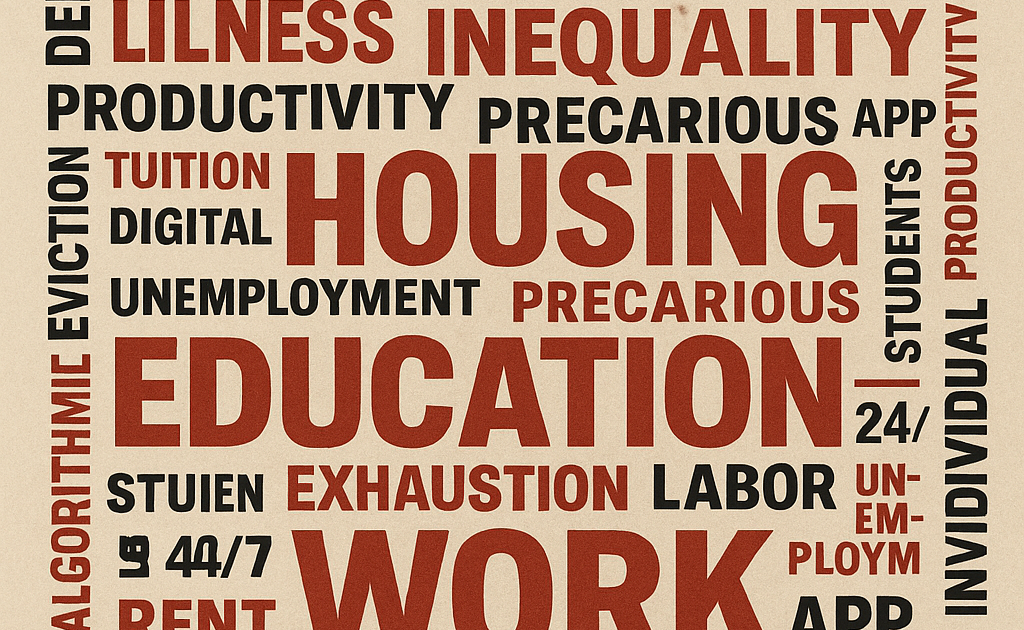
    Neoliberalism isn’t just an economic theory or a dry policy framework. It’s a lived reality that operates around the clock, shaping our lives in ways many people don’t fully see. Neoliberalism tells us that markets solve everything, that individual responsibility trumps social solidarity, and that human worth is best measured by productivity, consumption, and credentialing. Its presence is constant—at work, in education, in healthcare, in housing, even in our relationships.

    This is not a new critique. But as the 21st century drags on and late capitalism becomes more extractive, predatory, and digitally surveilled, the impacts of neoliberal ideology have intensified. For the working class, for students, for adjuncts, for debtors, for renters, and for the chronically ill, neoliberalism is not an abstraction—it is a system of permanent exhaustion.


    The Day Begins: Sleep-Deprived and Algorithmically Watched

    The neoliberal day begins before the alarm rings. If you’re poor, you may be sleeping in your car or waking up in a crowded home. If you’re middle-class, the first thing you see is likely your phone, already feeding you metrics about your body (sleep scores, heart rate, missed messages). Neoliberal logic tells us our time must be optimized, even our rest must be productive.

    Gig workers check their apps to see if they’ll get enough rides or orders to survive. Others log into remote jobs monitored by keystroke trackers, digital timesheets, or AI productivity tools. Control is constant, and surveillance is internalized: we discipline ourselves with planners, metrics, reminders, shame.


    Education: Credentials Over Knowledge

    For students, neoliberal education is a high-cost simulation of opportunity. Degrees are sold as investments in “human capital,” with ever-rising tuition and debt. Public funding is replaced by predatory loans, branding consultants, and privatized ed-tech platforms. The curriculum is shaped by market demand, not civic responsibility. Liberal arts are gutted, and adjuncts are paid poverty wages while administrators balloon in number.

    The university, once imagined as a space for critical thinking and collective inquiry, is now a debt-fueled credential mill—an HR pipeline for corporations, a subscription model of social mobility that rarely delivers.


    Healthcare: A Business of Despair

    Neoliberalism doesn’t take a break when you get sick. In fact, your illness becomes a profit center. In the U.S., the healthcare system is a financial trap. Insurance is often tied to employment; losing your job means losing your access to care. Big Pharma, hospital chains, and insurance conglomerates operate under the logic of maximizing shareholder value—not public health.

    Even mental health is commodified. Wellness apps, “self-care” products, and Instagram therapy push the idea that individual solutions will fix systemic problems. Suffering is reframed as personal failure.


    Housing: A Market, Not a Human Right

    Housing insecurity is one of neoliberalism’s clearest failures. Real estate speculation, gentrification, and the financialization of housing have made shelter a luxury good. Renters face skyrocketing costs and eviction threats, while homes sit vacant as investment vehicles.

    Public housing is stigmatized and underfunded. Homelessness becomes a criminal issue instead of a humanitarian one. You’re told to “pull yourself up” while the ladder is systematically removed.


    Work and Labor: You’re Always On

    The 9-to-5 is no longer the norm. Neoliberal work is either hyper-precarious or all-consuming. The gig economy pretends to offer flexibility, but in practice it strips away rights, benefits, and security. Professional workers face unpaid overtime, side hustles, and an expectation of constant availability. Labor laws lag decades behind. Union-busting is normalized.

    At the same time, those without work are treated with suspicion. Unemployment, disability, and even retirement are framed as moral failings or burdens on the system.


    Nightfall: No Rest for the Weary

    At night, the apps don’t sleep. Your data is still harvested. Your bank is still charging fees. Your landlord’s algorithm is still adjusting rent. Your student loan is still accruing interest. Your body, overstressed and under-cared-for, begins to break down.

    Even dreams aren’t free: entertainment has been colonized by neoliberal culture, feeding you aspirational lifestyles and endless content to dull your exhaustion. Everything is monetized. Everything is a subscription.


    Resistance in the Cracks

    Despite its pervasiveness, neoliberalism is not invincible. People are resisting in small and large ways—through union organizing, mutual aid, alternative media, degrowth activism, and radical pedagogy. These aren’t just political choices; they are survival strategies.

    But for resistance to grow, we must name the problem clearly. Neoliberalism is not just a phase of capitalism—it’s an ideology embedded in every institution and mediated by every platform. It isolates us, overworks us, and extracts from us while pretending to offer freedom and choice.


    The 24/7/365 Trap

    We live in neoliberalism’s world, but we don’t have to live by its rules. That starts with refusing its myths: that poverty is personal failure, that education is a private good, that health must be earned, that the market is sacred.

    As long as neoliberalism governs our lives without challenge, inequality will deepen and democracy will continue to erode. The question isn’t whether we can afford to abandon neoliberalism—the question is whether we can survive if we don’t.


    Sources:

    • Wendy Brown, Undoing the Demos

    • David Harvey, A Brief History of Neoliberalism

    • Sarah Jaffe, Work Won’t Love You Back

    • Marion Fourcade and Kieran Healy, “Seeing Like a Market”

    • Astra Taylor, The Age of Insecurity

    • Michael Hudson, The Destiny of Civilization

    • Maurizio Lazzarato, The Making of the Indebted Man

    Source link

  • Working-Class Wisdom in the Age of Neoliberalism and Trump

    Working-Class Wisdom in the Age of Neoliberalism and Trump

    In the United States of 2025—where neoliberal capitalism and creeping authoritarianism grind down the human spirit—there’s an urgent need for a way of thinking, surviving, and resisting that doesn’t come from think tanks or corporate wellness plans. Street Psychology is that way.

    This idea isn’t new. It’s an outbreak from earlier projects like Street Sociologist (2009–2012) and American Injustice (2009–2013), digital spaces that chronicled working-class survival under austerity, war, mass incarceration, student loan predation, and the Great Recession. Those projects documented both despair and resistance—voices from the margins that understood the system was not broken but operating as designed. Street Psychology is the next step in that lineage. It names the psychic toll of exploitation and dares to offer tools for survival drawn not from institutions, but from the people themselves.

    Street Psychology isn’t a licensed profession or clinical method. It’s a bottom-up philosophy. A way of being that honors grit, grief, memory, and movement. It draws from Black Psychology, Radical Social Work, and the unspoken survival strategies passed down through generations—especially those of the poor, the working class, the dispossessed.

    It tells us: you’re not crazy. You’re living in a society that has normalized cruelty.


    Life Under Pressure

    In today’s America, working people face a perfect storm. Medicaid cuts, climate shocks, unpayable debt, and housing crises are daily facts of life. The Trump regime, emboldened by a Supreme Court that erodes checks and balances, offers little more than political theater and corporate tax breaks. “Law and order” is back—but so are vigilante violence and state repression. In this environment, working-class people are expected to carry on as if nothing is wrong—grinding away at gig jobs, navigating broken transit systems, shouldering invisible pain.

    Street Psychology offers no false comfort. It teaches that burnout, anxiety, and despair are not personal failures—they are rational reactions to a system that exploits and isolates. It offers a politics of honesty.

    It reminds us that mental health cannot be separated from rent, food, dignity, and debt.


    Lessons from Horror and Triumph

    Street Psychology is grounded in history—not the history of presidents and generals, but the people’s history of how folks made it through.

    During the Great Depression, when one in four Americans was unemployed, it was mutual aid, union organizing, and government pressure from below that helped form the New Deal—not just FDR’s goodwill. Neighbors shared food. Workers seized factories. Families survived on ingenuity and grit. Street Psychology carries that memory.

    During World War II, ordinary people faced rations, displacement, and death on an unprecedented scale. But they also built community resilience. Black Americans moved north and west in the Great Migration, seeking both work and dignity. Women entered the workforce by the millions—not for empowerment branding, but to survive. Trauma was everywhere, but so was collective purpose. Street Psychology remembers that duality.

    And in the COVID-19 pandemic, we saw the brutal convergence of economic inequality, medical neglect, and state failure. But we also saw mutual aid networks rise overnight. Grocery workers, nurses, delivery drivers, and custodians became the front line—not billionaires or generals. People created community fridges, distributed masks, and organized rent strikes. Even amid mass death and disinformation, something deeply human survived. Street Psychology draws its oxygen from these moments.

    It says: we’ve been through hell before—and we’ve learned how to survive together.


    Radical Roots and Collective Healing

    Street Psychology stands on the shoulders of Black radical thinkers like Dr. Na’im Akbar and Dr. Wade Nobles, who taught that psychological liberation requires historical truth and cultural self-determination. It borrows from the Radical Social Worker tradition that insists depression and addiction often emerge from exploitation, not deficiency.

    It echoes the voices of those doing hard, dirty, “bullshit jobs,” as David Graeber called them—people whose work is exhausting, precarious, and spiritually deadening. It respects those whose minds and bodies are tired because they’ve been used up. And it says plainly: this is not your fault.

    Healing begins with naming the madness.


    A People’s Practice

    Street Psychology thrives outside institutions. It happens in union halls, kitchens, church basements, food pantries, WhatsApp threads. It takes the form of eye contact, a ride to work, a bag of groceries, a story told without shame. It asks us not to fix ourselves to fit a broken world—but to remember we are not alone in our pain or our power.

    It teaches that even in a world of distraction and despair, we can practice presence and solidarity. We can re-learn how to listen, how to mourn, how to laugh in defiance.

    This psychology is not neutral. It does not pretend to be apolitical. It stands with those being crushed—by the debt collectors, the landlords, the ICE raids, the fascists in suits. It says: you matter. Your struggle matters. And you’re not the only one carrying this weight.


    A Call to Reclaim Our Minds

    Street Psychology is not a cure. It is not a self-help manual. It is a collective reckoning. A refusal to be shamed into silence or fragmented into diagnosis. It is the unlicensed, unpolished wisdom of people who’ve lived through hell and still show up for each other.

    In the age of Trump, AI surveillance, climate breakdown, and economic betrayal, this might be our best chance: to recover the human, to restore the political, and to reclaim the psychological as a shared terrain.

    Let’s build a new commons—not just of resources, but of understanding. Let’s build a psychology that is street-smart, justice-rooted, and history-aware.


    Sources & Influences:

    • Akbar, Na’im. Breaking the Chains of Psychological Slavery

    • Nobles, Wade. Seeking the Sakhu

    • Graeber, David. Bullshit Jobs

    • Paulo Freire. Pedagogy of the Oppressed

    • Radical Social Worker Collective

    • Mutual Aid Disaster Relief

    • American Injustice (2009–2013) and Street Sociologist (2009–2012) blog archives

    • Historical memory from the Great Depression, WWII home front, and COVID-19 mutual aid networks

    • People’s CDC, APA, KFF data on structural causes of psychological distress

    Street Psychology lives in those who refuse to forget—and who refuse to give up. If you or your community are practicing this in any form, we want to hear from you.

    Source link