Tag: New Zealand

  • Study visa applications to NZ dip, approval rate jumps nearly 7%

    Study visa applications to NZ dip, approval rate jumps nearly 7%

    According to data highlighted by Immigration New Zealand (INZ), the government agency responsible for managing the country’s immigration system, the first 10 months of 2025 saw 55,251 study visa applications, down from 58,361 in the same period last year.

    However, approval rates have risen sharply. In 2024, INZ approved 42,724 of 58,361 applications (81.5%) and declined 9,161 (17.5%). Meanwhile, in 2025, despite fewer applications at 55,251, approvals rose to 43,203 (88.2%) with 5,317 declined (10.9%).

    NZ sets itself apart from other key study destinations

    Even as major anglophone study destinations take a cautious approach to international education policy, New Zealand is aiming to be an outlier in the market.

    The country is looking to boost international student enrolments from 83,700 to 119,000 by 2034 and double the sector’s value to NZD$7.2 billion (GBP £3.2bn) under the recently launched International Education Going for Growth plan.

    This month, new rules came into effect allowing eligible international tertiary and secondary students with visas from November 3 to work up to 25 hours a week, up from 20, while a new short-term work visa for some vocational graduates is also expected to be introduced soon.

    “As part of the International Education Going for Growth Plan, changes were announced to immigration settings to support sustainable growth and enhance New Zealand’s appeal as a study destination. These changes aim to maintain education quality while managing immigration risk,” Celia Coombes, director of visas for INZ, told The PIE.

    “Immigration New Zealand (INZ) and Education New Zealand (ENZ) work in close partnership to achieve these goals.”

    We have more students applying for Pathway Visas year on year, which means more visas granted for longer periods, and less ‘year by year’ applications
    Celia Coombes, Immigration New Zealand

    Why the drop in study visa applications?

    While study visa approval rates have skyrocketed over the past year — a stark contrast to the Covid period, when universities across New Zealand faced massive revenue losses owing to declining numbers — stakeholders point to a mix of factors behind the drop in new applications.

    “There has been an increase in approvals, but overall, a slight decrease in the number of students applying for a visa. However, interest in New Zealand continues to grow,” stated Coombes, who added that the number of individuals holding a valid study visa rose to 58,192 in August 2025, up from 45,512 a year earlier.

    “We have more students applying for Pathway Visas year on year, which means more visas granted for longer periods, and less ‘year by year’ applications.”

    While multi-year pathway visas can cover a full planned study path, reducing the need for repeated applications, Richard Kensington, an NZ-based international education consultant, says refinements could make the route more effective in attracting international students.

    “The Pathway Visa, introduced nearly a decade ago as a trial, has never been fully expanded. Although reviews are complete and the scheme is set to become permanent, no additional providers have been given access,” stated Kensington.

    “Simple refinements — such as allowing pathways to a broad university degree rather than a specific named programme — would encourage more students to utilise this route.”

    The drop could also be linked to the underdeveloped school sector and the slower recovery of New Zealand’s vocational education sector, as noted by Kensington.

    “The school sector remains one of New Zealand’s most untapped international education markets. Demand is growing, especially from families where a parent wishes to accompany the student. The Guardian Parent Visa makes that a viable option,” stated Kensington.

    “Vocational education hasn’t rebounded in the same way. The loss of work rights for sub-degree diplomas has significantly reduced demand from traditional migration markets.”

    New Zealand’s vocational education woes

    Just this year, the New Zealand government announced the disestablishment of Te Pūkenga, the country’s largest vocational education provider, formed through the merger of 16 Institutes of Technology and Polytechnics.

    It is being replaced by 10 standalone polytechnics, following concerns that the model had become too costly and centralised.

    “Te Pūkenga’s rise and fall created real confusion offshore. With standalone polytechnics returning, we should see greater stability from 2026 onwards,” Kensington added.

    “Many polytechnics are now relying on degree and master’s programmes, putting them in more direct competition with universities.”

    Applications fall in China, climb in India

    As per data shared by INZ on decided applications across both 2024 and 2025 — including on ones submitted in earlier years — countries like India (+2.7%), Nepal (+26.8%), Germany (+5.2%), and the Philippines (+7.8%) have seen growth in the number of study visas approved.

    Meanwhile, many East and Southeast Asian markets have recorded year-on-year declines, most notably the largest sending market, China, which dropped by 9.9%.

    The data shows that while 16,568 study visas were approved for China in January–October 2024, this fell to 14,929 in 2025 though it remains the largest source country.

    Other markets such as Japan (-9.7%), South Korea ( -24.8%), and Thailand (-33.7%) also saw significant declines.

    According to Frank Xing, director of marketing and operations at Novo Education Consulting, the slowdown from China is clear, with weaker student interest reflected in both their enquiries and feedback from partners, and echoed by some New Zealand institutions.

    “It’s a mixed picture — a few schools, particularly in the secondary sector, are still doing well, but many providers are starting to feel the impact,” stated Xing, who believes several factors are driving the slowdown.

    “The first is the weaker Chinese economy — many families have been affected by job losses or lower business income. In the past, property assets often helped families fund overseas study, but the real estate downturn has reduced that flexibility,” he added, also noting New Zealand’s own unemployment challenges and competition from lower-cost destinations.

    “We’ve actually seen some students abandon their New Zealand study plans or switch to more affordable destinations such as Malaysia or parts of Europe.”

    According to Xing, while China remains one of New Zealand schools’ strongest markets, this could change as Chinese families place greater emphasis on career outcomes — an area where New Zealand’s slower job market remains a challenge.

    He added that New Zealand’s role as the 2025 Country of Honour at China’s premier education expo could help raise awareness among prospective students.

    False applications remain a major concern

    For Education New Zealand and INZ, the more immediate challenge now lies in addressing fraudulent applications, according to Coombes.

    “New Zealand sees a lot of false financial documents. To address this and help ensure students have the money they need to live and study in New Zealand, we are improving processes to maintain integrity and streamline processing,” stated Coombes.

    “This includes expanding the Funds Transfer Scheme, where students deposit their living costs in New Zealand, and they are released monthly.”

    According to Kensington, some agencies across South Asia and likely parts of Africa, where New Zealand has limited representation may not meet required standards, creating challenges. However, he believes improved processing is reducing the impact.

    “INZ only accepts financial evidence from specific banks in some jurisdictions. Student loans must be secured; unsecured loans aren’t accepted even from major banks,” stated Kensington.

    “It’s hard to say whether fraud is increasing, but the rise in high-quality applications means INZ can process many files quickly and devote more time to forensic checks where needed.”

    Source link

  • NZ warns against exploitation as working hours for int’l students rise

    NZ warns against exploitation as working hours for int’l students rise

    As part of its plan to grow the international education sector — which includes doubling its contribution to $7.2 billion and increasing international enrolments to 119,000 by 2034 — New Zealand has introduced new immigration changes.

    The changes extend in-study work rights to all tertiary students on approved exchange or study abroad programs and clarify that most students who change providers or lower their study level will need a new visa.

    Apart from these, eligible tertiary students in post-school education, such as universities and polytechnics, and secondary students in Years 12-13 can now work up to 25 hours a week. Secondary students will continue to require parental and school approval for in-study work.

    The increased limit applies to all new visas granted from November 3, even if the application was submitted earlier.

    Moreover, students already holding visas with a 20-hour work limit will need to reapply, either through a variation of conditions or by obtaining a new study visa, to access the increased allowance.

    Stakeholders have noted the importance of making sure that the relaxed rules do not result in students being exploited for low-paid or exploitative work.

    The increase to in-study work rights comes at a time when New Zealand has 40,987 study visa holders eligible to work, with 29,790 of those visas expiring on or before 31 March 2026 and 11,197 after.

    The New Zealand government says the change will make the country “more competitive globally” and improve the overall student experience, at a time when international student satisfaction remains strong at 87%.

    “International students make a significant contribution to the economy, with each student spending around $45,000 on average in 2024 – supporting local businesses, tourism, and job creation,” Jeannie Melville, deputy COO for immigration at the Ministry of Business, Innovation and Employment, told The PIE News.

    “As part of the International Education Going for Growth Plan, changes were announced to immigration settings to support sustainable growth and enhance New Zealand’s appeal as a study destination. These changes aim to maintain education quality while managing immigration risk.”

    International students have the same minimum employment rights as any other worker, including being paid at least the minimum wage and working within visa conditions
    Jeannie Melville, Ministry of Business, Innovation and Employment

    The rise in working hours is a “confidence signal” that will help with living costs and shows that New Zealand is welcoming, according to Frank Xing, director of marketing and operations at Auckland-based Novo Education Consulting.

    But authorities are still expected to keep a close eye on the changes amid past concerns of international students working long hours for below-minimum wages, being denied sick leave, and struggling to find jobs.

    The New Zealand government has taken steps to address workplace exploitation in the past, including launching the multilingual Introduction to Your Employment Rights module to help migrant workers understand their agreements and rights.

    “International students have the same minimum employment rights as any other worker, including being paid at least the minimum wage and working within visa conditions. Exploitation, such as underpayment or forcing excessive hours, is a criminal offence under the Immigration Act and we do act against employers who exploit workers.

    “Immigration New Zealand (INZ) has strengthened protections for migrant workers, including the Worker Protection Act that took effect in January 2024,” Melville said, adding that this allows authorities to issue infringement notices, publish the names of non-compliant employers, and stop them from supporting migrant visa applications for a period.

    “We have also tightened visa settings and improved monitoring to reduce exploitation risks.”

    According to ex and current international students The PIE spoke with, employers often pushed them to work beyond the weekly hour limit, and while students tried to balance extra hours by reducing them later or carrying them into holiday periods, any overtime during term time was usually unpaid until the breaks.

    Some students also alleged mistreatment or harsh behaviour at their workplaces, though experiences varied by employer.

    Despite these concerns, Melville noted that students can report any instances of exploitation by calling Crime Stoppers on 0800 555 111, which she described as “a confidential and safe way to make a report”.

    According to Xing, the changes in working hours don’t replace core factors like academic fit, career pathways, and post-study visas that drive student applications but they will help international students avoid situations where they can be taken advantage of.

    “Extending legal working hours should also reduce the temptation to accept low-paid, cash-in-hand jobs. Of course, vigilance is still needed,” he said.

    He called for better student education on their employment rights, as well as stronger penalties for employers who break the rules and easier reporting channels for students.

    “It’s early days since the rule took effect – around 10 days – but we’re already seeing more enquiries mentioning ‘25 hours’ alongside programme and city choice, especially as other destinations tighten settings,” Xing added, noting that current international students have also requested help from their Licensed Immigration Advisers to apply for a variation of conditions to move from 20 to 25 hours.

    It’s early days since the rule took effect – around 10 days – but we’re already seeing more enquiries mentioning ‘25 hours’ alongside programme and city choice, especially as other destinations tighten settings
    Frank Xing, Novo Education Consulting

    The increase to 25 hours per week isn’t limited to students. New Zealand has also extended part-time work rights to dependent child visitor visa holders and skilled Migrant Category Interim visa holders.

    The move comes as a record number of New Zealanders leave amid a weakening economy, with relaxed migrant work rules seen as a way to fill workforce gaps and support students’ transition into future employment.

    “In certain professions, like healthcare, the number of hours of relevant work experience is a very important factor – it can directly affect your employability and career progression,” stated Vijeta Kanwar, director of operations, New Zealand Gateway.

    “For example, some job vacancies specify that a candidate must have 100 or even 500 hours of work experience. In that context, gaining five extra hours a week over a year can significantly increase the total experience a student has, enhancing their opportunities when pursuing post-study work.”

    “We’ve seen more enthusiasm from students, especially those looking to gain international work experience. They’re quite excited because, in many professions, the number of hours of work experience you gain, especially if it’s linked to your intended career, has huge importance.”

    Just in June this year, New Zealand announced that degree holders from countries including India, France, Germany, Italy, Sri Lanka, Singapore, South Korea, Sweden, and Switzerland can now bypass the qualification assessment process for certain immigration categories.

    Subject to New Zealand’s cabinet discussions, the government is also set to introduce a new short-term work visa for some vocational graduates and streamline visa processes, according to INZ.

    Source link

  • NZ’s new study visa rules strike chord with Australian sector

    NZ’s new study visa rules strike chord with Australian sector

    The New Zealand government announced earlier this week that, from November, Immigration New Zealand (INZ) will increase permitted work hours for study visa holders, extend work rights to all tertiary students on exchange or study abroad programs. It may also introduce a short-term work visa of up to six months for graduates not eligible for a post-study work visa.

    While the relaxations are a key part of New Zealand’s push to boost international student numbers by over 40% by 2034, INZ has also clarified that students who change their education provider or lower their study level will need to apply for a new visa, rather than simply requesting a variation of conditions on their existing one.

    The mandate has struck a chord with Australia’s international education sector, where some individuals and associations have been calling for an overhaul of the study visa system, specifically on linking study visas to the institution of initial enrolment.

    Commenting on New Zealand’s recent changes, Ravi Lochan Singh, managing director, Global Reach, wrote in a LinkedIn post that instead of banning agent commissions for onshore student transfers to address attrition, Australia could “just copy” the neighbouring country’s approach. 

    “Australia is currently facing a significant issue where students use higher ranked or low-risk universities (as categorised by Home Affairs) to secure their student visas easily and then after the first semester of studies, the students get moved to private colleges offering higher education degrees,” Singh told The PIE News. 

    According to Singh, while such moves, often made by Indian or Nepali students with the help of onshore immigration agents, may be genuine, they “waste” the efforts of offshore education agents and universities that initially recruited the students.

    “Some policy makers feel that students have a right to choose the correct education provider and if they feel that what they desire as a customer can be met at private colleges, they should be allowed to move,” stated Singh. 

    “However, we also have the situation where students have demonstrated their available funds through an education loan which is issued in the name of a particular university,” he added. If the student does move institutions, the education loan is not valid as a demonstration of funds and thus the argument that the students should be asked to apply for a fresh student visa.”

    According to Singh, many international students, particularly from South Asia, who arrive in Australia on education loans often find themselves without “available” or “accessible” funds when they switch providers and are required to show new financial evidence.

    It would appear that three modern advanced economies who have championed consumer protections and who have established international study destinations believe this measure is not contrary to ‘consumer choice’
    Gareth Lewis, Western Sydney University

    Moreover, a recent report by Allianz Partners Australia revealed that over 61% of international students found daily life in the country “significantly more expensive than expected”, with more than a quarter considering withdrawing from their studies due to financial woes. 

    “While we are discussing attrition and student movements once the student is onshore, we also need to acknowledge that university fees have been increasing and students are beginning to question ROI. Thus there is an argument for more student visa grants for higher education degrees at TAFE and private providers,” said Singh. 

    “The fees of such programs is much lower to what is charged at the universities. If this happens, the students who are more price sensitive will join the TAFE and private providers right in the beginning and universities will have only those students who can afford the degree and likely to complete them at the university itself.”

    While Australia’s Ministerial Direction 111, which replaced MD 107, provides immigration case officers stricter guidance on assessing the Genuine Student requirement, and introduces a two-tier visa processing system that prioritises institutions with strong compliance records and low visa risks, it influences the decision-making process, not the entire visa mechanism unlike New Zealand’s recent move. 

    However, New Zealand is not the only model Australia could look to, according to stakeholders.

    A recent submission by the Association of Australian Education Representatives in India (AAERI) to the ministers for education and home affairs in Australia pointed to examples from the UK and Canada, where students must obtain a new Confirmation of Acceptance for Studies (CAS) and a new study permit, respectively, if they wish to change institutions.

    “Australia’s recent reforms, such as closing the concurrent CoE loophole and requiring CoEs for onshore visa applications, are steps in a similar direction but do not go far enough to address the core issue of unethical student poaching, misuse of student visa and provider switching,” stated AAERI in its submission in May to the Labor government. 

    After New Zealand’s changes were announced, regional director, Western Sydney University, Gareth Lewis also echoed a similar opinion on Australia’s reluctance to do what New Zealand, the UK, and Canada have done. 

    “It would appear that three modern advanced economies who have championed consumer protections and who have established international study destinations believe this measure is not contrary to ‘consumer choice’,” read Lewis’s LinkedIn post

    “Unfortunately Australia believes it is. This needs to change.” 

    Find out more about how Australia can improve its visa system at The PIE Live Asia Pacific 2025 on July 30, during the session “Visa status: MD111 and MD106 mapping – is the current visa system working?”, which will explore the impact of current visa policies on HE, VET, and ELICOS sectors, covering genuine student assessments, onshore switching, and ways to improve the operating environment. Check out more details here – PLAP 2025 agenda.

    Source link

  • NZ debuts growth plan as it eyes 35k more international students

    NZ debuts growth plan as it eyes 35k more international students

    • New Zealand relaxes some immigration rules – including upping the number of hours overseas students can work outside of their studies – in its bid to attract more international students
    • Immigration New Zealand unveils ambitious plan to tempt 35,000 more international students to the country by 2034
    • Government shines light on economic benefits of international education, but says it will keep an eye on education quality and the impact on local communities as the sector grows

    The New Zealand government has launched the International Education Going for Growth plan, as part of its broader strategy to increase international student enrolments from 83,700 in 2024 to 119,000 by 2034, and double the sector’s value from NZ$3.6 billion ( £1.60 billion) to NZ$7.2 billion (£3.20 billion). 

    On Monday, Immigration New Zealand announced changes to immigration rules to help the country “attract more international students, maintain high education standards, and manage immigration risks”.

    On November 3 this year, INZ will implement changes to increase the permitted work hours for eligible study visa holders from 20 to 25 hours per week, and extend in-study work rights to all tertiary students enrolled in approved exchange or study abroad programs, including those on one-semester courses.

    As per data published by INZ, currently 40,987 study visa holders have in-study work rights with 29,790 set to expire on or before March 31 2026, with the remaining 11,197 visas expected to lapse after that date.

    The new rules on work hours will apply only to students who have been granted a visa from November 3 onward, meaning those with existing visas limited to 20 hours per week will need to reapply to avail the increased allowance.

    On average in 2024, an international student spent NZ$45,000 across the year. That means… ultimately more jobs being created
    Erica Stanford, New Zealand education minister

    “This (increase in work hours) will apply to all new student visas granted from that date, even if the application was submitted earlier,” read a statement by INZ. 

    “If you already have a student visa with a 20-hour work limit and want to work up to 25 hours, you will need to apply for a variation of conditions or a new student visa. The relevant immigration fees will apply.”

    While international students in years 12 and 13 are eligible under the new rules, they will still be required to obtain both parental and school permission to work during the academic year, even with the increased limit of 25 hours per week. 

    Moreover, international graduates who do not qualify for post-study work rights may soon have access to a short-duration work visa of up to six months, giving them time to seek employment in their field under the Accredited Employer Work Visa pathway.

    The government is also investigating how to make it easier for students to apply for multi-year visas.

    “International education is one of our largest exports, injecting NZ$3.6 billion into our economy in 2024. It also provides opportunities for research, strengthening trade and people-to-people connections, which are important to drive investment, productivity and innovation in New Zealand,” read a statement by education minister, Erica Stanford. 

    “On average in 2024, an international student spent NZ$45,000 across the year. That means more visits to our cafes and restaurants, more people visiting our iconic attractions and ultimately more jobs being created.”

    As per data released by Education New Zealand, international enrolments are inching toward pre-Covid levels, with 2024 figures (83,425) now reaching 72% of the 2019 total of 115,705.

    According to ENZ chief executive Amanda Malu, while China and India remain New Zealand’s two largest international student markets, accounting for 34% and 14% of enrolments respectively, they are followed by Japan (9%), South Korea (4%), Thailand (3%), the United States (3%), Germany (3%), the Philippines (3%), and Sri Lanka (3%)

    It’s important to strike the right balance between increasing student numbers, maintaining the quality of education, and managing broader impacts on New Zealanders
    Erica Stanford, New Zealand education minister

    New Zealand wants to “supercharge” this rising momentum and position New Zealand as the destination of choice for international students, according to Stanford. 

    This includes increasing awareness of New Zealand as a study destination from 38% in 2024 to 44% by 2034, and raising the proportion of prospective students who rank the country among their top three study choices from 18% to 22% over the same period.

    “To achieve our ambitious target, we’re taking a considered and strategic approach. It’s important to strike the right balance between increasing student numbers, maintaining the quality of education, and managing broader impacts on New Zealanders. Our plan will deliver that,” stated Stanford. 

    Source link

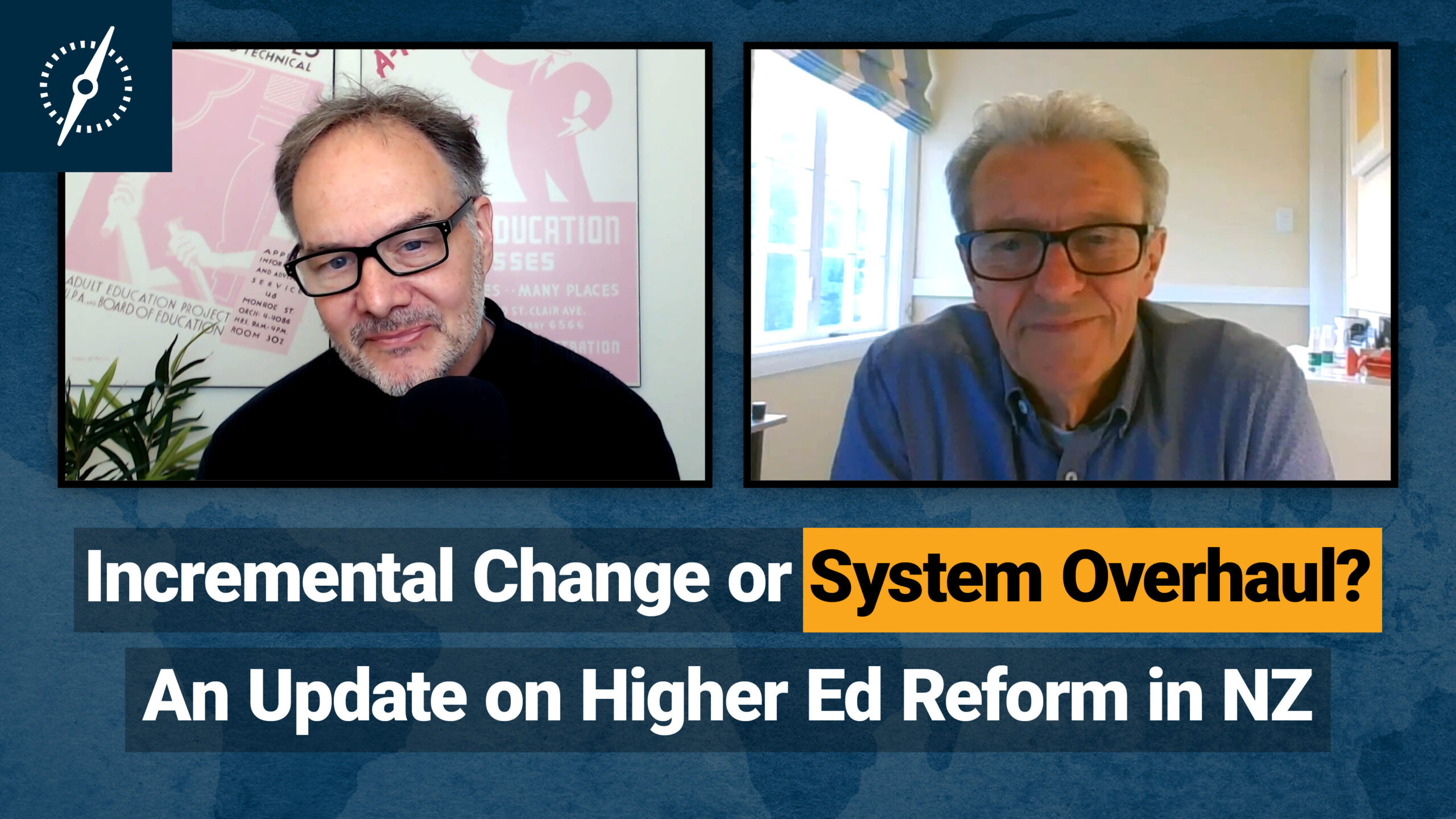
  • Incremental Change or System Overhaul? An Update on Higher Ed Reform in NZ with Roger Smyth

    Incremental Change or System Overhaul? An Update on Higher Ed Reform in NZ with Roger Smyth

    In some countries, higher education policy just seems to sit still for decades. In others, hyperactivity is a more normal state. Today we’re looking at the 2020s poster child for higher education hyperactivity. It’s not the usual suspects, the UK or Australia, it’s little New Zealand where we’re making our fourth stop on this podcast in just over two and a half years.

    When last we were in Wellington, we talked to Chris Whelan from Universities New Zealand about university underfunding the consequences of losing international students, and something called the University Advisory Group, which was supposed to set the national system on a new course along with a research advisory group who weirdly was made up of exactly the same people only following a different mandate.

    Since then, while these groups were noodling on how best to steer the system, the government made two big table flipping moves. One musing about creating a new type of institution, which was neither a university nor a college, and nobody knew what they were talking about, and the other simply deciding it wasn’t going to fund any more research in the social sciences and humanities through its research granting system. Fun times.

    Anyways, with all this excitement, we figured it was worth going back to the Tasman Sea to check in with one of our regular correspondents, Roger Smyth. He’s a former senior New Zealand public servant and now a consultant based in Canterbury. He’s got all the skinny for us. And so, over to Roger.


    The World of Higher Education Podcast
    Episode 3.32 | Incremental Change or System Overhaul? An Update on Higher Ed Reform in NZ with Roger Smyth

    Transcript

    Alex Usher (AU): Roger, the last time we did a show about New Zealand, we had Chris Whelan from Universities New Zealand on, and we talked a lot about the University Advisory Group process. How far along is that work, and what are people in the sector saying about it? What’s the view at this stage? Is there still interest and momentum behind the process, or has it stalled out a little?

    Roger Smyth (RS): Okay, so the advisory group submitted an interim report late last year, and it’s scheduled to submit its final report this month. I understand that the report has now been submitted, but nothing has been published yet. Neither the interim report nor the final report, nor any of the dozens of submissions made in response to the UAG’s questions, have been released publicly.

    In these sorts of cases, the report usually isn’t published until the government has had a chance to make its initial decisions on some of the high-level questions—and that could still be a little way off.

    Of course, as you implied, Alex, there are rumors. And in some of the face-to-face consultations, the UAG has given a bit of a steer as to where it was heading. For instance, it’s pretty clear that in their interim report, they were proposing a machinery of government change—a reorganization of some of the government agencies in higher education, such as the Tertiary Education Commission, the Ministry of Education, and the policy unit responsible for research and innovation. But we won’t know that for sure until the report comes out.

    One of the big challenges the advisory group would have faced is that the government is committed to returning to a financial surplus in the 2027–28 fiscal year. That’s a significant challenge, with major demands on the budget. So the advisory group would have been instructed to make their proposals fiscally neutral, and that’s a big constraint on what they could recommend.

    My main view on this whole process is that it was never really clear what problem the University Advisory Group was set up to solve—apart from a general instruction to look for improvement and to make the system work better. One of the most distinctive features of the New Zealand system is its homogeneity. That has a lot of positives—it means that wherever you go, you’re guaranteed a reasonable level of quality. But it also has the downside that there isn’t really any outstanding, world-leading university.

    AU: Let me stop you there, because alongside the University Advisory Group, there’s also been a commission on research—on research and science—a review going on at the same time. Why did that happen in parallel rather than together?

    RS: Yeah, I think that’s an important point. The first thing is that the two advisory groups were actually chaired by the same person—Peter Gluckman, a distinguished medical scientist and academic—and they began operating at roughly the same time.

    You can see there was a desire to think about knowledge transfer opportunities within universities and how they contribute to the broader economy and the wider science system.

    The Science Advisory Group has now completed its report. It’s been submitted, and the government has published its initial decisions. This is an area where the review proposed a very substantial overhaul of the machinery of government. They proposed creating a super ministry for higher education, science, technology, and innovation.

    The government, however, did not accept that proposal. Most governments are a bit wary of major machinery-of-government reshuffles unless there’s a very strong rationale. These kinds of changes often involve a settling-in period where the system can lose its way, as people jockey for position and the focus shifts away from the core goals the system is meant to achieve.

    Instead, the review also proposed merging the seven non-university research institutes into a single public research organization. The government opted for a partial reorganization, establishing three public research organizations—focused on the bioeconomy, earth sciences, and health and forensic science. They’re also creating a new organization to cover advanced technology fields like AI, synthetic biology, aerospace, and quantum tech. So that’s probably a reasonable foundation for advancing the science system.

    AU: But of course, before they even got to that point—before the advisory group had reported—the government unilaterally made a change to what’s called the Marsden Fund. That’s sort of like our combination of the social sciences, humanities, and natural science councils. And it effectively nuked the humanities and social sciences, as I understand it. They basically said, “We’re not going to fund those anymore.” Why did the government do that? Why undercut your own report before it even comes out?

    RS: Yeah, this was definitely a decision that caused a lot of pushback and consternation—real ill feeling in universities and across the broader community.

    Most of the government’s research funding is directed toward major national strategic priorities, so it tends to go to areas like health, the hard sciences, engineering, agriculture—things like that. The Marsden Fund was one of the few avenues where humanities researchers could secure external funding, outside of what universities provide internally.

    I think part of this decision reflects the government’s desire to place greater focus on the hard sciences. If you look at the Marsden Fund trends, the social sciences and humanities panel had been gaining a slightly larger share of the funding in recent years, which naturally came at the expense of the hard sciences. So in some sense, this was a declaration that the government wants to reorient support toward areas seen as having greater economic impact.

    That said, the main driver was probably to send a message. But in doing so, it sent a very negative signal to the humanities community. Even researchers in the now-favored areas were concerned about the loss of this funding stream—particularly given that social science research can produce huge social value.

    AU: This tension between favored STEM subjects and less-favored fields like the social sciences, humanities, and business is also playing out in discussions around the government’s funding model. My understanding is that in New Zealand, the funding model essentially funds places. So, the government allocates a certain number of places to each institution. Now we’re projecting that there will be more enrollments than there are funded places, and the government would like to provide a bit of additional funding for STEM subjects, but not for others. We’re very familiar with this in Canada—it’s exactly what’s happening in Ontario right now. I’m curious how you think that will play out in New Zealand?

    RS: Okay, well, just to give a bit of context on the financial situation of the universities: like most Anglophone countries with a heavy reliance on the international student market, COVID hit New Zealand universities hard. In 2021, the impact was cushioned by a surge in domestic enrollments. The labor market was weak due to the pandemic, so more people turned to study, and universities did okay financially.

    But in 2022, following government stimulus measures, the labor market recovered and became more robust. Domestic enrollments fell sharply, and the international student market still hadn’t bounced back. That made 2022 the worst financial year ever for the universities. Six of the eight were in deficit, and one was just breaking even.

    In 2023, when finances were still tight, there was a lot of concern about university viability. The government stepped in with a short-term funding rate boost—not an increase in the number of places, but an increase in the dollars per place.

    Then there was a small increase in funding again last year. But the broader funding review never happened. The government changed, and that process was superseded by the UAG process we discussed earlier.

    And that process, as we said, is likely to avoid anything that would seriously impact the government’s bottom line. So, the universities have been in a tough situation.

    But now, the international market is starting to recover. It’s been slower than in the other countries we compete with, but in EFTS terms—equivalent full-time students—2024 saw an 11% increase in international enrollments. It’s still below pre-pandemic levels, but the trend is positive. And that matters because each international student generates about 60% more revenue than a domestic student.

    Right now, we’re in the middle of the financial reporting season. Five of the universities have reported for 2024. One reported a small deficit on its core business, but it was much lower than expected and offset by a surplus on its wider trading operations.

    So, it’s still tough—marginal—but not as gloomy as it was a couple of years ago.

    Even though there’s still pressure, and enrollments may be shifting toward more expensive fields, financially speaking, the worst appears to be over. The system is beginning to grow again.

    And on the point about STEM versus other fields—it’s worth remembering this is a system driven by student choice. The government doesn’t have much influence over where students choose to go. So, no matter how the government might want to steer things, it can’t really control those choices under the current policy environment. So, I’d say that the universities are managing through this.

    AU: Roger, I want to get into something I read recently—there was a fascinating article where the government, or at least the minister, was musing about the idea of creating a new type of tertiary institution. Something that’s not quite a university and not quite a polytechnic.But before I ask you about that, I think we need to give our listeners a bit of background on polytechnics in New Zealand.

    Your system merged all the polytechnics into one big national institution just before COVID, right? That was Te Pūkenga. Why do that? What was the point of one national institution? It’s a big country—two islands, 15 campuses. That’s a lot to bring together. What was the thinking behind that?

    RS: These reforms had two separate sources.

    First, we talked earlier about the financial challenges in the university sector, but the polytechnics were facing a real financial crisis. They’d been growing for years and carried high fixed costs, with relatively small student numbers spread across multiple campuses.

    Between 2012 and 2019, domestic enrollments dropped by about 25%. By 2019, nearly all the polytechnics were running deficits, and the sector’s collective deficit was quite substantial. So something clearly had to be done.

    Second, the government looked at what had been done in Australia. In New South Wales, for example, they merged all the TAFE institutions into a single statewide TAFE. It worked reasonably well there, and in Queensland as well.

    So they decided to follow a similar path and merge all 16 institutions—along with all work-based training—into a single national organization. That was the rationale behind the creation of Te Pūkenga.

    AU: What about the un-merger? So, a few years later you get a new government—the National government—and they’re going to undo the whole thing. Was that because it was, as you said, a machinery-of-government issue? Or was it more about a shift in how the government views vocational education?

    RS: I think it was both.

    Let’s look at both sides. First, the merger didn’t go well. There were some good aspects to the reforms. For instance, they set up six Workforce Development Councils to set standards for training and take a forward-looking view of labor market needs in specific fields. That was a positive.

    The idea of reintegrating polytechnic and work-based training into one coherent trades training system was also a good one. But the merger was very poorly executed.

    Costs blew out, and after three years they still hadn’t settled on a functioning operating model. There was almost no progress on the actual integration of work-based and polytechnic-based training. The initial chief executive didn’t work out and had to go.

    So that was one rationale for reconsidering—or unpicking—the merger.

    But the second reason was political. The incoming minister in 2023 had previously been a very successful chief executive of one of the polytechnics that was merged into the national institution.

    She was deeply committed to undoing the merger and restoring control to regions and local communities. So, the government came in with a clear policy to do this, and she got the ministry, and things got moving quickly.

    But, of course, life’s not that simple. No one wanted to go back to a system everyone agreed had serious problems. So how do you reconcile those two positions?

    After two years of back and forth, we’re now getting close to the new model. Those six Workforce Development Councils—the best part of the previous reform—are being disbanded and replaced with smaller organizations focused mainly on setting standards.

    The polytechnics, which remained as divisions within the larger organization, have all gone through what are called ruthless efficiency reviews to determine what could be dropped or changed to make them financially viable.

    We haven’t seen the full results of those yet, but some institutions will likely be deemed viable and split off as standalone, autonomous polytechnics. These will focus partly on trade training, but also on foundation education and some degree-level programs. Those will become autonomous institutions.

    But for those polytechnics that aren’t viable in the long term, they’ll be required to join a federation anchored by the Open Polytechnic, which delivers programs online. The idea is that those institutions can draw on the federation’s expertise and infrastructure to complement their face-to-face delivery with online components.

    AU: So I don’t want to ask you what’s going to happen, but I do want to ask when it’s going to happen—because there are a whole bunch of moving parts here, and you’ve got an election coming up. Is there enough time for the government to unwind all of this before the next election? Because I know, for example, with the Universities Accord process in Australia, the report came out well before the election, and even then, they couldn’t get everything done before voting day. So, what’s the pace of decision-making here?

    RS: The first thing is that if we look at the University Advisory Group, we should see the results of that fairly soon. I’d expect it within a couple of months—possibly even sooner. It might come out all at once, or it could follow the science review model, where there were high-level interim decisions released first.

    My sense of the brief given to the UAG is that we’re not going to see truly transformational change—nothing on the scale of the three big reviews we’ve had in the past: 1961, 1989–90, and 2002–03.

    So I’d expect incremental change rather than sweeping reform. And because of that, I think the university review will largely settle before the election.

    In contrast, the un-merging of Te Pūkenga and the broader vocational education reforms will take longer.

    Under the new arrangements, there will be greater integration between workplace and institutional training. Polytechnics and private providers will be allowed to act as arrangers and supervisors of work-based training.

    But implementing that integration will take time. There’s a two-year transition period, starting in 2026—which is the election year. So the un-merging process will only be partly complete when voters go to the polls.

    That said, I think this process will continue to play out slowly over time. Hopefully, it results in something positive.

    Despite everything—despite what will have been six years of turbulence and ongoing uncertainty—I do believe the sector will move forward with reasonable operating models.

    AU: May you live in interesting times. Roger, thanks so much for joining us today.

    RS: Thank you very much, Alex.

    AU: And that just leaves me to thank our excellent producers, Tiffany MacLennan and Sam Pufek—and you, our listeners, viewers, and readers—for joining us. If you have any questions or comments about today’s episode, or suggestions for future ones, don’t hesitate to get in touch with us at [email protected]. Run—don’t walk—to our YouTube page and subscribe. That way, you’ll never miss an episode of The World of Higher Education.

    Join us next week when our guest will be David Lloyd. He’s the remarkable individual who serves as both the Vice Chancellor of the University of South Australia and the co–Vice Chancellor of the University of Adelaide. How does he manage it? Those two institutions are on the brink of what’s likely the biggest institutional shakeup in Australian higher education since the Dawkins reforms of 1988. He’ll be here to talk about the merger, how it came about, and what the future looks like. Until then—bye for now.

    *This podcast transcript was generated using an AI transcription service with limited editing. Please forgive any errors made through this service. Please note, the views and opinions expressed in each episode are those of the individual contributors, and do not necessarily reflect those of the podcast host and team, or our sponsors.

    This episode is sponsored by KnowMeQ. ArchieCPL is the first AI-enabled tool that massively streamlines credit for prior learning evaluation. Toronto based KnowMeQ makes ethical AI tools that boost and bottom line, achieving new efficiencies in higher ed and workforce upskilling. 

    Source link