Tag: News

  • Texas Students Make Gains in Reading but Struggle with Math, STAAR Scores Show – The 74

    Texas Students Make Gains in Reading but Struggle with Math, STAAR Scores Show – The 74


    Get stories like this delivered straight to your inbox. Sign up for The 74 Newsletter

    Texas’ students saw some wins in reading but continued to struggle to bounce back from pandemic-related learning losses in math, state testing results released Tuesday showed.

    Elementary students who took the State of Texas Assessments of Academic Readiness exam this year made the biggest gains in reading across grade levels. Third graders saw a three percentage point increase in reading, a milestone because early literacy is a strong indicator of future academic success. Progress among middle students in the subject, meanwhile, slowed.

    “These results are encouraging and reflect the impact of the strategic supports we’ve implemented in recent years,” said Texas Education Agency Commissioner Mike Morath. “We are seeing meaningful signs of academic recovery and progress.”

    This year’s third grade test takers have benefited from state investments in early literacy in recent years. Teachers in their classrooms have completed state-led training in early literacy instruction, known as reading academies. The state also expanded pre-K access and enrollment in 2019.

    Morath did acknowledge students needed more help to make similar gains in math. Five years after pandemic-related school closures, students are still struggling to catch up in that subject, the results showed. About 43% of students met grade-level standards for math, a 2 percentage point increase from the previous year, but still shy of the 50% reached in 2019.

    Low performance in math can effectively shut students out of high-paying, in-demand STEM careers. Economic leaders have been sounding the alarm about the implications that weak math skills can have on the state’s future workforce pipeline.

    The STAAR exam tests all Texas public school students in third through eighth grade in math and reading. A science test is also administered for fifth and eighth graders, as well as a social studies test for eighth graders. Science performance improved among fifth and eighth grades by 3 and 4 percentage points respectively, but students in those grades are still below where they were before the pandemic.

    Students in special education also made small gains. English learners, meanwhile, saw drops in all subjects but one — a 4% decrease in reading, a 2% decrease in math, and a 2% decrease in social studies.

    The test scores give families a snapshot of how Texas students are learning. School accountability ratings — which the Texas Education Agency gives out to each district and campus on an A through F scale as a score for their performance — are also largely based on how students do on the standardized tests.

    The test often casts a shadow over classrooms at the end of the year, with teachers across the state saying they lose weeks of valuable instructional time preparing children to take the test. Some parents also don’t like the test because of its high-stakes nature. They have said their kids don’t want to go school because of the enormous pressure the hours-long, end-of-year test puts on them.

    A bill that would have scrapped the STAAR test died in the last days of the 2025 legislative session. Both Republican and Democratic legislators expressed a desire to overhaul STAAR, but in the end, the House and Senate could not align on what they wanted out of an alternative test.

    Legislators this session did approve a sweeping school finance package that included academic intervention for students who are struggling before they first take their STAAR test in third grade. The package also requires teachers get training in math instruction, mirroring existing literacy training mandates.

    Parents can look up their students’ test results here.

    Graphics by Edison Wu

    This article originally appeared in The Texas Tribune, a member-supported, nonpartisan newsroom informing and engaging Texans on state politics and policy. Learn more at texastribune.org.


    Get stories like these delivered straight to your inbox. Sign up for The 74 Newsletter

    Source link

  • Assignments for Politically Disaffected Students (opinion)

    Assignments for Politically Disaffected Students (opinion)

    Joe Rogan is no fan of my work, obviously. The chart-topping conservative influencer famously insists that universities are “cult camps” where professors like me indoctrinate students with leftist ideas. Typically, I do not worry about my haters, but increasingly it seems that if I want to create a meaningful learning experience, I need to.

    I teach first-year undergraduate humanities electives. Like most universities, ours offers large-format 200-student lectures for training in academic writing and critical theory. This would be the “indoctrination” in question, as I introduce students to canonical thinkers from Karl Marx to Sylvia Wynter. These electives are degree requirements, snaring students who might intentionally avoid liberal arts in an otherwise professional degree.

    In the current political climate, many of my students come to the classroom with their minds made up based on authorities who directly undermine my scholarship and profession. Rogan is just one of many conservative anti-intellectuals who regularly attack liberal, feminist, social justice–oriented biases in university education. The result is a polarized atmosphere antithetical to learning: a tangibly mistrustful, sometimes even resentful classroom.

    Although only a small handful of students typically adhere to anti-intellectual doctrine, their small group undermines my authority with risky jokes in the classroom and intense criticism in student back channels (as reported by concerned classmates). This causes undecided students to falter in their trust of my authority, while students who do not share their views nervously censor their contributions.

    Ironically, my dissenting students often do not recognize that I am interested in their views. I am convinced that the way out of this explosive historic moment is through rigorous discussion in educational forums. Like any academic, this is why I teach: I love sincere inquiry, debate and critical engagement, and I was a rabble-rouser myself as a student. But the current classroom mood is less debate and more deadlock.

    So, I spent this year brainstorming with my students to build creative assignments to spin resentment into passion, no matter how opposite my own, welcoming self-directed research and encouraging deeply engaged reading. I offer any one of these assignments, with the goal to bring disaffected, anxious students back to a love of learning and democratized engagement. This is a work in progress, and I welcome suggestions.

    Turn Tensions Into Data: This introductory exercise eases students into an atmosphere of open collegial discussion. Surveys or anonymous polls quantify disagreements, and then we analyze the results as a class.

    Example: Class Belief Inventory—anonymously poll students on hot-button questions (e.g., “Is systemic racism a major problem?”). The objective here would be to compare the class’s responses to national survey data. Potential discussion topics: Why might differences exist? What shapes our perceptions?

    Hostile Influencers as Primary Sources: This in-class activity treats figures like Rogan or Jordan Peterson not as adversaries but as authors of texts to analyze, to disarm defensiveness and position students as critical investigators.

    Example: “Compare/contrast an episode of [X podcast] with a peer-reviewed article on the same topic. How do their arguments differ in structure, evidence and rhetoric? Whom do you find more persuasive, and why?”

    Gamifying Ideological Tensions: This class activity turns assigned readings into structured, rule-bound games where students must defend positions they don’t personally hold.

    Example: Role-Play a Summit—Students are assigned roles (e.g., Jordan Peterson, bell hooks, climate scientist, TikTok influencer) and must collaborate to solve a fictional problem (e.g., redesigning a curriculum). They must cite course readings to justify their choices.

    Therapy for Arguments: This fun early activity teaches students to diagnose weak arguments—whether from Rogan, a feminist theorist or you—using principles of logic.

    Example: Argument Autopsy—Students dissect a viral social media post, podcast clip or course reading. Identify logical fallacies, cherry-picked evidence or unstated assumptions. Reward students for critiquing all sides.

    Intellectual Sleuthing: This is a scaffolded midterm writing assignment building up to a final essay. Ask students to trace the origins of their favorite influencers’ ideas. Many anti-establishment figures borrow from (or distort) academic theories—show students how to connect the dots.

    Example: Genealogy of an Idea—Pick a claim from a podcast (e.g., “universities indoctrinate students”). Research its history: When was this idea popular in mainstream news or on social media? Are there any institutes, think tanks, influencers or politicians associated with this idea? What are the stated missions and goals of those sources? Where do they get their funding? Which academics agree or disagree, and why?

    Leverage “Forbidden Topics” as Case Studies: If students resent “liberal bias,” lean into it: make bias itself the subject of analysis. This might work as a discussion prompt for tutorials or think-pair-share group work.

    Example: “Is This Reading Biased?”—Assign a short text students might call “woke” (e.g., feminist theory) and a countertext (e.g., Peterson’s critique of postmodernism). Have students evaluate both using a rubric: What counts as bias? Is objectivity possible? How do they define “truth”?

    Choose-Your-Own-Adventure Assignments: The final essay assignment gives students agency to explore topics they care about, even if they critique my field. Clear guardrails are important here to ensure rigor.

    Example: Passion Project: Students design a research question related to the course—even if it challenges the course’s assumptions. They must engage with three or more course texts and two or more outside sources, as in favorite influencers or authorities, even those who oppose course themes.

    Red Team vs. Blue Team: For essays, students submit two versions: one arguing their personal view and one arguing the counterpoint. Grading is based on how well they engage evidence, not their stance.

    Elisha Lim is an assistant professor of the technological humanities at York University in Toronto. They used generative AI tools to assist with the editing of this piece.

    Source link

  • Judge Says Harvard Can Enroll International Students for Now

    Judge Says Harvard Can Enroll International Students for Now

    Photo illustration by Justin Morrison/Inside Higher Ed | greenleaf123/iStock/Getty Images | APCortizasJr/iStock/Getty Images

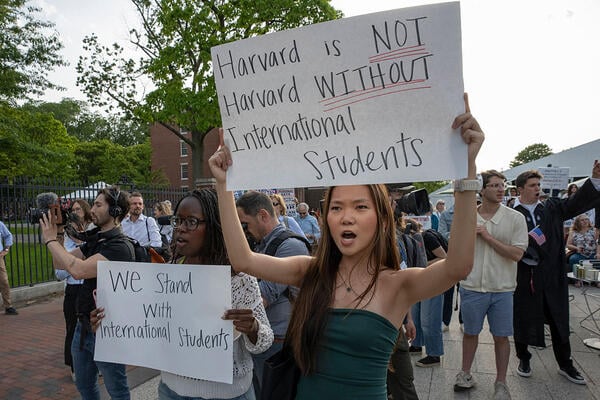
    District Judge Allison Burroughs granted a preliminary injunction to Harvard University on Friday in its case challenging the Trump administration’s efforts to prevent the university from enrolling international students. It’s the latest development in a tit-for-tat legal battle over the ability of more than a quarter of Harvard’s students to remain enrolled. 

    The injunction prevents the Department of Homeland Security from stripping Harvard of its Student Exchange and Visitor Program certification until Burroughs issues a final ruling in the lawsuit. It does not address President Donald Trump’s executive proclamation from earlier this month banning the State Department from issuing visas to international students and researchers attending Harvard; a temporary restriction on that ban expired June 20. 

    Burroughs has not issued an injunction on the Trump administration’s second attempt to revoke Harvard’s SEVP certification, which could take effect Wednesday if she declines to take further action, as Harvard has requested. 

    Source link

  • Judge Orders Mahmoud Khalil to Be Released

    Judge Orders Mahmoud Khalil to Be Released

    A federal judge ordered that Mahmoud Khalil, the Columbia University graduate and student protest leader who was detained by ICE agents in March, be released from a detention center in Louisiana. News outlets reported that he walked out of the detention center around 6:40 Central time Friday evening. 

    U.S. District Judge Michael Farbiarz ruled on Friday that Khalil, a legal permanent resident who has not been accused of any crime, should be released on bail and that continuing to hold him was highly unusual and could constitute “unconstitutional” punishment for his political beliefs. The Trump administration had sought to keep Khalil imprisoned based on a minor alleged immigration infraction after another judge ruled earlier this month that it could not continue to hold him purely based on the State Department’s claim that his continued presence in the U.S. posed a foreign policy threat. 

    Khalil’s arrest made national headlines and kicked off the Trump administration’s months-long campaign of detentions, visa revocations and threats of deportation against international students.

    Source link

  • 5 online resources to beat the summer slide

    5 online resources to beat the summer slide

    Key points:

    As the final school bells ring and students head into summer vacation, educators and parents alike are turning their attention to the phenomenon known as the summer slide–the learning loss that can occur when children take a long break from structured academic activity.

    NWEA research notes that students can lose up to two months of math skills over the summer, and reading abilities can also decline, particularly for students from underserved communities.

    But the summer slide isn’t inevitable. With the growing availability of engaging, high-quality online learning tools, students have more opportunities than ever to keep their skills sharp. These tools offer interactive lessons, personalized learning paths, and fun activities that reinforce what students learned during the school year–without making summer feel like school.

    Here are five standout online resources designed to help K-12 students stay on track over the summer months:

    1. Khan Academy: Khan Academy’s free online platform offers comprehensive lessons in math, science, history, and more. Its summer learning programs provide structured plans for students in grades K-12, including daily activities tailored by grade level. Each lesson includes short instructional videos, interactive quizzes, and mastery challenges. For students who want to get ahead or reinforce tricky concepts from the previous school year, Khan Academy is an ideal, self-paced resource.

    Khan Kids, a separate app for younger learners (ages 2-8), combines educational videos, stories, and games that focus on early literacy, math, and social-emotional development.

    2. PBS LearningMedia: PBS LearningMedia curates thousands of free videos, lesson plans, and interactive activities aligned to state and national standards. The content is engaging and age-appropriate, drawing from trusted PBS programs like Wild Kratts, NOVA, and Peg + Cat. During the summer, PBS typically offers special themed weeks–like “Summer of Reading” or “Science Week”–featuring playlists and activity bundles to help children stay curious and engaged.

    For younger children, PBS Kids also provides games and shows that reinforce foundational skills in reading, math, and critical thinking.

    3. ReadWorks: Reading skills are among the most vulnerable to decline during the summer, especially for students who do not have regular access to books or structured reading activities. ReadWorks is a nonprofit platform offering free, research-based reading comprehension materials for grades K-12. Teachers and parents can assign grade-level texts, paired with vocabulary lessons and comprehension questions. The platform also features an Article-A-Day challenge that encourages students to build background knowledge and reading stamina with just 10 minutes a day. ReadWorks is especially helpful for English Language Learners, offering audio versions and question supports to aid comprehension.

    4. Prodigy: For students who struggle to stay motivated during math practice, Prodigy turns learning into a role-playing adventure game. Students solve math problems to earn rewards and level up characters, making the experience both educational and fun. Aligned with state standards and suitable for grades 1-8, Prodigy adapts to each learner’s skill level, offering targeted practice without the pressure of grades or tests. Parents can access dashboards to track progress and set goals over the summer. Prodigy also offers a version for English Language Arts, expanding the platform’s reach beyond numbers.

    5. Smithsonian Learning Lab: For families looking to incorporate cross-curricular learning, the Smithsonian Learning Lab provides a treasure trove of multimedia collections that blend history, science, art, and culture. Students can explore virtual exhibits, complete inquiry-based lessons, and create their own digital portfolios. The platform is well-suited for middle and high school students, especially those interested in project-based learning and critical thinking. Whether studying the Civil Rights Movement or learning about ecosystems, students can explore real artifacts, images, and primary sources from the Smithsonian’s vast collection.

    Keeping minds active and curious

    Experts emphasize that summer learning doesn’t need to mirror the structure of the traditional classroom–keeping students intellectually engaged as they explore their personal interests reinforces academic skills in an low-stress environment.

    Families can also incorporate daily routines that promote learning–reading together before bed, practicing math while cooking, or exploring nature to spark scientific curiosity.

    As the digital learning landscape expands, there are more tools than ever to support students year-round. With just 20-30 minutes of meaningful academic engagement each day, students can maintain their momentum and return to the classroom in the fall ready to learn.

    Laura Ascione
    Latest posts by Laura Ascione (see all)

    Source link

  • Helping Students Navigate Transitions, Addressing Teacher Shortages

    Helping Students Navigate Transitions, Addressing Teacher Shortages

    Across Texas, students entering dual-credit programs with the goal of becoming educators often face unclear pathways and unnecessary obstacles. But in the North Texas region, a multisector group is working to change that—starting as early as high school.

    Through programs like Pathways in Technology Early College High School (P-TECH) and early-college high schools, students can begin working toward their teaching credentials before they graduate. The Acceleration to Credential (A2C) Working Group—convened by Educate Texas—brings together local independent school districts, Dallas College and four-year university partners to create clearly defined pathways that connect high school, community college and bachelor’s-level educator preparation.

    While the intention behind many dual-credit programs is to offer students more opportunity, the reality is that inconsistent requirements across institutions often create confusion. A student may graduate high school having earned college credits, only to find those credits don’t transfer toward a four-year degree. Or they may complete an associate degree that doesn’t align with bachelor’s programs in education.

    To address this, A2C partners designed a coordinated model known as Target Pathways, which:

    • Aligns associate degree pathways to all bachelor’s education programs in the region.
    • Meets both high school graduation and Texas Core Curriculum requirements.
    • Creates space for local adaptation within a unified regional framework.
    • Provides students with clear maps of all degree and certification requirements.

    These streamlined pathways aim to improve student outcomes, reduce excess credit accumulation and increase the number of teacher candidates completing their degrees on time and with less debt.

    The associate of art in teaching (A.A.T.) degrees that students earn in these P-TECH programs have shown promising outcomes when it comes to entering education careers. Between 2010 and 2023, 49 percent of A.A.T. earners in Dallas–Fort Worth became paraprofessionals or teachers or advanced into education leadership positions, according to an analysis by Wesley Edwards at the University of North Texas (Wesley Edwards, AAT Analysis, University of North Texas, April 23, 2024, and Sept. 21, 2024). As these pathways expand across more high schools, partners across the state should continue investing in the supports students need to enter the education workforce.

    “Developing a robust pathway for high school students to not only earn credentials but also gain valuable exposure to industry is critically important as we look to meet workforce needs,” said Robert DeHaas, vice provost of the School of Education at Dallas College.

    This work is about more than academic alignment—it’s about building the relationships and trust needed to create meaningful change.

    “This work requires close coordination between large systems that haven’t always worked together,” DeHaas said. “The collaborative has helped foster the coalition-building needed to break down these historical silos and create a college road map that supports the upward economic mobility of our students.”

    Educate Texas will continue supporting A2C by helping school districts implement these pathways and facilitating collaboration with higher education partners. By investing in regional alignment and early access, the A2C model offers a promising solution for expanding the teacher pipeline in Texas and beyond.

    Joseph Reyes is deputy director of teaching and leading at Educate Texas, an initiative of Communities  Foundation of Texas. In this role, he manages programs that increase access to high-quality educator preparation and works with school districts and higher education partners to strengthen the teacher workforce across the state.

    Source link

  • What’s With the Em Dash/AI Anxieties? (opinion)

    What’s With the Em Dash/AI Anxieties? (opinion)

    In recent months, a curious fixation has emerged in corners of academia: the em dash. More specifically, the apparent moral panic around how it is spaced. A dash with no spaces on either side? That must be AI-generated writing. Case closed.

    What might seem like a minor point of style has, in some cases, become a litmus test for authenticity. But authenticity in what sense—and to whom? Because here is the thing: There is no definitive rule about how em dashes should be spaced. Merriam-Webster, for instance, notes that many newspapers and magazines insert a space before and after the em dash, while most books and academic journals don’t. Yet, a certain kind of scholar will see a tightly spaced dash and declare: “AI.”

    This tells us less about punctuation and more about the moment we are in. It reflects a deeper discomfort within academic knowledge production—about writing, authority and who gets to speak in the language of the academy.

    Academic writing has long been a space of exclusion. Mastering its conventions—its structures, tones and unwritten rules—is often as important as the content itself. Those conventions are not neutral. They privilege those fluent in a particular kind of English, in a particular kind of intellectual performance. And while these conventions have sometimes served a purpose—precision, nuance, care—they have also functioned to gatekeep, obscure and signal belonging to a small circle of insiders.

    In that context, generative AI represents a real shift. Not because it replaces thinking—clearly, it does not—but because it lowers the barriers to expressing ideas in the right register. It makes writing less labor-intensive for those who are brilliant thinkers but not naturally fluent in academic prose. It opens possibilities for scholars writing in their second or third languages, for early-career researchers who have not yet mastered the unwritten codes and for anyone who simply wants to get to the point more efficiently. This is not a minor intervention—it is a step toward democratizing academic expression.

    And in that lies both the opportunity and the anxiety.

    I have read academic work recently that likely used AI writing tools—either to help organize thoughts, smooth expression or clarify argument. Some of it has been genuinely excellent: clear, incisive and original. The ideas are coherent and well articulated. The writing does not perform difficulty; it performs clarity. And in doing so, it invites more people in.

    By contrast, a fair portion of traditionally polished academic writing still feels burdened by its own formality—long sentences, theoretical throat-clearing prose that loops and doubles back on itself. It is not that complexity should be avoided, but rather that complexity should not be confused with value. The best writing does not show off; it shows through. It makes ideas visible.

    Needless to say, I am not about to cite examples—whether of the work I suspect was AI-assisted or the work that could have done with a bit of help.

    So why, then, do so many in academic circles focus their attention on supposed telltale signs of AI use—like em dashes—rather than on the substance of the ideas themselves?

    Part of the answer lies in the ethics discourse that continues to swirl around AI. There are real concerns here: about transparency, authorship, citation and the role of human oversight. Guidance from organizations such as the Committee on Publication Ethics, and emerging policies from journals and universities, reflect the need for thoughtful governance. These debates matter. But they should not collapse into suspicion for suspicion’s sake. That’s because the academic world has never been a perfectly level field. Those with access to time, mentorship, editorial support and elite institutions have long benefited from invisible scaffolding.

    AI tools, in some ways, make that scaffolding more widely available.

    Of course, there are risks. Overreliance on AI can lead to formulaic writing or the flattening of style. But these are not new issues—they predate AI and are often baked into the structures of journal publishing itself. The greater risk now is a kind of reactionary gatekeeping: dismissing writing not because of its content, but because of how it looks, mistaking typography for intellectual integrity.

    What is needed, instead, is a mature, open conversation about how AI fits into the evolving ecosystem of scholarly work. We need clear, consistent guidelines that recognize both the benefits and limitations of these tools. Recent statements from major institutions have begun to address this, but more are needed. We need transparency around how AI is used—without attaching shame to its use. And we need to refocus on what matters most: the quality of the thinking, the strength of the contribution and the clarity with which ideas are communicated.

    The em dash is not the problem. Nor is AI. The problem is a scholarly culture still too often wedded to performance over substance—one where form is used to mask or elevate, rather than to express.

    If we are serious about making knowledge more inclusive, more global and more just, then we should embrace tools that help more people take part in its production. Not uncritically, but openly. Not secretly, but responsibly.

    What we should be asking is not “Was this written with AI?” but rather, “Is this work rigorous? Is it generous? Does it help us think differently?”

    That is the kind of scholarship worth paying attention to—em dash or not.

    Joseph Mellors is a research associate for FUTOURWORK at Westminster Business School at the University of Westminster, in the U.K.

    Source link

  • Data Shows Uptake of Statewide Digital Mental Health Support

    Data Shows Uptake of Statewide Digital Mental Health Support

    In 2023, New Jersey’s Office of the Secretary of Higher Education signed a first-of-its-kind agreement with a digital mental health provider, Uwill, to provide free access to virtual mental health services to college students across the state.

    Over the past two years, 18,000-plus students across 45 participating colleges and universities have registered with the service, representing about 6 percent of the eligible postsecondary population. The state considers the partnership a success and hopes to codify the offering to ensure its sustainability beyond the current governor’s term.

    The details: New Jersey’s partnership with Uwill was spurred by a 2021 survey of 15,500 undergraduate and graduate students from 60 institutions in the state, which found that 70 percent of respondents rated their stress and anxiety as higher in fall 2021 than in fall 2020. Forty percent indicated they were concerned about their mental health in light of the pandemic.

    Under the agreement, students can use Uwill’s teletherapy, crisis connection and wellness programming at any time. Like others in the teletherapy space, Uwill offers an array of diverse licensed mental health providers, giving students access to therapists who share their backgrounds or language, or who reside in their state. Over half (55 percent) of the counselors Uwill hires in New Jersey are Black, Indigenous or people of color; among them, they speak 11 languages.

    What makes Uwill distinct from its competitors is that therapy services are on-demand, meaning students are matched with a counselor within minutes of logging on to the platform. Students can request to see the same counselor in the future, but the nearly immediate access ensures they are not caught in long wait or intake times, especially compared to in-person counseling services.

    Under New Jersey’s agreement, colleges and students do not pay for Uwill services, but colleges must receive state aid to be eligible.

    The research: The need for additional counseling capacity on college campuses has grown over the past decade, as an increasing number of students enter higher education with pre-existing mental health conditions. The most recent survey of counseling center staff by the Association for University and College Counseling Center Directors (AUCCCD) found that while demand for services is on the decline compared to recent years, a larger number of students have more serious conditions.

    Over half of four-year institutions and about one-third of community colleges nationwide provide teletherapy to students via third-party vendors, according to AUCCCD data. The average number of students who engaged with services in 2024 was 453, across institution size.

    Online therapy providers tout the benefits of having a service that supplements on-campus, in-person therapists’ services to provide more comprehensive care, including racially and ethnically diverse staff, after-hours support and on-demand resources for students.

    Eric Wood, director of counseling and mental health at Texas Christian University, told Inside Higher Ed that an ideal teletherapy vendor is one that increases capacity for on-campus services, expanding availability for on-campus staff and ensuring that students do not fall through the cracks.

    A 2024 analysis of digital mental health tools from the Hope Center at Temple University—which did not include Uwill—found they can improve student mental health, but there is little direct evidence regarding marginalized student populations’ use of or benefits from them. Instead, the greatest benefit appears to be for students who would not otherwise engage in traditional counseling or who simply seek preventative resources.

    One study featured in the Hope Center’s report noted the average student only used their campus’s wellness app or teletherapy service once; the report calls for more transparency around usage data prior to institutional investment.

    The data: Uwill reported that from April 2023 to May 2025, 18,207 New Jersey students engaged in their services at the 45 participating institutions, which include Princeton, Rutgers, Montclair State and Seton Hall Universities, as well as the New Jersey Institute of Technology and Stevens Institute of Technology. Engaged students were defined as any students who logged in to the app and created an account.

    New Jersey’s total college enrollment in 2022 was 378,819, according to state data. An Inside Higher Ed analysis of publicly available data found total enrollment (including undergraduate and graduate students) among the 45 participating colleges to be 327,353. Uwill participants in New Jersey, therefore, totaled around 4 percent of the state’s postsecondary students or 6 percent of eligible students.

    The state paid $4 million for the first year of the Uwill contract, as reported by Higher Ed Dive, pulling dollars from a $10 million federal grant to support pandemic relief and a $16 million budget allocation for higher education partnerships. That totals about $89,000 per institution for the first year alone, or $12 per eligible student, according to an Inside Higher Ed estimate.

    In a 2020 interview with Inside Higher Ed, Uwill CEO Michael London said the minimum cost to a college for one year of services is about $25,000, or $10 to $20 per student per year.

    New Jersey students met with counselors in more than 78,000 therapy sessions, or about six sessions per student between 2023 and 2025, according to Uwill data. Students also engaged in 548 chat sessions with therapists, sent 6,593 messages and requested 1,216 crisis connections during the first two years of service.

    User engagement has slowly ticked up since the partnership launched. In January 2024, the state said more than 7,600 students registered on the platform, scheduling nearly 20,000 sessions. By September 2024, Uwill reported more than 13,000 registered students on the platform, scheduling more than 49,000 sessions. The most recent data, published June 6, identified 18,000 students engaging in 78,000 sessions.

    Over 1,200 of Montclair State’s 22,000 students have registered with Uwill since June 2023, Jaclyn Friedman-Lombardo, Montclair State’s director of counseling and psychological services, said at a press conference, or approximately 6 percent of the total campus population.

    The state does not require institutions to track student usage data to compare usage to campus counseling center services, but some institutions choose to, according to a spokesperson for both the office of the secretary and Uwill. The secretary’s office can view de-identified campus-level data and institutions can engage with more detailed data, as well.

    Creating access: One of the goals of implementing digital mental health interventions is to expand access beyond traditional counseling centers, such as after hours, on weekends or over academic breaks.

    Roughly 30 percent of participants in the Uwill partnership completed a session between 5 p.m. and 9 a.m. on a weeknight or on the weekends. Over the 2024–25 winter break, students engaged in 3,073 therapy sessions. More than 90 of those took place outside New Jersey. Students also used Uwill services over summer vacation this past year (9,235 sessions from May 20 to Aug. 26, of which 10 percent took place outside New Jersey).

    A majority of users were traditional-aged college students (17 to 24 years old), and 32 percent were white, 25 percent Hispanic and 17 percent Black. The report did not compare participating students’ race to those using on-campus services or general campus populations.

    About 85 percent of New Jersey users were looking for a BIPOC therapist, and 9 percent requested therapists who speak languages other than English, including Hindi and Mandarin.

    Postsession assessment completed by students who do schedule an appointment has returned positive responses, with a feedback score of 9.5 out of 10 in New Jersey, compared to Uwill’s 9.2 rating nationally.

    Unanswered questions: Wood indicated the data leaves some questions left unanswered, such as whether students were also clients at the on-campus counseling center, or if the service had improved students’ mental health over time from a clinical perspective.

    “Just because a student had four sessions with a telehealth provider, if they came right back to the counseling center, did it really make an impact on the center’s capacity to see students?” Wood said.

    The high cost of the service should also give counseling center directors pause, Wood said, because those dollars could be used for a variety of other interventions to create capacity.

    The data indicated some benefits to counseling center capacity, including diverse staff and after-hours support. But to create a true return on investment, counseling centers should calculate how much capacity the tele–mental health service created and its direct impact on student wellness, not just participation in services.

    “It would be ideal to compare the number of students receiving services (not just creating an account) through the platform to the number of students who would likely benefit from receiving treatment, as identified by clinically validated mental health screens on population surveys,” said Sara Abelson, assistant professor at the Hope Center and the report’s lead author.

    What’s next: New Jersey renewed its contract with Uwill first in January 2024 and then again in May, extending through spring 2026. State leaders said the ongoing services are still supported by pandemic relief funds.

    On May 2, New Jersey assemblywoman Andrea Katz from the Eighth District introduced a bill, the Mental Health Early Access on Campus Act, which would require colleges to implement mental health first aid training among campus stakeholders, peer support programs, mental health orientation education and teletherapy services to ensure counseling ratios are one to every 1,250 students per campus. The International Accreditation of Counseling Services recommends universities maintain a ratio of at least one full-time equivalency for every 1,000 to 1,500 students.

    “We know that mental health services that our kids need are not going to end when we change governors,” Katz said at a press conference. “We need to make sure that all of this is codified into law.”

    Source link

  • For Learning, Focus on the Essence and the Experiences

    For Learning, Focus on the Essence and the Experiences

    When I was teaching, I always thought of this time on the calendar as the “postexhale” period.

    The end of the semester is a headlong sprint to the finish, which, unlike a race where you get to break the tape and coast to a stop, is more like hitting a wall and collapsing on the spot. At least that’s how it always felt to me, at least until I started ending the semester at week 13 (of 15) and using the last two weeks for wind-down and reflection on what we’d all learned.

    In the immediate aftermath of the semester, particularly spring semester, I couldn’t be bothered with any thinking or planning for the next semester. The next scheduled activity, usually something I started around the first week of August, would be the specific planning for the forthcoming semester, but there is also this postexhale period where no work needs to be done, conditions that are fertile for thinking and dreaming before the planning.

    The postexhale period is the spot where you’re likely to gestate your best ideas, because at least for the next month or so, you don’t have to do anything with them.

    I want to plant a seed of thought for anyone who is confronting having to or wanting to make changes to their course in order to accommodate the reality of generative AI technology being in the world.

    Here it is: Next semester, do less that means more.

    As I’ve been traveling around talking to people about how we can (and should) adjust how we think about teaching writing, one of the persistent worries is that introducing some AI-related content or experiences around ethics or safe use or whatever requires layering something new on what’s already happening. For many instructors, it’s an uninvited and therefore unwelcome burden.

    I get it. We can never cover everything to begin with. Here’s one more thing to cover.

    But what if we can use this as an opportunity to rethink what learning looks like? As we move through this period where we can reflect and reconsider, we can think about how to boil the experiences in the classroom down to an essence that can be reflected in learning experiences.

    Consider the learning that has proved most enduring from the full trajectory of your education and I think you’ll find that it clusters around essential, deep lessons. What has mattered are the moments where we have learned how to learn and think and act inside a particular domain. It is this learning that allows us to go forth and continue to learn eagerly, ceaselessly.

    Even as a decidedly and well-documented overall mediocre student, there are numerous learning experiences (in and out of class) that I can point to as inflection points that made a significant difference in the overall trajectory of my life because they provided something essential to my journey forward.

    One moment I invoke frequently is when my third-grade teacher asked us to write instructions for making a peanut butter and jelly sandwich and then had us try to make the sandwiches following the instructions to the letter. Because I forgot to say that you should use a knife to spread the peanut butter on the bread, I ended up sticking my hand in the jar of peanut butter to fulfill my own directive. I have a picture memorializing the occasion.

    That moment introduced me to the rhetorical situation and the fact that writing has a purpose and an audience—and careless writing has consequences. I’m sure I learned all kinds of other things in third grade and maybe some of them were important, but only one moment was indelible, and that’s all I needed.

    In high school, excited about the subject matter for my junior-year English term paper (the New Journalism of Tom Wolfe), while being not enthused about the parameters of what I was supposed to do with that subject matter, I decided to write my term paper in the style of Tom Wolfe, earning a not-so-great grade from my teacher, but a meaningful lesson in how to keep myself interested with a task. (I wrote in more detail about this previously.)

    Some reflection unearths other moments. A college nonfiction writing class had us pretending we were writing for specific publications and producing columns that could fit under the editorial banner. I chose Esquire, imagining myself a sophisticated male, I guess. We were required to understand how to write for very specific audiences with very specific aims, excellent practice for all kinds of different futures. At the end of the semester, we had a competition where we voted for the “best” columns across a number of different categories. I was a finalist in several but won zero, losing out to one specific classmate’s work every time.

    In a conference with the instructor, I must’ve expressed some kind of disappointment, and he said something that stuck with me: “X’s stuff sounds like themselves writing for a publication. You sound like someone doing an imitation of someone writing for a publication.” I walked away believing that authenticity was ultimately the differentiator in connecting with readers.

    I could name more moments. My first semester of grad school, my professor, Robert Olen Butler, had us do an in-class writing exercise based in sense memory (which can be found in his book From Where You Dream), and I experienced what it was like to tap into my artistic subconscious for an extended, focused period. Bob was not the most engaged of mentors, but I’m not sure I’d still be writing if I hadn’t had that experience.

    When I started teaching, the indelible lessons delivered by my students came even more often, possibly because I recognized my responsibility over the work in ways I hadn’t achieved as a student.

    All these moments are rooted in very specific and specifically designed experiences. These kinds of experiences are not threatened by the existence of large language models, because it was clear to me that the point of the exercise is to have the experience.

    Of course, generative AI tools could be present as part of an important learning experience, but when generative AI is used by students as a substitute for the experience, the learning is obviously deformed. Injecting LLMs into our courses simply because it seems like something we have to be doing is not a great recipe for learning.

    There are some, perhaps many, places where it is not and should not be welcome because it is not conducive to the experience of learning we’re trying to instantiate.

    As I think about these experiences, what I learned was really contained in a crystallizing moment made possible by the earlier experience of that class, or even before that class. This is not necessarily predicated on the amount of material covered or the volume of what students are exposed to.

    As you enjoy this exhale period, maybe spend some time thinking how little you could do in your course and still have students walk away with something that will be meaningful years down the road. That may be the core of your course when you come back and start thinking about it for real in a month.

    Source link

  • Gaza Encampments “Made University Leaders Lose Their Minds”

    Gaza Encampments “Made University Leaders Lose Their Minds”

    The war in Gaza and the adverse reaction of U.S. colleges to the pro-Palestinian movement have completely changed students’ relationship to higher education, according to the maker of a new film about last year’s protests.

    A new documentary, The Encampments, follows the movement from Columbia University, where the first tents were erected in April 2024, as protests spread to hundreds of campuses worldwide, including the University of Tokyo and Copenhagen University.

    Not just isolated to Ivy League institutions in the U.S., the movement spread to many traditionally Republican-dominated states as well, Michael Workman, co-director of the film, told Times Higher Education.

    “These are not just places where the coastal elite are,” he said. “This movement touched and reached into the middle of America. In places like [Idaho], there were protests every day in solidarity and support.”

    He hopes that the film, which he sees as a “counternarrative” to the media’s negative portrayal of the encampments, will “haunt” higher education leaders for being on the wrong side of history.

    Although the conflict in Gaza continues, the student movement has had a much smaller impact this year, with many students facing severe repercussions from both their universities and the White House.

    “For some reason camping out on the lawn demanding an end to a genocide made all these administrators around the world, and especially in the U.S., lose their minds,” said Workman.

    He said the encampments arrived at a time of “heightened” organization and engagement among the student body. These movements are not sustainable but always “ebb and flow,” he added.

    Along with demanding that universities lend their voices to Gaza, students have called on institutions to divest from companies that they believe are funding a genocide.

    Workman said the “twin demands” of many of the students were to support Palestinians and to take universities, which they were paying lots of money, back to being educational institutions.

    “Students have seen their educations get turned into moneymaking machines, [instead of institutions] that are primarily there to teach students,” he said.

    “This has completely changed this generation’s relationship to higher education, and I think their relationship to the U.S. and U.S. foreign policy.”

    He said the war in Gaza has “woken up this generation,” which is why colleges reacted with such force.

    “It’s why they responded in the way that they did, because they felt they couldn’t do anything else. The cat was out of the bag,” he said.

    “These students are not going to go back to thinking what Israel is doing in Gaza was justified … and they’re going to continue to grow their movement to raise awareness around what’s happening and to fight against it.”

    Workman, who also teaches documentary film production at the University of San Francisco, said the response by faculty in the U.S. is “not a monolith” but that it is becoming increasingly supportive of the students.

    This has been particularly evident since the detention of activist and green card–holder Mahmoud Khalil, who features in the documentary, he said. Khalil, an international student who moved to the U.S. in 2022, was arrested in March following a crackdown on student protesters by President Donald Trump’s administration.

    “The more they repress the movement, in a lot of ways, the stronger it gets, because people aren’t backing down,” Workman said.

    “That doesn’t mean that we have this huge moment like the encampment moment, but we’re building a sustained foundation that is continuing to grow with really committed organizers.”

    Source link