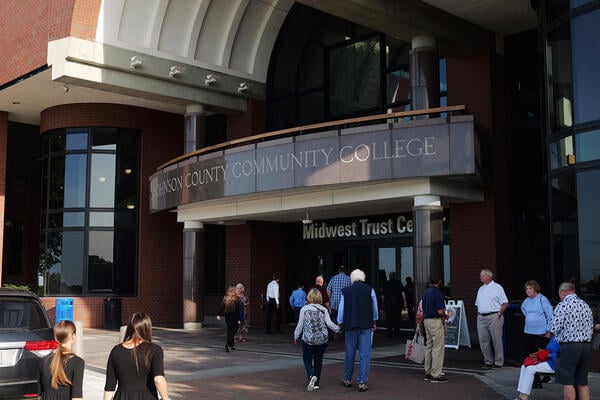
In response to federal guidance, Johnson County Community College no longer allows undocumented students to take adult education courses.
Matthew Fowler/iStock/Getty Images
An adult education instructor at Johnson County Community College in Kansas resigned after finding out the college would require proof of immigration status for adult ed programs in response to federal policy shifts, The Kansas City Star first reported.
Daniel Tyx, previously a middle school Spanish teacher, started teaching English to adults part-time at the college last year. He told the Inside Higher Ed that he took the job because he has a passion for working with immigrant students, and he planned to stay if not for the new policy. He described the college’s English language learner program as thriving, with over 800 students.
These students “always come to class. They’re always excited to be there. They’re full of questions. It’s just a dream job,” Tyx said.
But Tyx quit his job last Friday after he was told that he would have to verify students’ immigration statuses.
“That was not in alignment with my values,” Tyx said. “And I didn’t feel like, as a matter of conscience, that I was going to be able to continue.”
The college’s decision came after a February executive order demanded “no taxpayer-funded benefits go to unqualified aliens.” The U.S. Department of Education then announced in July that, to comply with the order, it would end Clinton-era guidance that allowed undocumented students to participate in adult and career and technical education programs. The department insisted that institutions receiving federal funds for these programs begin verifying that students are eligible to benefit from them.
“Under President Trump’s leadership, hardworking American taxpayers will no longer foot the bill for illegal aliens to participate in our career, technical, or adult education programs or activities,” U.S. Secretary of Education Linda McMahon said in the announcement. “The department will ensure that taxpayer funds are reserved for citizens and individuals who have entered our country through legal means who meet federal eligibility criteria.”
Checking a student’s immigration status is not a typical practice for community colleges, which are now grappling with how to comply with the federal edicts and continue to serve students, and staffers are uncertain how to move forward. Another complication for community colleges and other public institutions is the Trump administration’s crackdown on policies that allow undocumented students to pay in-state tuition if they meet other requirements. After Texas overturned its policy, state officials asked universities to identify undocumented students. At least one Texas institution, the University of Texas at Austin, now requires students to submit proof of immigration status, as well, KVUE reported.
The department’s guidance to bar undocumented students was the second blow to adult education programs after the Trump administration held up about $716 million in federal funds to these programs as part of a wider review of education-related grants in early July. The funds have since been released.
Johnson County Community College now has a message on its website saying that, starting in late July, students are required to show a Real ID, birth certificate, U.S. passport or their most recent immigration documents when they register for adult education classes.
Chris Gray, vice president of strategic communications and marketing at JCCC, said in an email to Inside Higher Ed that the college’s “compliance with federal requirements in this matter allows us to continue to serve qualified individuals” in adult education programs.
Tyx said he felt that college administrators were trying to get ahead of the federal guidance, which he considers “cruel and unjust.” He’s worried for his students, who have been peppering him with questions about whether their documents will suffice.
“My students make such sacrifices to come to class,” he said. “They have so many different reasons to want to learn English, and they’re all good ones. My students want to be able to connect better with their children or their children’s schools. They want to be able to employ the skills that they already have at work and progress in their work lives … It’s very weird that would be something that would be considered to be not desirable by our government.”
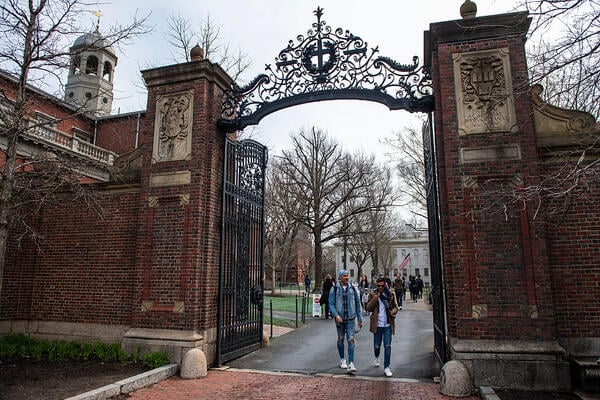
A new survey will collect data on academic flourishing among students enrolled in colleges and universities.
Joseph Prezioso/AFP/Getty Images
For prospective students looking to enroll in higher education, there are a variety of institutional factors to consider, among them location, course of study, cost of tuition and campus culture. Various sets of rankings provide additional information that might matter to students, such as spending on research or socioeconomic mobility for graduates.
But one key outcome of higher education remains underappraised, according to Tyler VanderWeele, a professor of epidemiology and biostatistics at Harvard University and director of the Human Flourishing Program: a student’s personal growth.
Many institutions publish lofty mission statements that connect the learning experience to students’ personal growth, leadership skills, vocation and sense of purpose upon graduation. But beyond anecdotal testimony, there are few measures to understand the influence of colleges and universities on student flourishing.
Next spring, Harvard University and Wanderweele are launching a new assessment tool as part of the Human Flourishing Program. The Flourishing Data Collaborative survey asks students to reflect on their college experience and provide their home institution with feedback as to what’s working and what needs additional intervention to affect student thriving.
What’s the need: Researchers created the survey in part to encourage colleges and universities to consider flourishing and student development a core function of the institution.
“I really do believe that what we measure shapes what we discuss, what we aim for, what policies are put in place to achieve those aims,” VanderWeele said. “So the very act of measurement, in some sense, itself constitutes an intervention and might help colleges and universities better pursue this.”
The assessment is not designed as a replacement for other measures of student success, including job placement or retention rates, Wanderweele noted. But sometimes a focus on ranking metrics can shift institutional priorities in a way that neglects the human-centered mission of postsecondary education, he said.
“For example, U.S. News & World Report rankings [have] very much shaped higher education, and people pay a lot of attention to this, but I think it’s also reoriented colleges and universities to specific metrics and ends that will help them go up in those rankings,” VanderWeele said. “Is it really the most important thing how much money has been spent on new student center facilities?”
The program also wants to better understand the role of higher education in promoting student well-being. Large numbers of young people report feeling on edge, lonely, unmoored or directionless, according to a study from Harvard’s Graduate School of Education. To get at this question, the survey asks about a learner’s sense of happiness and meaning and their financial security.
How it works: After promising results from pilot surveys conducted at the University of North Carolina at Chapel Hill, Harvard and Campus Bio-Medico University of Rome last year, the annual survey will launch in spring 2026, allowing first-year students to have at least one semester of undergraduate experience under their belts. Learners will respond to 24 questions ranging from “to what extent has university life helped you pursue truth?” to “to what extent has university life helped you to better lead a moral life?”
VanderWeele hopes the survey will serve as a reflection tool for students to consider how education has contributed to their development, but also where they can be self-motivated to improve their well-being.
After data collection is complete, each institution will receive a 50-page report and a dashboard with their survey results, allowing them to filter by specific data points.
What’s next: Presently, the program is recruiting member institutions to participate in the survey and engage in a community of practice, Wanderweele said. The goal is for institutions to gain insight about their current practices, or even assess interventions across several surveys, but also to learn from their peers.
“Our goal with this is not to differentially rank institutions, but to help each of these institutions come together, reflect on their strengths [and] areas for growth and to learn from one another in these different ways,” VanderWeele said.
Institutions will pay an annual $10,000 membership fee to participate, which VanderWeele said is a similar rate to other survey offerings of this kind.
Approximately 20 colleges have indicated interest in membership and another 100 have signed up for an upcoming webinar on Aug. 20 for additional information. VanderWeele said he is hoping a few dozen colleges and universities join the initiative this year.
In addition to providing institution-specific insights and policy recommendations, VanderWeele and his team hope to use survey results to conduct research on human flourishing in higher education in general.
Stanford is the latest university to announce layoffs in the wake of federal policy changes.
David Madison/Getty Images
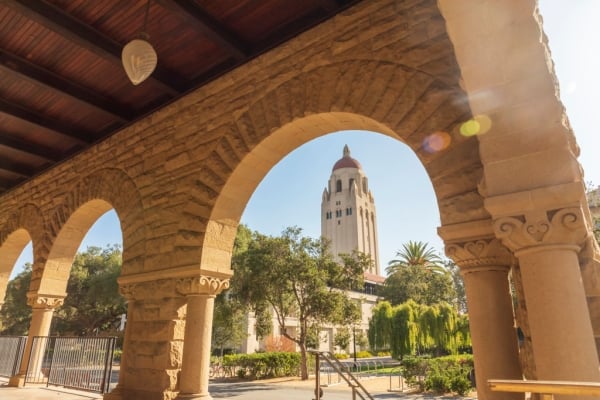
Stanford University plans to cut 363 jobs this fall, starting at the end of September, due to financial challenges driven by federal policy changes, the San Francisco Chronicle reported.
The university previously announced a hiring freeze in February.
Stanford president Jon Levin and provost Jenny Martinez noted in a letter to campus that the cuts were part of an effort announced last month to reduce $140 million in the general funds budget. They called the layoffs, reported Tuesday, “the product of a challenging fiscal environment shaped in large part by federal policy changes affecting higher education.”
University officials provided more information in a letter filed with the California Employment Development Department that accompanied the layoff notice. They cited “anticipated changes in federal policy—such as reductions in federal research funding and an increase in the excise tax on investment income” as significant factors driving the reduction of Stanford’s workforce.
Neither letter provided more specifics on who would be affected by the job cuts.
Stanford has been in the crosshairs of the Trump administration in recent months, with the Department of Justice launching an investigation into admissions practices at the private university, accusing it and several other institutions of skirting a ban on affirmative action.
Stanford is one of the wealthiest institutions in the U.S., with an endowment valued at $37.6 billion earlier this year; only two other institutions and a system had larger endowments.
Now Stanford joins other wealthy peers with multibillion-dollar endowments that have also enacted cuts recently. Last month, Duke University announced that 599 employees had accepted buyouts, and Northwestern University cut 425 jobs as it navigates a federal research funding freeze. While not as well resourced as Stanford, both are among the nation’s wealthiest universities.
Nicholas Kent, a career higher education policy expert and now the Department of Education’s under secretary, has made his priorities for American colleges and universities clear—controlling student debt, building public trust and ensuring students experience a positive return on investment.
“If colleges and other postsecondary institutions merit taxpayer investment, it is because they equip American citizens with the skills and knowledge needed to thrive in this rapidly-evolving economy,” he said in his first letter to the department’s staff. “The ‘higher education industrial complex’ must be shaken up by competition, accountability, and a future-focused mindset.”
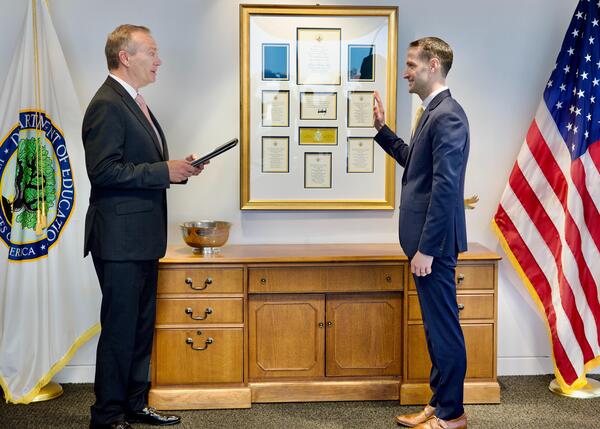
The letter was Kent’s first statement since being confirmed late Friday and sworn in early Monday morning. It is one of few times he has discussed what he plans to prioritize since President Trump nominated him to be the most senior official focused on postsecondary education in February.
Over all, Kent’s missive elicited praise and caution from higher education experts.
Some say his years of experience, combined with his resistance to the status quo, make him a prime appointee. Others worry that despite his promises of accountability and workforce development, he will focus more on the vitality of the market and less on consumer protection. Others still are encouraged simply by the fact that he’s focused on constructive regulation, not culture war–focused litigation.
“I feel a little bit like a broken record, because I keep coming back to it, but it’s so refreshing to be talking about things like accountability, outcomes, value and career-aligned education pathways, compared to what we have been talking about for the last six months with this administration,” said Jon Fansmith, senior vice president for government relations at the American Council on Education. “Hopefully the confirmation of Nicholas Kent will help reorient the Trump administration toward productive policy outcomes.”
A first-generation college student and Pell Grant recipient, Kent has spent the entirety of his career in higher education. Most recently, he served as deputy education secretary for Virginia governor Glenn Youngkin. But before that he advocated primarily for private institutions, working with both Career Education Colleges and Universities, which represents some for-profit colleges, and Education Affiliates, a for-profit college company that faced public scrutiny in 2013 after a whistleblower accused the company of fraud.
Critics say Kent’s ties to for-profit colleges, which they see as predatory, should have disqualified him from the job. But Education Secretary Linda McMahon voiced confidence in him.
His “technical expertise and vast experience in higher education will serve as an invaluable asset to the Department of Education team,” McMahon said in a statement Monday. “Not only will he work to fulfill President Trump’s vision for accreditation, accountability reforms, and more, but he will also be a great benefit to current and aspiring postsecondary students, faculty, and staff.”
In his letter to department staff, Kent provided little granular detail, though he’s expected to say more at several upcoming rule-making sessions. He did speak generally on a few topics, like increasing access to alternative postsecondary pathways, protecting campus free speech and helping students feel empowered by their postsecondary options.
“President Trump has entrusted me with a weighty task: to restore the greatness of American higher education and ensure that our taxpayer-supported colleges, universities, vocational schools, and other postsecondary programs are genuinely helping young Americans,” he wrote. “High school graduates should enter college with a clear direction. The taxpayer money spent on their education should have a direct impact on their ability to contribute to the workforce. [And] the federal government should be less focused on making legacy institutions ‘too big to fail’ and making students skilled enough to succeed.”
Kent also reiterated a point which Trump and McMahon have been making since the earliest days of the chief’s second term in office: The Department of Education and its Office of Federal Student Aid are failing to properly manage student loans.
“By no means should this Department administer a $1.7 trillion student loan portfolio—the fifth largest financial servicer in the country—that is 25 percent in default,” he said.
Unlike McMahon and Trump, however, Kent did not explicitly reference moving loan services to a different agency or department, like the Small Business Administration or Treasury. That said, the tone of his letter made it clear he thinks that the current system must change.
“Colleges should not be increasing their tuition each year, enabled by generous federal loan subsidies, without having to answer for their students’ outcomes,” Kent wrote.
Some policy experts like Preston Cooper, a senior fellow at the American Enterprise Institute, a conservative think tank, said they were “thrilled” to see Kent confirmed and characterized his letter as “right on the mark.”
Others, like Fansmith from ACE, weren’t quite as enthusiastic but still remained hopeful. He noted that while he likely won’t always agree with Kent on how to solve a problem, at least they will start on the same page and agree there is a problem that policy should be used to address.
“Maybe my expectations are too high,” Fansmith said. But “the letter, in a lot of ways, is a positive sign in terms of what we have repeatedly wanted from this administration—which is engagement and working with the community around matters of policy to reform and improve the higher education system.”
But Wesley Whistle, a project director for student success and affordability at New America, a left-leaning think tank, called the new under secretary’s view of public doubt in higher ed too narrow, his concerns about free speech unlicensed and his emphasis on accountability just rhetorical.
“I respect that Mr. Kent brings personal experience as a first-generation Pell recipient. But will that truly guide his approach?” Whistle said. “They’ve gone after Harvard, Columbia and other elite schools and have launched investigations into many public colleges over DEI, but where has their oversight been in terms of protecting students from fraud and poor outcomes?”
If the Trump administration really cares about improving student outcomes and holding colleges accountable, “they should make sure there is sufficient staff to properly oversee higher education and protect students and taxpayers,” he added. “It’s what students deserve and Americans want.”
For months, I’ve been grappling with the current state of higher education, which seems to be increasingly defined by anxiety, uncertainty and fear. Our budgets are shrinking and our programs are threatened. New federal legislation includes major changes to student aid. The values that have historically undergirded our work are under threat: We operate under a cloud of political interference, limiting academic freedom, diversity initiatives and even the very topics we are permitted to teach. We witness administrators, deans and presidents forced into impossible corners by the choices they have to make that pit their own convictions against their political survival and the financial health of their institutions. I wonder how many leaders have quietly caved to outside pressures because they feel that they have no other choice. And I wonder how many more will.
Our current moment isn’t the first time educators have faced profound moral dilemmas. During the McCarthy era, for instance, faculty and educators were forced to choose between signing loyalty oaths and risking professional ruin. These dilemmas did not simply fade into history; their echoes resonate powerfully in today’s educational climate, where, once again, many educators confront impossible choices, perhaps reflecting broader societal trends toward authoritarianism, censorship and anti-intellectualism. The recent wave of book bans and legislation restricting DEI initiatives highlights how deeply entangled education has become in national culture wars. These forces don’t just target policies; they directly wound the morale, trust and integrity of our campus communities.
This ongoing bending to pressures that run counter to our deeply held educational and ethical beliefs makes me wonder if we’re experiencing a collective moral injury in higher education. Moral injury is the profound emotional and psychological wound that occurs when our core values and integrity are betrayed or compromised, often through external pressures or systemic forces beyond our control. Unlikegeneralburnout, which emerges from chronic exhaustion, moral injury arises specifically from the betrayal or violation of deeply held ethical convictions, creating profound psychological and existential distress. In higher education, moral injury manifests when institutional and political demands clash with our educational and human mission—that is, when leaders, faculty and staff are compelled to enact policies or decisions that violate their beliefs about equity, care, academic freedom and justice. It goes beyond burnout and stress; moral injury cuts deep, affecting trust, agency and our very sense of purpose.
Why should we care? Because moral injury doesn’t simply stay contained within the individual experiencing it. It’s not just private pain; it’s a profoundly social and relational wound. Moral injury has a silent, corrosive effect: When we educators and leaders repeatedly experience a conflict between institutional demands and our ethical convictions, it gradually erodes our trust in ourselves, in others and in the institutions we serve. Left unnamed, it quietly undermines morale, corrodes relationships and weakens the very foundations of our educational communities.
Moreover, when we leave moral injury unaddressed, we risk allowing it to become normalized. That is, we treat it as just another form of stress or burnout rather than a profound betrayal that calls for careful attention, communal support and systemic change. So, by openly naming moral injury, not only do we validate its seriousness, we also create pathways toward collective acknowledgment, courageous dialogue, healing and, ultimately, transformative action.
Consider the recent example of Jim Ryan, the ninth president of the University of Virginia, who announced his resignation in late June in a deeply reflective, heartfelt letter to the university community. Ryan faced a difficult choice: fight the federal government on principle, potentially losing the university’s federal funding, causing hundreds of employees to lose their jobs, cutting off vital research support and jeopardizing the educations and visas of countless students—or step aside. Ryan explained that while he believes deeply in fighting for what he values, he simply could not justify risking real and immediate harm to the UVA community. He called this decision “excruciatingly difficult,” a choice made with “a very heavy heart.” His resignation was not a defeat, but rather a stark acknowledgment of the painful moral dilemmas facing higher education leaders today.
Ryan’s decision underscores precisely what moral injury looks and feels like in our institutions. Higher education leaders are being placed in impossible situations, forced to choose between bad and worse. His decision reveals that moral injury isn’t abstract; it’s profoundly personal and relational, deeply rooted in the values that guided many of our decisions to enter education in the first place. His ordeal, however, is only half the story; the ripples of such decisions roll outward to our classrooms and, most crucially, to our students.
That’s because moral injury does not only affect leadership. I worry about how these conditions shape our students’ experiences. What lessons do students internalize when their institutions and professors appear forced into moral compromises? When we as educators seem powerless to protect our values or our students’ right to honest inquiry, how does our acquiescence impact their ability to trust, engage deeply and imagine hopeful futures? How does this dynamic undermine the very educational outcomes we strive to achieve?
These moral dilemmas and compromises aren’t accidental; they’re often embedded in the institutional structures of higher education itself. Consider how our reliance on politically influenced state funding can leave institutions and their leaders little room to maneuver ethically. National research funding, such as from the National Science Foundation, National Institutes of Health or National Endowment for the Humanities, has now been politicized as well. These pressures become structural conditions that not only invite moral injury but almost inevitably enforce it. They leave educators and administrators feeling trapped between their values and institutional survival.
Yet, for me, Jim Ryan’s resignation provides us an example of moral clarity and moral courage. Ryan’s honest and public acknowledgment of his dilemma defines the harm and injustice of his situation. By openly describing his dilemma, Ryan makes the crucial first step toward us hearing it and allows us to bear witness to his moral wound.
Ryan’s choice thus compels us not only to recognize moral injury but also to grapple with how we might respond, heal and move forward collectively. When we experience moral injury, the clarity and courage we typically rely upon become distorted; in such moments, it is difficult to rise alone. We need that trusted community to recover our sight, to rekindle our nerve and to ask the hard questions that let healing begin. As educators and leaders, we need to consider the following questions:
How can we create spaces to compassionately name the wounds we carry from these morally injurious conditions?
What forms of community support might allow us to reclaim our sense of agency and take courageous, authentic action?
What new futures might we collectively imagine for higher education, futures rooted in justice, compassion and integrity?
These questions are critical precisely because moral injuries do not heal on their own; instead, they require intentional, communal responses. Importantly, asking tough questions and naming the wound are only the threshold; authentic healing demands the collective courage to hold one another accountable, to co‑imagine more beautiful possibilities and to cultivate the shared clarity and resolve needed to pursue them. Imagination can help us sketch the future we long for, clarity lights our path toward it and courage supplies our stride: Each feeds the next in a journey that carries us from injury to transcendence.
Across our campuses, educators at every level (librarians defending banned books, faculty resisting diluted curricula, department chairs shielding vulnerable programs and, yes, the occasional president who chooses conscience over position) are modeling what it means to align clarity, courage and imagination. Each act, whether public or quietly steadfast, reminds us that collective moral injury can become a springboard for systemic renewal. When we discern what truly matters, dare to envision just alternatives and summon the courage to act together, we shift from enduring harm to transcending it. In so doing, we begin to rebuild higher education on the ethical foundations that first called us to teach and learn.
Mays Imad is an associate professor of biology at Connecticut College. She serves as an AAC&U Senior STEM Fellow as well as a scholar in residence at the Red House at Georgetown University and a research fellow with the Centre for the Study of the Afterlife of Violence and the Reparative Quest at Stellenbosch University. She writes on higher education, effective teaching, stress, learning and the brain.
We have become accustomed to generative artificial intelligence in the past couple of years. That will not go away, but increasingly, it will serve in support of agents.
“Where generative AI creates, agentic AI acts.” That’s how my trusted assistant, Gemini 2.5 Pro deep research, describes the difference. By the way, I commonly use Gemini 2.5 Pro as one of my research tools, as I have in this column, however, it is I who writes the column.
Agents, unlike generative tools, create and perform multistep goals with minimal human supervision. The essential difference is found in its proactive nature. Rather than waiting for a specific, step-by-step command, agentic systems take a high-level objective and independently create and execute a plan to achieve that goal. This triggers a continuous, iterative workflow that is much like a cognitive loop. The typical agentic process involves six key steps, as described by Nvidia:
User or Machine Request
The LLM: Understanding the Task
The LLM acts as the brain of the AI agent. It interprets the user’s prompt to understand the task requirements.
Planning Module: Task Breakdown
The planning module divides the task into specific actions.
Memory Module: Providing Context
The memory module ensures context is preserved for efficient task execution.
Tool Integration: Performing the Task
The agent core orchestrates external tools to complete each step.
Reasoning and Reflection: Improving Outcomes
Throughout the process, the agent applies reasoning to refine its workflow and enhance accuracy.
An early version of a general agent was released last week by OpenAI to their paid subscribers of ChatGPT. The message accompanying the release explains the potential for power and productivity as well as the care one must take to ensure privacy:
“ChatGPT agent allows ChatGPT to complete complex online tasks on your behalf. It seamlessly switches between reasoning and action—conducting in-depth research across public websites, uploaded files, and connected third-party sources (like email and document repositories), and performing actions such as filling out forms and editing spreadsheets—all while keeping you in control. To use ChatGPT agent, select ‘Agent mode’ from the tools menu or type /agent in the composer. Once enabled, just describe the task you’d like completed, and the agent will begin executing it. It will pause to request clarification or confirmation whenever needed. You can also interrupt the model at any time to provide additional instructions … When you sign ChatGPT agent into websites or enable connectors, it will be able to access sensitive data from those sources, such as emails, files, or account information. Additionally, it will be able to take actions as you on these sites, such as sharing files or modifying account settings. This can put your data and privacy at risk due to the existence of ‘prompt injection’ attacks online.”
I tried the new agent for an update on an ongoing research project I have been conducting this year. It was faster than the ChatGPT-o3 deep research product I have used previously. The report was more concise but included all the data I expected for my weekly update. It also condensed and formatted relevant material in tables. I was careful with the way in which I handled sharing personal information with the agent. Over time, I am confident that more secure ways will be found to protect users and their privacy.
Inherently, the agentic AI is different from the generative AI. Generative AI is like a brilliant but rather passive research assistant that requires constant, explicit direction. You must provide a series of precise, individual prompts to get it to complete your real objective. Agentic AI, on the other hand, functions more like an experienced project leader. You provide it with a high-level, strategic objective such as “Prepare a report for the provost that outlines the potential of offering a number of relevant new online AI certificate programs this fall targeted to large regional corporations.”
The agent then autonomously deconstructs this goal into a multistep workflow. It will search for relevant topics and targets, identify potential programs, compare and contrast current and potential offerings with those at competing institutions, generate a ROI over time analysis, synthesize the findings, draft the briefing document, access the provost’s calendar, identify available meeting times, and send a calendar invitation with the briefing attached.
That’s just one example. Agentic AI will be useful in many aspects of the university operation. It will promote efficiency, accuracy and save significant money through its round-the-clock productivity. Here are some key areas where agentic AI may be useful in the year ahead.
Student recruitment, admissions and support: We are already seeing agentic AI transforming recruitment from a high-volume, nonpersonalized process into a deeply individualized and proactive process. Engaging prospective students 24-7 across multiple communication channels, agents tailor their outreach with the promise of personalized learning that has been a central goal of educational technology. Agentic AI is poised to make this vision a reality at scale.
Teaching and learning: At last, agentic AI can personalize the learning process. These systems function as autonomous, 24-7 AI tutors that adapt to each student’s unique learning pace and style. The agentic tutor can assess a student’s understanding of a concept, identify any knowledge gaps and adapt the materials for each learner to create a personalized learning path. By employing techniques such as Socratic questioning, an agent can guide a student through a problem-solving process, adapting to the learner’s understanding of the topic and prompting them to think critically, rather than simply providing the correct answer. This can lead to mastery learning, where all learners master the key concepts of a class before they are awarded credit. No learner is left behind.
Administrative support: Agentic AI can create enhanced, annotated grade books and continuously updated, enhanced course plans for faculty; predictive analytic reports for deans and directors; individualized retention and advancement recommendations; marketing and public relations materials and plans; library recommendations for acquisitions and student engagement; and many more functions across the spectrum of administration.
AI agents will offer the next level of artificial intelligence to higher education. We can anticipate embodied agents becoming available in a year or so. Meanwhile, I encourage us all to experiment with agentic AI as it becomes available. In doing so, we can begin to create our own personalized, proactive, professional assistant that can anticipate our needs and implement our preferences.
Who at your university is leading the move to agentic AI? Perhaps you may be in a position to model the efficiency and professionalism of AI agents.
We have a long history of working with Scott Jeffe during his time as the VP of research at RNL. Recently, Scott moved on from RNL to begin working as an independent higher ed market research consultant and adviser to universities. To learn more about the work that Scott does and to hopefully gain some insight into where things may be going with online and graduate programs, we asked Scott the following questions.
Q: Tell us about what it means to be an independent higher ed market researcher. What sort of projects do you work on? How does what you do for universities differ from the services available from traditional consulting firms?
A: In higher education, the best market research means more than just gathering data—it means showing up as a consultant. That’s something I’ve really learned throughout my career. Too often, I see research reports that are, frankly, hard to interpret or apply. The data might be sound, but it’s overly complex, the visualizations are unclear or the recommendations are disconnected from the realities of how colleges and universities actually operate.
I’ve had those moments—looking at a data visualization and spending several minutes just trying to figure out what it’s supposed to say. And I know that no dean, provost or president has the time to do that. I’ve also read plenty of conclusions that are technically accurate but completely impractical in the real-world context of higher ed. That’s the kind of disconnect that leads campus leaders to quietly shelve the report, walk away and think, “Well, that was a waste of money.”
That is exactly what my work today seeks to avoid. My research and consulting prioritize being more direct, actionable and grounded in higher ed’s current challenges. My work now spans both institutional consulting and national research, and I think that balance is part of what makes my approach effective. For example, I’ve recently completed national studies on graduate student expectations and mentorship, which give me insight into broader trends that I can then bring into highly tailored campus-level work.
Over the past six months, I’ve developed four core services designed specifically for this moment in higher ed—politically, economically and culturally. They’re affordable, practical and fast to implement. I don’t believe in one-size-fits-all solutions, but I do believe institutions deserve work that respects their time, their context and their need to move quickly on what matters.
That’s ultimately the difference between what I offer and what many vendors often provide. I’m not just delivering a report—I’m helping institutions make real decisions, grounded in both the data and the dynamics of higher ed today.
Q: What are the most significant challenges and opportunities for universities wanting to grow graduate and/or online enrollment today?
A: At the graduate level, one of the biggest looming challenges is the likely decline in international enrollment, which has quietly propped up graduate enrollment growth for the past several years. Under the Biden administration, we saw international graduate enrollment rise by more than 117,000 students—reaching over 500,000 total. Just last year, international students made up a full one-third of new graduate enrollments in the U.S., and over 200 institutions reported that international students represented more than 30 percent of their total graduate population.
But we have to be clear-eyed: Not only is that level of growth not sustainable, but decline is coming. Whether due to shifting geopolitics, visa policy changes or growing global competition, institutions will need to refocus their efforts on the domestic graduate market—and fast.
That said, there’s opportunity in the challenge. In fact, the current job market will likely nudge more adults to consider graduate study as a buffer or springboard during economic uncertainty. The catch? Institutions are now facing unprecedented competition. By some counts, we’re adding 800 new master’s programs each year. To grow—or even maintain—enrollment, institutions must have an acute understanding of what today’s graduate students expect. That means building a blueprint rooted in student preferences and behaviors and then aligning everything—program design, marketing, recruitment and support—around those insights.
That’s where much of my work comes in. Over the last two decades, I’ve helped institutions do exactly this through tools like my Scorecard and Playbook and the Audience Alignment Study, which zero in on how to position programs for today’s increasingly selective learners.
Now, on the online education side, the landscape is a bit more favorable at the moment—particularly due to the regulatory environment calming down. The Biden administration’s push to more heavily regulate online programs—particularly around OPMs and state reciprocity—has largely been shelved. That’s good news for smaller institutions, where online offerings often represent the best path to enrollment stability or growth. Interestingly, one of the unintended effects of that regulatory scrutiny is that OPM contract terms are now much more favorable than they were a few years ago. Institutions have more leverage.
In terms of opportunity, there are two major areas I’m watching closely. First, the long-discussed but rarely well-executed effort to serve the 30 to 40 million U.S. adults with some college and no credential is almost entirely an online opportunity. However, most institutions struggle to fully serve this group. The barriers tend to fall into three key areas: restrictive credit transfer policies, pricing models that remain out of reach and a misplaced assumption that these students will return to campus for their courses. Institutions that succeed here build fully online programs with wraparound support—advising, tech help, financial aid guidance—specifically designed for students who haven’t set foot on a campus in years. And when they do that, it doesn’t just help this population—it improves online education quality for everyone.
The second opportunity is more subtle but just as important: the increased demand from traditional undergraduates for access to online courses. While this isn’t online program growth in the classic sense, it presents a major advantage. A robust online course infrastructure doesn’t just support distance learners—it makes the entire campus experience more flexible, more attractive and more resilient. For institutions, that’s a strategic win across multiple audiences.
Q: How can universities better choose which programs to start and invest in and then grow enrollments to financially sustainable numbers?
A: At all levels, I think most institutions are doing a much better job now of integrating market data into their program decision-making. There’s a pretty direct line between the era when those insights were missing and the wave of program cuts we’re seeing now. For instance, Inside Higher Ed recently reported that Indiana’s public institutions have combined or eliminated over 400 programs that weren’t meeting fairly modest graduation thresholds. That’s a clear example of the consequences of earlier decisions made without solid market alignment.
When I work with institutions on program strategy, my role is really to facilitate a conversation that balances market data and institutional strengths. I bring the external perspective—labor market demand, competitor analysis, growth trends—and they bring the internal knowledge of what they’re truly good at. The goal isn’t just to chase hot programs, but to find areas where there’s strong or emerging market demand and where the institution already has expertise, capacity and visibility. That combination is where real opportunity lives.
Why take that approach? Because institutions need quick wins. We’re often working with limited time and resources and pressure to show results. If you can build momentum by improving or reconfiguring an existing program—something that already has a foundation—you get to impact faster and more cost-effectively. In fact, across dozens of program prioritization studies I’ve been involved in, I’ve rarely seen a proposed new program with more short- or midterm market potential than several underperforming existing ones. That’s why I usually recommend a 3-to-1 or 4-to-1 investment ratio favoring existing programs over net-new launches.
Once we identify the right programs to focus on, differentiation becomes key—especially in the online space, where commodification is a real concern. Institutions need detailed competitor intelligence, not just high-level benchmarking. We’re looking at how programs are positioned, how they’re structured and what messages they’re putting in front of students. That kind of granularity allows us to develop a true blueprint for differentiation—one that goes beyond clichés like “small class sizes” or “personalized attention” and speaks to what really sets a program apart.
And finally, with federal regulations increasingly focused on graduate outcomes and return on investment, it’s more important than ever to bake those metrics—job openings, wage growth, projected earnings—into the program planning process from the beginning. We’re entering a new phase where programs will be judged not just on academic merit or enrollment numbers, but on how they impact students’ long-term economic success.
So to me, the smartest institutions are those that align their strengths with market needs, invest in what they already do well and differentiate with purpose—grounded in real data.
International student enrollment is projected to decline this fall, based on projections from NAFSA using publicly available federal data.
Photo illustration by Justin Morrison/Inside Higher Ed | Getty Images
New international enrollments in the U.S. could drop by as many as 150,000 students in the next year, according to scenario modeling by NAFSA, the association of international educators, and JB International.
Based on a 30 to 40 percent decline in new students, the research projects that colleges and universities could see a 15 percent drop in overall international student enrollments in the next academic year, resulting in $7 billion in lost revenue and 60,000 fewer jobs.
“This analysis … should serve as a clarion call to the State Department that it must act to ensure international students and scholars are able to arrive on U.S. campuses this fall,” said Fanta Aw, executive director and CEO of NAFSA, in a press release. “For the United States to succeed in the global economy, we must keep our doors open to students from around the world.”
The modeling is based on data from the Department of Homeland Security’s SEVIS By the Numbers and State Department’s Bureau of Educational and Cultural Affairs Annual J-1 Exchange Visitor Report, as well as State’s Monthly Nonimmigrant Visa Issuance Statistics, available through May 2025.
NAFSA attributes the projected decline to recent changes to international student visa processing under the Trump administration.
NAFSA member institutions have also reported there are limited or no appointments available for their international students in China, India, Japan and Nigeria, which are among the top countries of origin for international students studying in the U.S.
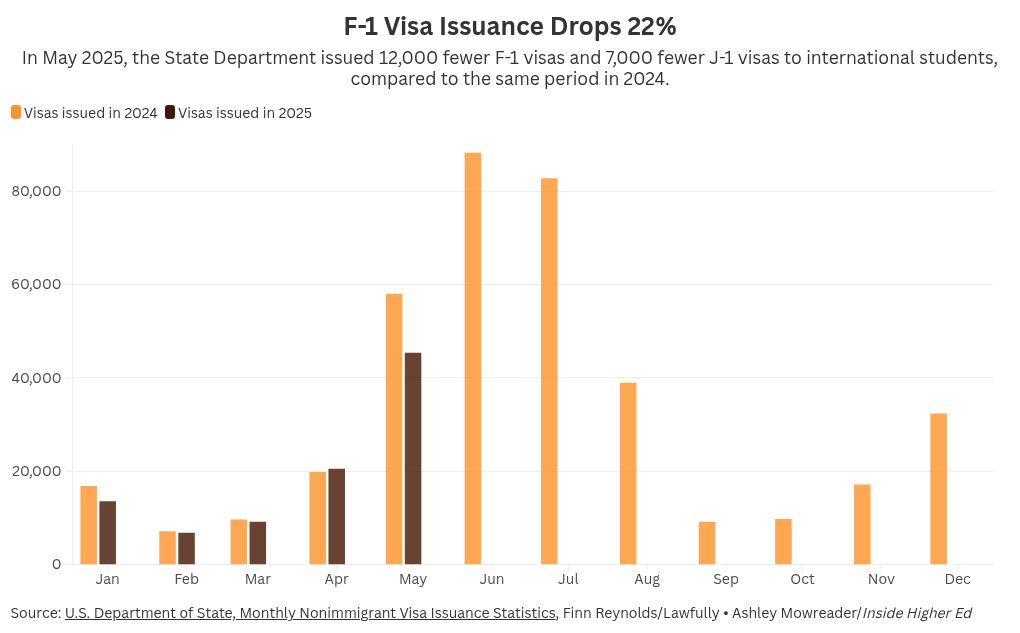
On June 4, President Trump signed an executive order restricting visitors from 19 countries, but visa issuances for students from those countries had already begun to drop. F-1 visa issuances declined 150 percent and J-1 issuances declined 105 percent in May compared to last year, according to an Inside Higher Ed analysis of State Department data.
Over all, F-1 and J-1 visa issuance dropped 12 percent from January to April 2025 and an additional 22 percent year over year in May. NASFA’s report estimates that June 2025 F-1 visa issuances will decline as much as 90 percent under the new policies.
NAFSA is urging Congress to direct the State Department to provide expedited visa appointments for F-1, M-1 and J-1 visa applicants as well as exempt international students from travel restrictions.
The projection does not reflect increasing anxieties among international students interested in studying in the U.S.; a May survey by Study Portals reported student interest in studying in the U.S. has dropped to its lowest point since COVID-19, with students considering other English-speaking nations like the U.K. or Australia instead.
Current visa projections only account for fall 2025 enrollment. In a July interview with Inside Higher Ed, Rachel Banks, senior director of public policy and legislative strategy at NAFSA, noted some colleges and universities are anticipating international students will be unable to make the start of classes in the fall but may be able to come to campus later in the term or in the winter.
Western New Mexico University is looking to claw back $1.9 million in severance already paid to former president Joseph Shepard, who stepped down in January following a spending scandal.
Shepard, who led the university for nearly 14 years, resigned late last year in the aftermath of media reports that found he spent university funds to upgrade the president’s house with lavish furniture. Critics also raised questions about costly recruiting trips to Greece, Spain and Zambia that yielded very few enrollments from those countries. The Office of the State Auditor determined in November that Shepard “engaged in the waste of public funds” and found instances where his travel appeared to be “unrelated to official university business.”
But in December, after the damning details came to light, board members—some of whom had joined the president on international trips—gave Shepard nearly $2 million in severance, plus additional fringe benefits and a five-year faculty contract that required him to teach six credit hours a year, though he had the option to do so online. Shepard’s annual faculty salary is set at $200,000, down from the base salary of $365,000 he was making as president.
The agreement prompted outrage at WNMU, which is located in one of the nation’s poorest states and has many low-income students. Democratic governor Michelle Lujan Grisham subsequently demanded the resignation of the board, who complied, and has since appointed new members.
Last week, the new board voided Shepard’s separation agreement and terminated his teaching contract, arguing that the regents who struck the deal did so improperly and in violation of New Mexico’s Open Meetings Act. State officials have made similar arguments in a related lawsuit.
A Board Reversal
WNMU regents took up Shepard’s contract and separation agreement at a Thursday meeting.
John V. Wertheim, one of the new regents appointed by the governor in recent months, argued that the prior board failed to provide proper notice of the action items at the December meeting where they approved Shepard’s contract. Given the alleged failure of compliance with New Mexico’s Open Meetings Act, Wertheim argued that the board’s approval of the deal was invalid.
In two separate motions, the board unanimously agreed to invalidate the deal and terminate Shepard’s teaching contract. Board Chair Steven Neville said the agreement is now “in limbo.”
Wertheim noted that while WNMU’s board hired special counsel to advise them on the matter, there are outstanding questions, many of which he said regents would not be able to answer immediately due to both the legal complexity of the issue and because it is a personnel matter.
“I’m sure both the press and the public are going to have a lot of questions, and all I ask is that there be patience … because all of these detailed questions, we don’t necessarily have the answers today to give everyone, but we will, in due course,” Wertheim said at the meeting.
Following the vote, Shepard accused WNMU in an emailed statement to Inside Higher Ed of orchestrating a smear campaign against him.
“After serving 14 exemplary years of advancing the university, it’s troubling that this new, Governor-appointed Board has chosen this path. This is a matter before the courts. The Board’s desire to attempt to circumvent the legal process is telling in that they know they can’t win where facts matter and are doing all they can to prevent the truth from being shared,” Shepard wrote, calling the move an effort to destroy his reputation and career.
But the state’s governor praised the board’s decisions as the “right thing.”
“They recognized that public dollars must serve the public good, not pad executive pockets during difficult transitions,” Lujan Grisham wrote on social media. “This decision represents exactly the kind of fiscal responsibility and accountability New Mexicans deserve from their public institutions. Our students and their families work too hard and sacrifice too much to see their tuition dollars and taxpayer investments squandered on excessive golden parachutes.”
What’s Next?
WNMU declined to provide a comment to Inside Higher Ed, noting the situation was a personnel matter. But according to board members’ remarks, a legal fight with Shepard is expected and a settlement remains a possibility.
Complicating the matter are two lawsuits brought by the state.
New Mexico attorney general Raúl Torrez filed a lawsuit earlier this year in an effort to void the contract and recover severance payments. Torrez argued regents breached their fiduciary duty by approving the costly agreement and violated open meeting laws at December’s meeting.
Torrez brought the initial complaint in January and amended it in February. While he initially attempted to block the payment, that effort was unsuccessful, as the funds had already been disbursed. The legal fight in that case is ongoing.
Then, in late June, the New Mexico State Ethics Commission also sued Shepard, accusing him of violating the Governmental Conduct Act, which applies to state employees. In addition to the prior complaints of lavish spending, the commission accused him of diverting $177,404 intended for an ADA-compliant walkway and ramp to instead construct a walkway and patio “for the purpose of hosting events related to his daughter’s wedding” held on campus.
(Shepard has denied that university funds were used to help pay for his daughter’s wedding.)
The lawsuit also alleges that as president, “Shepard had a practice of authorizing university expenditures from which he benefited that were only loosely connected to university purposes.”
The commission is seeking financial penalties and for Shepard to reimburse WNMU for the construction of the originally planned ADA-compliant ramp and walkway, which were not built.
Back at the university, board members say they are open to some financial compensation for the former president. Had Shepard been fired for cause, he would have received no severance. Had he been fired without cause, he would have received less than $600,000, per the contract he previously negotiated with the board in 2022.
Wertheim indicated at Thursday’s meeting a desire to reach a settlement.
“The best resolution for everyone is to get this in front of a retired judge or justice of the New Mexico Supreme Court to hammer out a fair, negotiated settlement,” he said at the meeting.
Before Thursday’s vote, Shepard was reportedly scheduled to teach two online classes this fall, including one on business ethics. However, Interim president Chris Maples told The Silver City Daily Press that he and other officials plan to meet to determine what will happen with those courses. And with the semester starting Aug. 15, they’ll need to make a decision soon.
“Whatever we do, we’ll do the best job we possibly can for our students,” he told the newspaper.
First-generation students can often feel alone or isolated on their college campuses, but a new initiative at the University of Texas, San Antonio, seeks to put first-generation student athletes in the spotlight.
Starting this fall, UTSA competitive athletes will be given special patches to place on their uniforms, recognizing their unique identity as a first-gen learner.
“We’ve been really intentional about telling the stories of our student athletes and sharing their personal stories that extend far beyond the fields and courts of competition,” said Lisa Campos, vice president for intercollegiate athletics and athletic director.
Approximately 45 percent of UTSA’s student population are the first in their families to attend college, and over one-third of student athletes (or 113 students) are also first-gen learners. So far, a majority of student athletes have opted to wear the patch—which displays the campus mascot, a roadrunner, and the words “first gen”—on their uniforms for the upcoming year, Campos said.
First gen in context: While NCAA student athletes are more likely to report thriving while in college, according to a study by Gallup, first-generation students are less likely to be engaged and connected on campus.
A 2023 Student Voice survey by Inside Higher Ed and College Pulse found 37 percent of first-gen students spent zero hours per week engaging in extracurricular activities, while just 25 percent of continuing-generation students reported spending no time participating in activities on campus.
Navigating institutional processes and the hidden curriculum of higher education can also be barriers to first-generation student success, because these students are less likely to ask for help or use campus resources.
“First-gen students need a lot of support and a lot of education about what the college experience is like because, unlike other students, there’s not someone in their household who can answer all of the questions they may have,” Campos said.
Past research shows, when given academic and emotional support, first-generation student athletes feel more driven and capable of graduating from their college or university.
Students on display: The patch is just one piece of how the university seeks to celebrate first-generation students’ identities. UTSA’s athletic department is in the middle of a campaign that highlights stories of first-generation students, coaches and staff, recognizing their unique experiences. The department is also creating a resource hub on its website for first-gen student athletes.
As a first-gen student herself, Campos said attending and graduating from college is a major accomplishment for these students because of how new and unfamiliar the experience can be. “It’s important to us to recognize those student athletes who every day are changing the trajectory of their families for generations to come.”
Many of UTSA’s athletic staff members, including those on the leadership team or senior staff, are also first-generation college graduates, which Campos said provides them a better understanding of how to support student athletes.
Across the university, first-generation students can participate in a mentorship program and other special programming from the First-Generation and Transfer Student division.
How does your campus celebrate first-generation student identities? Tell us about it.