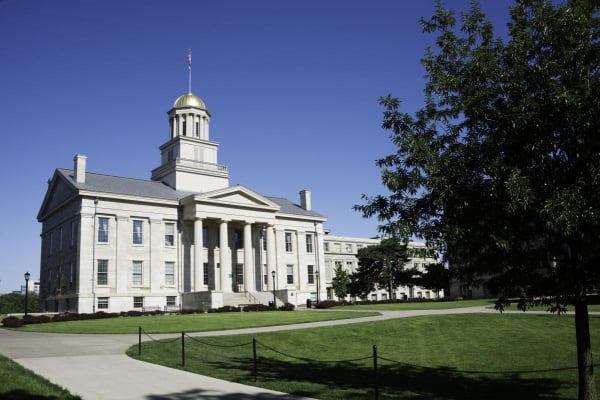
Following a complaint by Iowa governor Kim Reynolds, the state attorney general’s office is investigating a video that allegedly shows a University of Iowa administrator saying the institution is still promoting diversity, equity and inclusion, despite the state’s ban.
Fox News Digital published a story earlier this week based on what it called an “undercover video,” which shows a woman identified as Drea Tinoco, assistant director for leadership and student organization development at the university, saying, “On behalf of my office, we’re still going to talk about DEI, we’re still going to do all the DEI things.”
The story doesn’t specify who recorded the video or whether they were working for Fox or another entity. The conservative group Accuracy in Media has released similar videos allegedly revealing employees skirting DEI prohibitions in other states, but AIM president Adam Guillette said the video isn’t from his organization.
In the video, dated July 2, the woman also says, “DEI and student organizations and all of that, it is real, it still exists, we’re still doing DEI work.” Though it’s not in the clip, Fox also reported that Tinoco called Reynolds, a Republican, “cuckoo bananas.”
Tinoco didn’t respond to Inside Higher Ed’s requests for comment Thursday. In an email, a university spokesperson didn’t confirm or deny whether the video is real or whether Tinoco is the person shown in it, saying, “Personnel matters are considered confidential.”
Last year, Reynolds signed legislation banning DEI at public universities. In a statement Tuesday, Reynolds said, “I’m appalled by the remarks made in this video by a University of Iowa employee who blatantly admits to defying DEI restrictions I signed into law on May 9, 2024.”
She filed a complaint with Attorney General Brenna Bird, another Republican, who announced her office is investigating. University president Barbara Wilson additionally told the Iowa Board of Regents Wednesday that her institution has “launched an immediate and comprehensive investigation.”
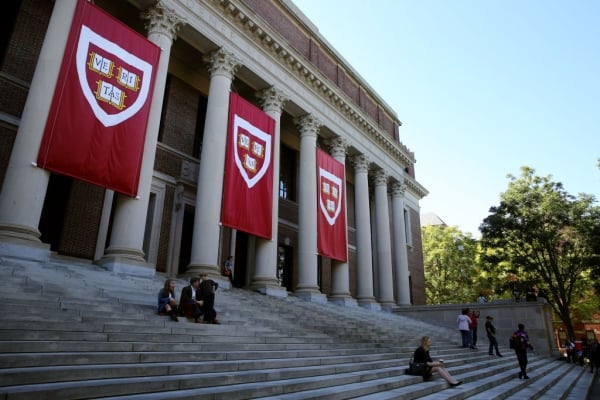
The Trump administration has accused Harvard University officials of failing to comply with an ongoing civil rights investigation into alleged campus antisemitism, The Boston Globe reported.
The U.S. Department of Health and Human Services said in a letter to Harvard president Alan Garber that it was referring the civil rights investigation to the U.S. Department of Justice, which it is permitted to do in cases where “compliance under Title VI cannot be obtained voluntarily.”
The letter, written by Paula Stannard, director of the HHS Office for Civil Rights, also referenced legal actions taken by Harvard, which has fought back against frozen federal research funding and other matters.
“Rather than voluntarily comply with its obligations under Title VI, Harvard has chosen scorched-earth litigation against the Federal government,” Stannard wrote. “The parties’ several months’ engagement has been fruitless.”
Harvard did not respond to a request for comment from Inside Higher Ed.
The letter comes as Harvard is reportedly considering a $500 million settlement with the Trump administration to close current investigations and unfreeze $2 billion in federal research funding. Harvard is reportedly mulling a settlement even though a judge appears to view its case favorably.
If Harvard settles, it will add to the list of wealthy and highly visible institutions that have yielded to the Trump administration’s demands in recent weeks. Columbia University agreed to far-reaching changes and a $221 million settlement to restore federal funding and close investigations into antisemitism on campus that stemmed from pro-Palestinian protests in 2024. Brown University also struck a deal with the Trump administration to restore $510 million in research funding, agreeing to various concessions but no payout to the federal government.
As a potential settlement with the Trump administration looms, some Harvard faculty members sent a letter to the president and board, urging Garber to push back on what they called “the Trump administration’s assault on the vibrancy and inclusiveness of U.S. higher education.”
Signed by multiple well-known scholars, the letter exhorted Garber not to “compromise core university and academic-freedom values that generations before us have worked to define and sustain,” and to resist ceding power to the federal government over hiring and admissions.
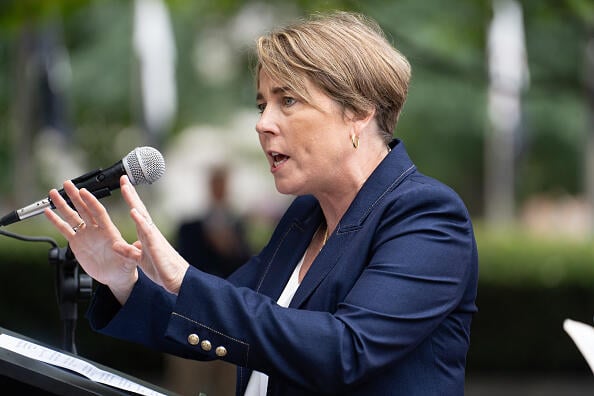
Massachusetts governor Maura Healey introduced legislation Thursday that would provide $400 million in state funding for research and development, including projects conducted by colleges and universities, The Boston Globe reported. The move appears to be an attempt to alleviate some of the pain caused by the Trump administration’s drastic federal funding cuts to higher ed institutions.
Introducing the legislation at the State House yesterday, Healey cited Massachusetts’ prowess as a research leader, noting that it has the highest percentage of STEM graduates and hosts 10 percent of all research and development jobs in the country. It is also home to Harvard University, which has had roughly $2.6 billion in funding frozen by the Trump administration.
“In the face of uncertainty from the federal government, this is about protecting one of the things that makes Massachusetts so special—our global leadership in health care and helping families across the world,” Healey said in a statement.
The plan calls for $200 million to be appropriated for research at hospitals, universities and independent research groups; the other $200 million will support the state’s public colleges and universities in covering the direct and indirect costs of research and partnerships, as well as hiring personnel. The funds must be approved by the Legislature.
Higher ed leaders applauded the move.
“University research fosters the creation of new knowledge, drives regional economies, and is vital to prepare the next generation of innovators,” said Northeastern University president Joseph Aoun in a statement. “I commend Governor Healey and her team for their commitment to ensuring Massachusetts remains a global leader in cutting-edge research.”
“In moments of uncertainty, it is essential that we protect the integrity of Massachusetts’ renowned biomedical research ecosystem, which contributes immensely to our nation’s research enterprise,” said Michael Collins, chancellor of the UMass Chan Medical School. “We are profoundly grateful to Governor Healey and her administration for their leadership in recognizing the urgent need to support research and innovation in the commonwealth, and we look forward to working with the Legislature to assure passage of this timely initiative.”
The $221 million settlement with the Trump administration by Columbia University (and a similar $50 million deal by Brown University) represent a terrible capitulation by these campus leaders. AAUP president Todd Wolfson called the settlement “a disaster for Columbia students, faculty, and staff, as well as for academic freedom, freedom of speech, and the independence of colleges and universities nationwide. Never in the history of our nation has an educational institution so thoroughly bent to the will of an autocrat.”
Columbia and Brown had slam-dunk legal cases against the Trump administration, which clearly violated the processes required under Title VI when they suspended funding. (Brown was never notified of any reasons for the funding to be cut off, and there wasn’t even the pretense of a finding of antisemitic discrimination.) By making a settlement, universities give up their legal rights to challenge this repression, agree to impose massive censorship and pay a huge sum for the privilege of sacrificing their values.
It’s possible that the leaders of Columbia and Brown made this agreement because they concluded that Trump is a pathological liar, a petty dictator, a petulant lawbreaker intent on taking revenge against any perceived enemy and a president who will simply ignore any adverse judicial rulings. That analysis is accurate. But if you think Trump will ignore the law and violate any rules, then trusting his regime to obey a legal settlement is just as crazy.
The settlements include a bizarre amount of federal micromanagement of private universities, requiring Brown to provide single-sex floors in student housing, ban admissions decisions using personal statements that mention race and conduct a survey about antisemitism by the end of the year and take “appropriate action” in response. Even the smallest violation of the numerous requirements could be used to justify a future cutoff in federal funds.
The same officials who made ludicrous accusations of antisemitic discrimination to punish these universities will get to decide if the colleges are violating the agreement and deserve to be punished. While the agreements settle the old baseless charges, nothing prevents new baseless charges from being filed and leading to the same illegal funding cuts. Colleges that settle with the Trump administration have no guarantee of safety from further retaliation, and Trump officials will actually use these settlements to demand a tighter reign of censorship.
The New York Timesreported about those praising the Columbia agreement, “Many have focused on a provision that said no part of the settlement ‘shall be construed as giving the United States authority to dictate faculty hiring, university hiring, admissions decisions or the content of academic speech.’” Far from being a positive protection for intellectual liberty, this language is actually a terrible threat to free expression on campus.
By only protecting academic speech, this provision leaves the door wide open for government-imposed repression. Most expression on college campuses is not academic speech. The extramural utterances of faculty, along with virtually all student speech, is not academic speech and therefore is open to any suppression by the government under this agreement. But protecting extramural utterances is an essential part of academic freedom and has been a fundamental aspect of its definition since the AAUP’s 1915 Declaration of Principles.
While the provision says that the government can’t “dictate faculty hiring,” there’s nothing about dictating faculty firings. By solely protecting hiring decisions, Columbia leaves the door wide-open for purging faculty, staff and students who are deemed undesirable by the Trump administration.
In an email to the campus, Brown president Christina H. Paxson wrote that the first key aspect of the settlement was that “no provision of this Agreement, individually or taken together, shall be construed as giving the United States authority to dictate Brown’s curriculum or the content of academic speech.” (Brown apparently didn’t bother to follow Columbia and get a ban on federal control over its hiring decisions, which is an alarming omission.)
Some people might think that paying $221 million to get $400 million in research grants is a good bargain. Federal grants aren’t free money for colleges. All of the funding goes to research expenses. Now that the Trump administration has arbitrarily lowered the indirect cost rate to 15 percent, government-sponsored research is much less profitable for colleges—and possibly an expense they must subsidize. Certainly, Columbia will be losing money by paying $221 million to get access to $400 million in grants.
Paramount bribed Donald Trump a mere $16 million (and purged a few critics) in order to get approved an $8 billion merger that can’t be undone. As terrible as Paramount’s submission to Trump was, Columbia purged far more students and spent 13 times as much to get a deal worth 1/20th the value that increases ongoing federal control over Columbia. Paramount and Columbia executives may share a moral gutter, but at least Paramount’s bribe made financial sense.
Worse yet, by making a settlement, Columbia loses that $221 million forever, with no opportunity to prevail in court and receive the full funding their researchers are entitled to. By agreeing to obey the government, Columbia hurts its legal options to challenge future funding cutoffs, because the government can claim that Columbia failed to live up to the terms of the settlement. If the courts rule against the Trump administration’s illegal actions, Columbia and Brown will still be forced to pay these millions, impose repressive censorship and face retaliation without legal recourse.
The Columbia capitulation sets a precedent for Harvard to pay an even bigger settlement, estimated at up to $500 million. Unfortunately, hapless apologists for repression such as former Harvard president Larry Summers are urging Harvard to follow Columbia’s model, and Summers praised the Columbia capitulation as “the best day higher education has had in the last year.” Summers claimed, “The prestige of the university is not to be arrogated by faculty members in support of any set of political convictions, particularly those in leadership positions of academic units.”
Let me translate this: Professors should not be allowed to express political views. For believers in censorship such as Summers, the desire to suppress academic freedom finds a convenient partner in the Trump administration.
Universities are making these deals with the Trump regime not in spite of the requirements for censorship, but because of those restrictions. The provisions in these settlements enhance administrative power to suppress dissent, and that’s precisely what makes them so appealing to some campus administrators.
Columbia and other colleges are trapped in a no-win situation, but even difficult moral dilemmas have wrong answers, and that’s what Columbia’s leadership has chosen. Let’s hope Harvard is not the next lemming to throw itself over the cliff and sacrifice its core values, its donor money and its common sense in the vain hope that fawning obedience and bribery can satisfy the vengeance of a mad leader.
The Justice Department this week accused UCLA of failing to protect its Jewish students.
Frederic J. Brown/AFP via Getty Images
(This article has been updated with comment from UCLA.)
The National Science Foundation said Thursday that it’s suspending grant awards at the University of California, Los Angeles.
An NSF spokesperson said that the university’s awards “are not in alignment with current NSF priorities and/or programmatic goals,” though they didn’t offer more specifics. NSF changed its priorities in April and, as a result, cut off funding to programs related to diversity, equity and inclusion and those aimed at combating misinformation
Freelance journalist Dan Garisto wrote on BlueSky that nearly 300 grants at UCLA are now suspended. That includes a $25 million grant that supports the university’s Institute for Pure and Applied Mathematics. (In 2022, UCLA had about 450 grants from the NSF, totaling more than $350 million.)
UCLA chancellor Julio Frenk wrote in a letter to the campus community that the freeze extended beyond NSF to include grants from the National Institutes of Health and other federal agencies.
“This is not only a loss to the researchers who rely on critical grants,” Frenk wrote. “It is a loss for Americans across the nation whose work, health, and future depend on the groundbreaking work we do.”
Frenk noted that UCLA was prepared for a grant freeze and has developed contingency plans. “We will do everything we can to protect the interests of faculty, students and staff—and to defend our values and principles,” he pledged.
The Associated Pressreported that the freeze affected $339 million in federal grants.
The grant suspension comes as UCLA finds itself the Trump administration’s latest target in its growing war with higher education. Earlier this week, the university settled a lawsuit in which a group of Jewish students alleged that UCLA enabled pro-Palestinian activists to cut off Jewish students’ access to parts of campus. On the same day the settlement was announced, the Justice Department accused UCLA of violating the federal civil rights law that bars antisemitism and race-based discrimination.
Frenk said the government claimed “antisemitism and bias as the reasons” for the freeze. But he argued that Trump’s “far-reaching penalty of defunding life-saving research does nothing to address any alleged discrimination.”
He added that UCLA shares the goal of eradicating antisemitism, detailing the steps the university has taken in the last year to address the issue, including establishing new policies for campus protests.
UCLA has until Aug. 5 to respond to the DOJ’s notice of violation; DOJ officials threatened that the university would “pay a heavy price for putting Jewish Americans at risk.” The Justice Department is also investigating the admissions practices at UCLA, but that inquiry hasn’t wrapped up yet.
Senate Republicans are planning to protect the Pell Grant program, keeping the maximum grant award at $7,395 for the coming academic year, despite the Trump administration’s proposal to lower it to $5,710.
The rejection of Pell Grant cuts at a key committee markup Thursday is just the latest rebuke from congressional appropriators as lawmakers in both chambers have appeared wary of President Trump’s plans to shutter offices, gut programs and generally reshape the federal government.
In addition to protecting $22.5 billion for Pell, the GOP also spared TRIO, campus childcare subsidies and numerous other programs that Trump had proposed zeroing out. It also set new staffing standards for the recently gutted Department of Education, increased funding for medical research by $400 million and rejected the National Institutes of Health’s attempt to cap indirect research cost reimbursements at 15 percent. The legislation also restricts other efforts at NIH to change how grants are awarded, though Democrats say “more needs to be done to protect NIH research programs.”
Over all, the Department of Education is going to receive $79 billion and the NIH will get $48.7 billion. In comparison, Trump had requested $66.7 billion for ED and $27.5 billion for NIH.
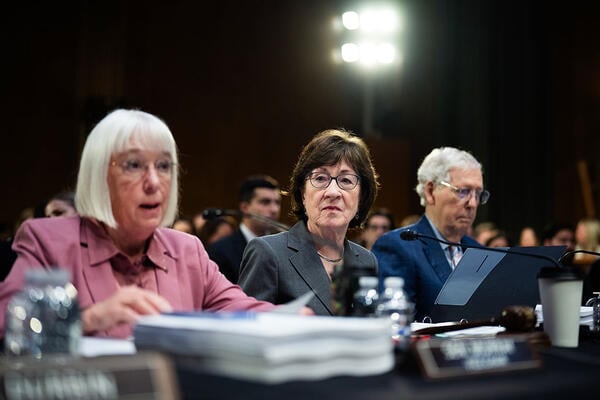
Committee chair Sen. Susan Collins, a Maine Republican, said she was proud of the legislation that advanced Thursday, calling it a bipartisan effort to fund the health and education of American families. She noted that “the appropriations process is the key way that Congress carries out its constitutional responsibility for the power of the purse.”
But Democrats, while overall supportive, noted that they’ve had to make a number of compromises already and warned that Trump could still attempt to make unilateral changes moving forward.
“These are not the bills I would have written on my own, but nonetheless they represent serious bipartisan work to make some truly critical investments in our country and families’ future,” said Sen. Patty Murray, a Washington Democrat and ranking member of the committee. Still, she added, this is only half the battle. “The fact of the matter is we have an administration right now that is intent on ignoring Congress, breaking the law and doing everything it can without transparency to dismantle programs and agencies.”
The Trump administration has repeatedly frozen or cut grant funding, largely declining to spend money that Congress appropriated—moves that Murray and others have decried as illegal. More recently, the administration waited weeks before sending critical funding to states that supports after-school programs, migrant education and adult education. About $7 billion was affected, and colleges had to scramble to find a way to fill the funding gaps before Trump’s Office of Management and Budget finally released the money last week. Meanwhile, colleges are still waiting for the Education Department to open up grant applications for millions in funds.
At NIH, grant cancellations and other changes have slowed the flow of research funding to colleges. Earlier this week the administration briefly paused all new grant awards, infuriating congressional Democrats. Over all, since Trump took office, the biomedical research agency has cut more than 4,000 grants at 600 institutions totaling somewhere between $6.9 billion and $8.2 billion.
Beyond the grant cuts, the Trump administration recently clawed back money that had been allocated to public broadcasting, using a legislative process called rescission. The president is expected to propose a second rescission package in the months to come, this time targeting education dollars. Democrats have warned that using rescissions to change the budget could endanger talks on fiscal year 2026 spending.
So while higher ed lobbyists typically look to the Senate’s spending plan as the framework for what to expect in the final bill, Trump’s willingness to test the limits of executive power complicates the picture.
Still, the Senate’s proposals for the NIH as well as the Education Department, which funds a number of programs at the previous year’s level, is a victory for advocates who spent months warning that Trump’s budget cuts would be devastating for students and research.
“We are not surprised by what we’ve seen. The Senate often works more bipartisanly together, and that was reflected in the markup today,” said Emmanual Guillory, senior director of government relations at the American Council on Education. “In this political environment, flat funding is a win. It’s not ideal, but it is us being mindful of the current realities that we’re in and the financial constraints that we’re in, especially with the upcoming rescissions package that’s supposed to include education.”
That said, Guillory noted that he’s bracing for deeper cuts from the House, which has yet to release its education and health spending proposals.
“I could see the House having a bit more influence [than most years past], as they have had more influence so far this Congress,” he said.
Seeking Guardrails
Democrats did try to amend the bill in order to establish guardrails that would retroactively address Trump’s funding cuts and protect the fiscal year 2026 appropriations from a similar ambush.
Sen. Dick Durbin, an Illinois Democrat, proposed reinstating all college grants frozen or retracted since Jan. 28, with the exception of those pulled due to financial malfeasance. He highlighted how, in Chicago, the cuts have halted infant heart defect research and then ran through a lengthy list of other medical projects affected in other senators’ districts.
“This could happen to any of your states’ research centers. It could hurt any of your families,” he argued.
Later, Sen. Chris Murphy of Connecticut, one of the few Democrats who did not support the bill, sought an inspector general report into whether the Department of Education’s civil rights office is properly following statutes when investigating discrimination complaints and issuing discipline.
Murphy proposed withholding OCR funding until the appropriations committee received the IG’s report.
“My worry is simply that the president is going to ignore the will of Congress that is present in this legislation,” he said. “If this does become normalized—if the president of the United States gets to deny funds to universities because they don’t like political viewpoints of the student body or of the faculty—that is a Pandora’s box that is hard to ever again close.”
Sen. Shelley Moore Capito, the West Virginia Republican who leads the education and health subcommittee, shot down both proposals, calling Murphy’s amendment “contrary to the point of the [OCR] office” and Durbin’s “too broad.”
“I think every administration has the prerogative to implement new goals and priorities,” she said.
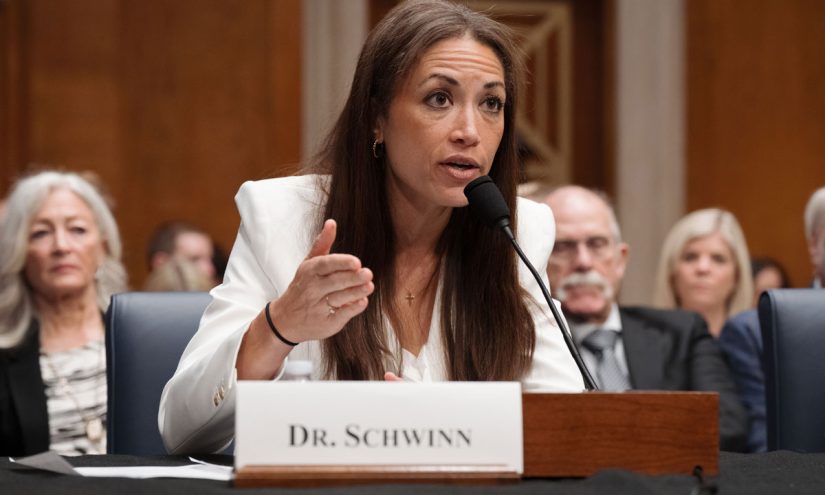
Penny Schwinn, in line to serve as second in command of the U.S. Department of Education, has withdrawn from the nomination, Education Secretary Linda McMahon announced Thursday.
Instead, the former Tennessee education commissioner will take on a different role for the department.
“I am grateful to Dr. Schwinn for her commitment to serving students, families, and educators across the nation,” McMahon said in a statement. “Penny is a brilliant education mind and I look forward to continuing working with her as my chief strategist to make education great again.”
Schwinn, in a statement, said she gave the decision “thoughtful consideration” and said she will “remain committed to protecting kids, raising achievement and expanding opportunity — my lifelong mission and north star.”
Considered a champion for improving reading outcomes and high-dosage tutoring, Schwinn was among President Donald Trump’s early picks for department posts. Many perceived her as a more bipartisan choice than others joining the administration, but among Tennessee conservatives, many who felt she was too liberal, opposition to her nomination was strong.
The timing of Schwinn’s withdrawal couldn’t be worse, according to some conservatives.
“Her decision to remove herself from consideration to become deputy secretary hurts students, educators, and the Trump administration,” said Jim Blew, co-founder of the Defense of Freedom Institute, a think tank. “Secretary McMahon has been charged by Congress and the president with huge tasks under the One Big Beautiful Bill and several urgent executive orders.”
As head of the Education Department, McMahon is striving to turn more authority over education to the states. It’s now unclear who will step into the deputy position and take the lead on the state’s requests for more flexibility over education funding. At least two states, Iowa and Oklahoma, have already submitted requests for block grants, and Indiana is currently gathering comments from the public in preparation for a similar proposal. Kirsten Baesler, North Dakota’s long-time education chief, is currently awaiting confirmation to be assistant secretary for elementary and secondary education at the department. In February, she joined 11 other GOP chiefs in asking McMahon for greater freedom to direct education funds toward state-level needs.
Controversies and questions over Schwinn’s conservative qualifications have followed her for years. Far-right groups, including Moms for Liberty, said her past support for equity initiatives, like hiring more teachers of color, was evidence that she was not a good fit for an administration determined to eliminate such programs. Others remained angry over Schwinn’s pandemic-era plan to conduct “well-being” home visits. Even though she scrapped the plan, parents and members of the legislature considered it an example of government overreach.
More recently, Steve Gill, a conservative commentator in Tennessee, reported that while she was deputy superintendent of the Texas Education Agency, Schwinn recommended individuals who advocate for comprehensive sex education, including abortion rights, to advise the state on health curriculum.
Gill told The 74 he shared his TriStar Daily article about her stance on these issues with Tennessee Sens. Marsha Blackburn and Bill Hagerty, as well as the state’s congressional delegation. Blackburn, who is expected to run for governor next year, was considered a possible no vote for Schwinn.
According to Gill, Blackburn’s office “has been working tirelessly behind the scenes with the White House, Secretary Linda McMahon and Majority Leader [John] Thune to block the confirmation.”
But Madi Biedermann, spokeswoman for the department, said the agency “strongly disagrees with that characterization.”
Republican Sen. Marsha Blackburn from Tennessee was expected to vote no on Penny Schwinn’s confirmation. (Anna Moneymaker/Getty Images)
Blew said it’s unfortunate that politics got in the way, noting that Schwinn’s experience in both blue and red states would have brought valuable expertise to the Ed Department role. In addition to her jobs in Tennessee and Texas, Schwinn founded a charter school in Sacramento and also served in the Delaware Department of Education.
“It’s sad that a handful of demagogues are standing in the way of giving Secretary McMahon the team she needs to succeed,” he said.
Others praised Schwinn’s record of prioritizing the science of reading in Tennessee schools and directing COVID relief funds toward tutoring.
“This is a setback for all who want to see Washington slashing red tape, advancing literacy and fighting for common sense values,” said Rick Hess, director of education policy studies at the conservative American Enterprise Institute.
For some critics, Schwinn’s business ventures since leaving the top spot in Tennessee two years ago raised questions as she waited to appear before the Senate education committee.
In June, a day ahead of her joint hearing with three other nominees, The 74 reported that shortly after Trump tapped her for the job, she registered a new education consulting business in Florida, New Horizon BluePrint Group, with a longtime colleague. Before Schwinn filed ethics paperwork with the federal government, her sister replaced her as a manager on the business.
When a reporter from The 74 asked questions about the new project, Donald Fennoy, her colleague and a former superintendent of the Palm Beach County School District, dissolved the business.
Ethics experts say candidates for an administration post often distance themselves from new business entanglements to avoid any appearance of a conflict, but Schwinn has faced accusations of poor judgment before.
While she was in Texas, the state agency signed a $4.4 million no-bid contract in 2017 with a software company where she had a “professional relationship” with a subcontractor, according to a state audit. And in Tennessee, the education agency made an $8 million deal in 2021 with TNTP, a teacher training organization where her husband Paul Schwinn was employed at the time. Lawmakers considered the deal a “huge conflict.”
“Ethics was a crucial concern,” said J.C. Bowman, executive director and CEO of Professional Educators of Tennessee, a non-union organization. He was among those who sent letters to the Senate, asking them to remove her from consideration. “Her personal business interests and possible conflicts could potentially influence educational decisions in ways that many found difficult to overlook.”
Clarification: An earlier version of this story mischaracterized the role Penny Schwinn will take on in lieu of serving as the deputy education secretary. Schwinn will be taking on an advisory role at the Education Department.
A colleague of ours recently attended an AI training where the opening slide featured a list of all the ways AI can revolutionize our classrooms. Grading was listed at the top. Sure, AI can grade papers in mere seconds, but should it?
As one of our students, Jane, stated: “It has a rubric and can quantify it. It has benchmarks. But that is not what actually goes into writing.” Our students recognize that AI cannot replace the empathy and deep understanding that recognizes the growth, effort, and development of their voice. What concerns us most about grading our students’ written work with AI is the transformation of their audience from human to robot.
If we teach our students throughout their writing lives that what the grading robot says matters most, then we are teaching them that their audience doesn’t matter. As Wyatt, another student, put it: “If you can use AI to grade me, I can use AI to write.” NCTE, in its position statements for Generative AI, reminds us that writing is a human act, not a mechanical one. Reducing it to automated scores undermines its value and teaches students, like Wyatt and Jane, that the only time we write is for a grade. That is a future of teaching writing we hope to never see.
We need to pause when tech companies tout AI as the grader of student writing. This isn’t a question of capability. AI can score essays. It can be calibrated to rubrics. It can, as Jane
said, provide students with encouragement and feedback specific to their developing skills. And we have no doubt it has the potential to make a teacher’s grading life easier. But just because we can outsource some educational functions to technology doesn’t mean we should.
It is bad enough how many students already see their teacher as their only audience. Or worse, when students are writing for teachers who see their written work strictly through the lens of a rubric, their audience is limited to the rubric. Even those options are better than writing for a bot. Instead, let’s question how often our students write to a broader audience of their peers, parents, community, or a panel of judges for a writing contest. We need to reengage with writing as a process and implement AI as a guide or aide rather than a judge with the last word on an essay score.
Our best foot forward is to put AI in its place. The use of AI in the writing process is better served in the developing stages of writing. AI is excellent as a guide for brainstorming. It can help in a variety of ways when a student is struggling and looking for five alternatives to their current ending or an idea for a metaphor. And if you or your students like AI’s grading feature, they can paste their work into a bot for feedback prior to handing it in as a final draft.
We need to recognize that there are grave consequences if we let a bot do all the grading. As teachers, we should recognize bot grading for what it is: automated education. We can and should leave the promises of hundreds of essays graded in an hour for the standardized test providers. Our classrooms are alive with people who have stories to tell, arguments to make, and research to conduct. We see our students beyond the raw data of their work. We recognize that the poem our student has written for their sick grandparent might be a little flawed, but it matters a whole lot to the person writing it and to the person they are writing it for. We see the excitement or determination in our students’ eyes when they’ve chosen a research topic that is important to them. They want their cause to be known and understood by others, not processed and graded by a bot.
The adoption of AI into education should be conducted with caution. Many educators are experimenting with using AI tools in thoughtful and student-centered ways. In a recent article, David Cutler describes his experience using an AI-assisted platform to provide feedback on his students’ essays. While Cutler found the tool surprisingly accurate and helpful, the true value lies in the feedback being used as part of the revision process. As this article reinforces, the role of a teacher is not just to grade, but to support and guide learning. When used intentionally (and we emphasize, as in-process feedback) AI can enhance that learning, but the final word, and the relationship behind it, must still come from a human being.
When we hand over grading to AI, we risk handing over something much bigger–our students’ belief that their words matter and deserve an audience. Our students don’t write to impress a rubric, they write to be heard. And when we replace the reader with a robot, we risk teaching our students that their voices only matter to the machine. We need to let AI support the writing process, not define the product. Let it offer ideas, not deliver grades. When we use it at the right moments and for the right reasons, it can make us better teachers and help our students grow. But let’s never confuse efficiency with empathy. Or algorithms with understanding.
Dennis Magliozzi & Kristina Peterson, University of New Hampshire’s Writers Academy
Kristina Peterson and Dennis Magliozzi have been teaching English since 2008. Kristina has a master’s degree in teaching and over a decade of experience mentoring teachers. Dennis holds an MFA in poetry and a PhD from the University of New Hampshire. Together, they co-teach in the University of New Hampshire’s Writers Academy and Learning Through Teaching program. Their work on generative AI’s impact in the classroom is highlighted on Heinemann’s blog, and in their forthcoming book, AI in the Writing Workshop: Finding the Write Balance.
Latest posts by eSchool Media Contributors (see all)
Institutions should be thinking about how all kinds of learners fit into their learning environments and avoid viewing online and in-person courses as distinct environments, according to Stephanie Moore, an associate professor in organization, information and learning sciences at the University of New Mexico.
“Higher ed is not just simply face-to-face but rather additional modalities of online or blended,” she said. “If an institution is planning strategically around these, then you’re better able to meet a range of diverse learner needs—and oh, by the way, that gives your institutions some pretty tremendous resilience and flexibility that if you ever have to shift or pivot in emergencies, [you can].”
The latest episode of The Key, Inside Higher Ed’s news and analysis podcast, features an interview between Moore and IHE’s senior editor for special content, Colleen Flaherty, recorded at the Digital Universities conference in Salt Lake City in June.
Moore discusses how to scale feedback and a foster a sense of connection in online learning ecosystems and why she thinks AI will not be more disruptive than any other communication technology that’s come before it.
Another academic year is fast approaching, and with it another promotion and tenure cycle in which faculty members will prepare dossiers for promotion. Some, but not all, universities have detailed instructions on what and what not to include in the dossier. At many research institutions, the service section consists of a list of committees on which the faculty member has served with little information about the nature of their participation. Having managed promotion and tenure at multiple institutions, I know that faculty members are often told to check the service boxes and move on.
Yet, the pandemic and its aftermath threw into high relief what most faculty members already knew: Faculty service is a mission-critical portion of workloads and highly undervalued by our institutions. We also know that mission-critical workload is unevenly allocated to and carried out by some faculty members while others either refuse to participate, focus their service outside the institution for the profession or participate as free riders while others pull their load. This leads to conversations about “service slacking” and “service shaming.” Articles abound with useful suggestions on how to address the uneven distribution of service, including advice on how to say no. And the Faculty Workload Equity project, part of an NSF ADVANCE award to the University of Maryland, provides important tools to better understand the contours of differential workloads and ways to create transparency around them.
This conversation is not new; Joya Misra and colleagues suggested in 2011 that changing the culture around service is essential in order to find ways to distribute the workload more evenly and to develop reward mechanisms for doing critical service in mission-central areas like curricular reform or student outcomes assessment. More than 10 years later, this conversation seems to have stalled. Properly recognizing the value of service would be a good way to restart it.
Articulating the Value of Service
Let me start with a story. About 15 years ago, I co-chaired my institution’s reaccreditation bid with the North Central Association of Colleges and Schools. We were tasked, among other things, with collecting information about how our faculty engaged in outreach to our community. Our campus survey about community engagement came back with pitifully little data. We realized that we needed to excavate the information. After visits to lots of faculty meetings, we had an amazingly rich list of ways our faculty were engaging with schools, nonprofits and local governments in our area. To my question about why these activities didn’t appear in any university document, faculty members universally replied that they didn’t think anyone cared.
As Cullen C. Merrit recently argued, service and engagement activities are ways that the academy provides value to society at large. I agree. Yet we cannot value or demonstrate the impact of what we don’t document.
To that end, colleges can launch a service portfolio that faculty can submit as part of promotion and performance-review processes. The service portfolio documents the range of service activities for each faculty member, as well as success metrics that demonstrate their impact on students, other faculty and the institutional mission. Identifying impact is a first step in increasing the value our institutions place on service activities and establishing fairer systems of allocation and rewards.
The Service Portfolio
Before you stop reading because no one wants to do more service work, a service portfolio can help bring attention to the value of work by demonstrating the impacts and outcomes. Indeed, some universities and colleges already have faculty members provide such information about service; others make suggestions about how to craft a promotion and tenure service and engagement dossier.
As with a teaching portfolio, a service portfolio is a structured assemblage of contributions to mission-critical activities around student and faculty success (e.g., mentoring, curriculum development, professional development) and engagement with local and regional communities (e.g., support for K–12 education, support for local governmental and nongovernmental agencies).
Service portfolio guidelines could begin by listing elements of the stated mission or the strategic planning goals at the department, college/school and institution levels. In consultation with department chairs or deans, faculty members would then select those elements to which they contribute through their service activities. In addition to describing their contributions, faculty could describe outcomes and impacts either in terms of future goals or what can already be measured.
For example, a faculty member might want to prioritize curriculum development or faculty mentoring. In that case, we might expect them to serve locally or institutionally in those areas, to engage in professional development opportunities, or to develop community engagement activities related to their specializations. A focus on value requires that the service portfolio identify the impacts or expected outcomes of each activity. For example, participation in a curriculum revision might result in higher learning outcomes or lower DFW rates. Faculty mentoring can result in improved teaching outcomes, enhanced research productivity and an improved work environment.
There are numerous advantages of a service portfolio over the current way of counting the number of committees on which we serve. First, faculty members can gain agency in the way that they shape and narrate their own contributions to the institutional mission through service. Agency is a motivating factor that might encourage yet more engagement. Faculty members will have a harder time free riding on a committee when they must articulate their contributions and when those contributions are then reviewed by departmental peers. Equity-minded faculty members and chairs/heads will be better able to track individual contributions and ensure that service is equitably allocated. And chairs and departmental colleagues who are impressed with a particular faculty member’s service contributions will be better positioned to suggest that recognition or reward for those contributions may be in order.
To be sure, putting together a service portfolio will require extra time, something that faculty members do not have lots of. But the relatively small time commitment can result in significant benefits to faculty and to the institution. Intentional and agentic shaping of service and engagement workloads can ensure that mission-critical work is accomplished in a visible way and can be assessed for impact. Perhaps most importantly, a service portfolio gives information and tools to our colleagues to amplify impactful and valuable activities.
Beth Mitchneck is professor emerita in the School of Geography, Development and Environment at the University of Arizona.