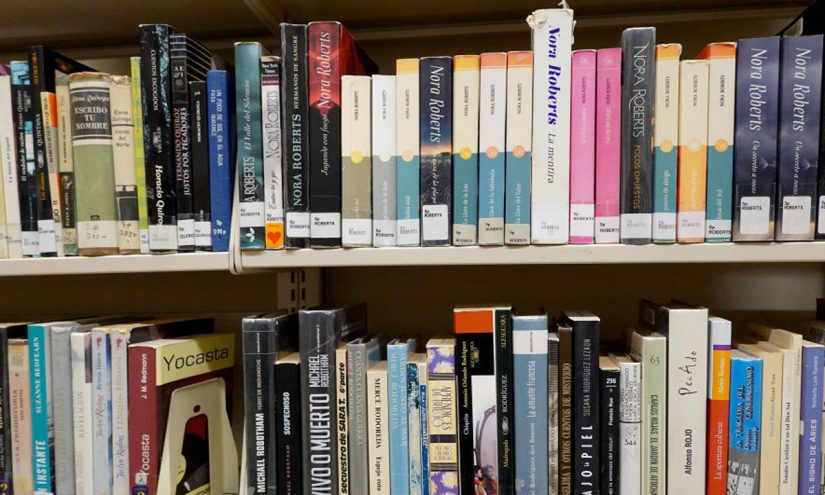
State lawmakers across the country filed more bills to restrict or protect libraries and readers in the first half of this year than last year, a new report found.
The split fell largely along geographic lines, according to the report from EveryLibrary, a group that advocates against book bans and censorship.
Between January and July 2025, lawmakers introduced 133 bills that the organization deemed harmful to libraries, librarians or readers’ rights in 33 states — an increase from 121 bills in all of 2024. Fourteen of those measures had passed as of mid-July.
At the same time, legislators introduced 76 bills in 32 states to protect library services or affirm the right to read, the report found.
The geographic split among these policies is stark.
In Southern and Plains states, new laws increasingly criminalize certain actions of librarians, restrict access to materials about gender and race, and transfer decision-making power to politically appointed boards or parent-led councils.
Texas alone passed a trio of sweeping laws stripping educators of certain legal protections when providing potentially obscene materials; banning public funding for instructional materials containing obscene content; and giving parents more authority over student reading choices and new library additions.
Tennessee lowered the bar to prosecute educators for sharing books that might be considered “harmful to minors.”
A New Hampshire bill likewise would’ve made it easier for parents or the state attorney general to bring civil actions against school employees for distributing material deemed harmful to minors, but it was vetoed by Republican Gov. Kelly Ayotte.
In Nebraska, a new law allows for real-time alerts for parents every time a student checks out a book. South Dakota requires libraries and schools to install filtering software. New laws in Idaho heighten the requirements to form library districts and mandate stricter internet filtering policies that are tied to state funding.
In contrast, several Northeastern states have passed legislation protections for libraries and librarians and anti-censorship laws.
New Jersey, Delaware, Rhode Island and Connecticut have each enacted “freedom to read” or other laws that codify protections against ideological censorship in libraries.
Connecticut also took a major step in modernizing libraries in the digital age, the report said, becoming the first state in the nation to pass a law regulating how libraries license and manage e-books and digital audiobooks.
Stateline reporter Robbie Sequeira can be reached at [email protected].
Stateline is part of States Newsroom, a nonprofit news network supported by grants and a coalition of donors as a 501c(3) public charity. Stateline maintains editorial independence. Contact Editor Scott S. Greenberger for questions: [email protected].
Fewer than 52% of Indiana high school graduates from the Class of 2023 went directly to college, according to the latest data quietly released by the Indiana Commission for Higher Education.
Just 51.7% of 2023 graduates, about 39,000 students, enrolled in college within a year of finishing high school, data showed. That’s down from a steady 53% between 2020 and 2022, and far below the state’s peak of 65% a decade ago.
Around 36% of all graduating seniors enrolled in one of Indiana’s public four-year institutions, followed by 8% who chose a private college or university.
Another 7.6% went to a school outside of Indiana, according to the data.
The figures, posted to the agency’s website earlier this month, reflect concerns state leaders have long expressed about Indiana’s declining college-going culture, especially as the state shifts focus toward career credentials and work-based learning.
“The startling drop in our college-going rate yet again can be credited to the lack of two things: money and morale,” said Rep. Ed DeLaney, D-Indianapolis, in a statement released Wednesday.
“While our governor has been taking a victory lap for getting our state universities to freeze tuition, he has failed to guarantee that his move will not decrease financial aid and scholarship opportunities,” DeLaney continued. “Any lack of opportunity for tuition support will lead to more Hoosiers not being able to afford college and being forced to choose a different path.”
The 2023 numbers come just six months after the higher education commission approved sweeping changes to Indiana’s high school diploma, set to take effect statewide in 2029, that emphasize work-based learning and career readiness over traditional college preparation.
High schoolers will be required to earn at least one “diploma seal” to graduate, including options for employment or postsecondary readiness. While some seal options are specifically geared toward college-bound students, graduates will no longer be required to complete all the coursework or meet other criteria typically expected for college admission.
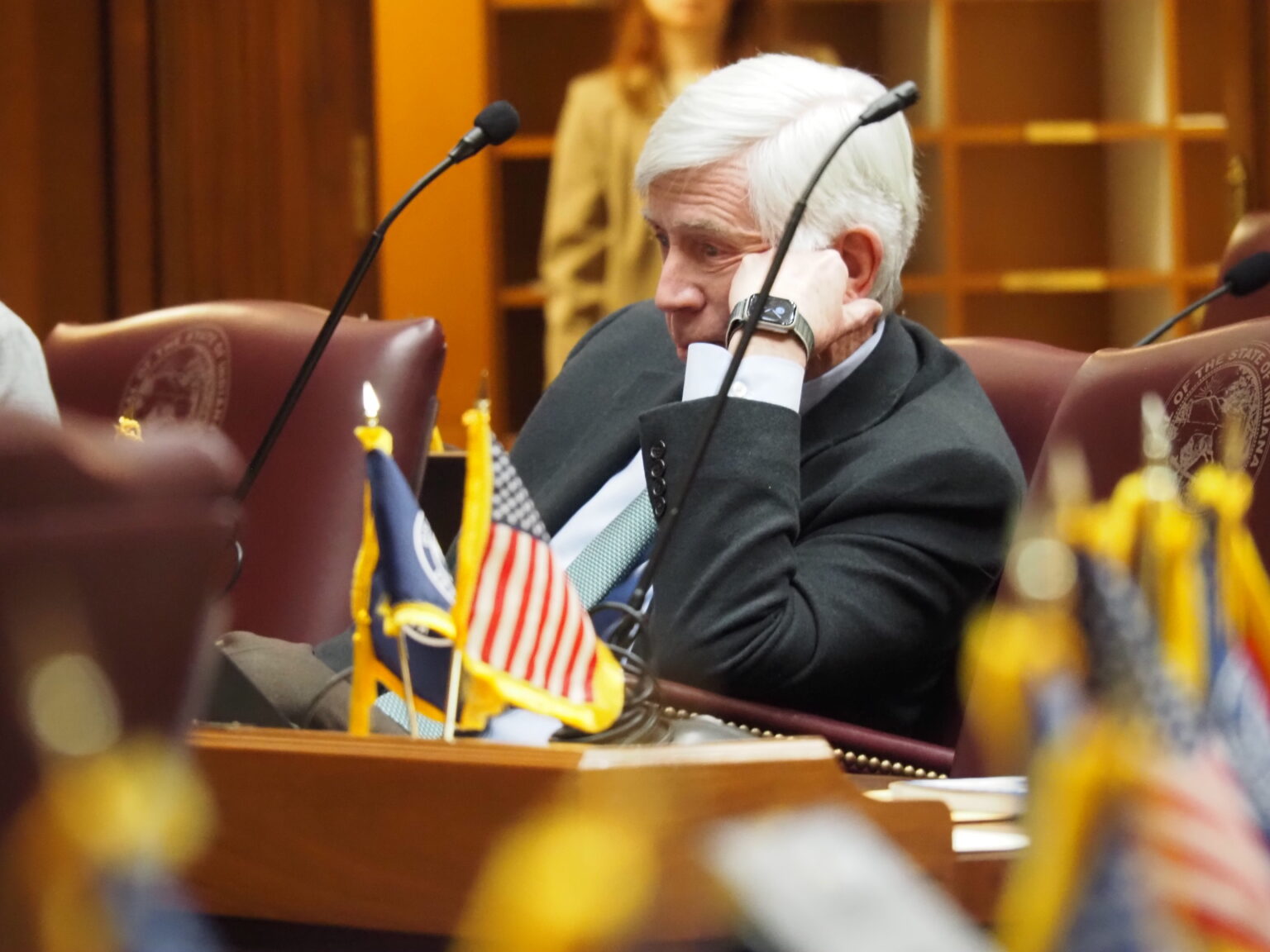
Rep. Ed DeLaney, D-Indianapolis, sits in the House Education Committee on Wednesday, Feb. 12. (Casey Smith/Indiana Capital Chronicle)
DeLaney maintained that Republican leaders “have been devaluing the opportunities that our colleges and universities can offer students.”
“At the same time, the supermajority has made attacking colleges and universities the centerpiece of their culture war agenda — from policing what can be taught in the classroom, to forcing institutions to eliminate hundreds of degree options, to creating an entirely new high school diploma that emphasizes the path directly into the workforce,” the lawmaker said.
“Trying to bury this report in a website and not send a press release is a telling sign that the Commission on Higher Education knows this does not look good, and does not act to fix it,” DeLaney added. “It simply isn’t important enough to them. They are busy eliminating college courses and creating new tests. This is what the legislature has asked them to do.”
CHE has not issued a press release on the latest data and did not immediately respond to a request for comment Wednesday.
Indiana’s college-going rate has dropped more than any other state tracked by the National Center for Education Statistics over the past 15 years.
Previously, Indiana reached a college-going rate of 65%.
“We set a goal to get it back when it slumped,” DeLaney recalled. “Now, it doesn’t seem like we care to address the issue. That is a shame for our students, a shame for our economy, and a shame for our state.”
“The supermajority has been in power for 20 years and this is their achievement,” DeLaney said. “At some point we have to ask ourselves: is a declining college-going rate not the result they want?”
By the numbers
According to the numbers published on CHE’s online college-going dashboard, the vast majority of 2023 grads who continued their education earned some form of college credit while still in high school: 85.6% of college-goers took and passed an Advanced Placement exam; 64.6% earned dual credit; 90.7% earned the Indiana College Core diploma, which comes with a block of 30 general education credits that can be transferred to and accepted at colleges across the state; 86.3% earned as associate’s degree; and 63.6% earned another type of credential.
A quarter of postsecondary enrollees, 25%, are seeking STEM-related degrees, while:
17.8% enrolled in business and communications programs
16% enrolled in health programs
11% enrolled in social and behavioral sciences and human services programs
9.9% enrolled in arts and humanities programs
7.4% enrolled in trades programs
5.8% enrolled in education programs
7% were undecided
College-going among male students dropped to 45%, compared to 59% for female students — widening an existing gender gap.
Among racial groups, Asian and white students had the highest college-going rates, at 70.7% and 54%, respectively. The college-going rates among other racial groups lagged, though, at 45.5% for Black students, and 41.7% for Hispanic students.
The rate for students from low-income backgrounds — as measured by eligibility for free or reduced lunch — was 38.7%, compared to about 60% for their higher-income peers.
More than 78% of college-bound graduates from the 2023 cohort were part of Indiana’s 21st Century Scholars program, according the the new data. The scholarship fund covers full tuition and fees at Indiana colleges and universities for low-income students, who enroll in the 8th grade.
Also previewed in the data was an update on the Class of 2022.
The CHE dashboard showed 53% of the 2022 cohort that enrolled in a postsecondary program within a year after high school graduation met all three early college success benchmarks: they did not need remediation; they completed all courses they attempted during their first year of enrollment; and they persisted to their second year of schooling.
According to the latest numbers, 77.5% of the 2022 cohort that enrolled in a postsecondary program persisted to the second year.
Indiana Capital Chronicle is part of States Newsroom, a nonprofit news network supported by grants and a coalition of donors as a 501c(3) public charity. Indiana Capital Chronicle maintains editorial independence. Contact Editor Niki Kelly for questions: [email protected].
Child care worries have been made worse this summer by federal cuts and depleting pandemic funds, and they aren’t expected to ease by the first day of school. While their kids might have gotten a rest, parents reported longer commutes and newfound stress.
A dozen parents from across the state told Mississippi Today about summer child care plans for their toddlers and elementary school-aged children. They shared a mix of anxiety about finding care and frustration with existing options.
Parents have had more reasons to be anxious about those options this summer than in previous ones. A loss of federally funded summer programming for youth, added fees for day care tuition and the loss of vouchers to subsidize tuition costs have changed the landscape of child care.
Shequite Johnson poses with newborn Noah on a work trip in Jackson, Miss., on Feb. 12, 2025. (Shequite Johnson)
For Shequite Johnson, a professor at Mississippi Valley State University, it has meant driving 45 minutes in the opposite direction of her job for day care.
“I’ve had to leave my 13-year-old with my 4-year-old,” she said. “And you’re put in a situation where you have to make these decisions. Some are even leaving their babies at home by themselves for five hours and checking on them during lunch hour.”
She had to pull her 4-year-old boy from a day care in her hometown because of excessive fees. She was charged a $20 late fee at pickup, a $100 registration fee for each of her two boys, and a $150 supplies fee that was announced in June on top of the $135 weekly fee.
The Mississippi Department of Human Services recently announced a cutback on vouchers that subsidize child care costs. Without Johnson’s child care voucher, her nearby options were limited to a city-run program in an unsafe neighborhood and three programs in aging facilities.
Delta Health Alliance runs free and reduced summer programming for elementary-aged children. But Johnson makes more than the income cut-off.
“It’s a crisis right now in Mississippi,” said Carol Burnett, executive director of Mississippi Low-Income Child Care Initiative. “The lack of affordable child care prevents employers from keeping their workforce. And yet the state of Mississippi wants people to go back to work.”
“Parents are having to make choices. And none of them are good,” she added.
The Child Care Initiative operates a program that connects single moms with higher-paying jobs and covers the costs of child care during the transition. The organization is also advocating for the Mississippi Department of Human Services to spend some of the $156 million in unspent Temporary Assistance for Needy Families on Mississippi’s Child Care Payment Program.
The Child Care Development Fund, which nationally supports these voucher state programs, relied on pandemic-era funding that ran out in September. The Department of Human Services asked the Legislature for $40 million to continue serving the same number of families – but received $15 million.
In April, the department put a hold on renewals for child care vouchers except for deployed military parents, parents who are TANF recipients, foster children guardians, teen parents, parents of special needs children and homeless parents. As a result, 9,000 parents lost child care assistance.
The department will keep the hold until the number of enrollees drops to 27,000 or its budget goes below $12 million in monthly costs. As of Friday, it had no further update but said it will have an announcement in the next couple of weeks.
Using TANF funds unspent from past years regardless of whether they were allocated for child care assistance is prohibited, according to federal guidance. However, the TANF state office can use the leftover funds to form a direct payment program. Ohio and Texas enacted this policy.
U.S. Department of Health and Human Services regional manager Eric Blanchette shared this idea with Mississippi Department of Human Services Early Childhood Director Chad Allgood, according to an email obtained as part of a records request filed by Mississippi Today into communication regarding TANF funds. As of Friday, there were no plans to enact a similar policy in Mississippi.
A second rent
Monica Ford pays nearly $1,600 in monthly child care costs for three kids. She works as a Shipt delivery driver in addition to her day job as a Magnolia Guaranty Life Insurance Co. auditor. She, her husband and their children recently had to move in with his parents.
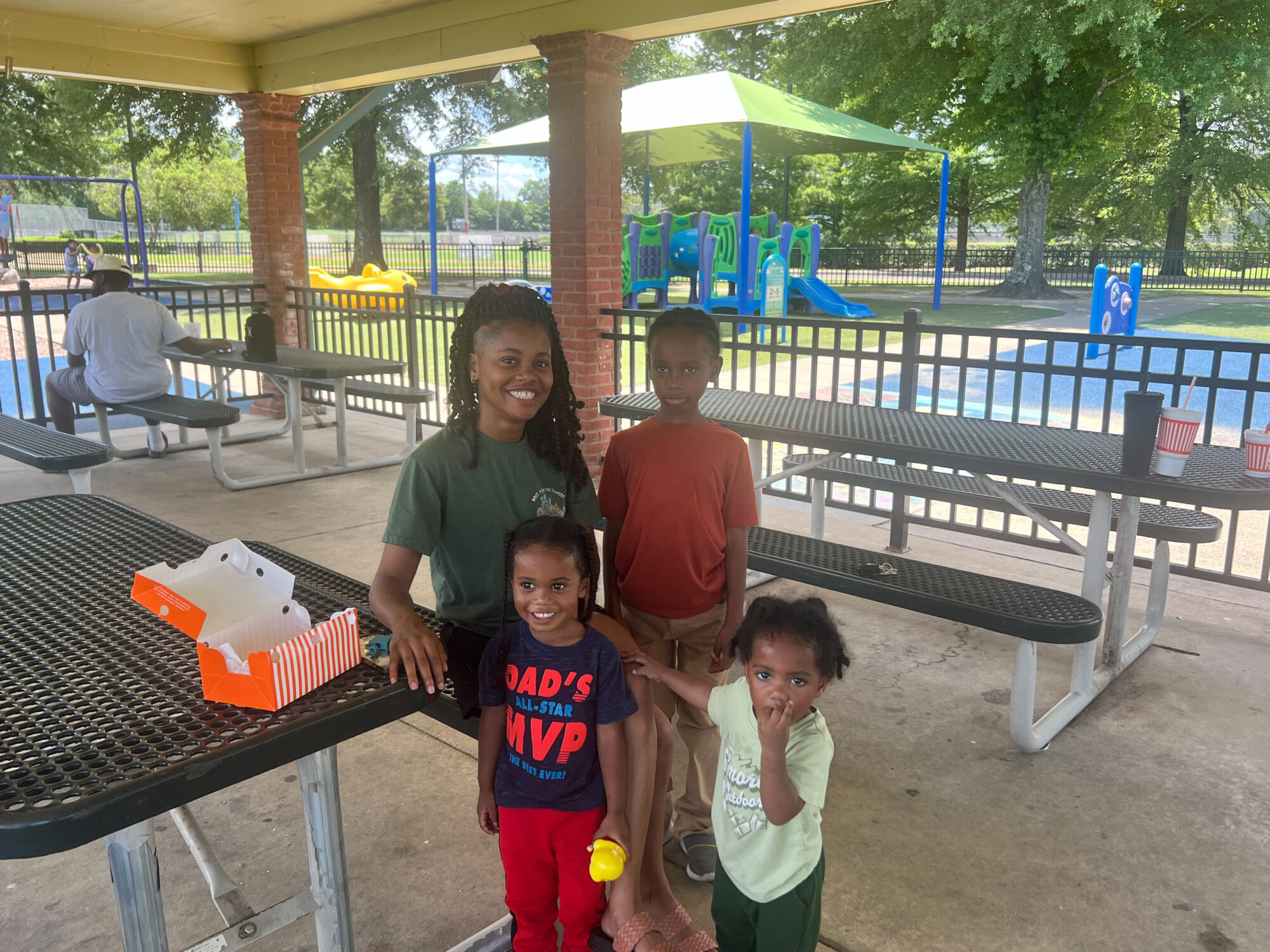
Monica Ford poses with children Tahir, 7, Kian, 4, Nuri, 1, at Freedom Ridge Park in Ridgeland, Miss., July 19, 2025. (Monica Ford)
“It’s more than I’ve paid in rent,” she said. “It’s why I live with my family now.”
She uses a Jackson day care that charges $10 per minute for late pickup. The fees must be paid by the next morning.
Nearly all of the single mothers interviewed said they take on extra work to cover the rising costs of child care in their area. It’s extra work that sees them spending less time with their children.
Ashley Wilson’s child care voucher wasn’t renewed in the spring. She works 55 hours a week at a bingo hall and at Sonic Drive-In.
“We don’t get help. That’s what I don’t understand,” said Wilson, an Indianola parent.
Her preferred day care option in Indianola charged $185 per week and $20 late fees, which Wilson could not afford. Her sister was able to afford monthly costs because of an arrangement with an Angel – a benefactor who helps local families with tuition at day care providers.
Wilson tried other day cares in town. Several were in dangerous neighborhoods with staff that left milk bottles to spoil. Her toddler came home wet some afternoons and with cuts another. She gets help from family when she can.
Whitney Harper lost her child care voucher in April. She is lucky when a relative is willing to watch her 2-year old. Lately, she has considered hiring a sitter off care.com, a website that connects parents with local babysitters. In Jackson, where she lives, the hourly rate is $14 per hour.
Most of the day cares in the Jackson metro area charge between $150 and $250 per week, which is more than she can afford as a sales associate at Home Depot.
“It has been harder this year. They won’t work around my schedule, but I need the job,” she said of her employer.
‘This is the worst I have seen it’
Day care centers are left on the brink when families lose child care vouchers. Making up the lost revenue has meant higher tuition and fees for some centers and reaching out to private donors for others.
“These are small businesses,” Burnette said. “The big story in child care is how much it costs to run it. It requires adequate public investment.”
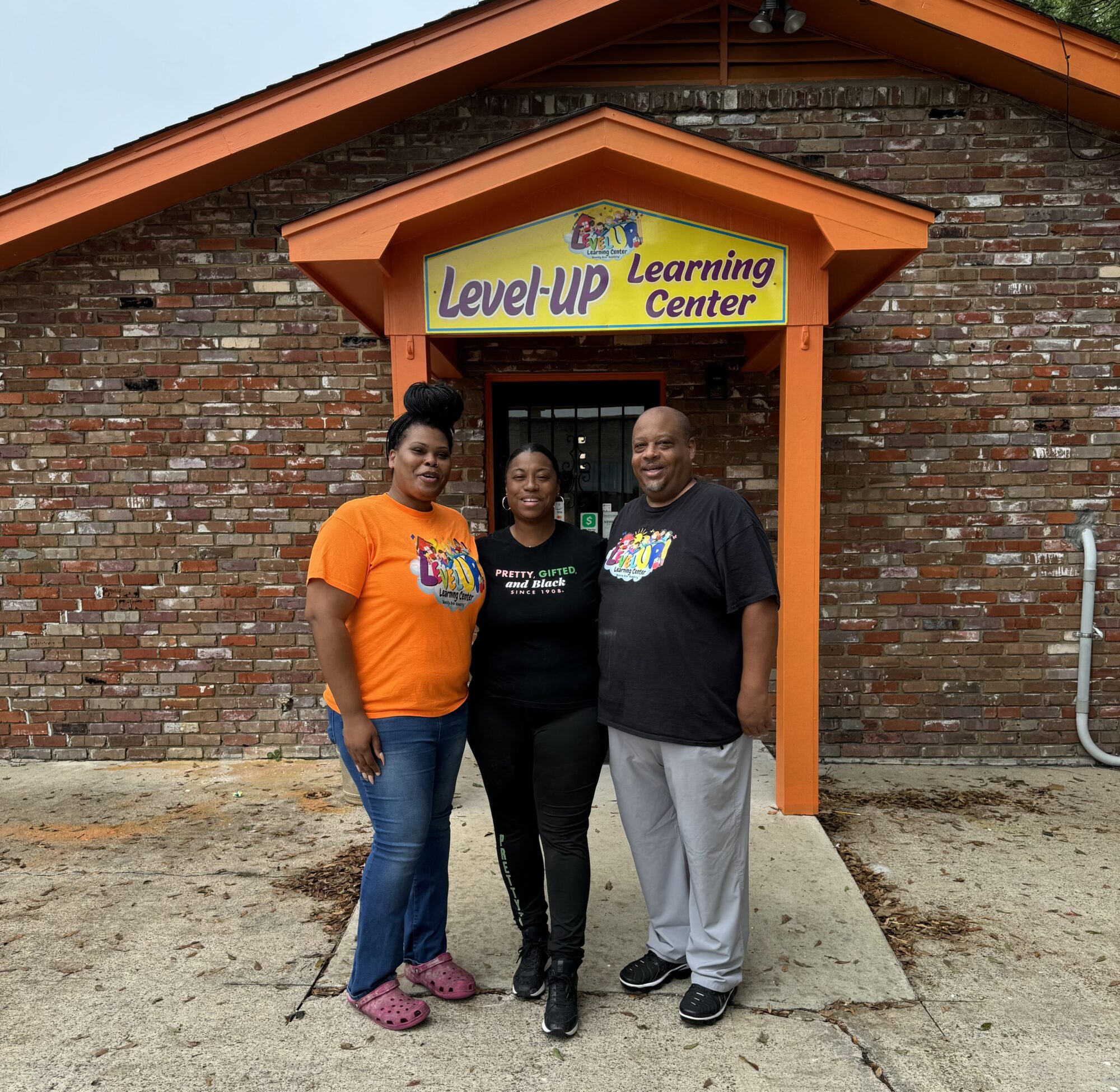
Level-Up Learning Center leadership team poses in front of their Greenville, Miss., location on July 26, 2024. Left to right are Chief Operating Officer Adrienne Walker, CEO Kaysie Burton and COO/Athletic Director Kwame Malik Barnes. (Level Up Learning Center)
This week, Level Up Learning Center owner and CEO Kaysie Burton visited Greenville’s Walmart, seeking to persuade the manager to sponsor his employees’ child care tuition. She submitted two grant applications and is working on at least three others. Burton’s business survived flooding and relocation. But the latest voucher cutback could shut her banner-adorned doors to the community
At Level Up Learning Center, 75% of parents rely on child care vouchers. In the last three months, 20 Learning Center parents have lost their child care vouchers yet most have stayed. Burton has a policy of not turning parents away if they are willing to contribute a portion of the weekly rate. She has not increased her tuition or instituted punishing fees.
But making up the lost revenue can be a challenge. Since the cutback, she has let seven teachers go, or roughly a third of her staff.
“We’re down to skin and bones right now,” Burton said. “I am willing to take anybody that is willing to come partner with us and help us help parents so that their kids can keep coming in.”
When Burton started her business during the COVID-19 pandemic, she saw the need in the Mississippi Delta for affordable, quality child care. She remains committed to helping prepare a future generation of Greenville leadership.
“We’re in the thick of it with our parents,” Burton said. “And we all just need help and we need prayer.”
SunShine Daycare owner Barbara Thompson has greeted each parent at the door since she started babysitting neighbors’ kids in her living room. The former banker has long had a passion for raising neighborhood children regardless of their parents’ status or income. She raised her seven siblings when her mother died when Thompson was 12.
But for the first time in 30 years of running a business in Greenville, Thompson is losing families by the dozen as well as longtime staff. She has leaned heavily on prayer and has reached out to state representatives for help. She fears more departures and the downsizing of her business.
In the last two months, 12 parents pulled their kids from SunShine. She will have to let three teachers go as a result.
“We won’t have any children if this continues,” Thompson said.
She regularly informs parents of the child care voucher waitlist and of the process for renewals. Besides caring for children, Thompson advises many young parents in her community. She noticed that state agencies communicate primarily through email, which a lot of her parents don’t check regularly.
Children who leave her stoop festooned with cartoon characters can face hours alone without parental supervision. Some children will sit and watch television with their grandparents. For Thompson, child care is about raising children to be “productive citizens.” The youngest years are some of the most important, she stressed.
“They didn’t take it from us,” Thompson said. “They took from the children. That’s the world’s future.”
Waitlisted
Vennesha Price is waitlisted at nearly every day care in Cleveland, where she lives. She’s been on some of the lists for eight months.
“If you haven’t been a resident for five years and you haven’t navigated the waiting list for five years, it’s harder to find a spot,” she said.
She found it difficult to both have a productive work day and watch her elementary-aged children. Eventually, she found a day care that was 40 minutes away. She wakes up an hour earlier to make the commute in time before work.
“I’m a single mother so it’s very difficult,” Price said. “After my grandmother went on to the Lord, it became a struggle trying to get to the day care in time.”
She started factoring late fees into her monthly budget. She’s also including the gas money needed for the extra legs of her commute. Her child care costs doubled for June and July.
“It’s almost like private school tuition now,” she said.
Agencies in at least 28 states and the District of Columbia have issued guidance on the use of artificial intelligence in K-12 schools.
More than half of the states have created school policies to define artificial intelligence, develop best practices for using AI systems and more, according to a report from AI for Education, an advocacy group that provides AI literacy training for educators.
Despite efforts by the Trump administration to loosen federal and state AI rules in hopes of boosting innovation, teachers and students need a lot of state-level guidance for navigating the fast-moving technology, said Amanda Bickerstaff, the CEO and co-founder of AI for Education.
“What most people think about when it comes to AI adoption in the schools is academic integrity,” she said. “One of the biggest concerns that we’ve seen — and one of the reasons why there’s been a push towards AI guidance, both at the district and state level — is to provide some safety guidelines around responsible use and to create opportunities for people to know what is appropriate.”
North Carolina, which last year became one of the first states to issue AI guidance for schools, set out to study and define generative artificial intelligence for potential uses in the classroom. The policy also includes resources for students and teachers interested in learning how to interact with AI models successfully.
In addition to classroom guidance, some states emphasize ethical considerations for certain AI models. Following Georgia’s initial framework in January, the state shared additional guidance in June outlining ethical principles educators should consider before adopting the technology.
In the absence of regulations at the federal level, states are filling a critical gap, said Maddy Dwyer, a policy analyst for the Equity in Civic Technology team at the Center for Democracy & Technology, a nonprofit working to advance civil rights in the digital age.
While most state AI guidance for schools focuses on the potential benefits, risks and need for human oversight, Dwyer wrote in a recent blog post that many of the frameworks are missing out on critical AI topics, such as community engagement and deepfakes, or manipulated photos and videos.
“I think that states being able to fill the gap that is currently there is a critical piece to making sure that the use of AI is serving kids and their needs, and enhancing their educational experiences rather than detracting from them,” she said.
Stateline is part of States Newsroom, a nonprofit news network supported by grants and a coalition of donors as a 501c(3) public charity. Stateline maintains editorial independence. Contact Editor Scott S. Greenberger for questions: [email protected].
A freeze on federal education funding that prompted two lawsuits has been lifted, and states will be able to access the money next week, the U.S. Department of Education announced Friday.
The White House Office of Management and Budget (OMB), which argued that districts were spending the money to advance a “radical left-wing agenda,” has completed its review of five different programs totaling $5.5 billion, said Madison Beidermann, spokeswoman for the department.
The funds support education for English learners and migrant students and pay for staff training and extra instructional positions. The news came a week after the administration released over $1.3 billion for summer and afterschool programs, which was also held up for review.
The department alerted states June 30, one day before they expected to receive the money, that the review was in process, forcing programs to cut staff and end summer programs early. Congress appropriated the funds for this coming school year, and President Donald Trump signed the budget in March.
The release of the funds, announced just hours before Education Secretary Linda McMahon was scheduled to meet with the nation’s governors in Colorado Springs, Colorado, comes as superintendents nationwide were preparing to eliminate services like literacy and math coaches, according to a survey conducted by AASA, the School Superintendents Association. Half of the 628 chiefs who responded from 43 states said they would have to lay off staff who work with special education students if the funds weren’t released. American Federation of Teachers President Randi Weingarten brought the message to attendees at the union’s annual TEACH conference in Washington, D.C.
“The administration backed down and we are getting the money,” she said to a cheering audience. “Those of you who lobbied yesterday, thank you. Those of you who brought the lawsuit, thank you.”
Attorney generals from 24 blue states and the District of Columbia sued on July 14 over the freeze, arguing that the administration’s actions were harming schools. School districts, parents, unions and nonprofits filed a second challenge on July 21, saying that OMB has never stood in the way of the department’s practice of releasing the funds in two steps, first on July 1 and the rest on Oct. 1. Republican senators joined their Democratic colleagues in pressuring the administration to free up the money.
Friday’s announcement doesn’t mean the legal fight is over. In a statement, Skye Perryman, president and CEO of Democracy Forward, which is handling the second case, said the legal team would “continue to monitor the situation and work in court to ensure the administration fully complies with the law and that these resources reach the schools and students who need them most.”
Districts can now start the school year without the shortfall, but that doesn’t mean advocates’ worries are over about future disruptions to funding. The July 1 distribution date is a longstanding practice, not something written into the law.
Tara Thomas, government affairs manager for AASA, said her organization wants to “have additional conversations” with Congress or the administration to “ensure that this type of uncertainty at the last minute doesn’t happen again. Districts need to continue to rely on stable, timely, reliable federal funding.”
Another fight over education funds could also be ahead. The White House is reportedly preparing another recissions package that would target education funding. Thomas said she didn’t know what might be included, but it could be cuts that the Department of Government Efficiency made to grant programs.
On Friday, Trump signed a recissions package, pulling back $9 billion in funds from public television and foreign aid.
The NIH has cut hundreds of millions of dollars in grant funding that it says is used to conduct illegal DEI and gender identity-related research.
Photo illustration by Justin Morrison/Inside Higher Ed | Adam Bartosik and Jacob Wackerhausen/iStock/Getty Images
The Trump administration has taken its fight over grants awarded by the National Institutes of Health to the Supreme Court, requesting permission Thursday to finalize millions of dollars in award cuts, CBS News reported.
President Trump began slashing research funding shortly after he took office in January, targeting projects that allegedly defied his executive orders against issues such as gender identity and DEI. By early April, 16 states and multiple academic associations and advocacy groups had sued, arguing the funding cuts were an unjustified executive overreach and bypassed statutory procedures.
Since then, a federal district court ordered a preliminary injunction requiring all grants to be reinstated, and a court of appeals denied the Trump administration’s request to halt the decision. Now, executive branch legal officials are taking the case to the highest court.
In an emergency appeal, Solicitor General John Sauer wrote that the NIH is attempting to “stop errant district courts from continuing to disregard” presidential orders.
The solicitor also pointed to an April ruling from the Supreme Court allowing the Department of Education to terminate some of its own grants for similar reasons. In that case, the justices said the Trump administration would likely be able to prove that the lower court lacked jurisdiction to mandate the payment of a federal award.
The court system does not allow a “lower-court free-for-all where individual district judges feel free to elevate their own policy judgments over those of the Executive Branch, and their own legal judgments over those of this Court,” Sauer wrote.
The Trump administration is slashing the funding for new projects focused on STEM education and has terminated hundreds of grants focused on equitable STEM education. This will have enormous effects on education and science for decades to come.
Meaningful science education is crucial for improving all of our lives, including the lives of children and youth. Who doesn’t want their child or grandchild or neighbor to experience curiosity and the joy of learning about the world around them? Who wouldn’t enjoy seeing their child making careful observations of the plants, animals, landforms, and water in their neighborhood or community? Who wouldn’t want a class of kindergartners to understand germ transmission and that washing their hands will help them keep their baby siblings and grandparents healthy? Who doesn’t want their daughters to believe that science is “for them,” just as it is for the boys in their classroom?
Or, if those goals aren’t compelling for you, then who doesn’t want their child or grandchild or neighbor to be able to get a well-paying job in a STEM field when they grow up? Who doesn’t want science itself to advance in more creative and expansive ways?
More equitable science teaching allows us to work toward all these goals and more.
And yet, the Department of Government Efficiency has terminated hundreds of grants from the National Science Foundation that focused squarely on equity in STEM education. My team’s project was one of them.
At the same time, NSF’s funding of new projects and the budget for NSF’s Education directorate are also being slashed.
These terminations and drastic reductions in new funding are decimating the work of science education.
Why should you care?
You might care because the termination of these projects wastes taxpayers’ hard-earned money. My project, for example, was 20 months into what was intended to be a 4-year project, following elementary teachers from their teacher education program into their third year of teaching in classrooms in my state of Michigan and across the country. With the termination, we barely got into the teachers’ first year–making it impossible to develop a model of what development looks like over time as teachers learn to engage in equitable science teaching.
You might care because not funding new projects means we’ll be less able to improve education moving forward. We’re losing the evidence on which we can make sound educational decisions–what works, for whom, and under what circumstances. Earlier NSF-funded projects that I’ve been involved with have, for example, informed the design of curriculum materials and helped district leaders. Educators of future teachers like me build on findings of research to teach evidence-based approaches to facilitating science investigations and leading sense-making discussions. I help teachers learn how they can help children be change-makers who use science to work toward a more just and sustainable world. Benefits like these will be eliminated.
Finally, you might care because many of the terminated and unfunded projects are what’s called NSF Early Career Awards, and CAREER program funding is completely eliminated in the current proposed budget. CAREER grants provide crucial funding and mentoring for new researchers. A few of the terminated CAREER projects focus on Black girls and STEM identity, mathematics education in rural communities, and the experiences of LGBTQ+ STEM majors. Without these and other NSF CAREER grants, education within these fields–science, engineering, mathematics, data science, artificial intelligence, and more, from preschool through graduate school–will regress to what works best for white boys and men.
To be sure, universities have some funds to support research internally. For the most part, though, those funds are minimal. And, it’s true that terminating existing projects like mine and not funding new ones will “save” the government some money. But toward what end? We’re losing crucial evidence and expertise.
To support all children in experiencing the wonder and joy of understanding the natural world–or to help youth move into high-paying STEM jobs–we need to fight hard to reinstate federal funding for science and science education. We need to use every lever available to us–including contacting our representatives in Washington, D.C.–to make this happen. If we aren’t successful, we lose more than children’s enjoyment of and engagement with science. Ultimately we lose scientific advancement itself.
Elizabeth A. Davis, University of Michigan
Elizabeth A. Davis is a professor of science education and teacher education at the University of Michigan in the Marsal Family School of Education. She teaches beginning elementary teachers how to teach science and studies how these teachers learn to teach science, particularly with a focus on how they learn to engage in justice-oriented science teaching. Davis has published over 60 peer-reviewed papers, focusing on aspects of science education, teacher education, and curriculum materials, and her work has been cited over 16,000 times. She chaired a recent report from the National Academies of Sciences, Engineering, and Medicine focused on preschool through elementary science and engineering education. Davis has received around $9 million dollars in grant funding, starting in the early 2000s when she received the Presidential Early Career Award for Scientists and Engineers at the White House (a version of the NSF Early Career Award mentioned in the commentary). Most of that funding has come from the National Science Foundation. She has mentored about a dozen doctoral students. Most importantly, Davis has taught over 800 preservice teachers in her 28 years as a teacher educator at Michigan, helping to launch them into their careers as elementary teachers.
Latest posts by eSchool Media Contributors (see all)
This audio is auto-generated. Please let us know if you have feedback.
How well did you keep up with this week’s developments in K-12 education? To find out, take our five-question quiz below. Then, share your score by tagging us on social media with #K12DivePopQuiz.
Education technology as a whole is an academic freedom issue, unfortunately, the encroachment of technological systems which shape (and in some cases even determine) pedagogy, research and governance have been left in the hands of others, with faculty required to capitulate to a system designed and controlled by others.
AI is here, rather suddenly, pretty disruptively, and in a big way. Different institutions are adopting different stances and much of the adaptation is falling on faculty, in some cases with minimal guidance. While considering how these tools impact what’s happening at the level of course and pedagogy is a necessity, it also seems clear that faculty concerned about preserving their own rights should be considering some of the institutional/structural issues.
Personally, I have more questions than answers at this time, but there’s a handful of recent readings that I want to recommend to others to help ground thinking that may lead to better questions and actionable answers.
A report, Artificial Intelligence and the Academic Professions, just released by the AAUP, should be at the top of anyone’s list. Based on a national survey, the report examines a number of big-picture categories, all of which have a direct relationship to issues of academic freedom.
Improving Professional Development Regarding AI and Technology Harms
Implementing Shared Governance Policies and Professional Oversight
Improving Working and Learning Conditions
Demanding Transparency and the Ability to Opt Out
Protecting Faculty Members and Other Academic Workers.
The report both summarizes faculty concerns as expressed in the survey and offers recommendations for actions that will protect faculty rights and autonomy. Having read the report, in some cases the recommendations initially seem frustratingly vague but looked at in total, they are essentially a call for active faculty involvement in considering the implications of the intersection of this technology (and the companies developing it) with educational institutions.
In a way, the report highlights, in hindsight, how truly absent faculty have been as existing educational technology has been woven into the fabric of our institutions, and that it would be a disaster for that absence to be perpetuated when it comes to AI.
After checking out the AAUP report, move on to Matt Seybold’s, How Venture Capitalists Built A For-Profit “Micro-University” Inside Our Public Flagships, published at his newsletter, The American Vandal. It’s a long and complicated story about the ways outside service providers conceived in venture capital/private equity have insinuated themselves into our universities in ways that undermine faculty roles and educational quality.
It would take a full column to do Seybold’s piece justice, but here are two quotes that I hope induce you to go consider his full argument.
Here Seybold pulls the lid back on what it means for these third-party provider offerings to exist under a university brand “powered by” the third-party provider:
The “powered by model” is a truly absurdist role reversal. A private, unaccredited company founded and run by sales and marketing professionals is responsible for the (pseudo)educational coursework, while the accredited university is employed only for its sales and marketing functions, getting paid by commission on the headcount of students who enroll from their branded portal. University partners are incentivized to flex their brand power and use their proprietary data, advertising budgets, and sales forces to maximize this commission, while Ziplines provides cookie-cutter landing pages and highly reproducible microdegrees, the content of which is largely created by gigworkers.
And here, Seybold pinpoints the downstream effect of these kinds of “partnerships.”
EdTech is not only always a Trojan horse for elite capture of public resources; it is also always a project in delegitimizing the project of public education itself.
The applicability of Seybold’s analysis to the “AI partnerships” many institutions are busy signing should be clear.
As another thought experiment exercise, I recommend making your way through a Hollis Robbins’s piece at her Anecdotal website, How to Deliver CSU’s Gen Ed with AI.
Robbins, a former university dean, perhaps intends this more as a provocation than an actionable proposal but, as a proposal, it is a comprehensive vision for replacing human labor with AI instruction that relies on a series of interwoven tech applications where humans are “in the loop,” but which largely run autonomously.
If realized, this sort of vision would obviate academic freedom on two fronts:
The curriculum would be codified and assessed according to a rigid standard and then be delivered primarily through AI.
Faculty would barely exist.
I read it as a surveillance-driven dystopia from which I would either have to opt-out (if allowed), or more likely have to flee, but you can check the comments to the post itself and find some early enthusiasts. The complexity of the technological vision suggests that such a vision would be difficult to impossible to realize, but the underlying values of increased efficiency, decreased cost and increased standardization are consistent with the direction educational systems have been going for decades.
Many of the factors that have eroded faculty rights and left institutions vulnerable to the attacks that have been coming were, indeed, foreseeable. Adjunctification is at the top of my list.
When it comes to technology and the university, we’ve seen this play before. If faculty aren’t prepared to assert their rights and exercise their power, you won’t see me writing the kinds of lamentations I’ve offered about tenure over the years because there won’t be enough faculty left to worry about such things.
An Idaho judge Wednesday sentenced the murderer of four University of Idaho students to life in prison without possibility of parole, various mediaoutlets reported.
Judge Steven Hippler of the state’s 4th Judicial District sentenced Bryan Kohberger to four consecutive life sentences.
Kohberger pleaded guilty June 30 to the 2022 killings of seniors Kaylee Goncalves and Madison Mogen, both 21; junior Xana Kernodle, 20; and freshman Ethan Chapin, 20. As part of Kohberger’s plea deal, prosecutors agreed to not pursue the death penalty.
Authorities said the four University of Idaho students were sleeping at an off-campus home in Moscow, Idaho, when Kohberger—then a criminology graduate student at nearby Washington State University—stabbed them to death. He declined to speak during his sentencing hearing, and his motive remains unknown.