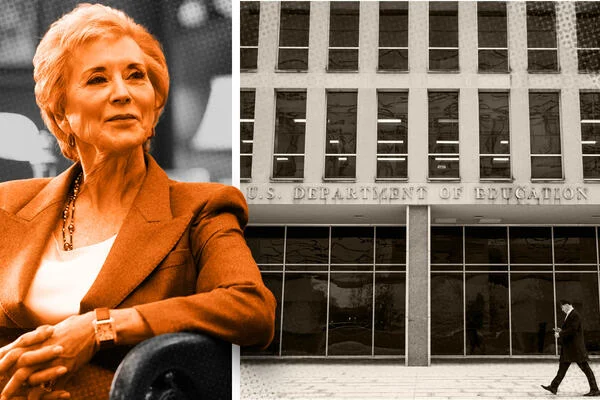
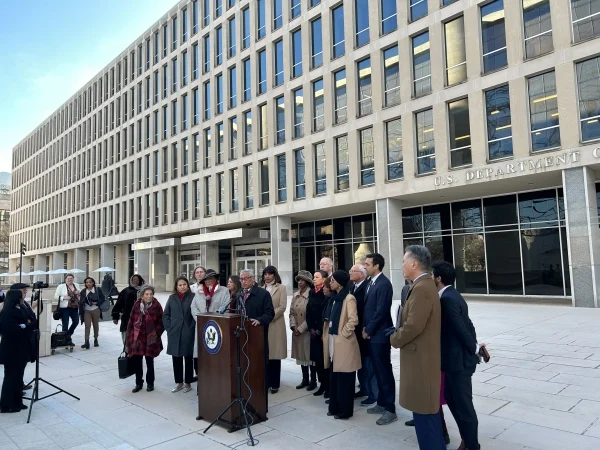
The Education Department said late last year that the grant program, which has funded student success initiatives, would support projects related to accreditation reform, civil discourse, artificial intelligence and workforce training.
Photo illustration by Justin Morrison/Inside Higher Ed | Anna Moneymaker/Getty Images | Pete Kiehart for The Washington Post via Getty Images
More than 70 colleges, universities, nonprofits and other organizations are sharing $169 million to advance a number of the Trump administration’s priorities.
Those include accreditation reform, promoting civil discourse, short-term workforce training programs and advancing the use of artificial intelligence in higher education. The Education Department announced the grant competition in November and said Monday that it had awarded the funds, which have historically gone to programs that support student success.
Colleges received funding to switch accreditors, start short-term programs that will be eligible for the new Workforce Pell program, hold workshops on constructive dialogue and support peer-to-peer engagement in civil dialogue.
Just over $50 million apiece went to the AI, civil discourse and Workforce Pell priorities, while projects related to accreditation received nearly $15 million, according to an Inside Higher Ed analysis of department data. All the grants in this tranche are for four years.
Two new accreditors planning to seek federal recognition—the Postsecondary Commission and the Commission for Public Higher Education Inc.—each received $1 million. The department also awarded $1 million to the University of Rochester for its plans to establish an accreditor focused on higher education certificate programs that serve students with intellectual disabilities, and another $1 million to Valley Forge Military College, which wants to create a new hybrid accrediting agency for military-aligned associate and certificate programs. (Valley Forge Military College is one of several institutions that have indicated interest in the Trump administration’s compact for higher education.)
Meanwhile, Davidson College’s Institute for Public Good is getting nearly $4 million to create the Deliberative Citizenship Network across 100 colleges and universities, according to a news release. Among other goals, the network aims to train faculty and staff on how to facilitate forums on difficult topics and create teaching resources that can be widely shared.
“With this funding, we will reach thousands of students and educators nationwide,” Chris Marsicano, executive director of the institute, said in a statement. “Davidson’s Institute for Public Good will serve as a national hub that connects research, teaching and public engagement around respectful inclusion across political viewpoints—no matter how unpopular on campus—as well as participating in community efforts to examine, talk through and solve big problems.”
The department’s initial announcement about the awards didn’t provide specific information about the funded projects, but the agency briefly posteddocuments Monday afternoon outlining which institutions received awards and for how much. Inside Higher Ed captured some of that information before the documents were taken down and compiled the details into a searchable database below. A department spokesperson said the final documents should be posted next week.
In the meantime, Inside Higher Ed reached out to the identified institutions for more information about how they plan to use the grant funding. The database will be updated as they respond.
The grant money comes from the Fund for Improvement of Postsecondary Education, which has historically supported programs related to student success. Those include the Basic Needs, Veteran Student Success and Postsecondary Student Success programs. But in November, the Education Department announced plans to send the funds to a different special projects program—a move that Democrats and advocates criticized. Department officials say this round of funding, for which they “received a historic number of applications,” will help to support students through their academic journeys.
“This historic investment will realign workforce programs with the labor market, break up the accreditation cartel and support institutions who want to change accreditors, and strengthen responsible use of AI in the classroom,” said Ellen Keast, a department spokesperson, in a statement. “These investments will open new, affordable higher education alternatives to American families, and we are very excited to see federal dollars driving change in the sector that is long overdue.”
Some critics have raised concerns about the truncated grant-review process. Typically, the FIPSE grant competition opens in the spring and awards go out by Dec. 31, one former department official said. They also question who will administer the program moving forward. Like other higher ed grant programs, FIPSE is slated to move to the Labor Department under agreements announced late last year.
One might expect to hear such exclamations from exultant college students, relieved or ready to rejoice upon polishing off their latest essay assignment. Instead, these are the words I hear with increasing frequency from fellow professors who have come to think that the out-of-class essay itself is now done. It’s an antiquated assignment, some say. An outmoded form of pedagogy. A forlorn fossil of the Writing Age, a new coinage that seems all too ready to consign writing instruction to extinction.
As a new director of my college’s faculty development office, I’m privy to ongoing conversations about the teaching of writing, many of which are marked by frustration, perplexity and pessimism. “I don’t want to read a machine’s writing,” one professor laments. “I don’t want to police student essay writing for AI use,” another asserts.
Kevin Roose, a tech writer for The New York Times, who recently visited my campus, has suggested that the take-home essay is obsolete, asking, “Why would you assign a take-home exam, or an essay on Jane Eyre, if everyone in class—except, perhaps, the most strait-laced rule followers—will use A.I. to finish it?”
Whether this situation is entirely new is arguable. For decades, we’ve had online resources that might make independent student reading unnecessary, yet we haven’t stopped assigning out-of-class reading. If I assign a rigorous novel like Charles Dickens’s Bleak House, I’ve long known that students can access an assortment of chapter summaries online—CliffsNotes, SparkNotes, LitCharts and others, all of which might make unnecessary the intellectual work of deciphering Dickens’s 19th-century sentences or wading into the deep waters of his sometimes murky prose. Maybe, as a recent New York Times piece about Harvard University students not doing their reading suggests, students aren’t doing that kind of homework, either.
Still, being able to create sentences, paragraphs, essays and research papers with a single prompt—or now, having “agentic AI” engineer an entire research process in a matter of minutes—seems different from googling the plot summary for the first chapter of Bleak House.
Maybe writing via LLMs is different because it’s not just about summarizing someone’s else’s idea; it’s about asking a machine to take the glimmer of one’s own half-hatched idea and turn it into a flawless, finished product. Somehow that process seems a little more magical, like being able to create a novel or a dissertation with a Bewitched-like twitch of the nose.
Further, the problems with out-of-class writing are different from those linked to out-of-class reading because of how embedded AI has become within the most basic writing tools—from Microsoft’s Copilot to Grammarly. With tools that blur the boundaries between the student and their “copilot,” students will increasingly have difficulty discerning what’s them and what’s the machine—to the chagrin of those who do want to develop autonomous intellectual skills. As high school senior Ashanty Rosario complained in an essay in The Atlantic about how AI is “demolishing my education,” AI tools have become “inescapable” and inescapably seductive, with shortcuts to learning becoming “normalized.”
In this world of ubiquitous AI shortcuts, how do we encourage students to take the scenic route? How do we help them see, as John Warner reminds us in More Than Words: How To Think About Writing in the Age of AI (Basic Books, 2025), that writing is an act of embodied thinking and a tool for forging human community, linking one human being to another? How do we encourage them, to use the language of Chad Hanson, to see their written assignments as “investments, not just in the creation of something to turn in on a deadline, but rather, investments in your humanity”? In an Inside Higher Ed essay, Hanson describes how he tells students, “When you give yourself time to use your faculties, you end up changing the dimensions of your mind.”
But there’s the rub. Writing takes time. Teaching writing takes time. The practice of writing takes even more time. If there is still value in the time invested in developing human writing skills, where is the time to be found within the constraints of traditional writing courses? Writing practice used to take place primarily at home, on student PCs and notepads, over hours, days and weeks. Now that student writing is being chronically offloaded to a magical deus ex machina, Roose asks why teachers wouldn’t simply “switch to proctored exams, blue-book essays, and in-class group work”?
As a writing professor, my answer is: There isn’t time.
Shifting writing practice from a largely out-of-class endeavor to an in-class one doesn’t provide students with the time needed to develop writerly skills or to use writing as a mode of deep thinking. Nor does it allow for both instruction and sufficient hands-on practice. At my college, courses typically run either three days per week for a short 50 minutes per class or two days per week for 80 minutes. Even in a “pure” writing course, such time periods don’t allow for students to have the sustained practice they would need to develop skill as writers. The problem is even worse in writing-intensive courses for which a significant amount of class time is needed for discussing literary history, philosophy, political theory, religion, art history or sundry other topics.
The solution I propose is to invest more rather than less in writing instruction: Just as we require labs for science lecture courses, we should provide required “writing labs” as adjuncts to writing classes. Here I don’t mean a writing lab in the sense of a writing center where students can opt to go for peer assistance. By writing lab, I mean a multihour, credit-bearing, required time during which students practice writing on a weekly basis under the supervision of the course’s instructor or another experienced writing teacher. Such labs would be time in which students develop their autonomous critical thinking skills, tackling assignments from conception to completion, “cloister[ed]” away, as Niall Ferguson puts it, from dependency on AI machines. And if writing “lab” sounds unduly scientific for the teaching of a human art, call it a weekly workshop or practicum. (Yet, even the word “laboratory” derives, via medieval Latin, from laborare, which simply means “to work or labor.”) Whatever the name, the need is real: Writing cannot be taught without student labor.
The problem I am addressing is a critical one, with too few alarms being sounded in higher education circles, despite the plethora of articles about education and AI. Even as colleges tout writing skill as a major outcome of college education, I fear that writing education may quickly fall between the cracks, with out-of-class writing being abandoned out of frustration or despair and insufficient in-class time available for the deep learning writing requires. Quiet quitting, let’s call it, of a long-standing writing pedagogy.
If colleges still wish to claim writing skill as an important learning outcome, they need to become more deliberate about what it means to educate student writers in the age of AI. Toward that end, colleges must first reassert the importance of learning to write and articulate its abiding value as a human endeavor. Second, colleges must devote professional development resources to prepare faculty to teach writing in the age of AI. And finally—here’s the pith of my argument—colleges need to restructure traditional models of writing instruction so that students have ample time to practice writing in the classroom, with a community of human peers and under the supervision of a writing guide. Only in, with and under those circumstances will students be able to rediscover writing as a true labor of love.
Carla Arnell is associate dean of the faculty, director of the Office of Faculty Development and professor of English at Lake Forest College.
The last month of 2025 brought more campus job cuts, capping off a tumultuous year for higher education.
While December yielded roughly 300 reported job cuts across the sector, that total reflects only a fraction of the jobs lost in higher education in 2025. Inside Higher Ed tracked more than 9,000 job cuts and buyouts last year—which is undoubtedly an undercount due to unreported personnel actions.
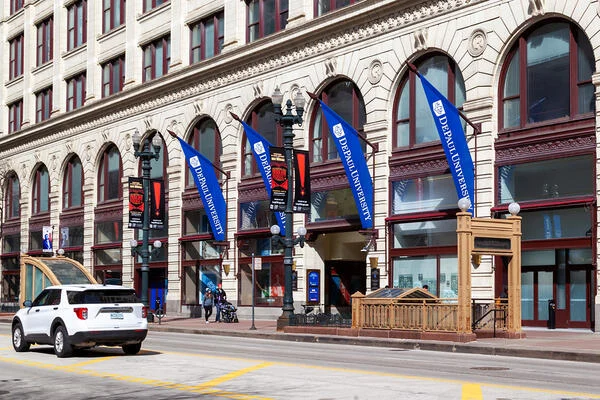
Rising operating costs and an uncertain federal policy environment drove cuts at even the wealthiest institutions last year as universities with multibillion-dollar endowments shed hundreds of jobs after President Donald Trump restricted federal research funds, sought to limit international student enrollment and clashed with multiple universities over alleged civil rights infractions. While many of December’s job cuts were not attributable to Trump, others seemed directly connected, including the loss of hundreds of international students at DePaul University, which undercut tuition revenues, prompting layoffs.
Here’s a look at layoffs, buyouts and program cuts announced in December.
DePaul University
The private Catholic university in Chicago cut 114 staff jobs last month, officials announced.
“These decisions were extraordinarily difficult and leaders across the university did not make them lightly. Each person affected contributed to the life of this university in meaningful ways,” officials wrote in a Dec. 15 message announcing the layoffs and assistance for employees, which included severance packages based on years of service, career counseling and more.
Staffing reductions at DePaul are part of a broader effort to reduce spending by $27.4 million as the university grapples with a budget deficit and aims to achieve a 2.5 percent operating margin. DePaul has also been hit with a staggering loss of international students amid the Trump administration’s crackdown on immigration, which has made it harder for some foreign nationals to obtain visas and deterred others. International enrollment at DePaul plunged by 755 students compared to the previous fall, a decline of nearly 62 percent, officials said in September.
University of Nebraska–Lincoln
Regents voted last month to close four programs at the flagship campus following months of consternation over the plan, which will see dozens of faculty positions eliminated.
Programs approved for closure are statistics, earth and atmospheric sciences, educational administration and textiles, merchandising and fashion design. The plan includes cutting 51 jobs, mostly from the faculty ranks, The Nebraska Examiner reported.
Program closures and job cuts are expected to save the university almost $7 million.
The December vote ended a bitter fight over the program cuts that prompted a faculty no-confidence vote in Chancellor Rodney Bennett. Faculty members have questioned the evaluation process and the timeline for the cuts; they also conducted their own financial assessment, which pushed back on the need for instructional cuts amid growing administrative expenses.
Bennett, who championed the program cuts, announced Monday that he plans to resign by Jan. 12. His sudden resignation ends an almost three-year stint as head of the flagship.
Martin University
Indiana’s only predominantly Black institution terminated all employees last month, a sign that points to an almost certain closure, though the Board of Trustees has not yet made it official. The move came shortly after the private university announced it would “pause” operations.
While the number of jobs lost is unclear, Martin—where enrollment has hovered around 200 students in recent years—employed 42 staff and faculty members in fall 2023, according to federal data.
Interim president Felicia Brokaw reportedly told employees the university was laying them off because it could not afford to pay them, according to an audio recording obtained by Mirror Indy. Brokaw also told staff she did not know when they would be paid for work already performed.
Martin officials have encouraged students to transfer elsewhere.
Western Wyoming Community College
Citing a need to balance its budget and avoid dipping into reserves, the community college in Rock Springs axed 33 jobs and reorganized 30 others, The Rocket Miner reported.
Last month’s cuts included eight full-time faculty jobs.
The newspaper reported that more layoffs could be on the horizon depending on what happens in the coming legislative session. State lawmakers are reportedly weighing a plan to cut property taxes by 25 percent (following a similar move last year), which would have a major effect on WWCC, given that its budget heavily relies on state appropriations and local property taxes.
University of Kansas
Nearly three dozen faculty members have opted to take buyouts offered by the public research university.
In all, 34 tenured faculty members applied to participate in an early-retirement incentive program at KU, The Lawrence Journal-World reported. University officials announced the launch of the early-retirement program in October, citing budget challenges. KU is currently seeking $32 million in cost reductions by July 1, when the next fiscal year begins.
Christian Brothers University
The private Catholic university in Memphis, Tenn., is cutting 16 faculty jobs, a move Interim President Chris Englert said was “designed to balance our operating budget and position CBU for transformation as we work to meet the needs of today’s students and today’s workforce.”
The Oklahoma Board of Regents for Higher Education voted to eliminate 41 degree programs and suspend 21 others across the state system due to underenrollment, NPR affiliate KOSU reported.
The flagship was hit the hardest, with 14 programs eliminated. No other state institution had more than three degree programs cut. Of the 14 at OU, eight were at the undergraduate level and six were graduate degrees. Cuts at OU include a mix of language programs—such as Arabic, Chinese, French and German—alongside geography, plant biology and others.
New Jersey City University
As part of a planned merger with nearby Kean University, the public institution is shedding nine degree programs alongside multiple minors and certifications, The Jersey City Times reported.
Undergraduate programs to be discontinued at NJCU are business information systems, chemistry, philosophy, women’s and gender studies, and a music performance degree. Graduate programs on the chopping block are business information systems, criminal justice, educational psychology and a music performance degree. An internal memo obtained by the newspaper noted that many programs have similar offerings at Kean that will continue unabated.
College of Idaho
The liberal arts college in Caldwell is cutting three majors but adding six new programs, a change that will see 10 employees laid off, including five professors, Idaho Ed News reported.
College officials said the eliminated majors—theater, communication arts and philosophy—were all underenrolled. New programs to be added are biochemistry, finance and criminology, at the undergraduate level, plus master’s degrees in data analytics, exercise science and accountancy.
Boston University
Facing a $30 million budget gap driven by low graduate enrollment numbers and other factors, the private university is offering buyouts to eligible faculty members, The Boston Globe reported.
Buyouts mark the latest effort by the research university to constrain costs. In early 2025, officials announced BU was laying off 120 workers and closing 120 vacant positions.
San Francisco State University
The public university is rolling out an early-retirement program to help close a budget deficit, Golden Gate Express reported.
SFSU officials announced the buyout program last month and reportedly expect between 60 and 75 faculty members to sign on. However, professors in some departments are not eligible, an exclusion officials told the news outlet was partly due to the need “to maintain business continuity.”
New research from Wake Forest University shows that boosting a student’s sense of belonging in college can significantly increase their likelihood of earning a degree.
The findings draw on nationally representative survey data from more than 21,000 undergraduates enrolled in two- and four-year colleges across the country.
The survey measured belonging by asking students to rate their agreement with the statement “I feel that I am a part of [school]” on a five-point scale, where 1 means strongly disagree and 5 means strongly agree.
Students who rated their sense of belonging in their second year one step higher on the five-point scale than they did in their first year—such as moving from neutral to agree—were 3.4 percentage points more likely to graduate within four years.
That pattern held over time: Each one-step increase in a student’s reported sense of belonging was linked to a 2.7-percentage-point higher likelihood of earning a degree within six years.
“What stood out to me was just how consistent the findings were,” said Shannon Brady, a Wake Forest University psychology professor and the study’s author. “We’re seeing this relationship hold across different kinds of students and institutions.”
Students in the study began college during the 2011–12 academic year, and their graduation outcomes were measured four and six years later. That’s the most recent nationally representative data available, Brady explained.
She said the findings send a clear message that fostering a sense of belonging is vital on campus, and that its impact on persistence and graduation rivals the effect of thousands of dollars in additional financial aid.
“One of the things that’s nice about belonging is that it doesn’t have to cost a lot,” Brady said, adding that intentional support—such as structuring first-year seminars or addressing hurdles in registering for classes—can make a meaningful difference in creating a sense of belonging with relatively few resources.
“It takes attention, and it takes people doing the work to make it happen,” she said.
The findings: The study identified two statistically significant differences in how belonging related to graduation outcomes for specific student groups.
The link between belonging and four-year graduation rates was stronger for students whose parents had attended college than for first-generation students. The report suggests this gap may be due to first-generation students being more likely to “face structural and psychological challenges that may, at times, weaken the benefits of belonging.”
“These challenges can take many forms,” the report said, including limited guidance in navigating college systems, financial pressures that compete with academic engagement and systemic cultural mismatches between institutional and home environments.
Belonging also had a weaker connection to six-year graduation rates for Asian students compared to non-Asian students. The report attributes this, in part, to the fact that Asian students are more likely to have “alternative supports that promote academic persistence.”
Those supports can include family expectations that emphasize educational achievement, peer networks with strong academic norms and cultural orientations that prioritize sustained effort over socio-emotional connection to an institution.
The authors caution that the broad “Asian” category includes considerable diversity across countries and regions of origin, generation status, and socioeconomic background; such diversity shapes both students’ access to support and their experiences of belonging and credential attainment.
The implications: Brady pointed to the City University of New York’s Accelerated Study in Associate Programs as a “fantastic” model for fostering student belonging.
The ASAP program works to remove everyday barriers, such as transportation costs, complicated scheduling and limited advising, and has been shown to improve graduation rates while also helping students feel connected to their campus.
“If you can’t get the classes you need, it’s hard to feel connected to school,” Brady said. “And if transportation is complicated—if you’re dependent on buses or rides from friends because you can’t afford a bus pass—it’s hard to build the relationships you want.”
Beyond individual programs, Brady recommended institutions adopt a standardized measure of student belonging across campuses.
“Almost no cross-institution conversation happens on this because the measures that schools are using are different,” she said. “You can’t aggregate knowledge as well as we might if we had a more standardized measure.”
Ultimately, Brady said, colleges have a responsibility to create environments where students feel they belong.
“I don’t want to suggest that belonging is always inherently a good thing, but we want to create institutions where it is reasonable and positive to build a connection to them,” she said.
Get more content like this directly to your inbox. Subscribe here.
Education Secretary Linda McMahon told a conservative news outlet she wants to focus less on higher ed this year. The comment comes after the Trump administration’s yearlong use of multiple federal departments to pressure universities and their employees and students to conform to the White House’s desires.
McMahon discussed her 2026 priorities in an interview with Breitbart before Christmas. As the outlet put it, “McMahon said the new year is a chance to shift a little bit away from higher education and focus on elementary and secondary.” (Education Department spokespeople didn’t respond Monday to Inside Higher Ed’s requests for further information on what she meant.)
On social media, McMahon posted, “In 2026 we will empower parents, strengthen families, and end Washington’s grip on education by returning it to the states.” She also shared a video touting what she sees as the administration’s many wins. Those included cutting deals with several universities to restore funding the administration froze, changes to the federal student aid application and steps toward dismantling the Education Department.
She told Breitbart her top three priorities will be literacy, noting poor scores on a national K–12 test; school choice, which usually refers to providing public money for parents to send their children to K–12 charter or private schools or to homeschool them; and “returning education to the states.”
Regarding that last priority, McMahon told the outlet, “That’s what we’re really going to be working on, and that falls in line with the president’s directive to eventually totally move education to the states and to make sure that the bureaucracy of the Department of Education doesn’t exist in Washington anymore.”
It remains unclear what “returning education to the states” would look like, even if Congress agrees to sign off on the Trump administration’s push to close the Education Department. Other laws Congress has passed over the decades would still continue to require a significant federal role in education.
McMahon also touted what Breitbart called her “victories,” with the outlet writing that “one of her favorite accomplishments is the department’s Title IX work protecting women’s sports.” It wrote that McMahon “specifically pointed to an agreement reached with the University of Pennsylvania ordering awards to be taken” from transgender former swimmer Lia Thomas “and given to the [cisgender] female athletes who really deserved them.”
In April, the department’s Office for Civil Rights found that Penn violated Title IX by allowing a trans woman to compete on a women’s sports team—presumably referring to Thomas, who last competed on the swim team in 2022, in accord with NCAA policies at that time.
Q: Where do CTLs come into the AI higher ed story? What has been going on with AI at CELT and UK, and what are you seeing nationally?
A: For some, CTLs might not be the first space that comes to mind when crafting vision and strategy or enhancing knowledge and skill about AI. Yet, for my money, regardless of where you are, you’ll be hard-pressed to find people who are more embedded in the discourse about AI in education, who are more knowledgeable about it in multidimensional ways, who experiment with and use AI tools daily, and who are more expert in both the scholarship and day-to-day realities of education across the institution. Teaching center staff are polymaths; they are scholars, practitioners, educators and curious minds that, every day, have to inhabit a dizzying range of epistemic grounds.
In response to the question, I’d venture that CTLs come into the story about AI in higher education before ChatGPT altogether. For years, we’ve engaged in critical and scholarly approaches to technology beyond how-to and best practices towards larger inquiries about how digital tools, platforms and infrastructures affect our capacity to learn, grow, connect and act in the world. Those are the waters in which we swim. From that history, CTLs were able to engage generative AI with nuance from the outset.
At the University of Kentucky, CELT began hosting information sessions, focused workshops, discussion forums and even play sessions starting in the first week of 2023. We were the main central unit to do so at that time, and we quickly became the go-to, trusted hub for faculty, staff and graduate students to make sense of AI as it might impact their scholarly work, student learning and our overall purpose.
As we begin 2026, CELT continues to make AI a central part of our work. We’ve led 200 AI-related events for thousands of participants and are working with the second faculty cohort of our Teaching Innovation Institute to focus on AI. In partnership with our Center for Computational Sciences, we’ve hosted education tracks for regionalsummits and an NSF ACCESS regional workshop. We’ve produced resources such as an AI use scale, which has proven popular among instructors and will soon release a comprehensive starter course on AI literacy for faculty, academic staff and graduate students.
Our work has informed the university advisory group on AI. I co-chair this group, which maintains guidelines on AI in educational, research, clinical and professional contexts. Colleagues have indicated that it has been meaningful for CTL leadership to play a significant role in composing institution-level guidance and contributing to a “post-AI” vision for education, scholarship and service.
Nationally, I’ve seen some variety in how CTLs are engaging with AI, though many are pursuing a version of what I’ve outlined here. CTLs are remarkably diverse in size, specialties, org charts, cultures and goals. Across higher education, though, I see an opportunity to further capitalize on CTLs in light of recent developments around institution-level requirements, curricular integration, industry partnerships and infrastructure.
If the first step is recognizing that CTLs are effective partners in making sense of AI as a disruption, the next step is including CTLs in these larger initiatives for implementation as well as assessment. There is a good deal of discussion about how to convincingly assess the impact of AI on student learning, scholarly activity and institutional success. This involves questions that often are oversimplified or shortchanged. What is learning? Where and how does it happen and for whom? What counts as evidence? How do we know that our data means what we say it means? What are the relevant scholarly precedents? What do we need to know about AI? CTLs stand to add a great deal of integrity and insight to these projects.
Q: You make the case for CTLs being an indispensable resource as universities navigate the AI tsunami. And yet, across the country, CTL budgets, staffing and sometimes even existence are under attack. How can CTL leaders better position their centers for institutional resiliency?
A: CTLs rarely operate with large budgets outside salary lines, which is to say that we traditionally have strategized for impact with this reality in mind. I don’t mean to dismiss the precarity that some CTLs may be feeling, but I do think there are ways to show our value and build resiliency, especially in the context of AI and when additional resources may not be available.
Christopher Hakala and Kevin Gannon have offered some great advice on that front. For me, the first step is about aligning CTL work with institutional priorities. Obviously, teaching excellence and student learning are a stated priority for any institution, but there are different ways that those goals resonate locally. Especially if we notice a gap, CTLs are well positioned to jump in and address it. A big part of resiliency is being imagined as a solution when the community is faced with a challenge.
AI offers a great example of an institutional exigency in CELT’s case, and we’ve contributed proactively to other priorities such as our quality enhancement plan, our state’s graduate profile and digital accessibility. But we should also make sure to prioritize the academic units within our institution. I regularly collaborate with our colleges and departments. Those leaders and their colleagues often are the most persuasive agents for communicating our value.
Resiliency is also built through partnerships that lend the CTL’s expertise, imprimatur and labor. AI is precisely the kind of catalyst that normalizes these exchanges even if they’re not typical. Other units may be able to assist with travel funding for a joint project, for example. In some cases, a unit might fund an initiative so long as the CTL coordinates it; our SoTL community is a good example of this. Bandwidth permitting, CTL staff can participate on funded grants that generate income through labor costs.
Despite the persistent urgency to expand, resiliency also means not losing sight of core services. At CELT, midsemester student feedback has become so popular that I have to shut off our request form early in the semester. Along with support for faculty dossiers and teaching portfolios, this work makes a clear case for our impact on career advancement as well as capitalizing on local data for student success.
When bandwidth seems scarce, light-lift activities can still offer a high yield. Communities of practice, reading groups, teaching triangles, drop-in hours and other programming that leverages the CTL as a community center can raise visibility and value while leaving gas in the tank. Faculty partners or affiliates allow for more sustainable reach and programming while increasing buy-in.
All of this, though—alignment, initiative, partnerships, services, reach—rely on relationships and recognition that CTL leadership needs to cultivate and work daily to affirm. We are, fundamentally, a relational enterprise. Our resiliency lies in our relationships.
Q: What was the career journey that brought you into a CTL and institutional leadership role, and what advice do you have for early or midcareer academics who might want to follow a similar professional path?
A: Ironically, I never interacted with the CTL at my doctoral institution. I did, however, begin to work in instructional development through unique graduate assistantships that friends had held and encouraged me to pursue. It was also critical that I used teaching assignments as opportunities to experiment and explore broader issues in higher education. Those projects ultimately determined the direction of my graduate work as a whole.
As I looked beyond my program, I wanted that work to continue as a career. It meant moving away from the traditional faculty role I’d imagined toward a version of what Donna M. Bickford and Anne Mitchell Whisnant have described as the administrator-scholar. Of course, I discovered most of what I know about this sort of work and about higher education on the job. My goal—my backward design—was (and still is) to elevate scholarly teaching, meaningful learning and the significance of a college education.
To be clear, I don’t mean to imply any sort of self-made myth; I can’t stress enough how much my mentors and colleagues have enabled my career every step of the way. Like many paths, CTL work is collaborative by nature. It’s not a stage for solo acts.
I’m still learning a lot about leadership. I worked as an educational developer at my CTL before stepping into the associate director and, later, director and assistant provost roles. Looking back, I see some thematic coherence despite the usual noise of life. Those transitional moments typically involved acting upon an opportunity to make our projects, organization or people more successful at a particular inflection point of pressure or change. I’ve also prioritized becoming as familiar as possible with the full complexity of the university and its communities well beyond the immediate operations of the CTL.
For the curious, I’d recommend getting to know your local CTL if you haven’t already. Attend their events, participate in a program or just set up a time to learn more about the center. Whether you’re in a staff or faculty role, you might discover an opportunity to support or collaborate with the CTL, even in just small ways. I’d also recommend getting to know what it’s like to teach in different disciplines and under different conditions than you normally experience. Getting to know the landscape of CTLs and higher education more broadly helps significantly with clarifying your why as well as what you’d want to see in a new position.
There are some helpful organizations and resources to get a sense of educational development as a field of work. This is especially helpful if a CTL is not easily accessible. The POD Network is a good place to start, though there are other organizations as well as surveys of the field. If you’re a podcast listener, there’s never been a better time for higher education podcasts: Teaching in Higher Ed, Tea for Teaching, Intentional Teaching, Centering Centers and so on. Becoming conversant about the work and the issues is at least half of the journey.
Keep in mind that there are many career paths in educational development: some with CTLs, some with other kinds of administrative offices and some outside higher education altogether in both public and private sectors. Depending on your interests and skills, you can go into a variety of meaningful roles.
It has been just over four months since I last wrote for my “Resident Scholar” column. There are two explanations for this. First, I am on a magnificent, hard-earned sabbatical that I delayed multiple times. My last one was 12 years ago. I have protected this sacred time for reflection and renewal.
Second, the political intensity of 2025 necessitated a break. I am not usually a break-taking kinda guy, but 2025 most certainly was not a usual year. It was disorienting, stressful, devastating and overwhelming. Consequently, I decided to take a much-needed break.
In 2024, the Inside Higher Ed editors and I chose to name my column “Resident Scholar” because I proudly live among the people—meaning, I try my hardest to not be an out-of-touch, ivory tower academician. I aim to write about realities that are relevant, timely and at times taboo. I know the enormous challenges that confront presidents, provosts, student affairs vice presidents, chief diversity officers, academic deans and other higher education leaders, because I talk with several of them every week.
I know what is happening on campuses because I spend time on dozens beyond my own year after year. I talk to students to hear and understand their experiences, expectations and appraisals. It feels like I live among policymakers because I often hear their considerations firsthand. Parents and family members of Black prospective and current students tell me what is on their minds. I do not have to guess what is happening at historically Black colleges and universities because informants on those campuses let me know.
The people told me that 2025 was disorienting, stressful, devastating and overwhelming for them. Consequently, to the greatest possible extent, many of them chose to take breaks.
At first, I did not think that doing so was an option for me. The vicious attacks on U.S. higher education and the dismantling of diversity, equity and inclusion efforts across all industries (including ours) demanded a fight-like-hell response, I thought.
I launched the National DEI Defense Coalition. Also, I dropped everything last spring to travel the country to interview students, faculty and staff for a forthcoming documentary film about the impact of the elimination of DEI programs and positions. I testified twice to Congress last summer; one hearing was specifically about DEI in higher education. I felt then and continue to feel a strong sense of urgency.
But many colleagues with whom I reside at the University of Southern California and elsewhere throughout American higher education modeled something different. Specifically, they showed me how taking breaks is essential to self-care. This break has afforded me space and opportunities to breathe, grieve, process, connect with affected others, consider conservative viewpoints, strategize and reflect on why higher education and our democracy were so easily disrupted in 2025 and the years leading up to it.
It allowed me to reside with my people and do what many of them wisely elected for themselves: pause, take a break. I now feel ready to resume the fight for our democracy, while savoring the seven months that remain in my sabbatical. I acknowledge that elective break-taking is not a privilege that is available to everyone in U.S. higher education.
I genuinely appreciate this “Resident Scholar” platform, mostly because it is an outlet that enables me to represent and weigh in on topics that are on the hearts and minds of actual people on the actual campuses at which I do research and climate assessments, strategy advising, keynote addresses, professional learning activities, and consultations. Those places and the people who live, learn and work at them gave me permission to take a much-needed break in the final months of 2025. I am grateful for this and ready to resume my important role as our field’s resident scholar in 2026 and beyond.
Shaun Harper is University Professor and Provost Professor of Education, Business and Public Policy at the University of Southern California, where he holds the Clifford and Betty Allen Chair in Urban Leadership. His most recent book is titled Let’s Talk About DEI: Productive Disagreements About America’s Most Polarizing Topics.
When a school building fails, everything it supports comes to a halt. Learning stops. Families scramble. Community stability is shaken. And while fire drills and lockdown procedures prepare students and staff for specific emergencies, the buildings themselves often fall short in facing the unexpected.
Between extreme weather events, aging infrastructure, and rising operational demands, facility leaders face mounting pressure to think beyond routine upkeep. Resilience should guide every decision to help schools stay safe, meet compliance demands, and remain prepared for whatever lies ahead.
According to a recent infrastructure report card from the American Society of Civil Engineers, the nation’s 98,000 PK-12 schools received a D+ for physical condition–a clear signal that more proactive design and maintenance strategies are urgently needed.
Designing for resilience means planning for continuity. It’s about integrating smarter materials, better systems, and proactive partnerships so that learning environments can bounce back quickly–or never go down at all.
Start with smarter material choices
The durability of a school begins at ground level. Building materials that resist moisture, mold, impact, and corrosion play a critical role in long-term school resilience and functionality. For example, in flood-prone regions, concrete blocks and fiber-reinforced panels outperform drywall in both durability and recovery time. Surfaces that are easy to clean, dry quickly, and don’t retain contaminants can make the difference between reopening in days versus weeks.
Limit downtime by planning ahead
Downtime is costly, but it’s not always unavoidable. What is avoidable is the scramble that follows when there’s no plan in place. Developing a disaster-response protocol that includes vendors, contact trees, and restoration procedures can significantly reduce response time. Schools that partner with recovery experts before an event occurs often find themselves first in line when restoration resources are stretched thin.
FEMA’s National Resilience Guidance stresses the need to integrate preparedness and long-term recovery planning at the facility level, particularly for schools that often serve as vital community hubs during emergencies.
Maintenance as the first line of defense
Preventative maintenance might not generate headlines, but it can prevent them. Regular inspections of roofing, HVAC, plumbing, and electrical systems help uncover vulnerabilities before they lead to shutdowns. Smart maintenance schedules can extend the lifespan of critical systems and reduce the risk of emergency failures, which are almost always more expensive.
Build flexibility into the design
Truly resilient spaces are defined by their ability to adapt, not just their physical strength. Multi-use rooms that can shift from classroom to shelter, or gymnasiums that double as community command centers, offer critical flexibility during emergencies. Facilities should also consider redundancies in HVAC and power systems to ensure critical areas like server rooms or nurse stations remain functional during outages.
Include restoration experts early
Design and construction teams are essential, but so are the people who will step in after a disaster. Involving restoration professionals during the planning or renovation phase helps ensure the layout and materials selected won’t hinder recovery later. Features like water-resistant flooring, interior drainage, and strategically placed shut-off valves can dramatically cut cleanup and repair times.
Think beyond the building
Resilient schools need more than solid walls. They need protected data, reliable communication systems, and clear procedures for remote learning if the physical space becomes temporarily inaccessible. Facility decisions should consider how technology, security, and backup systems intersect with the physical environment to maintain educational continuity.
Schools are more than schools during a crisis
In many communities, schools become the default support hub during a crisis. They house evacuees, store supplies, and provide a place for neighbors to connect. Resilient infrastructure supports student safety while also reinforcing a school’s role as a vital part of the community. Designs should support this extended role, with access-controlled entries, backup power, and health and sanitation considerations built in from the start.
A resilient mindset starts with leadership
Resilience begins with leadership and is reflected in the decisions that shape a school’s physical and operational readiness. Facility managers, superintendents, and administrative teams must advocate for resilient investments early in the planning process. This includes aligning capital improvement budgets, bond proposals, and RFP language with long-term resilience goals.
There’s no such thing as a truly disaster-proof building. But there are schools that recover faster, withstand more, and serve their communities more effectively during crises. The difference is often found in early choices: what’s designed, built, and maintained before disaster strikes.
When resilience guides every decision, school facilities are better prepared to safeguard students and maintain continuity through disruption.
John Scott Mooring, Mooring USA
John Scott Mooring is the Chief Executive Officer at Mooring USA, bringing nearly four decades of experience in disaster recovery and restoration services. With deep roots in a family-run business that helped pioneer the industry, he leads Mooring in delivering turnkey solutions for emergency response, remediation, and commercial construction across the U.S.
Latest posts by eSchool Media Contributors (see all)
Lowering college costs, boosting accountability and reforming accreditation will likely be at the top of congressional Republicans’ to-do list for 2026. But as public approval ratings for President Trump continue to decline and midterm elections loom, higher education policy experts across the political spectrum say congressional conservatives could be running out of time.
The push for more affordable higher education has been gaining momentum for years, and while it was a common refrain at the committee level in 2025, complex and sweeping debates over tax dollars soaked up much of lawmakers’ attention.
First, the Republicans passed their signature piece of legislation, the One Big Beautiful Bill Act, which cut taxes for wealthy individuals, increased them for elite universities and overhauled the student loan system. Then, they turned their attention to disagreements on the federal budget—an impasse that led to the record 43-day government shutdown.
But in the few cases where members of the GOP did get to home in on college cost issues, whether via legislation or hearings, an underlying theme emerged—holding colleges accountable for their students’ return on investment.
Higher education experts have no doubt that concern will continue in 2026, but Congress won’t have the time or the oxygen needed to nail down real changes unless they figure out how to fund the government, which runs out of money again Jan. 31.
“The Republican majority is very conscious that it may be on the clock, and this would argue for trying to move rapidly and get things done,” said Rick Hess, a senior fellow and director of education policy studies at the American Enterprise Institute, a right-leaning think tank. “But with the narrow and fractious House majority, the way the budget is going to chew up time going into January and the pressure on the Senate to get judges confirmed, it’s just going to be a challenge for them to find much time to move further higher ed–related legislation.”
Legislative Actions
Republicans spent much of 2025 using their control of Congress and the White House to pass what many industry leaders have described as the largest overhaul to higher education policy in more than a decade—the One Big Beautiful Bill Act. And while policy experts were initially skeptical that this multi-issue package could pass given the complex, restrictive nature of a legislative process called reconciliation, the GOP found a way.
The final bill, signed into law July 4, served as a major win for the GOP, expanding federal aid for low-income students to include nontraditional short-term training programs, limiting loans for graduate students, consolidating the number of repayment plans and increasing taxes on wealthy colleges, among other provisions.
Conservative policy experts like Hess praised the overhaul as “a much-needed and positive set of changes.”
“There’s certainly more that can be done, but I think it moved us in a substantially better direction than we’ve been,” he added.
But aside from OBBBA, little legislation concerning colleges and universities advanced. Only one bill tracked by Inside Higher Ed, the Laken Riley Act, reached the president’s desk. That law gave state attorneys general increased power over visas that could affect some international students and scholars. Others, including the Protection of Women and Girls in Sports Act, a bill that forbids trans women from participating in women’s sports, and the DETERRENT Act, a bill designed to restrict foreign academic partnerships, made it out of the House in a matter of weeks but then got stuck in the Senate.
The story of 2025 in higher ed is a big, dramatic one, but it’s almost entirely one of executive branch activity.”
—Rick Hess, AEI
So when asked what congressional accomplishments stood out from 2025, progressive policy experts told Inside Higher Ed they didn’t see much. The things that did happen, they added, hurt students and institutions more than they helped.
“‘Accomplishments’ is not really the word I would use considering the challenges that higher education faced this year,” said Jared Bass, senior vice president of education at the Center for American Progress. “I don’t think that Congress actually met the moment for affordability or defending and preserving higher education.”
Instead, he said, legislators placed the burden of cost on the backs of students.
“The Republican argument is by cutting access to these loans they’ll actually drive down costs. But we’ll have to wait and see if that happens,” he explained. “But I would say it didn’t actually make college more affordable. It just made resources less available.”
Although the House Committee on Education and Workforce hosted a greater number of higher ed hearings, some of the more notable panels came from the Senate Health, Education, Labor and Pensions Committee.
“They actually wanted to put the ‘E’ back in HELP and focus on education issues,” said Emmanual Guillory, senior director of government relations at the American Council on Education, a leading higher ed lobbying group. “That wasn’t really the case under prior leadership. So that was good.”
Chairman Bill Cassidy, a Republican from Louisiana, right, and ranking member Sen. Bernie Sanders, Independent of Vermont, lead the Senate Health, Education, Labor and Pensions Committee.
Tom Williams/CQ–Roll Call Inc./Getty Images
Much of the shift in interest, Guillory added, was likely tied to new leadership. This was the first year that Sen. Bill Cassidy, a Louisiana Republican, held the gavel. In the last Congress, Cassidy had served as ranking member.
The House Committee on Education and Workforce also had new leadership, as Rep. Virginia Foxx of North Carolina handed the baton to Rep. Tim Walberg from Michigan. But it was the Senate’s tactics that led to more meaningful legislative progress in ACE’s view.
“Mr. Walberg may have pushed a slightly more aggressive agenda. The House definitely had more hearings in the higher ed space and tackled more hard-punching issues, but in the Senate they took a different approach,” Guillory said. “When it came to those difficult issues and conversations, the Senate chose to discuss those a bit more quietly and really work on solutions with stakeholder groups and ask, ‘How can we be influential with actual legislation?’”
Chairman Tim Walberg took over the House Education and Workforce Committee in 2025.
Andrew Harnik/Getty Images
When asked for their reflections on the year, Cassidy and Walberg pointed to OBBBA, which they touted as a historic reform to drive down college costs and limit students from taking on insurmountable debt. But while Walberg then looked back to the ongoing antisemitism discussions and concerns about “hostile learning environments,” Cassidy touted his legislation aimed at helping students better understand the cost of college.
“College is one of the largest financial investments many Americans make, but there is little information to ensure students make the right decision,” he said. “That is why I introduced the College Transparency Act to empower families with better information so they can decide which schools and programs of study are best suited to fit their unique needs and desired outcomes.”
Democrats Fight Back
Meanwhile, Democrats in both chambers said they were forced to spend much of their time and attention maintaining the Department of Education, an agency they say is needed to do much of the work to fulfill Republicans’ priorities, be it addressing antisemitism and other civil rights issues or driving down college costs.
From his early days on the campaign trail in 2024, Trump has promised to dismantle the department, and starting in March of 2025, he began doing so—all without congressional approval.
Through it all, the Democrats repeatedly decried his “attack” on higher ed. They used statements, town halls and demonstrations outside the department to draw attention to decisions they said would be “detrimental” to “students, teachers and educators.”
Lawmakers tried to access the Education Department in February but were denied entry.
Katherine Knott/Inside Higher Ed
Rep. Bobby Scott, a Virginia Democrat and ranking member of the House education committee, said he has spent much of his year in defense mode, pushing back against each of these actions.
“The administration has been dismantling the Department of Education, making access to education much less available,” he said. “And we’ve been trying to keep it together.”
But both Scott and Sen. Patty Murray, a Washington Democrat and former educator, acknowledged that as members of the minority, they can only do so much. A few Republicans have joined them in voicing concern about specific issues, but not enough, they say.
“We’ve had some successes—forcing some funding to be restored and rejecting, for example, President Trump’s push to slash Pell Grants by half in our draft funding bill for the coming year—but ultimately, we need a whole lot more bipartisan outrage and pushback from Republicans to truly start to undo the sweeping damage Trump has already caused,” Murray said.
And it wasn’t just Democrats who raised concerns.
“Congress has done very little to ask important questions, to ask the executive branch to justify some of the actions it is taking,” said Hess from AEI. “Hill Republicans are very much marching in lockstep to what the White House asks. The story of 2025 in higher ed is a big, dramatic one, but it’s almost entirely one of executive branch activity.”
What’s Ahead in 2026?
Now that congressional Republicans have completed a number of the tasks they set for themselves back in January 2025, most experts say two remaining items—college cost and accreditation reform—will be top priorities in 2026.
Most sources Inside Higher Ed spoke with anticipated that college cost reduction and transparency would be addressed first, largely because related bills made it out of a House committee in December and senators held a hearing on the topic. The bills, which would standardize financial aid offers and create a universal net price calculator, have already gained some significant bipartisan support.
Meanwhile, many remain skeptical of Republicans’ proposals for accreditation. Although no exact legislative language has been released, GOP lawmakers and Trump officials at the Department of Education have called for a major overhaul to not only ensure better student outcomes but also to deconstruct a what they see as a systemic liberal bias.
“I would hope to see a focus on accreditors taking an active role and not just sort of a check-the-box approach to quality assurance,” said Carolyn Fast, director of higher education policy at the Century Foundation, a left-leaning think tank. “What I’m concerned about is some of the efforts to reform accreditation don’t seem necessarily as concerned about making sure that the system is working in terms of their role as gatekeepers of federal funds … but more about political and cultural war issues.”
Bass from CAP said that he will be keeping a close eye on the midterm election campaign trail for a pulse on higher ed policy in general this year, as it gives the public a chance to speak up and direct change.
“I’m curious to see how conversations about affordability play out, not just for higher education or education over all, but just for the country,” he said. “There are going to be over 30 gubernatorial races next year, and the debate gets shaped over key issues like higher education, like college costs, like affordability. So it will be very interesting to see how both parties are going to show up.”
The autonomy of states in setting their own higher education policies creates a series of natural experiments across the United States, offering insights into what approaches work best in particular contexts. Given the importance of local considerations, there are few universal policy prescriptions that can be recommended with confidence. Sadly, this complexity was overlooked in Saul Geiser’s recent Inside Higher Ed essay entitled “Why the SAT Is a Poor Fit for Public Universities.”
My position is not that all, or even any, public universities should require standardized test scores. In fact, I share Geiser’s view that a university’s “mission shapes admission policy.” However, it is because of this principle that I contend that the SAT cannot be dismissed as a poor fit for public universities without considering how institutions operationalize their missions and define their institutional priorities.
Vertical Stratification Within a Public University System
In my view, Geiser’s argument is fundamentally flawed in his comparison of elite private institutions to public university systems, which often include an elite flagship campus alongside a broader range of institutions. Geiser’s comparison is particularly surprising given his long-standing association with the University of California system.
The California Master Plan for Higher Education has long been studied and celebrated for establishing a public postsecondary education system consisting of institutions with differentiated missions and admission processes. Under its original design, the community colleges provided open access to all high school graduates and adult learners, offering a stepping-stone to the four-year institutions. The California State University institutions admitted the top third of high school graduates, focusing on undergraduate education and teacher preparation. The University of California institutions were reserved for the top eighth of high school graduates and emphasized research and doctoral education.
By using high school class rank to sort students into the different tiers of the system, the Master Plan established a baseline for admissions to both UC and CSU institutions. This framework enabled the emergence of two elite public flagship campuses in Berkeley and Los Angeles that prioritized academic excellence alongside accessible undergraduate institutions in the CSU system that served as drivers of economic development and social mobility.
Reorienting the analysis to a comparison between elite public and private institutions would have provided a stronger basis for discussing selective admissions, as both of these institutional types receive far more applications than available spaces in their first-year cohorts. In these circumstances, institutions must make choices about how to differentiate among a pool of qualified applicants.
It is common to start with assessing an applicant’s academic achievement. In a competitive pool, this assessment is less about whether the applicant meets minimum academic standards of the university and more about how the applicant has achieved above and beyond other applicants to the same program or institution. In a competitive admission pool, academic excellence is often an important distinction, but it can be defined in different ways.
Assessing Academic Excellence
Many researchers agree that the use of both high school GPA and standardized test scores yields the most accurate assessment of academic potential, rather than relying on either measure alone. Geiser’s own research from 2002 shows that combining both high school GPA and test scores better predicted UC students’ first-year grades than just high school GPA alone. Therefore, I was surprised that he presented the use of GPAs and test scores in admission policies as mutually exclusive alternatives.
Although somewhat dated, a compelling finding from his 2002 analysis was that the combination of SAT Subject Test scores (discontinued in 2021) and high school GPA accounted for a greater proportion of variance in UC students’ first-year GPA than the combination of GPA and SAT scores. This finding suggests that precollege, discipline-specific achievement is important.
This should come as no surprise, as college curricula for artists, anthropologists and aeronautical engineers differ substantially. It is reasonable to expect that the predictors of success in these programs would also differ. As such, academic programs within universities may be well served by setting admission standards calibrated to the specific competencies of their respective disciplines—a portfolio for the artist, an academic paper for the anthropologist and a math exam for the engineer.
Although Geiser maintains that “academic standards haven’t slipped” at the UCs since they went test-free four years ago, a recent Academic Senate report from the University of California, San Diego, revealed that about one in eight first-year students this fall did not meet high school math standards on placement exams despite having strong high school math grades—a nearly 30-fold increase since 2020—and about one in 12 did not even meet middle school standards. This mismatch between GPAs and scores on course placement exams underscores critics’ concerns about inflation of high school GPAs and undermines the reliability of GPAs as a sole marker of academic achievement. The authors of the report called for an investigation of grading standards across California high schools and recommended the UC system re-examine its standardized testing requirements.
It is understandable that faculty in quantitative disciplines, such as engineering and finance, would want to better gauge the readiness of applicants for their programs by considering test scores, if only the results from the SAT or ACT math sections, in light of these findings. However, if one in 12 students are not meeting middle school math standards, then the greater concern is that these students, regardless of major, will require remediation, creating longer, more expensive and more difficult paths to graduation.
Variation in Standardized Testing Requirements Across States
I was surprised Geiser did not acknowledge this report, instead arguing that the reinstatement of standardized test requirements at Ivy League institutions “provided intellectual cover for the SAT’s possible revival” nationwide. This characterization overlooks the fact that some public institutions in at least 11 states—Alabama, Arkansas, Florida, Georgia, Indiana, Louisiana, Mississippi, Ohio, Tennessee, Texas and West Virginia —already require standardized test scores in admission, according to the College Board. Notably, Florida public universities never suspended their test requirements during the COVID pandemic when all of the Ivies did.
In some states, public institutions, including Southern Arkansas University, Fairmont State University in West Virginia and Alcorn State University, a historically Black institution in Mississippi, waive test requirements for students with higher GPAs. In practice, this approach prioritizes performance in the classroom but offers low-performing high school students a second chance to demonstrate their proficiency and potential.
These examples show how variations in admission practices across institutions enable public systems to pursue their missions and diverse sets of state goals that may not be possible for any single institution within their system. These systems can offer broad access to four-year programs while also upholding academic standards and pursuing academic excellence. Whether that means all, some or none of the institutions in a public system require the SAT or ACT depends on the goals and strategies of each of the states.
While most public institutions adopted test-optional admissions during the pandemic, California implemented a test-blind policy that prohibited the consideration of test scores. Based on my experience as an admission officer, I applaud this decision. Test-optional admission is an easy policy decision, but I have seen how test-optional policies can create two different admission processes, where test scores are essentially required for some groups of students and not for others. Test-optional policies muddy the waters, offering less transparency in an already complicated process. The UC and CSU systems avoided this mistake by establishing equal grounds for evaluating applicants, but this does not mean that other public institutions need to do the same.
Aligning Admissions With Mission
Public universities are facing numerous enrollment pressures. Shifting state and regional demographics continue to force admission leaders to adjust their recruitment strategies and admission policies. The growing prominence of artificial intelligence appears apt to redefine the academic experience and admission processes, but exactly when and how are unknown. Meanwhile, the expected increase in states’ financial obligations in relation to Medicaid is likely to increase reliance on tuition revenue, which will ultimately shape the budgets and enrollments of higher education institutions.
A uniform, one-size-fits-all approach to admissions policy, such as test-blind admissions for all public universities, does not respect the autonomy of states and institutions and does not serve the diversity of institutional contexts. Public universities should continue to tailor admissions policies to their specific needs, which may include variation across campuses within a public system or even among programs within the same institution. What matters most is that admission policies remain transparent, are applied consistently to all applicants within a program and closely align with the institution’s mission and public purpose.
Ryan Creps is an assistant professor in the Graduate School of Education at the State University of New York at Buffalo and was previously an admission officer at Brown University. His research focuses on college admission practices and postsecondary enrollment trends.