With rising food costs and uncertain federal food-assistance benefits wreaking havoc on families nationwide, Alicia Wright has found relief in an unlikely place: her community college’s food pantry.
Wright, a student at Roxbury Community College, said her campus food pantry has been lifesaving, especially as she juggles classes while raising her 6-year-old daughter, Olivia.
“I was like, ‘Oh snap—I don’t have to trek around Boston to find food from other local pantries,’” said Wright, a theater major who is scheduled to graduate in 2027. “Having it right there really changed the game for me.”
Wright is one of more than 1,500 students who have relied on the pantry, better known as the Rox Box, since its launch in October 2023, according to Nancy Santos, RCC’s Project Access director.
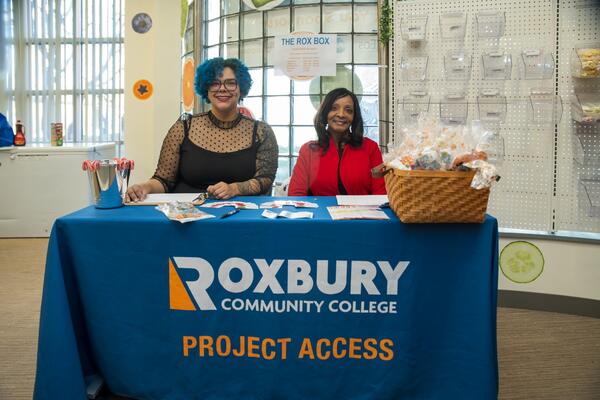
Roxbury Community College students shop for food and personal care essentials at the Rox Box.
Roxbury Community College
Designed to mirror a neighborhood grocery store, the pantry carries items such as food, diapers and personal care essentials and is funded entirely by the community.
“If I find myself going to class thinking about how I didn’t go grocery shopping this weekend, I know I can pick up something from the Rox Box,” Wright said, adding that students receive 30 points each month to redeem for items they need.
“That lets me be more present in class … [and] really does allow peace of mind,” Wright said.
Like Wright, nearly 60 percent of college students nationwide have experienced at least one form of basic needs insecurity in the past year, according to a recent Hope Center survey.
According to Swipe Out Hunger, a nonprofit dedicated to ending college student hunger, student visits to campus food pantries have increased by 30 to 50 percent over the past year across its more than 900 campus partners nationwide.
Origin story: The Rox Box started as an extension of Project Access, an initiative designed to address the nonacademic issues that can prevent degree completion at the Boston-area college.
Santos said the Rox Box has met a strong need, serving more than 300 students each month.
“It’s really taken off,” Santos said. “We see the athletes and everyone walking around with their little bags that say ‘Rox Box,’ and they’re proud that they’re going.”
Roxbury Community College Project Access director Nancy Santos (right) sitting with a student worker at the Rox Box.
Roxbury Community College
She noted that demand continues to rise, with more than 1,700 visits from over 1,500 students between September and December 2025.
“We know the need is out there, because 1,700 visits on our campus is a large number when we only have 2,400 students enrolled,” Santos said, noting that RCC’s student body is predominantly Black, Latino and Pell Grant eligible.
Santos said she regularly surveys students who rely on the Rox Box and has found that nearly 40 percent worry their food won’t stretch until the next time they can afford to buy more, while nearly 30 percent have changed their eating habits to make the provisions last longer.
She underscored how the federal government shutdown last fall contributed to growing “uneasiness” and “insecurity” around RCC students’ food needs.
This comes as nearly 40 percent of public college students in Massachusetts experienced food insecurity last year.
“The numbers are alarming to us,” Santos said. “Our faculty have even shared that they can sometimes see students are distracted or they don’t come to school if they’re hungry … [and] it really does affect their grades.”
To ensure the Rox Box runs smoothly, Santos said, they hired a coordinator who is an RCC alum and had previously relied on the pantry.
“She started as a work-study, so she worked in the pantry with us, and when she graduated we hired her back,” Santos said. “In doing so, the students identify with her and they see there’s a path. They see where they are isn’t where they’ll always be.”
Santos said the pantry helps students feel supported and actively works to reduce the shame around needing help.
“I often say that the shame is not that you are food insecure, the shame is that [food insecurity] exists,” Santos said. “Don’t pretend it isn’t happening. Address it and embrace it and let’s figure out a way to wipe it out.”
What’s next: Santos said starting a campus food pantry is a “big undertaking” but worthwhile for other institutions looking to create their own.
“We are a small college, but we care for our students,” Santos said. “When students are fed and when they’re able to concentrate and really study, it helps them go across the finish line.”
Wright agreed, adding that actively listening to students’ needs and implementing those changes really fosters a sense of trust and community.
“We tell them our views and what we need and everything, and then we see things being done about it,” Wright said. “It really allows us to feel seen, heard and supported.”
Ultimately, Wright said, RCC really gets it right about seeing students “holistically.”
“We’re not just students—we’re entrepreneurs, we’re parents, we’re our parents’ caregivers,” Wright said. “A lot of us are already full-grown people who have lived life and know how to survive, [but] we just need a bit more support that shows [the college is] here for your success.”
Want to help students battling food insecurity? You can support The Rox Box here.
Get more content like this directly to your inbox. Subscribe here.
As we enter the new year, I want to share some thoughts about what higher education needs to accomplish as a sector in 2026. I view these as resolutions: tough challenges we need to tackle with courage and determination. Are you ready?
Fix Accreditation
I have participated in accreditation as a college president, a law school faculty member and as a board member of the NWCCU, the Northwest’s regional accreditor, and so I say this from experience: Our accreditation system is horrible. It wastes massive amounts of time and accomplishes almost nothing to guarantee students a good education. We need to scrap it and start over. Instead of multiyear cycles, we should review schools every five years, in a process that takes no more than six months. It should focus on just three things: student outcomes, responsible financial management and academic freedom. Schools that do not meet strong, clear, objective standards in these areas should be placed on probation and, ultimately, decertified if they fail to improve. We have to stop rubber-stamping failure.
Discuss Creating a True National Higher Ed System
If I use the phrase “American higher education system” with colleagues from Europe and Asia, they laugh. “System? You don’t have a system! You have a giant collection of unregulated institutions that perform very inconsistently, many of them for-profit scams.”
There is so much truth in this reaction. The venerable Higher Education Act of 1965 no long meets our national needs. We need to start a rational discussion about reform of the higher education regulatory landscape. We need a smaller number of higher-performing universities, we need to eliminate institutions with poor outcomes that provide limited or no real return on investment, we need to provide truly affordable undergraduate programs in every state, we need to cut regulations and legal rules that drive up the cost of compliance, and we need to limit student debt. This is not the year for reform—Congress is a divided mess. But we need to start discussing the future.
Focus on Community Colleges
The foundation of American higher education is the part of the sector we talk about least: our community colleges. Community college is the best place to provide four vital services our students and our country desperately need: remedial education to make up for poor K–12 schools, valuable job training in skills and trades to help students prepare for the workplace, ESL classes to help nonnative English speakers thrive, and low-cost general education to help students determine whether they want to proceed to a four year degree.
Community college quality is inconsistent across the United States: excellent in some states, poor in others. As a result, there is no one-size-fits-all set of reforms we need to enact. Every state government needs to have a serious, honest conversation led by the governor on how to strengthen and improve this vital sector.
College costs too much. Instead of pretending this is not true, we need to develop new low-cost, high-quality models. We cannot rely on new institutions to do this: The entry costs and accreditation barriers are too high.
Here’s a place to start.
The eight (relatively wealthy) Ivy League universities should jointly create Ivy College, a low-cost undergraduate lab school in a place they currently don’t serve, like Los Angeles. They should cut everything ancillary to great undergraduate education that drives up costs. That means no research, no sports and recreation, no subsidized activities, no alumni association, no communications department, no health and counseling, no permanent campus (just rented office space). They should reduce the number of majors and the number of electives. Simplify admission, with a lottery for every student scoring 1100 or above on the SAT. Get federal regulatory waivers for compliance cost drivers.
If we tried this for four years, we would learn so much! Then, the Big Ten schools should follow suit.
Advertise on Television
A recent Pew poll found that 70 percent of Americans think higher education is headed in the wrong direction. How do we improve public trust in higher education? Reform will help, yes, but we also need a more effective approach to public relations. When other industries run into trouble, they don’t rely on heartfelt op-eds and books published by university presses to make their case. They launch proactive television and a social media ad campaigns.
ACE should enlist the top 100 universities to bankroll ads that explain the ROI of higher education and the value of university research to national security, health and the economy. Trusted figures should explain why college matters. Celebrities should explain why they benefited from college. And we should remind people that American research universities helped win the Second World War.
John Kroger served as president of Reed College, attorney general of Oregon, chief learning officer of the U.S. Navy and a visiting faculty member at Harvard and Yale Universities and Lewis and Clark College.
“When the economy is doing well, our enrollments are down, and when the economy is in a tough stretch or in a recession, we see our enrollments go up,” said Chris Ferguson, an executive vice chancellor with the California Community Colleges Chancellor’s Office, which oversees all of the state’s 116 community colleges.
Ferguson said the state has yet to release authoritative data on fall enrollment, but early data shows upward trends. In interviews with CalMatters, some college presidents said they’re seeing over 10% more students compared to last fall. But they say the state hasn’t provided enough funding to keep up with their growth.
California is not in a recession, but some economic indicators are grim. Unemployment is rising, and it’s getting harder to find a job. The cost of consumer goods, such as toilet paper and cosmetics, is going up, and economists say tariffs and President Donald Trump’s increased deportations could lead to further economic declines in the state.
“Typically when the economy gets a little crazy, like it is right now, people need to upskill or find new work,” and workers look to colleges for help, said Nicole Albo-Lopez, deputy chancellor for the Los Angeles Community College District. In the Los Angeles district, students between the ages of 35 and 54 are coming back to school in droves — up 28% compared to last year, she said.
Other factors may also be bringing students back to school. The COVID-19 pandemic created a sudden and historic drop in college enrollment, and some schools say the influx of students this year is just a return to pre-pandemic levels. A large portion of recent enrollment growth comes from high school students taking college courses, which has exploded in popularity in the past few years.
But most college officials agree that uncertainty about the economy is at least one of the driving forces for new students this semester.
At the Los Rios Community College District, which represents four campuses in the Sacramento metro area, enrollment is up by more than 5% compared to last fall. Part of that is due to “the gap between Wall Street and Main Street,” said Mario Rodriguez, an executive vice chancellor for the system: The stock market has performed well in the past few years, even as job seekers see fewer opportunities and families struggle with inflation. Enrollments in career technical classes are up 10% this semester at the district, the equivalent of almost 4,000 new students.
These job-ready programs, such as medical assisting, welding, and automotive, have always been popular, and some cap enrollment. School officials say waitlists are growing.
Quitting a job, starting school
Carla Gruhn, 29, has worked as a medical assistant in San Jose for 10 years. At one point she was making roughly $50,000 a year, but it wasn’t enough.
“In the last year, eggs started becoming super expensive,” she said. “That’s when I started paying more attention to gas and groceries.” Together with her husband, she started planning ways to scale back — fewer coffee runs, less travel with their truck, cheaper gifts this Christmas. But they needed a long-term solution, too.
In July, she quit her job and enrolled in a two-year radiologic technology program at Foothill College, in the south Bay Area, which will teach her how to read X-rays, CT scans, and MRIs. Her salary will double, maybe even triple, once she graduates with the new credential.
The pay raise could be “life-changing,” she said. At the moment, Gruhn said her family is small, just her husband and her dog, so their costs are lower, but they know it’s going to get more expensive, since they want to buy a house and have kids. “We’re trying to plan for the future too.”
At Foothill College, enrollment is up, especially in science and technology classes, said Simon Pennington, the school’s associate vice president of community relations. Many of these students are looking to fulfill prerequisites to enter careers in the health care sector, he added. Health care is one of the largest and fastest-growing job sectors in the state, according to a recent report from the Public Policy Institute of California.
In Merced, hours away from major urban centers like the Bay Area, Sacramento, or Los Angeles, students are clamoring for classes in electronics, where the fall waitlist numbers have nearly doubled compared to three years ago. Demand is also up for classes in criminal justice and mechanized agriculture, according to James Leonard, a spokesperson for the school.
“When the economy goes bad, enrollment skyrockets,” said Dee Sigismond, Merced College’s vice president of instruction, though she wasn’t certain that a recession would have the same impact it did 15 years ago. Staring during the pandemic, Merced College, like most community colleges, now offers many of its classes online, which can make it easier for students to juggle school with a full- or part-time job. She added that Merced is also experimenting with new, more flexible kinds of instruction, such as competency-based education, which allows students to pass a class by showing they already have the requisite skills.
Colleges call for more funding
California’s community colleges receive most of their funding based on the number of students they serve. When enrollment declined during the pandemic, colleges were set to lose funding, but the governor and the Legislature granted the community college system a special exemption, delaying many funding cuts.
Now that enrollment is ticking up, many colleges say they have the opposite problem — they aren’t getting enough money to serve the influx of new students. That’s largely because the state’s funding formula is based on the college’s average enrollment over the past three years, so sudden changes this year are slow to have an effect. Rodriguez said his Sacramento area district is serving about 5,000 more students than the system is funded to support, representing about $20 million in lost revenue.
This summer, the state agreed to send more money to California’s community colleges to account for recent enrollment growth, but Ferguson said it isn’t enough to fully fund all the new students.
Last month, presidents and chancellors from 10 different community colleges or community college districts, including representatives from Los Angeles and Sacramento, sent a letter to the governor, asking him to change state policy and allow colleges to get more funding in next year’s budget. Though he did not sign the letter, Ferguson said the state chancellor’s office is asking the governor for similar changes.
In 2008, colleges had to cut back on services or classes, even as new students poured in because the state didn’t provide proportionate funding for each new enrollment.
Next year, California is expected to face an $18 billion budget deficit, according to a November analysis by the Legislative Analyst’s Office. For comparison, the state had a deficit of about $24 billion in 2008, worth about $36 billion in today’s dollars.
In Chula Vista, Southwestern College President Mark Sanchez said his district is already saying no to potential college classes in high schools and prisons because of a lack of state funding.
His district had over 32,000 students in the last academic year — the highest enrollment rate since the Great Recession.
Did you use this article in your work?
We’d love to hear how The 74’s reporting is helping educators, researchers, and policymakers. Tell us how
Under Attorney General Pam Bondi, the Justice Department has sued seven states to challenge their tuition policies for undocumented students.
Andrew Harnik/Getty Images News/Getty Images
With just over two weeks left in office, Republican Virginia attorney general Jason Miyares agreed with the federal Justice Department that a 2020 law granting in-state tuition to undocumented students is unconstitutional.
In a joint court filing, Miyares and lawyers for the Justice Department asked a federal judge to declare the Virginia Dream Act invalid and bar state authorities from enforcing it. If approved, the joint consent decree order would make Virginia the fourth state to scrap its policies that allow eligible undocumented students to pay the lower in-state tuition rate. The joint agreement came just one day after the Trump administration sued Virginia over its in-state tuition policies—the seventh such lawsuit.
In response to these challenges, some states have fought the Justice Department, while several Republican-led states quickly agreed to stop offering undocumented students in-state tuition. The rapid change in policies spurred confusion and chaos for students as they scrambled to find ways to pay for their education. Some advocacy groups have sought to join the lawsuits to challenge the Justice Department.
Miyares, who lost his re-election bid to Democrat Jay Jones in November, wrote on social media that it’s clear that the 2020 statute “is preempted by federal law.”
“Illegal immigrants cannot be given benefits that are not available to American citizens,” he wrote. “Rewarding noncitizens with the privilege of in-state tuition is wrong and only further incentivizes illegal immigration. I have always said I will call balls and strikes, and I am proud to play a part in ending this unlawful program.”
Trump lawyers argued in the Virginia lawsuit and elsewhere that such policies discriminate against U.S. citizens because out-of-state students aren’t eligible for in-state tuition. In Virginia, undocumented students can qualify for the reduced rate if they graduated from a state high school and if they or their parents filed Virginia income tax returns for at least two years before they enroll at a postsecondary institution.
Jones, the incoming Democratic attorney general, criticized the administration’s lawsuit as “an attack on our students and a deliberate attempt to beat the clock to prevent a new administration from defending them.” He added that his team is reviewing their legal options.
In the meantime, the Dream Project, a Virginia nonprofit that supports undocumented students, is seeking to intervene in the lawsuit and has asked the court to delay its consideration of the proposed order. An estimated 13,000 undocumented students were enrolled in Virginia colleges and universities in 2018, according to the filing.
The Dream Project argued in its filing that it and the students it serves would be harmed if the Virginia Dream Act is overturned and that the court should hear a defense of the law.
“The motion by the Trump administration was deliberately filed over a holiday in the dead of night without briefing, without public scrutiny, and without hearing from our scholars and families who would be impacted by this judgment,” Dream Project executive director Zuraya Tapia-Hadley said in a news release. “The state and federal administrations are attempting to re-legislate and set aside the will of the people. If we don’t intervene, that essentially opens the door for settled law to be thrown out with the wave of a pen via a judgment.”
Carl Tobias, a law professor at the University of Richmond, said he’s hopeful that the judge, Robert Payne, will grant the motion for intervention, noting that he “is a stickler for proper procedures.”
“There’s a basic premise that there should be two sides to every litigation, and there aren’t two sides in this litigation,” he said, adding that if the judge does approve the consent decree, the General Assembly could always put a law similar to the Virginia Dream Act back in place.
To Tobias, the legislation is constitutional and should withstand a legal challenge.
“This administration has a very different view of what the Constitution requires, so they can make their arguments,” he said. “But they shouldn’t be making them in a vacuum without hearing the other side.”
The National Institutes of Health is deciding, per court agreements, whether to award or deny droves of grant applications that the agency previously either rejected or shelved. This funding was stalled last year amid the Trump administration’s blunt moves to restrict research into certain disfavored topics, such as diversity, equity and inclusion—though researchers and state attorneys general said officials shot down a greater range of projects, including ones that could save lives.
The NIH’s agreements, laid out in court filings in two ongoing lawsuits, are already bearing fruit. A spokesperson for the Massachusetts attorney general’s office, which is leading one of the cases, said the agreement in that suit promises decisions on more than 5,000 grants nationally. On Dec. 29, the date of the agreement, the NIH issued 528 grant decisions, 499 of which were approvals, the spokesperson said.
A spokesperson for the American Civil Liberties Union, which is leading the other case, said the agreement in that case involves about 400 grants. He said the NIH awarded at least 135 out of 146 applications in a batch of decisions on Dec. 29.
The filings set a series of dates by which the NIH agreed to decide on awarding or denying other types of grants. The last deadline is July 31.
The agreements are another example of the Trump administration reversing many of its sweeping cuts to research funding in response to litigation. Researchers and organizations filed suit after suit last year after the NIH and other federal funding agencies abruptly terminated previously awarded grants and sat on applications for new ones.
In a news release, the ACLU said the grants that the NIH will now decide on “address urgent public health issues, including HIV prevention, Alzheimer’s disease, LGBTQ+ health, and sexual violence.” ACLU of Massachusetts legal director Jessie Rossman said in the release that the NIH’s “unprecedented” and “unlawful” actions put “many scientists’ careers in limbo, including hundreds of members of the American Public Health Association and the UAW union.”
ACLU lawyers are among the attorneys representing those groups, Ibis Reproductive Health and individual researchers in a suit they filed in April against the NIH and the larger Health and Human Services Department for stalling and rejecting grant funding. Democratic state attorneys general filed a similar suit in the same court, the U.S. District Court of Massachusetts.
The agencies agreed to decide these grant applications in exchange for the plaintiffs dismissing some of their claims. The agencies didn’t admit wrongdoing.
In a news release, the Massachusetts attorney general’s office said the Trump administration “indefinitely withheld issuing final decisions on applications that had already received approval from the relevant review panels,” leaving the states that sued “awaiting decisions on billions of dollars.”
The release said that, for example, when the suit was filed in April, the University of Massachusetts “had 353 applications for NIH funding whose review had been delayed, signifying millions in potential grant funding that would aid in lifesaving medical research.” Massachusetts attorney general Andrea Joy Campbell said in a statement that “lifesaving studies related to Alzheimer’s disease, cancer, and other devastating illnesses were frozen indefinitely—stealing hope from countless families across the country and putting lives at risk.”
It’s unclear how much money the NIH may dole out in total. An HHS spokesperson told Inside Higher Ed that the “NIH cannot comment on the status of individual grant applications or deliberations.”
“The agency remains committed to supporting rigorous, evidence-based research that advances the health of all Americans,” the spokesperson said. HHS and the NIH didn’t provide interviews or further comment.
Meanwhile, a legal fight continues over grants that the NIH previously approved but later canceled.
Lingering Questions
In June, in these same two cases, U.S. District Judge William Young ordered the NIH to restore grants the agency had awarded but then—after Trump retook the White House—terminated midgrant.
Young, a Reagan appointee, criticized the federal government for not formally defining DEI, despite using that term to justify terminating grants. He said at a hearing that he’d “never seen racial discrimination by the government like this” during his four decades as a federal judge.
But, two months later, the U.S. Supreme Court, in a 5-to-4 preliminary decision, stayed Young’s ruling ordering restoration of the grants. Justice Amy Coney Barrett, a Trump appointee, wrote for the majority that Young “likely lacked jurisdiction to hear challenges to the grant terminations, which belong in the Court of Federal Claims.” However, STAT reported that the NIH had restored more than 2,000 terminated grants following Young’s ruling, and it didn’t reverse course after the Supreme Court decision.
That question of whether researchers with canceled grants must ultimately try their luck before the Court of Federal Claims is now before the U.S. First Circuit Court of Appeals. There’s a hearing Tuesday in that matter.
Questions linger about when the grant fight will really end. In a video interview with journalist Paul Thacker—released Wednesday and previously reported on by STAT—NIH director Jay Bhattacharya said that, despite the grant restorations, any grants dealing with DEI that come up for renewal this year won’t be funded. Bhattacharya distinguished between cutting a grant and not renewing it.
He said that, “as best I can understand the legal aspects,” the courts have said his agency can’t cut restored grants. “But, when it comes to renewal, those grants no longer meet NIH priorities … so when they come up for renewal over the course of the year, we won’t renew them,” he said.
Bhattacharya said the NIH’s DEI-related work “did not actually have any chance of improving the health of minority populations.” He said, “I think that the shift away from DEI is of a piece with the rest of what we’re trying to do at the NIH, which is to do research that actually makes the lives of people better.”
The rapid rise of generative AI has turned classrooms into a real-time experiment in technology use. Students are using AI to complete assignments, while teachers are leveraging it to design lessons, streamline grading, and manage administrative tasks.
According to new national survey data from RAND, AI use among both students and educators has grown sharply–by more than 15 percentage points in just the past one to two years. Yet, training and policy have not kept pace. Schools and districts are still developing professional development, student guidance, and clear usage policies to manage this shift.
As a result, educators, students, and parents are navigating both opportunities and concerns. Students worry about being falsely accused of cheating, and many families fear that increased reliance on AI could undermine students’ critical thinking skills.
Key findings:
During the 2024-2025 school year, AI saw rapid growth.
AI use in schools surged during the 2024-2025 academic year. By 2025, more than half of students (54 percent) and core subject teachers (53 percent) were using AI for schoolwork or instruction–up more than 15 points from just a year or two earlier. High school students were the most frequent users, and AI adoption among teachers climbed steadily from elementary to high school.
While students and parents express significant concern about the potential downsides of AI, school district leaders are far less worried.
Sixty-one percent of parents, 48 percent of middle school students, and 55 percent of high school students believe that increased use of AI could harm students’ critical-thinking skills, compared with just 22 percent of district leaders. Additionally, half of students said they worry about being falsely accused of using AI to cheat.
Training and policy development have not kept pace with AI use in schools.
By spring 2025, only 35 percent of district leaders said their schools provide students with training on how to use AI. Meanwhile, more than 80 percent of students reported that their teachers had not explicitly taught them how to use AI for schoolwork. Policy guidance also remains limited–just 45 percent of principals said their schools or districts have policies on AI use, and only 34 percent of teachers reported policies specifically addressing academic integrity and AI.
The report offers recommendations around AI use and guidance:
As AI technology continues to evolve, trusted sources–particularly state education agencies–should provide consistent, regularly updated guidance on effective AI policies and training. This guidance should help educators and students understand how to use AI as a complement to learning, not a replacement for it.
District and school leaders should clearly define what constitutes responsible AI use versus academic dishonesty and communicate these expectations to both teachers and students. In the near term, educators and students urgently need clarity on what qualifies as cheating with AI.
Elementary schools should also be included in this effort. Nearly half of elementary teachers are already experimenting with AI, and these early years are when students build foundational skills and habits. Providing age-appropriate, coherent instruction about AI at this stage can reduce misuse and confusion as students progress through school and as AI capabilities expand.
Ultimately, district leaders should develop comprehensive AI policies and training programs that equip teachers and students to use AI productively and ethically across grade levels.
Laura Ascione is the Editorial Director at eSchool Media. She is a graduate of the University of Maryland’s prestigious Philip Merrill College of Journalism.
eSchool News is counting down the 10 most-read stories of 2025. Story #1 focuses on the Trump Administration’s goal of dismantling the U.S. Department of Education.
Key points:
In light of Donald Trump assuming a second presidential term in 2025, conversations concerning dismantling the United States Department of Education have resurfaced. Supporters argue that federal involvement in education undermines state authority, while critics fear that removing the federal role could exacerbate inequities and hinder national progress. To evaluate the proposal, it is crucial to examine the federal and state roles in education, the historical and constitutional context, and the potential benefits and challenges of such a shift.
The federal role in education
The United States Constitution does not explicitly grant the federal government authority over education. As Lunenberg et al. (2012) noted, “Education is not a function specifically delegated to the federal government” (p. 327). Instead, under the Tenth Amendment, powers not delegated to the federal government are reserved for the states (McCarthy et al., 2019). This leaves education primarily under state jurisdiction, with federal involvement historically limited to indirect support rather than direct control.
The United States Department of Education was established in 1979. It is responsible for overseeing federal funding for schools, enforcing federal laws in education, and ensuring equal access for students across the country. Furthermore, it has played a significant role through legislation such as the Elementary and Secondary Education Act (ESEA) and its successors: NCLB (No Child Left Behind) and ESSA (the Every Student Succeeds Act). These laws link federal funding to specific requirements, which aim to address inequities in education. Currently, federal contributions account for approximately 8 percent of funding for elementary and secondary education, with the remaining 92 percent coming from state and local sources (“The Federal Role,” 2017).
The role of state and local control in education
Education policy and administration have traditionally been state functions. States determine funding formulas, establish teacher certification requirements, and oversee curricula through their departments and boards of education (Lynch, 2016). Governors and state legislatures allocate funds, which are often distributed to schools based on enrollment, need, or specific programs (Lunenberg et al., 2012).
Local school boards also play a critical role, managing day-to-day operations and responding to community needs. This decentralized structure reflects a longstanding belief that local authorities are better positioned to address the diverse needs of their communities. However, it has also led to significant disparities between states and districts in terms of funding, resources, and student outcomes.
Dismantling the United States Department of Education
One of the most compelling arguments for dismantling the United States Department of Education lies in the principle of localized control. Critics argue that education is best managed by state and local governments because they are closer to the specific needs of their communities. Localized governance could allow schools to tailor their policies, curriculum, and resource allocation in ways that best fit the unique demographics of their regions. For example, schools in rural areas may have vastly different needs than those in urban centers, which is why local authorities are likely better equipped to address these disparities without the interference of federal oversight.
The concern extends beyond general education. The Individuals with Disabilities Education Act (IDEA), which is enforced by the United States Department of Education, mandates that students with disabilities receive free and appropriate public education (FAPE) along with necessary services and accommodations. Similarly, the department oversees federal programs that support English Language Learner (ELL) students by helping schools provide tailored instruction and resources to students who are not native English speakers. Without federal oversight, it is possible that these programs could lose funding or be inconsistently applied across states, causing vulnerable populations to be without critical support.
Advocates of dismantling the United States Department of Education also point to the financial burden of maintaining a federal agency. They argue that billions of dollars allocated to the department could be redirected to state education budgets, thereby allowing for more impactful initiatives at the forefront. By eliminating bureaucratic layers, states could potentially deliver education funding more efficiently, thereby focusing resources directly on teachers, classrooms, and students.
Another critical function of the United States Department of Education is establishing and enforcing national education standards. Programs such as NCLB and ESSA aim to hold schools accountable for student performance and ensure consistency across states (albeit, there are arguments those programs have led to a culture of “teaching to the test” and have stifled creativity in the classroom), but allowing states and local districts to have greater freedom to design their own standards and assessments may fostering innovation while also leading to the quality of education varying dramatically from state to state and can cause challenges for students in transient populations due to a lack of cohesion disrupting their education and limiting their opportunities.
Keeping the United States Department of Education
Dismantling the United States Department of Education raises significant concerns about equity. The department plays a crucial role in addressing disparities in funding education, as well as in funding access. Federal programs (i.e., Title I, free meals, counseling, after-school programs, etc.) provide additional resources to schools serving high numbers of low-income students, many of which are located in inner-city areas. Without the United States Department of Education, these programs might be eliminated or left to the discretion of states that have historically struggled to prioritize funding for underserved communities.
Inner-city urban schools often face unique challenges (i.e., overcrowding, insufficient funding, higher rates of poverty among students, etc.). Many of these schools also serve disproportionately high numbers of students with disabilities and ELL students, thereby making federal support even more vital. The United States Department of Education enforces civil rights protections that ensures that all students (including vulnerable subgroups) receive equitable treatment. Dismantling the department could weaken these safeguards, thereby leaving marginalized communities more vulnerable to neglect. Therefore, the loss of federal oversight is a serious concern for public education. Historically, states have not always allocated resources equitably, and urban school districts have often been underfunded compared to their suburban counterparts. Federal intervention has been essential in addressing these disparities. Without it, inner-city schools may struggle to maintain even basic standards of education, thereby exacerbating poverty and inequality.
All schools (not just inner-city schools) will be adversely impacted by dismantling the United States Department of Education. Federal funding supports Advanced Placement (AP) courses, STEM initiatives, and dual-enrollment opportunities. Dismantling the United States Department of Education could lead to inconsistencies in college admissions processes because states might adopt different graduation requirements and assessments. This lack of standardization could complicate admissions for students applying to out-of-state or prestigious universities. Furthermore, the United States Department of Education funds research initiatives that lead to the development of new teaching methods, technologies, and curricula. These innovations often benefit all schools, but without federal support, such research might stagnate leaving schools without access to cutting-edge educational resources.
Conclusion
In conclusion, the debate pertaining to dismantling the United States Department of Education has taken on new urgency under the Trump administration in 2025. While advocates of dismantling the department argue for greater local control and efficiency, the critics highlight the potential risks to equity and access. As the nation grapples with this issue, it is essential to prioritize the needs of students (and communities). The ultimate goal must be to create a more equitable and effective education system that serves all students regardless of their background or zip code.
Latest posts by eSchool Media Contributors (see all)
By the time the morning bell rings at Rosewood STEM Magnet, Urban Planning and Urban Design, Monika Heidi Duque has already been in her classroom for hours — reviewing lesson plans, setting out materials, and greeting students by name.
Duque, who has taught at the award-winning, urban planning-themed LAUSD elementary school in West Hollywood for 18 years, was one of four teachers named as finalists by the state education department for the 2026 California Teachers of the Year in October. She was the only LAUSD teacher to receive the honor.
Duque works hard to create a free-flowing vibe in her first-grade classroom to promote the creativity of her students, describing the scene as the “best kind” of messy.
“It’s a place where my students are able to wonder, to be curious, to take risks, to be able to make things with their hands and minds,” said Duque, who has been a teacher in Los Angeles Unified since 2000.
“It’s a place where you can tell learning is happening,” she said of her classroom.
The veteran teacher’s freewheeling approach is apparent in her classroom but there’s a method to the mayhem. Everything her students do is somehow tied back to the school’s theme of urban planning and urban design, topics Duque admits could be heady for her 6-year-old students, were it not for her approach to the subjects, which links them to kids’ everyday lives.
On a recent school day, students in Duque’s class were drawing pictures of designs for a new community space in Griffith Park after she noticed a news report about the city’s struggle to repurpose the area formerly used for pony rides.
Students drew pictures of their ideas for the space, coloring construction paper using markers and drawing their visions for forests and lazy rivers that could be installed in L.A.’s historic park.
In subsequent parts of the project, Duque said, students will create three-dimensional models of their ideas for the part using recycled materials such as cardboard and paper.
“We’re making an arcade that’s called Fun Time, and then we put a petting zoo next to it called Pig Pig,” said Ben, a student in Duque’s class, who was working on a drawing with a few classmates. “I wonder if it will really happen.”
Duque often pulls ideas for lessons from real-life events in L.A., finding the sprawling and diverse city offers no shortage of inspiration for classroom activities tied to urban planning.
“I just keep my eyes and ears to the news, and I just see what’s happening in our community, and I just get ideas from there,” she said.
A favorite lesson from a few years ago was based on an experience the teacher had while walking her dog in Griffith Park, when a coyote approached the two and nearly attacked Duque’s pet.
Feral coyotes are common in L.A. and such experiences aren’t unusual, but this event inspired Duque to create a lesson for students to create outfits for pets to repel predatory coyote attacks.
Students created costumes for pets that featured things known to deter coyotes, such as flashing lights. One student liked the project so much she created a picture book about the lesson with her parents, a copy of which Duque keeps displayed on the wall in her class.
“It’s another example of how I really look at what’s in our city, what’s in the news, and what’s relevant to kids and our lives,” the teacher said.
Duque’s relentless curiosity and enthusiasm make her a natural leader among her colleagues at Rosewood, said the school’s principal, Linda Crowder.
“She is a lifelong learner,” Crowder said. “She gets something and she runs with it.”
Did you use this article in your work?
We’d love to hear how The 74’s reporting is helping educators, researchers, and policymakers. Tell us how
eSchool News is counting down the 10 most-read stories of 2025. Story #2 focuses on predictions educators made for AI in 2025.
When it comes to education trends, AI certainly has staying power. As generative AI technologies evolve, educators are moving away from fears about AI-enabled cheating and are embracing the idea that AI can open new doors for teaching and learning.
AI tools can reduce the administrative burden so many educators carry, can personalize learning for students, and can help students become more engaged in their learning when they use the tools to brainstorm and expand on ideas for assignments and projects. Having AI skills is also essential for today’s students, who will enter a workforce where AI know-how is becoming more necessary for success.
In 2025, online program leaders will begin to unlock the vast potential of generative AI, integrating it more deeply into the instructional design process in ways that can amplify and expedite the work of faculty and instructional designers. This technology, already making waves in instruction and assessment, stands poised to transform the creation of online courses. By streamlining time-intensive tasks, generative AI offers the promise of automation, replication, and scalability, enabling institutions to expand their online offerings at an unprecedented pace. The key is that we maintain rigorous standards of quality–and create clear guardrails around the ethical use of AI at a time when increasingly sophisticated models are blurring the lines between human design–and artificial intelligence. Generative AI holds extraordinary promise, but its adoption must be grounded in practices that prioritize equitable and inclusive access, transparency, and educational excellence. –Deb Adair, CEO, Quality Matters
In 2025, education in the United States will reflect both the challenges and opportunities of a system in transition. Uncertainty and change at the federal level will continue to shift decision-making power to states, leaving them with greater autonomy but also greater responsibility. While this decentralization may spark localized innovation, it is just as likely to create uneven standards. In some states, we’ve already seen benchmarks lowered to normalize declines, a trend that could spread as states grapple with resource and performance issues. This dynamic will place an even greater burden on schools, teachers, and academic leaders. As those closest to learners, they will bear the responsibility of bridging the gap between systemic challenges and individual student success. To do so effectively, schools will require tools that reduce administrative complexity, enabling educators to focus on fostering personal connections with students–the foundation of meaningful academic growth. AI will play a transformative role in this landscape, offering solutions to these pressures. However, fragmented adoption driven by decentralized decision-making will lead to inequities, with some districts leveraging AI effectively and others struggling to integrate it. In this complex environment, enterprise platforms that offer flexibility, integration, and choice will become essential. 2025 will demand resilience and creativity, but it also offers all of us an opportunity to refocus on what truly matters: supporting educators and the students they inspire. —Scott Anderberg, CEO, Moodle
As chatbots become more sophisticated, they’re rapidly becoming a favorite among students for their interactive and personalized support, and we can expect to see them increasingly integrated into classrooms, tutoring platforms, and educational apps as educators embrace this engaging tool for learning. Additionally, AI is poised to play an even larger role in education, particularly in test preparation and course planning. By leveraging data and predictive analytics, AI-driven tools will help students and educators create more tailored and effective learning pathways, enhancing the overall educational experience. —Brad Barton, CTO, YouScience
As we move into 2025, we’ll move past the AI hype cycle and pivot toward solving tangible classroom challenges. Effective AI solutions will integrate seamlessly into the learning environment, enhancing rather than disrupting the teaching experience. The focus will shift to practical tools that help teachers sustain student attention and engagement–the foundation of effective learning. These innovations will prioritize giving educators greater flexibility and control, allowing them to move freely around the classroom while effortlessly managing and switching between digital resources. An approach that ensures technology supports and amplifies the irreplaceable human connections at the heart of learning, rather than replacing them. –Levi Belnap, CEO, Merlyn Mind
The year 2025 is set to transform science education by implementing AI-driven learning platforms. These platforms will dynamically adjust to the student’s interests and learning paces, enhancing accessibility and inclusivity in education. Additionally, virtual labs and simulations will rise, enabling students to experiment with concepts without geographical constraints. This evolution will make high-quality STEM education more universally accessible. –Tiago Costa, Cloud & AI Architect, Microsoft; Pearson Video Lesson Instructor
In the two years since GenAI was unleashed, K-12 leaders have ridden the wave of experimentation and uncertainty about the role this transformative technology should have in classrooms and districts. 2025 will see a shift toward GenAI strategy development, clear policy and governance creation, instructional integration, and guardrail setting for educators and students. K-12 districts recognize the need to upskill their teachers, not only to take advantage of GenAI to personalize learning, but also so they can teach students how to use this tech responsibly. On the back end, IT leaders will grapple with increased infrastructure demands and ever-increasing cybersecurity threats. —Delia DeCourcy, Senior Strategist, Lenovo Worldwide Education Team
AI-driven tools will transform the role of teachers and support staff in 2025: The advent of AI will allow teachers to offload mundane administrative tasks to students and provide them more energy to be at the “heart and soul” of the classroom. Moreover, more than two-thirds (64 percent) of parents agreed or strongly agreed that AI should help free teachers from administrative tasks and help them build connections with the classroom. Impact of technological advancements on hybrid and remote learning models in 2025: AI is revolutionizing the online learning experience with personalized pathways, tailored skills development and support, and enhanced content creation. For example, some HBS Online courses, like Launching Tech Ventures, feature an AI course assistant bot to help address learners’ questions and facilitate successful course completion. While the long-term impact remains uncertain, AI is narrowing the gap between online and in-person education. By analyzing user behavior and learning preferences, AI can create adaptive learning environments that dynamically adjust to individual needs, making education more engaging and effective. –David Everson, Senior Director of Marketing Solutions, Laserfiche
In education and digital publishing, artificial intelligence (AI) will continue transitioning from novelty applications to solutions that address real-world challenges facing educators and students. Successful companies will focus on data security and user trust, and will create learner-centered AI tools to deliver personalized experiences that adapt to individual needs and enhance efficiency for educators, enabling them to dedicate more time to fostering meaningful connections with students. The ethical integration of AI technologies such as retrieval-augmented generation (RAG) is key to this evolution. Unlike traditional large language models that ingest information from the Internet at large, RAG delivers AI outputs that are grounded in authoritative, peer-reviewed content, reducing the risk of misinformation while safeguarding the integrity of intellectual property. Thoughtfully developed AI tools such as this will become partners in the learning journey, encouraging analysis, problem-solving, and creativity rather than fostering dependence on automated responses. By taking a deliberate approach that focuses on ethical practices, user-centered design, and supporting the cultivation of essential skills, successful education companies will use AI less as innovation for its own sake and more as a means to provide rich and memorable teaching and learning experiences. —Paul Gazzolo, Senior Vice President & Global General Manager, Gale, a Part of Cengage Group
Adaptive learning technologies will continue to personalize curriculum and assessment, creating a more responsive and engaging educational journey that reflects each student’s strengths and growth areas. Generative AI and other cutting-edge advancements will be instrumental in building solutions that optimize classroom support, particularly in integrating assessment and instruction. We will see more technology that can help educators understand the past to edit materials in the present, to accelerate teachers planning for the future. —Andrew Goldman, EVP, HMH Labs
We’ll witness a fundamental shift in how we approach student assessment, moving away from conventional testing models toward more authentic experiences that are seamless with instruction. The thoughtful integration of AI, particularly voice AI technology, will transform assessment from an intermittent event into a natural part of the learning process. The most promising applications will be those that combine advanced technology with research-validated methodologies. Voice-enabled assessments will open new possibilities for measuring student knowledge in ways that are more natural and accessible, especially for our youngest learners, leveraging AI’s capabilities to streamline assessment while ensuring that technology serves as a tool to augment, rather than replace, the critical role of teachers. –Kristen Huff, Head of Measurement, Curriculum Associates
AI is already being used by many educators, not just to gain efficiencies, but to make a real difference in how their students are learning. I suspect in 2025 we’ll see even more educators experimenting and leveraging AI tools as they evolve–especially as more of the Gen Z population enters the teaching workforce. In 2024, surveyed K-12 educators reported already using AI to create personalized learning experiences, provide real-time performance feedback, and foster critical thinking skills. Not only will AI usage continue to trend up throughout 2025, I do believe it will reach new heights as more teachers begin to explore GenAI as a hyper-personalized asset to support their work in the classroom. This includes the use of AI as an official teacher’s assistant (TA), helping to score free response homework and tests and providing real-time, individualized feedback to students on their education journey. –John Jorgenson, CMO, Cambium Learning Group
The new year will continue to see the topic of AI dominate the conversation as institutions emphasize the need for students to understand AI fundamentals, ethical considerations, and real-world applications outside of the classroom. However, a widening skills gap between students and educators in AI and digital literacy presents a challenge. Many educators have not prioritized keeping up with rapid technological advancements, while students–often exposed to digital tools early on–adapt quickly. This gap can lead to uneven integration of AI in classrooms, where students sometimes outpace their instructors in understanding. To bridge this divide, comprehensive professional development for teachers is essential, focusing on both technical skills and effective teaching strategies for AI-related topics. Underscoring the evolving tech in classrooms will be the need for evidence of outcomes, not just with AI but all tools. In the post-ESSER era, evidence-based decision-making is crucial for K-12 schools striving to sustain effective programs without federal emergency funds. With the need to further justify expenditures, schools must rely on data to evaluate the impact of educational initiatives on student outcomes, from academic achievement to mental health support. Evidence helps educators and administrators identify which programs truly benefit students, enabling them to allocate resources wisely and prioritize what works. By focusing on measurable results, schools can enhance accountability, build stakeholder trust, and ensure that investments directly contribute to meaningful, lasting improvements in learning and well-being. —Melissa Loble, Chief Academic Officer, Instructure
With AI literacy in the spotlight, lifelong learning will become the new normal. Immediate skills need: The role of “individual contributors” will evolve, and we will all be managers of AI agents, making AI skills a must-have. Skills of the future: Quantum skills will start to be in demand in the job market as quantum development continues to push forward over the next year. Always in-demand skills: The overall increase in cyberattacks and emerging risks, such as harvest now and decrypt later (HNDL) attacks, will further underscore the continued importance of cybersecurity skills. Upskilling won’t end with AI. Each new wave of technology will demand new skills, so lifelong learners will thrive. AI will not be siloed to use among technology professionals. The democratization of AI technology and the proliferation of AI agents have already made AI skills today’s priority. Looking ahead, quantum skills will begin to grow in demand with the steady advance of the technology. Meanwhile cybersecurity skills are an evergreen need. —Lydia Logan, VP of Global Education & Workforce Development, IBM
This coming year, we’ll see real progress in using technology, particularly GenAI, to free up teachers’ time. This will enable them to focus on what they do best: working directly with students and fostering the deep connections crucial for student growth and achievement. GenAI-powered assistants will streamline lesson planning after digesting information from a sea of assessments to provide personalized recommendations for instruction to an entire class, small groups, and individual students. The bottom line is technology that never aims to replace a teacher’s expertise–nothing ever should–but gives them back time to deepen relationships with students. —Jack Lynch, CEO, HMH
Looking to 2025, I anticipate several key trends that will further enhance the fusion of educators, AI and multimodal learning. AI-powered personalization enhanced by multimedia: AI will deliver personalized learning paths enriched with various content formats. By adapting to individual learning styles–whether visual, auditory, or kinesthetic–we can make education more engaging and effective. Expansion of multimodal learning experiences: Students will increasingly expect learning materials that engage multiple senses. Integrating short-form videos created and vetted by actual educators, interactive simulations, and audio content will cater to different learning preferences, making education more inclusive and effective. Deepening collaboration with educators: Teachers will play an even more critical role in developing and curating multimodal content. Their expertise ensures that the integration of technology enhances rather than detracts from the learning experience. –Nhon Ma, CEO & Co-founder, Numerade
AI and automation become a competitive advantage for education platforms and systems. 2025 will be the year for AI to be more infused in education initiatives and platforms. AI-powered solutions have reached a tipping point from being a nice-to-have to a must-have in order to deliver compelling and competitive education experiences. When we look at the education sector, the use cases are clear. From creating content like quizzes, to matching students with education courses that meet their needs, to grading huge volumes of work, enhancing coaching and guidance for students, and even collecting, analyzing and acting on feedback from learners, there is so much value to reap from AI. Looking ahead, there could be additional applications in education for multimodal AI models, which are capable of processing and analyzing complex documents including images, tables, charts, and audio. —Rachael Mohammed, Corporate Social Responsibility Digital Offerings Leader, IBM
Agentic and Shadow AI are here. Now, building guardrails for safe and powerful use will be key for education providers and will require new skillsets. In education, we expect the start of a shift from traditional AI tools to agents. In addition, the mainstream use of AI technology with ChatGPT and OpenAI has increased the potential risk of Shadow AI (the use of non-approved public AI applications, potentially causing concerns about compromising sensitive information). These two phenomena highlight the importance of accountability, data and IT policies, as well as control of autonomous systems. This is key mostly for education providers, where we think there will be greater attention paid to the AI guardrails and process. To be prepared, educators, students, and decision makers at all levels need to be upskilled in AI, with a focus on AI ethics and data management. If we invest in training the workforce now, they will be ready to responsibly develop and use AI and AI agents in a way that is trustworthy. —Justina Nixon-Saintil, Vice President & Chief Impact Officer, IBM
Rather than replacing human expertise, AI can be used as a resource to allow someone to focus more of their time on what’s truly important and impactful. As an educator, AI has become an indispensable tool for creating lesson plans. It helps generate examples, activity ideas, and anticipate future students’ questions, freeing me to focus on the broader framework and the deeper meaning of what I’m teaching. –Sinan Ozdemir, Founder & Chief Technology Officer, Shiba Technologies; Author, Quick Start Guide to Large Language Models
Data analytics and AI will be essential towards tackling the chronic absenteeism crisis. In 2025, the conversation around belonging will shift from abstract concepts to concrete actions in schools. Teachers who build strong relationships with both students and families will see better attendance and engagement, leading more schools to prioritize meaningful connection-building over quick-fix solutions. We’ll see more districts move toward personalized, two-way school communications that create trust with parents and the larger school community. In order to keep up with the growing need for this type of individualized outreach, schools will use data analytics and AI to identify attendance and academic patterns that indicate students are at risk of becoming chronically absent. It won’t be dramatic, but we’ll see steady progress throughout the year as schools recognize that student success depends on creating environments where both students and families feel valued and heard. —Dr. Kara Stern, Director of Education and Engagement, SchoolStatus
As access to AI resources gains ground in classrooms, educators will face a dire responsibility to not only master these tools but to establish guidelines and provide best practices to ensure effective and responsible use. The increasing demand for AI requires educators to stay informed about emerging applications and prioritize ethical practices, ensuring AI enhances rather than impedes educational outcomes.. This is particularly critical in STEM fields, where AI has already transformed industries and is shaping career paths, providing new learning opportunities for students. To prevent the exacerbation of the existing STEM gap, educators must prioritize equitable access to AI resources and tools, ensuring that all students, regardless of background, have the opportunity to engage with and fully understand these technologies. This focus on equity is essential in leveling the playing field, helping bridge disparities that could otherwise limit students’ future success. Achieving these goals will require educators to engage in professional development programs designed to equip them with necessary skills and content knowledge to implement new technology in their classrooms. Learning how to foster inclusive environments is vital to cultivating a positive school climate where students feel motivated to succeed. Meanwhile, professionally-trained educators can support the integration of new technologies to ensure that every student has the opportunity to thrive in this new educational landscape. —Michelle Stie, Vice President, Program Design & Innovation, NMSI
Artificial intelligence (AI) is poised to increase in use in K-12 classrooms, with literacy instruction emerging as a key area for transformative impact. While educators may associate AI with concerns like cheating, its potential to enhance human-centered teaching is gaining recognition. By streamlining administrative tasks, AI empowers teachers to focus on connecting with students and delivering personalized instruction. One trend to watch is AI’s role in automating reading assessments. These tools reduce the time educators spend administering and analyzing tests, offering real-time insights that guide individualized instruction. AI is also excelling at pinpointing skill gaps, allowing teachers to intervene early, particularly in foundational reading areas. Another emerging trend is AI-driven reading practice. Tools can adapt to each student’s needs, delivering engaging, personalized reading tutoring with immediate corrective feedback. This ensures consistent, intentional practice–a critical factor in literacy growth. Rather than replacing teachers, AI frees up educator time for what matters most: fostering relationships with students and delivering high-quality instruction. As schools look to optimize resources in the coming year, AI’s ability to augment literacy instruction can be an important tool that maximizes students’ growth, while minimizing teachers’ work. —Janine Walker-Caffrey, Ed.D., Chief Academic Officer, EPS Learning
We expect a renewed focus on human writing with a broader purpose–clear communication that demonstrates knowledge and understanding, enhanced, not replaced by available technology. With AI making basic elements of writing more accessible to all, this renaissance of writing will emphasize the ability to combine topical knowledge, critical thinking, mastery of language and AI applications to develop written work. Instead of being warned against using generative AI, students will be asked to move from demand–asking AI writing tools to produce work on their behalf, to command–owning the content creation process from start to finish and leveraging technology where it can be used to edit, enhance or expand original thinking. This shift will resurface the idea of co-authorship, including transparency around how written work comes together and disclosure of when and how AI tools were used to support the process. —Eric Wang, VP of AI, Turnitin
GenAI and AI writing detection tools will evolve, adding advanced capabilities to match each other’s detectability flex. End users are reaching higher levels of familiarity and maturity with AI functionality, resulting in a shift in how they are leveraged. Savvy users will take a bookend approach, focusing on early stage ideation, organization and expansion of original ideas as well as late stage refinement of ideas and writing. Coupling the use of GenAI with agentic AI applications will help to overcome current limitations, introducing multi-source analysis and adaptation capabilities to the writing process. Use of detection tools will improve as well, with a focus on preserving the teaching and learning process. In early stages, detection tools and indicator reports will create opportunities to focus teaching on addressing knowledge gaps and areas lacking original thought or foundation. Later stage detection will offer opportunities to strengthen the dialogue between educators and students, providing transparency that will reduce student risk and increase engagement. —Eric Wang, VP of AI, Turnitin
Advanced AI tools will provide more equitable access for all students, inclusive of reaching students in their home language, deaf and hard of hearing support through AI-enabled ASL videos, blind and visually impaired with real time audio descriptions, tactiles, and assistive technology. –Trent Workman, SVP for U.S. School Assessments, Pearson
Generative AI everywhere: Generative AI, like ChatGPT, is getting smarter and more influential every day, with the market expected to grow a whopping 46 percent every year from now until 2030. By 2025, we’ll likely see AI churning out even more impressive text, images, and videos–completely transforming industries like marketing, design, and content creation. Under a Trump administration that might take a more “hands-off” approach, we could see faster growth with fewer restrictions holding things back. That could mean more innovative tools hitting the market sooner, but it will also require companies to be careful about privacy and job impacts on their own. The threat of AI-powered cyberattacks: Experts think 2025 might be the year cybercriminals go full throttle with AI. Think about it: with the advancement of the technology, cyberattacks powered by AI models could start using deepfakes, enhanced social engineering, and ultra-sophisticated malware. If the Trump administration focuses on cybersecurity mainly for critical infrastructure, private companies could face gaps in support, leaving sectors like healthcare and finance on their own to keep up with new threats. Without stronger regulations, businesses will have to get creative–and fast–when it comes to fighting off these attacks. –Alon Yamin, Co-Founder & CEO, Copyleaks
Laura Ascione is the Editorial Director at eSchool Media. She is a graduate of the University of Maryland’s prestigious Philip Merrill College of Journalism.
A prominent academy trust leader will be knighted and a well-known professor of social mobility will be made a dame in the new year’s honours list.
Dr Stephen Taylor and Professor Sonia Blandford are among 57 people working in or with the schools community in England recognised this year.
Steve Taylor
Taylor, the CEO of the 35-school Cabot Learning Federation and chair of the Queen Street Group of academy leaders will be knighted for services to education.
“Since learning of this award, I have thought about all those colleagues in the Cabot Learning Federation and in the wider sector, whose work and successes have inspired me over the years to strive to do my best for the children we serve,” he said.
“Anything I would count as an achievement has come about as the result of working in collaboration with great people I have had the privilege of knowing, in the CLF and beyond.
“That includes a number of leaders in the Queen Street Group whose work in education has been recognised over the years, and I feel fortunate to have them as colleagues.”
Professor Sonia Blandford
He added he was “extremely grateful for this honour and look forward to sharing the news with colleagues and sharing the experience with my family, whose support I never take for granted”.
Blandford, professor of social mobility at Plymouth Marjon University and founder of the school improvement charity Achievement for All, will be made a dame.
She said: “My thanks to all my colleagues, friends and family for your support and kindness throughout my career. I am proud to be a member of the teaching profession.”
Leaders honoured
Fifty-five other people who work in or with schools were recognised this year.
Four will receive the CBE, 15 the OBE, 25 the MBE and 11 the British Empire Medal.
Among those recognised are 17 current or former trust CEOs or school executive headteachers, nine heads, eight people from the charity or third sectors, six support staff, five council officials, three governors or trustees, two volunteers, two academics, a civil servant and an assistant head.
Dr Nikos Savvas
Dr Nikos Savvas, chief executive of Eastern Education Group, which runs nine schools, will receive the OBE.
“This honour belongs to the whole of Eastern Education Group and to Suffolk,” he said.
“What we have achieved here shows that world-class education doesn’t only happen in big cities.
“Suffolk is leading the way, and this award is recognition of the people, partnerships and communities that make that possible. I’m incredibly proud of what we’ve accomplished together.”
Anita Bath
Anita Bath, chief executive of the Bishop Bewick Catholic Education Trust has also been awarded the OBE.
She said she was “deeply honoured and so happy to receive an OBE in the new year’s honours.
“This recognition is not something I ever expected, and I accept it on behalf of the many dedicated colleagues I have worked alongside throughout my career.
“I am particularly thankful for the opportunity to lead the Bishop Bewick Catholic Education Trust since its inception and I am so grateful to the leaders and staff who made this possible.
“It was a brave leap of faith to bring all 39 Catholic schools together in such a short time and the commitment shown by its people has been very humbling indeed.”
‘Highly respected’
Anne Dellar
Anne Dellar, the former chief executive of the Oxford Diocesan Schools Trust, will receive the MBE.
Kathy Winrow, chair of the trust’s trustees, said: “During her time as our CEO, Anne always had an exciting vision for ODST.
“She oversaw the MAT’s growth from two to 43 schools and her passion for ensuring every child had the opportunity to access the very best education was exemplary.
“She is highly respected by trustees and headteachers within the MAT, and colleagues at national level. It was been a privilege to work with Anne over many years and see her ambition, generosity of spirit and care have a lasting and positive impact.”
The full schools list
Please note the spellings, titles and styles of each entry match what has been provided by government. If there’s a mistake or we’ve missed anyone out, please email [email protected].
Please bear in mind we only cover the schools sector in England.
Damehood
Professor Sonia BLANDFORD, Professor of Social Mobility, Plymouth Marjon University. For services to Education. Wiltshire
Knighthood
Dr Stephen Peter TAYLOR Chief Executive Officer, Cabot Learning Federation. For services to Education. Somerset
Commanders of the Order of the British Empire (CBE)
Professor Teresa Mary CREMIN Professor of Education, The Open University. For services to Education. East Sussex
Shazia Kauser HUSSAIN Director of Children’s Social Care, Department for Education. For services to Children and Families. Greater London
Deborah Anna JONES Lately Executive Director Children, Families and Education Services, Croydon Council. For services to Children, Young People and Families. Oxfordshire
Heather Ann SANDY Executive Director of Children’s Services, Lincolnshire County Council. For services to Education. Lincolnshire
Officers of the Order of the British Empire (OBE)
Anita Frances Maria BATH Chief Executive Officer, Bishop Bewick Catholic Education Trust, Newcastle, North Tyneside and Northumberland. For services to Education. County Durham
Jonathan BISHOP Chief Executive Officer and Executive Headteacher, Cornerstone Academy Trust, Devon. For services to Education. Devon
Simon ELLIOTT Chief Executive Officer, Community Schools Trust. For services to Education. Greater London
Emma Kate ENGLISH Executive Director, British Educational Travel Association. For services to the Youth and Student Travel Industry. Greater London
Clare Elizabeth FLINTOFF Lately Chief Executive Officer, Asset Education, Ipswich, Suffolk. For services to Education. Suffolk
Linda Susan JONES Chief Executive Officer, Prospere Learning Trust. For services to Education. Cheshire
Carolyn MORGAN Lately Chief Executive Officer, The Ascent Academies’ Trust, Sunderland, Tyne and Wear. For services to Special Educational Needs and Disabilities. County Durham
Gaynor Alison RENNIE Lately Headteacher, All Souls Church of England Primary School, Heywood, Lancashire. For services to Education. Greater Manchester
Paul Thompson RICKEARD Ecumencial Canon, Cathedral of Newcastle upon Tyne and Chief Executive Officer, Durham and Newcastle Diocesan Learning Trust, Tyne and Wear. For services to Education. Northumberland
Dr Nikolaos SAVVAS DL Chief Executive Officer, West Suffolk College, West Suffolk Trust, and Eastern Education Group, and Principal Abbeygate Sixth Form College, Suffolk. For services to Further Education. Suffolk
Timothy William SHERRIFF Vice-Chair, Chartered Institute of Educational Assessors. For services to Education. Lancashire
William George Stewart SMITH Chief Executive Officer and Founder, Greenshaw Learning Trust. For services to Education. Oxfordshire
Thomas Brendan TAPPING Chief Executive Officer, Bishop Chadwick Catholic Education Trust, Houghton-le-Spring, Tyne and Wear. For services to Education. County Durham
Victoria Ann WELLS Lately Director of Sport, Youth Sport Trust, Loughborough, Leicestershire. For services to Special Educational Needs and Disabilities. Worcestershire
Rachel Emma WILKES Chief Executive Officer, Humber Education Trust. For services to Education. East Riding of Yorkshire
Members of the Order of the British Empire (MBE)
Olusola Oluronke Anike ALABI Director, Exam Success Education Centre. For services to Education. Essex
Oluremi Morenike ATOYEBI Headteacher, Osmani Primary School, London Borough of Tower Hamlets. For services to Education. Greater London
Helen Victoria BINGHAM Early Years Practitioner, Aspire Academy Trust, St Austell, Cornwall. For services to Early Years Education. Cornwall
Rebecca Jane BOLLANDS Head Teacher, Earlson Primary School, Coventry. For services to Cultural Education in the West Midlands. Warwickshire
Georgina BURROWS (Georgina Stafford) Senior Teacher, Rumworth School, Bolton, Greater Manchester. For services to Education. Greater Manchester
Mervin CATO Head of Secondary Behaviour Support Service, Enfield Council. For services to Education. Greater London
Judith Lesley CHARLESWORTH Lately Chair, Barnet Special Education Trust, London. For services to Education. Hertfordshire
Eileen Gillian CLARK Vice-Chair, Pickwick Academy Trust Board and Chair, School Improvement Committee. For services to Education. Wiltshire
Lucy CONLEY Lately Chief Executive Officer, South Lincolnshire Academies Trust. For services to Education. Lincolnshire
Kathryn Anne CREWE-READ Lately Headteacher, Bishop’s Stortford College. For services to Education. Shropshire
Edison DAVID Executive Headteacher, Granton Primary School, London Borough of Lambeth. For services to Education. Greater London
Jacqueline Anne DELLAR Lately Chief Executive Officer, Oxford Diocesan Schools Trust. For services to Education. Berkshire
Andrea ENGLISH Lately Executive Headteacher, North and South West Durham Learning Federation. For services to Education. County Durham
Margaret Antoinette FISHER Lately Chair of Governors, Dorridge Primary School. For services to Education. West Midlands
Fiona Mary GEORGE Trustee, Rumbletums Community Cafe, Kimberley, Nottinghamshire. For services to Special Educational Needs. Nottinghamshire
Beth GIBSON Head of Attendance and Inclusive Pathways, Birmingham City Council, West Midlands. For services to Education. Warwickshire
Vanessa Marie GRAUS (Vanessa Langley) Headteacher, Arbourthorne Community Primary School, Sheffield, South Yorkshire. For services to Education. South Yorkshire
David John GURNEY Chief Executive Officer, Cockburn Multi- Academy Trust, Leeds, Yorkshire. For services to Education. West Yorkshire
David William HUDSON Lately Headteacher, Royal Latin School, Buckinghamshire. For services to Education. Oxfordshire
Amanda KING Early Years Strategic Lead, Warwickshire County Council and Coventry City Council. For services to Early Years Education. Warwickshire
Michael Andrew LONCASTER Lately Headteacher, Molescroft Primary School, Beverley, East Riding of Yorkshire. For services to Education. East Riding of Yorkshire
Karen RATCLIFFE Lately Headteacher, Harton Primary School, South Shields, Tyne and Wear. For services to Education. Tyne and Wear
Kylie Melissa SPARK Chief Executive Officer, Inspiring Learners Multi-Academy Trust, Cheshire. For services to Education. Greater Manchester
John Francis TOWERS Headmaster, Barrow Hills School, Godalming, Surrey. For services to Education. Surrey
Rachael WARWICK Lately Chief Executive Officer, Ridgeway Education Trust, Oxfordshire. For services to Education. Oxfordshire
Medallists of the Order of the British Empire (BEM)
Jake Oliver ARMSTRONG Careers Leader, Addey and Stanhope School, London Borough of Lewisham. For services to Education. Greater London
Amila BEGUMAHMED (Amila Ahmed) Teaching Assistant, Cyril Jackson Primary, London Borough of Tower Hamlets. For services to Education. Greater London
Kelly CLARKE Inclusion Manager, Hanson Academy, Bradford. For services to Education. West Yorkshire
Annabel Susan Alice GITTINS Chair, Association of Senior Children’s and Education Librarians. For services to Young People. Shropshire
Frances Elizabeth HILL Caretaker, John Ruskin School, Coniston, Cumbria. For services to Education. Cumbria
John Melvyn JOHNSON Volunteer, Wolverhampton Grammar School, West Midlands. For services to Education. West Midlands
Susan Renee MARSHALL For services to Education and to the community in Weston-super-Mare. Somerset
Bhajan MATHARU Assistant Headteacher, Deanesfield Primary School, London Borough of Hillingdon. For services to Education and Early Years. Greater London
Lisa RIDING Head of the Speech and Communication Specialist Resource, St Thomas à Becket, Wakefield, West Yorkshire. For services to Education. West Yorkshire
Cindy Marie SUTCLIFFE Inclusion Manager, Hanson Academy, Bradford, West Yorkshire. For services to Education. West Yorkshire
Brenda Irene WRIGHT Volunteer, St Issey Church of England Primary School, Wadebridge, Cornwall. For services to Education. Cornwall