Tag: News

  • Debt Collection on Defaulted Student Loans to Restart in May

    Debt Collection on Defaulted Student Loans to Restart in May

    J. David Ake/Getty Images

    The Education Department will resume collecting on defaulted student loans early next month, restarting a system that’s been on hold since spring 2020, the agency announced Monday.

    Starting May 5, the department will withhold tax refunds or benefits such as Social Security from borrowers who are in default. Later this summer, the department will begin garnishing the wages of defaulted borrowers, a move consumer protection advocates have criticized as out of control.

    About 38 percent of the nearly 43 million student loan borrowers are current on their payments, and a record number of borrowers are at risk of or in delinquency and default, the department said Monday. Borrowers default when they miss at least 270 days of payments.

    When the Biden administration restarted student loan payments in September 2023, it offered a one-year grace period for borrowers during which those who didn’t make payments were spared the worst financial consequences, including default.

    Research into borrowers who default and other data shows they typically fall behind on their payments because other loans take a higher priority or they can’t afford their payments, among other reasons. And borrowers in default usually don’t have the ability to repay their loans. A survey from the Pew Charitable Trusts found that unemployed borrowers were twice as likely to default compared to those who worked full-time. Additionally, borrowers who didn’t complete the education they took out loans to pay for are more likely to default than completers.

    “The folks who fall behind on their payments are those who are least well served by the higher education and repayment systems,” said Sarah Sattelmeyer, project director for education, opportunity and mobility in the higher education initiative at New America, a left-leaning think tank. “A lot of those folks did not receive a return on their higher education investment … These aren’t people who overwhelmingly do not want to pay their loans.”

    About 5.3 million borrowers have defaulted on their loans, and many have been in default for more than seven years, according to the department. Another four million borrowers are in “late-stage delinquency,” or 91 to 180 days behind on their payments. The department expects about 10 million or nearly one-quarter of borrowers to default by the fall.

    “We think that the federal student loan portfolio is headed toward a fiscal cliff if we don’t start repayment and collections,” a senior department official said on a press call Monday. “American taxpayers can no longer serve as collateral for student loans.”

    The official didn’t take questions, and a department spokesperson referred reporters to Education Secretary Linda McMahon’s recent op-ed in The Wall Street Journal. She’s also slated to appear on CNBC and Fox Business to discuss the restart in collections.

    In her public statements Monday, McMahon blamed the Biden administration and colleges for the current situation.

    “Colleges and universities call themselves nonprofits, but for years they have profited massively off the federal subsidy of loans, hiking tuition and piling up multibillion-dollar endowments while students graduate six figures in the red,” she wrote in the Journal.

    Beyond the immediate restart, the senior department official said the department is planning to work with Congress to fix the system so that students can afford their loan payments and to lower the cost of college.

    Former Biden administration officials, borrowers and debt-relief advocates have said that efforts to forgive student loans were a way to address systemic failures in the student loan system and to help vulnerable borrowers who were likely to never repay their loans.

    The department is planning a “robust communication strategy,” the senior official said, to spread the word to borrowers and share information about their options, such as enrolling in an income-driven repayment plan or loan rehabilitation.

    Currently, about 1.8 million borrowers have pending applications for an IDR plan, but the department intends to clear that backlog over the next few weeks, the official said. The department also is planning to email borrowers individually about their options. The outreach plan also includes extending the loan servicers’ call center hours on weekends and weeknights.

    Sattelmeyer, who worked in the Office of Federal Student Aid during the Biden administration, said it will be important to ensure borrowers have access to information and the tools such as IDR plans to either get out of or avoid default and then stay on track. She questioned whether the department has enough staff to restart collections effectively, given the recent mass layoffs at the agency.

    “The issue is that the system is in disarray right now and there have not been a consistent set of options available for borrowers at the same time that we’re turning back on collections,” she said. “At the end of the day, I think the most important thing is that it does not feel like we have the resources and the staffing in place to make this go smoothly and to ensure that borrowers have support and access to resources and tools.”

    Source link

  • USF Reimagines Academic Supports for Student Success

    USF Reimagines Academic Supports for Student Success

    Colleges and universities are home to an array of resources to help students thrive and succeed, but many students don’t know about them. Just over half (56 percent) of college students say they’re aware of tutoring and academic supports on campus, compared to 94 percent of college employees who say their campus offers the resources.

    At the University of South Florida, the Academic Success Center is a central office in the library that houses tutoring, the writing lab, peer mentoring and supplemental instruction, among other academic support offerings for undergraduates.

    Zoraya Betancourt became director of the center in 2020 during a challenging time, she said—in part because the center had to reintroduce itself to incoming students who had never been on campus and those who had their college experience disrupted by COVID-19.

    National data shows that students at large public institutions are spending less time studying outside of class now compared to during the 2018–19 academic year, and they are less likely to participate in a study group with their peers.

    “For me, it was like, OK, we are going to have to be very different. We can’t go back to who we were,” Betancourt said.

    Spurred by student data and feedback, Betancourt and her team led a remodel of the center to be more responsive to student needs and meet them where they are.

    Data-based decisions: To start, Betancourt partnered with Steve Johnson, a data scientist on the university’s Predictive Analytics Research for Student Success team, to build a dashboard of student data.

    “For many years the only data we had was how many students come and use the services how many times,” as well as some student identification data, Betancourt said. “I always thought we need more than that—we need to know more than that.”

    Now, Betancourt has access to student majors, colleges and the types of services they utilize to identify high-demand subjects and create responsive learning support schedules. The dashboard also connects the way services are tied to student retention and outcome goals.

    In addition to automating some work, the dashboard allows staff to engage students more directly. Each week, the system generates a report of new visitors to the center, which staff use to reach out and personally welcome students to the center and its services.

    A care-centered model: One trend that became clear in student interactions was the prevalence of stress in the student experience, Betancourt said. “Our tutors are coming to us and saying, ‘I have a student … and I don’t know how to help them.’”

    In response, the office adopted a care model for referrals that quickly connects support staff with other departments, reducing opportunities for students to fall through the cracks.

    “Within this referral system, we can go in and see if a student who is using our services says, ‘I really need to change my major and I don’t know what to do, I’m really stressing out over it,’” Betancourt said. “We’re able to go into the system and refer them directly to an adviser.”

    Larry Billue Jr. serves as the Academic Success Center point person for care management, guiding students to counseling support, financial aid, basic needs support and academic advisers or just sitting with the student to discuss how they’re feeling.

    Increased peer engagement: Another new feature of the ACS was supplemental instruction. While the academic intervention has been around for decades, it was new to the university and created opportunities for increased collaboration between staff and faculty to promote academic success, as well as create jobs for student employees.

    “That became more evident because we were hearing from students, ‘I need more than just tutoring. I like working with my peers,’” Betancourt said.

    At USF, supplemental instruction is called PASS, short for peer-assisted study sessions. The ACS is tracking student participation in PASS to gauge use.

    Students can also sign up to receive remote tutoring in select courses through the PORTAL (peer online resources for tutoring and learning), to supplement in-person opportunities when the office may be closed.

    The impact: Over the past year, the center has seen a 75 percent year-over-year increase in student use.

    Having a care team member on board has also been successful; Billue Jr. can physically walk a student across campus to the relevant office and make introductions as needed.

    “It’s been well received by students; they take him up on the offer and they’ll walk with him,” Betancourt said.

    The center has also expanded training for academic peer mentors to address not only study strategies and effective learning practices, but also how to make referrals to other offices.

    The biggest lesson Betancourt has learned: There are a range of opportunities to engage students and connect with them, understanding those opportunities just requires a deeper look at what students need.

    “We serve to engage students on campus, to engage students with each other, to engage students with faculty and with staff, and it’s looking at that a little bit closer to improve our services and how we can build on that,” Betancourt said.

    Do you have an academic intervention that might help others improve student success? Tell us about it.

    Source link

  • Half of Colleges Don’t Grant Students Access to Gen AI Tools

    Half of Colleges Don’t Grant Students Access to Gen AI Tools

    Transformative. Disruptive. Game-changing. That’s how many experts continue to refer, without hyperbole, to generative AI’s impact on higher education. Yet more than two years after generative AI went mainstream, half of chief technology officers report that their college or university isn’t granting students institutional access to generative AI tools, which are often gratis and more sophisticated and secure than what’s otherwise available to students. That’s according to Inside Higher Ed’s forthcoming annual Survey of Campus Chief Technology/Information Officers with Hanover Research.

    There remains some significant—and important—skepticism in academe about generative AI’s potential for pedagogical (and societal) good. But with a growing number of institutions launching key AI initiatives underpinned by student access to generative AI tools, and increasing student and employer expectations around AI literacy, student generative AI access has mounting implications for digital equity and workforce readiness. And according to Inside Higher Ed’s survey, cost is the No. 1 barrier to granting access, ahead of lack of need and even ethical concerns.

    Ravi Pendse, who reviewed the findings for Inside Higher Ed and serves as vice president for information technology and chief information officer at the University of Michigan, a leader in granting students access to generative AI tools, wasn’t surprised by the results. But he noted that AI prompting costs, typically measured in units called tokens, have fallen sharply over time. Generative AI models, including open-source large language models, have proliferated over the same period, meaning that institutions have increasing—and increasingly less expensive—options for providing students access to tools.

    ‘Paralyzed’ by Costs

    “Sometimes we get paralyzed by, ‘I don’t have resources, or there’s no way I can do this,’ and that’s where people need to just lean in,” Pendse said. “I want to implore all leaders and colleagues to step up and focus on what’s possible, and let human creativity get us there.”

    According to the survey—which asked 108 CTOs at two- and four-year colleges, public and private nonprofit, much more about AI, digital transformation, online learning and other key topics—institutional approaches to student generative AI access vary. (The full survey findings will be released next month.)

    Some 27 percent of CTOs said their college or university offers students generative AI access through an institutionwide license, with CTOs at public nonprofit institutions especially likely to say this. Another 13 percent of all CTOs reported student access to generative AI tools is limited to specific programs or departments, with this subgroup made up entirely of private nonprofit CTOs. And 5 percent of the sample reported that students at their institution have access to a custom-built generative AI tool.

    Among community college CTOs specifically (n=22), 36 percent said that students have access to generative AI tools, all through an institutionwide license.

    Roughly half of institutions represented do not offer student access to generative AI tools. Some 36 percent of CTOs reported that their college doesn’t offer access but is considering doing so, while 15 percent said that their institution doesn’t offer access and is not considering it.

    Of those CTOs who reported some kind of student access to generative AI and answered a corresponding question about how they pay for it (n=45), half said associated costs are covered by their central IT budget; most of these are public institution CTOs. Another quarter said there are no associated costs. Most of the rest of this group indicated that funding comes from individual departments. Almost no one said costs are passed on to students, such as through fees.

    Among CTOs from institutions that don’t provide student access who responded to a corresponding question about why not (n=51), the top-cited barrier from a list of possibilities was costs. Ethical concerns, such as those around potential misuse and academic integrity, factored in, as well, followed by concerns about data privacy and/or security. Fewer said there is no need or insufficient technical expertise to manage implementation.

    “I very, very strongly feel that every student that graduates from any institution of higher education must have at least one core course in AI, or significant exposure to these tools. And if we’re not doing that, I believe that we are doing a disservice to our students,” Pendse said. “As a nation we need to be prepared, which means we as educators have a responsibility. We need to step up and not get bogged down by cost, because there are always solutions available. Michigan welcomes the opportunity to partner with any institution out there and provide them guidance, all our lessons learned.”

    The Case for Institutional Access

    But do students really need their institutions to provide access to generative AI tools, given that rapid advances in AI technology also have led to fewer limitations on free, individual-level access to products such as ChatGPT, which many students have and can continue to use on their own?

    Experts such as Sidney Fernandes, vice president and CIO of the University of South Florida, which offers all students, faculty and staff access to Microsoft Copilot, say yes. One reason: privacy and security concerns. USF users of Copilot Chat use the tool in a secure, encrypted environment to maintain data privacy. And the data users share within USF’s Copilot enterprise functions—which support workflows and innovation—also remains within the institution and is not used to train AI models.

    There’s no guarantee, of course, that students with secure, institutional generative AI accounts will use only them. But at USF and beyond, account rollouts are typically accompanied by basic training efforts—another plus for AI literacy and engagement.

    “When we offer guidance on how to use the profiles, we’ve said, ‘If you’re using the commercially available chat bots, those are the equivalent of being on social media. Anything you post there could be used for whatever reason, so be very careful,” Fernandes told Inside Higher Ed.

    In Inside Higher Ed’s survey, CTOs who reported student access to generative AI tools by some means were no more likely than the group over all to feel highly confident in their institution’s cybersecurity practices—although CTOs as a group may have reason to worry about students and cybersecurity generally: Just 26 percent reported their institution requires student training in cybersecurity.

    Colleges can also grant students access to tools that are much more powerful than freely available and otherwise prompt-limited chat bots, as well as tools that are more integrated into other university platforms and resources. Michigan, for instance, offers students access to an AI assistant and another conversational AI tool, plus a separate tool that can be trained on a custom dataset. Access to a more advanced and flexible tool kit for those who require full control over their AI environments and models is available by request.

    Responsive AI and the Role of Big Tech

    Another reason for institutions to lead on student access to generative AI tools is cultural responsiveness, as AI tools reflect the data they’re trained on, and human biases often are baked into that data. Muhsinah Morris, director of Metaverse programs at Morehouse College, which has various culturally responsive AI initiatives—such as those involving AI tutors that look like professors—said it “makes a lot of sense to not put your eggs in one basket and say that basket is going to be the one that you carry … But at the end of the day, it’s all about student wellness, 24-7, personalized support, making sure that students feel seen and heard in this landscape and developing skills in real time that are going to make them better.”

    The stakes of generative AI in education, for digital equity and beyond, also implicate big tech companies whose generative AI models and bottom lines benefit from the knowledge flowing from colleges and universities. Big tech could therefore be doing much more to partner on free generative AI access with colleges and universities, and not just on the “2.0” and “3.0” models, Morris said.

    “They have a responsibility to also pour back into the world,” she added. “They are not off the hook. As a matter of fact, I’m calling them to the carpet.”

    Jenay Robert, senior researcher at Educause, noted that the organization’s 2025 AI Landscape Study: Into the Digital AI Divide found that more institutions are licensing AI tools than creating their own, across a variety of capabilities. She said digital equity is “certainly one of the biggest concerns when it comes to students’ access to generative AI tools.” Some 83 percent of respondents in that study said they were concerned about widening the digital divide as an AI-related risk. Yet most respondents were also optimistic about AI improving access to and accessibility of educational materials.

    Of course, Robert added, “AI tools won’t contribute to any of these improvements if students can’t access the tools.” Respondents to the Educause landscape study from larger institutions were more likely those from smaller ones to report that their AI-related strategic planning includes increasing access to AI tools.

    Inside Higher Ed’s survey also reveals a link between institution size and access, with student access to generative AI tools through an institutionwide license, especially, increasing with student population. But just 11 percent of CTOs reported that their institution has a comprehensive AI strategy.

    Still, Robert cautioned that “access is only part of the equation here. If we want to avoid widening the digital equity divide, we also have to help students learn how to use the tools they have access to.”

    In a telling data point from Educause’s 2025 Students and Technology Report, more than half of students reported that most or all of their instructors prohibit the use of generative AI.

    Arizona State University, like Michigan, collaborated early on with OpenAI, but it has multiple vendor partners and grants student access to generative AI tools through an institutionwide license, through certain programs and custom-built tools. ASU closely follows generative AI consumption in a way that allows it to meet varied needs across the university in a cost-effective manner, as “the cost of one [generative AI] model versus another can vary dramatically,” said Kyle Bowen, deputy CIO.

    “A large percentage of students make use of a moderate level of capability, but some students and faculty make use of more advanced capability,” he said. “So everybody having everything may not make sense. It may not be very cost-sustainable. Part of what we have to look at is what we would describe as consumption-based modeling—meaning we are putting in place the things that people need and will consume, not trying to speculate what the future will look like.”

    That’s what even institutions with established student access are “wrestling with,” Bowen continued. “How do we provide that universal level of AI capability today while recognizing that that will evolve and change, and we have to be ready to have technology for the future, as well, right?”

    Source link

  • Northwestern to Fund Research After Federal Freeze

    Northwestern to Fund Research After Federal Freeze

    Northwestern University is stepping in to fund ongoing research projects after the private institution received stop-work orders on nearly 100 federal grants, CBS News Chicago reported.

    The move comes after the Trump administration froze $790 million in federal research funding at Northwestern, which is one of multiple institutions across the U.S. hit by similar setbacks. Others include Harvard University, which had $2.2 billion frozen after it rejected changes demanded by the Trump administration in response to alleged antisemitism and harassment; Cornell University (more than $1 billion); Columbia University ($650 million); Brown University ($510 million); Princeton University ($210 million); and the University of Pennsylvania ($175 million).

    Northwestern, like others on the list, had a pro-Palestinian encampment protest on campus last spring, which prompted Congress to bring its president in for a hearing on antisemitism in May.

    Northwestern president Michael Schill and Board of Trustees chair Peter Barris told the university community in an email obtained by CBS News Chicago that the university still had not received formal notice that federal research funding had been pulled, but the university has received stop-work orders. They noted the university will continue funding on projects that received stop-work orders as well as other research threatened by the Trump administration.

    “The work we do is essential to our community, to the nation and to the world. Enabling this vital research to continue is among our most important priorities, and supporting our researchers in this moment is a responsibility we take seriously,” Schill and Barris wrote in the Thursday email.

    Northwestern is among the nation’s wealthiest universities, with an endowment recently valued at $14.2 billion. However, financial experts have cautioned against leveraging endowments to plug budget holes, prompting some wealthy institutions targeted by the administration to issue bonds or take out private loans.

    Source link

  • As More High Schoolers Earn College Credit, Some Miss Out – The 74

    As More High Schoolers Earn College Credit, Some Miss Out – The 74


    Get stories like this delivered straight to your inbox. Sign up for The 74 Newsletter

    This story was originally published by CalMatters. Sign up for their newsletters.

    Students tap on their keyboards as a professor lectures at the front of the room. It looks like any other college course, except that it’s taking place at a high school. This year, more than 150,000 California teens are earning college credit in dual enrollment courses.

    Dual enrollment offers high schoolers the chance to attend community college, typically for free, often without having to leave their campuses. By helping students tackle the college academic experience, the programs increase the likelihood that students attend college after graduating high school.

    About 80% of California’s dual enrolled high school students go on to a community college or university, compared to 66% of California 12th grade students in general, the Public Policy Institute of California found. More than a third of California’s dual enrolled students go on to attend the same community college they attended while in high school after they graduate, according to the Community College Research Center.

    Many college and high school administrators have pushed to increase students’ college attainment rates, and the state has invested more than $700 million in dual enrollment, leading to a significant expansion. The number of students in these courses tripled between spring 2015 and spring 2024, according to state data. The Public Policy Institute of California found that about 30% of California’s high school graduating class of 2024 took at least one dual enrollment course.

    The growth of high schoolers is a bright spot in overall student totals at the state’s community colleges, which have struggled to fully rebound after enrollment tanked during the pandemic. However, some community college faculty have pushed back against widespread dual enrollment due to concerns about academic rigor and working conditions for educators.

    Furthermore, data shows that some of California’s rural students, as well as males and students of color, don’t enroll in and complete these courses at the same rate as others. Some experts and administrators say they’re not just missing out on a couple of college credits, they’re not getting the same opportunities to envision themselves as future college students.

    “When high schoolers complete these courses, they are able to fulfill requirements that help them access associate degrees and bachelor’s degrees,” said Daniel Payares-Montoya, a PPIC research associate. “The students benefit, but so do the community colleges, because it helps them enroll more students.”

    Rural schools and colleges face dual enrollment hurdles 

    In Siskiyou County, at the northern tip of California, the only community college serves a sprawling region that covers mountains, forests and rural towns. Although the county has a population of just 43,000, it is the fifth largest county in California by area, meaning that often the hardest part of supporting dual enrolled students isn’t the actual teaching — it’s having the right technology and transportation to reach them in the first place.

    “The personal interaction is a challenge, because we have high schools that are two hours away,” said Kim Peacemaker, a counselor and dual enrollment coordinator at College of the Siskiyous. The college currently has about 230 dual enrolled high school students and about 2,390 students total, based on state data.

    Peacemaker said the college has worked to make dual enrollment accessible by allowing professors to meet virtually with students in their high school classrooms. However, she added that some students don’t have reliable internet access at home for homework or tutoring. In Siskiyou County, 13.7% of households don’t have broadband internet.

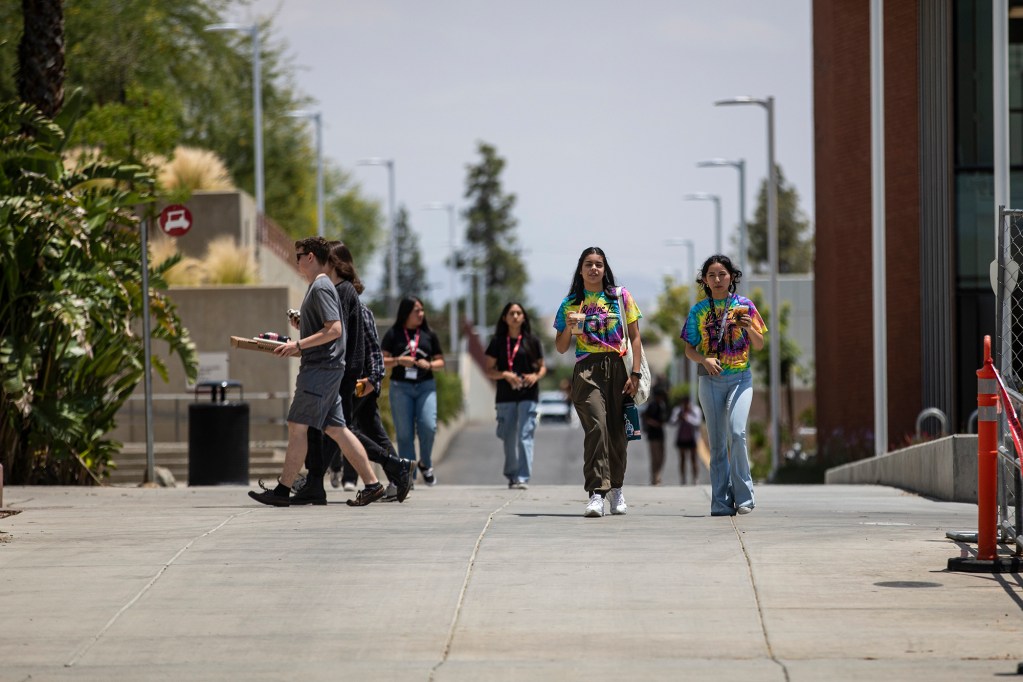
    On a sunny day on a community college campus, students walk along a concrete path flanked by rows of light poles and between more buildings. Two students are wearing bright tie-dyed shirts and holding coffee cups as they walk.
    Students walk through one of the main walkways onto Bakersfield College on June 14, 2023. (Larry Valenzuela, CalMatters/CatchLight Local)

    California’s rural colleges generally lag behind urban colleges in dual enrollment. Kern Community College District in the southern Central Valley and the Compton Community College District near Los Angeles had the two highest percentages of high school students in 2024, at 41%  and 36%  respectively, based on state data. In comparison, 9.7% of students at College of the Siskiyous are dual enrolled high schoolers, and this drops to about 5% in some other parts of the state.

    Sonya Christian, the chancellor of the California Community College system, previously led the Kern Community College District, spearheading its expansion of dual enrollment. Now, dual enrollment in the district is “one of the most successful models in the state,” Christian said in an emailed statement to CalMatters.

    “I prioritized dual enrollment because I saw it as a potential pathway to increase college-going rates, accelerate degree completion and provide students — especially those in rural and low-income communities — with early exposure to college-level coursework,” Christian said in the statement.

    For many high school students in the small city of Blythe, which sits along California’s border with Arizona, the only people they know with bachelor’s degrees are their teachers. That’s why Clint Cowden, the vice president of instruction and student services at Palo Verde College, said the exposure to college that dual enrollment provides these students can be transformative.

    “It’s really a win-win for the community,” Cowden said.

    A recent alumnus of Palo Verde College’s dual enrollment program, Manuel Milke earned his high school diploma and his associate degree simultaneously, while juggling varsity soccer and football. Now Milke, who is 19, is set to graduate in the fall from San Diego State with a bachelor’s degree in kinesiology. Milke said he chose to attend San Diego State to stay close to his family in Blythe, and aspires to work as a physical therapist somewhere nearby.

    “Everyone should do dual enrollment,” said Milke. “It saved me time, it saved me money and it made me feel more prepared for college.”

    Student gaps remain in dual enrollment

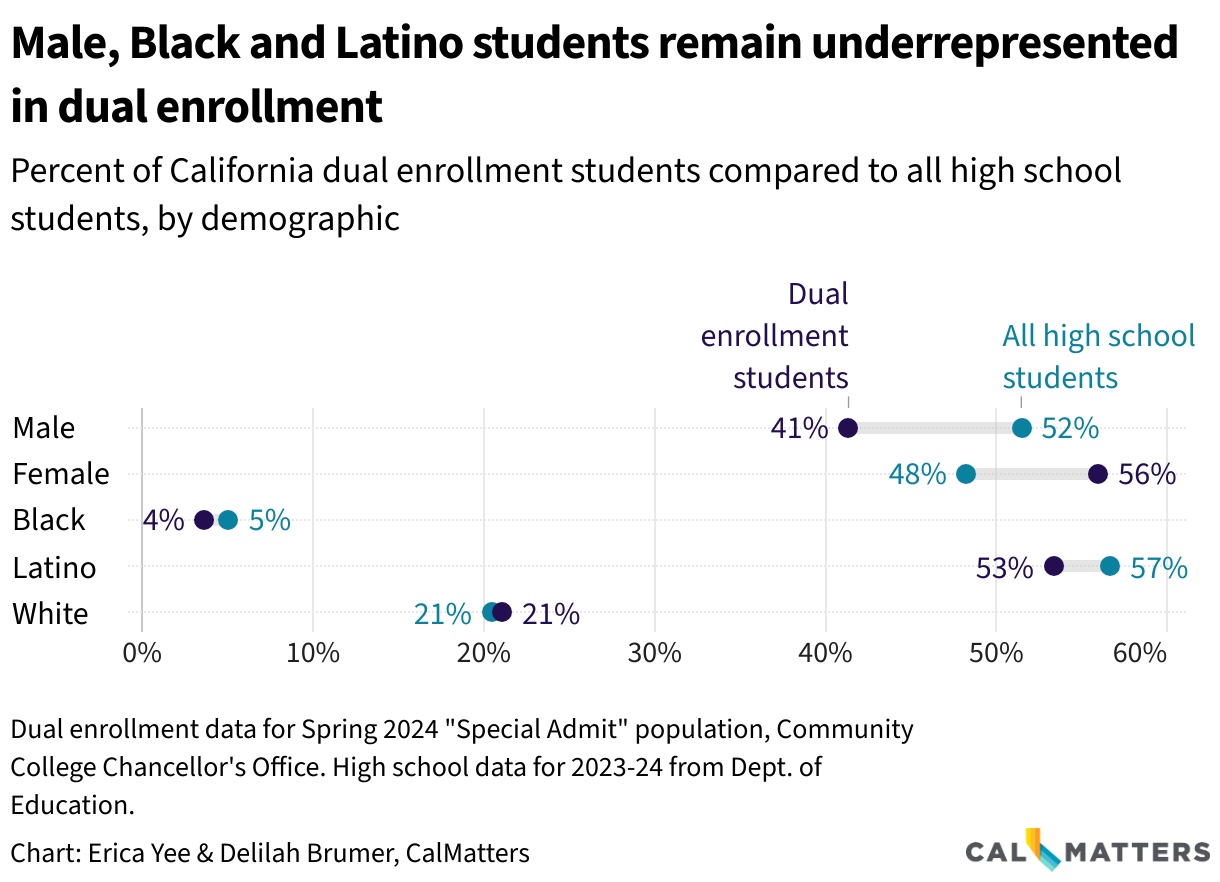
    As a Latino male, Milke is in the minority for dual enrollment. Based on state data, Black and Latino students are both underrepresented in dual enrollment courses. In the spring 2024 semester, 41% of dual enrollment students were male, while 56% were female. According to Payares-Montoya, these gaps in access to dual enrollment can make it so Black, Latino and male students are less likely to see higher education as an option, compared to their dual enrolled peers.Range plot comparing dual enrollment students and high school students by gender (male, female) and race/ethnicity (Black, Latino, White). Male, Black and Latino students are underrepresented in dual enrollment.

    For Jesse Medrano, an 18-year-old senior at Daniel Pearl Magnet High School in the Los Angeles Unified School District, dual enrollment has provided “a good outline of what college is like.” His high school first placed him in dual enrollment in ninth grade, and since then he has taken five classes, covering topics including economics and political science.

    “I didn’t have the drive to seek these courses out, so the fact that they put me in them set this standard for me, and now I’m meeting it,” said Medrano, who is Latino and plans to study accounting at Cal State Northridge. “I didn’t have the motivation, but now I do, and I’m able to succeed.”

    At Compton College more than a third of the current students are still in high school, according to state data. Latino and Black students comprise 75% and 9% of dual enrollees, respectively, which are significantly higher than state averages. Keith Curry, the college’s president, said that when students of color complete dual enrollment courses, this gets them comfortable with college academics and leads to better representation at colleges and universities.

    Some faculty push back against expansion

    Some community college faculty have raised concerns about the process by which dual enrollment partnerships are established, the level of readiness of high school students for college courses, and who teaches these classes. In many districts across the state, some dual enrollment courses are not taught by community college faculty, but by existing high school teachers who hold the credentials required to teach at a college level. In the Kern Community College District, about 60% of dual enrollment courses held on high school campuses are taught by high school teachers who meet the college qualifications, according to district spokesperson Norma Rojas.

    Tim Maxwell, an English professor at College of San Mateo, is a “conscientious objector” to California’s expansion of dual enrollment. Maxwell said he is concerned about what he sees as a focus to get as many students to graduate and earn college credits as quickly as possible, sacrificing college-level rigor and evaluation.

    “Completion is important, but our primary responsibility is for students to learn something along the way,” said Maxwell, who has taught community college courses for about 30 years.

    Maxwell has taught creative writing courses on his college campus with several dual enrolled students, one as young as 15 years old, and he said these students are “phenomenal.” But, he added, there’s a difference between a handful of proactive high schoolers going to a community college campus and a high school classroom that “switches to a college class during fifth period.” He said he is concerned about poor working conditions for professors, primarily adjunct faculty, who have to travel to high schools and teach without the proper background or support.

    “We need to resist this, and we need lawmakers who understand something about education and not just spreadsheets,” Maxwell said.

    Wendy Brill-Wynkoop, the president of the Faculty Association of California Community Colleges, said dual enrollment is beneficial for students, but that she has “heard grumblings” about a need for faculty to have a more active role in setting standards and policies for dual enrollment.

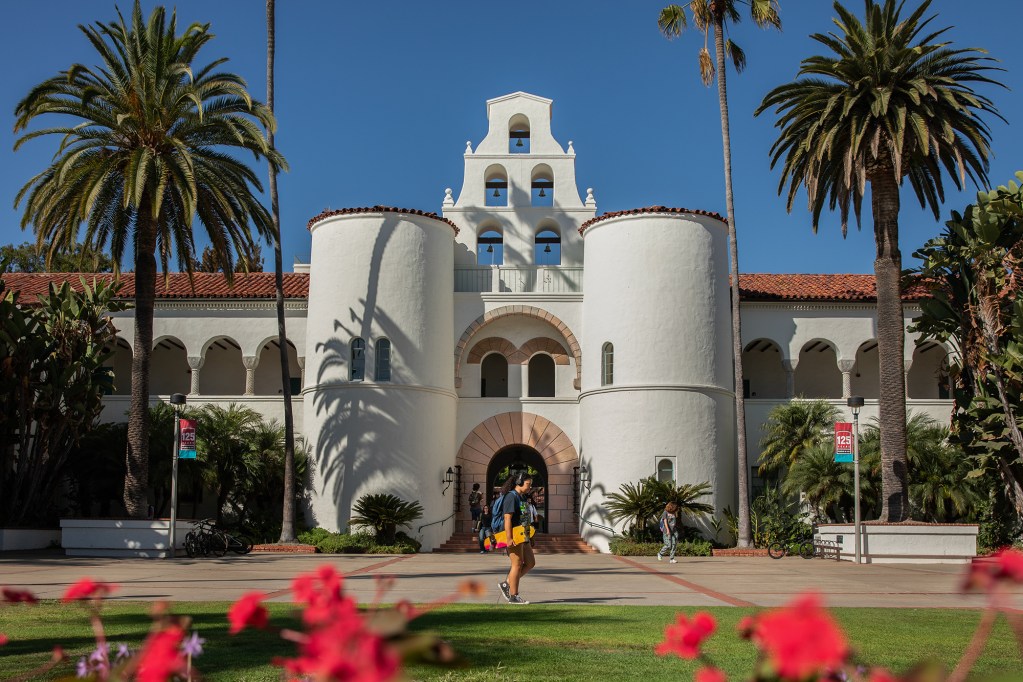
    A person holding a skateboard walks by a white mission-style building surrounded by palm trees on a sunny and clear day.
    Students walk near Hepner Hall at San Diego State University in San Diego on Oct. 10, 2024. (Adriana Heldiz/CalMatters)

    While in high school in Blythe, Milke said his dual enrollment courses were generally easier than the courses he takes at San Diego State. But they still challenged him and prepared him for a college-level workload, he said.

    Lawmakers work to continue growth

    Several state laws have been enacted in the past decade to expand dual enrollment in California. In 2015, Assembly Bill 288 established the College and Career Access Pathways program, allowing community colleges and high schools to enter into dual enrollment partnerships. These institutions bring the courses to students, as opposed to those students having to seek them out. The state streamlined the pathways program with the passage of Assembly Bill 30 in 2019, allowing students to submit fewer forms to enroll. Assembly Bill 731, which is currently in committee, would, among other changes, increase the number of units that students in the program can take.

    Based on PPIC research, students in the College and Career Access Pathways program now account for about 37% of dual enrollees. This program has a higher percentage of underrepresented students compared to other dual enrollment programs, in part because it eliminates some of the restrictions that can make it hard for schools to offer broad and barrier-free dual enrollment.

    As dual enrollment continues to expand, it increases costs to California beyond the more than $700 million that the state has already invested. That’s because both community colleges and high school districts are typically both able to receive state funding for dual enrolled students, according to the Legislative Analyst’s Office.

    According to the statement from Christian, state leaders are working to increase dual enrollment access by expanding partnerships between high schools and colleges.

    “My vision is to make dual enrollment a standard opportunity for all California students, not just an option for a select few, increasing equitable access to higher education and workforce-aligned learning,” Christian said in the statement.

    Alana Althaus-Cressman, who runs the dual enrollment program at Golden Eagle Charter School, a K-12 school in Siskiyou County, markets the program to all students, not just those who already have a record of high achievement. She studied dual enrollment access for rural students for her graduate school dissertation at Sacramento State University, and started the early college high school program at Golden Eagle Charter in 2024. Students in the program take dual enrollment courses for part of the school day, and high school courses for the rest.

    Althaus-Cressman said that because dual enrollment offers students a glimpse of college, it’s important that the classes aren’t only filled with students who already plan to attend college. Some high schools require minimum grade point averages or have other barriers to entry for dual enrollment, which Althaus-Cressman said can perpetuate inequalities.

    The early college high school program enrolls about a third of Golden Eagle Charter’s ninth graders. Althaus-Cressman attributes this level of participation to extensive outreach, which included working with school staff to call the families of every incoming high school student to invite them to a dual enrollment orientation.

    “We don’t want students to think that they aren’t the type of student for this program,” Althaus-Cressman said. “It’s for everybody.”

    This article was originally published on CalMatters and was republished under the Creative Commons Attribution-NonCommercial-NoDerivatives license.


    Get stories like these delivered straight to your inbox. Sign up for The 74 Newsletter

    Source link

  • Federal Education Cuts and Trump DEI Demands Leave States, Teachers in Limbo – The 74

    Federal Education Cuts and Trump DEI Demands Leave States, Teachers in Limbo – The 74


    Get stories like this delivered straight to your inbox. Sign up for The 74 Newsletter

    Early this month, the U.S. Department of Education issued an ultimatum to K-12 public schools and state education agencies: Certify that you are not engaging in discrimination under the banner of diversity, equity and inclusion, or risk losing federal funding — including billions in support for low-income students.

    The backlash was immediate. Some states with Democratic governors refused to comply, arguing that the directive lacks legal basis, fails to clearly define what constitutes “illegal DEI practices,” and threatens vital equity-based initiatives in their schools.

    After lawsuits from the National Education Association teachers union and the American Civil Liberties Union, the Department of Education agreed to delay enforcement until after April 24.

    But states across the country, both liberal- and conservative-led, are worried about losing other aid: the pandemic-era money that in some cases they’ve already spent or committed to spending.

    The Department of Education has long played a critical role in distributing federal funds to states for K-12 education, including Title I grants to boost staffing in schools with high percentages of low-income students, and emergency relief like that provided during the COVID-19 pandemic.

    Conservative-led states — particularly Mississippi, South Dakota and Arkansas — rely the most heavily on these funds to sustain services in high-need districts.

    The 15 states with the highest percentage of their K-12 budget coming from federal funding in fiscal year 2022 — the latest year with data available from the National Center for Education Statistics — voted for Trump in the 2024 presidential election. Similarly, 10 of the 15 states receiving the highest amounts of Title I funding in fiscal year 2024 also voted for Trump.

    Mississippi and Kentucky have sent letters to the Department of Education expressing concern over halted pandemic aid.

    The clash over federal funding comes even as the future of the Department of Education is murky, given President Donald Trump’s pledge to dismantle the department.

    DEI-related cuts

    In letters to the Department of Education, state officials and superintendents in Illinois, New York and Wisconsin pushed back against the DEI directive.

    New York officials said they would not provide additional certification beyond what the state already has done, asserting that there “are no federal or State laws prohibiting the principles of DEI.” Illinois Superintendent Tony Sanders wrote that he was concerned that the Department of Education was changing the conditions of federal funding without a formal administrative process. Wisconsin Superintendent Jill Underly questioned the legality of the order.

    New York State Department of Education Counsel and Deputy Commissioner Daniel Morton-Bentley noted that the federal department’s current stance on DEI starkly contrasts with its position during Trump’s first term, when then-Education Secretary Betsy DeVos supported such efforts.

    Colorado and California also confirmed they would not comply with the Department of Education’s order.

    While some states with liberal leaders are gearing up for legal battles and possible revocation of funding, conservative-led states such as Florida have embraced the federal directive as part of a broader push to reshape public education.

    In Florida, anti-DEI laws have been in place dating back to 2023. In fact, many school districts and the state education department say they plan to follow the federal department’s directives, noting the similar state laws.

    Pandemic aid cancellations

    In March, the Department of Education abruptly rescinded previously approved extensions of pandemic-era aid, ending access to funds months ahead of the original March 2026 deadline.

    When the Massachusetts governor’s office voiced concern over that decision, the federal department’s reply on social media was blunt: “COVID is over.

    Sixteen mostly Democratic-led states and the District of Columbia filed a federal lawsuit against the Department of Education and Secretary Linda McMahon, challenging the abrupt rescission of previously approved extensions for spending COVID-19 education relief funds.

    But backlash against abrupt federal cuts to education has not been limited to blue states.

    Mississippi’s Department of Education warned the cuts would jeopardize more than $137 million in already obligated funds, slated for literacy initiatives, mental health services and infrastructure repairs. “The impact of this sudden reversal is detrimental to Mississippi students,” state Superintendent Lance Evans wrote in a letter to McMahon.

    The letter also outlines the state’s repeated — but unsuccessful — efforts to draw down millions in approved funds since February.

    Shanderia Minor, a spokesperson for the Mississippi education department, told Stateline the agency is awaiting next steps and direction about the funds and federal directives.

    In Kentucky, state Education Commissioner Robbie Fletcher told districts — which stand to lose tens of millions in pandemic aid — that abrupt federal changes leave them “in a difficult position,” with schools already having committed funds to teacher training and facility upgrades.

    According to Kentucky Department of Education spokesperson Jennifer Ginn, the state has about $18 million in unspent pandemic aid funds left to distribute to districts. And districts have about $38 million in unspent funds, for a total $56 million that could be lost.

    Lauren Farrow, a former Florida public school teacher, told Stateline that schools that receive Title I money are already underfunded — and the federal threat only widens the gap.

    “Florida is pouring billions into education — but where is it going? Because we’re not seeing it in schools, especially not in Title I schools,” said Farrow. “I taught five minutes away from a wealthier school, and we didn’t even have pencils. Teachers were buying shoes for students. Why is that still happening?”

    Effects in the classroom

    Tafshier Cosby, senior director of the Center for Organizing and Partnerships at the National Parents Union, a parents advocacy group, told Stateline that while most families don’t fully understand the various school funding systems, they feel the impact of cuts in the classroom.

    Cosby said parents are worried about the loss of support services for students with disabilities, Title I impacts, and how debates about DEI may deflect from more urgent needs like literacy and teacher support.

    “We’ve been clear: DEI isn’t the federal government’s role — it’s up to states,” she said. “But the confusion is real. And the impact could be devastating.”

    Today, as a consultant working with teachers across Florida’s Orange County Public Schools — one of the largest districts in the country — Farrow says many educators are fearful and confused about how to support their students under changing DEI laws.

    “Teachers are asking, ‘Does this mean I can’t seat a student with glasses at the front of the room anymore?’ There’s so much fear around what we’re allowed to do now.”

    “There’s no one giving teachers guidance or even basic acknowledgment. We’re just left wondering what we’re allowed to say or do — and that’s dangerous.”

    Amanda Hernández contributed to this report. Stateline reporter Robbie Sequeira can be reached at [email protected].

    Stateline is part of States Newsroom, a nonprofit news network supported by grants and a coalition of donors as a 501c(3) public charity. Stateline maintains editorial independence. Contact Editor Scott S. Greenberger for questions: [email protected].


    Get stories like these delivered straight to your inbox. Sign up for The 74 Newsletter

    Source link

  • How Harvard Is Standing Up to Trump Means Everything

    How Harvard Is Standing Up to Trump Means Everything

    When it comes to fighting the current authoritarian threats coming out of the Trump administration, it’s important to remember that the symbol is the substance.

    Frankly, this is always true of politics generally, but it’s more true and more important than ever in this moment.

    We have an object example of this principle at work presently in the different responses from Harvard and Columbia when it comes to the threats to funding and demand for control by the Trump administration.

    Columbia appeared to capitulate, forging an “agreement” to take steps sought by Trump, ostensibly to address antisemitism on campus, but this fig leaf was unconvincing, and Trump himself quickly dropped the pretense, as we all understand he has no interest in combating antisemitism and every interest in sending signals of domination and stoking fear that turns into pre-emptive compliance from other institutions.

    Columbia looked unprincipled and weak in the face of the authoritarian threat, and the internal and external backlash against Columbia has been significant.

    In contrast, once Harvard received the Trump administration demands, it crafted a careful public response, producing multiple public-facing communications meant to speak to different audiences (press, public, students, faculty, alumni) with different needs, including a letter from Harvard president Alan Garber to the university community that invoked a shared responsibility to defend the core values of the institution specifically and higher education in general.

    To be fair, the call was much easier for Harvard than Columbia for several reasons. For one, Harvard had seen what happened to Columbia, where what looked like capitulation to outsiders still proved insufficient, because, again, Trump is interested in subservience, not reaching a mutual agreement. When Trump-world figures like JD Vance and Chris Rufo say they intend to destroy higher education, we should take them seriously.

    The Trump administration demands of Harvard were also so extreme—amounting essentially to a takeover of the university—that it had no choice but to resist and take every possible step to rally others to the fight. The public thirst for an institutional response to Trump’s lawless power grabs has been so great that even the New York Times editorial board has weighed in with its approval of Harvard’s actions and the university’s explicit pledge to stand against violations of the rule of law.

    An interesting bit of information in the form of an op-ed by Columbia history professor Matthew Connelly has come out that perhaps sheds additional light on Columbia’s actions. Writing at The New York Times, Connelly laments the hapless situation his institution finds itself in, first receiving blows from Trump and then being subjected to the “circular firing squad” of those who oppose Trump signing on to a collective boycott of Columbia.

    Connelly argues that we should not view Columbia as “capitulating” to Trump because, “In fact, many of the actions the Columbia administration announced on March 21 are similar to those originally proposed last August by more than 200 faculty members.”

    In other words, in agreeing with Trump, Columbia is only doing what it was possibly going to do anyway. Connelly goes on to argue that Columbia would never give in on key principles of institutional operations, and acting Columbia University president Claire Shipman has subsequently declared that Columbia would not sign any agreement that would “require us to relinquish our independence and autonomy as an educational institution.”

    Columbia’s actions look similar to those taken by some of the big law firms that have reached vaguely worded “agreements” with Trump that have them pledging not to do “illegal DEI hiring” and to donate tens or hundreds of millions of dollars to pro bono causes favored by Trump. At Talking Points Memo, Josh Marshall has gone digging into some of these agreements and found that there’s not much of specific substance to be found, the wording often so generalized and vague that it would be easy for firms to fulfill the agreements without doing anything beyond their usual patterns and practices.

    I’m not entirely unsympathetic to Connelly’s irritation or the decisions by the big law firms; they thought they could make Trump go away with a little performative minor supplication and get back to their substantive work.

    They’ve obviously misread the moment badly. I don’t know what more evidence we need to conclude that Trump intends to govern as an authoritarian. In both the cases of these law firms and Columbia University, the entire battle was over Trump being allowed to claim a symbolic victory over these institutions, to get them to be seen capitulating.

    It is strange to say that the symbolic fight is the genuine battle over principles, but this is obviously the case. Trump wants to make others fearful of standing up to his authoritarian aims, so he will simply defy the rule of law until someone forces the victims to fight. There is no choice but to test the administration’s resolve. Trump’s response on Truth Social following Harvard’s action shows a lot of bluster aimed at tearing down Harvard’s reputation with a lot of right-wing tropes, but the rhetoric shows how nonexistent his substantive case is.

    Any capitulation, real or even perceived, is a loss. Either choice will come with costs. Trump is going after Harvard’s funding and nonprofit status, and there will be significant turbulence for the university in the foreseeable future. But turbulence is not the same thing as a plane heading for the ground.

    Harvard had its legal strategy prepared before the fight even went public. Law and precedent appear to be on its side, though this is not a guarantee of success. Trump seems determined to hold back whatever money he can in his ongoing attempts at coercion.

    What we are learning is that there is no such thing as accommodating or reaching an agreement with an authoritarian project. Harvard’s stand is an important symbolic illustration of this, and because of the symbolism, it is proving to be hugely substantive.

    Let’s hope it’s only the first example of how to fight back.

    Source link

  • Immigrants Keep Lining Up to Learn English as City Hall Cuts Support – The 74

    Immigrants Keep Lining Up to Learn English as City Hall Cuts Support – The 74


    Get stories like this delivered straight to your inbox. Sign up for The 74 Newsletter

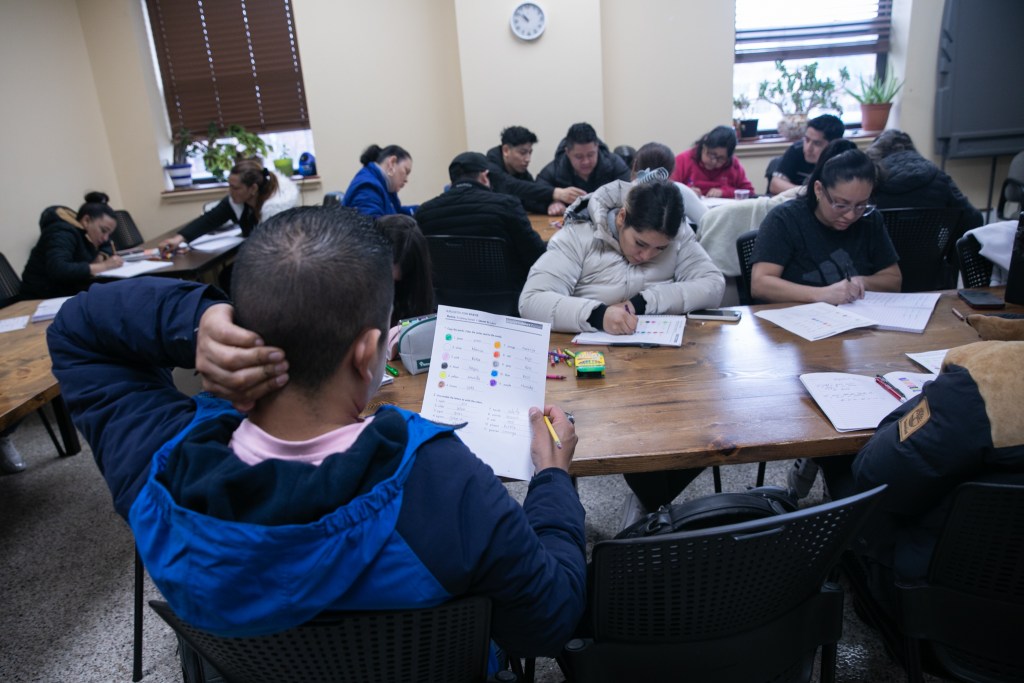
    Inside a classroom at the Center for Family Life in Sunset Park on a recent Monday morning, teacher Julian Colón was busy setting out notebooks, folders, pens and crayons on a table. Outside in the hallway, a sign taped to a wall reads “CLASES DE INGLÉS POR ESTE CAMINO” — English classes this way.

    It was the first day of the spring semester in this predominantly Latino corner of the Brooklyn neighborhood, where Colón was expecting about 30 students in class.

    Julian Colón teaches an English as a Second Language class at the Center for Family Life in Sunset Park, Brooklyn, April 7, 2025. (Ben Fractenberg/THE CITY)

    But not everyone who wanted a seat at the table was there. More than 400 students are now on the center’s waitlist, according to Maria Ferreira, its adult employment program director.

    “I sit right by the reception, and every single day we get inquiries about ESOL,” Ferreira told THE CITY, using the acronym for English for Speakers of Other Languages. “Every day we’re adding people to the waiting list.”

    Demand for English classes has increased with the influx of migrants that began in 2022, according to a new report by United Neighborhood Houses, which represents 46 settlement houses that help serve immigrant populations, even as City Hall has slashed funding.

    At Flatbush-based social services giant CAMBA, program manager Jude Pierre said more than 700 prospective students are now waiting to get into one of its 10 city-funded ESL classes, which collectively accommodate about 200 students.

    “With the migrant crisis…we ended up getting a lot of individuals coming here to register for classes to the point where we basically had to stop taking registrations,” Pierre told THE CITY. “We got to the point where it didn’t make any more sense to have thousands of people on a waiting list, knowing we would never get to most of them. We started saying, ‘Sorry, we can’t do this, because it’s not fair to you,’ and trying to refer them to other places.”

    Last year, the Department of Youth and Community Development reduced funding for literacy classes by nearly 30% to $11.9 million from $16.8 million, the report noted. Many long-time providers in areas where migrant shelters were clustered also lost out on DYCD dollars after the agency adjusted its funding eligibility formula,” as THE CITY previously reported.

    An immigrant student takes an English as a Second Language class at the Center for Family Life in Sunset Park, Brooklyn.
    An immigrant student takes an English as a Second Language class at the Center for Family Life in Sunset Park, Brooklyn, April 7, 2025. (Ben Fractenberg/THE CITY)

    According to the report, many classes now depend entirely on discretionary dollars from the City Council, which increased its funding to $16.5 million in fiscal year 2025 from roughly $6.5 million in recent years to back organizations DYCD left behind.

    Several providers, however, told THE CITY that compared to DYCD’s multi-year contracts, Council funding, which requires annual reconsideration, makes it difficult to plan ahead and maximize offerings.

    And for some, like CAMBA, Council funding was not enough to cover the losses from DYCD with the group reducing the number of students it serves by 174 and closing its waitlist, Pierre said.

    So far, providers say, demand among new arrivals has remained steady even as the Trump administration’s mass deportation efforts have led many new arrivals fearful of working or sending kids to school or even walking the streets.

    “Ideally, these programs would be supported by a robust, baselined program managed by DYCD that offered students and providers stability with year-over-year funding,” the report says. “However, until DYCD revisits its unnecessarily restrictive stance…it is crucial that the City Council continue this support to make sure that adult learners continue to have access to quality classes.”

    ‘I Understand People Now’

    While fewer than 3% of the 1.7 million immigrants in need of English classes are able to access it through city-funded programs, according to the report, students who were able to find their way into a class told THE CITY improved English has helped with their daily lives — and their job prospects.

    Currently, two-thirds of New Yorkers with limited English proficiency earn less than $25,000 a year, according to American Community Survey data cited in the report.

    Rosanie Andre, 42, came to New York City from Haiti in 2023, and said she started taking English classes at CAMBA last year after three months on a waitlist. Since then, she’s been able to get a job serving food at Speedway while also delivering packages for Amazon per diem.

    “When I did my interviews, you have to speak in English with the manager. And it helped me a lot because I understand people now,” Andre, a native Haitian Creole and French speaker, said in English.

    Learning English has also helped Andre communicate with her 6-year-old — who only started speaking after their move to New York City.

    “And she started to speak English — English only. She knows nothing in Creole,” Andre said. “I try to listen to my daughter and speak to her English-only.”

    With her English improving, Andre said she is better able to help her daughter with her homework.

    “I try to explain her how to do it in English,” Andre said. “If no CAMBA, I have difficulty to understand. Cuz when I come here, I don’t understand nothing. When people speak, I smile because I understand nothing.”

    Roodleir Victor, 29, saw English classes as an essential stepping stone in furthering his education. He had completed his college coursework for an economics degree in his native Haiti, he said, though he ultimately fell just short of obtaining a degree because it would have required him to stay in the country’s capital, which has been embroiled in political turmoil and gang violence. 

    He started taking English classes when he moved to the city in 2023, he said, in hopes of continuing his studies here. For four days a week, he attended English classes in Flatbush from 1 to 4 p.m. before heading to Long Island to work at a pasta factory on a 5 p.m. to 5 a.m. overnight shift.

    Victor is now enrolled in a GED class, he said, and hopes to study computer programming after that.

    “I would like to study at a university which I can learn technology. But it’s difficult for me, because I don’t have the support I need to go there,” Victor said in English. “But for me personally, I believe in my capacity to adapt.”

    ‘It’s Not Impossible’

    Back in Sunset Park, a 55 year-old asylum seeker was patiently waiting to enter the room half an hour before class started at 9 a.m.

    “I’m just eager to learn,” the native of Ecuador  said in Spanish. “It’s important because I want to communicate with others for a job.”

    The mother of five arrived in New York City three months ago, she said, after seeking asylum at the Mexico-California border then being detained there for three months. She’s cleaning homes to help make ends meet, but hopes to land a job with steadier income soon.

    “Whatever I can get I pick up, but those jobs come and go,” she said. “I was in a workforce development program but the curriculum was in English so I started looking for classes.”

    Oscar Lima rolled into English class with his e-scooter just after class started at 9:30 a.m. The 34-year-old is now in his second semester of classes, he said, which he makes time for in between catering gigs, food deliveries and a third job as a barback.

    Columbian immigrant Oscar Lima says learning English will help him work in the food service industry.
    Columbian immigrant Oscar Lima says learning English will help him work in the food service industry, April 7, 2025. (Ben Fractenberg/THE CITY)

    “My bosses told me, ‘You’re a good worker, but you need to learn English,’” Lima said. “And I decided that I didn’t want to learn English myself.”

    Lima and other students now settled into their seats, turning their attention to Colón.

    “Everybody, are we ready? Listos?” Colón asked.

    “Yes,” the class responded timidly.

    Students practice learning the names of colors at an English as a Second Language class in Sunset Park, Brooklyn.
    Students practice learning the names of colors at an English as a Second Language class in Sunset Park, Brooklyn, April 7, 2025. (Ben Fractenberg/THE CITY)

    Colón then began presenting ground rules on a digital whiteboard: Try to arrive within the five-minute grace period after the class start time, and come prepared with books, papers and pencils.

    “The most important rule,” Colón continued, before repeating himself in Spanish. “Please don’t be afraid to participate and make mistakes.”

    At break time, Lima shared how he, his wife and his two sons had arrived in the city from Colombia about three years ago. While the family had started off at a shelter, Lima said, they’re now able to afford an apartment of their own. His two kids — seven and ten years old — quiz him about names of objects around the house, he said, and often encourages him to learn English alongside with them.

    “New York, it poses many challenges. It’s difficult at the beginning, but it’s not impossible,” Lima said in Spanish. “My American Dream is my sons…I want my children to perhaps have what I didn’t have, but at the same time I want to show them how to earn it, and how to work like good people.”

    The story was originally published on THE CITY.


    Get stories like these delivered straight to your inbox. Sign up for The 74 Newsletter

    Source link

  • College Athletes Can Now Make Millions Off Sponsorship Deals – The 74

    College Athletes Can Now Make Millions Off Sponsorship Deals – The 74


    Get stories like this delivered straight to your inbox. Sign up for The 74 Newsletter

    $390,000 to Jaylon Tyson, a former basketball guard at UC Berkeley, from a group of private donors.

    $3,000 to Jordan Chiles, a UCLA gymnast and Olympic gold-medal winner, from Grammarly, an AI writing company. 

    $390 to Mekhi Mays, a former Cal State Long Beach sprinter, from a local barbecue joint. 

    These payments — derived from data that public universities provided to CalMatters — were part of “name, image and likeness deals” requiring students to create favorable posts on social media. 

    Such sponsorship deals were unheard of just four years ago. In 2021, California enacted a law allowing athletes to make these kinds of brand deals. It was the first state to pass such a law, prompting similar changes across the country. 

    This is the first-ever look at what many California athletes have actually made. University records show that money is flowing, but how much college athletes earn depends largely on the popularity of the sport, the gender and star power of its players and the fanbase of the university. While UCLA gymnasts earned over $2 million in the last three school years, university records show that players on the UCLA women’s water polo team earned just $152 during the same time frame, despite winning the national championship last year. 

    For companies, these name, image and likeness deals are akin to paying any other celebrity or professional athlete to promote a product. University alumni and sports fans can’t give money directly to a student athlete — at least not yet — but they are allowed to make name, image and likeness deals. Many universities have private donor groups, known as collectives or booster clubs, that offer athletes money, sometimes more than $400,000 in a single transaction, in exchange for an autograph or participation in a brief charity event. Often, those deals are a pretext to send money to top-tier players and discourage them from seeking better deals at other colleges.

    CalMatters reached out to every public and private university in the state with Division 1 teams, where the potential for profit is typically highest, and requested data that shows how much money each of its student athletes have made since 2021. State law requires all student athletes to report to their school any compensation they receive from their name, image and likeness, and public universities are required to disclose certain kinds of data upon request. Private universities, such as Stanford University and the University of Southern California, are not required to disclose any data about their students’ earnings. 

    All of the public Division 1 universities responded to CalMatters’ inquiry, though they did not all provide the same degree of transparency. San Jose State and Cal State Northridge said they had no records of any deals.

    There’s no consequence for students who fail to report what are known as NIL deals, so the data from public institutions may be incomplete. Still, certain trends emerge: 

    • College athletes at the state’s public universities received millions of dollars from collectives or booster clubs. At four University of California schools, around 70% or more of all compensation came from these collectives, according to university records. That’s just below national trends, according to a report by Opendorse, a tech company that tracks students’ deals. 
    • Male basketball players earned the most. While football is more popular and lucrative, nationally, many public Division 1 schools in California lack a football team. The football data may also be incomplete. For instance, all football players at UC Berkeley reported making a total of just over $113,000 since 2021 — less than what all San Diego State players made — even though Berkeley is in a more prominent conference. 
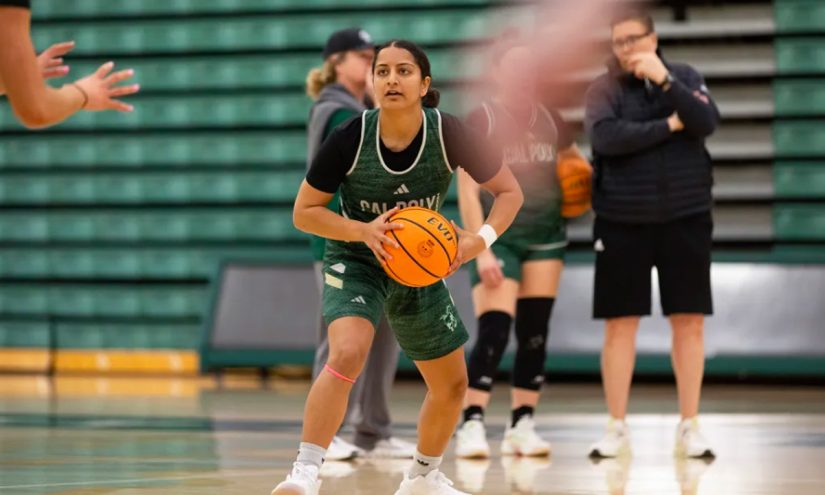
    • For high-profile football or basketball players in particular, it’s becoming more common for students to transfer multiple times, often in search of better name, image and likeness deals. Some California institutions, such as UC Davis and Cal Poly San Luis Obispo, have seen top athletes transfer colleges or threaten to transfer in order to attain better compensation elsewhere.
    • Except for a few star players, such as Chiles, most female college athletes made very little, according to the data provided to CalMatters. 
    • Collectively, athletes at UCLA and UC Berkeley earned more than double what those attending other UC and California State University campuses made. Some donors, such as those supporting Sacramento State and UC San Diego, have rapidly raised money to compete, while at other schools, athletic directors say they’ll never be able to guarantee such high-dollar deals. 

    Schools often removed any information that could identify an individual student. While UCLA generally did not provide the individual names of its athletes, the school was more transparent than most and shared the date of each transaction, the name of the brand or company, the amount of money it gave, and the sport. In February, a UCLA gymnast reported receiving $250,000 from the beverage company Bubbl’r. Since then, Chiles has promoted that brand, repeatedly. In May, a UCLA gymnast reported receiving $210,000 from the cosmetic brand Milani for “social media” — just a few months before Chiles posted a video on Instagram, promoting its makeup. One or more members of the UCLA gymnastics team have also reported deals with the food company Danone for $300,000 and with the health care company Sanofi for $285,000. 

    Fresno State shared less information. In the 2021-22 academic year, the Fresno State women’s basketball team raked in over $1.1 million from multiple name, image and likeness deals, but the university did not disclose which players were involved or how many were paid. After influencers and former basketball players Haley and Hanna Cavinder transferred to the University of Miami in April 2022, the number and dollar amount of deals for the Fresno team diminished. In the 2023-24 academic year, the team made just over $1,000 from 10 different deals.

    Money from boosters or collectives is the hardest to trace. In May, for example, a group of UCLA donors gave an undisclosed football player $450,000 for “social media.” 

    While private universities are not required to disclose students’ earnings, market estimates from On3, a media and technology company focused on college sports, say the highest-earning Stanford University athlete, basketball player Maxime Raynaud, could collect $1.5 million in the next 12 months. The top USC athlete, football player Jayden Maiava, could make $603,000 in the next year, according to the same estimates. These numbers are based on an algorithm that uses aggregate deals from college athletes across the country. Nationwide, the Opendorse report estimates that college athletes will earn $1.65 billion in the 2024-25 academic year. 

    Soon, college athletes may make even more. A high-profile class-action lawsuit will likely allow schools to pay athletes directly, while still classifying them as students, not employees. If the proposed settlement agreement goes into effect, students could see payouts as early as this fall. 

    If a school pays a student directly, the money should be divided roughly proportional to the number of male and female athletes, the Biden administration said in a U.S. Department of Education fact sheet issued in January. The page no longer exists

    In the last few months, attorneys have rescinded federal labor petitions asking that USC and Dartmouth College student athletes be reclassified as employees, but new cases are likely on the horizon, said Mit Winter, an attorney who specializes in name, image and likeness law: “I do think at some point — two years, five years, whatever it is — at least some college athletes will be employees.”

    A Times Square billboard reads: NIL has begun

    For decades, college sports have been a big business, though most of the money flowed to universities, not students. Nationally, Division 1 universities reported $17.5 billion in athletic revenue in 2022, according to the National Collegiate Athletic Association (NCAA). That’s more than the gross domestic product of 83 countries. For schools with top-performing football programs, such as UCLA and Berkeley, broadcast deals and other kinds of marketing represent over a third of total revenue. 

    Before California’s law went into effect, college athletes weren’t allowed to profit off their sport, though they frequently received scholarships equal to the cost of college tuition. On July 1, 2021 the new law took effect, and Haley and Hanna Cavinder were the first to benefit, signing deals with Boost Mobile, a cell phone company, and Sixstar, a nutrition company, just after the stroke of midnight. A Times Square billboard proclaimed they were the first such deals in the country. 

    Over the past four years, other California college athletes have signed advertising deals with clothing brands such as Crocs, Heelys and Aeropostale and food brands such as Liquid I.V. and Jack in the Box. FTX, the now-bankrupt cryptocurrency exchange, signed contracts with at least six players on the UCLA women’s basketball team in 2021. In 2022, the Biden campaign gave a UCLA gymnast $7,000, but public records did not disclose the purpose of the transaction. No other politicians appeared in any university’s data.

    Last year, Visit Fresno County, a nonprofit that promotes tourism, paid former Fresno State football players Dean Clark and Kosi Agina just under $10,000 to post Instagram videos about a local farmer’s market and a minor league baseball team, according to President and CEO Lisa Oliveira. She said the posts were so successful that she asked Agina to make another video, promoting a hiking trail in the Sierra National Forest

    But much of the money for students’ name, image and likeness doesn’t come from brands at all — it’s from private donors. Philanthropist and entertainment lawyer Mark Kalmansohn has given nearly $150,000 in 12 different transactions to athletes on UCLA’s volleyball, softball and women’s basketball teams since 2022, according to the data, which runs through May of last year. In an interview with CalMatters, Kalmansohn said he’s given more than $175,000 since May. “Women’s sports were almost always treated in a second-hand nature and given inferior resources,” he said, adding that his philanthropy is about “women’s rights.”

    In exchange for money, he asks each recipient to issue a free license of their name, image and likeness to a nonprofit organization that’s relevant to the athlete’s sport. But he said that’s not the norm. “In men’s football and men’s basketball, it’s pretty obvious that money is not for an ‘appearance’.” Instead, he explained that it’s a way to support the player and keep the team competitive. 

    Most donors give money to specific athletes through a collective, where the donors’ identities are largely hidden. At UCLA, public data through the 2023-24 academic year shows that a collective known as the Men of Westwood channeled nearly $2 million in private donations to the football, basketball and baseball teams. At Berkeley, collectives gave over $1.3 million to athletes since the 2022-23 academic year — the vast majority of which went to the men’s basketball team. 

    Supporting ‘elite talent’ at UC and Cal State

    For years, NCAA rules made it difficult for college athletes to transfer schools, but in 2021, right around the time that California started to allow name, image and likeness deals, the NCAA eased those rules. The number of students who transfer suddenly jumped in 2021 and has ticked up each year since, according to NCAA data. In practice, the new rules means that a well-endowed collective can lure athletes who want to make more money. 

    This year, over 11% of all Division 1 football players have tried to transfer colleges, an increase from the previous year, said Matt Kraemer, whose organization, The Portal Report, uses social media posts and tips from insiders to gauge college athletes’ transfer activity. Quarterbacks are even more likely to try to transfer, Kraemer said.

    For institutions like UC Davis, the threat of losing a top athlete can be costly. Late in the 2023-24 academic year, donors from other universities promised top athletes lucrative deals if they agreed to transfer, so UC Davis formed a collective, Aggie Edge, to make counter-offers, said Athletic Director Rocko DeLuca. “It’s a means to retain elite talent here at Davis.”

    DeLuca said the collective gave men’s basketball guard TY Johnson $50,000 and UC Davis running back Lan Larison $25,000. Those transactions were for “social media, appearances, autographs,” according to the university’s data. 

    So far, all other UC Davis athletes — more than 700 students over 25 sports — have reported just under $19,000 in deals since 2021. A few other athletes received products, such as a free cryotherapy session or a commission based on sales.

    In December, former UC Berkeley quarterback Fernando Mendoza transferred to Indiana University, where he later signed a name, image and likeness deal with a collective for an undisclosed amount. UC Berkeley then recruited former Ohio State quarterback Devin Brown the day after he won a national championship. It’s not clear if the Berkeley collective offered Brown a deal, since the university’s data doesn’t name Brown. 

    Justin DiTolla, Berkeley’s associate athletic director, said the university is “not affiliated with the collective” and that the university provides “equal support to all student athletes.” “We recognize that there is a difference in NIL support,” he said, “But it isn’t under our scope or umbrella.” The Berkeley collective, California Legends, declined to comment.

    At Cal Poly San Luis Obispo, some football players sought more money through a name, image and likeness deal by transferring to another school, but they didn’t all succeed, said Don Oberhelman, the university’s athletic director. “That’s the dirty little secret of all of this: the number of kids who blow an opportunity.”

    This fall, nine football players at Cal Poly San Luis Obispo announced their intention to transfer, he said. Six of them found a new university, he said, including University of Texas El Paso, San Diego State, Stanford, and Washington State — but three of them never received an offer from another school. 

    Oberhelman said that his football coach begins recruiting a replacement the moment a player announces his intention to transfer. If that student doesn’t end up transferring, he may lose his spot on the football team and the entirety of his athletic scholarship, which can be up to $30,000 a year. 

    “There’s raw emotion involved in these kinds of decisions,” he said. “I don’t think that’s how we would operate, but I can see a lot of people say, ‘You broke up with us.’” 

    Oberhelman said he doesn’t know what happened to the three players from the football team who failed to transfer. “For me, it would boil down to: Did we promise that money to someone else? Did we find another transfer or a high school person to replace you? If we did, that would put your future financial aid with us in jeopardy.”

    Small-town name, image and likeness deals 

    Outside of top football and men’s basketball programs, many of California’s college athletes vie for smaller name, image and likeness deals, often with local businesses, lesser-known clothing or athletic brands, or anything else they can find.

    Former Berkeley softball player Randi Roelling got $50 from one woman to give a pitching lesson to her daughter. In July 2023, chiropractor Lance Casazza started giving out free sessions to at least one Sacramento State football player in exchange for social media posts.

    Annika Shah, a basketball player at Cal Poly San Luis Obispo, got her first deal through a local restaurant, Jewel of India, which occasionally has a pop-up tent outside the college gym. “I just said, ‘Hey I can market you. Let’s think of a cool slogan to put out.’” Customers who ask to “swish with Shah” at the checkout counter get a discount on their meal, she said. Shah doesn’t get any money, she said, but she does get free food whenever she visits. 

    “It was just a cool relationship and connection that I made with this family and the owners of Jewel of India, where they just want to help me out and I want to help them.” 

    Walking around campus, friends jokingly refer to Shah as their own “Jewel of India” and she likes it. “It’s such a marketable slogan now, and it kind of identifies who I am.”

    Many Division 1 schools have their own websites where customers can buy gear with an athlete’s name on it, but last fall, no such platform existed at Cal Poly San Luis Obispo, said Shah, so she created her own. She partnered with a company, Cloud 9 Sports, and launched her own apparel brand. It’s brought in about $2,000 in sales so far, but after the university and Cloud 9 Sports take a cut, Shah said she’s left with about $800. 

    Shah said she was never told to report any of her monetary or in-kind contributions. After CalMatters asked, Oberhelman, the athletic director, said the school is now requiring it. “We haven’t done a great job following up because we’re just not going to have student athletes that are getting even five-figure deals,” he said. 

    Oberhelman said he only knew of eight deals, each for $2,000, all to the men’s football team from a group of private donors.

    Fresno State provided more data than Cal Poly San Luis Obispo, but it did not designate which deals came from its collective, known as Bulldog Bread. On its website the collective says it has raised more than $690,000 in corporate donations for Fresno State. At the top tier, that includes money from former Fresno State quarterbacks David and Derek Carr, property developer Lance Kashian, and construction company Tarlton and Son, Inc. The collective recently launched a vodka brand in partnership with a distillery, where a portion of all proceeds support students’ name, image and likeness deals.

    Athletes at UC Santa Barbara have reported $1,800 from their collective, Gold & Blue, but many other transactions reported by the school provide few details. According to the school’s data, an unnamed person or group made 15 deals with one or more members of the UC Santa Barbara men’s basketball team, totaling over $50,000 in “appearance fees” for an event last August associated with Heal the Ocean, a local environmental nonprofit. 

    The organization’s executive director, Hillary Hauser, said the nonprofit made no such contribution and had no events in August. University spokesperson Kiki Reyes said it’s “possible” that a collective made those payments, but she refused to respond to CalMatters’ questions regarding Hauser’s statement the event never occurred. 

    From August 2023 to August 2024, male basketball and baseball athletes at UC Santa Barbara reported roughly $500,000 in compensation for appearance fees related to various charities. Over the same time frame, all other athletes reported receiving free products, sales referrals, and cash payments totaling about $1,000.

    At UCLA, the CEO of the Men of Westwood collective, Ken Graiwer, is listed in university records as the “point of contact” for a $450,000 contribution, distributed over six transactions in the 2023-24 academic year, to the men’s basketball team for “public appearances.” For each of those transactions, the university’s data lists the Team First Foundation, a sports nonprofit, as the vendor. Neither UCLA nor the Team First Foundation responded to questions about who made the payment. 

    A few months before those transactions, the Men of Westwood posted a few photos on its Instagram account, showing UCLA men’s basketball players on the court with smiling children from the Team First Foundation programs. In the post, the Men of Westwood said it was “NIL outreach.” 

    California universities try to ‘stay competitive’

    Since becoming legal in 2021, the market for name, image and likeness compensation has exploded. Sports commentators, attorneys, and athletic directors say the landscape is a kind of “wild West” or “gold rush”: The money is pouring in, but the regulations are sparse or evolving.

    CalMatters has partial data from the 2024-25 academic year, but early indicators suggest that even more cash will soon flow to players. In September, a group of Sacramento State alumni, including some state lawmakers, said they raised over $35 million in one day for name, image and likeness deals. Cal State Bakersfield and UC San Diego recently formed their own collectives too.

    Last year, former Democratic Sen. Nancy Skinner of Berkeley — one of the co-authors of the watershed name, image and likeness law — proposed a new bill to gather more data about spending by collectives and its impact on women’s sports. Newsom vetoed the bill, saying “Further changes to this dynamic should be done nationally.” 

    Initially, the NCAA tried to prevent colleges from directly assisting athletes with deals, but the association has eased those regulations recently, blurring the lines between universities and the private collectives that support them. Many states have passed laws explicitly allowing universities to make deals directly with students. In October, Skinner and former Democratic Sen. Steven Bradford wrote a letter to California universities, encouraging them to do the same. 

    “I strongly urge California schools to make full use of (the watershed law) to stay competitive in college sports, especially now that other states are copying California and allowing their schools to make direct NIL deals with their student athletes,” said Skinner in a press release about the letter.

    This spring, California District Judge Claudia Wilken is expected to approve a settlement between athletes and the NCAA that would further expand the ways universities can pay their players. In the proposed settlement, a college could directly spend up to a combined $20.5 million per year on payments to all of its athletes. The spending limit would grow over time.

    Regardless of the settlement, athletic directors at many of California’s public institutions, such as Cal Poly San Luis Obispo and Cal State Bakersfield, said they don’t plan on giving any more money directly to students because their athletic programs lack the cash. “They’re already on full scholarship, so there aren’t any more existing dollars we can really offer that person,” said Oberhelman, with Cal Poly San Luis Obispo. Even if the university did have the money, he said he’s concerned about the legal implications of paying students directly. “Are they going to get a W-2 now? Are we paying workers comp? Nobody seems to have answered a lot of these questions.”

    DiTolla, at Berkeley, said the university will start paying its athletes once the settlement is finalized. UC San Diego joined Division 1 sports last year, and Athletic Director Earl Edwards said it is “seriously considering” paying its athletes too “if that’s what we need to do to be competitive.” UCLA refused to comment on the proposed settlement.

    USC Senior Associate Athletic Director Cody Worsham said the university will “invest the full permissible $20.5 million in 2025-26.” Stanford refused to answer any questions.

    While no Division 1 school in California has shared details about how it plans to pay its athletes, experts, such as attorney Mit Winter, say the proposed settlement is unlikely to change the current disparities in college sports, especially within the four most lucrative and dominant athletic conferences, known as the Power Four. Stanford, USC, UC Berkeley and UCLA are all in the Power Four. 

    For female rowers like Anaiya Singer, a freshman at UCLA, the disparities among men’s and women’s sports — and between football, basketball and everyone else — are no surprise. “Those big sports do bring in the most revenue, and they’re the most watched,” she said, while acknowledging that other athletes, such as fellow rowers, “deserve much more than we’re getting.” 

    Singer said she’s been working on building her social media brand and has nearly 3,000 followers on TikTok and just over 1,300 on Instagram. A few “very small companies” reached out to her through TikTok about promoting beauty products, but none of the brands felt like a good fit, she said. She has yet to agree to any deals or receive any funding from a collective.

    Neither have most of her peers. The UCLA women’s rowing team has reported less than $500 in name, image and likeness compensation since 2021.

    In the proposed settlement, each school will each be able to independently determine how to distribute their funds, but Winter said universities will likely follow their peers. “If you’re in UCLA, Berkeley….you’re in the Power Four and you’re going to have to stay competitive in recruiting,” he said. 

    “Most of the Power Four schools have all sort of landed on a similar way they’re going to pay that money out,” he added: 75% to the football team, 15% to the basketball team, around 5% to women’s basketball, and 5% to all other sports.

    This article was originally published on CalMatters and was republished under the Creative Commons Attribution-NonCommercial-NoDerivatives license.


    Get stories like these delivered straight to your inbox. Sign up for The 74 Newsletter
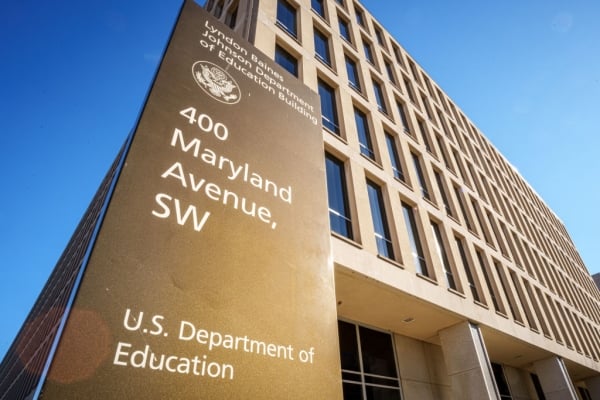


    Source link

  • Hundreds Waitlisted for Pre-K in South Carolina Despite Thousands of Open Seats – The 74

    Hundreds Waitlisted for Pre-K in South Carolina Despite Thousands of Open Seats – The 74


    Get stories like this delivered straight to your inbox. Sign up for The 74 Newsletter
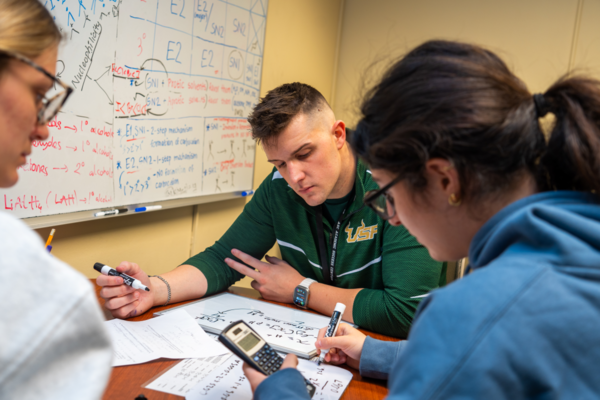
    COLUMBIA — Hundreds of 4-year-olds across South Carolina are on waitlists to access state-funded preschool programs, even though there are thousands of open seats, according to a report presented Monday to the state Education Oversight Committee.

    The state funds a dual system of full-day kindergarten for 4-year-olds deemed “at risk.” Students are eligible under state law if they qualify for Medicaid or free or reduced-price meals, or if they are homeless, in foster care or show developmental delays. Many public school districts use local property tax dollars to expand that eligibility.

    The state Department of Education oversees programs in public schools, while First Steps, a separate state agency, oversees state-funded classes in approved private schools and child care centers.

    As of November, 400 4-year-olds were waiting for spots to open up to enroll at their local public school. At the same time, First Steps 4K reported more than 2,300 open seats, often in the same counties as the districts with the longest waitlists, according to the report.

    “It’s just a matter of finding an open seat for a child on a waitlist or finding an eligible child for the open seat,” said Jenny May, a committee researcher who presented the report.

    Because 4K is a one-year program, students who are on the waitlist are unlikely to end up in a preschool program before starting kindergarten. Children need at least 120 days of preschool to prepare, so even if a slot happens to open up toward the end of the school year, they will start kindergarten less ready than other 5-year-olds, according to the study.

    It’s not clear why some 4-year-olds are on a waiting list for a public school when vacancies exist in private programs, May said.

    In some cases, the issue could be that another preschool program isn’t available nearby. The four counties with the longest waitlists — Lexington, Anderson, Berkeley and Newberry — all have at least one First Steps 4K program with availability, according to the report. However, that doesn’t account for potential cross-county drives.

    Other parents may not know that other options are available, May said. Having a person designated to help direct parents to other preschool options, such as the nearest First Steps 4K program with open seats, could help reduce that waitlist, May said.

    “It’s likely that if we had a more efficient process, we could serve most of the 400 kids on a waitlist on one of the First Steps seats,” May said.

    The state already has several websites meant to help parents figure out what programs they’re eligible for and how to enroll. Palmetto Pre-K, launched in 2020, tells parents whether they’re eligible for state-funded preschool programs. First Five SC does the same but includes all early childhood programs with federal or state funding.

    But having a person parents can call, or who can reach out to families with children on waitlists, could help reach some parents who might not know about the websites or have other concerns, the study suggests. That person, who the committee dubbed a 4K navigator, could then talk parents through the differences in programs, find available seats and answer any other questions parents might have, researchers said.

    First Steps 4K has a similar program, in which applicants are directed to a central phone line or website that helps parents find the right fit for their child. That has helped prevent First Steps from having its own waitlist, May said. The 4K navigators, who the study suggested trying out in areas with the largest waitlists first, would have a broader knowledge of pre-K programs, the report said.

    If a school district has a persistent waitlist of more than 20 students, that suggests the population has risen in that area, and state officials should consider giving the district more funding to create enough slots for those students, the report suggested.

    The waitlisted students represent less than 1% of students who are eligible for the program but not enrolled. More than 18,000 4-year-olds, or about 55% of all eligible, are living in poverty but not enrolled in a 4K program, according to the report.

    That’s a decrease from the 2022-2024 school year, when 60% of eligible students were not enrolled in districts. Still, it’s not enough, May said.

    Even if every student on a waitlist enrolled in one of the available spots, programs would have space left over to take on at least 1,900 more students, according to the report. That suggests there are barriers other than program space keeping parents from enrolling their students in state-funded preschool, May said.

    In many cases, the problem might be that parents don’t know about 4K programs or their benefits, May said. The state should put more funding and effort into outreach to help those students, the report suggests.

    Data shows preschool programs are highly beneficial, helping students learn skills in reading, math and socialization, studies have found. According to the report, at-risk students who attended a state-funded pre-K program were more likely to be prepared for school than their counterparts who didn’t, according to the report.

    “So, we want those students who are eligible and not served to be able to access it, and we definitely want those students who are on a waitlist to be able to access the program,” said Dana Yow, executive director of the committee.

    SC Daily Gazette is part of States Newsroom, a nonprofit news network supported by grants and a coalition of donors as a 501c(3) public charity. SC Daily Gazette maintains editorial independence. Contact Editor Seanna Adcox for questions: [email protected].


    Get stories like these delivered straight to your inbox. Sign up for The 74 Newsletter

    Source link