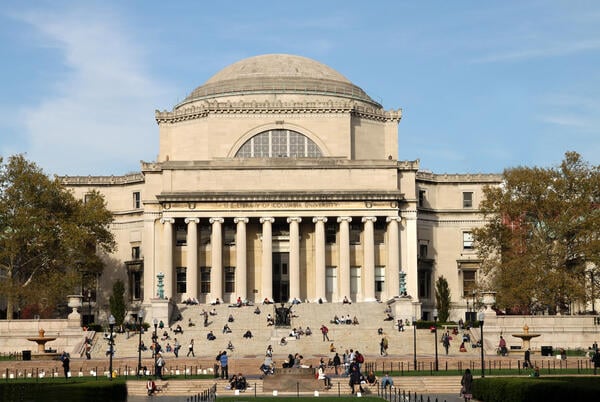
Moody’s Ratings on Tuesday downgraded its outlook for the higher education sector from stable to negative due to recent and potential federal policy changes.
The revised outlook comes as the Trump administration has gutted the Education Department via mass layoffs and sought to aggressively overhaul higher education with a flurry of executive orders that have destabilized certain funding streams.
“Actions and potential changes include cuts to research funding, enforcement actions against diversity programs, staff reductions at the US Department of Education, uncertainty over federal student aid, and possible expanded taxes on endowments,” Moody’s analysts wrote in the report released Tuesday. “These factors are causing institutions to pause capital investments, freeze hiring, and cut spending.”
In December, Moody’s projected a stable 2025 with anticipated revenue growth of 4 percent—the most optimistic outlooks for the sector among a trio of predictions from key financial organizations. Now the ratings agency notes federal policy changes could prompt revenue shortfalls, particularly at research universities, due to a proposed cap on National Institutes of Health reimbursements for research-related costs. That cap, which is currently blocked by a court order, would mean about $100 million in cuts annually for research universities that spend at least $50 million on research and award 70 research doctorates a year, according to Moody’s.
In addition to the NIH rate cut, an increase to the endowment tax would hit wealthy, private universities and likely drive cuts to financial aid or in other spending categories, the report found. The current endowment tax is 1.4 percent for institutions with at least 500 students and $500,000 in assets per student, but recent Republican proposals have floated raising that tax significantly. One proposal has called for a 10 percent tax and changing the per-student endowment threshold from $500,000 to $200,000. Another GOP proposal would set the tax at 21 percent.
Potential disruptions to federal financial aid disbursement, however, would impact all colleges and universities. Moody’s noted that “only a select group of wealthy institutions have the financial flexibility to manage such a scenario without likely seeing steep enrollment decline.” Given steep cuts to the Education Department, Moody’s expressed concern that the Federal Student Aid office could be affected, particularly after last year’s overhaul of the Free Application for Federal Student Aid, which was beset by multiple technical challenges.
“The administration has said the reductions will not affect the department’s statutorily mandated functions such as administering Title IV financial aid and providing assistance to federal student loan borrowers, but the extent to which that will be the case is uncertain,” the report noted.
Federal enforcement actions against diversity, equity and inclusion initiatives—which the Trump administration has targeted—also pose a financial risk to the sector, according to Moody’s. The report cited the potential for “a wide array of funding cuts, including Title IV funding suspension, if [universities] do not comply” with Trump’s executive orders clamping down on DEI offerings.
Moody’s also flagged potential losses due to the possible reduction in visas for foreign students. Colleges and universities that would be hit the hardest, according to the report, are those that are “reliant on STEM master’s programs, or more niche offerings like art and design programs.”
The report concluded that the outlook could revert to stable “if many of the federal policies and proposals are reversed or halted by judicial intervention or do not come to pass. Stronger-than-expected investment market returns and operating revenue growth could also lead to a revision of the outlook to stable.”
A federal judge in Maryland this week ordered the U.S. Department of Education to reinstate numerous grants that support teacher-preparation programs.
The department canceled the $600 million in grants last month as part of a wider effort to slash federal funding and eliminate programs that promote diversity, equity and inclusion. In response, the American Association of Colleges for Teacher Education, the National Center for Teacher Residencies and the Maryland Association of Colleges for Teacher Education challenged the cuts, arguing in a lawsuit that the grant terminations were illegal.
On Monday, U.S District Judge Julie Rubin ordered the department to restore funding for the Supporting Effective Educator Development program, the Teacher Quality Partnership program and the Teacher and School Leader incentive program within five business days. That order comes after a federal judge last week directed the department to reinstate canceled grants in eight states.
“We are thrilled that the court has ruled in favor of preserving funding for TQP, SEED, and TSL grants, which have a transformative impact on our nation’s education system,” AACTE president and CEO Cheryl Holcomb-McCoy said in a news release.
The order also blocks the department from terminating any other TQP, SEED or TSL grant awards “in a manner this court has determined is likely unlawful as violative of the Administrative Procedure Act,” which instructs courts to “hold unlawful and set aside final agency actions” deemed “arbitrary, capricious, an abuse of discretion, or otherwise not in accordance with law.”
The judge asked both the department and the plaintiffs to file a status report within seven business days showing compliance with the order.
March Madness officially begins Thursday with a match-up between the University of Louisville and Creighton University.
Michael Allio/Icon Sportswire/Getty Images
No shame if you forgot National Collegiate Athletic Association’s Division I basketball championships were coming up—after all, this March has been filled with more than enough madness in higher ed, even without paying attention to basketball.
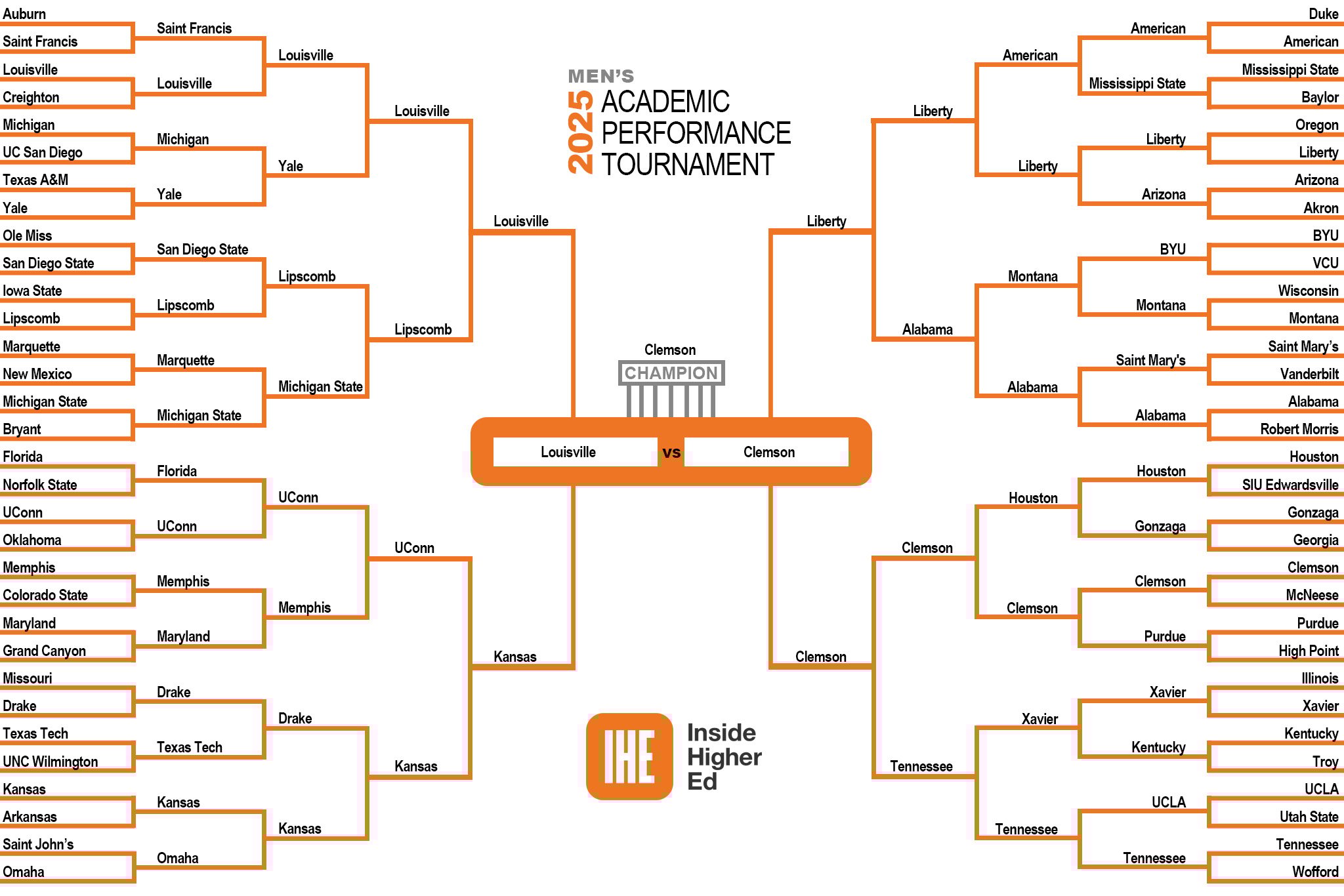
Nonetheless, the biggest event in college sports kicks off this week. If you’ve been a little too concerned with the news cycle to fill out your bracket, we’re here to help. Every year since 2006, Inside Higher Ed has determined which teams would win in the men’s and women’s tournaments if the results were based on academic, rather than athletic, performance.
To determine the winners, we used the NCAA’s key academic performance metric, known as the academic progress rate, for the 2022–23 academic year, the most recent data available. The academic progress rate measures student athlete retention and academic eligibility, though some outside experts have said the metric paints an imperfect picture of a program’s academic performance.
(Full disclosure, we did use this metric to determine the winners of the First Four matchups, even though two of the four games will be determined before publication Wednesday morning.)
If two colleges had the same APR, we used 2023–24 graduation success rate, the proportion of athletes who graduated within six years of entering an institution, as tiebreakers. If teams tied again, we turned to the team’s six-year federal graduation rates, which is a more inclusive metric.
Luckily, none of the teams tied in all three categories. Still, there were a handful of nail-biting victories. For instance, the Clemson University Tigers tied the Liberty University Flames on both the academic progress and graduate success rates. But when looking at the overall graduation rate, Clemson won by one point. After besting the Flames in the Final Four, the Tigers beat out the University of Louisville to win the whole thing.
Now, the Inside Higher Ed bracket likely won’t win you any money. But there’s no bad time to celebrate the academic achievements of student athletes alongside their athletic prowess.
Several future posts are in the works, as well as a Resources Page, so stay tuned. – rklc
Professor Timothy Zick
Presidents and suppressive campaigns: Today’s unprecedented practices
Executive Watch is an effort to record and analyze the many First Amendment-related conflicts and concerns arising during the second administration of President Donald Trump. One of the challenges in assessing the administration’s approach to the press and critics is to identify and explain what is distinct or unique about it. After all, the policies and actions of every administration have raised First Amendment issues and concerns. John Adams had reporters jailed under the Sedition Act, Richard Nixon had his “enemies list,” President Obama’s Department of Justice was criticized for prosecuting reporters in national security cases, and President Biden’s administration was accused of pressuring social media platforms to censor disfavored speech.
However, as I explained in my introductory post for Executive Watch, what is distinct about the current president and administration is the depth and breadth of the campaign they are waging against critics, both inside and outside government.
The current situation represents an unprecedented and coordinated effort to use courts, governmental agencies, and even private individuals to engage in retribution, intimidate media and non-media critics, impose official orthodoxies, and punish dissent.
Civil lawsuits as engines of leverage and intimidation
“I spent a couple of bucks on legal fees, and they spent a whole lot more. I did it to make his life miserable, which I’m happy about.” — Donald J. Trump
One aspect of the broader current agenda involves the filing of civil defamation, consumer fraud, and other lawsuits against the press and others who publish disfavored information or opinions critical of Trump or his administration.
Like any other citizen, a political candidate, president, or ex-president has the right to file lawsuits and seek redress for reputational or other harms. Indeed, prior to Trump, at least one ex-president did so. However, the extent to which Trump has relied, and continues to rely, on defamation and other civil lawsuits against media and non-media defendants is a unique aspect of a broader campaign against political critics. No other political candidate or president has wielded the civil lawsuit as a political sword quite as Trump has.
When it comes to civil litigation, Trump is in a league of his own. By one account, Trump has been involved in more than 4,000 civil lawsuits over the years, ranging from business disputes to defamation and other actions. Even for someone like Trump, who has been involved in a variety of complex business ventures, that is a remarkable number of civil actions.
One lesson Trump likely learned from his litigation experience is that lawsuits can be an effective form of leverage in business and other dealings. Indeed, even if a claim has no or little legal merit, it can be useful in terms of exhausting, intimidating, and silencing opponents.
For a long time, many of Trump’s civil lawsuits were business-related. However, since he became a political candidate, Trump’s filing of defamation actions has significantly spiked. As a political candidate and officeholder, he has pursued several defamation lawsuits against media and non-media defendants.
Trump has sued CNN, The Washington Post, and The New York Times, as well as local media outlets, for critical coverage of his campaign and first term as president. For example, he brought a $475 million defamation lawsuit against CNN over the network’s use of the term “the Big Lie” to describe his false claims that he won the 2020 election. That claim was dismissed. More recently, Trump brought a $20 billion civil action against “60 Minutes” and CBS for allegedly editing an interview with Kamala Harris in ways that obscured or improved her answers to questions.
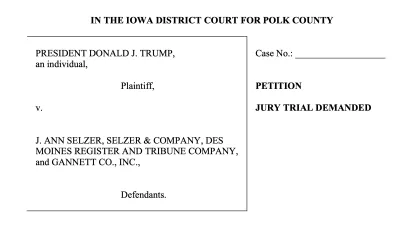
Trump also sued ABC News and George Stephanopoulos for stating that he had been found liable for “rape” in a civil case. Finally, Trump sued The Des Moines Register and its parent company, Gannett, for publishing a flawed poll showing Trump trailing Harris in the 2024 presidential election in Iowa. He also filed suit against the pollster herself, J. Ann Selzer. All of this despite Trump ultimately winning Iowa handily, raising questions about what damages he allegedly suffered.
Trump has also filed civil lawsuits against non-media defendants. For example, he has sued the Pulitzer Board for recognizing The New York Times for its reporting on the Russia investigation. (That suit has been allowed to proceed, at least for now.)
Trump and his lawyers have also been expanding their civil suit repertoire. He sued CBS and the defendants in the Iowa case for consumer fraud and election interference. His lawsuit against CBS also contains a claim under the Lanham Act, which provides civil damages for false advertising. These suspect allegations target core press functions and political speech.
Additionally, Trump has vowed to file many more civil lawsuits against those who publish unflattering opinions or disfavored information. He has claimed such legal action is necessary to “straighten out the press” and punish those he accuses of fraud and election interference.
Poor litigation track record
For all his litigation experience, Trump has a very poor track record in civil lawsuits, particularly those claiming defamation. In fact, he nearly always loses — sometimes very badly. Trump has even been ordered to pay media defendants substantial damages for filing harassing and frivolous defamation lawsuits. Some states have laws that impose liability on plaintiffs for bringing so-called SLAPPs (Strategic Lawsuit Against Public Participation) — essentially, defamation actions intended to silence or intimidate critics. Trump has been found liable for damages under such laws.
This is one context in which Trump may not mind being a loser or even paying damages. Weaponizing civil lawsuits and courts is not about restoring Trump’s damaged reputation, recovering damages, protecting consumers, ensuring the integrity of elections, or any other legitimate private or public interest. Rather, they are a means of punishing critics and chilling, through expensive and often frivolous litigation, the publication of unfavorable or unflattering information and opinion.
Civil lawsuits as political weapons
“Donald Trump is abusing the legal system to punish speech he dislikes. If you have to pay lawyers and spend time in court to defend your free speech, then you don’t have free speech.” — Adam Steinbaugh
Like many other aspects of the Trump administration’s agenda, civil lawsuits serve important political purposes. They are part of the campaign to suppress dissent, undermine the press, and entrench executive power.
Decades of litigation have likely convinced Trump that the prospect of defending against frivolous and strategically harassing claims will either convince defendants to settle, trim their critical reporting, or both. In that sense, civil lawsuits are an effective means of intimidating, leveraging, and silencing opponents.
The civil lawsuits communicate political narratives about the press as an institution, hoping to further weaken its public standing. Many of Trump’s civil complaints present hyperbolic and unsupported claims concerning Trump, the press, or both. They also highlight longstanding grievances against the media and other critics. Regardless of their outcome, Trump will be applauded by political supporters for waging war against the press, which Trump continues to describe as “the enemy of the American people.”
In a broader sense, civil lawsuits are part of a campaign to entrench executive power by undermining or eliminating institutions — including the press, agencies, lawyers, and universities — that can check the administration’s political and other narratives. Destroying the credibility of media and non-media fact-checkers and harassing them in civil suits, often through exorbitant demands for damages, serves these larger goals.
Regardless of their merit, Trump’s lawsuits force defendants to consider whether it is worth publishing truthful information or opinions that reflect poorly on him or his administration. The ordinary demands and pressures of civil litigation are even more pronounced when the plaintiff is the president of the United States. Judges may be reluctant to dismiss frivolous claims as a result of Trump’s status, and juries in some jurisdictions may be inclined to side with the president against his critics.
Past as prelude: The Sullivan story and its current importance
Using civil lawsuits as a cudgel against the media and other critics is an abusive practice that threatens to chill communication of opinions and facts. Although unprecedented for a presidential candidate or president, weaponizing defamation and other civil lawsuits to suppress criticism and chill reporting is not a new tactic.
During the Civil Rights Era, local southern officials relied on pro-plaintiff standards to censor and intimidate both media outlets and civil rights activists. Through frequent lawsuits, local and state officials sought to control the narrative about racial segregation.
Recognizing the chilling effect of this litigation tactic, in its 1964 decision New York Times Co. v. Sullivan the Supreme Court adopted a demanding standard of proof applicable to public officials who sued for allegedly defamatory statements about the conduct of their official duties. Under that precedent, public officials must show the statements were made with “actual malice,” i.e., that the defendant knew they were false when published or published them with reckless disregard for their truth. The Court later extended the actual malice standard to suits brought by public figures, including those like Trump who have gained extensive public notoriety.
Sullivan was a direct response to early SLAPPs, which were filed to censor local and national reporting about the extent and effects of racial segregation. As the Court recognized, because no double jeopardy limit applied in the civil context, defamation lawsuits could be even more chilling to a free press than the threat of criminal prosecution.
Anthony Lewis
Indeed, as Anthony Lewis observed in his book about the Sullivan case, by 1964, southern officials had brought $300 million in libel claims against the press for truthfully reporting on civil rights abuses. Sullivan’s protective standard — which the president favors eliminating — has been an effective shield for defendants sued by Trump. Without it, media and non-media defendants may face sizable damage awards for publishing even truthful criticism of Trump or the administration.
To be sure, the press does not always act responsibly. Media outlets and reporters can be held liable for knowingly or recklessly publishing false statements about public officials or figures. At the same time, as anti-SLAPP legislation shows, expensive lawsuits and the threat of civil damages can undermine the ability of the press and others to share vitally important information with the public. Trump and his lawyers have upped the ante with consumer fraud and other claims, which must still be rebutted even if frivolous.
In the hands of political officials, including presidents, abusive civil lawsuits can significantly undermine efforts to check power and educate the public.
Troubling successes — and possible responses
Trump has had some recent success in his civil lawsuits. For example, ABC News settled a defamation lawsuit, agreeing to donate $15 million to Trump’s presidential library and issue an apology for George Stephanopolous’s comments about the civil sexual assault verdict (which the trial judge held was “substantially true” in another Trump defamation lawsuit). CBS and “60 Minutes” are reportedly also considering a settlement, even though legal experts agree the lawsuit is based on a frivolous theory that a news network can be held liable for how it edits interviews.
Meanwhile, Trump has already extracted (if that is the right word) hefty settlements from Meta and X, for seemingly defensible decisions they made to de-platform or restrict Trump based on violations of their terms of service. A judge had dismissed Trump’s action against Twitter (now X), which was based on the First Amendment.
Of course, as law students in my classes know, the First Amendment constrains state action, not the private actions of social media platforms.
WATCH VIDEO: Firing the Watchdogs | 60 Minutes Full Episodes
There are many reasons a defendant might want to settle a civil lawsuit. One reason being to avoid a protracted and costly court proceeding, to avoid discovery, or to avoid the risk of a jury verdict. However, settlement of SLAPPs raise concerns about press obeisance and lack of independence. Rather than defend core First Amendment press prerogatives and functions, large media corporations with regulatory or other business before the Trump administration may be making balance sheet decisions.
As some commentators have suggested, social and media legacy companies may be settling meritless cases to grease the regulatory skids for pending mergers and other potential benefits from the Trump administration. Some have even suggested that some of these settlements may constitute a novel form of political corruption. Thus, one commentator referred to settling frivolous civil lawsuits brought by Trump as “a novel pathway to engage in political bribery.” (Of course, even if the practice fits that description, the administration can simply refuse to enforce political corruption laws against settling defendants.)
There are several means of combatting the weaponization of civil lawsuits. The most direct and obvious is to defend against these lawsuits and offer a robust First Amendment defense. As history shows, weaponizing civil lawsuits has dangerous implications for the freedoms of the press and speech. Trump’s aggressive resort to defamation and other civil lawsuits also highlights the importance of retaining Sullivan’s press-protective standard. Defendants ought to put up substantial and sustained resistance to lawsuit weaponization.
Anti-SLAPP statutes can also provide a deterrent. A federal anti-SLAPP law would make this important protection more widely available. Thus far, Trump has not been much deterred by anti-SLAPP liability. However, making such protections available regardless of jurisdiction would provide all defendants an opportunity to dismiss harassing defamation claims.
There are also actions judges can take to punish and deter abusive civil lawsuits. Judges have the power to dismiss baseless or frivolous claims on their own, and to sanction lawyers who file them. Some commentators have urged judges to refuse to approve media settlements of frivolous claims brought by Trump, on the grounds that they are the product of duress or fraud, or are otherwise against public policy.
Like agency employees, private employers, lawyers, universities, and others who have been subject to executive actions meant to punish or chill expression, media and non-media defendants currently face a critical choice: capitulate or fight.
For the sake of the First Amendment, let us hope the targets of strategic civil lawsuits defend them vigorously.
2024-2025 SCOTUS term: Free expression and related cases
Cases decided
Villarreal v. Alaniz(Petition granted. Judgment vacated and case remanded for further consideration in light of Gonzalez v. Trevino, 602 U. S. ___ (2024) (per curiam))
Murphy v. Schmitt (“The petition for a writ of certiorari is granted. The judgment is vacated, and the case is remanded to the United States Court of Appeals for the Eighth Circuit for further consideration in light of Gonzalez v. Trevino, 602 U. S. ___ (2024) (per curiam).”)
TikTok Inc. and ByteDance Ltd v. Garland (The challenged provisions of the Protecting Americans from Foreign Adversary Controlled Applications Act do not violate petitioners’ First Amendment rights.)
This article is part of First Amendment News, an editorially independent publication edited by Ronald K. L. Collins and hosted by FIRE as part of our mission to educate the public about First Amendment issues. The opinions expressed are those of the article’s author(s) and may not reflect the opinions of FIRE or Mr. Collins.
As more students and parents consider the value of higher education and the cost of a four-year degree, interest has grown in three-year degree opportunities that allow students to complete their education in less time for a lower tuition rate.
Westminster College in Pennsylvania launched a new Degree in Three program in the School of Business this year, allowing learners to graduate with 125 credits and shave a year off their time in undergraduate education. Additionally, the program pairs with the college’s master of business administration, so learners can complete two degrees in four years if they so choose.
The background: There were a few catalysts for creating a formal three-year degree program, explains Robert Badowski, Westminster’s school of business chair. First, more students were coming in with credits from high school from AP or dual-enrollment programs, making their degree progress quicker. Second, more students and parents had noted the high cost of education and concerns about student debt.
A May 2024 Student Voice survey by Inside Higher Ed and Generation Lab found seven in 10 respondents say higher education institutions in general charge too much for an undergraduate education.
Westminster isn’t the only college facing pressure to get students to graduation sooner: Interest in formalized three-year degree programs has grown in recent years, and more institutions are looking to get in the game, even medical schools.
At Westminster, the college had helped students shape their own schedules to graduate in three years rather than four, but a curriculum review and restructuring of elective courses has helped make this accessible to all students.
What’s different: Westminster students can take up to 19 credit hours per semester and be considered full-time, but the business program offered primarily four-credit courses, making it difficult for students to max out their credit load.
“You could take four classes, but if you took the fifth class, you were paying extra money, and most students don’t want to take on that burden, even if it was cutting off a year,” Badowski explains.
Many three-year degree programs reduce the total number of credits students have to complete, but Westminster accelerated business students still complete at least 125 credits. To do so, faculty members reimagined their four-credit elective courses to be worth either one or two credits instead.
Now, instead of engaging in a deep dive into an elective topic, students receive greater breadth in a variety of areas and are able to hit that 19-credit threshold exactly.
“We had a meeting [with faculty members] as far as which courses made sense to do this with, and we found out in the process that a lot of [content] was stretched out purposefully just to be stretched out,” Badowski says. The process of removing content or packing it into seven or eight weeks, therefore, made more sense in many cases.
The restructuring of elective courses is something that will benefit all business students, not just those participating in the accelerated degree program, giving them greater flexibility in scheduling.
BOGO deal: In addition to removing costs associated with attending college, the Degree in Three program allows students to pair their undergraduate and graduate degrees in a four-year timeline.
“We have a pretty neat deal that if students want to take one of their M.B.A. classes the last semester of their senior year, they can,” Badowski says. “We don’t charge for the M.B.A. course, so that gets them kind of jettisoned into the program.”
The offering is particularly attractive to student athletes at the college, many of whom want to use all four years of eligibility.
The price of an M.B.A. at Westminster is also around $10,000, so students spend less for a three-plus-one M.B.A. degree than four years in their undergraduate program, Badowski says.
What’s next: Administrators are working on creating awareness of the offering among prospective students and particularly parents, who “are going to look at this and hopefully go, ‘I can help my kids save a year of tuition, maybe get them out of college a year faster,’” Badowski says.
The college doesn’t have specific goals for enrollment, but Badowski would like to see 20 in the first year and consistent growth after that. “I’m hoping that people find it useful for them, [because] they’re still getting the same amount of credits. They’re taking the same classes as everybody else, it’s just faster.”
Get more content like this directly to your inbox. Subscribe here.
How many artificial intelligence and higher education meetings have you attended where much of the time is spent discussing the basics of how generative AI works? At this point in 2025, the biggest challenge for universities to develop an AI strategy is our seeming inability to achieve universal generative AI literacy.
Given this state of affairs, I’d like to make a modest proposal. From now on, all attendees of any AI higher education–focused conversation, meeting, conference or discussion must first have read Ethan Mollick’s (short) book Co-Intelligence: Living and Working With AI.
The audiobook version is only four hours and 37 minutes. Think of the productivity gains if we canceled the next five hours of planned AI meetings and booked that time for everyone to sit and listen to Mollick’s book.
For university people, Co-Intelligence is perfect, as Mollick is both a professor and (crucially) not a computer scientist. As a management professor at Wharton, Mollick is experienced in explaining why technologies matter to people and organizations. His writing on generative AI mirrors how he teaches his students to utilize technology, emphasizing translating knowledge into action.
In my world of online education, Co-Intelligence serves as an excellent road map to guide our integration of generative AI into daily work. In the past, I would have posted Mollick’s four generative AI principles on the physical walls of the campus offices that learning designers, media educators, marketing and admissions teams, and educational technology professionals once shared. Now that we live on Zoom and are distributed and hybrid—I guess I’ll have to put them on Slack.
Mollick’s four principles include:
Always Invite AI to the Table
When it comes to university online learning units (and probably everywhere else), we should experiment with generative AI in everything we do. This experimentation runs from course/program development, curriculum and assessment writing to program outreach and marketing.
Be the Human in the Loop
While anything written (and very soon, visual and video) should be co-created with generative AI, that content must always be checked, edited and reworked by one of us. Generative AI can accelerate our work but not replace our expertise or contribution.
Treat AI Like a Person (But Tell It What Kind of Person It Is)
When working with large language models, the key to good prompt writing is context, specificity and revision. The predictive accuracy and effectiveness of generative AI output dramatically improve with the precision of the prompt. You need to tell the AI who it is, who the audience it is writing for is and what tone the generated content should assume.
Assume This Is the Worst AI You Will Ever Use
Today, we can easily work with AI to create lecture scripts and decks. How long will it take to feed the AI a picture of a subject matter expert and a script and tool to create plausible—and compelling—full video lectures (chunked into short segments with embedded computer-generated formative assessments)? Think of the time and money we will save when AI complements studio-created instructional videos. We are around the corner of AI’s ability to accelerate the work of learning designers and media educators dramatically. Are we preparing for that day?
How are your online learning teams leveraging generative AI in your work?
What other books on AI would you recommend for university readers?
A recent issue of Liberal Education, a magazine published by the American Association of Colleges and Universities, takes up the issue of the mental health crisis in academia with five excellent pieces on how institutions can enhance student well-being. Two other articles explore how administrators and faculty members should administer self-care. That split is telling, for it sends the tacit message that universities are in the business of setting up systems to support students, but when it comes to employees, you are on your own.
As a dean in the middle of his eighth year in that role, I want to address this gap by sharing tangible steps and practices administrators can use to systematize support for faculty well-being, in the hopes that I might inspire my decanal colleagues at other institutions to experiment with some of the strategies below. While those examples are inspired by my experience in a small, private, comprehensive university setting, most will translate to other environments.
Just to be clear, it makes perfect sense why administrators do not focus on the well-being of their faculty, as a plethora of other responsibilities takes precedence. My own institution is a case in point, for while our deans’ responsibilities document calls on us to provide “recognition, encouragement, and support for the work faculty are doing,” the emphasis is on the labor produced by faculty rather than on their well-being. Such support work is often elided institutionally by more pressing and more measurable tasks tied to the operations of the university.
This elision has been especially acute over the past half decade, as universities and colleges wrestle with a brutal collision of challenges, including enrollment pressures, budget cuts, student unrest, attacks on DEI, program prioritization, AI challenges and so on. When faced with such a list of horrors, though, I conclude that support of faculty well-being has never been more important, given the weight of these pressures on professors.
Deans (as well as other leaders) can embrace the following strategies to enhance the well-being of their faculty. Most of them do not cost any money.
Protect faculty’s time. Because time is the most valuable currency of faculty life, think about how you can protect that precious resource. Because the “university bureaucracy … inevitably consumes the time and attention of its subjects to justify its existence,” according to Cal Newport, deans should consider how they can shield faculty from the pressures of the neoliberal, bureaucratic machine that thrives on forms, reports and trainings. Focus on work that is directly mission-aligned and create efficiencies in required processes like accreditation reports, tenure and promotion review, and budget management so that faculty are free to concentrate on their students and research.
Newport also laments that our technocentric workplace—an environment “defined by hyperactive digital distraction and onerous administrative burdens”—has converted faculty into middle managers, ultimately “strangling productivity and making [them] miserable.” Therefore, ask yourself if that latest email update to your faculty is really necessary.
Speaking of email, try to lay off the communication outreach outside of business hours—it’s the rare issue that requires immediate attention from faculty at 10 p.m. on a Tuesday. Use your email’s delay-delivery function liberally. And the tag appended to your signature line announcing that you “may work outside regular business hours and thus don’t expect an immediate reply from recipients” still does not stop the issue from landing on the psychological plate of faculty and could be misinterpreted as merely a passive-aggressive signal that you are working when others are not.
Acknowledge mental health challenges. It’s tough out there: Data show that higher ed employees are feeling burned out, with more than half of faculty and staff respondents in one recent survey saying “their job took a negative toll on their mental or emotional health.” More than a third pointed to their work supporting the emotional needs of students as having an impact on their own mental well-being. Recognizing that faculty in my own unit were being stretched thin as a consequence of their extraordinary efforts supporting students during the COVID-19 pandemic, I invited two of the university’s mental health counselors to visit our annual retreat to help faculty reset boundaries that had eroded during the past few years, to offer them insight into the mental health challenges of students and, most importantly, to give faculty permission to say no to unreasonable student requests.
Defend faculty’s academic freedom.A recent AAC&U survey shows faculty are feeling enormous pressure from external attacks on academic freedom, and they are struggling to navigate these treacherous waters inside and outside the classroom. Such anxieties will most likely accelerate over the next four years. According to the survey, “more than one out of three faculty report that they feel more constrained, compared with six or seven years ago, in their ability to speak freely” in terms of classroom content, faculty governance and even as a citizen. About half are self-censoring—even statements they believe to be true—for fear of “drawing negative attention.”
Faculty see their academic leaders—deans and provosts—as chiefly responsible for protecting those freedoms, so we should be ready to stand up for faculty if they do come under attack. But in the meantime, deans must also acknowledge and support the well-being of faculty, which happens to be the final recommendation of the AAC&U report: “Even as legislative actions and the mercurial nature of politics may feel beyond institutional control, colleges and universities must find ways to support faculty mental health.”
Lead with empathy. When life intrudes or a family tragedy strikes, necessitating that a faculty member step away from their work unexpectedly, deans can give the imprimatur of the institution for faculty to redirect their emotional energy away from work and toward the personal matter at hand. A small change in wording in replying to their unfortunate news can make a world of difference. Instead of a curt email like “thanks for letting me know,” try something a bit more proactive: “I’m so sorry to hear this difficult news. Please know that we’ve got things covered for you so that you can focus your attention where it belongs, on your loved ones. Please let me know if there’s any way I can help with that project.”
Walk the talk. The narrative of faculty “going to the dark side” of administration and immediately forgetting the needs of their professorial colleagues is as old as the university itself, but one consequence of that narrative is that the resultant distrust, anger and suspicion can wear on the well-being of faculty. One approach to bridging that gulf is to demonstrate you are still in touch with the needs of faculty by standing in their shoes. The most obvious way to send that signal is to teach one class annually as a dean. If presidents can do it, certainly we can find a way.
For me, this gesture was never more important than during the COVID-19 pandemic, as faculty were asked to pivot online with one week of warning and changes to protocols (wipe down the surfaces, stay behind the plastic shields, support students in quarantine) came down from on high at a dizzying pace. Standing beside my faculty in the classroom gave my requests during that difficult time extra weight. Likewise, make sure you are visible at the university’s latest Title IX training, attend required orientations and share tips learned from navigating your institution’s new frustratingly opaque HR system so that faculty know you are not exempt from such institutional responsibilities.
Own your mistakes. Being quick to admit your errors—both small and large—models for faculty that it is OK to fail, thus lowering the emotional pressure they may be feeling to perform, particularly junior faculty. Mea culpas from a leader may even encourage risk-taking and innovation in your unit. If an electronic form for faculty prepared by an administrative assistant does not work, that is on the dean for not checking it before its distribution, and you should say so. I once mishandled a conflict between faculty members and apologized afterward to faculty for not doing better. Taking Augustine’s dictum to heart—“fallor, ergo sum” (I err, therefore I am)—will humanize the dean and hopefully make you more approachable when faculty need support.
Advocate for faculty. One of the great pleasures of the dean’s role is your ability to advocate for your unit and its personnel. Letting faculty know you’ve got their backs and that you are always on the lookout for opportunities they might find exciting can help ground them mentally. Connecting them with a conference opportunity, suggesting them for a speaking gig or putting their name forward for a professional development workshop gives faculty confidence that they have someone in a position of power looking out for them, even in the face of all the uncertainties currently plaguing higher ed. Likewise, making professional development funds easier to access makes it less stressful for faculty who want to improve their craft.
Know your faculty’s work and recognize their achievements.As president of Princeton, Harold Shapiro used to read one book per week by his faculty members and even attended lectures to better understand their work and what they cared about. I would be hard-pressed to think of another gesture by a leader that might gratify an academic colleague more. Other signals of support can include a private note of congratulations or a “well done” at a university function. Following the mantra of “criticize in private and praise in public,” recognize faculty achievement at unit meetings, alumni gatherings and in email blasts, and do so for a wider variety of achievements beyond major grants, publications or teaching awards.
Provide stability. With new strategic plans coming down the pike every few years, administrative churn resulting in continuously shifting priorities, and constant requests to cut budgets while also innovating, the dean has the unique opportunity to provide a modicum of stability for their faculty in terms of processes and practices, consistent timelines and the unit’s strategic direction. In the face of turmoil across the larger institution, establishing your own unit as a sea of tranquility—as much as is possible—will be welcome. Parroting the institution’s “hair on fire” ethos is not helpful.
Bring faculty into the decision-making loop. Anxiety can surface when we do not feel in control of our circumstances, especially during times of crisis. While it is difficult to counter the many macro pressures facing higher ed, deans can give faculty some sense of ownership over your school’s direction by soliciting feedback on matters that go beyond those identified in the faculty manual, whether it is the unit’s fundraising focus for the year, locations for retreats or approaches to space allocation. Not all will be interested in participating, but faculty will appreciate being asked. On the flip side, no one’s mental health ever improved by being micromanaged by a supervisor: Give your faculty room to breathe.
Surface inequities—and then do something about them. Service work across units tends not to be distributed equitably: Women and faculty of color do more than their fair share. That is unacceptable, and deans are in position to right this wrong through strategies I have discussed previously. Systemizing equity policies instead of forcing faculty to depend on the good will of supervisors will also lessen the anxiety of faculty with the least power to say no.
On a related note, deans can play a role in supporting faculty of color, LGBTQ+ faculty and other minoritized faculty in light of the overtly hostile national (and sometimes state) climate that gets expressed through attacks on DEI programming, the hollowing out of the curriculum and demonization of personnel. Tokenism, microaggressions and overt discrimination in the white, heteronormative space of the academy provide daily challenges for minoritized faculty. William A. Smith’s concept of “racial battle fatigue” is unfortunately alive and well in higher education, and deans can support their personnel suffering under the weight of that trauma not only by enacting policies that advance equity and inclusion, but also by offering to listen, intervening when invited and endorsing strategies of self-care.
Create community. Individuals who do not have a strong sense of community typically have greater odds for experiencing mental health challenges. While I am certainly not suggesting the workplace stand in for family or friend groups, deans have the opportunity to create community in their academic units in ways that will enhance faculty well-being, whether that be through annual retreats where faculty can deepen personal relationships with each other or the establishment of a strong culture and clarity around a unit’s mission, so that faculty buy-in for the unit’s work will excite and unite personnel.
When I recently reviewed my annual dean’s evaluations from faculty for the past two years, anonymous respondents repeatedly highlighted in their optional narrative comments the following features of my leadership: commitment to faculty, listening and helping faculty feel heard, creating community, providing support, evincing compassion and care, and relationship-building. These qualities all fall under the faculty well-being umbrella, so it is worth honoring such faculty voices as we choose, as deans, where to focus our attention and request that universities fold these responsibilities into administrative job descriptions.
Richard Badenhausen is dean of the Honors College at Westminster University and a board member of the American Conference of Academic Deans.
Starting next academic year, Harvard will offer free tuition to students from households that earn $200,000 or less a year, according to a Monday announcement from university leaders.
In addition, students with household incomes of $100,000 or less per year will attend Harvard for free, with the university covering not just tuition costs but food, housing, health insurance and travel expenses. Those students will also receive a $2,000 start-up grant in their first year and a $2,000 launch grant junior year to support their transitions to and from college.
“Putting Harvard within financial reach for more individuals widens the array of backgrounds, experiences, and perspectives that all of our students encounter, fostering their intellectual and personal growth,” Harvard president Alan M. Garber said in the announcement. “By bringing people of outstanding promise together to learn with and from one another, we truly realize the tremendous potential of the University.”
The changes make roughly 86 percent of American families eligible for Harvard financial aid, according to the announcement. The move comes at a time when the Ivy League institutions are under intense scrutiny from the Trump administration and lawmakers. Harvard joins a slew of other universities, including some highly selective institutions like the University of Pennsylvania and the Massachusetts Institute of Technology, that have unveiled expansive new financial aid plans.
March 13 was a watershed day in the annals of American higher education and the history of America’s commitment to freedom and limited government. On that day, the Trump administration issued an edict telling Columbia University, a private institution, how to function.
The people who founded the American republic must be turning over in their graves.
Such a bold assertion of government power would be more familiar to people in many other nations. But in the United States, this is a shocking development and a warning of what is in store, not just for higher education, but for the entire country.
What is happening at Columbia is an initial test of the Trump administration’s ambition to curb institutional autonomy, limit and punish dissent, and make life miserable for anyone who does not toe their line. That’s why each of us, whether or not we work in higher education, has a stake in Columbia University’s fate.
Let’s face it: Universities are what people in the Departments of Defense or Homeland Security might call “soft targets.” Soft targets are easily accessible, relatively unprotected and therefore vulnerable to attack.
Like the successful, decades-long right-wing campaign to take over the courts in this country, which has wreaked havoc in the lives of ordinary Americans, the campaign against Columbia will, if similarly successful, prove costly well beyond that New York City campus.
What is unfolding there is a testing ground for efforts in other sectors of American life.
Acting in a high-handed and arbitrary manner in its dealings with Columbia paves the way for the government to carry out similar abuses of power elsewhere. Attacking academic freedom is a stalking horse for attacking freedom of speech and other freedoms.
It is important to recall that Trump’s campaign against Columbia didn’t start on March 13. It began earlier with the cancellation of $400 million in federal grants and contracts and the move by Immigration and Customs Enforcement to arrest and detain Mahmoud Khalil, a green card holder and recent graduate who helped lead pro-Palestinian protests on campus.
The first thing to note about that letter was that it came from officials in the Departments of Education and Health and Human Services and the General Services Administration. They joined not only in asserting their right to intervene at Columbia under Titles VI and VII of the 1964 Civil Rights Act but to remind the university of the Trump administration’s power to cripple it financially.
Title VI prohibits discrimination on the basis of race, color or national origin in programs and activities receiving federal financial assistance. Title VII makes it unlawful for employers to discriminate based on race, color, religion, sex or national origin.
Since the act’s passage, it has been clear that alleged violators of Title VI must be afforded due process before federal funds can be withheld. That guarantees fairness and impartiality in investigations and ensures that enforcement actions will not be precipitous.
The March 13 letter, with its demand for “immediate next steps that we regard as a precondition for formal negotiations regarding Columbia University’s continued financial relationship with the United States government,” is a chilling reminder of what happens when a government seeks to wield its formidable power without respecting the due process rights of those it targets.
And if it gets away with practicing what one commentator calls “regulation by intimidation” at Columbia, the administration will be emboldened to do more of the same, and not just in higher education.
The March 13 letter touches on matters colleges and universities routinely determine for themselves. For example, it demands that the university complete disciplinary proceedings against students who were involved in taking over a campus building last year and who participated in encampments in support of Palestinians. And it specifies that penalties of “expulsion or multi-year suspension” should be imposed.
The same day it received the Trump administration’s letter, the university announced that it was expelling or suspending some students involved in the Hamilton Hall takeover and temporarily revoking the diplomas of other students who had since graduated.
In addition, the March 13 letter directs Columbia to “Abolish the University Judicial Board (UJB) and … empower the Office of the President to suspend or expel students.”
The intrusiveness of the letter extends to telling Columbia that it must ban the wearing of masks on campus and “formalize, adopt, and promulgate a definition of antisemitism” (it specifically cites the definition used in Trump’s Executive Order 13899). It even demands that Columbia’s Department of Middle East, South Asian and African Studies be put into “academic receivership” so that its faculty can no longer make hiring and curriculum decisions.
That is the administration’s way of forcing the university to punish the department, some of whose faculty supported the encampment movement. Receivership means someone from outside the department would be appointed to make decisions for its faculty. It is a rarely used and nuclear response to departmental dysfunction.
If Columbia were to do what the March 13 letter asks, it would be waving the white flag of surrender to any pretense that it will respect and protect academic freedom, the most prized and essential aspect of teaching and research in higher education. That would send a powerful and chilling signal about the administration’s ability to ensure freedom means the freedom to say and do what it prescribes.
Taken together, the provisions in the March 13 letter amount to an effort to put the entire university into a kind of receivership. Beyond the world of higher education, receivership involves a court appointing “an independent ‘receiver’ or trustee to manage all aspects of a troubled company’s business. The company’s principals remain in place, but they have little authority over the company for the duration of the receivership.”
The March 13 letter signals that intention when it calls for the development of a plan of “long-term structural reforms that will return Columbia to its original mission of innovative research and academic excellence.”
“Innovation” and “excellence” are the watchwords for colleges and universities, businesses, artistic enterprises and individuals seeking to lead a free life. But since the founding of the republic, this country has been guided by the belief that the government would not be in the business of saying what could count as innovative and excellent in private life.
If Americans stay on the sidelines as the current administration tries to bring Columbia to its knees, we will not only be damaging higher education, we will also be turning the founders’ vision of the relationship between the government and the people on its head.
Austin Sarat is the William Nelson Cromwell Professor of Jurisprudence and Political Science at Amherst College.
The University of Delaware has received a $71.5 million gift, the largest single donation in the university’s history, according to a news release Monday.
The donation is from alumni Robert Siegfried Jr. and Kathleen (Horgan) Siegfried and will benefit the institution’s Alfred Lerner College of Business and Economics.
As owners of the Siegfried Group LLP, an entrepreneurial leadership organization that advises financial executives, the couple have long been key donors to the university, but UD president Dennis Assanis said this gift in particular would be “transformative.”
“The Siegfrieds’ generosity will significantly advance Lerner’s critical mission of preparing the next generation of leaders, change-makers and entrepreneurs to make an impact in the rapidly evolving world of business and economics,” Assanis said.
UD plans to put the funding toward a state-of-the-art, student-centric learning space with modern classrooms, research and teaching labs, a student-run cafe, and an auditorium. The money will also be spent on developing a new Siegfried Institute for Leadership and Free Enterprise where students can develop as business leaders and study “the critical role [of] basic principles of limited government, rule of law, and free enterprise.”
The university will commission the design process for Siegfried Hall this spring, with a goal of breaking ground within the next four years, the news release said.