Tag: News

  • Federal Cuts Deepen Tennessee State U’s Budget Woes

    Federal Cuts Deepen Tennessee State U’s Budget Woes

    President Trump’s assault on federal grants is making Tennessee State University’s ongoing financial troubles even worse.

    The Tennessean reported last week that the chronically underfunded historically Black university in Nashville is preparing to lose $14.4 million, the remainder of an $18 million grant it received from the National Institute of Food and Agriculture. It’s one of hundreds of colleges and universities across the country facing financial uncertainty as the Trump administration moves to cut trillions of dollars from the federal budget.

    “This is going to impact our people,” Jim Grady, TSU’s chief financial officer, said at a finance committee meeting Wednesday evening. “We’ll continue to evaluate the volatility … and the potential impact to employees, students and university operations.”

    Grady said nothing would change for at least 90 days after receiving notice of the grant cancellation, and it’s not yet clear how many jobs will be eliminated as a result. And that’s not the only federal grant in question, according to The Tennessean.

    In February, the U.S. Department of Agriculture—which includes the National Institute of Food and Agriculture—canceled $45 million in federal grants to the cash-strapped university, which eliminated 114 positions last fall amid a looming budget shortfall.

    Earlier this month, the USDA restored about $23 million of those grants, though another $115 million could be suspended or frozen. TSU’s federal grants fully fund 62 employees and partially fund another 112.

    In the midst of the financial uncertainty, TSU has suspended its search for a permanent president, WKRN reported.

    Source link

  • Arizona Republicans Want Chaplains to be in Public Schools – The 74

    Arizona Republicans Want Chaplains to be in Public Schools – The 74


    Get stories like this delivered straight to your inbox. Sign up for The 74 Newsletter

    Republican politicians who accuse public school teachers of indoctrinating students with a “woke agenda” are pushing to bring religious chaplains into the same schools to provide counseling to students.

    “I think Jesus is a lot better than a psychologist,” Rep. David Marshall, R-Snowflake, said during a March 11 meeting of the Arizona House of Representatives’ Education Committee.

    Marshall said that he’s been a chaplain who provides counseling for 26 years.

    Senate Bill 1269, sponsored by Flagstaff Republican Sen. Wendy Rogers, was modeled after similar legislation passed in recent years in Texas and Florida.

    The proposal would give school districts the option of allowing volunteer religious chaplains to provide counseling and programs to public school students. Districts that decide to allow chaplains would be required to provide to parents a list of the volunteer chaplains at each school and their religious affiliation, and parents would be required to give permission for their child to receive support from a chaplain.

    Despite ample concerns that the proposal violates the First Amendment’s Establishment Clause and that it would open up schools to legal liability for any bad mental health advice a chaplain might provide, the bill has already passed through the Senate on a party-line vote. The House Education Committee also approved it along party lines.

    Rogers told the Education Committee that the existence of any requirement for the separation of church and state in U.S. law “was a myth,” adding that she sees no harm in bringing religion into public schools.

    Rogers, a far-right extremist, has embraced white nationalism, and in 2022 spoke at a white nationalist conference, calling the attendees “patriots” and advocating for the murder of her political enemies.

    She has also said she is “honored” to be endorsed by a prominent antisemitic Christian nationalist and regularly trafficks in antisemitic tropes. And Rogers has advocated racist theories, appeared on antisemitic news programs and aligned herself with violent anti-government extremists.

    Democrats on the committee raised the alarm that Rogers’ bill would violate the Establishment Clause by allowing chaplains with religious affiliations to counsel students, while not providing the same kinds of services to students who don’t follow a religion or who follow a less-common religion with no chaplains available to the school.

    An amendment to the bill, proposed by committee Chairman Matt Gress, a Phoenix Republican, requires that the chaplains be authorized to conduct religious activities by a religious group that believes in a supernatural being. The amendment would also allow a volunteer chaplain to be denied from the list if the school’s principal believes their counsel would be contrary to the school’s teachings.

    Both of these changes would allow districts to exclude chaplains from The Satanic Temple of Arizona, a group that doesn’t believe in a higher power but promotes empathy and has chapters across the country that challenge the intertwining of Christianity and government.

    Oliver Spires, a minister with The Satanic Temple of Arizona, voiced his opposition to Rogers’ bill during a Feb. 5 Senate Education Committee meeting.

    The legislation, Spires said, would disproportionately impact students from minority religions who see Christian chaplains providing support to their peers while no chaplains representing their religion are available.

    “If a district listed a Satanist on their chaplain list, would they have your support?” he asked the committee members.

    Gress’s amendment would preclude that.

    Gaelle Esposito, a lobbyist for the American Civil Liberties Union of Arizona, told committee members on Tuesday that school counselors are required to undergo specialized training to prepare them to help students — requirements that religious chaplains wouldn’t have to meet, even though they’d be providing similar services.

    “They will simply not be equipped to support students dealing with serious matters like anxiety, depression, eating disorders, self harm or suicidal ideation,” Esposito said. “Religious training is not a substitute for academic and professional training in counseling, health care or mental health… Even with the best intentions, chaplains may provide inappropriate responses or interventions that could harm students.”

    But as Democrats on the House Education Committee argued that Arizona should provide more funding for trained counselors and social workers to help students with mental health issues, the Republicans on the panel said that students are actually struggling with mental health issues because they don’t have enough religion in their lives.

    “I’ve heard that there is a mental health crisis afflicting kids,” Gress, a former school board member, said. “Now, I don’t necessarily think in many of these cases that something is medically wrong with these kids. I think, perhaps, there is a spiritual deficit that needs to be addressed.”

    Rep. Justin Olson, R-Mesa, said he’s been frustrated by the federal courts’ interpretation of the First Amendment to require the separation of church and state, claiming it has made the government hostile to religion instead of protecting it.

    “I heard comments here today that this is going to harm kids — harm kids by being exposed to religion? That is absolutely the opposite of what is happening here today in our society,” Olson said. “We have become a secular society, and that is damaging our society. We need to have opportunities for people to look to a higher power, and what better way than what is described here in this bill?”

    Democratic Rep. Nancy Gutierrez, of Tucson, called SB1269 “outrageous” and “incredibly inappropriate.”

    And Rep. Stephanie Simacek, of Phoenix, pointed out that the courts have repeatedly ruled against allowing religious leaders to be invited to share their faith with public school students. She described Rogers’ bill as indoctrination that gives preferential treatment to students who have religious beliefs over those who don’t

    “No one is saying that you may not go and celebrate your God, however you see fit,” Simacek, a former teacher and school board member, said. “But this is not the place, in public education, where our students go to learn math, reading and writing and history.”

    Florida’s school chaplain law, which went into effect last July and is similar to Rogers’ proposal, has received ample pushback from First Amendment advocacy groups, as well as some church groups who said that allowing untrained chaplains to provide mental health support to students would have unintended negative consequences.

    The option to bring chaplains into schools in Florida has not been particularly popular, with several large school districts deciding not to implement a program allowing them.

    Proposed legislation similar to SB 1269 has been introduced in red states across the country this year, including in Indiana, Nebraska, Iowa, Montana and North Dakota.

    The bill will next be considered by the full House of Representatives. If it passes the chamber, it will return to the Senate for a final vote before heading to Gov. Katie Hobbs.

    Arizona Mirror is part of States Newsroom, a nonprofit news network supported by grants and a coalition of donors as a 501c(3) public charity. Arizona Mirror maintains editorial independence. Contact Editor Jim Small for questions: [email protected].


    Get stories like these delivered straight to your inbox. Sign up for The 74 Newsletter

    Source link

  • Education Department Accuses 51 Colleges of Discrimination

    Education Department Accuses 51 Colleges of Discrimination

    The Education Department’s Office for Civil Rights launched investigations into 51 colleges on Friday, accusing them of violating Title VI of the Civil Rights Act and flouting guidance put forth in the department’s Dear Colleague Letter last month, which warned colleges that all race-conscious programs and policies would be considered unlawful.

    “The Department is working to reorient civil rights enforcement to ensure all students are protected from illegal discrimination,” Education Secretary Linda McMahon wrote in a statement. “Today’s announcement expands our efforts to ensure universities are not discriminating against their students based on race and race stereotypes.”

    According to the department’s statement, all but six of the investigations revolve around colleges’ partnerships or support for The PhD Project, a nonprofit organization that connects prospective business doctoral candidates from underrepresented backgrounds with academic networks and hosts recruitment events for business school faculty. In its statement, the Education Department said the organization “limits eligibility based on the race of participants.”

    A spokesperson for the PhD Project told Inside Higher Ed the organization works “to create a broader talent pipeline of current and future business leaders…through networking, mentorship, and unique events.” 

    The spokesperson also said they changed their membership requirements “this year” to include “anyone who shares that vision,” but did not say exactly when the change was made. Snapshots of the organization’s website, captured on the WayBack Machine, show different language as recently as two weeks ago, including a section on the homepage titled “we believe inclusion is critical,” which has since been scrubbed.

    The OCR is also investigating five additional colleges for allegedly using race in scholarship eligibility requirements. One institution, the department said, was included for “administering a program that segregates students on the basis of race.”

    Representatives for the education department did not respond to multiple questions from Inside Higher Ed in time for publication. 

    Inside Higher Ed also contacted the two dozen institutions under investigation, and their responses varied. The University of Wisconsin-Madison and Carnegie Mellon University said they had yet to be formally notified of any complaint by the OCR, and were awaiting more information to determine how to comply with an investigation.

    A spokesperson for the University of Notre Dame, which is still listed as a PhD Project partner, said the university “follows the law and in no way practices or condones discrimination.”

    As a Catholic university, we are fully committed to defending the dignity of every human person and ensuring that every person can flourish,” the spokesperson added. 

    At least one university on the list has already terminated its partnership with the PhD Project. A spokesperson for Arizona State University said the business school “would not be supporting [faculty] travel to the upcoming PhD Project Conference.”

    “The school also this year is not financially supporting the PhD Project organization,” the spokesperson added. 

    A spokesperson for Ithaca College, one of the five institutions accused of limiting scholarship eligibility based on race, denied that the scholarships the department cited violated Title VI. The department targeted two scholarships, the spokesperson said: the African Latino Society Memorial Scholarship and the Rashad G. Richardson “I Can Achieve” Memorial Scholarship. Both recognize students who work with the college’s BIPOC Unity Center, but don’t list any racial eligibility requirements on their respective webpages

    The Dear Colleague Letter released by the OCR last month aimed to greatly expand the scope of the Supreme Court’s affirmative action ruling in Students for Fair Admissions v. Harvard and University of North Carolina Chapel Hill, from one squarely focused on the policies and practices of admission offices to a sweeping decree on the illegality of all educational programs that consider race. 

    In its aftermath, colleges have struggled to understand how to comply with such a broad mandate—or whether they are even legally required to. Many have made surface-level changes, altering the names of programs and scrubbing websites of language associated with diversity, equity and inclusion. Some have gone further, eliminating DEI offices, shuttering residential housing for student groups or cutting race-based scholarships. 

    Jon Fansmith, senior vice president of government relations and national engagement at the American Council on Education, said the investigations were “cause for concern” among higher ed institutions that may have thought they were in compliance with the Dear Colleague Letter. But he said institutions shouldn’t panic yet. 

    “This is very clearly [the administration’s] first effort to try and enforce their interpretation of SFFA, as opposed to what most legal scholars accept that case means,” Fansmith said. “I think that schools understand, especially post-SFFA, what constitutes an impermissible benefit to a student based on race…it seems to me that they will probably be on solid ground defending their actions in these cases.”

    Recruitment in the Crosshairs

    The PhD Project has been a target of conservative activists in the past. In January, Christopher Rufo—a stalwart anti-DEI crusader who Florida Gov. Ron DeSantis appointed to the board of New College in 2023—brought attention to institutions attending the organization’s annual recruiting conference. 

    In a tweet, Rufo showed screenshots of the organization’s eligibility requirements for attendance, which stated that applicants had to be Black, Hispanic or Indigenous. Shortly after, Texas A&M University announced it would not send business faculty to the conference, following a threat by Texas Gov. Greg Abbott to fire the university president. Rufo did not respond to Inside Higher Ed’s request for comment.

    On Friday morning, the PhD Project website included a list of all university partners, accessible via drop-down menu. By that evening, the list had disappeared from the site. A spokesperson for the organization did not say why it was removed. 

    Inside Higher Ed catalogued the list before its removal. Of the 45 institutions that the department alleges violated civil rights by partnering with the PhD Project, 31 were listed as partners on the organization’s website Friday morning, including ASU. It’s not apparent what connection the other 14 institutions have to the PhD Project, and the education department did not respond to requests for clarification. But more than half of the 97 U.S. partner colleges the organization had listed on its website are not included in the OCR’s investigation. Its unclear why some PhD Project partners are under investigation while others are not.

    A spokesperson for Boise State University, which is under OCR investigation but not on the PhD Project’s list of partners, told Inside Higher Ed the institution isworking with our general counsel’s office to look into the matter.” A spokesperson for the California State University system, which has two campuses under investigation—CSU San Bernadino and Cal Poly Humboldt—said the system “continues to comply with longstanding applicable federal and state laws.” A spokesperson from the University of North Texas, also under investigation, said they are “fully cooperating” with investigations but are “not affiliated with the PhD Project.” 

    The PhD Project’s annual conference is set to start next week in Chicago. A spokesperson for the organization did not say how many universities have pulled their support for attendees, or if they’d seen an uptick in requests to cancel registrations. 

    Fansmith said that initiatives to recruit a more diverse applicant pool shouldn’t be viewed as discriminatory—especially in academic fields that have struggled to diversify. Only 35 percent of doctoral candidates in business, and 26 percent of business school faculty, are people of color, according to a 2023 report from the Association to Advance Collegiate Schools of Business. 

    “There’s lots of admissions initiatives seeking to put institutions in front of groups of students so they become aware of the programs they offer. Those are not discriminatory,” Fansmith said. “The reason these programs exist is because there are categories of students who are underrepresented in many fields… it would be a shame to see schools walk away from them.”

    Source link

  • UC Riverside Hopes Early Exposure to College Boosts IE Grad Rates – The 74

    UC Riverside Hopes Early Exposure to College Boosts IE Grad Rates – The 74


    Get stories like this delivered straight to your inbox. Sign up for The 74 Newsletter

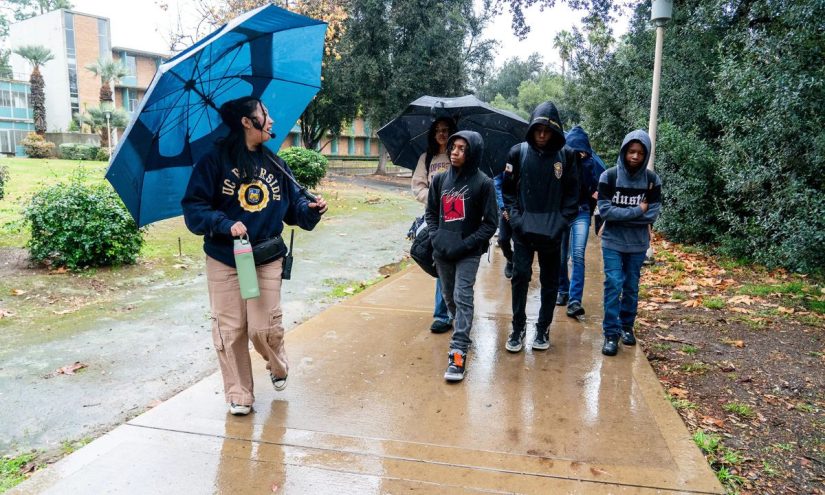
    On a recent rainy day, several dozen students sat in a UC Riverside classroom, planning their path to college.

    These weren’t high school seniors. They were seventh graders getting a jump-start on the competitive university application process. They’re part of a university program called the Middle School Initiative that aims to get Inland Empire students thinking about higher education long before they take their first AP class or submit an application.

    With a four-year college graduation rate about half the state average of 35%, the Inland Empire is falling behind in educating students for well-paid, professional jobs, limiting the economic prospects of the region’s youngest inhabitants. In an effort to raise that ceiling, educators are trying to get tweens to envision their potential for a college education and career. 

    The students from Riverside middle schools discussed how to write college application essays, toured the university campus and learned about admission standards for California universities. 

    “I like that there’s something you can do in middle school so you can do more in high school,” said 13-year-old Simone Reid, a seventh-grader at Villegas Middle School who wants to major in business. “I want to get started early so I have more opportunities.”

    UC Riverside Dean of Education Joi Spencer said she introduced the program this year to reach students who might not consider attending a university, or know how to prepare for it. Middle grades “are where kids get sorted into who’s going to go to college and who’s not,” she said.

    The initiative aims to change that pattern. With an annual budget of $15,200, the program launched has so far reached 500 students, including more than 300 who joined campus tours at UC Riverside.

    “Our first goal is to invoke a conversation across the Inland Empire related to university access and eventual success,” Spencer said. “First and foremost, too many youngsters do not even see university attendance as a possibility for them. This is our fault as adults and educators. We keep producing the same winners and losers in education and we need to break this cycle.”

    The Middle School Initiative is open to students throughout Riverside and San Bernardino counties, with Jurupa, Moreno Valley, Alvord and Riverside Unified school districts among the first participants. Any students in the Inland Empire can participate, but in the early days of the program, administrators have prioritized students who have fallen through the cracks in class.

    “Some of the students are high flyers, but are somehow overlooked in their school setting,” Spencer said. “Others may have average achievement, but high aspirations.”

    The program isn’t just an introduction to college readiness. Program administrators plan to follow students along their academic journey, meeting with them throughout middle and high school and during the transition to college. They will also track college enrollment of students who participate in a related summer program called the STEAM Academy, which increases exposure to the fields of science, technology, education, art and math.

    “This middle school period is the pivotal period to prepare for college,” said Elizabeth Benitez, Middle School Initiative coordinator.

    For instance, she said, many middle schools have foreign language options. Taking that early, in seventh or eighth grade, can pave the way for advanced placement language classes in high school, which boost students’ grade point averages and allow them to earn credits for college. 

    Some students may be a step ahead because of their family background, Frances Calvin, director of the university’s Early Academic Outreach Program, told the group. During the campus workshop she asked seventh graders to raise their hands if they spoke a second language. Several responded that they spoke Spanish, Portuguese or other languages at home.

    “If you speak a second language you are becoming marketable because the world is getting smaller and smaller,” Calvin said.

    Students at the campus event said they clearly heard the message about academic achievement and vowed to work on raising their grade-point averages.

    “I personally think I should focus more on my GPA,” said Dike Okeke, 12. “Then when I have that figured out I could find work to save for college.”

    Money matters loom large for many of the students, especially those hoping to be the first in their family to attend a university. The initiative offers instruction on how to fill out financial aid forms and tips on finding scholarships. Students can come back to the program later in high school to seek help with that process, Benitez said.

    “My family didn’t have the resources to experience college,” said Jeremiah Stinson, 12, who aims to study business and play college football. “I think I need to start saving money to afford this. I need to focus on a scholarship. Debt lasts forever. I don’t want to struggle with that.”

    Interestingly, the seventh graders also discussed personal discipline, and almost universally acknowledged that they needed to curtail electronics use and pay attention to school.

    “I also need to get rid of all my devices because I spend a lot of time on social media,” said Tatum Tobios, an aspiring fashion designer who favors Victorian Gothic styles and plans to go to art school.

    Her peers nodded in agreement. How will they scale back their TikTok and Instagram habits? 

    Some of their solutions: “Delete the apps,” “Lock them away,” “Give it to my mom,” “Hide it from myself.”


    Get stories like these delivered straight to your inbox. Sign up for The 74 Newsletter

    Source link

  • Trump Escalates Attack on Columbia With His Latest Demands

    Trump Escalates Attack on Columbia With His Latest Demands

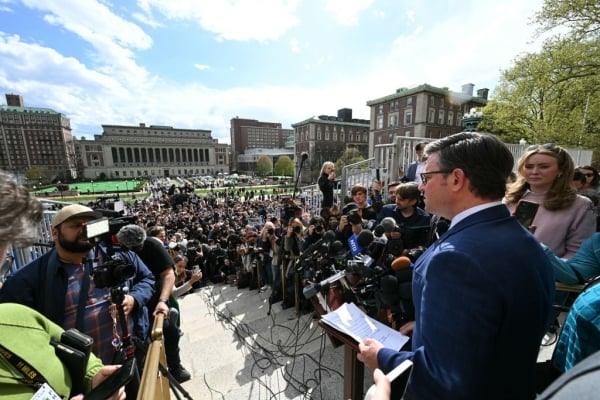
    If Columbia University wants a financial relationship with the federal government, the Ivy League institution will need to overhaul its discipline process, ban masks, expel some students, put an academic department under review, give its campus security “full law enforcement authority” and reform its admissions practices.

    Those are just some of the sweeping and unprecedented demands the Trump administration made Thursday in a letter to the Manhattan-based institution. They come less than a week after the cancellation of $400 million in federal grants and contracts at the university. Columbia has until March 20 to respond.

    “We expect your immediate compliance with these critical next steps,” three Trump officials wrote. “After which we hope to open a conversation about immediate and long-term structural reforms that will return Columbia to its original mission of innovative research and academic excellence.”

    The demands escalate an already precarious situation for Columbia as it simultaneously faces pressure from the White House to comply and pressure from students and faculty to fight back.

    “We are in a state of shock and disbelief, and we are working with our administration to … reaffirm free speech and shared governance on campus, and to resist all Trump efforts to take academic decisions out of the hands of academics,” said Jean Howard, a member of the executive committee of the Columbia chapter of the American Association of University Professors. “Our administration has been cautious in dealing with Trump up to now. We’re hoping they will take a more aggressive posture in the future.”

    A Columbia spokesperson told Inside Higher Ed that officials are reviewing the letter but didn’t say Friday whether the university will comply with the demands. Several free speech and higher ed policy experts say the letter amounts to an unprecedented assault on higher education that could threaten foundational principles such as academic freedom. The demands, which don’t appear rooted in any specific legal authority, also offer yet another hint at how President Trump could reshape higher education.

    “The subjugation of universities to official power is a hallmark of autocracy,” Jameel Jaffer, executive director of the Knight First Amendment Institute at Columbia, said in a statement. “No one should be under any illusions about what’s going on here.”

    But the Trump administration says canceling the grants and contracts is necessary due to Columbia’s “continued inaction in the face of persistent harassment of Jewish students.” In the letter, officials said that the university “has fundamentally failed to protect American students and faculty from antisemitic violence.”

    Building Tensions

    Ted Mitchell, president of the American Council on Education, criticized the letter as an “outrageous” example of “extreme federal overreach,” adding that institutional autonomy is a critical part of American higher education.

    “It’s perfectly reasonable for the federal government to hold all of those institutions accountable to civil rights laws, and we expect that,” he said. “But for the government to prescribe changes in academic structure, changes essentially in curriculum and to curtail research, that’s beyond the pale.”

    One of the letter’s 12 demands is for Columbia to put its Middle East, South Asian and African Studies department under academic receivership for at least five years. This would mean that faculty lose control of the department and the university puts an outside chair in charge. The letter didn’t specify why officials focused on this particular department. But it’s worth noting the academic division is home to Joseph Massad, a controversial tenured professor whom lawmakers have accused of making anti-Israel and anti-Jewish statements over the years.

    Federal scrutiny of colleges and universities, especially by Republicans, ratcheted up after the wave of pro-Palestinian protests in fall 2023 and spring 2024. But the Trump administration has only added to the pressure on colleges since it took office in January, quickly moving to cut funding to programs and institutions seemingly at odds with the president’s priorities.

    Columbia has been at the epicenter of the scrutiny, particularly after an encampment popped up on the small Manhattan campus’s central lawn last April. The protests culminated in early May, when students occupied a campus building and New York City police officers eventually stormed the hall, arresting those inside.

    Although other colleges faced protests and were accused of mishandling reports of antisemitic harassment and discrimination, Columbia took a hard line with protesters and was one of the few to bring in law enforcement. But that hasn’t stopped the Trump administration from targeting the university, nor has it led Columbia to draw a line and start fighting back.

    On Thursday, the same day the letter was sent, Columbia handed down student sanctions related to the building occupation. The sentences ranged from multiyear suspensions and expulsions to temporary degree revocations for graduates.

    Professors and other experts have warned that federal scrutiny—including high-profile grillings and subpoenas from Capitol Hill—could have damaging consequences for colleges. But alarm escalated significantly last week when the Trump administration bypassed the typical investigation process for civil rights violations and slashed Columbia’s access to grants and contracts.

    The cuts, made by Trump’s novel multidepartment antisemitism task force, are the first but likely not the last.

    The task force has already said at least 10 other universities are under review, including Harvard University and the University of California, Berkeley. Meanwhile, the Office for Civil Rights is investigating allegations related to antisemitism at at least 60 colleges.

    Ryan Enos, a professor of government at Harvard, said Columbia needs to reject the demands and other universities need to speak up now in defense of higher education. If left on its own, Columbia could fail to defend itself, he said.

    “Other universities have an imperative to come to the defense of Columbia, because this is not just about Columbia,” Enos said. “The Trump administration is trying to attack all of higher education, and Columbia cannot try to mount a defense on its own.”

    Frustrations Abound

    Outside policy analysts and scholars on both sides of the political spectrum are frustrated with the situation—but for different reasons.

    Frederick Hess, director of education policy studies at the American Enterprise Institute, a right-leaning think tank, described Columbia’s handling of antisemitism on campus over the course of the past year as “egregious” and a “clear violation” of Title VI of the Civil Rights Act of 1964, which prohibits discrimination based on ethnicity or national origin. But at the same time, he said the Trump administration’s unclear process for determining a remedy is problematic.

    “Some of the things on the list I find pretty facially plausible. Others require a much higher standard of justification,” he said. “But because they have not been transparent and … there has not been any back-and-forth, there has not been a proper demonstration of the misconduct, which would be necessary to convince me that these specific remedies are called for.”

    Benjamin Ginsberg, a Johns Hopkins University professor who studies American politics and Jewish history, sees the situation as one of “competing truths.”

    “The Columbia administration has needed for a long time to act against antisemitic demonstrators and vandals on the campus,” Ginsberg said, noting that arrests without indictments or suspensions are not enough. But at the same time, “the Trump administration has overreached by threatening Columbia with dire consequences,” he added.

    He noted that the situation presents Columbia administrators with an opportunity.

    “Sure, the [Trump] administration has overstepped. It’s threatening to fire a cannon, drop a nuclear bomb,” Ginsberg said. “But as I say, that threat gives the Columbia administration an opportunity to do things that it has needed to do and probably wanted to do for some time.”

    He added that though he’s certainly hesitant when the government tries to dictate what departments are valid, in this instance, higher education has failed in its responsibility to its students. He also trusts that the Trump administration will be satisfied so long as Columbia carries out disciplinary action against students who disrupt academic life and threaten others’ safety.

    “Anytime the federal government tells the university how to organize its admissions processes, or which, if any, academic departments are valid and legitimate, of course I’m concerned,” Ginsberg said. “But my guess is that nothing will come of those particular demands. I mean, I hope the university won’t cave in.”

    On the other hand, Eddy Conroy, a senior education policy manager at New America, a left-leaning think tank, said all the Trump administration’s recent actions should be “deeply troubling.”

    Columbia has already demonstrated an aggressive response to student protests, which should be protected by the First Amendment, Conroy said, and it’s not up to the federal government to determine whether those disciplinary procedures were adequate.

    “We have an important history of peaceful protest in the United States, and sit-ins are part of that. Columbia can choose if it wants to deal with those things through its own disciplinary procedure or by pursuing trespassing charges,” he said. But to Trump, this “is a test case of how far we can push things when it comes to suppressing speech.”

    Conroy believes that the president is trying to make an example of Columbia in the hops that other institutions will then capitulate without fight, and the university’s response as a test dummy isn’t helping.

    “The [Trump] administration hits Columbia, and Columbia cowers and says, ‘Please hit us harder,’” he said.

    To Howard, the Columbia AAUP representative, Trump’s actions are a threat to the gemstone that is American higher education.

    We’ve become “the greatest university system in the world. But that requires independence. It requires the free expression of differing viewpoints,” she said. Trump’s demands are “so undemocratic, so against the norms and conventions of university life, that to comply would just destroy the heart of the institution.”


    Source link

  • How a Republican Plan to Cut Universal Free School Meals Could Affect 12 Million Students – The 74

    How a Republican Plan to Cut Universal Free School Meals Could Affect 12 Million Students – The 74


    Get stories like this delivered straight to your inbox. Sign up for The 74 Newsletter

    Every school in Kentucky’s LaRue County provides free breakfast and lunch to any student who wants it.

    It’s been that way for a decade, ever since the federal government launched a program allowing LaRue County Schools, and thousands of other districts nationwide, to skip the paperwork asking how much families earn.

    In these communities, lots of kids already receive other kinds of assistance for low-income families. Federal officials saw a way to make the subsidized meals program more efficient: Cover meal costs based on how many children are in similar assistance programs, rather than verify every family’s income.

    But LaRue County Schools won’t be able to do that anymore if sweeping changes to social programs proposed by congressional Republicans become law. GOP lawmakers say they want to ensure only eligible families get help and that taxpayer dollars are reserved for the neediest students, so that federal subsidies for school meals remain sustainable. But by one estimate, the Republicans’ plan would affect nearly a quarter of the students in the nation’s public schools.

    Research has found that universal free school meals can boost school attendance, increase test scores, and decrease suspensions, likely because it eliminates the stigma students often associate with the free meals. Taking them away from students on a large scale could also have downstream effects on everything from families’ household budgets to local unemployment.

    Stephanie Utley, the LaRue County district’s director of child nutrition, said that inevitably, fewer kids would eat school meals, either because their families no longer qualify for free breakfast and lunch or because they cannot produce documents to verify their income.

    When fewer kids eat school meals, it’s harder for districts to cover their costs. To save money, Utley would likely swap higher-quality foods for cheaper ones, she said.

    Apples and beef from local farms would go. The high school would serve fewer salads — they’d be too labor-intensive to prep. And a popular chicken breast sandwich would become a ground chicken patty.

    Utley may have to lay off staff, too, she said, which would hurt the rural community’s economy.

    “We’re the biggest restaurant in town,” she said. “It would be a nightmare.”

    GOP school meals proposals would impact states

    Republican lawmakers are considering a trio of proposals to help offset tax cuts sought by President Donald Trump that would be “devastating” to children and schools, said Erin Hysom, the senior child nutrition policy analyst for the nonprofit Food Research & Action Center.

    One proposal would dramatically increase the share of students who need to be enrolled in aid programs — such as the Supplemental Nutrition Assistance Program and Temporary Assistance for Needy Families — for schools to be eligible to serve free meals to all kids through the Community Eligibility Provision.

    Right now, schools need to show 25% of students are enrolled in those kinds of assistance programs to participate in community eligibility. The House Republican proposal would raise the share to 60% — higher than the threshold has ever been. That would kick more than 24,000 schools off of community eligibility, and some 12 million students would no longer automatically qualify for free meals, Hysom’s organization estimated.

    Essentially, only communities where nearly every child qualifies for free or reduced-price lunch could serve free meals to all kids.

    “They’ve really moved the needle to the upper echelon of poverty,” Hysom said. “You couldn’t get any higher than that.”

    Another proposal would require all families who don’t automatically qualify for free school meals through programs like SNAP to submit documents to verify their income with their application. That would burden families and schools with time-consuming added paperwork. Schools could end up cutting staff who serve food and work on school menus to hire more people to process applications.

    Together, those changes would save $12 billion over 10 years, according to the list of proposals circulated by U.S. Rep. Jodey Arrington, the Republican chair of the House budget committee.

    A third proposal would change how families qualify for SNAP and likely make over 1 million students no longer automatically eligible for free school meals. That would increase the paperwork burden even more.

    All of that would make it more costly for states with universal free school meals to run their programs, because they rely heavily on federal reimbursement. Some states were already weighing whether they could afford to keep up free meals for all.

    These three proposals are part of a process known as budget reconciliation that GOP lawmakers are using to make long-term changes to federal spending and revenue. As of Wednesday, Congress was considering a separate, stopgap budget that would keep funding essentially flat for the Agriculture Department, which pays for the school meal program, through the end of September.

    School staff and child nutrition advocates are taking the House’s budget reconciliation proposals seriously. The Trump administration has already cut a $1 billion Agriculture Department program that helped schools buy food from local producers.

    Free school meal cutbacks would have ripple effects

    If fewer kids have access to free meals at school, more families would likely struggle to afford groceries at home. Many families who don’t qualify for free meals struggle to pay for food. This school year, a family of four qualified for free school meals if they made under $40,560 a year.

    When schools eliminated free school meals for all following the pandemic, there was a surge in unpaid school meal debt, an issue school staff say will only intensify if these proposals go through.

    Right now, schools typically have to verify the family’s income for 3% of their applications. If schools had to check income for every application, the burden would be enormous, school staff and child nutrition advocates said.

    Many families who eke out a living working multiple jobs would have a hard time gathering up all the required documents to show how much they earn. Though children can participate in the school meals program regardless of their immigration status, undocumented parents may be afraid to hand over personal documents when Trump is threatening mass deportations.

    “Eligible children are going to fall through the cracks,” Hysom said.

    Many schools are already facing financial pressures from higher-than-usual food and labor costs, a 2024 survey of nearly 1,400 school nutrition directors showed. On top of that, schools are navigating new and stricter requirements for how much salt and sugar can be in food served by schools.

    Schools have to buy most of their food from American sources, but if Trump puts certain tariffs in place for the long term, that could create new financial constraints.

    “Cost is absolutely a concern,” said Diane Pratt-Heavner, a spokesperson for the School Nutrition Association, which represents school nutrition directors and conducted the survey. “When avocados or tomatoes from Mexico become much more expensive, that will cause an increase in demand for domestic produce, and an increase in price, as well.”

    Shannon Gleave, the president of the School Nutrition Association, understands the need to make sure the school meal program runs as it should.

    In Arizona’s Glendale Elementary School District, where Gleave is the director of food and nutrition, kids can speed through the lunch line because everyone qualifies for free meals. But staff scan student ID badges to make sure each kid only takes one meal, and that children with dietary restrictions get the right food.

    Upping the verification requirements a little could work, she said. But verifying 100% of applications “is not an efficient use of time.”

    “There is no way my existing staff could do that now,” she said. “You have to figure out a way to be good stewards of resources, but also look at the amount of administrative burden that it’s going to entail.”

    This story was originally published by Chalkbeat. Chalkbeat is a nonprofit news site covering educational change in public schools. Sign up for their newsletters at ckbe.at/newsletters.


    Get stories like these delivered straight to your inbox. Sign up for The 74 Newsletter

    Source link

  • My robot university counsellor – The PIE News

    My robot university counsellor – The PIE News

    The PIE’s Director of Research and Insight, Nicholas Cuthbert tests the limits of virtual counsellor software!

    Can he tell the difference between a human and a machine? The video shows how AI is revolutionising recruitment, with powerful WhatsApp integrations and offer-letter capabilities making lead conversion faster and smoother than ever.

    Source link

  • Columbia Sanctions Students Who Occupied Campus Building

    Columbia Sanctions Students Who Occupied Campus Building

    Columbia University handed down sanction decisions for student protesters who occupied Hamilton Hall in April of last year, the university announced in a statement Thursday.

    The sanctions come as the university faces crippling attacks from the Trump administration over its handling of the protests last year, including the loss of $400 million in federal funding, which could lead to mass layoffs and program cuts.

    The university has not released the names of affected students, nor more details about how many will be expelled or suspended.

    The punishments, determined by the university judiciary board, are unusually harsh, ranging from multiyear suspensions and expulsions to temporary degree revocations for graduates, according to the email. While occupying the building—which students renamed Hind Hall in honor of a 5-year-old Palestinian girl killed by Israeli soldiers—students damaged property and broke windows. 

    Last year, only a few of the students who occupied the building were punished, and most remained in good standing with the university, according to documents the university gave to Congress last year. Of the 22 students who occupied the hall, only three received sanctions, the most severe being short-term suspension. At the time, Columbia said the disciplinary process was “ongoing for many students.”

    University spokespeople told Inside Higher Ed that the decisions were the culmination of a months-long investigation. For all other student protests last spring, the judiciary board “recognized previously imposed disciplinary action,” according to the email.

    Last weekend, Columbia graduate and legal U.S. permanent resident Mahmoud Khalil was arrested and threatened with deportation for his role in the pro-Palestine protests. Yesterday, Khalil sued the university, along with Barnard College, for allegedly sharing private student disciplinary records with members of Congress and other third-party groups.

    Source link

  • Layoffs Gut Federal Education Research Agency

    Layoffs Gut Federal Education Research Agency

    Five years after the COVID-19 pandemic first forced schools and colleges into remote learning, researchers, policymakers and higher education leaders may no longer have access to the federal data they need to gather a complete picture of how those disruptions have affected a generation of students long term—or hold states and colleges accountable for the interventions they deployed to address the fallout.

    That’s because the National Center for Education Statistics, the Education Department’s data-collection arm that’s administered surveys and studies about the state of K-12, higher education and the workforce since 1867, is suddenly a shell of itself.

    As of this week, the NCES is down to five employees after the department fired nearly half its staff earlier this week. The broader Institute of Education Sciences, which houses NCES, also lost more than 100 employees as part of President Donald Trump’s campaign to eliminate alleged “waste, fraud and abuse” in federal funding.

    The mass firings come about a month after federal education data collection data took another big blow: In February, the department cut nearly $900 million in contracts at IES, which ended what some experts say was critical research into schools and fueled layoffs at some of the research firms that held those contracts, including MDRC, Mathematica, NORC and Westat.

    Although Trump and his allies have long blamed COVID-related learning loss on President Joe Biden’s approval of prolonged remote learning, numerous experts told Inside Higher Ed that without some of the federal data the NCES was collecting, it will be hard to draw definitive conclusions about those or any other claims about national education trends.

    ‘Backbone of Accountability’

    “The backbone of accountability for our school systems begins with simply collecting data on how well they’re doing. The fact that our capacity to do that is being undermined is really indefensible,” said Thomas Dee, a professor at Stanford University’s Graduate School of Education and research associate at the National Bureau of Economic Research. “One could conceive this as part of an agenda to undermine the very idea of truth and evidence in public education.”

    But the Education Department says its decision to nearly eliminate the NCES and so many IES contracts is rooted in what it claims are the agency’s own failures.

    “Despite spending hundreds of millions in taxpayer funds annually, IES has failed to effectively fulfill its mandate to identify best practices and new approaches that improve educational outcomes and close achievement gaps for students,” Madi Biedermann, deputy assistant secretary for communications at the department, said in an email to Inside Higher Ed Thursday.

    Biedermann said the department plans to restructure IES in the coming months in order to provide “states with more useful data to improve student outcomes while maintaining rigorous scientific integrity and cost effectiveness.”

    But many education researchers disagree with that characterization of IES and instead view it as an unmatched resource for informing higher education policy decisions.

    “Some of these surveys allow us to know if people are being successful in college. It tells us where those students are enrolled in college and where they came from. For example, COVID impacted everyone, but it had a disproportionate impact on specific regions in the U.S. and specific social and socioeconomic groups in the U.S.,” said Taylor Odle, an assistant professor of educational policy studies at the University of Wisconsin at Madison.

    “Post-COVID, states and regions have implemented a lot of interventions to help mitigate learning loss and accelerate learning for specific individuals. We’ll be able to know by comparing region to region or school to school whether or not those gaps increased or reduced in certain areas.”

    Without uniform federal data to ground comparisons of pandemic-related and other student success interventions, it will be harder to hold education policymakers accountable, Odle and others told Inside Higher Ed this week. However, Odle believes that may be the point of the Trump administration’s assault on the Education Department’s research arm.

    “It’s in essence a tacit statement that what they are doing may potentially be harmful to students and schools, and they don’t want the American public or researchers to be able to clearly show that,” he said. “By eliminating these surveys and data collection, and reducing staff at the Department of Education who collect, synthesize and report the data, every decision-maker—regardless of where they fall on the political spectrum—is going to be limited in the data and information they have access to.”

    Scope of Data Loss Unclear

    It’s not clear how many of the department’s dozens of data-collection programs—including those related to early childhood education, college student outcomes and workforce readiness—will be downsized or ended as a result of the cuts. The department did not respond to Inside Higher Ed’s request for clarity on exactly which contracts were canceled. (It did confirm, however, that it still maintains contracts for the National Assessment of Educational Progress, the College Scorecard and the Integrated Postsecondary Education Data System.)

    A now-fired longtime NCES employee who asked to remain anonymous out of fear of retaliation said they and others who worked on those data-collection programs for years are still in the dark on the future of many of the other studies IES administers.

    “We’ve been out of the loop on all these conversations about the state of these studies. That’s been taking place at a higher level—or outside of NCES entirely,” said the terminated employee. “What these federal sources do is synthesize all the different other data sources that already exist to provide a more comprehensive national picture in a way that saves researchers a lot of the trouble of having to combine these different sources themselves and match them up. It provides consistent methodologies.”

    Even if some of the data-collection programs continue, there will be hardly any NCES staff to help researchers and policymakers accurately navigate new or existing data, which was the primary function of most workers there.

    “We are a nonpartisan agency, so we’ve always shied away from interpreting or making value judgments about what the data say,” the fired NCES worker said. “We are basically a help desk and support resource for people who are trying to use this data in their own studies and their own projects.”

    ‘Jeopardizing’ Strong Workforce

    One widely used data set with an uncertain future is the Beginning Postsecondary Students Longitudinal Study—a detailed survey that has followed cohorts of first-time college students over a period of six to eight years since 1989. The latest iteration of the BPS survey has been underway since 2019, and it included questions meant to illuminate the long-term effects of pandemic-related learning loss. But like many other NCES studies, data collection for BPS has been on pause since last month, when the department pulled the survey’s contract with the Research Triangle Institute.

    In a blog post the Institute for Higher Education Policy published Wednesday, the organization noted that BPS is intertwined with the National Postsecondary Student Aid Study, which is a comprehensive nationwide study designed to determine how students and their families pay for college and demographic characteristics of those enrolled.

    The two studies “are the only federal data sources that provide comprehensive insights into how students manage college affordability, stay enrolled and engaged with campus resources, persist to completion, and transition to the workforce,” Taylor Myers, assistant director of research and policy, wrote. “Losing these critical data hinders policy improvements and limits our understanding of the realities students face.”

    That post came one day after IHEP sent members of Congress a letter signed by a coalition of 87 higher education organizations and individual researchers urging lawmakers to demand transparency about why the department slashed funding for postsecondary data collection.

    “These actions weaken our capacity to assess and improve educational and economic outcomes for students—directly jeopardizing our ability to build a globally competitive workforce,” the letter said. “Without these insights, policymakers will soon be forced to make decisions in the dark, unable to steward taxpayer dollars efficiently.”

    Picking Up the Slack

    But not every education researcher believes federal data is as vital to shaping education policy and evaluating interventions as IHEP’s letter claims.

    “It’s unclear that researchers analyzing those data have done anything to alter outcomes for students,” said Jay Greene, a senior research fellow in the Center for Education Policy at the right-wing Heritage Foundation. “Me being able to publish articles is not the same thing as students benefiting. We have this assumption that research should prove things, but in the world of education, we have very little evidence of that.”

    Greene, who previously worked as a professor of education policy at the University of Arkansas, said he never used federal data in his assessments of educational interventions and instead used state-level data or collected his own. “Because states and localities actually run schools, they’re in a position to do things that might make it better or worse,” he said. “Federal data is just sampling … It’s not particularly useful for causal research designs to develop practices and interventions that improve education outcomes.”

    Other researchers have a more measured view of what needs to change in federal education data collection.

    Robin Lake, director of the Center on Reinventing Public Education at Arizona State University, has previously called for reforms at IES, arguing that some of the studies are too expensive without enough focus on educators’ evolving priorities, which as of late include literacy, mathematics and how to handle the rise of artificial intelligence.

    But taking a sledgehammer to NCES isn’t the reform she had in mind. Moreover, she said blaming federal education data collections and researchers for poor education outcomes is “completely ridiculous.”

    “There’s a breakdown between knowledge and practice in the education world,” Lake said. “We don’t adopt things that work at the scale we need to, but that’s not on researchers or the quality of research that’s being produced.”

    But just because federal education data collection may not focus on specific interventions, “that doesn’t mean those data sets aren’t useful,” said Christina Whitfield, senior vice president and chief of staff for the State Higher Education Executive Officers Association.

    “A lot of states have really robust data systems, and in a lot of cases they provide more detail than the federal data systems do,” she said. “However, one of the things the federal data provides is a shared language and common set of definitions … If we move toward every state defining these key elements individually or separately, we lose a lot of comparability.”

    If many of the federal data collection projects aren’t revived, Whitfield said other entities, including nonprofits and corporations, will likely step in to fill the void. But that likely won’t be a seamless transition without consequence.

    “At least in the short term, there’s going to be a real issue of how to vet those different solutions and determine which is the highest-quality, efficient and most useful response to the information vacuum we’re going to experience,” Whitfield said. And even if there’s just a pause on some of the data collections and federal contracts are able to resume eventually, “there’s going to be a gap and a real loss in the continuity of that data and how well you can look back longitudinally.”

    Source link

  • Residential Communities Centered on Race, LGBTQ Closed for 2025

    Residential Communities Centered on Race, LGBTQ Closed for 2025

    In the wake of federal and state bans on diversity, equity and inclusion, several colleges and universities are eliminating the option for students to live in culture-based housing starting next fall—a trend that could signal increased attacks on certain student resources that went largely untouched under previous state-level DEI bans.

    The University of Iowa confirmed to Inside Higher Ed that it will be ceasing operations of three of its living-learning communities: All In, for LGBTQ students; Unidos, for Latino students; and Young, Gifted and Black, for Black students. North Carolina State University will also shut down two culture-based dorms—called Living and Learning Villages at NCSU—dedicated to Native American and Black students, as first reported in The Nubian Message, the college’s Black student-led newspaper.

    In both cases, the institutions will no longer offer the residential communities starting next semester. Both NCSU and Iowa are retaining other learning communities focused on academic majors and other interests.

    The cancellations come in the wake of President Donald Trump’s crusade against all things even tangentially related to diversity, equity and inclusion. A Feb. 14 Dear Colleague letter from the Department of Education stated that federal law prohibits the use of race in relation to a variety of campus programs and activities, including housing, going beyond the restrictions set by most statewide anti-DEI legislation.

    In the aftermath of that letter, many universities—including some private institutions and institutions in solidly blue states—began scrubbing words related to DEI from their websites and shuttering DEI offices. But only a handful of institutions have gotten rid of the housing communities, which have often been lauded for strengthening students’ sense of belonging on campus. (Belonging is associated with higher rates of retention and mental well-being, multiple studies have found.)

    A spokesman for the University of Iowa did not say what led to the decision to close the three living-learning communities. Iowa passed legislation last year banning diversity, equity and inclusion offices on college campuses. The university also announced Thursday that it would be permanently shuttering its DEI office, which it had rearranged and renamed to the Division of Access, Opportunity, and Diversity as a result of last year’s legislation.

    NCSU did not respond to Inside Higher Ed’s request for comment but told The Nubian Message that the changes were “part of the university’s ongoing review of compliance with executive actions issued by the federal government and UNC System policy.”

    Another institution, the University of Florida, has removed the option to sign up for any of its nonacademic learning communities for next semester, including those dedicated to Black, first-generation, international, LGBTQ+ and out-of-state students, plus one for students in the arts. According to The Alligator, the university’s student paper, the university also changed language on its housing website from describing the learning communities as “interest-based communities” to “academic-based communities.”

    In an email to the campus community, the institution said the change was related to the university’s housing master plan.

    “The University of Florida’s Housing & Residence Life is unwavering in our commitment to providing community-orientated facilities where residents are empowered to learn, innovate and succeed. As we enter a 10-year Housing Master Planning process, all programmatic offerings are being evaluated to ensure we continue to provide a premiere on-campus living experience,” the message read. “As a result, we are pausing all activities associated with non-academic Living Learning Communities.”

    But some students have expressed concern that the elimination of the communities focused on identity may actually be related to Trump’s anti-DEI push or existing Florida anti-DEI legislation.

    “Cancelling the activities of marginalized LLCs follows a long history of UF stripping protections from vulnerable students,” reads a petition calling on the university to reverse its decision. “It is clear that this latest attack on safe housing is only part of a larger plan to transform the UF campus into a space that is no longer safe for marginalized groups. LLCs will not be the last protection to be targeted.”

    A Best Practice to Support Students

    The Young, Gifted and Black learning community debuted in 2016 in response to a proposal by a group of students, The Daily Iowan, the University of Iowa’s student newspaper, reported at the time.

    The university’s housing website says that students living in YGB “will be challenged to understand the various experiences among the African/Black diaspora, encouraged to learn and develop critical thinking skills outside the classroom, relate your passions to your academics and better Iowa’s Black Community through campus involvement.” Students who live on the floor are also required to take a course on African American culture.

    Sandrah Nasimiyu, an Iowa alumna, lived in the community in the 2019–20 academic year—though, of course, her time there was cut short by the COVID-19 pandemic. Her happiest memories in college took place in the residence hall, she told Inside Higher Ed, from debriefing with her floor mates after a long day of classes to a memorable game night when her friends tried, unsuccessfully, to teach her to play spades.

    “I was already at a [predominantly white institution]. We live in Iowa—I had grown up in the suburbs and really wanted to have some form of community,” she said. “Where you put your head at night, where you’re going to spend the most time, you have to feel comfortable … when I stepped off that floor, I was in an environment I see all the time that wasn’t made for me.”

    Nasimiyu is still friends with several people she met in the brief time she lived there. Sometimes, she recalled, Black students who didn’t live on YGB would tell her that they struggled to make Black friends on campus; Black people make up just 2.8 percent of the student body at Iowa.

    LGBTQ+ and culture-based residence halls have come under fire from conservatives before; in 2023, the conservative campus group Young Americans for Freedom criticized Lavender Living Learning Community, the LGBTQ+ dorm at UF, for “segregating” students and “bombarding” them with leftism because its residents were encouraged to take a course on social justice. Right-wing news sources like Campus Reform and The Daily Caller, too, have discredited affinity housing as segregation.

    But advocates for these spaces have long countered that residents of learning communities are rarely, if ever, required to be a certain race or identity. Jason Lynch, a professor of higher education at Appalachian State University and an expert in housing and residential life, said he saw firsthand that a number of non-Black students lived in the Black residential community when he worked in residential life at a previous institution.

    Beyond that, though, he noted that the communities “are seen as a best practice, a high-impact practice … LLCs are a direct way to combat loneliness and isolation. We’re going to see a rise in mental health [concerns], especially for these minority communities” if these communities vanish.

    Restricting LGBTQ+ Housing

    At the same time that some campuses are doing away with LGBTQ+ affinity housing, others are overhauling inclusive housing in other ways. Florida State University recently came under fire for removing an option on its housing application that allows students to indicate that they would like to live in LGBTQ-friendly housing.

    Unlike the learning communities, this option doesn’t place students in a particular dorm, but rather attempts to pair the student with someone who would be accepting and welcoming of an LGBTQ+ roommate, Marco Lofaso, an FSU student and member of the campus’s Young Democratic Socialists of America chapter, told Inside Higher Ed. LGBTQ+ housing has been available at FSU since 2021.

    But the option was soon reinstated after student backlash—though the university never directly answered why it had been removed, telling the student newspaper, “Florida State University routinely reviews and refreshes campus information and messaging on a regular basis to ensure information is up to date and accurate. During this review, a previously used question was omitted from the returning student housing application for the 2025–26 academic year. A revised version of the question will be included in the new student housing application when it is released Feb. 27.”

    FSU did not respond to Inside Higher Ed’s request for comment.

    The state of Utah also recently passed a law targeting trans students that requires any students who live in gender-segregated housing to live in the housing that aligns with their “biological sex.” However, the law doesn’t prevent institutions from offering gender-neutral housing.

    At least one institution has updated its housing policies to comply with the law, which passed in February. In an emailed statement, a spokesman for Utah State University said that the institution “strives to create a welcoming environment where all students who live on campus are comfortable so they can focus on succeeding in their studies. Consistent with the new law, USU’s sex-segregated housing will be assigned based on an individual’s biological sex at birth.”

    The spokesman added that the university will continue to provide gender-inclusive housing “that meet the needs of all residents and in a manner that treats everyone with dignity and respect.” He did not respond to a question about how the university will determine residents’ biological sexes.

    Source link