Tag: News

  • AI-authored abstracts “more authentic” than human-written ones

    AI-authored abstracts “more authentic” than human-written ones

    Journal abstracts written with the help of artificial intelligence are perceived as more authentic, clear and compelling than those created solely by academics, a study suggests.

    While many academics may scorn the idea of outsourcing article summaries to generative AI, a new investigation by researchers at Ontario’s University of Waterloo found peer reviewers rated abstracts written by humans—but paraphrased using generative AI—far more highly than those authored without algorithmic assistance.

    Abstracts written entirely by AI—in which a large language model was asked to provide a summary of a paper—were rated slightly less favorably on qualities such as honesty, clarity, reliability and accuracy, although not significantly so, explains the study, published in the journal Computers in Human Behavior: Artificial Humans.

    For instance, the mean score for honesty for an entirely robot-written abstract was 3.32, based on a five-point Likert scale (where 5 is the highest rating), but just 3.38 for a human-written one.

    For an AI-paraphrased abstract, it was 3.82, according to the paper, which asked 17 experienced peer reviewers in the field of computer game design to assess a range of abstracts for readability and guess whether they were AI-written.

    On some measures, such as perceived clarity and compellingness, entirely AI-written abstracts did better than entirely human-written summaries, although were not seen as superior to AI-paraphrased work.

    One of the study’s co-authors, Lennart Nacke, from Waterloo’s Stratford School of Interaction Design and Business, told Times Higher Education that the study’s results showed “AI-paraphrased abstracts were well received” but added that the “researchers should view AI as an augmentation tool” rather than a “replacement for researcher expertise.”

    “Although peer reviewers were not able to reliably distinguish between AI and human writing, they were able to clearly assess the quality of underlying research described in the manuscript,” he said.

    “You could say that one key takeaway from our research is that researchers should use AI to enhance clarity and precision in their writing. They should not use it as an autonomous content producer. The human researcher should remain the intellectual driver of the work.”

    Emphasizing that “researchers should be the primary drivers of their manuscript writing,” Nacke continued, “AI [can] polish language and improve readability, but it cannot replace the deep understanding that comes with years of experience in a research field.”

    Stressing the importance of having distinctive academic writing—a desire expressed by several reviewers—he added that, “In our AI era, it’s perhaps more essential than ever to have some human touch or subjective expressions from human researchers in research writing.”

    “Because this is really what makes academia a creative, curious and collaborative community,” said Nacke, adding it would be a pity if scholars became “impersonal paper-producing machines.”

    “Leave that last part to the Daleks,” he said.

    Source link

  • Media on the run: A sign of things to come in Trump times? — First Amendment News 451

    Media on the run: A sign of things to come in Trump times? — First Amendment News 451

    “[There is a] deeply troubling notion that anyone who dares to report unfavorable facts about a presidential candidate is engaged in ‘sabotage’ (as opposed to, say, contributing to the free exchange of information and ideas that makes our democracy possible).” – David McCraw (New York Times lawyer)

    While some liberals are busy pissing in the free speech pot with their PC campus cancel culture campaigns, some conservatives do likewise with their compliant support of Trump’s anti-free speech crusade.

    Mind you, this is not any equivalence dodge but rather further proof of Nat Hentoff’s damnatory maxim, “free speech for me — but not for thee.” 

    I continue to be amazed by the fact that so many so-called free speech supporters in the conservative and even libertarian camps are cowardly silent when Trump and his sycophantic serfs (e.g., his Attorney General candidate) make it abundantly clear that they intend to wage censorial war on their political opponents.

    ABC’s $15 million+ settlement

    Before I say more about anti-free speech Trumpsters, let me say a few words about ABC’s $15 million settlement (replete with an apology and another $1 million for attorneys’ fees) in the Trump defamation case involving George Stephanopoulos. ABC News agreed to pay that amount toward Donald Trump’s presidential library.

    Warranted or not, ABC’s settlement has drawn criticism. For example:

    Alejandro Brito, lawyer for Donald Trump.
    • Joyce Vance: “I’m old enough to remember — and to have worked on — cases where newspapers vigorously defended themselves against defamation cases instead of folding before the defendant was even deposed. . . . That, by the way, includes defamation cases brought by candidates for the presidency.”
    • Stephen Rohde: “I think the reasoning behind Judge Altonaga’s denial of ABC’s Motion to Dismiss was flawed and ABC should have sought appellate review before paying Trump’s non-existent ‘Presidential Library’ $15 million and his lawyers another $1 million. I think on the witness stand Stephanopoulos would have impressed the jury that he genuinely believed the defamation verdict meant that Trump had raped Carroll. Even before it got to the jury, ABC would have had a good motion for a nonsuit under NYT v Sullivan that Trump failed to prove Stephanopoulos subjectively possessed ‘knowledge of falsity’ or acted in ‘reckless disregard of the truth.’ And ABC’s lawyers would have a field day cross-examining Trump on his entire sordid past in order to show that his reputation as a sexual abuser, liar, and convicted felon was hardly damaged by this one broadcast.”

    Five possible reasons for ABC’s settlement

    Though ABC was represented by Nathan Siegel and Elizabeth McNamara (Davis Wright Tremaine), it is well to remember that while settlement agreements can be those urged by counsel, they are ultimately decided by the client even if their counsel urges otherwise. In other words, in the Trump case, counsel and client may have agreed on settling or disagreed, and the client’s wishes prevailed. However that might be, the following reasons might explain why ABC opted to settle:

    1. Fear of what discovery might reveal: Here, the concern would have to do with the possibility of making public damning e-mails or other communications that showed an animus towards Trump and/or a certain recklessness in how ABC conducted itself.
    2. Desire to shield Stephanopolous from deposition and/or cross-examination at trial: The concern here may have been that Stephanopolous might be dangerously vulnerable during discovery or at trial when pressed by Trump’s lawyer (Alejandro Brito).
    3. Fear of a potential hostile Florida jury: Trying a case before a South Florida jury could be dangerous given the possibility of sympathy towards Trump and/or the possibility of Dominion-sized damages (unlikely though still possible). 
    4. Best time to settle: After U.S. Magistrate Judge Lisette M. Reid ordered Trump to be deposed, ABC might have figured that this was the best time to cut a deal with the plaintiff and cut its losses.
    5. Desire to placate Trump moving forward: Here, fear of retribution going forward might have also played a role in ABC’s decision to settle.

    Going forward: Media on the run

    While not compliant in duplicitous ways, some in the media world are nonetheless guarded in how to proceed in Trump times.

    For example, “The news media is heading into this next administration with its eyes open,” said Bruce Brown, executive director of the Reporters Committee for the Freedom of the Press. “Some challenges to the free press may be overt, some may be more subtle,” Brown said. “We’ll need to be prepared for rapid response as well as long campaigns to protect our rights — and to remember that our most important audiences are the courts and the public.”

    That said, consider the following:

    1. Libel Lawsuits on the rise: “During the presidential campaign, Trump sued CBS News [for $10 million] for the way it edited an interview with opponent Kamala Harris. At his news conference, Trump said he was expecting to file a lawsuit against the Des Moines Register in Iowa for publishing results of a poll shortly before the election that suddenly had him behind Harris. He said that amounted to ‘fraud and election interference.’”

    UPDATE: Graham Kates, “Trump sues Des Moines Register over poll, promises more lawsuits against news outlets after ABC News settlement,” CBS News (Dec. 17)

    1. Licensing Threats: “Over the past several weeks, lawyers for Mr. Trump and two of his most high-profile nominees — Pete Hegseth, the potential defense secretary, and Kash Patel, whom Mr. Trump has picked to run the F.B.I. — warned journalists and others of defamation lawsuits for what they had said or written.”

    See also: Jon Brodkin, “Trump FCC chair wants to revoke broadcast licenses—the 1st Amendment might stop him,” Ars Technica, (Dec. 17):

    “Look, the law is very clear,” Brendan Carr [Trump’s pick for the FCC] told CNBC on Dec. 6. “The Communications Act says you have to operate in the public interest. And if you don’t, yes, one of the consequences is potentially losing your license. And of course, that’s on the table. I mean, look, broadcast licenses are not sacred cows.” Carr has said his FCC will take a close look at a complaint regarding a CBS 60 Minutes interview with Kamala Harris before the election. Trump criticized the editing of the interview and said that “CBS should lose its license.”

    [ . . . ]

    The Carr FCC and Trump administration “can hassle the living daylights out of broadcasters or other media outlets in annoying ways,” said Andrew Jay Schwartzman, who is senior counselor for the Benton Institute for Broadband & Society.

    1. Seizing Journalists’ Records: “News organizations are worried that a Justice Department policy that has generally prohibited prosecutors from seizing the records of journalists in order to investigate leaks will be reversed, and are already urging journalists to protect their work. ‘If you have something you don’t want to share with a broader audience, don’t put it on the cloud,’ ProPublica’s [Jesse] Engelberg said.”
    2. Ending Support for Public Radio and TV: “Sen. John Kennedy of Louisiana recently introduced a bill that would end taxpayer funding for public radio and television, a longtime goal of many Republicans that may get momentum with the party back in power.”
    3. Testing the Boundaries of Current Defamation Law“‘There’s been a pattern and practice for the past couple of years of using defamation litigation as a tactic to harass or test the boundary of case law,’ said Ms. [Elizabeth] McNamara, who represented ABC News and Mr. Stephanopoulos but was speaking in general.”

    See also: Angel Eduardo, “Why New York Times v. Sullivan matters more than ever,” FIRE (March 7, 2023):

    There have been numerous bids for the Supreme Court to overrule the Sullivan decision, and Justices Clarence Thomas and Neil Gorsuch have both expressed a willingness to revisit it. Politicians from former President Donald Trump to Florida Governor Ron DeSantis have publicly attacked the Sullivan decision and its underlying arguments, and Florida state legislator Alex Andrade filed a bill in February 2023 designed to effectively overturn it.

    1. Currying favor with Trump: A recent New York Times headline says much: “In Display of Fealty, Tech Industry Curries Favor with Trump.” That seems to be the trend:

    The $1 million donations came gradually — and then all at once.

    MetaAmazonOpenAI’s Sam Altman. Each of these Silicon Valley companies or their leaders promised to support President-elect Donald J. Trump’s inaugural committee with seven-figure checks over the past week, often accompanied by a pilgrimage to Mar-a-Lago to bend the knee.

    The procession of tech leaders who traveled to hobnob with Mr. Trump face-to-face included Sundar Pichai, Google’s chief executive, and Sergey Brin, a Google founder, who together dined with Mr. Trump on Thursday. Tim Cook, Apple’s chief executive, shared a meal with Mr. Trump on Friday. And Jeff Bezos, the founder of Amazon, planned to meet with Mr. Trump in the next few days. 

    [ . . . ]

    With their donations, visits and comments, they joined a party that has already raged for a month, as a cohort of influential Silicon Valley billionaires, led by Elon Musk, began running parts of Mr. Trump’s transition after endorsing him in the campaign.

    See also: “List of Tech Companies That Donated to Trump’s Inaugural Fund,” Newsweek (Dec. 13)

    Related

    TikTok takes its case to Supreme Court

    A group of TikTok users filed a separate application on Monday afternoon, also asking the court to block enforcement of the law.

    Social media giant TikTok and its parent company, ByteDance, on Monday asked the justices to block a federal law that would require TikTok to shut down in the United States unless ByteDance can sell off the U.S. company by Jan. 19. Unless the justices intervene, the companies argued in a 41-page filing, the law will “shutter one of America’s most popular speech platforms the day before a presidential inauguration.”

    The request came three days after a federal appeals court in Washington turned down a request to put the law on hold to give TikTok time to seek review in the Supreme Court. A panel made up of judges appointed by Presidents Barack Obama, Donald Trump, and Ronald Reagan explained that the companies were effectively seeking to delay “the date selected by Congress to put its chosen policies into effect” — particularly when Congress and the president had made the “deliberate choice” to “set a firm 270-day clock,” with the possibility of only one 90-day extension.

    Congress enacted the law, the Protecting Americans from Foreign Adversary Controlled Applications Act, earlier this year, and President Joe Biden signed it on April 24. The law identifies China and three other countries as “foreign adversaries” of the United States and bans the use of apps controlled by those countries.

    TikTok, which has roughly 170 million users in the United States and more than a billion worldwide, ByteDance, and others filed challenges to the law in the U.S. Court of Appeals for the District of Columbia Circuit.

    Related

    Oklahoma Settlement protects journalists’ right to cover education officials

    Oklahoma City, OK — After officials blocked reporters from attending state government proceedings, Oklahoma’s oldest television station has now secured a major victory for press freedom, reaching a settlement that ensures its reporters will have full access to state education meetings and officials. The win also includes a court-ordered permanent injunction that bars officials from ever repeating the behavior that led to the lawsuit.

    The agreement resolves the First Amendment lawsuit filed by the Institute for Free Speech and local counsel Robert “Bob” Nelon of Hall Estill on behalf of three reporters and their employer, the owner of Oklahoma City television station KFOR-TV, against Oklahoma Superintendent of Public Instruction Ryan Walters and Press Secretary Dan Isett. The settlement guarantees KFOR equal access to State Board of Education meetings, press conferences, and other media events.

    “This settlement vindicates the fundamental principle that government officials cannot declare themselves the arbiters of ‘truth,’ or pick and choose which news outlets cover their activities based on how favorable the reporting is,” said Institute for Free Speech Senior Attorney Charles “Chip” Miller. “The First Amendment protects the right of journalists to gather and report news, even — or especially — when the coverage scrutinizes government officials and holds them accountable to the public.”

    The agreement requires the Oklahoma State Department of Education to restore KFOR’s access to board meetings, press conferences, and media events. It also mandates KFOR’s inclusion in all press distribution lists and advance notifications of department activities. Additionally, the department agreed to re-establish a media line for journalists to attend board meetings.

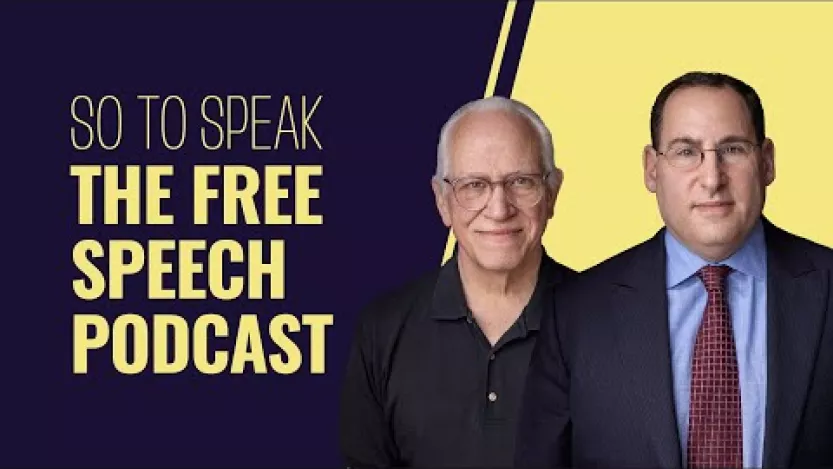
    ‘So to Speak’ podcast: Whittington on academic freedom


    “Who controls what is taught in American universities — professors or politicians?”

    Yale Law professor Keith Whittington answers this timely question and more in his new book, “You Can’t Teach That! The Battle over University Classrooms.” He joins the podcast to discuss the history of academic freedom, the difference between intramural and extramural speech, and why there is a “weaponization” of intellectual diversity.

    Keith E. Whittington is the David Boies Professor of Law at Yale Law School. Whittington’s teaching and scholarship span American constitutional theory, American political and constitutional history, judicial politics, the presidency, and free speech and the law.

    Stephen Solomon on ‘Revolutionary Dissent’


    What persuaded our nation’s founders to reject the British laws that made it a crime to criticize government officials and, instead, guarantee freedom of speech and press? NYU Professor and First Amendment Watch editor Stephen Solomon told the story of the protests and controversy that led to the First Amendment in a recent talk at The Ferguson Library in Stamford, CT.

    More in the News

    2024-2025 SCOTUS term: Free expression and related cases

    Cases decided

    • Villarreal v. Alaniz (Petition granted. Judgment vacated and case remanded for further consideration in light of Gonzalez v. Trevino, 602 U. S. ___ (2024) (per curiam))
    • Murphy v. Schmitt (“The petition for a writ of certiorari is granted. The judgment is vacated, and the case is remanded to the United States Court of Appeals for the Eighth Circuit for further consideration in light of Gonzalez v. Trevino, 602 U. S. ___ (2024) (per curiam).”)

    Review granted

    Pending petitions

    Petitions denied

    Last scheduled FAN

    FAN 450: “‘What Is Free Speech? The History of a Dangerous Idea’ — Major new book coming next year

    This article is part of First Amendment News, an editorially independent publication edited by Ronald K.L. Collins and hosted by FIRE as part of our mission to educate the public about First Amendment issues. The opinions expressed are those of the article’s author(s) and may not reflect the opinions of FIRE or Mr. Collins.

    Source link

  • Good News About the FAFSA

    Good News About the FAFSA

    Millions of current and prospective college students were let down last year when the federal rollout of the new FAFSA form was badly bungled and delayed for months. The fallout from the resulting chaos and uncertainty was well-documented and widespread, including a drop in over 5 percent in first-year enrollment for fall 2024 linked at least in part to the FAFSA problems.

    But now, there is some good news for students, their families, and the institutions working hard to ensure that low- and middle-income students have a path to higher education.

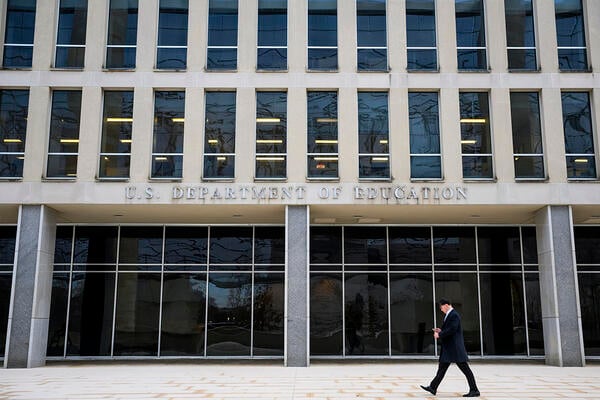
    While we have been harsh critics of the Department of Education’s failed FAFSA rollout, it is important to recognize when they’ve done well. The department committed to making the new FAFSA form work as intended for the next academic year—and they not only have accomplished that, but they have also done it faster than promised, and faster than many expected.

    Education Secretary Miguel Cardona announced Nov. 21 that after four successful rounds of beta testing, the 2025-26 FAFSA form is now available to all students and families. While we would have preferred for the 2025-26 FAFSA to have been available on Oct.1, we applaud that the department’s announcement came 10 days ahead of the promised Dec. 1 date, and the system appears to be performing as expected. In addition, this fully opens the gateway to the other benefits of the new FAFSA form, including allowing hundreds of thousands more individuals to access Pell Grants, the cornerstone of college affordability for so many students.

    This success is mirrored by a rare bipartisan moment in Congress that underscores how important it is to get federal student financial aid determinations to low-income students as early as possible. During the lame-duck session of Congress–and despite the partisan polarization and acrimony of the election season—the House and Senate approved and sent to President Biden legislation  aimed at streamlining the application process for federal student aid by making Oct. 1 the official FAFSA launch date each year.

    ACE and other higher education associations identified how critical this change in date was, and Congress listened. The FAFSA Deadline Act, introduced earlier this year, gives students and families more time to make crucial financial decisions and institutions adequate time to provide clear and transparent aid offers. We pushed Congress to move the legislation as quickly as possible, and lawmakers acted quickly—and in a bipartisan manner—to approve it.

    Passage of this legislation is a vital step toward improving access to financial aid, particularly for low-income students. Ensuring a properly functioning FAFSA form is another.

    There has been much consternation, rightfully so, about the flawed FAFSA roll out, and the consequences remain serious. All of us—the government and colleges and universities—will have to work hard to bring back the students who were not able to attend college this year because the financial aid system failed them.

    Campus leaders can do their part by ensuring that current and prospective students are well informed about the FAFSA and how to best navigate the new form and process. In its Nov. 21 announcement about the release of the 2025-26 FAFSA, the department also included an array of resources that institutions can share with students and their families and college counselors.

    In a difficult political climate, it is great to see both the legislative and executive branches of the federal government working in tandem to better support low- and middle-income students. These twin successes are extremely important and long overdue. We’ll keep urging policymakers to build on this progress in 2025, and we know that our institutions will do their part as well.


    If you have any questions or comments about this blog post, please contact us.

    Source link

  • CUPA-HR Data Highlights Trends in Representation and Pay Equity in the Higher Education Workforce, and the News Is Mixed – CUPA-HR

    CUPA-HR Data Highlights Trends in Representation and Pay Equity in the Higher Education Workforce, and the News Is Mixed – CUPA-HR

    by CUPA-HR | March 1, 2023

    When it comes to representation and pay equity for women and people of color in the higher education workforce, colleges and universities have frequently struggled to make meaningful progress. Through several new interactive graphics representing years of research, CUPA-HR shines a light on the progress that has been made and the disparities that persist. These graphics represent data from CUPA-HR’s four signature higher ed workforce surveys — Administrators, Faculty, Professionals, and Staff — through 2022.

    Administrators

    While the proportion of people of color in higher ed administrator positions has grown steadily over the last 10 years, these increases have not kept pace with the rate at which minorities are obtaining graduate degrees. In 2022, people of color made up 18.2 percent of administrators, up from 12.9 percent in 2012.

    The data also show that pay gaps for women administrators of all races/ethnicities are consistent across the past 10 years and notably wide. Pay inequity is particularly egregious for women administrators of color (with the exception of Asian women). Men of color, on the other hand, have been paid salaries equitable to or greater than those of White men in recent years.

    The Administrators in Higher Education Survey collects data on administrator positions that manage a higher ed institution or a division within it.

    See the Administrators Composition and Pay Equity by Gender and Race/Ethnicity interactive graphics, as well as data broken out by CEO, provost and chief HR officer.

    Faculty

    There are two notable findings in faculty composition. First, more women are represented in non-tenure-track than in tenure-track faculty. Second, for each tenure status and with each increase in rank, the proportions of women and faculty of color decrease. This means that women are over-represented in the lowest-paying and lowest-ranking positions. This remains the case despite the fact that the proportion of women and faculty of color have increased slightly at each rank over the past five years.

    Pay gaps for women faculty, regardless of tenure status or rank, continue to persist, particularly at the rank of professor. These gaps are most notable for women of color. Pay gaps at other ranks have narrowed over time, particularly for tenure-track faculty. Importantly, the factor that most impacts faculty pay is promotion to a higher rank. Often, the only significant increases in salary happen with these promotions. These data show that the only group that has greater representation with each increase in rank is that of White male faculty, and this pattern has persisted over time.

    The Faculty in Higher Education Survey collects data on tenure-track faculty positions and non-tenure-track teaching faculty positions.

    See the Faculty Composition and Pay Equity by Gender and Race/Ethnicity interactive graphics.

    Professionals

    Women’s representation has increased across all professionals’ positions since 2017, and in 2022, women represented more than 60 percent of higher ed professionals. This change is due to slight increases in representation of women of color since 2017. In 2022, representation of people of color was 24 percent overall, with the highest percentage among human resources professionals (34 percent) and diversity and equal opportunity professionals (33 percent).

    In 2022, women were consistently paid less than White men, a pattern that has worsened since 2017. However, men of color were paid more equitably in 2022 compared to previous years.

    The Professionals in Higher Education Survey collects data on positions in specific functional areas in higher ed institutions, such as academic or student services, that usually require a baccalaureate degree.

    See the Professionals Composition and Pay Equity by Gender and Race/Ethnicity interactive graphics.

    Staff

    Staff employees have a higher representation of people of color than any other higher ed employee group. This is notable in that these are the lowest-paying positions in higher ed. In 2022, women of color represented about 19 percent of all higher ed staff, and men of color represented about 13 percent of all higher ed staff. These numbers have increased since 2017, though modestly. Skilled craft employees were the least racially diverse group, as 80 percent were White men, a finding that has persisted across the past six years. Notably, skilled craft staff are among the highest-paid staff positions.

    Since 2017, women in staff positions have been paid consistently and considerably less than White men in staff positions, a pattern that has worsened over time, particularly for women in office and clerical positions. Men of color were paid more equitably in 2022 when compared to 2017.

    The Staff in Higher Education Survey collects data on positions that are generally non-exempt and do not require a college degree.

    See the Staff Composition and Pay Equity by Gender and Race/Ethnicity interactive graphics.

    CUPA-HR Research

    CUPA-HR is the recognized authority on compensation surveys for higher education, with its workforce surveys designed by higher ed HR professionals for higher ed HR professionals and other campus leaders. CUPA-HR has been collecting data on the higher ed workforce for more than 50 years, and we maintain one of the largest workforce databases in existence. CUPA-HR also publishes numerous research publications and interactive graphics highlighting trends and issues around higher ed workforce planning, pay equity, representation of women and racial/ethnic minorities and more. Learn more about CUPA-HR research.


    Source link