In a keynote speech at the Michigan Literacy Summit, held Tuesday at the Michigan Science Center, Gov. Gretchen Whitmer said that improving literacy rates would remain her top priority in her final year as governor.
“Helping every child read is tough. It’s a worthwhile goal,” she said. “It’s a long term project that will pay off in decades, not days. It’s a team effort that requires buy-in from students, parents, teachers and policy makers.”
She referenced the increased implementation of the “science of reading” law, which she signed in October 2024, as part of this priority. That law standardized literacy teaching methods across the state and implemented regular dyslexia testing for students up to third grade. She also touted the free school breakfast and lunch program, a key piece of the state’s education budget, and funding to reduce class sizes.
Michigan currently ranks 44th in the nation for 4th grade reading skills, Whitmer said, calling it a “crisis.”
“The vast majority of people in our state agree this isn’t the fault of any one person or any one policy or any one political party,” she continued. “I know how hard every one of our educators works every day, but we’re all feeling the impact of our literacy crisis.”
Gov. Gretchen Whitmer and State Superintendent Glenn Maleyko pose for a photograph before her speech at the Michigan Literacy Summit. Dec. 16, 2025. | Photo by Katherine Dailey/Michigan Advance.
State Superintendent Dr. Glenn Maleyko, who officially took over the role leading the state’s department of education on Dec. 8, introduced Whitmer to a crowd of educators and advocates, who had gathered in Detroit for the day-long event that included panels with teachers and school leadership.
“What stood out to me the most was the governor’s genuine commitment to partnership,” Maleyko said. “She understands that improving outcomes for students is not about politics, it’s about listening, working together and staying focused on what matters most.”
This was Whitmer’s first public appearance since Michigan House Republicans canceled nearly $650 million in spending for departmental projects, a move heavily criticized by Democrats as “untransparent” and “cruel”. While Whitmer’s press secretary shared similar criticism from the governor’s office, Whitmer herself has yet to make a statement on the cuts, and left the summit before speaking to the press.
Michigan Advance is part of States Newsroom, a nonprofit news network supported by grants and a coalition of donors as a 501c(3) public charity. Michigan Advance maintains editorial independence. Contact Editor Jon King for questions: [email protected].
Did you use this article in your work?
We’d love to hear how The 74’s reporting is helping educators, researchers, and policymakers. Tell us how
In a move called historic by charter advocates and shameful by opponents, Indianapolis officials reached agreement on a plan to provide all charter students with buses and close struggling schools.
The proposal, recommended to the state legislature by a panel of leaders from around the city calls for creating a powerful new government agency, the Indianapolis Public Education Corporation, handing charters a measure of control over citywide education decisions they have never had.
The corporation — Indiana’s legal term for a school district — would oversee a unified transportation system for all schools; along with the ability to decide which schools are not serving students. The agency would also oversee a single enrollment system.
The plan, which still needs approval by the state legislature, is a big win, in some ways, for charter schools that have grown rapidly in recent years and now educate more than half of Indianapolis’ students.
Along with gaining transportation for students, charters will have representatives on the new board with equal standing to district officials for the first time in shaping Indianapolis school policy.
That power, though, is taken from the Indianapolis Public Schools district, whose schools could be closed by the corporation and which already saw the state legislature shift property taxes away from the district to charters earlier this year.
Robert Enlow, CEO of the national charter advocacy group EdChoice, based in Indianapolis, called the recommendation “historic” in its support of charters.
“It is a bold and courageous direction that represents a groundbreaking pathway,” Enlow said after the vote on Wednesday.
But the proposal has tradeoffs for all sides, which have already sparked howls of opposition from voters and other charter advocates, as well as worry from the district about how the legislature could change the plan.
That more power could go to charters has enraged some residents since leaders started discussing the new plan this summer. Right before the vote, Rev. Clyde Posley, president of the General Missionary Baptist State Convention of Indiana, spoke on behalf of several clergy calling the entire effort a “heavy-handed public overreach” in support of “private agendas.”
“(It) not only invites scavengers and investors to pillage off the plight of a broken school system,” Posley said. “It is not only wrong, it is vicious.”
Indianapolis Public Schools Superintendent Aleesia Johnson, who worked on the plan for several months, urged residents to keep fighting as the plan goes to the legislature, but said change is necessary.
“The proposal tonight is an imperfect solution for a challenging set of realities,” Johnson said before voting in favor of it..
Those realities include growing pains from the rapid rise of charters in a city with a stagnant population. Many charter schools don’t offer buses, forcing students to use public transport or be driven by parents who have pleaded for buses for their children.
The city also has about 50,000 school seats for 41,000 students, leaving 9,000 open, while the Indianapolis Public Schools faces a budget deficit that will require a tax increase from voters.
Whether the plan will pass as is by the Republican-dominated, pro-charter legislature is unclear. State Sen. Jeff Raatz, chairman of the Senate Committee on Education and Career Development, had no immediate comment.
Bob Behning, the chairman of the House Education Committee who wrote the bill forcing Indianapolis officials to work out a partnership, said he was “pleased with the decision.” He did not elaborate on details of the plan, some of which he has opposed.
The new corporation would move toward mayoral control of schools, which cities across the U.S. have tried with varying success. It would have an executive director and a nine-member board appointed by the mayor – three chosen from the Indianapolis Public Schools board, three charter school leaders and three others.
That proposal for a mostly-unelected board immediately drew protest from residents, many with the Central Indiana Democratic Socialists of America. After constant shouts of “Unelected!” and “This is a sham!” residents called for the city’s voters, not the legislature, to approve the new corporation. One climbed onto the platform where the panel was seated and was removed by security. And audience members chanted “Shame!” as the panel ended its meeting.
Charter schools are also raising opposition, including the recommendation that every charter must share money and participate in the new busing system, even as the overall recommendation would give them more power.
One charter school advocacy group, the Indiana Charter Innovation Center, called that an “unfunded mandate.”
“The proposals put forward would place significant burdens on charter schools without providing funding, would reverse major legislative progress, and would create a structure that pulls decision-making farther from the schools and families most affected,” the center said in a social media post.
The center also objected to the recommendation to limit charter authorizers — organizations that oversee charters and decide which can open — just to the mayor’s office, the state charter board and, as a recent development, the Indianapolis Public Schools board.
Andrew Neal, a member of the panel making the recommendation, said requiring all schools to be part of the plan is “a significant equity issue.”
“I know there are some individuals out there who fear how that will impact their schools, or how that will impact their systems,” Neal said just before the vote. “But I am telling you, this is an opportunity for students…the ones that because of a fragmented system, continue to fall through the cracks.”
Stand for Children, an education advocacy group that has led the push for busing, said parents will appreciate the new system.
One parent, Christa Salgado, has repeatedly asked state and local officials for help with transportation after driving her son to school every day took a toll on her and her son had to move to live with his father.
“I had to drive across the city about 30 minutes back and forth in the morning, and then in the afternoon to pick him up, as a single mother,” she told the panel just before Wednesday’s vote. “This was unsustainable, and unfortunately, I could only do this for a year.”
The district still isn’t sure, with the final result still up to the legislature, what impact it will have on its authority and budgets. But superintendent Johnson voted in favor of the recommendations, while urging residents to put pressure on the state legislature to make sure the district doesn’t lose too much to charters.
“If we continue to have an elected board with just the same oversight as they do today…,” she conceded, “the challenges of incoherence and thinning resources will remain.”
Did you use this article in your work?
We’d love to hear how The 74’s reporting is helping educators, researchers, and policymakers. Tell us how
When Vevian Nguyen heard the strike of a gong echo for the 10th time, signaling that 10,000 meals had been made, her school cafeteria erupted in applause, and she knew her gloves and hairnet were staying on.
“Every time we hit the gong, it felt like a little pat on the back, like, ‘Oh, you did something good,’” Vevian said. “Now you can keep doing it.”
Within an hour, Vevian and more than 200 students at Laguna Creek High School, a school in the Elk Grove Unified School District in Sacramento County, packed more than 10,000 meals to be donated during the holidays, exceeding their goal for the night. But Vevian, who is a junior and president of Laguna Creek High’s service-oriented Interact Club, said she wasn’t there to simply check off her service hour requirements.
“We want to be involved in our community, which is having to be able to know that you’ve helped a family or at least just one person out there,” the 16-year-old said. “And, I feel like that helps your character, it builds who you are and where you stand within your school and your community.”
The October food-preparing night was part of an international initiative called Rise Against Hunger, which is run by a coalition of student groups such as the National Honor Society and the Rotary International Club. This was Laguna Creek’s second Rise Against Hunger. During the holidays, their 20,000 meals will reach families in Vietnam that were affected by major floods and landslides this year.
Sandi Peterson, a positive behavior intervention support administrator and adviser for the National Honor Society, had helped Vevian prepare for the event throughout the school year. At weekly club meetings, students created infographics and posters, spread the word on social media, and promoted their goal of packing 10,000 meals to every classroom on campus. It was a student-led collaboration and a clear, ambitious objective, Peterson said, that drove hundreds of students to sign up, show up, and lock in.
“Not one student was on their phone; they were all talking to each other, chatting, laughing. Once we heard the 10,000 gong, it was this huge celebration, and then it started moving so fast,” Peterson said. “We were having to hit the gong for 5,000, 6,000, 7,000 (more) all at the same time. These kids, in less than two hours, assembled 20,000 meals.”
Like most schools in California, Laguna Creek has struggled to recover from high rates of chronic absenteeism after the pandemic’s school closures. Many of those students across the state also report a persistent feeling of loneliness and detachment from their school communities. For Cynthia Dettner, an instructor and supervising teacher for the Interact Club at Laguna Creek High, the night of meal-packing also showcased a rare school connectedness among students.
“After the Covid years, where students were often isolated, watching all of these students laugh and smile and build their own character by reaching out to help others, it’s a gift,” Dettner said. “It’s a joy to see them come together and befriend each other.”
On each side of a cafeteria table, students sporting red hairnets and plastic gloves measured and assembled nutritionally balanced portions of dried rice, vegetable protein, vitamin packets, dried tofu and protein additives into pre-labeled bags. They then rotated each bag to teams of students who stapled, heat-sealed, and counted each package to be ready for distribution worldwide.
“It looks almost like a Hallmark movie where you see the cookie factory in progress,” Dettner said. “It’s all kinds of hands and smiles working together, they’re all engaged and involved, and that lifts the community.”
Students plan to pack more than 40,000 meals next year for families in need. (Sandi Peterson)
Although Peterson had spent the year raising sponsorship funds for the event, she said the students who packed the meals soon took ownership of the initiative.
“Within two weeks, I had students come up to me and say, ‘Ms. Peterson, maybe if we go around and start collecting money on our own, we could do another one in a couple months,’” Peterson said. “So, now they’re trying to tag-team and do 40,000 meals in our next school year. The ticket to longevity is I know that the kids will always show up.”
Vevian grew up in a low-income family, and after watching friends and family members struggle financially in recent months, she said she’s felt more compelled to help others. Laguna Creek’s new holiday ritual has further motivated her year-round commitment to community service.
“To contain the attributes of a leader, I learned that you have to actually step up and use your voice and really hold yourself accountable,” Vevian said. “If you just make one impact, it can slowly build that momentum for the rest of everyone else to stand behind you.”
Did you use this article in your work?
We’d love to hear how The 74’s reporting is helping educators, researchers, and policymakers. Tell us how
Florida professors, university faculty, and teaching assistants could soon be able to openly carry firearms on campus, thanks to a sweeping new measure filed by a Republican lawmaker.
Sen. Don Gaetz, R-Crestview, is sponsoring the legislation, entitled “School Safety,” to address security concerns in higher education. If passed, the bill would remove college campuses as gun-free zones — marking a significant shift in how Florida handles gun issues.
It would become one of the few Second Amendment expansion bills adopted in Florida since the Parkland massacre at Marjory Stoneman Douglas High School in 2018, which prompted a higher gun-purchasing age and red flag laws.
In an interview with the Phoenix, Gaetz called his legislation “sadly timed,” adding that he “never wanted” to file a bill like this.
He referred to a slate of violent incidents in the past few months, including a shooting spree at Florida State University in April, the assassination of Charlie Kirk at Utah Valley University in September, a shooting at Brown University over the weekend, and, most recently, an anti-Jewish shooting in Australia that left 15 dead.
“We’re living in a world where our institutions are being threatened,” Gaetz said, adding that he’s already filed another bill aimed at increasing protection outside of churches, mosques, and synagogues. “I’m sorry that I’m having to do this, but it just seems as though places in our society that we thought were safe, even sacrosanct, are now becoming targets.”
Although he anticipates objections that teachers may abuse the ability to bring a gun to school, Gaetz pointed out that there have been no instances of a school shooting sprouting from an unwell volunteer in the guardian program. This school safety initiative allows trained and vetted school employees to carry concealed weapons on K-12 campuses.
“None of the parade of terribles have happened that the opponents to the guardian program tried to advance,” he said. “While none of that has happened, people have been killed.”
What else is in the bill?
Gaetz isn’t this first Florida lawmaker to try to promote campus carry. At the start of the 2025 legislative session, then-Sen. Randy Fine brought his all-encompassing campus carry bill to its first committee — unlike Gaetz’s, Fine’s bill would have allowed all students to carry — but it was voted down. Fine later left to serve in the U.S. House of Representatives.
Gaetz said that the heart of his bill is hardening Florida’s state colleges and universities by requiring better threat assessments, better responses to threats, and better communications between first responders and faculty in emergencies.
SB 896 would allow university employees, faculty, and students who are also working for a college to either openly carry or carry conceal weapons on campus. It also would expand the school guardian program to the university level and create an offense of discharging a firearm within 1,000 feet of school.
Gaetz said his measure also would require universities to ensure all classroom doors lock during an emergency — especially after FSU students discovered during the April school shooting that their doors could not lock. He estimates that around $60 million will end up being appropriated for the effort, in line with what Gov. Ron DeSantis requested in his budget proposal last week.
An identical bill has been filed in the House by Rep. Michelle Salzman.
Florida Phoenix is part of States Newsroom, a nonprofit news network supported by grants and a coalition of donors as a 501c(3) public charity. Florida Phoenix maintains editorial independence. Contact Editor Michael Moline for questions: [email protected].
Did you use this article in your work?
We’d love to hear how The 74’s reporting is helping educators, researchers, and policymakers. Tell us how
Sitting in his wheelchair at a highly specialized private school in Manhattan designed for students with severe and multiple disabilities, Joshua Omoloju, 17, uses assistive technology to activate his Spotify playlist, sharing snippets of his favorite songs in class — tracks even his parents were unaware he loved.
It’s a role this deejay is thrilled to fill at a school that encourages him to express himself any way he can. The magnetic and jovial Omoloju, a student at The International Academy of Hope, is legally blind, hearing impaired and nonverbal. But none of that stopped him from playing Peanut Butter Jelly Time by Buckwheat Boyz mid-lesson on a recent morning.
“OK, Josh!” his teachers said, swiveling their hips and smiling. “Let’s go!”
iHOPE, as it’s known, was established in Harlem in 2013 for just six children and moved to its current location blocks from Rockefeller Center in 2022. It now serves 150 students ages 5 through 21 and is currently at capacity with 27 people on its waitlist, according to its principal.
The four-story, nonprofit school offers age-appropriate academics alongside physical, occupational and speech therapy in addition to vision and hearing services.Every student at iHOPE has a full-time paraprofessional, who works with them throughout the day, and at least half participate in aquatic therapy in a heated cellar pool.
The school has three gymnasiums fitted with equipment to increase students’ mobility, helping many walk or stand, something they rarely do because of their physical limitations.
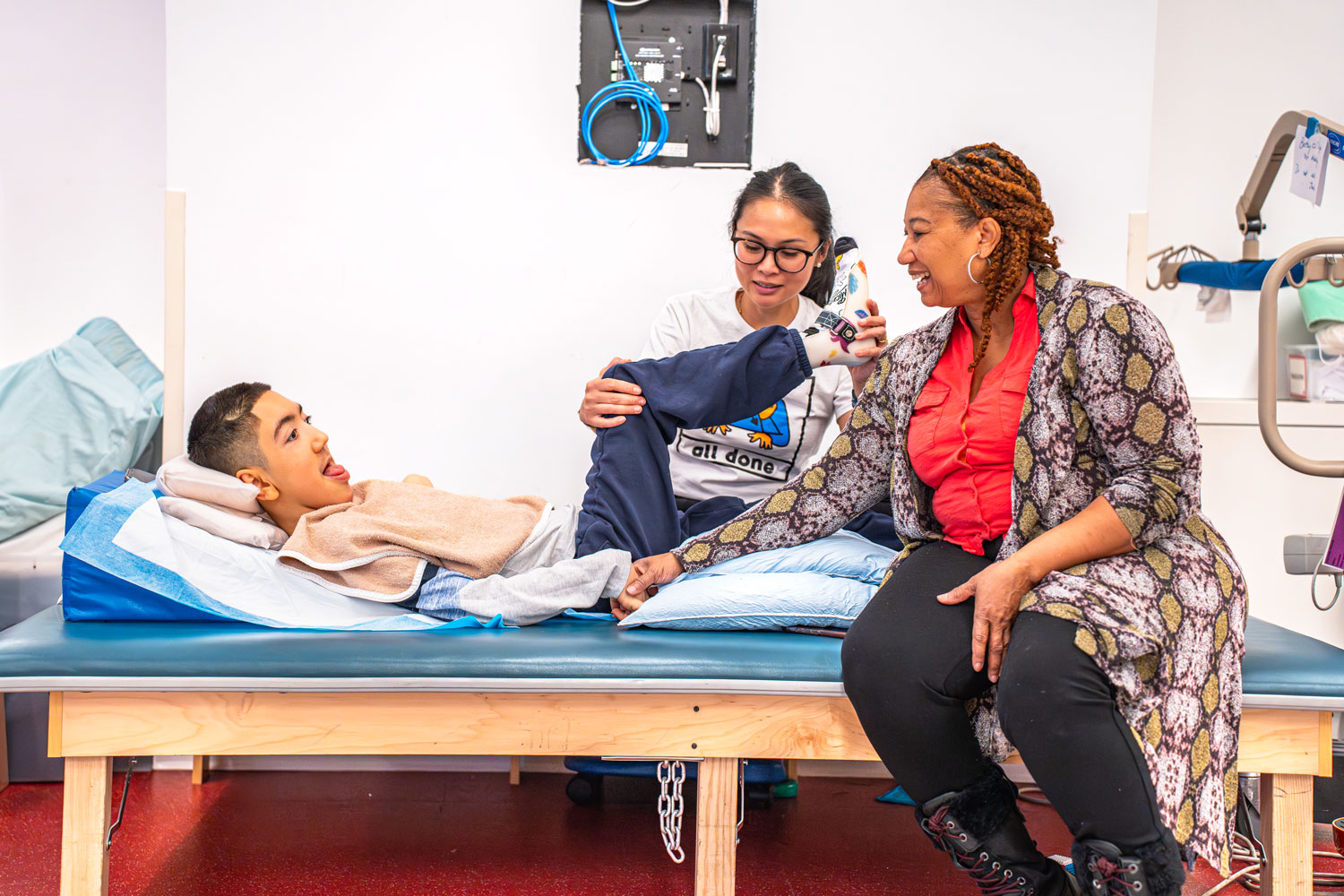
Arya Venezio, 12, with physical therapist Kendra Andrada (Heather Willensky)
Edward Loakman, 18, with physical therapist Navneet Kaur (Heather Willensky)
Gabriel Torres, 15, with physical therapist Jeargian Decangchon and his one-to-one nurse, Guettie Louis. (Heather Willensky)
Its 300-member staff includes four full-time nurses and its six-figure cost averages $200,000 annually depending on each child’s needs. Parents can seek tuition reimbursement from the New York City Department of Education through legal processes set out by the Individuals with Disabilities Education Act, arguing that the public school cannot adequately meet their child’s needs.
iHOPE focused primarily on rehabilitation in its early years but is now centered on academics and assistive technology, particularly augmentative and alternative communication devices that improve students’ access to learning. Mastery means users can take greater control of their lives. Shani Chill, the school’s principal and executive director, said working at iHOPE allows her to witness this transformational magic each day.
“Every student who comes here is a gift that is locked away inside and the staff come together to figure that out, saying, ‘I can give you this device, this tool, these tactiles’ and suddenly the student breaks through and shows us something amazing about themselves,” she said. “You see their personality, their humor, and the true wisdom that comes from students who would otherwise be sitting there in a wheelchair with everything being done for them — or to them.”
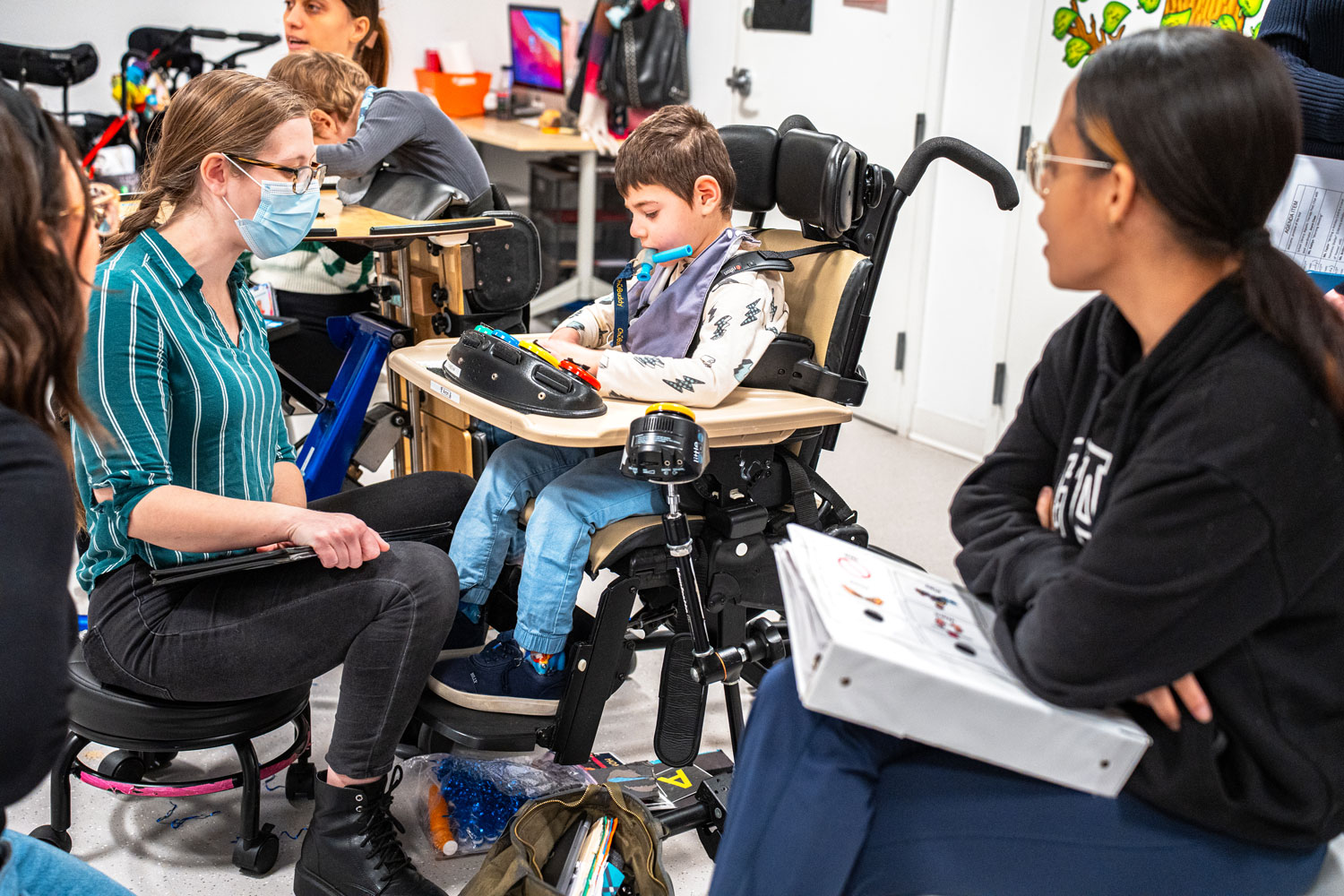
Aron Mastrangelo, 5, with his occupational therapist, Rose Siciliano, to his left and and his paraprofessional, Emely Ayala, to his right. (Heather Willensky)
Some devices, like the one Omoloju uses in his impromptu deejay booth, track students’ pupils, allowing them to answer questions and express, for example, joy or discomfort, prompting staff to make needed modifications.
Because he’s unable to speak, Omoloju’s parents, teachers and friends assess his mood through other means, including his laughter, which arrives with ease and frequency at iHOPE. It’s a welcome contrast to what came before it at a different school, when a sudden eruption of tears would prompt a call to his mother, who would rush down to the campus, often too late to glean what upset him.
“One of the things we saw when we first visited (iHOPE) was that they knew exactly how to work with him,” Terra Omoloju said earlier this week. “That was so impressive to me. I don’t feel anxious anymore about getting those calls.”
Yosef Travis, father to 8-year-old Juliette, said iHOPE embodies the idea that children with multiple disabilities and complex syndromes can grow with the right support.
Juliette has a rare genetic disorder that impacts brain development and is also visually impaired. She squeals with joy with one-on-one attention and often taps her feet in excitement, Chill said.
“Juliette has grown in leaps and bounds over the past three and a half years and the dedication and creativity of the staff played a significant role,” her father said. “When she is out sick or on school vacation, we can tell that she misses them.”
Travis said his family considered many options, both public and private, before choosing iHOPE.
“iHOPE was the only one that could provide a sound education without sacrificing the necessary supports and related services she needs for her educational journey,” he said.
iHOPE currently serves one child from Westchester but all the others are from New York City. Parents are not referred there by their local district: They learn about it from social workers, therapists, doctors or through their own research, the principal said.
Those seeking enrollment complete an intake process to ensure their child would be adequately served there. Parents typically make partial payments or deposits upfront — the amount varies depending on income — while seeking tuition reimbursement from the NYC DOE.
iHOPE does not receive state or federal funding but some organizations that aid its students saw their budgets slashed by the Trump administration, reducing the amount of support they can provide to families in the form of services and equipment.
You can have classrooms that feel like a babysitting facility with kids in wheelchairs given colored paper and crayons, which makes no sense. Or you have a place like iHOPE, which takes advantage of the age in which we are.
Shani Chill, iHope principal and executive director
Principal Chill said her school is devoted to giving children the tools they need, even if it means absorbing added costs.
“We’ll get it from somewhere,” she said, noting iHOPE can turn to partner organization YAI and to its own fundraising efforts to pay those expenses so that every child, no matter their challenges, can learn.
‘He knows he is in the right place’
Omoloju’ symptoms mimic cerebral palsy and he also has scoliosis. He’s prone to viruses and other ailments, is frequently hospitalized and has undergone surgeries for his hip and back.
“He is also very charming,” his mother said. “He likes to have fun. He loves people. I feel very blessed that he is so joyous — even when he’s sick. He is very resilient. I love that about him. He teaches me so much.”
Joshua Omoloju’s parents said their son is a happy young man who loves his school. (Nicole Chase)
This is Omoloju’s fourth year at iHOPE. He’s in the upper school program — iHOPE does not use grade levels — which serves students ages 14 through 21.
He has made marked improvements in his mobility and communication since his enrollment. And his parents know he loves it there: Josh’s father, Wale, saw that firsthand after he dropped his son off at campus after a recent off-site appointment.
“I wish I had a video for when Keith [his son’s paraprofessional] came out of the elevator,” his father said. “[Josh] was beside himself laughing and was so excited to see him. He absolutely loves being there. I know he is in the right place and we love that.”
Principal Chill notes many of these students would not have been placed in an academic setting in decades past. Instead, she said, they would have been institutionalized, a cruel loss for them, their families and the greater community.
“These kids deserve an education and what that looks like runs the spectrum,” she said. “You can have classrooms that feel like a babysitting facility with kids in wheelchairs given colored paper and crayons, which makes no sense. Or you have a place like iHOPE, which takes advantage of the age in which we are.”
Chill notes that assistive and communication-related devices have improved dramatically in recent years and are only expected to develop further. She’s not sure how AI might transform their lives moving forward, but highly sensitive devices that can be operated with a glance or a light touch could be life changing, for example, allowing students to activate smart devices in their own living space.
Benjamin Van den Bergh, 6, with paraprofessional Mirelvys Rodriguez (Heather Willensky)
“This is a great time when you look at all of the technology that is available,” she said.
‘Moved to tears’
Miriam Franco was thrilled about the progress her son, Kevin Carmona, 16, made in just his first six months at iHOPE, she said.
Kevin, a high-energy student who thrives on praise from his teachers, is also good at listening: Ever curious, he’ll keep pace with a conversation from across the room if it interests him.
Kevin has cerebral palsy and a rare genetic disorder that affects the brain and immune system. He has seizures, hip dysplasia and is fed with a gastronomy tube.
“He was able to receive a communication device, which opened an entirely new world for him and allowed him to express himself in ways he could not before,” his mother said. “He also became more engaged and independent during his physical therapy and occupational therapy sessions. His attention and focus improved when completing tasks or responding to prompts, leading to greater engagement and participation.”
His enthusiasm for the school shows itself each morning, Franco said.
“You can see how happy he is while waiting for the bus and greeting his travel paraprofessional,” she said. “It starts from the moment he wakes up and continues as he gets ready for school. In every part of his current educational setting, Kevin is given real opportunities to participate, with the support in place to make that possible.”
Principal Chill said she cherishes the moment parents visit the site for the first time, imagining all their child is capable of achieving.
“They are moved to tears, saying, ‘Now I can picture what my child can do someday,” she said.
Did you use this article in your work?
We’d love to hear how The 74’s reporting is helping educators, researchers, and policymakers. Tell us how
eSchool News is counting down the 10 most-read stories of 2025. Story #9 focuses on chronic absenteeism.
Key points:
The biggest problem in education is that kids aren’t showing up to school. Last year, 26 percent of students missed a month of class or more, leading to dramatic declines in academic performance. Chronic absenteeism accounted for 27 percent of the drop in math scores and 45 percent of the decline in reading scores from 2019 to 2022. Students who are chronically absent are 7x more likely to drop out before graduating, and while state and district leaders are scrambling for solutions, kids are falling further behind.
Why chronic absenteeism is hard to solve
In 2019, only 13 percent of students in the U.S. were chronically absent. Typically, these students missed school because of significant personal reasons–long-term illness, gang involvement, clinical depression, working jobs to support their families, lacking transportation, drug use, unplanned pregnancy, etc.–that aren’t easily fixed.
However, since the pandemic, the rate of chronic absenteeism has doubled from 13 percent to 26 percent.
The change is cultural. For the last hundred years, it was drilled into the American psyche that “school is important.” A great effort was made to provide bussing to any child who lived too far to walk, and the expectation was that every child should come to school every day. Cutting class was sure to land you in the principal’s office or potentially even lead to police showing up at your door.
During the Covid-19 pandemic, this narrative flipped. As parents began working from home, their kids sat beside them. With lectures recorded and assignments posted online, attending class began to feel optional. When school doors reopened, many families didn’t fully come back. Common excuses like being tired, missing the bus, or simply not feeling like going were validated and excused rather than admonished. While students who skip school were once seen as delinquent, for many families it has become culturally acceptable–almost even expected–for kids to stay home whenever they or their parents want.
Overwhelmed by the drastic rise in absenteeism, school staff are unable to revert cultural norms about attendance. And it’s not their fault.
The root of the problem
Each student’s situation is unique. Some students may struggle with reliable transportation, while others skip certain classes they don’t like, and others still are disengaged with school entirely. Without knowing why students are missing school, staff cannot make progress addressing the root cause of chronic absenteeism.
Today, nearly 75 percent of student absences are “unexplained,” meaning that no authorized parent called or emailed the school to say where their children are and why they aren’t in class. This lack of clarity makes it impossible for schools to offer personalized solutions and keep students engaged. Unexplained absences only deepen the disconnect and limit schools’ ability to tackle absenteeism effectively.
Knowing why students are missing school is critical, but also very difficult to uncover. At a high school of 2,000 students with 85 percent average daily attendance, 225 students will be absent each day without providing any explanation. In an ideal world, schools would speak with every parent to find out the reason their child wasn’t in class–but schools can’t possibly make 225 additional phone calls without 3-5 additional staff. Instead, they rely on robocalls and absence letters, and those methods don’t work nearly well enough.
Normalize attendance again: It takes a village
Improving attendance is about more than just allocating additional resources. It’s about shifting the mindset and fostering a culture that prioritizes presence. This starts with schools and communities making attendance a shared responsibility, not just a policy.
First, schools must take the initiative to understand why students are missing school. Whether through modern AI-driven attendance systems or with more traditional methods like phone calls, understanding the root causes is critical to addressing the issue.
Next, categorize and recognize patterns. Small adjustments can have big impacts. One district noticed that students who were 0.9 miles away from school were much more likely to not show up because their bussing policy was for families living 1 mile away from school or further. By changing their policy, they saw a surge in attendance. Similarly, pinpointing specific classes that students are skipping can help tailor interventions, whether through teacher engagement or offering additional support.
Lastly, schools should focus resources on students facing the most severe challenges. These students often require personalized solutions, such as home visits for unresponsive parents or help with transportation. Targeted efforts like these create a direct impact on reducing absenteeism and improving overall attendance.
When communities unite to make school attendance a priority, students receive the support they need to succeed. Tackling chronic absenteeism is not an easy task, but with focused effort and a culture of engagement, we can reverse this troubling trend and give students the foundation they deserve for future success.
Joe Philleo, Edia
Joe Philleo is the co-founder and CEO of Edia, an AI-powered platform that tackles two critical challenges in K-12 education: improving math outcomes and reducing absenteeism. Edia’s mission is to ensure every student has access to an exceptional education, grounded in the belief that school shapes the trajectory of people’s lives.
Latest posts by eSchool Media Contributors (see all)
This audio is auto-generated. Please let us know if you have feedback.
How well did you keep up with this week’s developments in K-12 education? To find out, take our five-question quiz below. Then, share your score by tagging us on social media with #K12DivePopQuiz.
The higher ed sector underwent rapid change in 2025, as leaders navigated new and evolving federal and state policy, emerging technologies and shifting employer expectations for graduates, all while responding to the diverse and pressing needs of students.
For practitioners, faculty, staff and administrators looking to impact student success in the new year, Inside Higher Ed identified 26 data points that outline the major trends of 2025 and those to watch out for in 2026.
80 percent of college students rate the quality of their education as good or excellent, up 7 percentage points from 2024.
83 percent of the class of 2023 remained enrolled for two terms and the national persistence rate rose to 77.6 percent, up from 74.8 percent in 2019.
Two-thirds of Americans say a four-year degree isn’t worth the cost because graduates leave without a specific job and with large amounts of debt.
One-third of students said they’re thriving, reporting high levels of success in relationships, self-esteem, purpose and optimism.
15 percent of colleges are using AI for student advising and support; an additional 26 percent use genAI for predictive analytics in student performance and trends.&
70 percent of Americans believe higher education is “going in the wrong direction” due to high costs, poor preparation for the job market and ineffective development of students’ life skills.
62 percent of students said they have “very high” or “somewhat high” trust in their college or university; 11 percent rate their trust as “somewhat low” or “very low.”
23 percent of stop-outs said they won’t re-enroll because they can’t afford upfront costs; 15 percent said they are already too burdened by student debt to re-enroll.
45 percent of students want colleges to encourage faculty members to limit high-stakes exams to improve their academic success; 40 percent want to see stronger connections between classroom learning and their career goals.
36 percent of students have not participated in any extracurricular or co-curricular experiences while in college; an additional 39 percent say they’re very involved in at least one activity.
71 percent of students have experienced financial trouble while enrolled in college, and 68 percent said they ran out of money at least once since the start of the year.
43 percent of students say they study in the evening, while 18 percent said they study at night.
84 percent of students say they know when and whether to use generative artificial intelligence to help with their coursework; the majority attributed this knowledge to faculty instruction or syllabi language.
71 percent of students said it was acceptable to shout down a speaker to prevent them from speaking on campus; 54 percent believe it’s acceptable to block other students from attending a campus speech.
International enrollment declined 1 percent in fall 2025, with 17 percent fewer new students coming to U.S. campuses this past fall.
As of August, 37 percent of students said federal actions to limit diversity, equity and inclusion have had no real impact on their college experience.
57 percent of students said cost of living is “a major problem,” for college students today; 55 percent said mental health issues are a major problem, as well.
59 percent of Americans are in favor of awarding green cards to foreign students who graduate from American universities so they can work in the U.S.
87 percent of Gen Z said they feel unprepared to succeed at work due to limited guidance, unclear paths to career from school and uncertainty about which skills matter most.
Only 44 percent of students say they know some information about post-graduation outcomes for alumni of their college or university; 11 percent say they’re not sure where to find this information.
67 percent of students said they don’t use AI in their job searches; 29 percent said they avoid it because they have ethical concerns about using the tool.
94 percent of employers think it’s equally important for colleges to prepare a skilled and educated workforce and to help students become informed citizens.
A total of 14 centers and institutes will be decommissioned, according to a budget reductions presentation to the board in November.
Tar_Heel_Rob/iStock/Getty Images
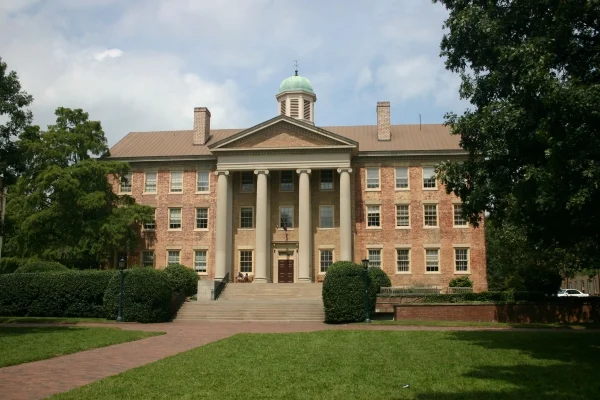
The University of North Carolina at Chapel Hill will close its area studies centers in 2026, faculty members within the centers told Inside Higher Ed.
The six centers—the Center for European Studies, the African Studies Center, the Carolina Asia Center, the Center for Middle East and Islamic Studies, the Institute for the Study of the Americas and the Center for Slavic, Eurasian and East European Studies—are all expected to close at some point next year.
“Our leadership team is taking a thoughtful and targeted approach, looking into areas that can be streamlined for greater efficiency, strengthening our operations while meeting our fiduciary responsibility to the people of North Carolina,” the UNC media relations department said in a statement. “A number of factors were taken into consideration while evaluating Centers and Institutes and some programs have been identified to be sunset [sic] in 2026. The list is not finalized at this time.”
Further updates will come after the January Board of Trustees meeting, the spokespeople said.
In a “budget reductions update” to the board’s finance and infrastructure committee in November, university officials said they planned to save $7 million in annual spending from “centers and institute reductions” made over several years, with a goal of $3 million in budget reductions before the end of this fiscal year in June 2026. A total of 14 centers and institutes will be decommissioned, according to the presentation.
The department says Palantir was involved in a portal tracking universities’ foreign gifts and contracts.
The American Association of University Professors (AAUP) is publicly expressing concern about the Education Department working with Palantir, a controversial artificial intelligence and data analysis company that serves the U.S. military and Immigration and Customs Enforcement.
The AAUP says it learned of the partnership when FedScoop reported that it noticed a message referencing Palantir on the website foreignfundinghighered.gov Dec. 4. An hour later, the website showed “a login page with the Palantir logo,” and, a couple of hours after that, “the Palantir logo was replaced with an Education Department logo,” the outlet wrote.
Foreignfundinghighered.gov tracks foreign gifts and contracts data for higher ed institutions. If a foreign source provides a college or university more than $250,000 in a year, Section 117 of the Higher Education Act of 1965 requires the institution to report the payment to the federal government.
In an email to Inside Higher Ed, the Education Department described Palantir’s involvement in the past tense. It said Palantir was involved with the foreign funding portal as a subcontractor for Monkton, a company that has long handled privacy and data issues for the Departments of Defense and Homeland Security.
“After soliciting feedback from institutions of higher education, the Trump Administration has upgraded the portal to make it easier for colleges and universities to report their foreign gifts and contracts as required,” Julie Hartman, the Education Department’s press secretary for legal affairs, said in a statement.
The AAUP held a news conference Wednesday raising concern about Palantir’s past work and about critical statements that Palantir leaders Alex Karp and Peter Thiel had made about higher ed.
“We want transparency,” AAUP president Todd Wolfson told reporters. “We want to know what Palantir is doing on this contract and we want to know how much they stand to make.” He said it “seems to be yet another front aimed at surveilling and criminalizing our colleges and universities,” and could indicate a “shift toward treating higher education not as a public good, but as a security threat to be monitored.”
The department didn’t tell Inside Higher Ed how much Palantir is being paid. Hartman said “universities’ clear disclosure and public transparency requirements have been in statute for decades,” adding that the AAUP’s “baseless assertion that the portal is a ‘politicized punitive action’ demonstrates their utter disregard for the rule of law.”
She said, “the Trump Administration is ending the secrecy surrounding foreign dollars and influence on American campuses.” Palantir spokespeople didn’t return Inside Higher Ed’s requests for comment.