Major accreditors are following through on their plans to bring new quality checks to the short-term credentialing landscape.
After years of preparation, the Higher Learning Commission is launching a new process to evaluate and endorse short-term credential providers this week, according to a Tuesday announcement from the HLC. The accreditor will be accepting applications for its first cohort of endorsed providers through Jan. 23.
Higher Learning Commission president Barbara Gellman-Danley said in the announcement that HLC’s goal is “to expand the nation’s pool of valuable, HLC endorsed providers, thereby increasing pathways for students to gain the qualifications they need to get ahead and succeed.”
The New England Commission of Higher Education also announced its inaugural cohort of eight recognized noncredit program providers last week, including higher ed institutions and external organizations.
“We know that there are increasing numbers of students enrolled in non-credit programs,” Michaele Whelan, chairperson of NECHE, said in a news release. “There has also been a growing need for quality assurance in this space. NECHE has taken the bold step to address this need and we are excited to expand our work into this area.”
Nearly 60 percent of all college students in the U.S. experience at least one form of basic needs insecurity, lacking stable housing and/or consistent access to food, according to national surveys.
The One Big Beautiful Bill Act, which Congress passed in July, creates sweeping changes to higher education—including a new tax rate for university endowments and accountability metrics for student income levels after graduation. It also directly impacts college students, threatening their access to food assistance programs and their ability to pay for college, which experts warn could hamper their persistence and completion.
Policy and higher education leaders convened during an Oct. 28 webinar hosted by the Hope Center for Student Basic Needs at Temple University to discuss how the new legislation threatens student financial wellness and success.
“We are very, very worried that student basic needs insecurity will be increasing dramatically over the next few years,” said Bryce McKibben, senior director of policy and advocacy at the Hope Center.
For current students, experts outlined three major shifts in federal financial supports.
1.Cuts to SNAP Funding
OBBBA includes $186 billion in cuts to the Supplemental Nutrition Assistance Program, which provides support obtaining food for nearly three million young adults, according to U.S. Census data. The bill places more requirements on SNAP recipients; at present, all funding for SNAP is at risk due to the government shutdown. Some states expect to run out of SNAP dollars as early as Nov. 1.
“[SNAP] is our first line of defense against hunger. It reduces health care–related issues and it bolsters local economies,” said Gina Plata-Nino, interim director of the SNAP, Food Research & Action Center. “It also provides jobs; it provides federal income taxes. And all of this is going to be threatened.”
Under the bill, all adults ages 18 to 64 must demonstrate they work at least 20 hours per week to be eligible for SNAP, Plata-Nino said.
Approximately one in four college students experience food insecurity. SNAP resources are largely underutilized by college students, in part because of complicated enrollment processes. Instead, many rely on campus pantries, which are mostly privately funded by individual donors or campus budgets. Plato-Nino anticipates the changes to SNAP will impact funding and capacity for higher education institutions to provide resources, “because now they have to focus on these issues,” she said.
The federal cuts could cause further damage to an already fragile system.
“We have a threadbare social safety net that really hits students when they can least afford to meet what are pretty acute and deep costs as they’re trying to get through their degree program,” said Mark Huelsman, director of policy and advocacy at the Hope Center.
Many colleges and universities expanded emergency grant funding for students during the COVID-19 pandemic to address sudden expenses that could threaten a student’s ability to remain enrolled. While supplemental funding can help ease this gap, it’s not sufficient, Huelsman said.
“Campuses don’t often have the resources to help students meet what can be an acute financial emergency,” Huelsman said.
An August 2025 Student Voice survey by Inside Higher Ed and Generation Lab found that 64 percent of respondents said they didn’t know whether their college provides emergency financial aid, and an additional 4 percent indicated that resource was not available at their institution. Only 12 percent of respondents said they knew how to apply for emergency aid at their college.
2.Changes to Pell Grants
The reconciliation bill also includes a variety of changes to student eligibility for the federal Pell Grant program, which provides financial aid to low-income students.
Over one-third of Student Voice respondents indicated paying for college was a top source of stress while enrolled, second only to balancing family, academic, work and personal responsibilities.
For the academic year 2026–27, those with a student aid index (SAI) over $14,790, as identified by the FAFSA, are no longer eligible for Pell Grants. Similarly, students who receive scholarships that meet the full cost of attendance (including books, housing, food, tuition and fees) are not eligible for Pell, regardless of their SAI.
“We anticipate that this will affect a very small number of students,” said Jessica Thompson, senior vice president at the Institute for College Access and Success. “But this remains to be seen how this takes effect and what it looks like on the ground.”
3.Limits on Graduate and Parent Borrowing
OBBBA caps loans on professional degree programs (which include medical, law, veterinary and dentistry programs, among others) at $200,000, and other graduate programs at $100,000. It also eliminates Grad PLUS loans, which are unsubsidized federal loans with no borrowing limits. Students currently enrolled can borrow from Grad PLUS for three academic years or the remainder of their credential program, whichever is shorter.
While these limits can be beneficial for keeping student borrowing down, there may be unintended consequences regarding who can access the programs, Thompson said. For example, students who enroll at historically Black colleges and universities or minority-serving institutions are more likely to utilize Parent PLUS loans to pay for college.
“This has been a really big lifeline for accessing credit in order to cover college costs for people’s children, and there will be a disproportionate impact on these new caps on those types of institutions,” Thompson said.
Thompson also noted that a lack of federal loan opportunities for graduate and professional students may cause a rise in private loan borrowing, which often has higher interest rates and fewer protections for borrowers.
“We want to keep a really close eye on what it means for the availability of programs in general … but also access and looking at increasingly less diverse pipelines in terms of historically marginalized populations being able to access graduate and professional programs,” Thompson said.
Similar to SNAP cuts, Thompson anticipates the loan caps will add significant financial pressure on colleges and universities due to loss of revenue and enrollment.
Just 27 percent of undergraduates describe their mental health as above average or excellent, according to new data from Inside Higher Ed’s main annual Student Voice survey of more than 5,000 undergraduates at two- and four-year institutions.
Another 44 percent of students rate their mental health as average on a five-point scale. The remainder, 29 percent, rate it as below average or poor.
In last year’s main Student Voice survey, 42 percent of respondents rated their mental health as good or excellent, suggesting a year-over-year decline in students feeling positive about their mental health. This doesn’t translate to more students rating their mental health negatively this year, however, as this share stayed about the same. Rather, more students in this year’s sample rate their mental health as average (2025’s 44 percent versus 29 percent in 2024).
About the Survey
Student Voice is an ongoing survey and reporting series that seeks to elevate the student perspective in institutional student success efforts and in broader conversations about college.
Some 5,065 students from 260 two- and four-year institutions, public and private nonprofit, responded to this main annual survey about student success, conducted in August. Explore the data captured by our survey partner Generation Lab here and here. The margin of error is plus or minus one percentage point.
The story is similar regarding ratings of overall well-being. In 2024, 52 percent of students described their overall well-being as good or excellent. This year, 33 percent say it’s above average or excellent. Yet because last year’s survey included slightly different categories (excellent, good, average, fair and poor, instead of excellent, above average, average, below average and poor), it’s impossible to make direct comparisons.
How does this relate to other national data? The 2024-2025 Healthy Minds Study found that students self-reported lower rates of moderate to severe depressive symptoms, anxiety and more for the third year in a row—what one co-investigator described as “a promising counter-narrative to what seems like constant headlines around young people’s struggles with mental health.” However, the same study found that students’ sense of “flourishing,” including self-esteem, purpose and optimism, declined slightly from the previous year. So while fewer students may be experiencing serious mental health problems, others may be moving toward the middle from a space of thriving.
Inside Higher Ed’s leadership surveys this year—including the forthcoming Survey of College and University Student Success Administrators—also documented a gap between how well leaders think their institutions have responded to what’s been called the student mental health crisis and whether they think undergraduate mental health is actually improving. In Inside Higher Ed’s annual survey of provosts with Hanover Research, for example, 69 percent said their institution has been effective in responding to student mental health concerns, but only 40 percent said undergraduate health on their campus is on the upswing.
Provosts also ranked mental health as the No. 1 campus threat to student safety and well-being (80 percent said it’s a top risk), followed by personal stress (66 percent), academic stress (51 percent) and food and housing insecurity (42 percent). Those were all far ahead of risks such as physical security threats (2 percent) or alcohol and substance use issues (13 percent).
Among community college provosts, in particular, food and housing insecurity was the leading concern, with 86 percent naming it a top risk.
Financial insecurity can impact mental health, and both factors can affect academic success. Among 2025 Student Voice respondents who have ever seriously considered stopping out of college (n=1,204), for instance, 43 percent describe their mental health as below average or poor. Among those who have never considered stopping out (n=3,304), the rate is just 23 percent. And among the smaller group of students who have stopped out for a semester or more but re-enrolled (n=557), 40 percent say their mental health is below average or poor, underscoring that returnees remain an at-risk group for completion.
Similarly, 43 percent of students who have seriously considered stopping out rate their financial well-being as below average or poor, versus 23 percent among students who’ve never considered stopping out—the same split as the previous finding on mental health.
The association between students’ confidence in their financial literacy and their risk of dropping out is weaker, supporting the case for tangible basic needs support: Some 25 percent of respondents who have considered stopping out rate their financial literacy as below average or poor, compared to 15 percent of those who have not considered stopping out.
Angela K. Johnson, vice president for enrollment management at Cuyahoga Community College in Ohio, said her institution continuously seeks feedback from students about how their financial stability and other aspects of well-being intersect.
“What students are saying by ‘financial’ is very specific around being unhoused, food insecurity,” she said. “And part of the mental health piece is also not having the medical insurance support to cover some of those ongoing services. We do offer some of them in our counseling and psychological services department, but we only offer so many.”
All this bears on enrollment and persistence, Johnson said, “but it really is a student psychological safety problem, a question of how they’re trying to manage their psychological safety without their basic needs being met.”
A ‘Top-of-Mind Issue’
Tri-C, as Johnson’s college is called, takes a multipronged approach to student wellness, including via an app called Help Is Here, resource awareness efforts that target even dual-enrollment students and comprehensive basic needs support: Think food pantries situated near dining services, housing transition coordination, childcare referrals, utility assistance, emergency funds and more.
Faculty training is another focus. “Sometimes you see a student sleeping in your class, but it’s not because the class is boring. They may have been sleeping in their car last night,” Johnson said. “They may not have had a good meal today.”
Political uncertainty may also be impacting student wellness. The American Council on Education hosted a webinar earlier this year addressing what leaders should be thinking about with respect to “these uncertain times around student well-being,” said Hollie Chessman, a director and principal program officer at ACE. “We talked about identity, different identity-based groups and how the safe spaces and places are not as prevalent on campuses anymore, based on current legislation. So some of that is going to be impacting the mental health and well-being of our students with traditionally underrepresented backgrounds.”
Previously released results from this year’s Student Voice survey indicate that most students, 73 percent, still believe that most or nearly all of their peers feel welcomed, valued and supported on campus. That’s up slightly from last year’s 67 percent. But 32 percent of students in 2025 report that recent federal actions to limit diversity, equity and inclusion efforts have negatively impacted their experience at college. This increases to 37 percent among Asian American and Pacific Islander and Hispanic students, 40 percent among Black students and 41 percent among students of other races. It decreases among white students, to 26 percent. Some 65 percent of nonbinary students (n=209) report negative impacts. For international students (n=203), the rate is 34 percent.
The Student Voice survey doesn’t reveal any key differences among students’ self-ratings of mental health by race. Regarding gender, 63 percent of nonbinary students report below average or poor mental health, more than double the overall rate of 29 percent. In last year’s survey, 59 percent of nonbinary students reported fair or poor mental health.
In a recent ACE pulse survey of senior campus leaders, two in three reported moderate or extreme concern about student mental health and well-being. (Other top concerns were the value of college, long-term financial viability and generative artificial intelligence.)
“This is a top-of-mind issue, and it has been a top-of-mind issue for college and university presidents” since even before the pandemic, Chessman said. “And student health and well-being is a systemic issue, right? It’s not just addressed by a singular program or a counseling session. It’s a systemic issue that permeates.”
In Inside Higher Ed’s provosts’ survey, the top actions these leaders reported taking to promote mental health on their campus in the last year are: emphasizing the importance of social connection and/or creating new opportunities for campus involvement (76 percent) and investing in wellness facilities and/or services to promote overall well-being (59 percent).
Despite the complexity of the issue, Chessman said, many campuses are making strides in supporting student well-being—including by identifying students who aren’t thriving “and then working in interventions to help those students.” Gatekeeper training, or baseline training for faculty and staff to recognize signs of student distress, is another strategy, as is making sure faculty and staff members can connect students to support resources, groups and peers.
“One of the big things that we have to emphasize is that it is a campuswide issue,” Chessman reiterated.
More on Health and Wellness
Other findings on student health and wellness from this newest round of Student Voice results show:
Mental health is just one area of wellness in which many students are struggling.
Asked to rate various dimensions of their health and wellness at college, students are most likely to rate their academic fit as above average or excellent, at 38 percent. Sense of social belonging (among other areas) is weaker, with 27 percent of students rating theirs above average or excellent. One clear opportunity area for colleges: promoting healthy sleep habits, since 44 percent of students describe their own as below average or poor. (Another recent study linked poor sleep among students to loneliness.)
Many students report using unhealthy strategies to cope with stress, and students at risk of stopping out may be most vulnerable.
As for how students deal with stress at college, 56 percent report a mix of healthy strategies (such as exercising, talking to family and friends, and prioritizing sleep) and unhealthy ones (such as substance use, avoidance of responsibilities and social withdrawal). But students who have seriously considered stopping out, and those who have stopped out but re-enrolled, are less likely than those who haven’t considered leaving college to rely on mostly healthy and effective strategies.
Most students approve of their institution’s efforts to make key student services available and accessible.
Despite the persistent wellness challenge, most students rate as good or excellent their institution’s efforts to make health, financial aid, student life and other services accessible and convenient. In good news for community colleges’ efforts, two-year students are a bit more likely than their four-year peers to rate these efforts as good or excellent, at 68 percent versus 62 percent.
‘It’s Easy to Feel Isolated’
The Jed Foundation, which promotes emotional health and suicide prevention among teens and young adults, advocates a comprehensive approach to well-being based on seven domains:
Foster life skills
Promote connectedness and positive culture
Recognize and respond to distress
Reduce barriers to help-seeking
Ensure access to effective mental health care
Establish systems of crisis management
Reduce access to lethal means
At JED’s annual policy summit in Washington, D.C., this month, advocates focused on sustaining the progress that has been made on mental health, as well as on the growing influence of artificial intelligence and the role of local, state and federal legislation on mental health in the digital age. Rohan Satija, a 17-year-old first-year student at the University of Texas at Austin who spoke at the event, told Inside Higher Ed in an interview that his mental health journey began in elementary school, when his family emigrated from New Zealand to Texas.
“Just being in a completely new environment and being surrounded by a completely new group of people, I struggled with my mental health, and because of bullying and isolation at school, I struggled with anxiety and panic attacks,” he said.
Satija found comfort in books and storytelling filled with “characters whom I could relate to. I read about them winning in their stories, and it showed me that I could win in my own story.”
Satija eventually realized these stories were teaching lessons about resilience, courage and empathy—lessons he put into action when he founded a nonprofit to address book deserts in low-income and otherwise marginalized communities in Texas. Later, he founded the Vibrant Voices Project for incarcerated youth, “helping them convert their mental health struggles into powerful monologues they can perform for each other.”
Currently a youth advocacy coalition fellow at JED, Satija said that college so far presents a challenge to student mental health in its “constant pressure to perform in all facets, including academically and socially and personally. I’ve seen many of my peers that have entered college with me, and a lot of us expect freedom and growth but get quickly bogged down with how overwhelming it can be to balance coursework, jobs, living away from your family and still achieving.”
Rohan Satija, center, speaks at JED’s annual policy summit in Washington earlier this month.
He added, “This competitive environment can make small setbacks feel like failures, and I’d say perfectionism can often become kind of like a silent standard.”
Another major challenge? Loneliness and disconnection. “Even though campuses are full of people, it’s easy to feel isolated, especially as a new student, and even further, especially as a first-generation student, an immigrant or anyone far from home.”
While many students are of course excited for the transition to adulthood and “finally being free for the first time,” he explained, “it comes with a lot of invisible losses, including losing the comfort of your family and a stable routine … So I think without intentional efforts to build connection in your new college campus, a lot of students feel that their sense of belonging can erode pretty quickly.”
In this light, Satija praised UT Austin’s club culture, noting that some of the extracurricular groups he’s joined assign a “big,” or student mentor, to each new student, or “little,” driving connection and institutional knowledge-sharing. Faculty members are also good at sharing information about mental health resources, he said, including through the learning management system.
And in terms of proactive approaches to overall wellness, the campus’s Longhorn Wellness Center is effective in that it “doesn’t promote itself as this big, like, crisis response space: ‘Oh, we’re here to improve your mental health. We’re here to make your best self,’ or anything like that,” he said. “It literally just promotes itself as a chill space for student wellness. They’re always talking about their massage chairs.”
“That gets students in the door, yeah?” Satija said.
This independent editorial project is produced with the Generation Lab and supported by the Gates Foundation.
Illinois has partnered with ReUp to bring stopped-out students back to college.
Photo illustration by Justin Morrison/Inside Higher Ed | rawpixel | Anand Raj/Pexels
Illinois has launched a statewide effort to re-enroll students who stopped out of college, in partnership with ReUp Education, a company focused on recruiting and supporting adult learners, according to a news release. ReUp has established a re-enrollment marketplace in Illinois that will connect stopped-out learners with 19 participating community colleges and universities and provide them with live coaching and other resources.
The platform will be accessible to 200,000 Illinois residents who have earned some college credits but not completed a degree. Nationwide, about 43 million Americans fall into that category.
Illinois joins several otherstates and institutions that have begun making a concerted effort to bring stopped-out individuals back to college. According to ReUp’s release, the company has supported 40,000 students in re-enrolling in college.
“Building a brighter future requires looking long and hard at the economic realities facing Illinois’ families and work force,” State Rep. Katie Stuart, chair of the Illinois House Higher Education Committee, said in the release. “Partnering with an established name in the adult education space to get more people skilled up for high-paying jobs is a big step in the right direction.”
More universities are signaling opposition to the Trump administration’s compact for higher education, which would require institutions to make changes to their policies and practices in order to receive an unspecified edge in grant funding.
In comments to faculty groups and studentjournalists, a handful of university leaders have made clear that they won’t sign on to the compact in its current form. But those comments don’t amount to a formal rejection of the agreement, several university spokespeople told Inside Higher Ed. Each said that because their institution hasn’t been formally asked to sign, they haven’t officially considered the administration’s proposal.
For instance, at Miami University in Ohio, Provost Chris Makaroff told the University Senate that “right now, there is no appetite to even consider joining it,” according to the Miami Student.
“The administration is totally against it in every way possible, and probably the only way that it would possibly go through is if somehow or another, they threaten to cut off all funding to the university,” Makaroff added.
When asked about those comments and whether that constituted a rejection, Seth Bauguess, the university’s senior director of communications, noted that Miami wasn’t part of the first group of universities asked to sign, so “therefore we have not formally considered it.”
When the administration initially invited nine universities to give feedback on the document, Trump officials sent each institution a signed cover letter and a copy of the agreement. Another three universities were invited to an Oct. 17 White House meeting to discuss the compact.
Beyond those overtures, President Donald Trump wrote on social media platform he owns, Truth Social, that universities that prefer to “return to the pursuit of Truth and Achievement” are “invited to enter into a forward looking Agreement with the Federal Government to help bring about the Golden Age of Academic Excellence in Higher Education.” Officials, speaking on condition of anonymity, told mediaoutlets that the post was an invitation to all colleges to sign on to the compact.
So far, nearly a dozenuniversities have publicly rejected the deal, and White House officials are reportedly planning to update the document in response to the feedback from universities. Only New College of Florida has said that it’s ready to sign, though it hasn’t yet been formally asked. The White House hasn’t said how interested universities can join, but officials have threatened the federal funding of institutions that don’t sign the compact.
Jon Fansmith, senior vice president for government relations and national engagement at the American Council on Education, said the mixed messages from universities likely stem from “the general confusion around how the administration is handling this.”
“Even the statement by New College raises the question of how would anyone actually sign up if they wanted to?” he said, adding that the compact’s terms don’t appear to be final and there’s no form or website where colleges and universities can go to sign it.
Fansmith said he’s not surprised that some campus leaders are seeking to make their concerns clear while not definitively turning down something they haven’t been offered.
“Why pick an unnecessary fight?” he said.
The growing cohort of presidents and leaders speaking out about the compact includes Arizona State University president Michael Crow, who told the State Press on Oct. 24 that the compact is no “longer a viable thing” and that he’s “been trying to guide people in a different direction.”
Crow was invited to the Oct. 17 White House meeting to discuss the compact, which also included representatives from Dartmouth College, the University of Arizona, the University of Kansas, the University of Texas at Austin, the University of Virginia, Vanderbilt University and Washington University in St. Louis. After that meeting, an ASU spokesperson said the university was engaging in dialogue with Trump’s team.
After the State Press published its interview with Crow, Inside Higher Ed followed up to see if “no longer a viable thing” meant “no.”
“It’s important to note that ASU has not been asked to sign the Compact for Academic Excellence in Higher Education,” an ASU spokesperson responded. “So we can’t be ‘reviewing’ or ‘negotiating’ or ‘weighing’ it. ASU has long been a voice for change in higher education, something the university has been pushing for more than 20 years. If the administration looks for new and innovative approaches to serve the needs of the country, ASU is likely one to be consulted. President Crow is happy to share his vision for the future of higher education with anyone, if asked, whether they’re students, parents, alums, members of the public, or the administration.”
But some universities, including Emory and Syracuse, have chosen to reject the compact before receiving a formal ask. And on Thursday, University of Kansas provost Barbara Bichelmeyer told The Kansan, “Fundamentally, there’s no way, with the compact as it is written and sent out to other institutions, that KU could sign that.”
Bichelmeyer also noted that KU wasn’t asked to sign the compact.
Brendan Cantwell, a higher education professor at Michigan State University, said there’s no reason for colleges to say no at this moment.
“The basic tenet of college administration is don’t make a decision until you have to,” he said. “No one is forcing their hand right now … and they don’t want to antagonize the administration, particular donors or state officials. If I wasn’t explicitly invited, I wouldn’t explicitly decline to participate.”
Cantwell added that the president’s social media post and other communications from Trump officials have created a lot of ambiguity, and institutions are using that to their advantage.
“What the president has said, by saying that anyone can apply, but not specifically inviting anyone beyond the 12, has created an opportunity for campuses to message ‘no’ to students and ‘not yes’ to everyone else,” he said.
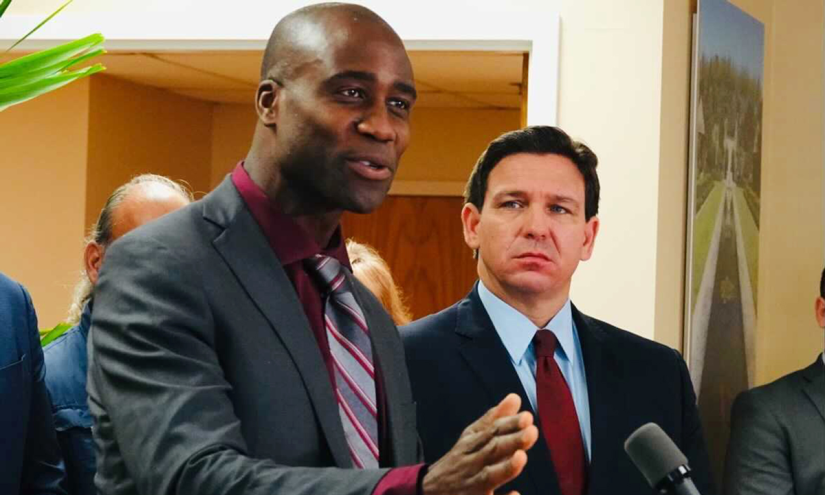
Florida governor Ron DeSantis on Wednesday ordered the state’s public universities “to pull the plug on the use of these H-1B visas in our universities.” In doing so, the Republican appeared to call for his state to go further than President Trump in restricting entry of these foreign employees—an issue that has divided prominent conservatives.
Since fiscal year 2022, Florida public universities have employed nearly 2,000 people via the H-1B program—nearly half at the University of Florida. The program is capped at 85,000 new visas a year, but colleges, universities and some other organizations aren’t subject to that cap. In the first three quarters of 2025, nearly 16,800 visas were approved for employees at colleges and universities; 395 of the visas were for jobs at Florida’s public universities. Universities use the program to hire faculty, doctors and researchers and argue it’s required to meet needs in health care, engineering and other areas.
Last month, Trump announced a $100,000 application fee for H-1B visas. U.S. Citizenship and Immigration Services says the fee will apply to new H-1B petitions filed on or after Sept. 21 and must be paid before the petition is filed. It said there could be exceptions from the fee in an “extraordinarily rare circumstance” in which the Homeland Security secretary determines a foreigner’s presence in the U.S. “is in the national interest.”
Lawsuits have been filed over the fee, and higher ed associations and institutions have spoken out in opposition. The Trump administration says employers are abusing the program to avoid hiring Americans.
In a speech at the University of South Florida on Wednesday, DeSantis called on the state board governing public universities to “pull the plug” on H-1B visa employees. He didn’t mention any exceptions.
If this the ban happens, it would be another example of a red state going further than the Republican-controlled federal government in restricting public higher ed institutions. In states such as Texas and Ohio, GOP politicians have exceeded Trump in regulating curricula and restricting faculty rights. Before Trump retook office, DeSantis put Florida on the leading edge of the conservative overhaul of higher ed, from cracking down on what he called “woke” education to putting allies in charge of universities—a playbook other states have followed.
It’s unclear, however, whether the Florida Board of Governors, which oversees the state’s public universities but not it’s public colleges, will follow DeSantis’s directive. Fourteen of the board’s 17 members are appointed by the governor and confirmed by the state Senate.
It’s also unclear what his directive specifically means; a news release the governor’s office issued Wednesday didn’t, unlike his speech, go as far as suggesting an end to all H-1B visa employees at public universities.
But neither the State University System of Florida nor the governor’s office provided more details in response to Inside Higher Ed’s questions about DeSantis’s intent. A news release from the governor’s office said DeSantis directed the board to “crack down on H-1B Visa abuse in higher education” but didn’t repeat the governor’s apparent call to end H-1B employment completely.
University of Florida interim president Donald Landry spoke at the press conference after DeSantis and mentioned his institution was called out.
“It’s a complex issue, and we can chat,” Landry said, to laughs from the audience. He did list one benefit, saying H-1Bs are mainly used at UF to hire new faculty from the international student population.
“Occasionally, some bright light might be good enough for the faculty, and then we will try and retain the person into whom we have invested so much,” he said.
UF is conducting its own review of the H-1B program, he added. “We know that H-1B is not handled in a pristine fashion, even in academia,” he said.
Robert Cassanello, president of the United Faculty of Florida union and a tenured associate history professor at the University of Central Florida, suggested that banning H-1B visa holders would be illegal.
“You can’t discriminate against someone based on foreign birth,” Cassanello said. “My big question coming away from this is: Where’s the authority?”
‘Do It’ With Florida Residents
In his speech, DeSantis started his criticism of the H-1B program from a national perspective. He said, “Tech companies will fire Americans and hire H-1B at a discount, and they’re basically indentured servants … They’re indentured to the company, so the company can basically pay them low.”
He then turned to Florida universities, appearing to read from a list of positions occupied by H-1B holders at unnamed institutions. (His office didn’t provide the list Wednesday.)
After mentioning a public policy professor from China, DeSantis said, “Why do we need to bring someone from China to talk about public policy?” Later—apparently looking at information on another H-1B holder—he exclaimed, “Wuhan, China!”
Although DeSantis’s complaints focused on supposed international scholars from China, he didn’t spare those from other countries.
“Assistant swim coach from Spain, on an H-1B visa—are you kidding me, we can’t produce an assistant swim coach in this country?” he said. He then turned to the Middle East.
“Clinical assistant professor from the West Bank, clinical assistant professor from supposed Palestine,” he said. “Is that just social justice that they’re doing? And that’s University of Florida.”
“We need to make sure our citizens here in Florida are first in line for job opportunities,” DeSantis said. But he also suggested he doesn’t fully know why universities are hiring H-1B workers.
“I guess there’s probably reasons why it ends up being this way,” DeSantis said. “But I think it’s a poor reflection on some of the decisions that some of these universities have made that they’re trying to say they need an H-1B visa to do some of these jobs … We can do it with our residents in Florida, or with Americans, and if we can’t do it then—man—we need to really look deeply about what is going on.”
Sarah Spreitzer, vice president and chief of staff for government relations at the American Council on Education, said DeSantis’s move would limit universities’ ability to hire the best researchers.
“It’s going to have an enormous impact, obviously, on Florida institutions,” Spreitzer said.
Cassanello, who said his union includes some H-1B holders, called DeSantis’s speech a “xenophobic and nativist diatribe.”
“He’s a nativist, he’s anti-immigrant and so he’s coming to these decisions based on no facts,” Cassanello said. He also said DeSantis opposed diversity, equity and inclusion programs by arguing they were anti-meritocratic, but now, “all of a sudden, he’s willing to throw out meritocracy.”
“He’s using fear of people of color and fear of immigrants to sort of impose his will on the running of our public colleges and universities,” Cassanello said. He said the speech represents “a further attack from DeSantis and our state political leaders on the autonomy of our public colleges and universities.”
As a high school STEM teacher at Baldwin Preparatory Academy, I often ask myself: How can we make classroom learning more meaningful for our students? In today’s rapidly evolving world, preparing learners for the future isn’t about gathering academic knowledge. It is also about helping all learners explore potential careers and develop the future-ready skills that will support success in the “real world” beyond graduation.
One way to bring those two goals together is by drawing a clear connection between what is learned in the classroom and future careers. In fact, research from the Education Insights Report shows that a whopping 87 percent of high school students believe that career connections make school engaging–and as we all know, deeper student engagement leads to improved academic growth.
I’ve tried a lot of different tactics to get kids engaged in careers over my 9 years of teaching. Here are my current top recommendations:
Internship opportunities As many educators know, hands-on learning is effective for students. The same goes for learning about careers. Internship opportunities give students a way to practice a career by doing the job.
I advise students to contact local businesses about internships during the school year and summer. Looking local is a wonderful way to make connections, learn an industry, and practice career skills–all while gaining professional experience.
Tallo is another good internship resource because it’s a digital network of internships across a range of industries and internship types. With everything managed in Tallo, it’s easy for high school students to find and get real-world work experience relevant to school learning and career goals. For educators, this resource is helpful because it provides pathways for students to gain employable skills and transition into the workforce or higher education.
Career events In-person career events where students get to meet individuals in industries they are interested in are a great way for students to explore future careers. One initiative that stands out is the upcoming Futures Fair by Discovery Education. Futures Fair is a free virtual event on November 5, 2025, to inspire and equip students for career success.
Held over a series of 30-minute virtual sessions, students meet with professionals from various industries sharing an overview of their job, industry, and the path they took to achieve it. Organizations participating in the Futures Fair are 3M, ASME, Clayco, CVS Health, Drug Enforcement Administration, Genentech, Hartford, Honda, Honeywell, Illumina, LIV Golf, Meta, Norton, Nucor, Polar Bears International, Prologis, The Home Depot, Verizon, and Warner Bros. Discovery.
Students will see how the future-ready skills they are learning today are used in a range of careers. These virtual sessions will be accompanied by standards-aligned, hands-on student learning tasks designed to reinforce the skills outlined by industry presenters.
CTE Connections All students at Baldwin Preparatory Academy participate in a career and technical education pathway of their choosing, taking 6-9 career specific credits, and obtaining an industry-recognized credential over the course of their secondary education. As a STEM teacher, I like to connect with my CTE and core subject colleagues to learn about the latest innovations in their space. Then I connect those innovations to my classroom instruction so that all students get the benefit of learning about new career paths.
For example, my industry partners advise me about the trending career clusters that are experiencing significant growth in job demand. These are industries like cybersecurity, energy, and data science. With this insight, I looked for relevant reads or classroom activities related to one of those clusters. Then, I shared the resources back with my CTE and core team so there’s an easy through line for the students.
As educators, our role extends beyond teaching content–we’re shaping futures. Events like Futures Fair and other career readiness programs help students see the relevance of their learning and give them the confidence to pursue their goals. With resources like these, we can help make career readiness meaningful, engaging, and empowering for every student.
Jessica Stanford, RN, Baldwin Preparatory Academy
Jessica Stanford, RN, is a Health Science Instructor at Baldwin Preparatory Academy. Jessica has been a Registered Nurse for 20 years, and a health science instructor in career and technical education since 2017. She is passionate about using secondary education to harness natural curiosity and cultivating that into interest and effort toward an educational pathway that young people can pursue before high school graduation. Jessica believes that students can make great strides in planning, networking, and experiences that will catapult them into a career and lifelong success.
Latest posts by eSchool Media Contributors (see all)
The Trump administration reportedly froze nearly $6 billion in grants and contracts, but most of that has since been restored.
Photo illustration by Justin Morrison/Inside Higher Ed | arlutz73 and Wolterk/iStock/Getty Images
Thanks to a series of settlements and court orders, some universities that had their grants frozen by the Trump administration earlier this year have seen that funding restored.
But others are still trying to unfreeze the grants and learn more about why they were suspended in the first place.
Since March, the Trump administration has said that it put nearly $6 billion on hold at nine universities. Three universities—Columbia, Penn and Brown—cut deals with the administration to restore the funding, while the University of California, Los Angeles, and Harvard got the money back via court orders. The fate of the remaining four freezes—at Duke, Cornell, Northwestern and Princeton Universities—remains uncertain.
Princeton has seen about half of its frozen grants restored, President Christopher Eisgruber told the alumni magazine in late August. Roughly $200 million was put on hold initially.
Eisgruber said Princeton never learned why the funds were frozen, beyond media reports that connected it to concerns over antisemitism on campus. A Princeton spokesperson confirmed the magazine’s report but declined to share more details about the status of the remaining grants.
At Northwestern, the Trump administration reportedly froze about $790 million in early April, though officials said at the time they never received formal notification about why the funds were put on hold. Since then, Northwestern officials have said they are working to restore the grants—a process that apparently hasn’t gone smoothly.
Northwestern University interim president Henry Bienen toldThe Daily Northwestern in an Oct. 17 interview that “a negotiation really requires two parties, at least, and at the present time, there’s not been anybody on the other end of the line.”
As the freeze persists, Northwestern has said it will continue to support researchers’ “essential funding needs” at least through the end of the calendar year. Bienen told the student newspaper that supporting the research costs $30 million to $40 million a month.
The university has laid off more than 400 employees and instituted other measures to cut costs, though officials said those moves were driven by more than just the funding freeze.
Cornell University is also in talks with the administration to find a solution to the freeze. However, President Michael Kotlikoff recently shared new information about the impact of the freeze that calls into question the Trump administration’s figures.
Trump officials told media outlets in April that they froze more than $1 billion at Cornell. But Kotlikoff said last week in his State of the University address that Cornell is actually facing about $250 million in canceled or unpaid research funds. (The university’s research expenditures totaled $1.6 billion in the 2023–24 academic year.)
Like Northwestern and Princeton, Cornell hasn’t received a formal letter about the freeze, though media reports suggested that the administration froze the grants “because of concerns around antisemitism following pro-Palestinian activities on campus beginning in fall of 2023,” Kotlikoff said.
Following news stories about the freeze, Kotlikoff said the university “started receiving stop-work orders ‘by direction of the White House’: halting research on everything from better tests for tick-borne diseases, to pediatric heart assist pumps, to ultrafast lasers for national defense, to AI optimization for blood transfusion delivery. At the same time, many other research grants, while not officially canceled, stopped being paid.” (About $74 million of the $250 million is in unpaid bills, he said.)
Kotlikoff added that Cornell has been talking with the federal government for six months “to identify their concerns, provide evidence to address them, and return to a productive partnership.” In August, Bloombergreported that the White House wanted to reach a $100 million settlement with Cornell.
But Kotlikoff also criticized the administration for not using established legal processes to investigate potential civil rights violations, echoing a point expertshavemade for months.
“I want to be clear that there are established procedures in place for the government to handle such concerns,” he said in his State of the University address. “Accusations of discrimination should be supported by, and adjudicated on the basis of, facts. This has not happened.”
Kotlikoff, who was appointed president in March, made clear in his address to the Board of Trustees and university alumni that Cornell won’t agree to give up control of admissions or curricular decisions, among other things.
“We will not agree to allow the government to dictate our institution’s policies, or how to enforce them,” he said. “And we will never abandon our commitment to be an institution where any person can find instruction in any study.”
The administration has also said it froze about $108 million at Duke University, but neither Duke nor the National Institutes of Health responded to Inside Higher Ed’s request for an update.
Reid retired in August after 30 years at New College.
Thomas Simonetti/The Washington Post/Getty Images
Amy Reid, a former professor of French at New College of Florida, was granted “honorary alumni” status by the New College Alumni Association Board of Directors in a unanimous vote nearly three weeks after she was denied emerita status by college president Richard Corcoran.
“I was honored when my colleagues nominated me for emerita status and when the New College Alumni Association adopted me as one of their own, in recognition of my long teaching career and my vocal advocacy for the College, its academic program, and for the position of gender studies in the liberal arts,” Reid said in a statement to Inside Higher Ed. “New College students have made their mark because they are fiercely independent and courageous learners. I’ll try to live up to their standards. To the Novo community: Honor & Respect.”
The honorary designation, rarely bestowed, gives Reid the same “rights and privileges” as other New College alumni, including access to alumni events, according to the alumni association’s motion. Reid retired in August after teaching at New College for more than 30 years and now serves as interim director of PEN America’s Freedom to Learn program.
Reid was also the founder of the now-defunct gender studies program at New College, which the then–newly appointed conservative board eliminated in 2023. The college was mired in controversy again the following summer when officials tossed books from its former Gender and Diversity Center in the trash.
Despite what alumni association governance committee chair Chris Van Dyk described as “overwhelming recommendation” for emerita status, including from New College provost David Rohrbacher and leaders in the Division of Humanities, Corcoran denied Reid the emerita title because of her outspoken faculty advocacy and criticism of conservative leadership at New College.
“Although I recognize Professor Reid’s contributions to New College in teaching and scholarship, I cannot concur with the Division and Provost that she be honored with the title of emeritus,” Corcoran wrote in an email to Rohrbacher. “When I became president with a mandate for change from the Board of Trustees, there was need for reasoned and respectful exchange between the faculty and administration. Regrettably, Professor Reid was one of the leading voices of hyperbolic alarmism and needless obstruction. In her letter of resignation, Professor Reid wrote that ‘the New College where I once taught no longer exists.’ She need not be burdened by further association with it.”
After the former faculty representative to the New College Board of Trustees quit in protest, Reid was elected to fill the role in 2023. She and student representative Grace Keenan were the only two board members to vote against Corcoran’s appointment as permanent president, Florida Politics reported.
Emeritus status is largely symbolic, but it does usually come with some concrete perks, including the continued use of institutional email accounts, library and athletic facilities access, and sometimes free campus parking.
Beleaguered by the Trump administration’s efforts to reshape higher education to align with conservative policy priorities, major universities continue to spend heavily on lobbying efforts to protect their interests.
While lobbying expenses over all have boomed during 2025 compared to last year, spending fell in the third quarter, according to an Inside Higher Ed analysis of major research universities.
Members of the Association of American Universities spent less in the third quarter of 2025 than in either of the first two quarters, racking up more than $8.6 million in lobbying costs, compared to $9 million in the first quarter and more than $10 million in Q2.
AAU’s member institutions have already spent more than $27.8 million combined on lobbying this year.
Top Spenders
Among individual AAU members, Johns Hopkins University spent the most on lobbying in the third quarter, shelling out $390,000. JHU spent $170,000 in the first quarter and $380,000 in Q2, for a total of more than $940,000 so far this year.
JHU’s lobbying disclosure form shows the private university in Baltimore engaged Congress on multiple issues, including the Trump administration’s One Big Beautiful Bill Act, student loans and psychedelic research.
“We continue to advocate for our research mission through all appropriate channels,” a Johns Hopkins University spokesperson wrote in an emailed statement to Inside Higher Ed.
Others that invested heavily in lobbying include Yale University, which spent $370,000 in the third quarter, and its Ivy league counterpart the University of Pennsylvania, which spent $360,000. The University of Washington was the top-spending public institution at $310,000, while Columbia University rounded out the top five with $290,000 in lobbying expenses for Q3.
“Communicating the impact of Columbia’s researchers, scientists, scholars, and clinicians to policymakers in Washington, New York, and locally is vital, and we utilize a combination of in-house and outside professionals to ensure our message reaches key stakeholders, including our New York delegation,” a Columbia spokesperson wrote in an email to Inside Higher Ed.
In addition to research funding and the One Big Beautiful Bill Act, common areas of focus noted in lobbying disclosure forms include appropriations, student visas and immigration, among other concerns that college officials have raised in private conversations with lawmakers on Capitol Hill.
Including their third-quarter expenditures, several of the institutions above are among the top spenders for the year. Northwestern leads AAU members in lobbying expenses at $1.1 million, followed by the University of Washington at $1 million, JHU and Yale at $940,000, and Cornell at $914,000.
Many universities dialed back lobbying expenses in the third quarter, some by significant amounts. Emory University, for example, spent $500,000 on lobbying in the second quarter but only $185,000 in Q3. Emory has spent $855,000 on lobbying in 2025.
Though still among the top-spending AAU members, Cornell pulled back on lobbying, which fell to $240,000 in Q3 compared to $444,000 in the second quarter.
Northwestern has cut spending in each successive quarter. The private university spent $607,000 on federal lobbying in Q1, the most of any university in any quarter this year. But that number fell to $306,000 in the second quarter and $230,000 more recently.
Outliers
Some universities outside the AAU also spent heavily on lobbying in the third quarter.
The University of Phoenix, for example, spent $480,000 on federal lobbying efforts. Phoenix has spent consistently across all three quarters, totaling $1.4 million in lobbying expenditures in 2025. That appears to make the for-profit institution the top individual spender across the sector this year.
Lobbying disclosure forms show Phoenix engaged on legislation, including the One Big Beautiful Bill Act and a bill related to student veteran benefits, but also on broad public policy issues.
Phoenix officials declined to comment.
Northeastern University is another top spender that falls outside of AAU membership. The university has spent $270,000 in each quarter, totaling $810,000 in 2024 lobbying expenditures.