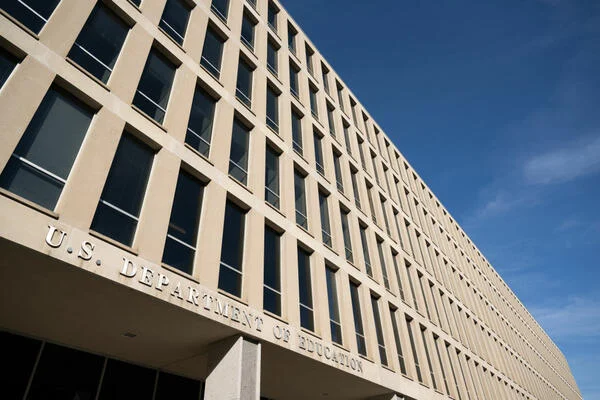
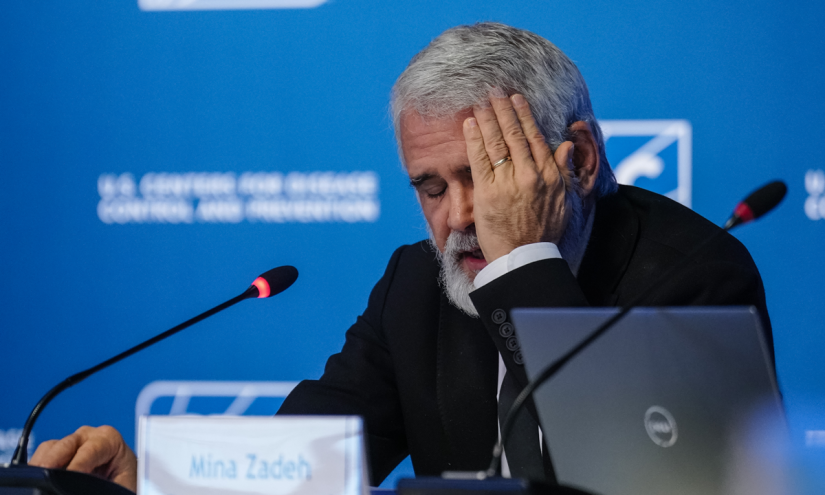
The OCR employees were fired in March as part of a broader reduction in force at the Education Department.
Saul Loeb/AFP via Getty Images
The Education Department is calling Office for Civil Rights employees who were fired earlier this year back to work.
The Trump administration tried to ax half of the Education Department’s OCR staff in March, but it has been paying them not to work since then while it continues to fight litigation contesting its plan. The department says it hasn’t given up on defending that move, but now says it’s “important to refocus OCR’s work and utilize all OCR staff to prioritize OCR’s existing complaint caseload.”
“In order for OCR to pursue its mission with all available resources, all those individuals currently being compensated by the Department need to meet their employee performance expectations and contribute to the enforcement of existing civil rights complaints,” the department said in Friday emails obtained by Inside Higher Ed. “Utilizing all OCR employees, including those currently on administrative leave, will bolster and refocus efforts on enforcement activities in a way that serves and benefits parents, students, and families.”
One email gave an employee a Dec. 15 return date, while another said Dec. 29. It’s unclear how many workers will return. Bloomberg reported that the order went out to “more than 260,” while USA Today cited the department as saying “roughly 250,” but the Associated Press said “dozens.” Inside Higher Ed is awaiting clarification from the department.
Rachel Gittleman, president of American Federation of Government Employees Local 252, which represents department employees, said her union hasn’t been told how many workers in its bargaining unit received the email. She said in a statement Monday that “while we are relieved these public servants are finally being allowed to return to work, Education Secretary Linda McMahon has made clear that she would rather play politics than uphold her responsibility to protect students’ rights.”
“For more than nine months, hundreds of employees at the Office for Civil Rights (OCR) have been sidelined from the critical work of protecting our nation’s most vulnerable students and families,” Gittleman said. She said the administration’s actions keeping these employees out of work and on leave “wasted more than $40 million in taxpayer funds.”
“By blocking OCR staff from doing their jobs, Department leadership allowed a massive backlog of civil rights complaints to grow, and now expects these same employees to clean up a crisis entirely of the Department’s own making,” she added.
Earlier this year, Pennsylvania State University announced it would close seven campuses due to financial constraints, while Louisiana State University implemented a hiring freeze and other cost-cutting measures.
Months later both institutions fired their head football coaches—for a price. Despite Penn State’s financial challenges, administrators were willing to pay more than $45 million to make head coach James Franklin go away after the Nittany Lions posted a 6-3 record. LSU fired Brian Kelly after a 5-3 start and gave him a buyout of $54 million.
Franklin’s total buyout was ultimately reduced to $9 million when he landed the head coaching job at Virginia Tech, and Kelly’s exit package will also shrink should he find another position. But the eye-popping compensation numbers are adding up—and setting new records at a time when many colleges and universities are cutting costs.
Record Buyouts
Recent data compiled by the Knight Commission on Intercollegiate Athletics shows that failing is a lucrative business for college football coaches. Fifteen fired football coaches have already racked up collective buyouts of nearly $228 million from public universities, compared to $120 million in fiscal year 2024. (Those totals are for Football Bowl Subdivision coaches only, formerly known as Division I-A, and only include public universities, since private institutions don’t release such contract details.)
Former LSU coach Brian Kelly landed one of the largest buyouts in the history of college sports.
Gus Stark/LSU/University Images/Getty Images
The Knight Commission noted that individual coaching buyouts this year “are the second, third, fourth, and fifth highest severance pay obligations in history.” The top slot still belongs to Texas A&M University, which fired Jimbo Fisher in 2023 with an exit package of more than $75 million.
Looking across a longer timeline, the commission estimates that universities shelled out a total of $852 million in severance pay for football coaches, including assistants, between 2012 and 2024.
University Responses
Universities often stress that coaching buyouts are paid with donor funds, not public money. Even so, some experts argue that paying vast sums of money to fire coaches is problematic and damages faculty and staff morale, especially at universities that are slashing jobs and budgets.
Penn State defended its recent buyout to Inside Higher Ed by emphasizing that its athletic program is among the few in the nation “that is self-sustaining and therefore does not use any tuition or taxpayer dollars.” In addition, the university said, it has a major economic impact on the surrounding area.
“Decisions regarding budgets and operations of the academic enterprise are separate and distinct,” a spokesperson wrote in an emailed response to a question about closing rural campuses across Pennsylvania. “As noted, no tuition or tax dollars are used for athletics. The difficult but necessary decisions Penn State has made impacting campuses and unit budgets, have been made with a core focus on setting our students up with the best opportunities for success.”
LSU did not provide a statement to emailed questions prior to publication.
Congressional Scrutiny
While Congress has deliberated capping pay for college athletes—whom institutions can now pay directly, as of earlier this year—Knight Commission on Intercollegiate Athletics CEO Amy Privette Perko has encouraged lawmakers to rein in coaching salaries.
“As Congress debates the merits of federal legislation to place limits and guardrails on college athlete compensation, it should also examine the conditions that allow for the continued growth of excessive compensation and severance for football coaches at non-profit universities,” she said in a statement accompanying the organization’s report on buyouts.
Some members of Congress appear interested in taking on runaway salaries and buyouts.
In October, Representative Michael Baumgartner, a Washington Republican, introduced the Correcting Opportunity and Accountability in Collegiate Hiring Act, a proposal that would cap annual pay for all athletics department employees. Baumgartner’s proposed bill would limit annual pay to no more than 10 times the cost of in-state tuition for undergraduate students.
While new LSU coach Lane Kiffin is set to make $13 million a year, his annual salary would be dramatically lower—about $280,000—under the pay scheme proposed by Baumgartner.
Multiple state attorneys general have already voiced opposition to the proposal.
New LSU coach Lane Kiffin is poised to make $13 million a year.
Tyler Kaufman/Getty Images
Some lawmakers have also questioned whether college sports should remain tax-exempt. Senator Maria Cantwell, a Democrat representing Washington, wrote a letter to the Joint Committee on Taxation earlier this year, seeking an analysis of the implications of stripping the NCAA, member institutions and athletic conferences of their ability to continue as tax-exempt organizations.
“Given the evolving market dynamics of college sports coupled with changes in the legal framework affecting college athletes, legitimate questions have been raised about whether it is time to rethink the tax-exempt regime under which college sports currently operates,” she wrote.
But so far, legislation to alter the college sports landscape has proven difficult to pass. The latest effort to overhaul athletics—which would have limited student transfer eligibility and how much universities can spend on name, image and likeness deals—collapsed short of the end zone last week when House members balked on the GOP-backed bill and sponsors pulled it from a vote.
Former University of Florida president Ben Sasse is now an American Enterprise Institute fellow.
The American Enterprise Institute, a prominent conservative-leaning think tank, has named former U.S. senator and university president Ben Sasse a nonresident senior fellow, AEI announced Friday. Its website says his work there will focus on “higher education, innovation, technology, American history and culture, and national security.”
Sasse’s AEI post and his continuing voice at other major conservative institutions—The Wall Street Journal has run at least three op-eds by him this year, including one calling on university board members across the country to stand up to faculty “radicals” and “encourage greater intellectual diversity”—shows he’s not persona non grata after his abrupt exit from the University of Florida last year.
Sasse attributed his resignation from UF to his wife’s health, though the student newspaper, The Independent Florida Alligator, has reported the board may have forced him out. During the first year of his roughly 18-month presidency, his office spent more than $17 million. Sasse denied wrongdoing and argued that driving new initiatives at UF required major investments.
Sasse, a Republican who represented Nebraska in the Senate, remains a professor in UF’s Hamilton Center for Classical and Civic Education. He previously was president of Midland University.
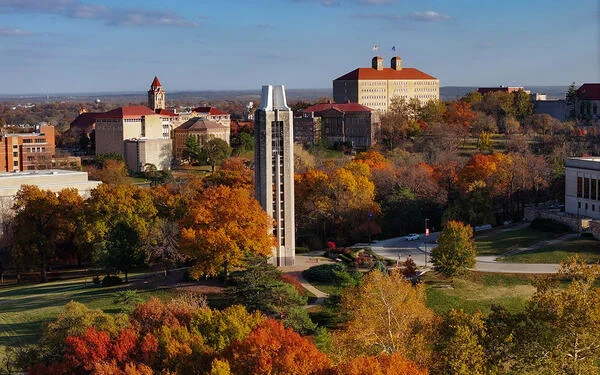
The University of Kansas has received a five-year, $1.9 million grant from the U.S. Department of Education’s Office of Postsecondary Education to grow the university’s transition program for students with intellectual disabilities.
KU Transition to Postsecondary Education (KU TPE) first launched at the Lawrence campus in 2015 to provide experiences for such students to engage in higher education and land a meaningful job. Now, the program will expand to two neighboring institutions, increasing opportunities for learners in the state.
The background: Approximately one in five individuals with disabilities graduate from college, compared to 38 percent of people without disabilities, according to a 2024 report from the U.S. Government Accountability Office.
Other colleges, including Utah Valley University, have received similar grants from ED to kick-start educational programs for individuals with intellectual disabilities. For the 2025 award year, Northeastern State University in Oklahoma, Washington State University, Texas A&M University–San Antonio, Georgian Court University in New Jersey, Indiana University of Pennsylvania, the University of Memphis and Curry College in Massachusetts were among the grant recipients.
How it works: Students enrolled in KU TPE complete two-year undergraduate certificates, with the goal of landing a competitive job after graduation that aligns with their personal and career goals, according to the university press release.
“Students come in as full-fledged, card-carrying Jayhawks,” Dana Lattin, research project director at KU TPE, said in a university press release. “They take courses like those in any other program of study that are aligned with their career and personal interest.”
TPE students complete 24 credit hours—about six credits per semester—including nine credits on career and life planning, three credits for communication coursework, three credits for health and wellness classes, and nine for electives. In addition, students are encouraged to find employment and paid internships while enrolled, helping set them up for success after graduation.
Part of the program’s effectiveness stems from the students’ integration into campus life, researchers said. TPE participants engage in campus resources and activities—including clubs, organizations and events—just like their peers enrolled in bachelor’s degree programs.
Data shows that 74 percent of graduates are employed in their communities after completing their credential; by comparison, only 6 percent of all adults with disabilities in Kansas are employed in a competitive role.
Scaling up: Campus leaders plan to use the funding to increase program supports for KU TPE participants, including adding credential programs, bolstering peer supports and establishing more career development elements, according to the program abstract submitted to ED.
The university will also establish a consortium with Wichita State University Tech and Benedictine College, also in Kansas, to create additional transition programs for students with disabilities. The goal is to increase enrollment opportunities for as many as 48 students across the state.
The KU research team is also looking for additional funding from the state to ensure the programs are sustainable.
“Sharing that 75 percent of people with intellectual disability who attend college are competitively employed, many of which are working full-time, will help show the value of ongoing support for these programs in Kansas,” Lattin said.
Get more content like this directly to your inbox. Subscribe here.
At the time of his initial arrest, Gouvea said he was hunting rats.
APCortizasJr/iStock/Getty Images
Immigration authorities arrested Carlos Portugal Gouvea, a visiting professor at Harvard Law School, on Wednesday after his J-1 visa was revoked for shooting a BB gun outside of a Boston-area synagogue Oct. 2, the day of Yom Kippur. Gouvea agreed to voluntarily leave the United States rather than be deported.
The Department of State revoked Gouvea’s visa Oct. 16, and a month later, Gouvea accepted a plea deal “on the charge of illegal use of the air rifle while his other charges for disturbing the peace, disorderly conduct, and vandalizing property were dismissed,” the Department of Homeland Security wrote in a news release.
Gouvea shot the pellet gun outside Temple Beth Zion in Brookline, Mass., just a few miles south of the Harvard campus, The New York Times reported. Private security guards for the synagogue heard a loud noise outside, and the temple was put in a lockdown. When a guard saw Gouvea behind a tree and attempted to arrest him, they engaged in a brief physical struggle and then Gouvea fled, the Times reported. He was later arrested by Brookline police. Gouvea fired two total shots, one of which police later discovered had shattered a car window. Harvard officials put Gouvea on administrative leave shortly after his October arrest.
In its news release, the Department of Homeland Security called the act an “anti-Semitic shooting incident,” a characterization federal officials have maintained since the incident.
“It is a privilege to work and study in the United States, not a right. There is no room in the United States for brazen, violent acts of anti-Semitism like this. They are an affront to our core principals as a country and an unacceptable threat against law-abiding American citizens,” Tricia McLaughlin, assistant secretary for public affairs at DHS, said in a statement. “We are under zero obligation to admit foreigners who commit these inexplicably reprehensible acts or to let them stay here. Secretary Noem has made it clear that anyone who thinks they can come to America and commit anti-American and anti-Semitic violence and terrorism should think again. You are not welcome here.”
At the time of his initial arrest, Gouvea said he was “hunting rats.” He was not charged with a hate crime by local police, and leaders from Temple Beth Zion told the Times they did not believe the shooting was motivated by bias.
“From what we were initially told by police, the individual was unaware that he lived next to, and was shooting his BB gun next to, a synagogue, or that it was a religious holiday,” Benjamin Maron, the synagogue’s executive director, and Larry Kraus, its president, wrote in the statement to the Times. “It is potentially dangerous to use a BB gun in such a populated spot, but it does not appear to have been fueled by antisemitism.”
A lawyer for Gouvea also told the Times in October that the matter was “a total misunderstanding of an entirely innocent situation.”
For the first five years of children’s lives, many families are experiencing child care challenges — which have been at the center of discussions among the NC Task Force on Child Care and Early Education since Gov. Josh Stein established the group in March.
But gaps in child care do not disappear once children start kindergarten. Finding affordable, high-quality child care solutions for school-age children should be part of the state’s continuum of care, advocates and providers told the task force Monday.
“The parents I work with don’t experience child care as a 0 to 5 situation,” said Beth Messersmith, task force member and campaign director of MomsRising’s North Carolina chapter. “They experience it as a 0 to 12 situation, or older.”
Many families need care before and after the school day and during the summer months in order to work and keep students safe and engaged. However, four in five students in North Carolina do not have access to the out-of-school care they need, according to a report from the national Afterschool Alliance.
Students, including young children, are instead spending time unsupervised. About 3% of K-5 students, 11% of middle school students, and 34% of high school students spend an average of 5.7 hours without adult supervision per week, according to the same report.
Providers shared their struggles to serve children despite high demand and the benefits children, families, and businesses see when out-of-school care is accessible. After-school programs face many of the same challenges as child care programs. And some child care programs serving children before kindergarten also serve school-age children when school is out of session.
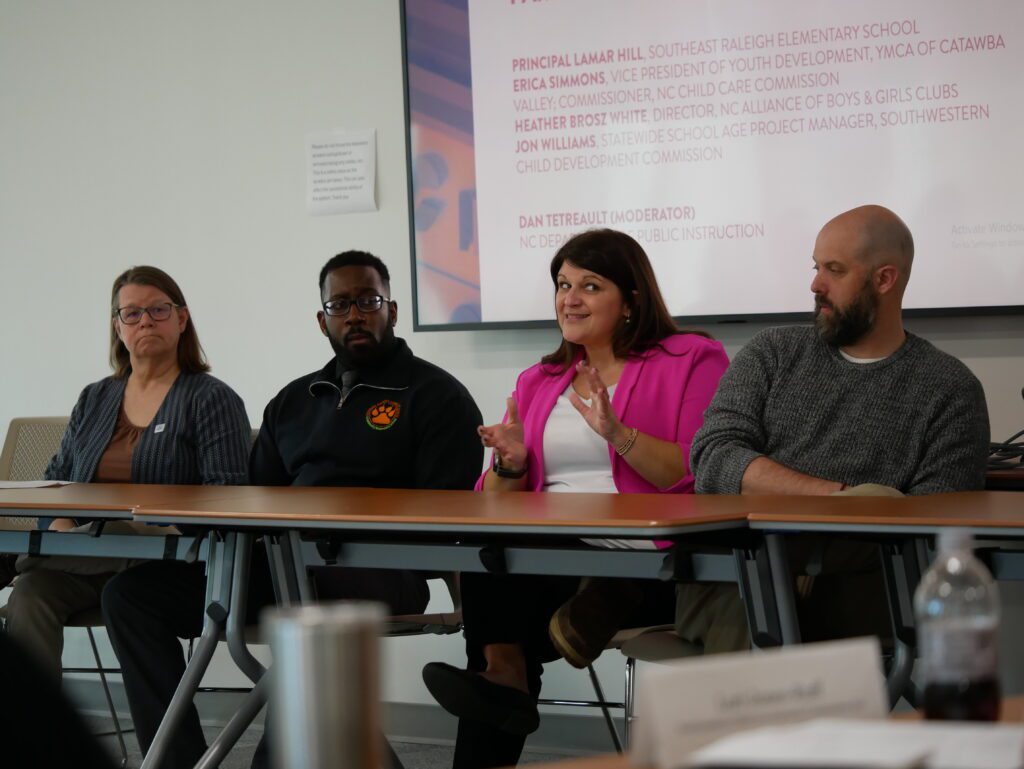
Erica Simmons, vice president of youth development at YMCA of Catawba Valley, shares her programs’ reach and barriers to that reach. (Liz Bell/EdNC)
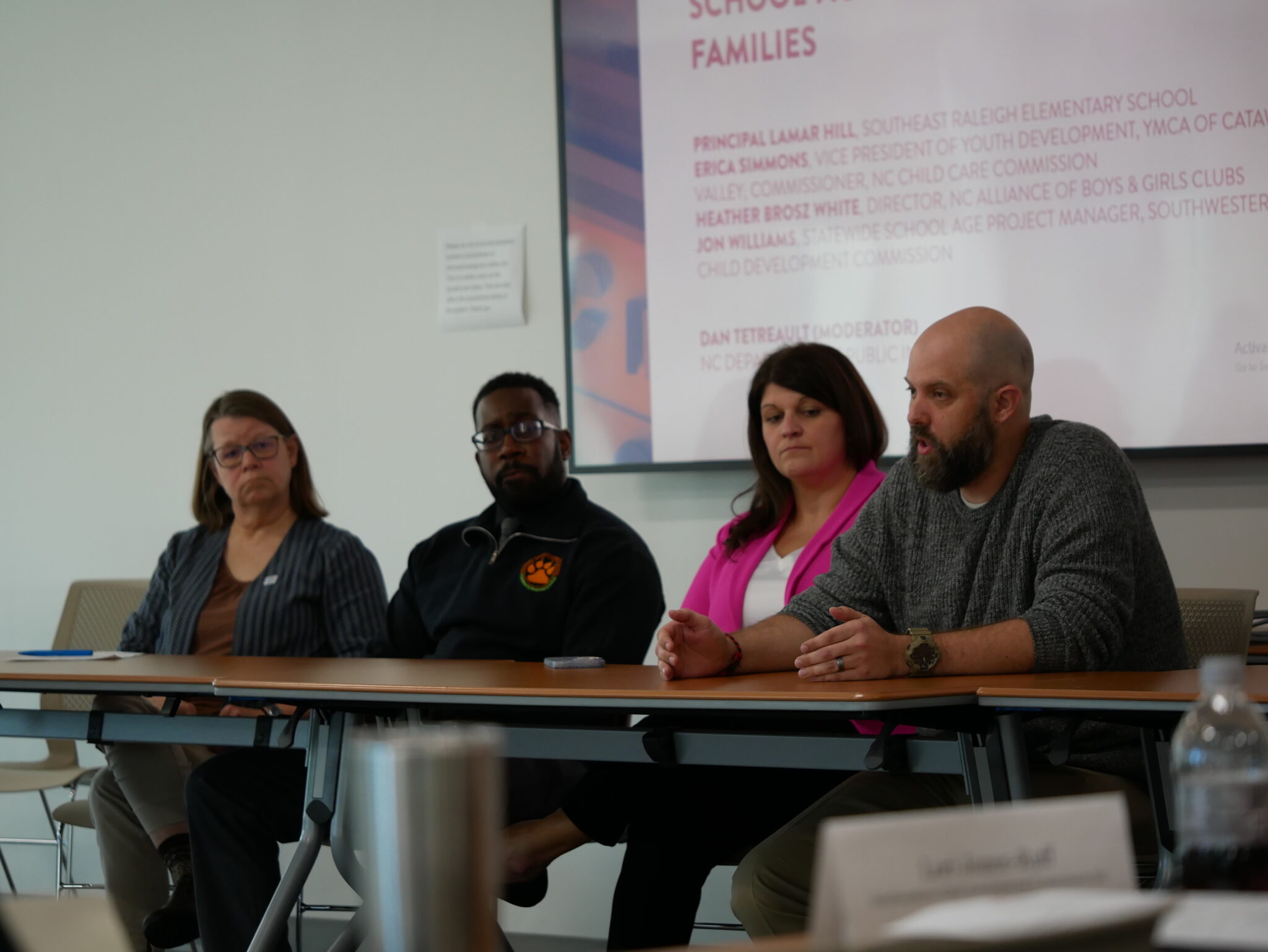
Families need care that works with their schedules and engages students in activities that support them academically and socially, said Elizabeth Anderson, executive director of the North Carolina Center for Afterschool Programs, a nonprofit under the Public School Forum of North Carolina. That requires funding, workforce supports, transportation, and creative partnerships, Anderson and a panel of providers said.
“The more we can create a spectrum of opportunities for birth through grade 12, the more that children and families in our state are going to recognize the positive economic impacts of those investments,” Anderson said.
Report due in December on child care solutions ahead of short session
The governor’s task force will release a report by the end of December with recommendations on how the state should expand access to high-quality, affordable child care. Stein formed the group earlier this year as pandemic-era child care funding ran out and advocates across the state and country called for consistent public investment to meet families’ needs.
The state legislature did not allocate new funding for child care this year and did not pass a new comprehensive budget. Some new funding, though lower than advocates’ and state officials’ requests, was included in budget proposals from Stein’s office and the House and Senate, but those proposals were not ultimately passed.
The main child care legislation that was passed made regulatory changes to loosen staffing requirements and allow providers to serve more children in classrooms with appropriate space and teacher-to-child ratios.
The task force will meet again in February, though a date is not yet set. Ahead of next year’s short session, members on Monday discussed what role the group should play in moving policy solutions forward, including six recommendations in the group’s interim report released in June:
Set a statewide child care subsidy reimbursement rate floor.
Develop approaches to offer non-salary benefits to child care professionals.
Explore partnerships with the University of North Carolina System, N.C. Community Colleges System, and K-12 public school systems to increase access to child care for public employees and students.
Explore subsidized or free child care for child care teachers.
Link existing workforce compensation and support programs for early childhood professionals into a cohesive set of supports.
Explore the creation of a child care endowment to fund child care needs.
As the state faces many funding requests, federal funding uncertainty, and slim tax revenue, members said more legislators need to be aware of the state’s child care crisis and why it’s relevant to the state’s economy and future.
“Maybe we have some more work to do around actually educating and engaging members of the General Assembly to get this on their radar and build more champions,” said Susan Gale Perry, CEO of Child Care Aware of America and task force member.
Funding to address issues of access, quality, and affordability is needed, members said, and considering existing funding streams rather than new ones might be more politically feasible in the short term.
“Certain proposals about, ‘Let’s just go raise taxes,’ are probably not going to be something that is going to get across the aisle agreement, but it does create the opportunity to looking at areas where tax rates are already set, or certain revenue streams are already existing,” said Mary Elizabeth Wilson, task force member and the Department of Commerce’s chief of staff and general counsel.
Mary Elizabeth Wilson, task force member and the Department of Commerce’s chief of staff and general counsel, shares considerations for 2026. (Liz Bell/EdNC)
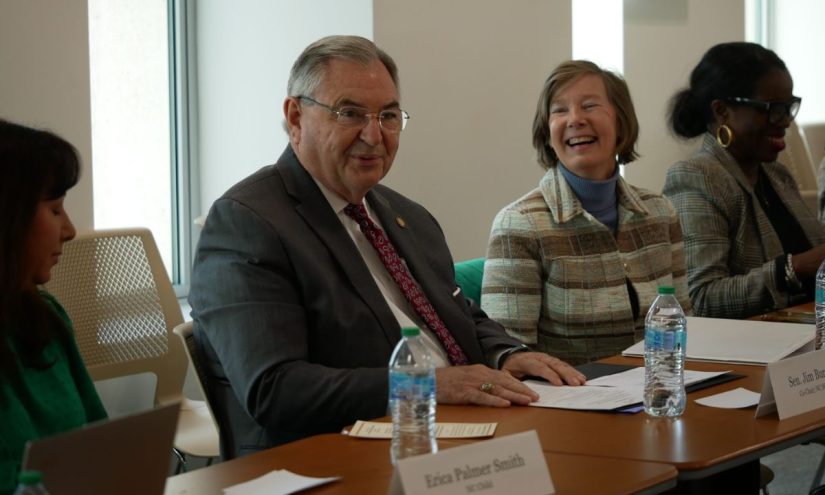
Sen. Jim Burgin, R-Harnett, who chairs the task force along with Lt. Gov. Rachel Hunt, said he and other legislators will be introducing legislation that would double the tax rates on sports gambling.
“If it’s for the children, everybody needs to support it,” Burgin said. “And I don’t believe in gambling … I’m doing it because we need the money.”
Child care fixes would also increase tax revenue, said Erica Palmer-Smith, executive director of nonprofit NC Child and task force member.
“(The generated revenue) would more than cover the overall cost that we would need to put in in the long run to fix the child care system,” Smith said.
‘The gap between 3 and 6 and between May and August’
Many families either do not have an after-school program nearby, do not have transportation to programs, or cannot afford programs, Anderson said in a presentation to the group Monday.
In 2025, 188,295 children participated in after-school programs, but 664,362 additional children would have if they had access, according to the presentation.
Programs are funded through a mix of private grant funding, public funding, and parent tuition. The two biggest funding sources are from the federal government: the Child Care Development Fund, which funds child care subsidies for young children and school-age children up through 12 years old, and 21st Century Community Learning Centers through the Department of Public Instruction.
After-school programs exist in all different types of facilities — community-based organizations, schools, faith-based organizations, and child care centers and home-based programs. Anderson described these programs as “folks stepping in to fill the gap between 3 and 6 and between May and August.”
Students benefit when they access out-of-school programs, she said. In the case of the 21st Century Community Learning Centers, 72% improved their attendance in the 2023-24 school year, 75% of students had decreased suspensions, and 90% improved their overall engagement in school.
Elizabeth Anderson, executive director of the North Carolina Center for Afterschool Programs, provides an overview of the demand for school-age care across the state. (Liz Bell/EdNC)
Anderson said the skills employers are seeking align with those that children are gaining from after-school programs, like problem-solving, teamwork and collaboration, communication, and leadership.
“We know that our after-school programs are an important place where children get to interact with one another and interact with mentors and positive adult figures that help them build these skills, which ultimately help them to become more successful, independent earners in the future,” she said.
Like child care programs in the early years, after-school programs not only help children, but allow parents to work. In a survey from the national report, 91% of parents said these programs help them be able to keep their job.
Families face particular challenges in the summer months. A national survey from LendingTree of more than 600 parents found this year that 66% of parents who seek summer care struggle to afford it, and 62% had taken on debt to pay for summer care.
Anderson said more conversations on child care should extend beyond the early childhood period. She pointed to research from the University of California that found educational and occupational attainment improvements were higher when children had access to both early care and education and out-of-school care once they entered school.
“It is something that parents need and want,” she said. “I think that we talk a lot about what happens for children birth to 5, but a child does not turn 5 years old and suddenly not need opportunity.”
Subsidy funding and reform would help, experts say
North Carolina is one of 23 states that does not have state level funding for after-school care, Anderson said. Anderson and panelists said funding is needed to retain teachers, increase access, provide transportation, and help families afford care.
Jon Williams, manager of the statewide School-Age Initiative at the Southwestern Child Development Commission, is focused on increasing the quality of out-of-school care across the state. He said the transient nature of school-age professionals disrupts consistency for children, families, and programs. A burdensome orientation process creates challenges for owners and directors constantly onboarding new people.
Williams said business training for after-school program directors would be helpful. Many have educational backgrounds and lack the business expertise to be successful in a challenging environment.
“They don’t have that financial background that is needed to run a business, and that creates a lot of financial instability,” Williams said. “If they don’t know how to orient or get new staffing in, that creates a huge problem.”
Jon Williams, manager of the NC School Age Initiative at the Southwestern Child Development Commission, says providers need funding and business training to improve the stability and quality of school-age care. (Liz Bell/EdNC)
A policy change that several panelists and task force members raised as a need is to align the eligibility requirements for child care subsidies across age groups. Right now, families who earn less than 200% of the federal poverty line are eligible for child care subsidies when their children are 5 years old or younger. But for school-age children, the threshold lowers: families must make less than 133% of the poverty line.
That disrupts care for families whose children need after-school care going to kindergarten or for families with multiple children of different ages who would prefer to send all of their children to one program.
A statewide subsidy floor, which is one of the policy priorities of the task force, would also help school-age care providers, said Erica Simmons, vice president of youth development at YMCA of Catawba Valley.
The floor would raise the per-child rate that child care programs receive to the state’s average rate. In cases where programs receive more than the average rate, they would continue receiving the same amount.
“(The floor) would make it a little more equitable,” Simmons said.
She said it costs similar amounts to provide care at her licensed programs in rural and urban communities. But the subsidy rates are much lower in rural areas.
“We have the same requirements for staff, we have the same programming requirements,” she said. “There’s no difference in the amount that we spend per program as an organization. However, there is a very big difference in what we are able to capture for subsidy. So there’s a big funding gap.”
Williams said there was a gap of $8,000 for one program just last month between the cost of services and the subsidy reimbursement. Annually, some programs in her network accrue around $100,000 in funding gaps for caring for children through subsidy.
Burgin asks a question of after-school program experts. (Liz Bell/EdNC)
Programs also receive subsidy payments retroactively. Changing the timing of funding could relieve some of the financial burden from programs, Williams said.
“I get paid via subsidy after I provide the services, and that’s a huge problem if I’m already in the red,” he said.
“… When we think about the mental health of our administration and our directors, that just adds fuel to the flame,” Williams said. “And it creates another gap, a 30-day gap, where I can say, ‘I can’t do this anymore,’ and then that care drops off. So we have to rethink how we get that money out in the state. We have to rethink the rates at which they are given.”
Panelists also shared that liability insurance rates have risen drastically. Williams said her program’s rates have increased by 44% over the last year, a trend among child care providers overall. A 2024 survey from the National Association for the Education of Young Children (NAEYC) found 80% of respondents saw their liability insurance costs increase in the last year and 62% reported difficulty finding or affording it.
Updates on care for public employees, workforce supports, and funding models
The task force has been split up into three subgroups which have been studying how to move toward the group’s six recommendations.
Samantha Cole, child care business liaison at the Department of Commerce, said a subgroup focusing on expanding child care access for public employees has looked at models across K-12, community college, and UNC-system schools to create child care solutions.
“We really see that there have been a lot of successes that have come about in these three examples and others, but they’re hyperlocalized,” Cole said. More external communication is needed for other campuses to understand how and why peer institutions are offering child care.
Madhu Vulimiri, senior advisor for health and families policy for Stein’s office, said the subgroup focused on workforce compensation and supports has been studying strategies to ensure early childhood teachers have access to non-salary benefits like health insurance.
They have studied the possibility of adding early childhood teachers as an eligible population for the State Health Plan, subsidizing ACA marketplace premiums through state dollars, and educating early childhood providers about the recently launched Carolina Health Works, which offers options for groups of small businesses.
The group is also studying how existing workforce supports like TEACH scholarships, child care academies, and apprenticeships could be more seamlessly tied together to strengthen the early childhood profession. They have requested that the Hunt Institute create a map to demonstrate what supports are available in what counties.
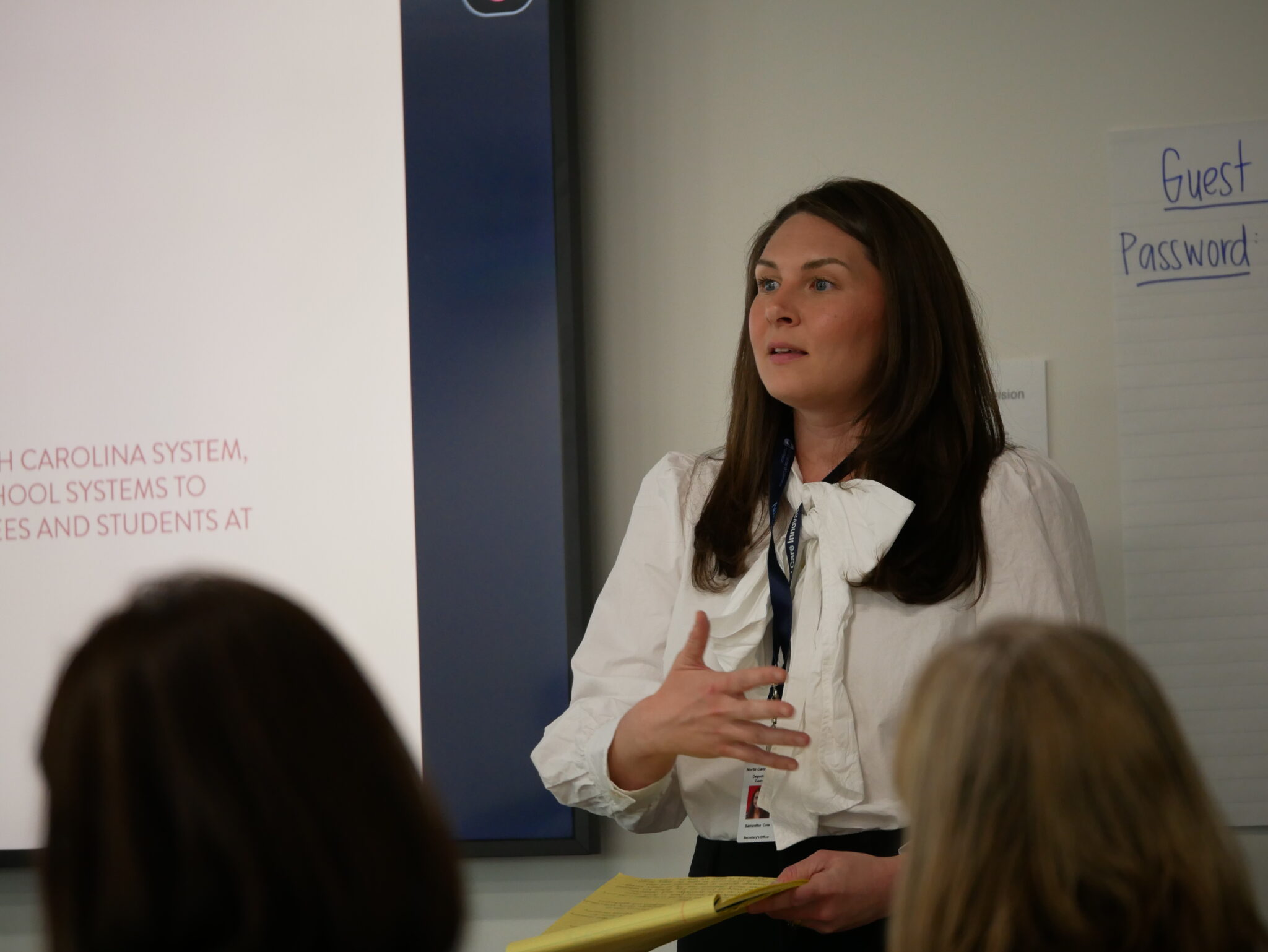
Samantha Cole, child care business liaison at the Department of Commerce, says some schools and colleges across the educational continuum have built models to provide child care specific to their local needs and resources. (Liz Bell/EdNC)
“That will help us see more holistically, where do we have resources and where are there gaps, and help us hopefully target future resources that we might have to expand those statewide,” Vulimiri said.
The third group, which is focused on financing, has been studying several states’ approaches to endowments and other funding mechanisms for child care, including Nebraska, Connecticut, Arizona, Montana, and Washington, D.C. They aim to develop a paper that weighs the options for North Carolina and analyses costs and benefits of each.
Seventy years have passed since Rosa Parks refused to surrender her seat on a Montgomery bus, and yet the country still tries to shrink her into that single moment — a tired seamstress who’d simply had enough.
Detroit, the city where she chose to continue her life, insists on remembering her differently. Not as an icon frozen in time, but as a Black woman whose lifelong organizing stretched from sexual violence cases in rural Alabama to open housing fights on Detroit’s west side.
That fuller story — truth beyond the myth — is exactly what the Rosa Parks Scholarship Foundation has fought to tell for 45 years.
The Rosa Parks Scholarship Foundation (RPSF) has awarded more than $3 million in scholarships to more than 2,250 high school seniors since its founding by The Detroit News and the Detroit Public Schools (DPS) in 1980.
“Most people actually don’t know the story of Rosa Parks,” said Dr. Danielle McGuire, RPSF board member, historian and author of “At the Dark End of the Street”, whose research permanently shifted how historians write about Parks and the civil rights movement. “She’s so much more interesting, so much more radical, and so much more involved in all kinds of things that we forget about. We keep her stuck on the bus in Montgomery in 1955.”
According to Kim Trent, a Detroit civic leader and former board president, the foundation, created through a racial discrimination lawsuit settlement involving Stroh’s Brewing Company, became one of the rare instances where federal accountability for racism produced long-term investment in Black futures.
A judge, DPS and The Detroit News agreed the money should honor Parks — who was living in Detroit and working for Rep. John Conyers at the time — by funding scholarships for Michigan students devoted to service and social change.
It is a statewide program, reaching students from Detroit to Grand Rapids to rural school districts where scholarship dollars often determine whether higher education is possible at all.
That framing makes her legacy active, not ceremonial.
“As part of her family, I feel grateful to be able to work together with my fellow board members to keep fighting for more opportunities to continue to provide scholarships,” said Erica Thedford, Parks’ great-niece and a foundation trustee. “I think Auntie Rosa would be extremely proud of what the Foundation has been able to achieve.”
The numbers tell one story — more than 1,000 scholars, millions awarded, forty $2,500 scholarships each year — and the essays tell another. Applicants must identify a modern social issue and explain how they would confront it using principles Parks embodied: discipline, non-negotiable dignity, community before self.
“Reading the essays of the students who apply is a great reminder that each person doing one act, no matter how small, creates a stronger network of love and kindness,” Thedford said. “Some of these students come from extreme hardship and still find the time and resources to volunteer at food banks, shelters… Some even take it upon themselves to be the organizer of ways to help the less fortunate at their schools.”
The award is one-time, not renewable, yet its impact stretches across decades.
“Once you become a Rosa Parks Scholarship Foundation recipient, you are a Rosa Parks Scholar for life,” Thedford said. “These students are now part of a network of people who root for each other, and that kind of support system is important.”
Trent knows that firsthand: She was a Parks Scholar herself when she graduated from Cass Tech High School.
“I received the scholarship in 1987,” she said. “Ironically, not only did I get it, but my best friend… also received the same scholarship. And then her son got the scholarship like 30 years later.”
Trent said the scholarship’s origin mirrors Parks’ life — created in response to injustice and sustained through community action.
“It’s one of those rare occasions where something beautiful grew out of an instance of racism and oppression,” Trent said.
Over the years, some Parks Scholars attended community college. Others enrolled at flagship universities. All had to articulate how their education would serve a community beyond themselves.
Some, like Emmy-winning actor Courtney B. Vance, who’s from Highland Park, Michigan, went on to shape national culture. Others are now attorneys, educators and nonprofit leaders across the state.
“What gets lost in what she did is the reason she did it,” Trent added. “It wasn’t just so she could sit on a bus. It was because she was trying to open up opportunity for people who had been denied opportunity.”
That is the heartbeat of the foundation’s lineage.
Parks was not simply resisting segregation. She was rejecting the entire machinery that kept Black women from safety, education and economic autonomy.
McGuire’s research highlights how Rosa Parks was investigating sexual violence cases long before #MeToo, defending Black girls like Recy Taylor, whose voices were dismissed in courtrooms and newspapers. She worked alongside the NAACP on equity cases. When she left Alabama under threat of death and moved to Detroit, she became the neighbor who knew everyone’s children, the church member who attended every meeting, the woman who collected information and names and needs.
“She was the person in the neighborhood who knew all the kids, who worked in almost every community organization you can imagine, to make life better for her people,” McGuire said. “The scholarship foundation is an example of that — just one of many.”
Every year, nearly 400 applicants encounter that fuller history — the Parks who fought for open housing in Detroit, who believed in Black self-determination, who, as McGuire notes, “never stopped fighting for equality and justice for people who didn’t have a voice that was being heard.”
That is not accidental. It is by design.
“We ask our applicants to become familiar with Rosa Parks and the tactics and strategies she used to make changes in her community and how they will do the same,” McGuire said. “I think it gives them hope. It links them to a tradition and a history of hope and change.”
This anniversary of Parks’ arrest arrives as school boards strip Black history from K-12 classrooms and as scholarship programs for marginalized students come under attack. Thedford sees the foundation’s work as a refusal.
“During this time, when we are hearing of funding being pulled from schools and programs that are needed to serve our youth, the Foundation is able to continue its provision of funds,” she said.
McGuire is blunt about what that represents:
“No matter how hard people try to cancel the past, the past is very much alive,” she said. “Rosa Parks’ history gives us so much honesty about America… and studying her is paramount to getting through any difficult time.”
Seventy years later, the lesson remains unchanged: Rosa Parks did not fight for a place to sit, she fought for the generations who would rise. Today, those students are still applying, still studying her strategies, still refusing to yield.
Some families enrolled in the Idaho Home Learning Academy public virtual charter school used state funding to pay for virtual reality headsets, hoverboards, hunting equipment, video games and video game controllers, paddleboards, smart watches, admission tickets to water parks and subscriptions to streaming services like Netflix and Hulu, according to a new state watchdog report released Tuesday.
OPE released the evaluation report after multiple Idaho legislators signed a March 5 letter requesting the office study the Idaho Home Learning Academy’s finances, expenditures, policies, contracts and student achievement results.
The Idaho Home Learning Academy, or IHLA for short, is a rapidly growing public virtual charter school authorized by the small, rural Oneida School District.
There were about 7,600 online students enrolled at Idaho Home Learning Academy during the 2024-25 school year, many of which do not live within the traditional geographic boundaries of the Oneida School District.
New report raises questions about how supplemental learning funds are used by some families
As part of Idaho Home Learning Academy’s contract, its education service providers administer supplemental learning funds of $1,700 to $1,800 per student to families enrolled in IHLA that were paid for by Idaho taxpayer dollars, the report found. The money is intended to help pay families for education expenses, and the OPE evaluators found that the largest share of the funds were spent on technology expenses, such as computers, printers and internet access. Other significant sources of supplemental learning fund expenses went for physical education activities and performing arts expenses, the OPE report found.
However, OPE evaluators found that some families used their share of funding for tuition and fees at private schools and programs. Some families also used their funds for noneducational board games, kitchen items like BBQ tongs, cosmetics, a home theater projector screen, video games, Nintendo Switch controllers, a Meta Quest virtual reality headset, movie DVDs, weapons, sights lasers, shooting targets, remote controlled cars, hoverboards, action figures, smartwatches, water park tickets and the cost of registering website domain names, the OPE report found.
Families with students enrolled at Idaho Home Learning Academy are able to access the funds though both direct ordering programs and reimbursements. The OPE report found that Idaho Home Learning Academy’s three service providers (Braintree, Home Ed and Harmony) spent about $12.5 million providing supplemental learning funds for IHLA families during the 2024-25 school year. Service providers said that some families did not spend any or all of their supplemental learning funds, and the money was retained by the service providers, not returned back to the state or school district, the OPE report found.
Idaho governor, superintendent of public instruction respond to OPE report’s findings
Idaho Gov. Brad Little called the report’s findings “troubling” in a letter released with the report Tuesday.
“We also have an obligation to be responsible stewards of taxpayer dollars,” Little wrote. “The OPE report on IHLA is troubling, especially as it pertains to supplemental learning fund expenses, academic performance, supplemental curriculum and the funding formula that enables virtual programs to receive more funding than brick-and-mortar public schools. The OPE report reveals that statutory safeguards are insufficient, oversight is inconsistent and accountability measures have not kept pace with the fast expansion of the IHLA program.”
The OPE evaluation report findings come at a time when every dollar of state funding in Idaho is being stretched further amid a revenue shortfall. All state agencies outside of the K-12 public school system are implementing 3% mid-year budget holdbacks, and the state budget is projected to end fiscal year 2026 and fiscal year 2027 in a budget deficit, the Idaho Capital Sun previously reported.
Idaho Superintendent of Public Instruction Debbie Critchfield said the report raised concerns for her as well.
“(The OPE report) also raises important questions about whether direct and indirect payments to families are a proper and legal use of funds appropriated for public schools,” Critchfield wrote in a Nov. 26 letter to OPE leadership.
The OPE evaluation report found that limited oversight and accountability create uncertainty about how supplemental learning funds paid for with state taxpayer dollars are used and whether students’ curriculum choices align with state standards and transparency requirements.
Idaho state laws and administrative rules do not specifically allow or prohibit the use of supplemental learning funds, the OPE report found. That finding was one of several “policy gray areas” that the OPE evaluation report documented.
Little concluded his letter by saying he is ready to work with the Idaho Legislature, the Idaho State Department of Education and the Idaho State Board of Education to restore meaningful accountability for the use of taxpayer dollars.
“I have carefully reviewed the recommendations provided in this report and strongly encourage the Legislature to address the loopholes in state statute,” Little wrote.
Oneida School District superintendent stresses Idaho Home Learning Academy did not break state law
In response to the OPE report, Oneida School District Superintendent Dallan Rupp, who is also a member of the Idaho Home Learning Academy School board, emphasized that the report did not find that IHLA was guilty of any misconduct.
“Importantly, the OPE report did not identify any misconduct at IHLA,” Rupp said during a meeting Tuesday at the Idaho State Capitol in Boise. “This outcome underscores the effectiveness of Oneida School District’s oversight and reflects IHLA’s consistent compliance with Idaho’s laws, statutes, rules, regulations and procedures, as well as its cooperative relationship with the Idaho State Department of Education. We remain fully committed to operating within all established guidelines, just as we have in the past.”
Idaho Sen. James Ruchti, D-Pocatello, said it was beside the point that the school didn’t break any laws.
“I’m extremely concerned,” Ruchti said during Tuesday’s meeting at the Idaho State Capitol in Boise. “This is public money – public taxpayer money – and we have an obligation to make sure that it’s spent appropriately and with oversight. And so, yes, it may not have violated any statutory requirements at this point. But what I’m saying is that what I saw in that presentation caused me serious concerns about how IHLA and other online teaching institutions are able to spend public dollars in a way that was not intended.”
Idaho watchdog report found most online virtual teachers were part-time employees
OPE also found that most Idaho Home Learning Academy teachers were part-time, unlike traditional schools, and the Idaho Home Learning Academy spends much less on salaries and benefits than it receives from the state’s salary apportionment formula.
The report found IHLA was able to use the savings it realized in state funding provided to pay for staff salaries and health benefits to instead use at IHLA’s discretion or to pay its education service providers.
The OPE report found that most of IHLA’s teachers are part-time employees and do not provide full-time direct instruction to students. Instead, the report found that Idaho Home Learning Academy’s kindergarten through eighth grade instructional model relied heavily on parent-directed learning and that IHLA teachers typically offered feedback and oversight instead of direct instruction.
According to the report, IHLA reported $46.3 million in total expenditures from state funds during the 2024-25 school year. While traditional brick-and-mortar public schools’ largest expenditures are for staff salaries and benefits, the report found that only 36% of IHLA’s expenditures went to staff. A larger portion – 45% of IHLA’s total expenditures, or $20.6 million – went to paying education service providers.
The OPE report also found that Idaho Home Learning Academy’s students lagged behind statewide averages for scores on Idaho Standards Achievement Test, or ISAT. The OPE report found 42% of IHLA students were proficient in English language arts during the 2024-25 school year, compared to the statewide average of 52% of Idaho students.
The report also found just 25% of IHLA students were proficient in math during the 2024-25 school year, compared to the Idaho statewide average of 43%.
However, the OPE report highlighted that some IHLA families interviewed for the report said they do not believe statewide standardized tests are a good measure of student learning. The report also noted that many Idaho Home Learning Academy families identified themselves as homeschoolers and said they were using IHLA by choice because they were unhappy with the quality of education in traditional brick-and-mortar schools or felt that their child’s educational needs were not being met by more traditional public schools.
Idaho Capital Sun is part of States Newsroom, a nonprofit news network supported by grants and a coalition of donors as a 501c(3) public charity. Idaho Capital Sun maintains editorial independence. Contact Editor Christina Lords for questions: [email protected].
Did you use this article in your work?
We’d love to hear how The 74’s reporting is helping educators, researchers, and policymakers. Tell us how
The committee that advises on national vaccine policy today overturned a decades-long recommendation that newborns be immunized for hepatitis B, a policy credited with nearly eliminating the highly contagious and dangerous virus in infants.
The decision came in an 8-3 vote from the committee that has been handpicked by Health and Human Service Secretary Robert F. Kennedy Jr., a long-time vaccine skeptic. It followed three previous failed attempts to vote on the measure and two days of contentious, confused hearings that further undermined the group’s credibility.
Amy Middleman, a longtime committee liaison and a University of Oklahoma pediatrics professor, said it was the first time the committee “is voting on a policy that, based on all of the available and credible evidence … actually puts children in this country at higher risk — rather than lower risk — of disease and death.”
Susan J. Kressly, the president of the American Academy of Pediatrics, which is continuing to recommend the hepatitis B vaccine at birth, called the committee’s guidance “irresponsible and purposely misleading” and said that it will bring about more infections in infants and children.
“This is the result of a deliberate strategy to sow fear and distrust among families” she said.
The members of the Advisory Committee on Immunization Practices, known as ACIP, who voted in favor of the new guidance said the universal birth dose, first introduced in 1991, had likely played a small role in the reduction of acute cases and noted that the country’s policy was an outlier when compared to those of peer nations, which have more targeted approaches. They also raised concerns about the safety of the vaccine, arguing there were insufficient trials done, a claim that has been widely debunked.
The committee’s new recommendations still include a dose of the vaccine within the first 24 hours of life for infants born to hepatitis B-positive mothers. But for those born to mothers testing negative, they recommend “individual-based decision-making, in consultation with a health care provider” to decide “when or if” to give the vaccine.
Removing the universal birth dose “has a great potential to cause harm,” dissenting committee member Joseph Hibbeln said, “and I simply hope that the committee will accept its responsibility when this harm is caused.”
The committee also voted to upend the rest of the schedule for the hepatitis B vaccine, which is required for school attendance in the vast majority of states and historically included three doses in an infant’s first year. Now, after the first dose, parents will be encouraged to ask their doctors to check infants for a sufficient immune response before proceeding with any future doses, a practice that currently lacks any scientific evidence, according to vaccine experts.
The recommendation now heads to Jim O’Neill, the acting head of the Centers for Disease Control and Prevention, newly installed after September’s ousting of the previously confirmed director, who said she resisted Kennedy Jr.’s demands to pre-approve vaccine recommendations and fire career scientists.
O’Neill’s decision could impact not only the vaccine’s availability, but also its accessibility, since both public and private health insurers look to these policies to determine coverage.
“The American people have benefited from the committee’s well-informed, rigorous discussion about the appropriateness of a vaccination in the first few hours of life,” O’Neill said in a statement Friday.
Rochelle Walensky is the former CDC director and is now a Harvard University medical professor. (Harvard T.H. Chan School of Public Health)
Former CDC director Rochelle Walensky, now a Harvard University medical professor who recently co-authored a paper on the importance of the hepatitis B birth dose, projected that eliminating it for infants whose mothers test negative will raise the number of newborn hepatitis B cases by 8% each year.
“We rely on an infrastructure of vaccines not only to protect ourselves and our children, but to protect our communities and one another,” Walensky said. “Today’s meeting was just another one of those chisels in the infrastructure.”
Paul Offit, the director of the Vaccine Education Center and an attending physician in the Division of Infectious Diseases at Children’s Hospital of Philadelphia, referred to the committee as “a clown show” in an interview on CNN Friday morning.
“Honestly, it’s a parody of what this committee used to be,” he said. “It’s hard to watch, and for those of us who care about children, it’s especially hard to watch.”
Offit said he doubted that the committee understood how hepatitis B was transmitted in young children — half the time through the mother during childbirth but just as often through casual contact with someone who was chronically infected and didn’t know it. About 50% of the millions of Americans infected with hepatitis B are unaware of it.
“By loosening the [immunization] reins, you are just putting children in harm’s way,” Offit said.
The hepatitis B vaccine was first recommended by ACIP in 1982. Before that point, an estimated 200,000 to 300,000 people, including about 20,000 children, were infected with the highly contagious virus each year.
This was particularly dangerous for infants who have a 90% chance of developing liver cancer or chronic liver disease, if they contract the virus. For 4- and 5-year-olds, that chance remains high at 30-40%.
Committee members argued the guidance change reflected a return to pre-1990s policies that focused on a targeted approach, rather than a universal one. A number of them said that these earlier practices were successful and sufficient in cutting hepatitis B rates, a claim other experts — including those at the CDC — refuted.
In a departure from typical practices, presentations on disease rates and safety concerns at the hearing were not given by CDC subject-matter experts, but instead were led by a climate researcher and a known anti-vaccine activist, who authored a since-retracted paper on the impact of rising autism rates.
Amy Middleman, a pediatrics professor at the University of Oklahoma. (University of Oklahoma)
When one CDC hepatitis B expert was invited to weigh in during a question-and-answer period, he expressed concern about the presented research and emphasized the lack of evidence to support the committee’s changes. Middleman jumped in at one point to correct the committee when it misinterpreted “the conclusions of my own study.”
Throughout the meeting, Kennedy Jr.’s appointees spoke about the importance of protecting parents’ rights, seemingly pitting this against public health policy.
“My personal bias is to err on the side of enabling individual decision making and individual rights over the right [of] the collective,” said Robert Malone, the committee’s vice chair who led the meeting since newly appointed chair Kirk Milhoan, a cardiologist and critic of the COVID vaccine for children, was unavailable to attend in person.
Earlier this year, the committee also voted to change policies surrounding the measles, mumps, rubella and varicella (chickenpox) combination vaccine and this year’s COVID 19 booster.
Historically, committee members were highly qualified medical professionals, vetted for months to years before serving. But, in an unprecedented upheaval in June, Kennedy Jr. fired all 17 existing advisory members via a Wall Street Journal op-ed — after promising he would leave the committee’s recommendations intact — and hastily replaced them.
Many of the new members have espoused anti-vaccine rhetoric and other scientific misinformation and a number of them do not have medical degrees or significant experience in the field.
Cody Meissner, a professor at Dartmouth’s Geisel School of Medicine and the only committee member to have previously served, also opposed the guidance change.
Cody Meissner is a professor at Dartmouth’s Geisel School of Medicine. (Dartmouth College)
“We’ve heard ‘do no harm’ is a moral imperative,” he said. “We are doing harm by changing this wording, and I vote no.”
The committee vote was the latest in a wave of policy changes, firings and general chaos at the CDC and HHS that have alarmed experts since Kennedy Jr. took charge almost a year ago.
Last week, the Food and Drug Administration’s chief medical and scientific officer released an unsupported memo claiming COVID-19 vaccinations had contributed to the deaths of at least 10 children. Last month, Kennedy Jr. ordered CDC staff to change information on their website to promote a link between vaccines and autism, a widely discredited theory that he has promoted for years.
According to Offit, the negative impacts are already being seen: This year tallied the greatest number of measles cases (1,828) since it was declared eliminated in 2000, the majority of which were in unvaccinated children, two of whom died. It marked the first pediatric measles deaths since 2003.
There have also been nearly 300 childhood flu deaths — among predominantly unvaccinated kids — the most seen since the country’s last flu pandemic and whooping cough cases are surging in some states. The highly contagious respiratory infection, prevented through the DTaP vaccine, has killed three unvaccinated infants in Kentucky.
Did you use this article in your work?
We’d love to hear how The 74’s reporting is helping educators, researchers, and policymakers. Tell us how
As someone who’s dedicated my career to advancing the Science of Reading movement, I’ve seen firsthand what it takes to help every child become a strong, fluent reader. We’ve made incredible strides in shifting the conversation toward evidence-based instruction, but I know we’re at a critical inflection point. While we–obviously–continue our work helping schools and districts adopt SOR, there’s an issue that stands in the way of real, sustained, progress: the staffing crisis and leadership churn that are leaving our educators overwhelmed and skeptical toward “change.” Without addressing these deeper structural issues, we risk stalling the momentum we’ve worked so hard to build.
The hidden costs of constant turnover
The data on teacher and leader turnover is bleak, and I’ve seen how it undermines the long-term commitment needed for any meaningful change. Consider this: Roughly 1 in 6 teachers won’t return to the same classroom next year, and nearly half of new teachers leave within their first five years. This constant churn is a massive financial burden on districts, costing an estimated $20,000 per teacher to recruit, hire, and onboard. But the real cost is the human one. Every time a new leader or teacher steps in, the hard-won progress on a literacy initiative can be jeopardized.
I’ve watched districts spend years building momentum for the Science of Reading, providing extensive training and resources, only to see a new superintendent or principal arrive with a new set of priorities. This “leader wobble” can pull the rug out from under an initiative mid-stream. It’s especially frustrating when a new leader decides a program has had “plenty of professional learning” without taking the time to audit its impact. This lack of continuity completely disrupts the 3-5 years it takes for an initiative to truly take hold, especially because new teachers often arrive with a knowledge gap, as only about one-quarter of teacher preparation programs teach the Science of Reading. We can’t build on a foundation that’s constantly shifting.
Overwhelmed by “initiative fatigue”
I know what it feels like to have too much on your plate. Teachers, already juggling countless instructional materials, often see each new program not as a solution but as one more thing to learn, implement, and manage. Instead of excitement, there’s skepticism–this is initiative fatigue, and it can stall real progress. I’ve seen it firsthand; one large district I worked with rolled out new reading, math, and phonics resources all at once.
To prevent this, we need to follow the principle of “pull weeds to plant flowers.” Being critical, informed consumers of resources means choosing flowers (materials) that are:
• Supported by high-quality, third-party research • Aligned across all tiers of instruction • Versatile enough to meet varied student needs • Teacher-friendly, with clear guidance and instructional dialogue • Culturally relevant, reflecting the diverse backgrounds of students
Now, even when a resource meets these standards, adoption shouldn’t be additive. Teachers can’t layer new tools on top of old ones. To see real change, old resources must be replaced with better ones. Educators need solutions that provide a unified, research-backed framework across all tiers, giving teachers clarity, support, and a path to sustainable student progress.
Building a stable environment for sustained change
So, how do we create the stable environment needed to support our educators? It starts with leadership that is in it for the long game. We need to mitigate turnover by using data to understand why teachers are leaving and then acting on that feedback. Strengthening mentorship, clarifying career pathways, and improving school culture are all crucial steps.
Beyond just retaining staff, leaders must foster a culture of sustained commitment. It’s not enough to have a few “islands of excellence” where a handful of teachers are getting great results.
We need system-wide adoption. This requires strong leaders to balance support and accountability. I’ve seen how collaborative teams, engaged in problem-solving and data-based decision-making, can transform a school. When teachers see students as “our students” and not just “my students,” shared ownership grows.
A leader’s job is to protect and sustain this vision, making sure the essential supports–like collaborative planning time, ongoing professional development, and in-classroom coaching–are in place. But sustaining change goes beyond daily management; it requires building deep capacity so the work continues even if leadership shifts. This means hiring, training, and retaining strong educators, investing in future leaders, and ensuring committed advocates are part of the implementation team. It also requires creating a detailed, actionable roadmap, with budgets clearly allocated and accountability measures established, so that any initiative isn’t just a short-term priority but a long-term promise. By embedding these structures, leaders can secure continuity, maintain momentum, and ensure that every step forward in literacy translates into lasting gains for students.