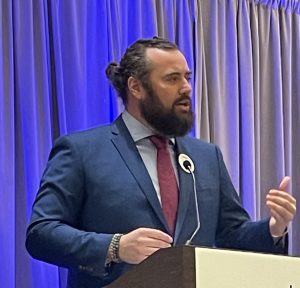
On his website, antizionist.net, Ramsi Woodcock asks fellow legal scholars to sign a “Petition for Military Action Against Israel.” He says Israel is a colony and war is needed to decolonize, and he calls for the war to continue until “Israel has submitted permanently and unconditionally to the government of Palestine everywhere from the Jordan River to the Mediterranean Sea.”
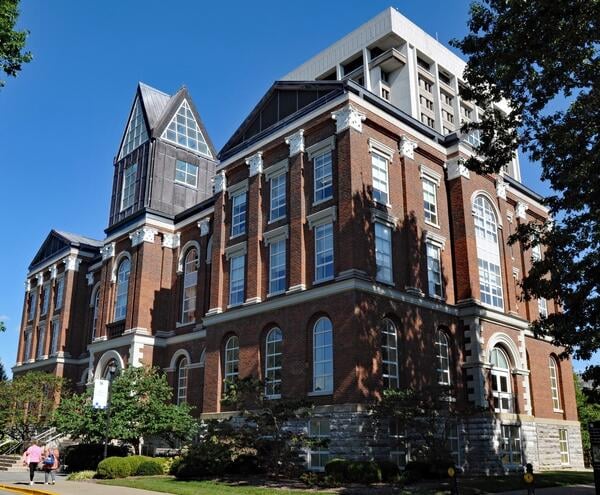
In his lawsuit, filed Thursday in U.S. District Court for the Eastern District of Kentucky, Woodcock asks a judge to order the university and top officials to restore his normal teaching and other duties, allow him back into the College of Law building, end the university’s investigation of him, and pay monetary damages. But he also asks the judge to order Education Secretary Linda McMahon to “refrain from requiring or using” the controversial International Holocaust Remembrance Alliance definition of antisemitism when enforcing Title VI of the Civil Rights Act of 1964.
The IHRA says antisemitism “might include the targeting of the state of Israel,” “comparisons of contemporary Israeli policy to that of the Nazis” or claims “that the existence of a State of Israel is a racist endeavor.” Earlier this year, Kentucky state lawmakers ordered public universities to use the IHRA definition in their policies combating antisemitism. Woodcock is also asking the judge to declare that that order violates the First Amendment.
His lawsuit alleges the state and federal actions are related to his “suspension,” saying the university’s tolerance of his speech “ended in summer 2025” after the federal government threatenedto withdraw funding from universities and moved to enforce the IHRA definition. He also cited the passage of thestate legislation that “enabled and pressured administrators to suppress speech critical of Israel and Zionism.”
The Education Department didn’t respond to requests for comment Friday. A university spokesperson said Woodcock hasn’t been suspended but was “reassigned pending the outcome of an investigation,” adding that the university will be “limited in our comments while that investigation is ongoing.”
In an email to Inside Higher Ed, Woodcock responded, “Israel is a colonization project that practices apartheid and is currently exterminating two million Palestinians in Gaza. The scandal is not that I am calling for immediate military action to end Israel but that the university is willing to violate our nation’s constitution in order to preserve Israel. Every American scholar has a First Amendment right to oppose Israel and I look forward to holding the university accountable for breaking the law.”
Leaders of faith-based colleges and universities have spoken out on a slew of political issues in recent months, sometimes standing alongside secular universities and at other times differentiating themselves and defending their unique standing and missions.
The Council for Christian Colleges and Universities and the Association of Catholic Colleges and Universities signed on to an October statement from the American Council on Education opposing the administration’s higher education compact, for example. Over the summer, CCCU also came out with a statement on the One Big Beautiful Bill Act that echoed those of secular associations and institutions, expressing concern that “it ultimately falls short in supporting student access and success.”
ACE’s Commission on Faith-Based Colleges and Universities was among the higher ed groups that lobbied hard against Pell Grant cuts, later dropped from the bill. At the same time, the University of Notre Dame and other faith-based institutions fought for an exemption for religious institutions from the higher education endowment tax, ultimately left out of the legislation’s final version.
Like their secular peers, faith-based colleges and universities have been buffeted by the rapid-fire policy changes roiling higher ed this year. Some leaders of religious colleges say their institutions are enjoying renewed support that they hope sets a precedent for future policymakers across party lines. At the same time, some advocates fear religious colleges—and their missions—are suffering collateral damage in Trump’s war against highly selective universities, and they’re making careful decisions about when and how to speak out.
“I knew change would be coming,” said David Hoag, president of CCCU, “but I never expected the pace to be this fast.”
Raising Concerns
Under any administration, CCCU’s job is to “make it possible for our institutions to achieve their missions,” Hoag said. But some recent policy changes pose an obstacle to that.
Christian colleges—which tend to be small, enrolling about 2,500 students on average—can’t afford to join Trump’s proposed compact for higher ed, he said. He believes some of the compact’s demands, such as freezing tuition for five years, are a tall order with campus expenses on the rise. He also opposes the compact’s standardized test mandate when so many Christian colleges offer broad access, and he’s concerned by the possibility that government could have some control over curriculum, though he said the compact was unclear on that score.
“On the curriculum side, most of our institutions are conservative. We have a solid Christian mission,” Hoag said. “I’m fine with civics being a part of some of the work that we do, but it, to me, starts to … step over academic freedom.”
Christian colleges are also balking at the new $100,000 fee for H-1B visas, which these institutions use to bring in visiting professors from other countries.
“Our institutions can’t afford anything like that,” Hoag said. Such a fee might be more easily affordable for tech or other industries that use H-1B visas to hire foreign employees, he said, “but for nonprofit colleges and Christian colleges, that’s a big financial burden.”
He’s also alarmed by some of the provisions in the One Big Beautiful Bill Act, including the requirement that programs prove students will earn more than high school graduates in order to access federal loans. Hoag worries that won’t bode well for institutions where a significant portion of students go into ministry, social work or other public service jobs that don’t necessarily pay high wages. He said the end of the Grad PLUS program is also poised to hurt Christian colleges; graduate students borrowed about $460 million annually to attend CCCU institutions, he said. Now he expects many will struggle to pay. Caps on loans for professional school students are also going to affect those earning master’s degrees in divinity.
Donna Carroll, president of the Association of Catholic Colleges and Universities, said Catholic institutions are hardly “immune” to the challenges rocking the rest of higher ed. She said her nonpartisan organization has decided to speak up on a particular set of policy issues, including financial aid and supports for low-income students, autonomy for faith-based institutions, and immigration policy and access for international students. For example, the association signed on to a statement by U.S. bishops condemning “indiscriminate mass deportation” as an “affront to God-given human dignity.”
“There are some issues and situations where there is consensus and a unity across Catholic institutions,” Carroll said. “There are other situations where different institutions have different perspectives.”
In a similar vein, Clark G. Gilbert, commissioner of the church educational system for the Church of Jesus Christ of Latter-day Saints and chair of the Commission on Faith-Based Colleges and Universities, said members of his coalition had mixed views on parts of the bill involving federal loans—he’d like to see colleges drop their prices—but they collectively pushed hard against proposed cuts to Pell Grants, which didn’t make it into the legislation.
“We’re concerned about first-generation and low-income students. That’s not a partisan issue,” Gilbert said.
‘Not Like Some of These Ivies’
A mounting frustration for some faith-based institution leaders is the blowback their campuses face from Trump administration policies targeting expensive, highly selective private universities, even though they view their missions as distinct.
Hoag pointed out that, while some Christian colleges are pricier, the average tuition costs about $30,600 per year, not including room and board, and the average tuition discount rate is about 52 percent.
“Christian schools are very affordable, and we’re not like some of these Ivies that have tuition from $80,000 to $100,000 a year,” Hoag said. Yet “I do feel that they’re … putting everybody in the same category.”
Some faith-based institutions, led by the University of Notre Dame, sought to distinguish themselves from other higher ed institutions when they pushed for a religious exemption from the One Big Beautiful Bill Act’s endowment tax.
Gilbert said Brigham Young University joined that effort because university leaders viewed the situation as a religious freedom issue.
“We feel like there are public goods of faith-based schools that are often ignored,” such as research from faith-based perspectives, he said. “Without the internal funding at these schools, it wouldn’t happen. We feel like there is a religious liberty issue at stake there.”
“I’m sure secular schools would feel their unique missions need that protection, too—that’s not my job to write and defend that,” he added.
Gilbert said he feels a particular need to advocate on behalf of religious colleges, compared to higher ed as a whole, because he believes faith-based institutions are too often maligned. He said such institutions are doing research on topics ignored by their secular counterparts—like how family structures affect intergenerational poverty or how faith and religious community resources affect health outcomes—but these projects struggle to get federal funding or recognition from secular peers. He also stressed that these institutions provide a campus climate religious students can’t find elsewhere.
“Many Jewish students do not feel safe at Columbia and at Harvard and at UCLA. Many LDS students do not feel welcome in certain programs,” he said. “Faith-based schools do feel like they need to preserve their rights.” He emphasized that doesn’t mean he wants to see any university lose out on cancer research funding, for example, but “faith-based scholars are doing things that no one else is doing, and why isn’t that getting the attention, the funding and the support, regardless of who the administration is?”
Despite their policy disagreements, some leaders of faith-based institutions believe the Trump administration is offering them a warmer reception than they’ve perhaps received in the past. The president issued an executive order in February founding a task force on eradicating “anti-Christian bias” within government. In May, Trump’s Education Department also rescinded a $37.7 million fine levied by the Biden administration on Grand Canyon University, a private Christian institution, for allegedly misleading doctoral students about its cost. And the Trump administration recently partnered with Hillsdale College, a conservative Christian campus in Michigan, on a series of videos for the country’s 250th anniversary. The president of Yeshiva University, Rabbi Ari Berman, gave the benediction at Trump’s inauguration.
Amid renewed outreach to faith-based institutions under Trump, Gilbert said he’s trying to walk a fine line, advocating for more attention and resources for faith-based institutions’ research but doing so in a way that remains apolitical.
“We don’t care about party politics. We care about the American family. We care about alleviating poverty,” he said. “We’re going to continue to help shine a light on the contributions these schools make in the current climate, but not so overboard that when things may change, and they will, that we can’t make the same arguments using the same principles with a different administration.”
Sense of belonging is a significant predictor of student retention and completion in higher education; students who believe they belong are more likely to bounce back from obstacles, take advantage of campus resources and remain enrolled.
For community colleges, instilling a sense of belonging among students can be challenging, since students often juggle competing priorities, including working full-time, taking care of family members and commuting to and from campus.
To help improve retention rates, the California Community Colleges replicated a belonging intervention developed at Indiana University’s Equity Accelerator and the College Transition Collaborative.
Data showed the intervention not only increased students’ academic outcomes, but it also helped close some equity gaps for low-income students and those from historically marginalized backgrounds.
What’s the need: Community college students are less involved on campus than their four-year peers; they’re also less likely to say they’re aware of or have used campus resources, according to survey data from Inside Higher Ed.
This isolation isn’t desired; a recent survey by the ed-tech group EAB found that 42 percent of community college students said their social life was a top disappointment. A similar number said they were disappointed they didn’t make friends or meet new people.
Methodology
Six colleges in the California Community Colleges system participated in the study, for a total of 1,160 students—578 in the belonging program and 582 in a control group. Students completed the program during the summer or at the start of the term and then filled out a survey at the end.
Moorpark Community College elected to deliver the belonging intervention during first-semester math and English courses to ensure all students could benefit.
How it works: The Social Belonging for College Students intervention has three components:
First, students analyze survey data from peers at their college, which shows that many others also worry about their academic success, experience loneliness or face additional challenges, to help normalize anxieties about college.
Then, students read testimonies from other students about their initial concerns starting college and how they overcame the challenges.
Finally, students write reflections of their own transition to college and offer advice to future students about how to overcome these concerns or reassure them that these feelings are normal.
The goal of the exercise is to achieve a psychological outcome called “saying is believing,” said Oleg Bespalov, dean of institutional effectiveness and marketing at Moorpark Community College, part of the Ventura Community College District in California.
“If you’ve ever worked in sales, like, say I worked at Toyota. I might not like Toyota; I just really need a job,” Bespalov said. “But the more I sell the Toyota, the more I come to believe that Toyota is a great car.” In the same way, while a student might not think they can succeed in college, expressing that belief to someone else can change their behaviors.
Without the intervention, students tend to spiral, seeing a poor grade as a reflection of themselves and their capabilities. They may believe they’re the only ones who are struggling, Bespalov said. Following the intervention, students are more likely to embrace the idea that everyone fails sometimes and that they can rebound from the experience.
At Moorpark, the Social Belonging for College Students intervention is paired with teaching on the growth mindset, explained Tracy Tennenhouse, English instructor and writing center co-coordinator.
“Belonging is a mindset,” Bespalov said. “You have to believe that you belong here, and you have to convince the student to change their mindset about that.”
The results: Students who participated in the belonging program were more likely to re-enroll for the next term, compared to their peers in the control group. This was especially true for students with high financial need or those from racial minorities.
In the control group, there was a 14-percentage-point gap between low- and high-income students’ probability of re-enrolling. After the intervention, the re-enrollment gap dropped to six percentage points.
Similarly, low-income students who participated in the intervention had a GPA that was 0.21 points higher than their peers who did not. Black students who participated in the exercise saw average gains of 0.46 points in their weighted GPA.
To researchers, the results suggest that students from underrepresented backgrounds had more positive experiences at the end of the fall term if they completed the belonging activity. Intervention participants from these groups also reported fewer identity-related concerns and better mental and physical health, compared to their peers who didn’t participate.
What’s next: Based on the positive findings, Moorpark campus leaders plan to continue delivering the intervention in future semesters. Tennenhouse sees an opportunity to utilize the reflection as a handwritten writing sample for English courses, making the assignment both a line of defense against AI plagiarism and an effective measure for promoting student belonging.
Administrators have also considered delivering the intervention during summer bridge programs to support students earlier in their transition, or as a required assignment for online learners who do not meet synchronously.
In addition, Tennenhouse would like to see more faculty share their own failure stories. Research shows students are more likely to feel connected to instructors who open up about their own lives with students.
How does your college campus encourage feelings of belonging in the classroom? Tell us more here.
One week after President Donald Trump contradicted his own policies by stressing how important international students are to sustaining university finances, there’s new evidence that his administration’s crackdown on visas and immigration is hurting international student enrollment and the American economy.
While overall international student enrollment has declined only 1 percent since fall 2024, new enrollment has declined 17 percent, according to fall 2025 snapshot data in the annual Open Doors report, published Monday by the Institute for International Education. The 825 U.S.-based higher learning institutions that responded to the fall snapshot survey host more than half of all international students in the country.
“It gives us good insight into what is happening on campuses as of this fall,” Mirka Martel, head of research, evaluation and learning at IIE, said on a press call last week. “Some of the changes we’re seeing in new enrollment may be related to some of the more recent factors related to international students.”
Fewer New Graduate Students
Those factors include cuts to federal research funding, which has historically helped support graduate students. Although graduate students made up roughly 40 percent of the 1.2 million total international students studying in the U.S during the 2024–25 academic year, they’re now driving the enrollment decline—a trend that started before Trump retook the White House.
While the total number of new international students fell by 7 percent last academic year, new graduate enrollment dropped by 15 percent, according to the Open Doors report—a decline that was partially offset by new undergraduate enrollment, which grew by 5 percent.
The fall 2025 snapshot data shows that pattern continuing.
Colleges and universities reported a 2 percent increase in undergraduate students, a 14 percent increase in Optional Practical Training students and a 12 percent decrease in graduate students.
The 2024–25 Open Doors report also includes more details about international students during the last academic year—broken down by country of origin, field of study and primary funding sources—though that data reflects trends from last fall, before Trump took office and initiated restrictions that experts believe have deterred some international students.
It shows that international enrollment in the United States jumped 5 percent between fall 2023 and fall 2024, continuing to rebound from a 15 percent pandemic-induced drop during the 2020–21 academic year. That’s in line with the fall 2024 snapshot data, which indicated 3 percent growth in international student totals.
However, the majority (57 percent) of colleges and universities that responded to IIE’s fall 2025 snapshot survey reported a decline in new international enrollment. And 96 percent of them cited visa concerns, while 68 percent named travel restrictions as the reason for the drop.
Meanwhile, 29 percent of institutions reported an increase in new international enrollment and 14 percent reported stable enrollment. For those institutions that saw an uptick this fall, 71 percent attributed the growth to active recruitment initiatives, and 54 percent cited outreach to admitted students.
The Open Doors data also confirms earlier projections from NAFSA: Association of International Educators and recent analyses from The New York Times and Inside Higher Ed about the Trump administration’s immigration policies leading to falling international student enrollment, as well as hardship for university budgets and the broader national economy.
According to the report, international students accounted for 6 percent of the total population enrolled in a higher education institution last academic year and contributed nearly $55 billion to the U.S. economy in 2024.
“International students come to the United States to advance their education and contribute to U.S. colleges and communities,” Jason Czyz, president and CEO of IIE, said in a news release. “This data highlights the impact international students have in driving innovation, advancing scholarship, and strengthening cross-cultural understanding.”
Trump’s Changing Stance
But since Trump took office in January, his administration has cast international students—the majority (57 percent) of whom come to the U.S. to study in high-demand STEM fields—as threats to national security and opportunity for American-born students rather than economic stimulants.
International university students attending wealthy, selective universities are “not just bad for national security,” Vice President JD Vance said in March. “[They’re] bad for the American dream for a lot of kids who want to go to a nice university and can’t because their spot was taken by a foreign student.”
But as the Open Doors data shows, it’s not just wealthy, private institutions that host international students. During the 2024–25 academic year, 59 percent attended public institutions. Meanwhile, among all institution types, community colleges experienced the fastest rate of international student growth, at 8 percent.
In May, Secretary of State Marco Rubio threatened to “aggressively revoke” Chinese students’ visas, including those “with connections to the Chinese Communist Party or studying in critical fields.”
Although the Open Doors report shows that enrollment among Chinese students declined 4 percent between the 2023–24 and 2024–25 academic years, China is still the second-most-popular country of origin for international students, making up 23 percent of all international students; India—which surpassed China as the No. 1 source in 2023—produced 31 percent of all international students living in the U.S. during the 2024–25 academic year.
But as of late, Trump has walked back some of his hostility toward international students. Over the summer, he proposed allowing 600,000 Chinese students into the country. And last week, he defended the economic benefit of international students during an interview with Fox News’ Laura Ingraham.
“We take in trillions of dollars from students,” he said. “You know, the students pay more than double when they come in from most foreign countries. I want to see our school system thrive. And it’s not that I want them, but I view it as a business.”
Economic Consequences
According to the Open Doors Report, roughly half (52 percent) of international students funded their education primarily with their own money during the 2024–25 academic year. And the 17 percent drop in new international enrollment this fall translates into more than $1.1 billion in lost revenue and nearly 23,000 fewer jobs, according to a new analysis from NAFSA, also published Monday.
The report explained that the reasons for that vary but may be tied in part to the disproportionate decline in international graduate student enrollment and uptick in OPT students.
The decline in graduate students on college campuses is “cutting into higher-spending populations that typically contribute more through tuition, living costs, and accompanying dependents,” the report said. Meanwhile, “the increased share of students pursuing OPT (up 14 percent) reduced the amount of campus-based spending [on] tuition, housing and dining.”
Nearly 9,000 children across 16 states and Puerto Rico remained locked out of Head Start programming as of Friday evening, according to the National Head Start Association, despite the federal government’s reopening on Wednesday night.
For some programs, the promise of incoming funding will be enough to restart operations. But many won’t be able to open their doors until they receive their federal dollars, which could take up to two weeks, said Tommy Sheridan, deputy director at the NHSA.
Sheridan said the Trump administration understands the urgency and is “moving as fast as they possibly can.”
That said, this interruption had an opportunity cost, and it’s led to instability for families and providers, he said, adding that the shutdown caused staff to focus on issues they “should not be worried about,” such as fundraising and contingency planning.
“They’re going to be working as hard as they can, but they’re going to be doing it with half the capacity,” said Katie Hamm, former deputy assistant secretary for early childhood development under President Joe Biden.
And even once the funding comes through, closed centers will need to go through a series of logistical hurdles, including reaching out to families who may have found alternative child care arrangements and calling back furloughed staff, some of whom have found employment elsewhere.
“Head Start is not a light switch,” Hamm said. “You can’t just turn it back on.”
This interruption has also further eroded trust between grantees and the federal government that was already shaky, she added.
The Administration for Children and Families did not respond to a request for comment on when programs can anticipate communication from the office or their funding.
Since Nov. 1, approximately 65,000 kids and their families — close to 10% of all of those served by Head Start — have been at risk of losing their seats because their programs had not received their awarded funding during the longest government shutdown in history. The early care and education program delivers a range of resources to low-income families including medical screenings, parenting courses and connections to community resources for job, food and housing assistance.
At the peak of the Head Start closures, roughly 10,000 kids across 22 programs lost access to services, according to Sheridan. A number of the remaining programs were able to stay open through private donations, loans, alternative funding streams and staff’s willingness to go without pay.
Valerie Williams, who runs a Head Start program with two facilities in Appalachian Ohio, was excited to tell parents that classrooms would be reopening soon. Her centers have been closed since Nov. 3, impacting 177 kids and 45 staff, many of whom already live paycheck to paycheck, she said.
Valerie Williams runs two Head Start centers in Appalachian Ohio, serving 177 kids. (Valerie Williams)
A number of families were doubly impacted, losing access to Head Start’s resources as well as the Supplemental Nutrition Assistance Program, also known as SNAP, simultaneously. In the days leading up to the closure, Williams and her staff prepared families as best they could, sharing information about resources for food, assistance for utilities and heating and guidance on child care options.
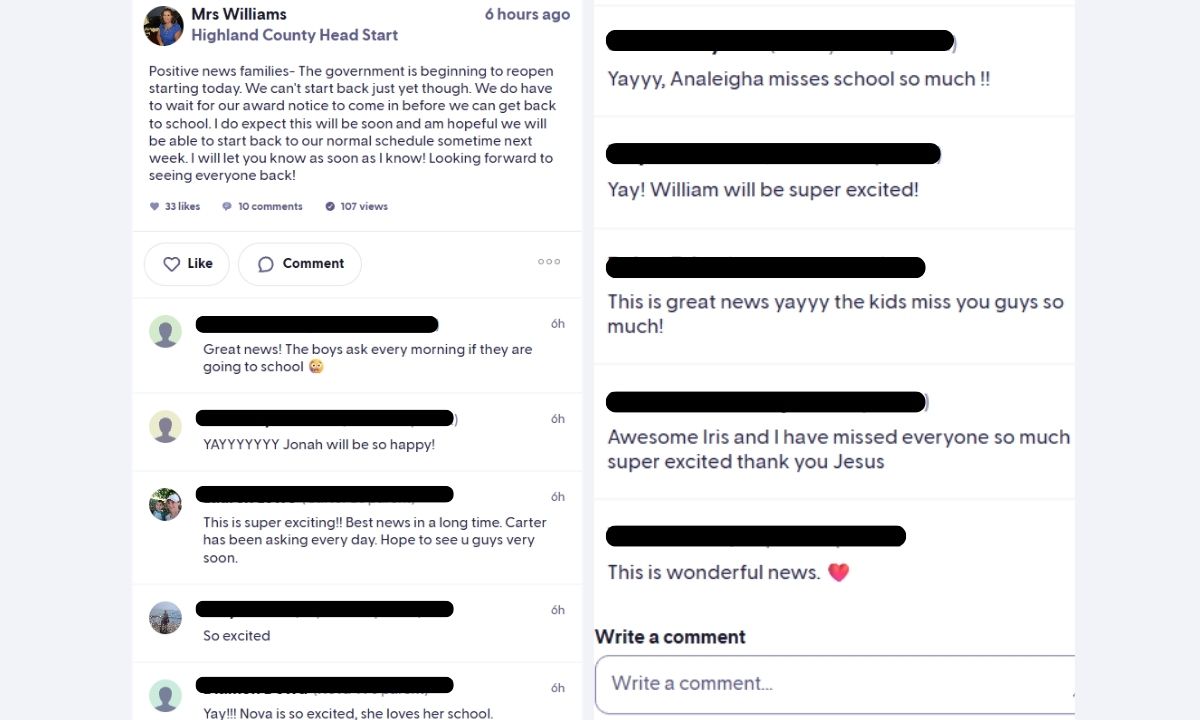
On Thursday, Williams wrote to parents via an online portal that she hopes to restart the normal school schedule sometime next week. The post was quickly flooded with comments.
“This is super exciting!!” wrote one parent. “Best news in a long time. Carter has been asking every day. Hope to see u guys very soon.”
“Yayyy,” wrote another. “The kids miss you guys so much!”
Valerie Williams, who runs a Head Start program in Appalachian Ohio, was excited to tell parents that classrooms would be reopening soon. (Valerie Williams)
Still, Williams knows reopening won’t be seamless. Along with program leaders across the country, she’ll need to call back furloughed staff, place food orders and handle a number of other operational challenges.
And despite the excitement, the transition back may also prove tricky for some kids.
“I do think that it will feel like starting school again for a lot of our classrooms,” Williams said. “They’ve been out for two weeks … You’re going to work on separation anxiety issues, you’re going to have to get into that routine again and the structure of a classroom environment. So I think that will be a big issue for a lot of our teachers.”
As of Friday afternoon, Williams was still awaiting communication from the federal Office of Head Start with information about the anticipated timeline for next steps.
“As soon as we get that notice of award, [I want to] start our staff and kids back immediately,” she said. “The very next day.”
Now that the shutdown has ended, what’s next for Head Start?
Funding for Head Start is complex. Some 80% comes from federal grants that are released to local providers on a staggered schedule throughout the year. This year, grant recipients with funding deadlines on the first of October and November were left scrambling, as the federal shutdown dragged on.
The government began to resume operations late Wednesday night after President Donald Trump signed a bill, funding most federal agencies through Jan. 30 and allowing programs that didn’t receive their funding on time, including Head Start, to use forthcoming dollars to backpay expenses incurred over the past month and a half.
Here’s what Hamm predicts will happen next: The Office of Head Start will recall all staffto resume, including those who were furloughed during the shutdown. The employees will review grant applications, a process which now requires them to flag any language that might be reflective of diversity, equity and inclusion practices. Next, money will be sent along to the remaining regional offices, and eventually dispersed to individual grantees. The NHSA is hopeful that this process will be completed by Thanksgiving for all grantees.
There are two things the federal government can do to help centers open faster, according to Hamm. First, they could waive a typical protocol that leads to a period of seven days between when a member of Congress is notified that their state will be receiving funding and when the funding actually goes out, Hamm explained.
Officials could also notify grantees, in writing, about how much money they’ll get and when it’s expected to come through, so they can begin planning.
Unlike SNAP, which received guaranteed funding through the budget year, money for Head Start remains uncertain beyond Jan. 30. While the fear of another shutdown has caused “quite a bit of worry” among the Head Start community, Sheridan said it would likely lead to fewer program disruptions, since it wouldn’t fall at the start of the fiscal year.
Tommy Sheridan, deputy director of the National Head Start Association. (Tommy Sheridan)
To prevent similar chaos moving forward, Democratic Sen. Tammy Baldwin of Wisconsin introduced a bill in the final days of the shutdown that would guarantee uninterrupted service for fiscal year 2026.
“The 750,000 children and their families who use Head Start shouldn’t pay the price for Washington dysfunction,” Baldwin, the ranking member of the Senate Appropriations Subcommittee for Labor, Health and Human Services, Education, and Related Agencies, wrote in a statement to The 74.
Multiple funding threats and deep staffing cuts by the Trump administration over the past year have plunged programs across the country into uncertainty. In the wake of that recent upheaval, a leadership change is also underway. The acting director of the Office of Head Start, Tala Hooban, accepted a new role within the Office of Administration for Children and Families and will be replaced by political appointee Laurie Todd-Smith, according to an email statement from ACF. Todd-Smith currently leads the Office of Early Childhood Development, which oversees the Office of Head Start.
Sheridan described this move as anticipated and not particularly concerning, though others were less sure. Joel Ryan, the executive director of the Washington State Association of Head Start, noted that Hooban was a longtime civil servant and strong supporter of the Head Start program. Without her, he fears “there’s nobody internally with any kind of power that will push back,” on future threats to the program.
Another worry plaguing providers: current funding for Head Start has remained stagnant since the end of 2024, meaning that through at least Jan. 30, programs will be operating under the same budget amid rising costs across the board.
In previous years, the program’s grant recipients typically got a cost-of-living adjustment, such as the 2.35% bump ($275 million) for fiscal year 2024. In May, a group of almost 200 members of Congress signed a letter to a House Appropriations subcommittee, requesting an adjustment of 3.2% for 2026. A recent statement from NHSA suggested that instead, the proposed Senate bill for next year includes a jump of just 0.6%, or $77 million.
“If we don’t see a funding increase in line with inflation, that means that Head Start will be facing a cut of that degree,” said Sheridan. “It’s just kind of a quiet cut, or a silent cut.”
“I think what will end up happening,” said Ryan, “is you’ll end up seeing a massive reduction in the number of kids being served.”
Did you use this article in your work?
We’d love to hear how The 74’s reporting is helping educators, researchers, and policymakers. Tell us how
A judge ordered federal agencies Friday to end their “blanket policy of denying any future grants” to the University of California, Los Angeles, and further ruled that the Trump administration can’t seek payouts from any UC campus “in connection with any civil rights investigation” under Titles VI or IX of federal law.
The ruling also prohibits the Department of Justice and federal funding agencies from withholding funds, “or threatening to do so, to coerce the UC in violation of the First Amendment or Tenth Amendment.” In all, the order, if not overturned on appeal, stops the administration’s attempt to pressure UCLA to pay $1.2 billion and make multiple other concessions, including to stop enrolling “foreign students likely to engage in anti-Western, anti-American, or antisemitic disruptions or harassment” and stop “performing hormonal interventions and ‘transgender’ surgeries” on anyone under 18 at its medical school and affiliated hospitals.
The administration’s targeting of the UC system came to the fore on July 29. That’s when the DOJ said its months-long investigations across the system had so far concluded that UCLA violated the equal protection clause of the 14th Amendment and Title VI of the Civil Rights Act of 1964 in its response to alleged antisemitism at a spring 2024 pro-Palestinian protest encampment.
Federal agencies—including the National Institutes of Health, National Science Foundation and Department of Energy—quickly began freezing funding; UC estimated it lost $584 million. But UC researchers sued and, even before Friday’s ruling, U.S. District Court judge Rita F. Lin of the Northern District of California ordered the restoration of almost all of the frozen funding.
Friday’s ruling came in a case filed this fall by the American Association of University Professors, the affiliated American Federation of Teachers and other unions. Lin again was the judge.
“Defendants did not engage in the required notice and hearing processes under Title VI for cutting off funds for alleged discrimination,” she wrote.
“With every day that passes, UCLA continues to be denied the chance to win new grants, ratchetting [sic] up Defendants’ pressure campaign,” she wrote. “And numerous UC faculty and staff have submitted declarations describing how Defendants’ actions have already chilled speech throughout the UC system. They describe how they have stopped teaching or researching topics they are afraid are too ‘left’ or ‘woke,’ in order to avoid triggering further funding cancellations by Defendants. They also give examples of projects the UC has stopped due to fear of the same reprisals. These are classic, predictable First Amendment harms, and exactly what Defendants publicly said that they intended.”
Maia Jackson should have been cranking out a research paper for her communications class. Instead, she found herself queuing up at a food pantry to secure groceries for her household amid the nation’s longest government shutdown.
“I walked out with a shopping cart full of food,” the 25-year-old college senior said. “I could barely carry it all. I got cereal. I got some frozen meat, hamburger buns. I got a bag of black beans, and then I got a bag of rice.”
Finding a package of chicken strips, a dish she knew her picky 2-year-old daughter would actually eat, almost made her cry, Jackson said. She expects the combination of perishable, bagged and canned foods to last them a month. By then, she hopes her Supplemental Nutrition Assistance Program (SNAP) payments — widely known as food stamps — will have resumed.
On November 1, SNAP benefits ground to a halt during the federal budget impasse that began a month earlier, with President Donald Trump’s administration refusing to fully fund these payments, a matter now tied up in court. Even as the Senate has reached a framework deal that leaves lawmakers and the White House a step closer to ending the shutdown, the disruption in benefits has revealed how fragile the social safety net is for vulnerable Americans. That includes single parents and young adults experiencing food insecurity, a problem that occurs when people lack regular access to the nourishment needed to sustain their health.
An estimated 1.1 million college students rely on SNAP, including parents like Jackson, who attends North Dakota State University (NDSU) in Fargo. For such students, a delayed SNAP payment isn’t a mere hiccup, but a serious setback that can imperil their education, their health and stability for their children, experts contend.
“It’s such a distraction for me as a single mom in school,” Jackson said. “I don’t have any bandwidth to give to trying to find food at pantries.”
She tried to minimize the time she spent at the food pantry last week by making an appointment first, but she was still one of a couple of dozen people in line. The visit prevented her from completing her research paper by its due date, which will likely result in her grade being docked. Jackson, who has so far maintained a 4.0 grade point average, isn’t happy about that prospect, but with her family members an hour away and her child’s father mostly out of the picture, she had to prioritize food over her education.
No college student should have to choose between a basic need and school, said Deborah Martin, a senior policy associate for The Institute for College Access & Success, a nonprofit that advocates for college access and affordability.
“A lot of students have to make these daily tough decisions where they’re wondering, ‘Where am I going to get my next meal from?’ instead of focusing on homework, on classwork,” Martin said. “We know that when students have these unmet basic needs such as food insecurity, they’re more likely to struggle academically, less likely to persist from semester to semester, and in some cases, may even drop out of college altogether.”
Roughly 60 percent of college students are women. For the most marginalized students, the risk of quitting school due to food insecurity may be even greater. The Government Accountability Office (GAO), a nonpartisan federal agency that provides fact-based information to Congress, reported last year that about 80 percent of food-insecure students are nontraditional — meaning their parents don’t financially support them, they didn’t begin college immediately after high school or they are caring for dependents. Moreover, the 2023-2024 Student Basic Needs Survey Report from the Hope Center, a research center at Temple University focused on the food, housing and health of college students, found that around three-quarters of parenting, Black and Indigenous students experience insecurity related to a basic need.
Most of these students, the GAO discovered, do not sign up for services like SNAP, and those who do may hesitate to discuss their food insecurity. As a mom and a slightly older student who works part-time, Jackson has felt largely alone on campus as SNAP benefits have paused. Her classmates don’t appear to share her anxiety over the shutdown, if they know about it at all.
A woman shops at the Feeding South Florida food pantry on October 27, 2025 in Pembroke Park, Florida. (Joe Raedle/Getty Images)
“A lot of the kids that I’m in class with, they’re not in the same circumstance,” Jackson said. “It’s weird to see a lot of people just carrying on as usual.”
Since most of her classmates — about an even percentage of NDSU students are women and men — are childfree and on the school meal plan, she doesn’t want to be a “downer” by bringing up her difficulties. For the same reason, she didn’t explain to her professor why her paper was late. “I didn’t want to tell him, ‘Oh, I couldn’t write it because I was standing in the food pantry line’ because it just sounds so sad,” she said. “What’s he supposed to say? I don’t want him to feel bad for me. I don’t want to be pitied.”
But faking normal could come at a high cost for college students who don’t reach out for help. Martin fears these young adults will resort to using high-interest payment plans or acquire credit card debt just to afford groceries.
“The longer that students and other SNAP participants don’t receive their funds, this is just more days that students are going to have to make these difficult decisions,” she said.
Some college administrators are taking action. When the shutdown began, Compton College President and CEO Keith Curry contacted Everytable, a food company that offers inexpensive made-from-scratch meals via carryout storefronts and a delivery service. The college, about 18 miles southeast of downtown Los Angeles, has partnered with Everytable for seven years to provide all students — approximately 6,000 of whom attend full time — with one nutritious free meal on weekdays.
The federal government crisis prompted Curry and Everytable CEO Sam Polk to scale up that program so SNAP-recipient and economically disadvantaged students didn’t suffer during the shutdown.
“We need to do something. Can we split the cost?” Curry recalled asking Polk. “I think if we double the meals, at least they get another meal for the day.”
On November 5, Compton College’s most underprivileged students began getting two free meals per day, or 10 per week. The need for such an intervention there is substantial: A 2025 basic needs survey of students found that 81 percent of them experience at least one form of insecurity related to a basic need. That includes signs of food insecurity such as skipping meals, reducing meal sizes or fearing they will run out of food. Most Compton College students are moderately food insecure, the survey revealed, indicating persistent hardship. Women make up 61 percent of the student body.
“Right now, students have other stress, and what we’re doing to them is adding more stress,” Curry said of the shutdown. “They still want to do well in classes, but now they don’t have food.”
Together, Compton College and Everytable have the resources to supply students with 10 weekly meals for a month, Curry said. The students are deeply grateful for the additional provisions, according to Dee Garrett, who oversees Everytable’s operation at the college.
“What better way to start your studies than with a stomach that’s full?” Garrett asked. “You don’t have to think about, ‘Oh, my God, my stomach. I can’t concentrate or focus.’”
Asked what impact he hopes the scaled-up program makes, Curry said he’s more interested in letting students know they’re not alone.
“It’s not about the impact. It’s about our students knowing that we were there for them during this time,” he said. “In our community, when students need us most, we have to step up and be there for them, and they’re never going to forget that.”
Martin applauds the efforts of colleges and K-12 schools, which have connected students and their families to food banks, to curb food insecurity during the shutdown. But she also advocates for long-term policies to ensure students have enough food to eat. That includes the Enhance Access to SNAP Act, proposed legislation to remove the barriers that prevent economically disadvantaged college students from utilizing benefits generally — not just during the current crisis.
However, Martin continued, “the most important thing that we can do right now in this moment is for these SNAP benefits to be fully funded and for them to go out to students as soon as possible.”
Back in Fargo, Jackson has refocused her attention on her coursework now that she has a month’s worth of food. Still, she worries about the people who couldn’t make it to a pantry or that the government will cut other social services she needs. She currently earns $400 monthly working part time as an academic journal editor. The job, which she performs remotely, allows her to attend school and be her daughter’s primary caretaker when the toddler is not in day care.
“If they cut child care, if they cut these programs I rely on, I would have to drop out of school,” Jackson said. “But I’m trying to give my daughter a better life than that.”
Jackson is majoring in university studies with a pre-law emphasis, a dramatic shift from her life before motherhood when she dropped out of school and struggled with addiction. Getting pregnant inspired her to undergo a transformation, which she largely credits to the Jeremiah Program. The national nonprofit provides single mothers with support for college, child care and housing, and it recently started a campaign to raise $190,000 to cover essential needs for families who have lost SNAP and other benefits because of the shutdown. The organization estimates that single-parent families represent nearly a third of families in the United States, with 80 percent of those headed by mothers.
Jackson has been deeply disturbed to see the misperceptions that abound about mothers like herself. She’s encountered online commenters who have characterized SNAP recipients as “welfare queens.”
If she could confront such individuals in person, Jackson would emphasize how much value mothers add to society. “And on top of it… we are all in school and working, too,” she said. “The insinuation is that we’re just scammers, freeloaders, when, in reality, I’m working very hard every day to hopefully not need these supports.”
Senate lawmakers on Monday advanced legislation that would launch the most comprehensive overhaul of New Jersey’s regulation of charter schools in 30 years.
The bill advanced by the Senate Education Committee on Monday would outright ban for-profit charter schools, require them to post a range of documents online, and impose residency requirements for some charter school trustees.
“We have not looked at charter schools as a whole legislatively in this committee since the 1990s, so this is an opportunity where we’re trying to do that,” said Sen. Vin Gopal (D-Monmouth), the panel’s chair and the bill’s prime sponsor.
The bill comes as New Jersey charter schools have faced scrutiny after reporting revealed top officials were paid far more than their counterparts at traditional public schools, including, among others, a Newark charter school CEO who was paid nearly $800,000 in 2024.
The proposal, which Gopal said was the product of a year of negotiations, would require charter schools to post user-friendly budgets that include the compensation paid to charter school leaders and school business administrators. They must also post existing contracts.
Charters would be required to post meeting notices, annual reports, board members’ identities, and facility locations online. Some critics have charged that charter schools routinely fail to provide notice of their public meetings.
The legislation would also require the state to create a dedicated charter school transparency website to host plain language budgets, 990 disclosure forms filed with the IRS, contracts with charter management organizations, and a list of charter schools on probation, among other things.
It would also ban fully virtual charter schools.
“We support the bills as a step forward in holding all public schools in our state accountable for fiscal and transparency requirements that will ultimately best serve our students,” said Debbie Bradley, director of government relations for the New Jersey Principals and Supervisors Association.
The two sides remained at odds over the membership of charter school boards.
Charter critics argued residency for those positions — which, unlike traditional public school boards, are largely appointed rather than elected — should mirror those imposed on regular public schools.
In New Jersey, school board members must live in the district they serve. That’s not the case for charter schools, whose trustees face no residency or qualification limits under existing law.
The bill would only impose a residency requirement on one-third of a charter school’s trustees, and rather than forcing them to live in the district, the bill would require charter trustees to live in the school’s county or within 30 miles of the school.
That language was criticized by statewide teachers union the New Jersey Education Association, which has called existing law governing charter schools outdated and flawed.
“School board representation should remain primarily local, and when we mean local, we don’t mean within a 30-mile radius. A 30-mile radius of Newark could include Maplewood, South Orange, communities that don’t necessarily represent what Newark looks like as a community,” said Deb Cornavaca, the union’s director of government relations.
Charter school supporters said their boards need flexibility because their leadership has broader responsibilities than counterparts in traditional public schools.
“Running a charter is a little different than running a traditional district. You need experience in school finance. You need to fundraise a bunch of money on the front end because you’re not getting paid on the front end,” said New Jersey Charter School Association President Harry Lee, adding they also needed familiarity with real estate and community experience.
Amendments removed provisions that would have required charter school board members to be approved by the state commissioner of education, though the commissioner retains sole power over whether to allow the formation of a new charter, a power that gives the commissioner some veto power over a charter’s board.
Gopal acknowledged the 30-mile residency rule was a sticking point and said legislators would discuss it before the measure comes before the Senate Budget Committee. Earlier, he warned the bill was likely to see more changes as it moved through the Legislature.
Some argued enrollment in charter schools should be more limited by geography, arguing that out-of-district enrollments that are common at New Jersey charters could place financial strain on the students’ former district.
Most per-pupil state and local funding follows students who enroll in charter schools, even if their departure does not actually decrease the original district’s expenses because, for example, those schools still require the same number of teachers and administrators.
Charter operators said that would make New Jersey a national outlier and argued that a separate provision that would bar new charter schools when there are empty seats in existing area charters should come out of the bill.
“It could be read as a moratorium on charters, so we want to revisit that provision,” Lee said.
Such vacancies could exist for various reasons, they argued, including student age distributions.
Alongside that measure, the panel approved separate legislation that would bar charter schools from setting criteria to enroll students, ban them from imposing other requirements on a student randomly selected to attend, and place new limits on how such schools can enroll children from outside their district.
That bill would also bar charter schools from encouraging students to break with the district. Some opponents have charged that charter schools push out low-performing students to boost their metrics.
The committee approved the bills in unanimous votes, though Sens. Owen Henry (R-Ocean) and Kristin Corrado (R-Passaic) abstained from votes on both bills, saying they are broadly supportive but need more time to review amendments.
New Jersey Monitor is part of States Newsroom, a nonprofit news network supported by grants and a coalition of donors as a 501c(3) public charity. New Jersey Monitor maintains editorial independence. Contact Editor Terrence T. McDonald for questions: [email protected].
Did you use this article in your work?
We’d love to hear how The 74’s reporting is helping educators, researchers, and policymakers. Tell us how
LEWISTOWN — Slaughterhouses and butchers used to be scattered throughout the United States, numbering about 10,000 in 1967.
Only about 3,000 remain and about 85% of the American meatpacking industry is controlled by four companies: JBS, Tyson Foods, Cargill and Smithfield. The other 15% of that market share is held in part by small and very small meat producers scattered across the country, including some in Montana.
This is true for much of the agricultural industry, and many small businesses have disappeared as corporate America has exerted its will on farmers and ranchers. About 70% of the consumer’s dollar went to cattle producers in 1970, with the other 30% going to processors and retailers. Cattle producers now get about 30% of the consumer’s dollar, according to Farm Action.
Additionally, about 98% of America’s beef is processed in just over 50 plants. Beef processing co-ops have been created around the state in an effort to help give beef producers more options, but there’s another problem too — employees.
That’s the place some educators in Montana are looking to step in. Fergus High School in Lewistown, for example, has a robust agricultural education program. It’s also part of the Central Montana Career and Technology Education Academy, a public charter school that was set up this year to connect students with skills and knowledge needed to work in agriculture.
‘A dying art’
Logan Turner, one the teachers at Fergus High School, put it pointedly.
“Kids aren’t really getting into it,” he said. “Cutting meat is kind of a dying art.”
His goal has been, in part, to help change that trend. The technical academy seeks to bridge a gap of agricultural knowledge. Beyond meat cutting, classes at the school include farm business management, fabrication and science classes geared toward teaching about soil health among others.
Turner grew up on his family’s farm outside Missoula and quickly decided he wanted to be a teacher. There’s an urgency for him too, with worries, among them a feeling no one knows where their food comes from and the world’s growing population.
“We’ve always been faced with this big issue as agriculturalists,” Turner said. “2050 is right around the corner, and there’s going to be two billion more people on the face of the planet, and how are we going to feed them all? I think it all starts with education and understanding … and so I felt like being an educator probably was the best way for me to contribute.”
Only about three percent of the food Montanans eat is produced in the state. There are options for eating local food, but they can sometimes be hard to find.
Having kids learn about these could also help them enter the workforce with more ideas about what they want to do, which is one of the goals of the program. Orin Johnson, the Central Montana CTE Academy director, said they also want to get students as close as possible to certification in a variety of careers.
“Every kid doesn’t learn the same way,” Johnson said. “And some really do strive and need to be hands on, and it’s about finding a way to create opportunities that they can be hands on.”
Students at the school have shown interest and it’s included partnerships with Future Farmers of America and the Montana Farmers Union, which gave the meat processing program two grants totaling about $13,000 over the summer.
“We do a lot of meat processing at my house because my dad loves hunting, and so we do a lot of wild game,” said Shyanne Ricks, a student at the school who’s gone through the program. “And so doing the meats class really helps with seeing the whole process, not just wild game.”
Ricks, along with Tori Rindal, a freshman at the school, and the other Lewistown agricultural education teacher — Jared Long — went to the Montana Farmers Union Annual convention and spoke about the program.
Rindal said she’s hoping to take the meats class next year. Long pointed out agricultural education is broad and students can take many different paths.
The program offers five pathways: welding, natural resource and conservation, meat processing, animal science and agricultural mechanics. There’s a variety of classes within those, both Long and Turner explained.
“The common misconception is that it’s just cows and plows,” Long said. “So that’s really our job, we feel like, is to open doors to kids that they might never have.”
Daily Montanan is part of States Newsroom, a nonprofit news network supported by grants and a coalition of donors as a 501c(3) public charity. Daily Montanan maintains editorial independence. Contact Editor Darrell Ehrlick for questions: [email protected].
Did you use this article in your work?
We’d love to hear how The 74’s reporting is helping educators, researchers, and policymakers. Tell us how
Former University of Virginia president Jim Ryan has broken his silence concerning his abrupt resignation, accusing the Board of Visitors of dishonesty and complicity in his ouster, which came amid federal government scrutiny over the university’s diversity, equity and inclusion practices.
In a 12-page letter to the UVA Faculty Senate on Friday, Ryan wrote that he was “stunned and angry” over the board’s lack of honesty as it faced pressure from the federal government to force him out due to an alleged failure to dismantle DEI initiatives. Ryan also wrote that recent letters by UVA rector Rachel Sheridan and Governor Glenn Youngkin do not “present an accurate accounting of my resignation,” which prompted him to release his own statement.
Inside Higher Ed has uploaded Ryan’s full letter below.
Ryan’s letter follows a message Sheridan sent to the UVA Faculty Senate on Thursday. In that letter, Sheridan downplayed the pressure from the federal government to force Ryan out. While she acknowledged that the Department of Justice “lacked confidence in President Ryan to make the changes that the Trump Administration believed were necessary to ensure compliance,” she disputed the notion that his resignation was part of the agreement that the university recently reached with the federal government to pause investigations into DEI practices.
The full text of that letter is available below.
Also on Thursday, Youngkin sent a letter related to Ryan’s departure to Governor-elect Abigail Spanberger, who has called for UVA to halt its ongoing presidential search until her board picks are in place. The Republican governor pushed back on his Democratic successor’s claims that Ryan was ousted as a result of federal overreach and accused her of interfering in the search. Youngkin also accused Ryan of “not being committed to following federal law.”
That letter has been uploaded in full below.
This is a breaking news story and will be updated.