Tag: News

  • Trump Partially Funds SNAP, Colleges Scramble

    Trump Partially Funds SNAP, Colleges Scramble

    In the last week, campuses scrambled to shore up resources as 42 million Americans, including over a million college students, prepared to lose federal assistance to buy food. Payments for the Supplemental Nutrition Assistance Program, or SNAP, didn’t go out on the first of the month as they normally would amid the ongoing government shutdown.

    Now the Trump administration plans to dole out some of the benefits this month—but not all—in response to two federal court orders.

    In court filings Monday, the Trump administration agreed to expend emergency reserves to issue partial benefits this month, but also said the funds will only cover half of eligible households’ current benefits. And for at least some states, payments could take months to come through because of bureaucratic hurdles.

    Erika Roberson, senior policy associate at the Institute for College Access and Success, said she worries students who rely on SNAP will still get less food than they need.

    “Some food is not nearly enough food—especially when students are left to decide between finding their next meal and studying for an exam,” Roberson said in a statement to Inside Higher Ed. “Food should not be a luxury, but today, sadly, many college students are finding themselves in a position where that’s their reality.”

    And while partial benefits are better than none at all, some questions remain unanswered. It’s unclear whether all SNAP recipients will get half of their benefits or whether some will get less than others this month, said Mark Huelsman, director of policy and advocacy at the Hope Center for Student Basic Needs at Temple University. He also expects payments to be delayed.

    “I think that it still holds that campuses and food pantries and community organizations are going to be stretched pretty thin in the coming weeks,” Huelsman said, “even if the courts did the right thing here and stepped in and made sure that people’s benefits weren’t completely withheld.”

    Campuses ‘Plan for the Worst’

    Colleges and universities across the country have been furiously stocking up their campus pantries and expanding on-campus food programs in preparation for a pause in SNAP.

    Southeast Community College in Nebraska typically runs a food drive in November for the food pantries on its three campuses. But this year, the college started its drive a month early, predicting a surge of students in need. Already, the Lincoln campus’s pantry went from serving 49 students two years ago to 505 students this September, said Jennifer Snyder, communications specialist at Southeast Community College. That number is only expected to grow. The college also plans to run a fundraising campaign for its emergency scholarship fund in case more students need aid than usual.

    Ramping up these supports comes with challenges, Snyder said. Campus pantries used to be able to stock up by buying items at a low price from local food banks, but food banks are holding on to more of their goods as they also prepare for increases in demand. As campus pantries become harder to fill, Snyder worries staff members will have to make difficult decisions about how much food students can take.

    “The need is there, and the demand is there, but the supply just keeps dwindling,” Snyder said. “So, how do you make it even? How do you make it fair for everybody so that everybody has access?”

    Snyder said the Trump administration’s promise to partially fund SNAP this month hasn’t changed the college’s plans.

    “If it’s partial funding, that’s a benefit,” she said. But “you just don’t know when it’s going to be taken away, so we should plan for the worst.”

    Keith Curry, president of Compton College in Los Angeles, also sprang into action when he realized his students’ SNAP benefits were at risk.

    The college already offers students one free meal per day through a partnership with the nonprofit Everytable. Starting Wednesday, the college is upping the number to two free meals daily for students participating in CalFresh, the state’s SNAP program, and CalWORKs, a state benefit program for low-income families. CalWORKs students will also get $50 in grocery vouchers per week, and students in either program get an extra $20 in farmers market vouchers per week.

    Compton College also has a data-sharing agreement with the Los Angeles County Department of Public Social Services that helps the college identify students who are eligible for CalFresh and CalWORKs to offer them extra supports, if students sign a waiver allowing it. The college plans to lean on that partnership to verify more students participating in these programs who are now eligible for Compton College’s new supports. The college and Everytable are splitting the costs of the additional free meals, and the college plans to reassess the political situation every Friday to determine whether the extra measures are still needed.

    “We’re moving forward, because we don’t know what the impact will be to our students,” Curry said. “We don’t know how much they will actually receive. And our students need us more now than ever before. People are waiting for their benefits, and they’ve got to figure it out. Students are in a precarious position where they already have other needs.”

    The Foundation for California Community Colleges expects more than 275,000 students in the system will be affected by SNAP payment delays, according to an emergency fundraising campaign launched Monday.

    Grant Tingley, 41, is one of those students. He’s a student at Cypress College and an ambassador for the foundation whose job is to spread information about student food and housing resources. He’s also a SNAP recipient himself. In preparation for SNAP’s lapse, he’s been working with community organizations and other students to create a database of local food pantries and is pushing his campus food pantry to expand its hours.

    Tingley emphasized that hunger makes it harder for the most vulnerable students to focus on their schoolwork. He’s also a student worker at Rising Scholars, a support program for formerly incarcerated students, students with incarcerated family members or students recovering from substance use, like himself. He fears these students in particular are at risk of losing academic momentum.

    “They’re a group of people that have been beaten down repeatedly, time after time, and sometimes a small roadblock can really be a huge impediment for them going forward and continuing on their path,” he said. “Every little roadblock that we put in front of these students is almost make or break.”

    Huelsman, of the Hope Center, encouraged colleges and universities to keep pushing forward plans to bolster student food supports and emergency aid as students divert funds they use for housing and other necessities to groceries. The Hope Center also put out a guide to help colleges navigate how to support students through disrupted SNAP benefits.

    Even with partial benefits flowing, “every contingency plan and every preparation that institutions were making to help students weather this is still live,” he said. “Students are going to still feel a pretty severe disruption. And there’s just general confusion about what’s next.”

    Source link

  • A Tumultuous Tenure Leading the Nation’s Diversity Officers

    A Tumultuous Tenure Leading the Nation’s Diversity Officers

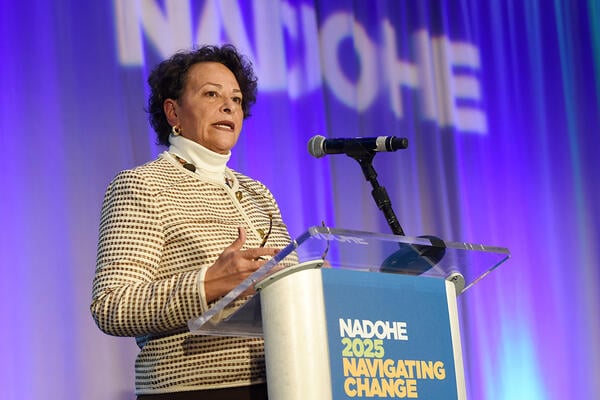
    Paulette Granberry Russell is stepping down as president of the National Association of Diversity Officers in Higher Education after a dramatic and unpredictable five years at the helm.

    She represented campus diversity professionals amid the national racial reckoning that accompanied the Black Lives Matter movement, and then through the dizzying years that followed as anti-DEI laws swept the country. She also spent 22 years as a diversity professional at Michigan State University.

    Granberry Russell told Inside Higher Ed she never planned to stay at NADOHE longer than five years, so she’s ready to move on and facilitate a “smooth transition and handoff.”

    But what a tenure it’s been.

    She spoke with Inside Higher Ed about how she navigated the headwinds facing diversity professionals and the future of diversity, equity and inclusion work on campuses. The conversation has been edited for length and clarity.

    Q: Over the course of your term, from 2020 to 2025, the landscape for diversity professionals in higher education radically shifted. What has it been like for you to represent DEI professionals then and now?

    A: When I came into the role, my goals were to do a few things, which, not only were intended to build on our past successes, but also [to] develop new initiatives that would enhance a few areas, [including] increasing our membership but also providing our support for them. It included, for example, enhancing our industry influence but also sustainability of the organization.

    I came into the role in March of 2020, and what happened in March of 2020? The pandemic, which altered much of what was going on in higher education and how we were doing our work, whether that was remotely, but also with threats in terms of both student experiences but also student support. And then in May of 2020, the murder of George Floyd, and all of the ways in which our institutions were reacting and responding and certain commitments were made to enhance antiracism efforts on our campuses.

    When I think about my first few months, it was something very different than what I anticipated. And I’m certain that’s true for higher education as well. I lived in this state of shifting priorities, having to think about ways to best support members who were having to adjust to significant shifts on their campuses. We were also dealing with significant challenges around freedom of speech and disruption on our campuses prior to these more recent experiences.

    And the politics are very different. When you shift from an environment of enhanced commitment built on an understanding that our campuses had to deal with issues around race and expanding opportunities more broadly across identity to now pushback—it was causing quite a shift in equilibrium. And that’s true for our members as well as the organization. And because of the evolution of diversity, equity and inclusion in higher education historically, as painful as a lot of this was, I believe we were better prepared than we understood ourselves to be.

    Q: You touched on how you started at NADOHE in this moment in 2020, when campuses made commitments and investments in thinking about race and racial inequities, and now campuses are rolling back so much of those efforts in response to anti-DEI legislation. How did these policy shifts change NADOHE’s work and change your work as its leader? How did you have to pivot?

    A: Our successes, I think, resulted in some of the pushback. The pushback was evolving. Expanding on opportunities [created by diversity initiatives] beyond race, so that people understood that diversity was more inclusive than they initially understood it to be—we did not do as good a job as we could have and should have.

    But [we] are beginning to do [it] now, in broadening people’s understanding that diversity is and should be interpreted very broadly. I think that the narrative was hijacked, meaning it was easy to unfortunately define diversity narrowly on the basis of race, gender and sexuality. And others used that narrative to create fear and apprehension that somehow others were being advantaged, versus understanding that we all have benefited from the ways in which we were adjusting our efforts on campus to broaden access, to broaden opportunities, to increase equitable outcomes, understanding that [it’s] not one-size-fits-all, and we had to tailor and adjust our efforts to accommodate the broad range of interests and identities that presented on our campuses and have always presented on our campuses. What we failed to do well was messaging both the communities impacted by our work and the work that was being done to expand opportunities as well.

    Q: How did the backlash shift your priorities, if at all?

    A: When we think about the early challenges, some [opponents] would point to critical race theory. I don’t know that they necessarily understood it very well, and [they] were having a difficult time messaging it. But it was easier to talk about diversity, because for many people, that conjures up issues around race, it harkens back to earlier views of affirmative action and I think it became an easier message to divide higher ed both internally as well as externally.

    It was important for NADOHE to emphasize—whether it was around academic freedom, First Amendment rights and freedom of speech and freedom of expression—that diversity, equity and inclusion are embedded in those. Freedom of expression cannot be sanitized. Our research, for example, or our curriculum is going to touch on issues that may impact communities broadly—and diverse, marginalized, underserved communities. And the work that we do in higher education as diversity leaders requires evidence-based research that informs our work. In the absence of that, you’re guessing at strategies and interventions that will support all students.

    This work is not going to go away. We’re not going to go back to a time when opportunities were constrained, when fairness did not extend to certain communities. That’s unacceptable.”

    —Paulette Granberry Russell

    And so, I don’t know that it was as much a shift in our priorities as much as it was helping higher ed internally, as well as audiences outside of higher ed, to understand that access and opportunity are not limited to any one demographic or a few demographics. If there was a shift in priorities, it was hopefully helping broader audiences understand that there’s nothing to fear, especially in the ways that diversity, equity, inclusion was being demonized. This work is not intended to grant preferential treatment to some and deny others opportunities.

    Q: So, you found yourself having to do a lot of explaining about what’s actually meant when people say “DEI” in a higher ed context.

    A: That’s right. And it’s also saying to folks, don’t use the acronym. Because the acronym, unfortunately, supported a very narrow way of defining efforts.

    Diversity is not defined narrowly. Equity is intended to reduce barriers that may result in differential impact, and those differential impacts are not limited to any one category. Inclusion doesn’t happen just naturally. We know individuals feeling included allows them to be themselves but also allows them to be more successful. If I don’t feel like I belong, what do I do? I tend to retreat, or I don’t access the resources that are there, resources that may benefit me, resources that are accessible to all, with an understanding that, again, we’re not monolithic. It is helping people differently understand, and hopefully better understand, that there are no threats here. Diversity on our campuses is a reality, period. And it’s not going to change, certainly not as long as organizations like NADOHE are here to defend access and opportunities.

    Changes in nomenclature happen. How we define our work, how we label our work, how we tag our work has always changed. If we think historically, going back 20, 30 years, we talked about affirmative action. We talked about multiculturalism. We talked about diversity. We talked about equal opportunity. We talk about fairness. We talk about equity. We talk about belonging. We talk about inclusion. Terminology evolves over time, given how the work itself evolves.

    Q: As campuses close centers associated with DEI and get rid of diversity roles, what do you see as the next phase of the work? How do campus diversity professionals move forward from here? And what does the DEI movement look like now and into the future?

    A: At least for this moment in time, we need to more closely scrutinize the systems that have been designed that have resulted in barriers to success. And how do we redesign, or how do we begin to design systems that differently support our campuses?

    There’s no single office or individual that can do this work alone. Certainly, in my own career at an institution that was a large public land-grant with over 40,000 students at that time and 14,000 faculty and staff, there was no way that a person with two staff was going to be able to dramatically impact change. [Change comes from] working with others and understanding that it’s going to take what I would call a whole institution approach, which means that our leadership, our policies, budget, people, culture have to be aligned. That also means that we have to take a look at the policies, practices, procedures that we have in place that may be having differential impacts, and how do we make adjustments in those? Not to grant preferential treatment, not to discriminate, but to say, can we design systems that work better?

    We’re talking about a systems approach for structural change. When I say a systems approach, this is going to be far more extensive than I think many of us are prepared to do, but I think that it’s the future. [In the past], unfortunately, we didn’t [always] look at connections between the needs of our students, the capacity of faculty to meet those needs, the capacity of staff to meet those needs and connecting our students to potential employers. Things were very siloed. Things are still very siloed. We have to think about the life cycle of a student. And we do that, but it’s not that we are always very deliberate in how we do it.

    When I grew up as a child, the expectation was that I would go to college, but my family by all definitions was very low income. [When] I got to my undergraduate experience, there were no tools in the way that there are now. There were no interventions. There were no programs that I could access that connected me to all of the resources that would allow me to be successful. I was a low-income Black female who arrived on a campus with no prior experience, not knowing how to navigate the space, not knowing where the resources were, not knowing how to fund my education. I was a person with a dream and a family that really wanted me to be successful, but they didn’t have the tools to provide that. It’s a very different world we live in today.

    [The goal is] helping that student understand where the resources are, and then helping faculty understand the differences of those students that come into your classroom, ways that you as faculty can support them, connecting those faculty with the advisory services that those students might need. We have to design [systems] in ways that reduce barriers, that acknowledge the differences that exist and with the goal of those individuals being successful [and] reducing the barriers for faculty to be successful.

    Q: After leaving NADOHE, what’s next for you?

    A: My entire trajectory, my entire life, I have always been this person who believed in fairness. I always believed in opportunities. I’m always that person who fought for not only myself, but for others to be treated fairly, because I grew up in a family where my history included ancestors who were formerly enslaved.

    At 16 years old, I decided I wanted to increase participation in voting. In 12th grade, I remember I had a speech class, and I was that person giving speeches on the slaughtering of baby seals. I was the person who was giving speeches on sexuality and treating people differently based on how they identified. I was that person who gave speeches on the Black Power movement, civil rights, Martin Luther King. And as I reflect now, as I transition, I’m not going to be any different than what I have always been. I will find new ways to [apply] my experiences and my advocacy. Because I have no choice. I realized that about myself.

    My time with NADOHE has been to build on the successes of my predecessors. I believe that I have done that. I achieved the goals that I set out to achieve, both for myself and for the organization, whether that is increasing our membership, our influence within higher ed [and] beyond higher ed. We’ve done that.

    This work is not going to go away. We’re not going to go back to a time when opportunities were constrained, when fairness did not extend to certain communities. We’re not going back to a time when discrimination on the basis of identity was lawful, certainly in the context of race, gender, sexuality, sexual orientation. That’s unacceptable. We’re not going back.

    My next move is, I’m going to breathe. I’m going to take a little bit of time for myself. But I know I will always find my way back to what I have always been committed to, that I want people to be treated fairly. I want people to have opportunities.

    Q: Whoever takes over your position is going to face significant headwinds. What would be your advice to them?

    A: Bring your passion. Bring your commitment. Coming into this role, it’s going to be exhausting, but you have to decide that there’s no other way forward. Too many lives depend on it. This country, our democracy, depends on it.

    Source link

  • Collective Punishment, Early Decision Edition (opinion)

    Collective Punishment, Early Decision Edition (opinion)

    Tulane University’s admissions office has banned students from four high schools from applying to Tulane through early decision this fall, according to reporting from The New York Times. Though three of the schools have not been publicly identified, the one-year ban (or “suspension”) for Colorado Academy comes after a student from that school backed out of the early-decision agreement they signed when they applied to Tulane last year.

    For those who aren’t card-carrying college admission geeks like I am, early decision is an application option and enrollment management strategy in which students apply earlier and promise to enroll if admitted, in exchange for receiving an earlier decision offer. The binding nature of early decision means that a student can apply to only one college through early decision.

    In most cases students applying through early decision are asked, along with a parent and their school counselor, to sign an early-decision agreement attesting to their understanding of the commitment to enroll if admitted. Early decision is in no way legally binding, but colleges take the early-decision commitment seriously and are appalled and disgusted when students back out of the commitment. The one agreed-upon reason for backing out of an early-decision commitment is when an institution can’t meet a student’s financial need (as determined by the college’s financial aid formula, not what a family thinks it can pay).

    I have had admission deans tell me that they would hold it against a school whose students did not follow through on the early-decision commitment, but Tulane is the first college I’ve seen publicly penalize schools. The Tulane ban raises some interesting and thorny ethical questions.

    The most obvious is whether it is permissible to punish students in the Class of 2026 for offenses committed by students in the Class of 2025. Retribution may be fashionable these days, but punishing the innocent because you have no way to punish the guilty is not retribution, just wrong.

    But that may be just me. The National Association for College Admission Counseling has an “Ethical Dilemmas in College Admission” page on its website that includes a hypothetical case study in which a student wants to back out of an early-decision commitment. Among the suggested advice for counselors is to caution the student and parents that withdrawing could have negative consequences for future applicants from the school. Even if that might be the case, that’s terrible advice from NACAC, making it seem like colleges punishing future applicants is acceptable and normal.

    At least Tulane is being transparent with its early-decision ban for the schools. As bad as that is, there is a scenario that would be worse, if Tulane ostensibly welcomed early-decision applications from the four schools when it had no intention of admitting any of them.

    The Times article didn’t provide any details about the circumstances leading up to the ban for the four schools, but Tulane’s position seems to be, as the Times paraphrased it, that the schools “failed to uphold the expectations of the early decision agreement.” Let’s examine that claim a little more closely.

    What is a school’s responsibility in advising students wanting to apply early decision? As a counselor, I always advised students and parents that it was a binding commitment, not to be taken lightly. I don’t remember any of my students backing out of an early-decision commitment, but on several occasions I had students who told me on Friday they planned to apply early decision to one college and then a different college on Monday. My response was that they were not ready to apply early decision at all if their thinking was that fluid.

    It’s hard for me to imagine how the schools would have failed in their responsibilities. The counselor part of the early-decision agreement states, “I have advised the student to abide by the early decision commitment outlined above.” As long as they have done that, are they responsible for policing the student’s actions? The school could withhold sending transcripts to other colleges, but in today’s litigious environment, it could face legal action from parents for doing so. I have learned that parents who are lawyers are especially skeptical of the early-decision commitment. If the student wanted to renege on early decision, I would require the student to inform the college. An applicant owes the college that courtesy. Beyond that, schools can’t be expected to enforce early decision.

    There are several other issues that deserve scrutiny. One is Tulane’s claim in a statement to the Times that “A last-minute withdrawal without explanation unfairly impacts other applicants who may have missed opportunities due to the limited number of early-decision offers a university can make.” Excuse me, my BS detector is going off. Tulane has no restriction that I am aware of in the number of students it can admit through early decision, as suggested by the fact that, in recent years, it’s admitted more than 60 percent of its freshman class using early decision, and it has other opportunities to make up for any loss through early decision 2, early action and regular decision.

    There is also an interesting philosophical question about the nature of the early-decision binding commitment. At what point does the binding commitment kick in? Or, more to the point, when does Tulane believe that the commitment is binding?

    The common understanding across the world of college admission is that students take on the binding commitment either as soon as they sign the early-decision agreement, or at least as soon as they are accepted. Tulane’s application instructions state that early decision is binding and that students are expected to withdraw all other applications once accepted and issued a financial aid offer, but there are two other points in the same instructions that bring into question whether Tulane really believes that students are committed as soon as accepted.

    The first bullet point in Tulane’s instructions for early decision defines it as an “application timeline for students whose first choice is Tulane and who are prepared to enroll soon after (italics mine) being admitted and receiving a financial aid offer.” The use of the phrase “soon after” suggests that there is a period of time after acceptance when the student is not yet committed.

    In addition, Tulane expects accepted early-decision applicants to submit a $1,000 enrollment deposit by Jan. 15. Asking for a deposit is not unique to Tulane, but if the student is committed to attend Tulane as soon as they sign the early-decision agreement or upon acceptance, why require an enrollment deposit? If a student is accepted early decision but doesn’t then make the deposit, have they broken the commitment or does that commitment only kick in with the deposit? Am I the only one who sees a contradiction here? (The answer may well be yes, and it wouldn’t be the first time.)

    The broader issue here has to do with early decision itself. Early decision has been around since the 1950s, and it’s controversial. The early-decision “bargain” can be argued to benefit both colleges and students, but it is far more beneficial to institutions as a way to manage enrollment. It doesn’t work well for students for whom financial aid is essential or those who come from schools without savvy college counselors who understand the early-decision game.

    Tulane is the poster child for how colleges and universities use early decision to manage both enrollment and prestige. Its admit rate has declined precipitously in recent years largely through strategic use of early decision. According to its most recent Common Data Set, about 63 percent of the freshman class was admitted through early decision (that’s assuming a 100 percent yield rate for early-decision admits).

    That may actually understate the impact of early decision. Another 20 percent of the class was admitted off the wait list (the CDS shows the number of students admitted off the wait list but does not break it down in terms of enrollments, but there are universities that only admit students off the wait list if they know they will enroll, almost a form of “early decision 3”).

    The heavy use of early decision means that there is a huge variance in the admit rates for early decision and other admissions plans at Tulane (it also has nonbinding early action). According to the Common Data Set, the admit rate for early decision was 59 percent, compared with 11 percent for all other options. That’s not new. A 2022 Inside Higher Ed article reported that Tulane had admitted only 106 students in regular admission. In any case, the numbers suggest that not applying early decision is hugely disadvantageous at Tulane, which makes the ban even more punitive.

    I am trying to be sympathetic to Tulane’s hurt feelings over being dissed by students they admitted in early decision, but I would hope the university’s admissions office will take to heart the wisdom of Gilbert and Sullivan, as well as the Ramones, and let the punishment fit the crime.

    Jim Jump recently retired after 33 years as the academic dean and director of college counseling at St. Christopher’s School in Richmond, Va. He previously served as an admissions officer, philosophy instructor and women’s basketball coach at the college level and is a past president of the National Association for College Admission Counseling. He is the 2024 recipient of NACAC’s John B. Muir Excellence in Media Award.

    Source link

  • Minor in Holistic Wellness Advances Student Career Wellness

    Minor in Holistic Wellness Advances Student Career Wellness

    Most, if not all, colleges and universities provide mental health support and wellness resources to encourage resiliency and thriving among students, who report high rates of mental health concerns.

    At Rutgers University at New Brunswick, staff are taking health education one step further, offering a new minor in holistic wellness to support students’ personal well-being as well as to provide practical skills so they can share well-being principles in their workplaces.

    The minor, developed by ScarletWell, the university’s well-being division, is open to any student on campus. It is designed to empower a new generation of workers who demonstrate wellness in all dimensions of their lives.

    What’s the need: One of the key features of the holistic wellness minor is that it expands education beyond personal well-being into teaching and creating a culture of wellness, said ScarletWell director Peggy Swarbrick. Included in the learning outcomes are an understanding of policies that foster wellness, wellness communication and program development.

    “These skills will make Rutgers students more attractive for jobs, regardless of their career or discipline of focus, because they will be able to work with leadership to improve sense of community and belonging and overall health of the workforce,” ScarletWell leaders wrote in the minor proposal to administrators.

    Burnout is a frequent concern among American workers and can be a threat to both student and worker retention. One survey published earlier this year found that 66 percent of American employees say they’re experiencing some sort of burnout; young adults (ages 18 to 24) were even more likely to say they’re burned out (81 percent).

    Providing wellness education is one way to support student success and give workers the tools they need to be impactful in their roles, Swarbrick noted.

    In addition, wellness as an industry has grown, meaning more sectors—including schools and police departments—are looking to hire individuals with a focus on organizational wellness, said chief wellness officer Josh Langberg. More employers are also seeking individuals with a background in wellness.

    Data from the U.S. Bureau of Labor Statistics shows wellness-focused jobs are expected to grow at a faster pace over the next decade than the current 5 percent average for all workers.

    What’s involved: Any student in any major at Rutgers’s New Brunswick campus can enroll in the 18-credit minor. Students complete three core courses that provide a foundational understanding of well-being as well as a range of skills and strategies courses, which focus on practical applications of wellness, including exercise, journaling or other self-regulation methods.

    ScarletWell staff helped develop the program, but the minor is housed in the school of environmental and biological sciences. Students complete courses from a variety of disciplines including the arts, nutrition, sociology and horticulture.

    This is the first academic program at Rutgers to have “wellness” in the title. It’s distinct from the offerings of other institutions in the state because of its holistic focus, Langberg noted.

    What’s next: The minor was approved in spring 2025 and soft launched this fall with the course Wellness Learning Community, which enrolled a range of students across disciplines at Rutgers. The course teaches students the eight dimensions of wellness—physical, social, intellectual, spiritual, emotional, financial, environmental and occupational wellness—developed by Swarbrick, as well as how to reflect on their own definitions of wellness and how to apply what they’ve learned to their future occupations.

    Students were also introduced to various resources on campus including Harvest, an on-campus dining option that focuses on sustainability, economic responsibility and reducing food waste.

    Initial feedback from students indicated they valued the course content and wished they had taken it sooner in their academic careers, said Amy Spagnolo, senior program coordinator of ScarletWell. Students also said they appreciated being in classes outside of their disciplines with peers from other majors across campus.

    Swarbrick hopes to enroll between 40 and 60 students in the minor. So far, the program has grown through word of mouth.

    In addition to the minor, students and staff can engage in digital badging to be credentialed as a Wellness Champion or peer support leader. Since the program launched last year, 60 staff and faculty have participated in the peer-support program.

    Do you have a wellness intervention that might help others promote student success? Tell us about it.

    Source link

  • North Carolina Continues to Lose Licensed Child Care Programs – The 74

    North Carolina Continues to Lose Licensed Child Care Programs – The 74


    Get stories like this delivered straight to your inbox. Sign up for The 74 Newsletter

    Members of Gov. Josh Stein’s bipartisan Task Force on Child Care and Early Education got an update on licensed child care closures during their most recent meeting.

    “Just in the month of August, we had more than twice as many programs close as open,” said Candace Witherspoon, director of the Division of Child Development and Early Education (DCDEE).

    Her statement is evidence that — despite a small uptick in the number of centers last quarter — the overall trend of licensed child care losses has continued since the end of pandemic-era stabilization grants earlier this year.

    Based on data provided by the N.C. Child Care Resource and Referral (CCR&R) Council in partnership with DCDEE, EdNC previously found that North Carolina lost 5.8% of licensed child care programs during the five years when stabilization grants were used to supplement teacher wages.

    That net loss has increased to 6.1% since the end of stabilization grants. Family child care homes (FCCHs) make up 97% of that net loss.

    Trends among licensed centers and homes

    Since February 2020, the last month of data before the COVID-19 pandemic, the number of licensed FCCHs has decreased by 23%. The number of licensed child care centers has decreased by 0.3%.

    The trend for licensed FCCHs since EdNC began tracking the data in June 2023 has been one of consistent net loss, decreasing each quarter.

    Graphic by Katie Dukes/EdNC

    There were 1,363 FCCHs in February 2020. That number was down to 1,096 in March 2025, the last data before the end of stabilization grants. Now there are 1,052 FCCHs across the state.

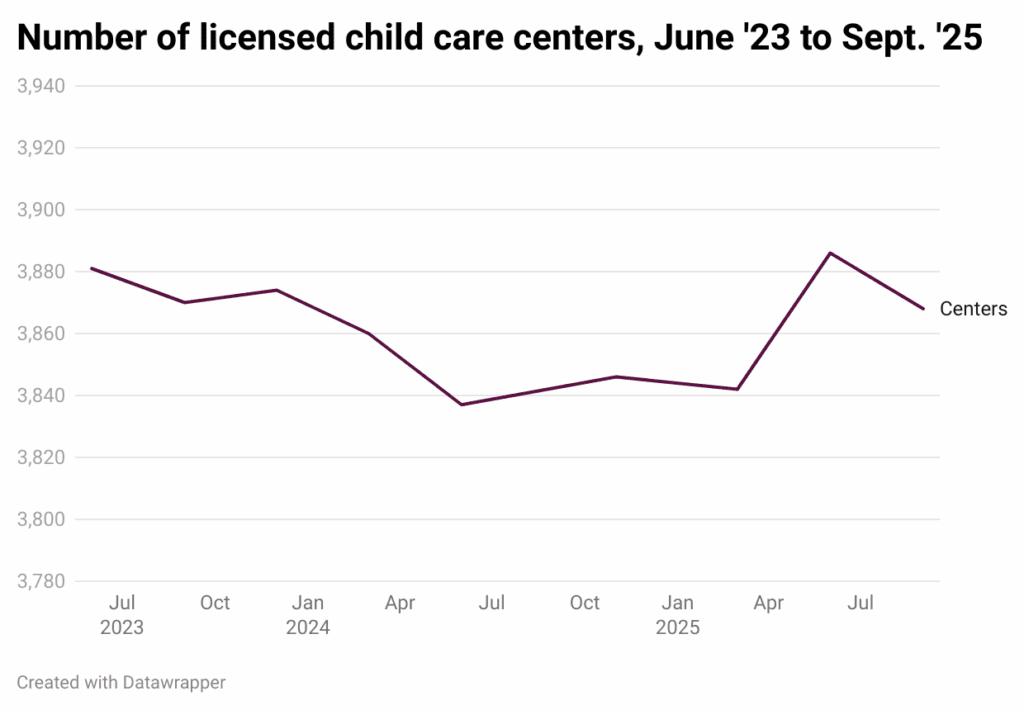
    While licensed child care centers have also experienced a net loss since February 2020, the trend has been less linear.

    Graphic by Katie Dukes/EdNC

    There were 3,879 licensed centers in February 2020. When EdNC began tracking in June 2023, the number was slightly higher at 3,881. From then on it fluctuated, with net gains in some quarters and net losses in others. There are now 3,868 licensed centers statewide.

    While the net loss of centers remains small, the effect of a single center closing is huge — especially in rural communities.

    Families on Hatteras Island are learning this firsthand. The only licensed child care program on the island is scheduled to close at the end of the year. With no licensed FCCHs and no clear way to save the sole licensed center, families are trying to figure out how to keep their businesses open and remain in their communities without access to child care.

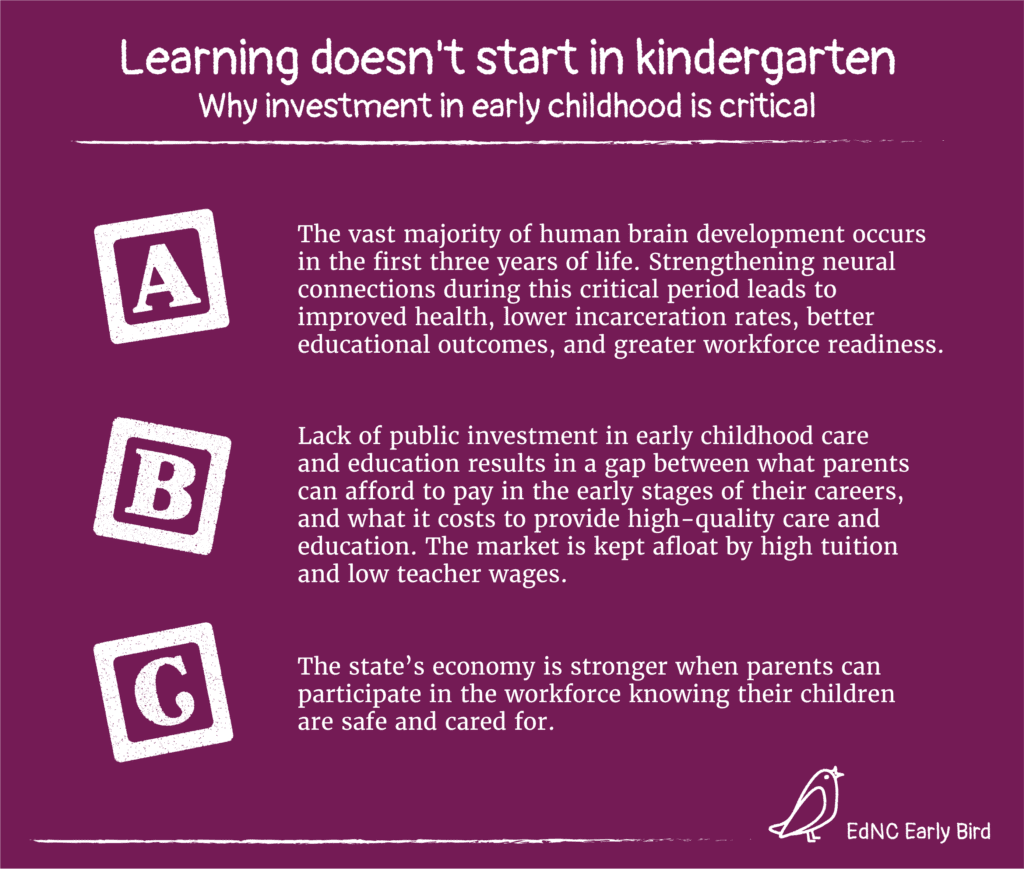
    Access to high-quality, affordable early care and learning is crucial to child and family freedom and well-being. It enables parents to participate in the workforce or continue their education without concern for the safety of their children. It also puts North Carolina’s youngest residents on a path to future success.

    Graphic by Lanie Sorrow

    Trends among subgroups

    In addition to monitoring overall licensed child care trends, EdNC zooms in on trends among three subgroups of counties each quarter.

    In the counties that make up the area covered by the Dogwood Health Trust (Avery, Buncombe, Burke, Cherokee, Clay, Graham, Haywood, Henderson, Jackson, Macon, Madison, McDowell, Mitchell, Polk, Rutherford, Swain, Transylvania, and Yancey), the number of licensed child care sites is 5% lower than before the pandemic. These counties had a net loss of eight programs from July through September 2025, the largest single-quarter decrease since EdNC began tracking.

    In the majority-Black counties (Bertie, Edgecombe, Halifax, Hertford, Northampton, Vance, Warren, and Washington), the number of licensed child care sites remained relatively stable during and after the pandemic. But in the most recent quarter, these counties had a net loss of nine programs, putting them 4% lower than before the pandemic, a sudden and dramatic shift in circumstance. As with the Dogwood counties, this represents the largest single-quarter decrease since EdNC began tracking.

    In Robeson and Swain, which both have large Indigenous populations, the number of licensed child care sites had also remained relatively stable during and after the pandemic. In the most recent quarter, for the first time since EdNC began tracking, the number of licensed child care programs in these counties has dipped just below pre-pandemic levels.


    Editor’s note: The Dogwood Health Trust supports the work of EdNC.


    This article first appeared on EdNC and is republished here under a Creative Commons Attribution-NoDerivatives 4.0 International License.


    Did you use this article in your work?

    We’d love to hear how The 74’s reporting is helping educators, researchers, and policymakers. Tell us how


    Source link

  • Describing a Social Trend Is Not an Endorsement

    Describing a Social Trend Is Not an Endorsement

    In the essay “Misogyny and ‘Hoeflation’ at the National Association of Scholars” (Oct. 28, 2025) John K. Wilson takes aim at me and Minding the Campus

    He describes me generously as an “idiot,” but an influential one in the conservative movement. He misinterprets nearly every line of my essay “College Students in a Romance Recession, Boys Blame ‘Hoeflation.’”

    His central charge is that I’m a misogynist. His evidence is that I use the word “hoeflation.” Using a term coined by others to describe a social trend does not mean I endorse it. Reporting or analyzing a phenomenon is not the same as condoning it.

    In my essay, I wrote,

    “And, unfortunately for men, dating algorithms concentrate attention on the top 10 percent—those deemed most attractive—rendering the majority effectively unseen. This imbalance has led young men to coin the term ‘hoeflation,’ the grind of chasing women they might barely fancy, but will date just to escape loneliness. (Young American men experience loneliness at rates far exceeding those of their counterparts across other developed countries.)”

    This was an observation on what is being said among some young men. The term reflects a real cultural phenomenon: Many young men feel alienated from modern dating, seeing it as transactional, unequal or algorithmically stacked against them. It expresses their view that women’s expectations have risen out of reach. 

    Jared Gould is managing editor of Minding the Campus.

    Source link

  • Sober communities thriving as alcohol use drops (CBS News)

    Sober communities thriving as alcohol use drops (CBS News)

    A smaller percentage of Americans are drinking alcohol than ever before. For non-drinkers, Lilia Luciano reports, businesses and organizations are ready to serve alternatives.

    Source link

  • Arkansas Judge Orders Removal of Ten Commandments Displays from Lakeside School District – The 74

    Arkansas Judge Orders Removal of Ten Commandments Displays from Lakeside School District – The 74


    Get stories like this delivered straight to your inbox. Sign up for The 74 Newsletter

    A federal judge on Friday ordered Ten Commandments posters be removed from Lakeside School District, two days after he permitted the Garland County district to be added to a lawsuit challenging a new state law requiring the displays.

    Following passage of Act 573 of 2025 this spring, public schools are now required to “prominently” display a “historical representation” of the Ten Commandments in classrooms and libraries. The posters must be donated or bought with funds from voluntary contributions. The law also requires them to be displayed in public colleges and universities and other public buildings maintained by taxpayer funds.

    Seven Northwest Arkansas families of various religious and nonreligious backgrounds filed a lawsuit in June challenging the constitutionality of the statute. The families allege the state law violates the First Amendment’s Establishment Clause, which guarantees that “Congress shall make no law respecting an establishment of religion,” and its Free Exercise Clause, which guarantees that “Congress shall make no law … prohibiting the free exercise [of religion].”

    Supporters of the law have argued the tenets have historical significance because they influenced the country’s founders in creating the nation’s laws and legal system.

    U.S. District Judge Timothy Brooks granted a preliminary injunction in August that blocked implementation of the statute in four districts — Bentonville, Fayetteville, Siloam Springs and Springdale.

    Brooks later allowed the Conway School District to be added to the suit as a defendant and district families as plaintiffs. He also ordered Ten Commandments posters be removed from the district’s schools and converted a temporary restraining order against the district into a preliminary injunction.

    A temporary restraining order temporarily halts an action and may be issued immediately, without informing all parties and without holding a hearing. It’s intended to last until a court holds a hearing on whether to grant a preliminary injunction, according to Cornell Law School.

    After Brooks granted permission Wednesday to add Lakeside School District as a defendant and Christine Benson and her minor child as plaintiffs in the case, attorneys for the plaintiffs filed a motion for a temporary restraining order and/or preliminary injunction on Thursday.

    Brooks granted the temporary restraining order Friday and held the preliminary injunction in abeyance. He also temporarily blocked Lakeside from complying with the law and ordered the district to remove Ten Commandments displays from its schools by 5 p.m. Monday.

    “A temporary restraining order should issue as to Lakeside School District No. 9,” Brooks wrote in Friday’s order. “Lakeside Plaintiffs are identically situated to the original Plaintiffs: They advance the same legal arguments, assert the same constitutional injuries, and request the same relief.”

    Defendants and the attorney general’s office, which intervened in the case, have until Nov. 3 to submit briefs to address why the existing preliminary injunction should not be modified to include Lakeside School District as a defendant, according to Friday’s order.

    Arkansas Advocate is part of States Newsroom, a nonprofit news network supported by grants and a coalition of donors as a 501c(3) public charity. Arkansas Advocate maintains editorial independence. Contact Editor Sonny Albarado for questions: [email protected].


    Did you use this article in your work?

    We’d love to hear how The 74’s reporting is helping educators, researchers, and policymakers. Tell us how
    Source link

  • Philadelphia Kids Face Delays Accessing Early Intervention Services – The 74

    Philadelphia Kids Face Delays Accessing Early Intervention Services – The 74


    Join our zero2eight Substack community for more discussion about the latest news in early care and education. Sign up now.

    When Kimberly Halevy’s son Joshua was 3, she started hearing from his preschool that he was acting out. He rarely participated in circle time and had trouble playing with other kids.

    Halevy’s friend had recently opened the preschool, and she liked that someone she knew took care of her son. But eventually, the preschool said it would only allow him back if he had a 1-to-1 aide to address his “disruptive” behavior, Halevy said.

    At first, Halevy thought getting him that aide would be straightforward. But she now describes the effort to get her kid support through Philadelphia’s federally mandated, publicly funded early intervention system as exhausting.

    Though state evaluators found Joshua should receive multiple forms of therapy each week, it took months for any services to begin, Halevy said. Then, once providers contacted her, she said it became a “guessing game” whether her son would receive the home-based occupational therapy and specialized instruction he qualified for every week.

    “I kept being mad at myself for not pushing,” Halevy said. “But now I realize that it’s just the program.”

    Across Philadelphia, young kids like Joshua are waiting months and sometimes years for early intervention services that they are legally entitled to, according to families, therapy providers, and advocates Chalkbeat spoke with.

    Federal law states a child must receive services as soon as possible after an evaluation team completes their Individualized Education Program, or IEP. Pennsylvania has interpreted that to mean 14 days. But one provider said the list she can access of children waiting for speech therapy — one of several early intervention services — is sometimes more than 2,000 families long.

    Early intervention providers are under strain nationwide, with not enough funding or staffing to meet the need. But in Philadelphia — home to 16% of the state’s early intervention population — one player is largely responsible for the system: a 170-year-old nonprofit called Elwyn that the state pays to manage the publicly funded program.

    As Philly’s early intervention system struggles to meet the needs of all kids, some providers and advocates say neither Elwyn nor the state officials who oversee the program are doing enough to ensure kids get services on time.

    In response to Chalkbeat’s questions, Elwyn President and CEO Charles McLister said Elwyn does not comment on specific cases, but the organization works quickly to assess children and provide them with services. “For the vast majority of cases, services are provided within the defined window,” said McLister.

    But McLister acknowledged that there can be delays due to family communication, transportation, scheduling, provider availability, and severe staffing shortages across the sector.

    Erin James, press secretary at the Pennsylvania Department of Education, said in a statement that the department stays in close contact with Elwyn throughout the year “to remind them of their legal obligations.”

    James did not respond to questions about service delays for Philadelphia families. But she said that early intervention programs often lack resources. “Current funding levels for EI [early intervention] services are not sufficient because the population of students who qualify for EI services has been increasing for years,” James said.

    In Philadelphia, the program’s delays are a key reason many of the city’s most vulnerable kids fall behind before they even start kindergarten, advocates say. Data from early intervention program reports the state publishes shows Philly children in early intervention programs lag behind their peers elsewhere in key growth areas, like developing social emotional skills.

    “The whole idea of having to wait more than the required time is really putting kids at a disadvantage,” said Inella Ray, director of parent advocacy and engagement at the advocacy organization Children First. “Because when kids don’t have the support that they need, in today’s current education or environment, they get pushed out.”

    Parents face delays accessing early intervention services

    Early intervention is part of the landmark Individuals with Disabilities Education Act, which dictates that all children with disabilities must have access to a free and appropriate public education. Though each state creates and manages its own program, all kids through age 5 who are identified as having a developmental delay or disability are eligible.

    In Pennsylvania, the Department of Education oversees local early intervention programs for preschool-age kids. In almost every county, families get connected with services through an intermediary unit, a kind of regional education service agency.

    But in Philadelphia, things work differently. The state pays Elwyn a combination of state and federal dollars to administer the city’s preschool early intervention program, along with a much smaller program in Chester. Last fiscal year, its contract was worth around $90 million. Elwyn is in charge of assessing children, developing their IEPs, and subcontracting with a network of providers for services they qualify for.

    When Halevy’s kids’ preschool said her son needed an aide, the preschool owner gave Halevy advice: phone Elwyn. So she did, and she was relieved when the organization told her they could fit Joshua in to begin his evaluation later that week.

    That was July 2024. She hoped Joshua would have services in time to be back at preschool by the following September. But soon, Halevy said she began hitting roadblocks.

    In August, she said she didn’t hear much from Elwyn. Like other early intervention programs statewide, Elwyn often takes a two-week service break at the end of summer — one of many scheduled break periods during the year.

    But then when she did hear back that September, she learned Elwyn wouldn’t consider providing a 1-to-1 aide without observing Joshua in his educational environment. But the preschool said he couldn’t return to class unless he had someone there to specifically support him.

    At the end of September, when evaluators wrote Joshua’s initial IEP, they documented that they discussed adding an aide to assist Joshua at preschool. But they wrote that because they could not observe Joshua in his educational environment, they did not have enough information to support that recommendation. “[T]he family is in a difficult position,” the team wrote on the IEP, which Chalkbeat has reviewed.

    Joshua’s IEP states that he should receive occupational therapy and specialized instruction each week. The law requires services to begin within 14 days. But more than a month after, Joshua still wasn’t receiving services, Halevy said.

    At the time, Halevy was stretched thin. She was also working to get services for her 2-year-old daughter, who struggled with speech, through the separate early intervention program that serves children up to age 3 run by the city.

    For Halevy, sorting out her daughter’s services in the birth to 3 program was simple. Service providers quickly began contacting her and therapists started showing up for sessions. But for her son, nothing.

    “One day, I’m like, ‘Oh my gosh, what’s going on with Josh?’ and I start calling every number I had at Elwyn,” said Halevy.

    It wasn’t until two more months later, in November, when he finally began to receive occupational therapy, she said recently after reviewing text messages. In December, she said his special instruction began.

    Early intervention IEPs not always followed

    Elwyn’s Philadelphia program is the largest in the state, serving around 11,000 preschool-age children, according to the most recent data from the 2023-24 school year. The organization first won its contract for early intervention services in Philadelphia in 1998.

    But its outcomes for kids are behind the rest of Pennsylvania.

    The state requires early intervention programs to report data on how kids progress in certain areas, like social emotional learning and acquiring new skills. State program reports show that for the last five years of data, children in Elwyn’s Philadelphia program have been less likely to progress in all three growth categories compared with the state average.

    Margie Wakelin, a senior attorney at the Pennsylvania-based Education Law Center, said her team has assisted more than 80 Philadelphia families in the last year whose kids’ education was disrupted at least in part because they couldn’t access appropriate services from Elwyn. The vast majority of those children, she said, were Black and Brown kids affected by poverty.

    Some families hire attorneys to help them access the services they’re entitled to, or get pro bono representation from organizations like the Education Law Center. Many who win their cases get compensatory education, often in the form of money the family can use to pay for services after the case is over.

    But that doesn’t make up for lost time as children quickly age out of early intervention. Research shows that children’s brains develop more rapidly between birth to 5 than any other time of their life. Many families, Wakelin said, have also had their children suspended from preschool or made to only attend partial days because of their disabilities.

    “It’s such a critical period for kids to have access to high quality education,” said Wakelin. A system that identifies children as needing services but doesn’t follow through, she added, is “really failing our kids.”’

    McLister, Elwyn’s CEO, said the organization has learned that, in some cases, children are suspended from their preschool programs because of learning or behavioral needs. “Elwyn is not part of this decision making and often learns about it after the fact,” he said. He added that the organization is developing tools “that will help us understand the frequency in which this happens” and is creating additional resource materials for families.

    State reports show that Elwyn’s program is successful in some areas, like evaluating 97% of kids within 60 days, the state-required timeline. But that’s just the first step in what advocates say often becomes a month-long process to get services.

    Though the law is clear that kids should receive services within 14 days of their IEP being written, the state does not publish information on how long kids wait for services after an evaluation, or how many service interruptions they’ll experience when providers are no longer available.

    When it comes to Elwyn’s performance, CEO McLister said that students’ growth data does not account for the unique challenges of providing services in Philadelphia. The children Elwyn serves have higher needs than the state average, he said, with higher incidences of developmental delays and a greater prevalence of multiple other challenges, such as limited English proficiency, economic disadvantages, and other social risk factors.

    “For younger children, these factors produce more modest gains,” said McLister.

    McLister emphasized that Elwyn has been successful in evaluating the vast majority of children on-time, and said the most common reason an evaluation falls outside the 60-day window is a parent cancelling an initial evaluation appointment and needing it to be rescheduled.

    He said delays in getting kids services are often the result of scheduling challenges and staffing shortages — 95% of service issues related to speech and language services, he said, are due to a lack of staff. He said other delays occur when families move or change their child’s preschool enrollment, and when providers return kids to the “needs list,” meaning they stop service for that child, which happens “for a variety of reasons.”

    For Joshua, getting a consistent special instructor, a position meant to support Joshua’s learning, has been impossible, Halevy said. Her text history, which she reviewed recently, documents the challenges: The first special instructor who contacted her never visited and stopped responding to texts, she said. The next person was more helpful and saw Joshua a few times, but then abruptly quit. Now, after more than a month of no special instruction, a new provider comes mostly regularly, Halevy said.

    Access to occupational therapy has been slightly better, Halevy said. For the first several months of service, Joshua’s occupational therapist showed up inconsistently and seemed rushed, Halevy said. Now, after working out a schedule, she consistently comes around once a week.

    Early childhood intervention needs more funding, some say

    These and other challenges aren’t unique to Philadelphia families. But preschool operators and early intervention providers say there are particular and longstanding problems in Philly.

    Two years ago, Sharon Neilson, former director of the Woodland Academy Child Development Center in West Philadelphia, was part of a group pushing to bring attention to problems in the city’s early intervention program. Council members held a hearing about parents’ challenges accessing services, and Neilson and other providers met with Elwyn.

    At the time, Neilson said, she was hopeful that things would improve. But since then, she said, “we’ve actually seen it get worse.”

    Neilson, who now works as support staff at Woodland Academy, said of the 22 children enrolled at the preschool, about four currently receive services from Elwyn, and three more are going through the process of getting evaluated.

    The preschool helps families navigate the process, in part because submitting required paperwork and scheduling evaluations can create additional barriers, she said. But even with additional help, in her experience it still usually takes months for kids to be evaluated and services to begin, she said.

    “I think that’s the saddest thing for me,” Neilson said. “The families are very frustrated because they don’t know what to do — they just know that they need help for their child, but it’s just very hard to navigate.”

    Officials say a lack of resources is largely to blame. Over the past decade, the number of preschool-age children in Pennsylvania receiving early intervention services has grown by a third, and funding hasn’t kept up.

    Pennsylvania Department of Education spokesperson Erin James said that is why Gov. Josh Shapiro proposed increasing funding for preschool early intervention by $14.5 million in the state budget. However, months past the budget deadline, lawmakers remain at an impasse over the budget and early education providers are further strained.

    One provider who contracts with Elwyn said concerning inequities exist in Elwyn’s program. (Chalkbeat is not naming the provider due to her fears of retaliation from Elwyn.) It’s an accepted norm, the provider said, that kids in nicer neighborhoods get picked up for service much faster than those in poorer neighborhoods.

    “There’s an access and equity issue across the board,” said the provider. “And that’s exacerbated by the shortage of providers.”

    Asked about those access and equity concerns, McLister said that to address some related challenges, this year Elwyn is implementing more targeted training for staff and plans to develop a family resource center. He said the organization has also employed internal speech language pathologists to assign to high-priority cases.

    When families reach out to Elwyn, McLister said staff provide them with documentation and verbal explanations of how the process works to ensure families understand their rights, next steps, and how to give consent for evaluations.

    The organization also periodically notifies providers of historically underserved ZIP codes to encourage providers to serve kids equitably across the city, and includes provisions in its contracts meant to “promote fairness and accountability.” McLister said Elwyn places subcontractors on corrective action plans if the organization “detects patterns of non-acceptance that disproportionately impacts underserved areas.”

    As for Halevy, she says her family has gotten relatively lucky. They were able to get Joshua started on an evaluation quickly. And she’s been able to get new therapists when others stop showing up.

    But her family’s biggest piece of luck, she said, is that her husband recently got a new job with better health insurance. She plans to use that to get some of the services her kids need. That means she no longer will completely rely on Elwyn.

    She just wishes she could erase the months of waiting and worrying about why Joshua’s services took so long to start.

    “Basically, what happened is we fell through the cracks,” she said.

    Chalkbeat is a nonprofit news site covering educational change in public schools. This story was originally published by Chalkbeat. Sign up for their newsletters at ckbe.at/newsletters.


    Did you use this article in your work?

    We’d love to hear how The 74’s reporting is helping educators, researchers, and policymakers. Tell us how

    Source link

  • Judges Rule Trump Can’t Completely Stop SNAP Aid – The 74

    Judges Rule Trump Can’t Completely Stop SNAP Aid – The 74


    Get stories like this delivered straight to your inbox. Sign up for The 74 Newsletter

    Two federal judges on Friday ruled against President Donald Trump’s move to suspend food stamp benefits starting November 1 amid the month-long government shutdown, with each noting contingency funding is available. 

    It’s unclear if the Trump administration plans an appeal or how quickly food assistance can flow to the 42 million Americans who rely on the Supplemental Nutrition Assistance Program. Sixteen million of them are children, putting pressure on schools to address their needs.

    U.S. District Judge John McConnell of Rhode Island ordered the U.S. Department of Agriculture to distribute the funds in a timely manner using contingency money. 

    “SNAP benefits have never, until now, been terminated,” McConnell said, as reported in The Hill. “And the United States has in fact admitted that the contingency funds are appropriately used during a shutdown, and that occurred in 2019.”

    In a separate ruling, U.S. District Judge Indira Talwani of Massachusetts gave the Trump administration until Monday to decide whether it will provide at least some food stamp benefits to recipients. She indicated the suspension of SNAP benefits is contrary to law. 

    She found fault with the defendants’ assertion that the U.S Department of Agriculture is prohibited from funding SNAP because Congress has not enacted new appropriations for the current fiscal year.

    “To the contrary, defendants are statutorily mandated to use the previously appropriated SNAP contingency reserve when necessary and also have discretion to use other previously appropriated funds,” she wrote. 

    Despite the judges’ rulings, many advocates say some kids will go hungry in November because the process for obtaining the aid consists of multiple steps — some of which have already been missed for those who receive help at the start of every month. 

    On October 28, more than 20 states, the District of Columbia, and three governors sued the USDA for suspending November’s SNAP benefits. They called the move unprecedented and illegal.

    “SNAP is one of our nation’s most effective tools to fight hunger, and the USDA has the money to keep it running,” New York Attorney General Letitia James, long embroiled in her own legal battle with the president, said in a statement. “There is no excuse for this administration to abandon families who rely on SNAP, or food stamps, as a lifeline. The federal government must do its job to protect families.”

    Gina Plata-Nino, interim director for SNAP at the Food Research & Action Center, said her organization encouraged the USDA to tap into its contingency and reserve funds to save children and families from going hungry. By missing this opportunity, at least some recipients will likely miss their allotment. 

    Plata-Nino said states were directed by federal officials on Oct. 10 to stop reporting critical data — a list of household eligibility and food stamp allocation — information they send directly to electronic benefit transfer contractors, who are key in distributing the aid. 

    “Even in the best-case scenario, if the judge says, ‘We rule in your favor and we demand that this happens right now’, and the Trump administration doesn’t appeal…the process of getting benefits into recipients’ accounts would take time,” she said. 

    Arlen Benjamin-Gomez, executive director of EdTrust New York, a statewide education policy and advocacy organization, said it’s clear that serious damage has already been done to what is an essential program. 

    “We know from what has happened so far with this administration that when they make announcements like this, it does have a direct impact on programs and the ability to sustain them,” she said. “For example, there was an announcement of federal cuts to Head Start very early on in the administration, and the program actually shut down. It’s still recovering. So, we can’t predict the chaos that is spread by this most recent effort to cut benefits.”

    Benjamin-Gomez praised New York for declaring a state of emergency on the matter: Gov. Kathy Hochul is committing an additional $65 million in new state funds for emergency food aid to support state food banks. But not all states will do the same.  

    Ian Coon, spokesperson for Alliance for Education, an independent, local education fund that supports Seattle Public Schools, said his organization has already earmarked funding to bridge the gap for those in need. 

    He said the Alliance decided in late October to fund $150,000 in gift cards to area food stores for families in crisis. He said school staff will help identify children in need and offer the assistance of $25, $50 or $100. The $150,000 comes from a reserve fund.  

    “We are fully aware it’s not a long-term solution, but we needed to do something,” Coon said. 

    Carolyn Vega, associate director of policy analysis for Share Our Strength, which runs No Kid Hungry, said her organization also does not predict an abrupt or smooth end to the suffering of American families who rely on these benefits. 

    “We are not holding our breath for the money to start flowing today,” she said. “Kids can’t wait: Families have to eat every single day. We know from our extensive work with schools that teachers already see kids show up to school hungry on Monday mornings. We can only imagine how much worse that would be if a family came in and were expecting to see benefits on Saturday and they did not. It’s an unbelievable strain for food banks. We know that schools will be an important resource for many families, but they can’t fill in the gap.”

    In fiscal year 2023, nearly 80% of SNAP households included either a child, an elderly person or a nonelderly individual with a disability, according to the USDA. About 39% of SNAP participants were children that year. 

    A statement on the federal agency’s website blames Senate Democrats for the shutdown. 

    “They can continue to hold out for healthcare for illegal aliens and gender mutilation procedures or reopen the government so mothers, babies, and the most vulnerable among us can receive critical nutrition assistance,” the statement read

    The department declined to comment on the judges’ rulings.


    Did you use this article in your work?

    We’d love to hear how The 74’s reporting is helping educators, researchers, and policymakers. Tell us how

    Source link