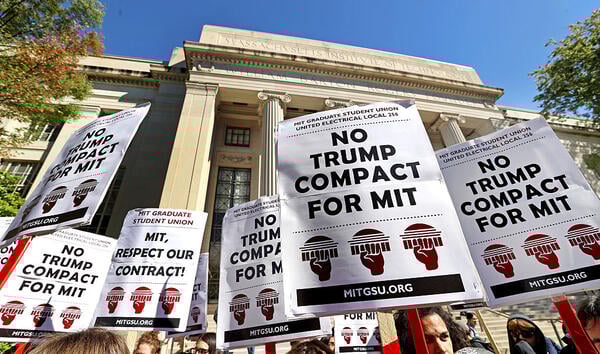
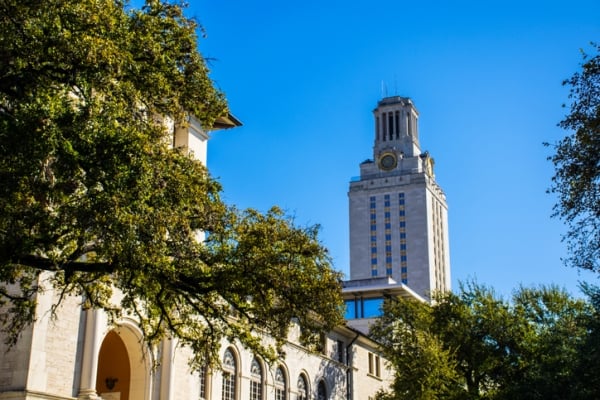
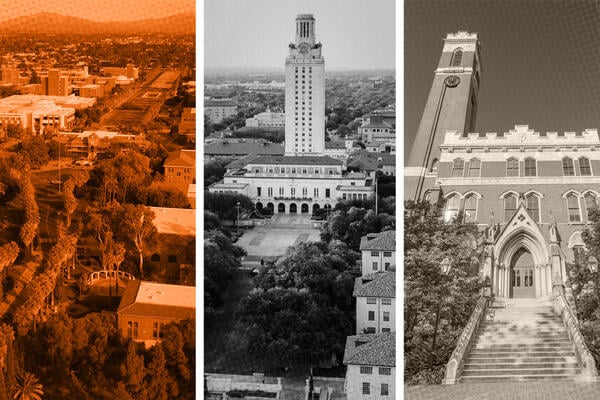
The Trump administration’s initial effort to convince universities to join its “Compact for Academic Excellence” did not go well. Of the original nine colleges and universities, so far none has signed it, and seven—Brown University, Dartmouth College, the Massachusetts Institute of Technology and the Universities of Arizona, Pennsylvania, Southern California and Virginia—have loudly and forcefully rejected it, citing “our core belief that scientific funding should be based on scientific merit alone” (MIT) and “the government’s lack of authority to dictate our curriculum or the content of academic speech” (Brown).
The Trump administration made more headway with its earlier efforts to force a “deal” on one university at a time. But that was never going to be enough. An authoritarian needs to establish control over the entire higher education sector, not just a handful of institutions. But the truth is, this government does not have the legal leverage or even the staff to negotiate bespoke agreements with the thousands of colleges and universities in the United States.
The compact is an effort to overcome that problem. But it is also a gift. It has flipped the default: Now collective action does not necessarily require affirmative acts like banding together to file a lawsuit (although several are warranted). Collective action can simply take the form of nonacquiescence. All university leaders need to do is … nothing.
Last week, the Trump administration—apparently unafraid to look desperate—decided to open the compact to any American college or university that will accept its terms. Suddenly, literally anyone affiliated with any college or university—faculty, staff, students, parents, alumni, trustees, donors—has the opportunity to use their voice to help persuade their institution not to sign, as their counterparts at the original nine invitees have been doing rather vociferously and, in six cases so far, successfully. By opening the compact so broadly, the government is risking, or inviting, an equally broad response: a recognition throughout the vast American higher education sector that the integrity and value of our whole enterprise depend on independence from government control.
Regardless of their politics, every university leader should reject this compact. University leaders have a fiduciary responsibility to plan ahead on a time scale longer than three years. As Sally Kornbluth, the president of MIT, explained, “America’s leadership in science and innovation depends on independent thinking and open competition,” not special “preferences” for institutions that submit to government control. Future federal governments are much more likely to embrace Kornbluth’s view than Trump’s. It does not put a university in a strong position to compete for future faculty and students if the university enthusiastically agrees to toe one administration’s political line.
To sign the compact is to invite a breathtaking degree of federal government control. Colleges signing it agree that in the future, if the Department of Justice—perhaps acting on orders from the president—“finds” that the university is disobeying any one of the compact’s many ambiguous commands, the department can take away all the university’s federal funding for a year or more. That includes not only scientific research grants but also student loans or Pell Grants, potentially even the university’s 501(c)(3) status—and not only future funds but also, incredibly, funds already spent that must somehow be returned.
The ambiguous rules that signing institutions must avoid transgressing are numerous. Signing universities must “abolish” or “transform” academic departments that “belittle” “conservative ideas.” They must screen out foreign students with “anti-American values” and those with “hostility” toward any of America’s “allies.” They must punish students or faculty whose speech, in the DOJ’s opinion, “support[s]” any group the government deems a terrorist group, which would include “antifa” as well as Hamas (and the government has a long recent record of defining “support for Hamas” extremely broadly, so that it encompasses much pro-Palestinian speech).
They must commit to “defining” and “interpreting” gender in the government’s preferred way, which denies that transgender people exist. Signing institutions must obtain, to the DOJ’s satisfaction, “a broad spectrum of viewpoints” not only in the university as a whole, but “within every field, department, school, and teaching unit.” They must admit students on the basis of sufficiently “objective” criteria. Leaders of signing universities must avoid speaking out about “societal and political events” beyond those that directly affect the university.
Not a single one of those terms is self-defining. The arbiter of whether a university is fulfilling these vague promises is a Department of Justice that has a record of acting in bad faith and takes orders from a notoriously mercurial president. No university leader or trustee can truthfully say that it fulfills their fiduciary responsibility to sign their school up for this.
The compact is also blatantly illegal. The Trump administration has cited no statutes that give it the authority to boss universities around in this way, because there aren’t any. Many of the compact’s provisions listed above—and others—violate the First Amendment. Clear black-letter law holds that what the government cannot impose by law, it also cannot impose as a condition of receiving government funds.
It is crucial to keep in mind the larger context here: the rise of an authoritarian regime that seeks to undermine the independence of many types of civil society institutions, not just universities. The national governments in both Turkey and Hungary have increased political control over their universities as part of their consolidation of power, but neither has gone as far as this compact would go in putting universities under the government’s thumb. To sign the compact is to participate in an authoritarian project.
Any university leaders still inclined to join the compact should consider a final argument: The dollars and cents simply don’t add up. The compact requires, among many other things, a five-year tuition freeze. In the high-inflation environment of the second Trump administration, this is very costly. (At today’s 3 percent inflation rate, it amounts to a 16 percent cut in real terms over five years; if inflation continues to rise, that could easily become a 20 to 25 percent cut.)
The government offers a vague, nonbinding promise that it will give signing institutions extra research grants, but such grants do not easily make up for lost tuition in an environment of rising costs. The grants require doing the research; that eats up most of the money. Any college that becomes dependent on extra grants, beyond those they would have been qualified to receive without the compact, is going to be in big fiscal trouble down the line.
This compact has vast implications, which deserve careful study. For faculty, staff, students, parents, donors and alumni hoping for a no but willing to settle for silence, time is your friend; inaction is your goal. A faculty committee would certainly be in order. If you do nothing, and most other universities do nothing, the government will have no more leverage over your institution than over any other, and academic freedom and the pursuit of knowledge and truth will continue for another day.
In the late 1990s, a group of commuters would board the early-morning Amtrak train from Philadelphia to Washington, D.C. They’d sit in the first car behind the locomotive, enjoying communal, consensual silence. Eventually and with the conductor’s help, their car was officially designated as a noise-free zone. Soon after, Denise LaBencki-Fullmer, an Amtrak manager, recognized the value of a peaceful ride and institutionalized the program as the quiet car. At the request of passengers, it soon spread to a number of other commuter services.
The educational technology sector has something to learn from the Amtrak commuters’ deliberate design of their environment. Learning requires the ability to concentrate. You need a space where you are allowed to process information, recall facts, analyze complex questions and think creatively about ideas, problems and solutions. Learning is not a smooth and easy process—in fact, it is desirable that it’s a bit difficult, because that is how we actually learn. Getting someone to do learning tasks for you, as tempting or comfortable as that might be, won’t work.
A great deal of learning still happens online, even at colleges that value in-person teaching as much as Princeton University does. The learning management system is where our students find readings, review lecture slides and practice their skills and comprehension on homework assignments. It is also where many instructors administer assessments, both low-stakes quizzes and high-stakes exams.
Last month, Google launched a feature called “Homework help” in Chrome—a shiny blue button right in the address bar. By engaging it, a student could prompt Google Gemini to summarize a reading or solve a quiz question in a matter of seconds. It thereby robbed the student of the learning activity that they were there to do. A few weeks later Google repositioned the feature so it is a bit less obvious (at least for now), but the question remains: What kind of AI tools should we make available to our students in learning management systems and assessment platforms?
You might be thinking that this is a pointless question: AI is going to be everywhere—it already is. And sure, that is true. Also, if a student wants to use AI, it is easy enough to open another browser tab and ask an LLM for help. But installing the AI right in the environment in which the student is trying to learn is equivalent to sitting next to the most obnoxious cell yeller on your train ride: You can’t think your own thoughts, because the distraction is so big.
Just as there are quiet cars on trains, there can be quiet areas of the internet. Learning management systems and assessment platforms should be one such area. That doesn’t mean that there can’t be good uses of AI in learning. Our students should know how to use AI responsibly, thoughtfully and critically, as should the faculty who teach them (I sometimes use AI in my own teaching, for instance). But we should also ask that the companies that provide us with learning technologies think critically and carefully about whether AI aids the difficult, careful work that learning requires or, in fact, removes the opportunity for it. AI is inevitable, but that doesn’t mean we can’t be intentional about how, why and where we implement it.
I have spent the last few weeks talking with colleagues at other colleges and universities and with the partners that provide our educational technology. Everyone I have spoken with cares about education, and none of them think it’s a good idea that we implement AI in a way that so clearly pulls students out of the learning process. It is actually not unrealistic that people in the tech industry and education sector come together to make the same kind of pact that the train commuters made some 25 years ago and declare our online learning systems an AI quiet zone. We would be doing the right thing by our students if we did.
Mona Fixdal provides strategic planning and pedagogical leadership for Princeton University’s suite of teaching and learning technologies as well its online learning program. She has a Ph.D. in political science from the University of Oslo and is the author of Just Peace: How Wars Should End and a number of chapters and articles on postwar justice and third-party mediation.
As part of National Transfer Student Week, hundreds of college campuses are hosting public celebrations to uplift their transfer student communities, including many in our home state of California. While these celebrations are important to increase visibility and a sense of belonging, transfer students warrant our attention and support year-round. The data demonstrate why: While 80 percent of community college students nationally aspire to earn a bachelor’s degree, just 17 percent of community college students in California reach that finish line within six years. Moreover, sizable inequities by race and ethnicity, income, and age point to the need for drastic change.
As former transfer students from the California Community Colleges who have worked in various capacities to improve transfer, including working directly with students through admissions, partnering with higher education system leaders to implement statewide legislation like Assembly Bill 928 and educating lawmakers and system leaders on the gaps that persist as policy fellows with the Campaign for College Opportunity, we know these challenges firsthand. Reflecting on our own transfer journeys and professional experience, we have identified three priorities that must be addressed to improve transfer student outcomes.
Align and streamline transfer pathways to create flexibility for learners.
When we began our community college journeys, we had no idea where the road might lead us: to a California State University, a University of California or a private nonprofit institution. Like many first-time students, we explored our options and built contingency plans. Yet California’s transfer pathways are not designed to provide such flexibility. Eligibility requirements vary across systems, with CSU and UC maintaining their own preferred pathways.
Adding complexity, individual campuses and academic programs also impose local requirements, as documented in a recent study of five public institutions in California. This means that the same community college class can be treated differently by every campus, even in the same system, and may not end up applying to the intended major. As Just Equations further documented, the campus- and major-specific requirements are especially complicated for math.
To avoid wasting time and credits, transfer students must commit early to a specific path. Making sense of these requirements, however, falls largely on students. One resource that helped us navigate course transfer in California is ASSIST.org. Nancy was able to use this tool to decide that the flexibility afforded by the general education transfer curriculum recognized by all CSU and UC campuses would be the best path for her. Meanwhile, both Brianna and Carlos relied on the tool to understand which math classes to take for their intended majors. Brianna discovered that the business calculus class she planned to take at American River College would work at her target CSU campus but would disqualify her from every UC campus.
Unfortunately, while tools exist, students must independently seek them out and interpret complex rules. This adds unnecessary stress and risk of error. While we each ultimately succeeded in transferring and graduating, too many students are thrown off course. California should cut through this confusion by better aligning curricular requirements across the CSU and UC, and across campuses in the same system, so students have breathing room.
Expand access to accurate and timely advising.
While students in specialized programs often receive consistent advising, all community college students would benefit from personalized, ongoing support. Advising was pivotal for each of us, but only after we made the effort to seek it out and build relationships.
For Nancy, proactively meeting with a transfer counselor every semester at El Camino College ensured that her general education plan and major requirements stayed on track. Brianna initially struggled to connect with advisers, but after joining her college’s track team, she began working with a consistent counselor who understood her long-term goals and helped her recognize that her coursework qualified her for several associate degrees.
Through EOPS and athletics, Carlos met with his counselors multiple times each semester to monitor his progress on his plan to transfer to UCLA for economics. Despite his persistence, he was not informed of the calculus prerequisites until a year into his studies, which delayed his graduation from Porterville College. This gap was not the result of inaction on his part but of advising structures that are too underresourced to keep up with the ever-changing terrain of major requirements and hidden prerequisites.
Together, our experiences highlight both the promise and pitfalls of advising. Consistent guidance turned potential setbacks into opportunities, but these outcomes depended on resources and relationships that are not universally accessible. California can and must do better by guaranteeing timely, accurate advising from the start. That means staffing campuses with sufficient transfer counselors, ensuring continuity with the same adviser, embedding transfer-specific advising across programs, as well as transfer receiving institutions investing more into their future students before the application process begins.
Invest in transfer success and building transfer-receptive cultures.
Admission to a four-year institution is only the beginning of the transfer journey. Just like first-year students, transfer students need resources and communities to thrive at an entirely new school and system. For Nancy and Carlos, UCLA’s Transfer Summer Program provided an early introduction to key campus resources and a strong peer community. That foundation smoothed their transition and reinforced their sense of belonging. With one in three UC undergraduates entering as transfer students, investing systemwide in transfer-specific programming is essential. Summer bridge programs, structured mentorship and visible campus traditions can ensure transfer students feel valued from the first day they enter campus.
By contrast, Brianna entered Pomona College as one of just 20 transfer students. While living with fellow transfer students helped build community, formal support was limited. She stepped up as a student leader, serving as the first transfer community residential adviser and partnering with university leaders to design and implement transfer-specific programming.
These stories illustrate both the power of institutionalizing support services and of recognizing the inherent assets that transfer students bring to the table, because building a transfer-receptive culture must begin with valuing transfer students and treating them as integral contributors to the intellectual and social life of their campuses.
Looking Ahead
Our transfer success stories were possible because of our persistence in seeking tools like ASSIST.org, the guidance of dedicated advisers and the support of peer communities that helped us navigate through an unduly complex and high-stakes process. But no student’s success should depend on luck—our higher education systems need to make sure they are student-ready. California has made important progress through reforms like common course numbering, the Associate Degree for Transfer and Cal-GETC. Now it is time to build on that momentum by aligning and streamlining pathways, expanding access to accurate advising and degree planning tools, and investing in transfer-receptive campuses.
Brianna Huynh is a former policy fellow at the Campaign for College Opportunity. She is completing her M.S. in mathematics at California State Polytechnic University Pomona, and holds an A.S.T. in mathematics from American River College and a B.S. in mathematics from Pomona College.
Nancy Ohia is a current policy fellow at the Campaign for College Opportunity. After graduating from UCLA as a transfer student, Nancy earned her M.P.P. from USC.
Carlos Rodriguez is a current policy fellow at the Campaign for College Opportunity. He earned his A.S. in business management from Porterville College and is a current transfer student at UCLA majoring in economics.
Virtual reality courses have become more common, thanks to the development of new classroom applications for the software and the increased affordability of VR and augmented reality technology for institutions. A 2025 survey of chief technology officers by Inside Higher Ed and Hanover Research found that 14 percent of respondents said their institution has made meaningful investments in virtual reality and immersive learning.
Past research shows that VR activities benefit student learning by making the classroom more engaging and encouraging creative and entrepreneurial thinking.
A group of faculty at Pepperdine University in California adapted virtual reality content to teach undergraduates about ethical systems in a practical and applied setting.
Their research study, published in the Journal of Business and Technical Communication, showed that students who used VR in a case study had a heightened emotional response to the material, which clouded their ability to provide a measured analysis. By comparison, students who watched a straight video about the same case not only expressed empathy for the subjects but also maintained a clear view of their situation.
How it works: The research study evaluated student learning over the course of two semesters in 2023. Students were presented with three variations of a case study related to the Malibu Community Labor Exchange, a nonprofit organization that helps day laborers and individuals without housing secure work. Students read a news article and watched a VR video or watched a standard video about the lives of workers at the MCLE, which provides a variety of opportunities for individuals in the Los Angeles region. Some watched both VR and a standard video.
Course content focused primarily on the workers, their personal lives, their role in addressing wildfires in Malibu and the risks they face in fighting fires.
After watching the materials, students had to connect the ethical questions presented about MCLE’s mission and workers’ conditions with a previously taught lesson about ethicists and their ethical systems, as well as write a recommendation for the organization.
Faculty reviewed students’ responses to identify whether they exhibited appropriate reasoning about ethical systems and whether their recommendations reflected their ability to interpret the content.
The takeaways: In their reflections, students underscored the way videos exposed them to someone else’s circumstances and realities, saying the content felt very authentic. But those who used VRwere more likely to say the format was distracting than those who saw only videos.
Students who watched the standard video said it helped them expand their understanding of the organization, its members and the context of the work in an emotional and logical way. They wrote that they felt empathetic and had a richer sense of the work being done.
“The video was very raw. It didn’t glamorize or have fantastic editing. It showed us exactly what it is like for these workers,” one student wrote.
For some students, the VR video was more powerful because it was more “shocking and realistic than seeing the video in normal format,” one course participant wrote. Instructors noted students were almost too personally affected by the first-person vantage point to talk about the organization and the ethical systems from an objective or factual perspective.
Students who watched only the VR were also more likely to conflate the experience with reality, calling it a “true view” instead of a representation or interpretation of events; students who watched a standard video as well as the VR version had a more balanced perspective.
Based on their findings, researchers suggest that using both standard and VR videos that require students to reflect, analyze and recommend solutions can increase students’ “practical wisdom,” or balancing cognition and emotion for ethical action, as researchers defined it.
“Rather than assuming that students know how to critically evaluate visual messages and their emotions, we need to intentionally teach students how to develop visual literacy and practical wisdom, especially by using VR video,” researchers wrote in the article.
The Graduate Student Assembly had planned to consider resolutions against two Texas laws.
Officials at the University of Texas at Austin blocked the Graduate Student Assembly from considering two resolutions against Texas state laws last week, arguing that the student-run body must follow institutional neutrality policies.
Mateo Vallejo, a first-year master’s student and representative in the GSA for the School of Social Work, drafted two resolutions for the assembly to consider: one condemning Texas SB 17, which bans diversity, equity and inclusion initiatives at Texas public institutions, and another against Texas SB 37, a state law that, among other changes, put faculty senates at public institutions under the control of university presidents and boards.
On Oct. 10, GSA president David Spicer submitted the two resolutions to Associate Dean for Graduate Studies Christopher J. McCarthy for approval. According to the assembly bylaws, the dean of students’ office must approve all proposed GSA legislation before it can be considered by the full assembly, effectively giving the office an opportunity to veto, Vallejo explained. Once a bill is submitted to the dean’s office, the assembly cannot make any changes to the text. Vallejo, Spicer and the GSA vice president were careful to follow the bylaws during the drafting process to give administrators as little reason as possible to shut the resolutions down.
Five days later, McCarthy nixed them.
“[Vice President for Legal Affairs] considers the legislation to be political speech that is not permitted to be issued by a sponsored student organization in their official capacity,” McCarthy wrote in an email to Spicer, which Inside Higher Ed obtained. “This legislation should not be permitted to go forward.”
Spicer followed up, asking why the GSA was prohibited from engaging inpolitical speech when others have done so in their official capacity at UT Austin. He pointed to an op-ed by Provost William Inboden in the conservative magazine National Affairs and a statement from University of Texas System Board of Regents chairman Kevin P. Eltife, who said the university was “honored” to be among the institutions “selected by the Trump Administration for potential funding advantages” under Trump’s “Compact for Academic Excellence in Higher Education.”
“Their speech was on ‘political and social’ matters, so I do not know how they escape the neutrality requirement whereas GSA cannot,” Spicer wrote in his response to McCarthy. In addition, UT Austin’s undergraduate student government recently put out a statement of support for the university’s new president, Jim Davis, which Spicer argued is also political speech.
“Like attacks on the Faculty Council, silencing GSA through institutional neutrality is an attack on the notion of shared governance,” Spicer said in a statement to Inside Higher Ed. “GSA appoints students to university-wide committees and, previously, Faculty Council committees. GSA is the one space at UT Austin where students can voice issues impacting their graduate education.”
When asked about the double standard, UT Austin spokesperson Mike Rosen told Inside Higher Ed that the resolution in support of Davis is not political speech because he was appointed by a nonpartisan board and not by an elected official. Members of the University of Texas System Board of Regents are appointed by the Texas governor.
“UT Austin exercises institutional neutrality consistent with a policy approved by the UT System Board of Regents, which prohibits System institutions from expressing positions on political matters or issues of the day. As a sponsored student organization, GSA acts as an extension of the University and cannot act to cause the University to violate the UT System policy,” Rosen wrote in an email.
Vallejo’s resolutions against SB 17 and SB 37 would not be the firstattempt by the GSA to address Texas politics. In 2022, the Assembly passed a resolution in response to Texas attorney general Ken Paxton’s opinion and Gov. Greg Abbott’s directive to the Department of Family and Protective Services that gender-affirming medical care for minors could be treated as child abuse. In its resolution, the Assembly urged campus officials not to adopt that definition for campus reporting purposes.
The University of Arizona is the latest institution to reject an offer to sign on to the Trump administration’s “Compact for Academic Excellence in Higher Education,” issuing its response on the same day feedback on the proposal was due.
While some universities have rejected the compact outright, Arizona president Suresh Garimella announced the decision in a message to the campus community that sent mixed signals. “The university has not agreed to the terms outlined in the draft proposal,” Garimella wrote. He emphasized the need to preserve “principles like academic freedom, merit-based research funding, and institutional independence.”
At the same time, he said that some of the compact’s provisions “deserve thoughtful consideration as our national higher education system could benefit from reforms that have been much too slow to develop,” noting that many were already in place at Arizona. He added that the federal government said it was “seeking constructive dialogue rather than a definitive written response.”
Indeed, in a letter to Education Secretary Linda McMahon, Garimella indicated an openness to further engagement. “We have much common ground with the ideas your administration is advancing on changes that would benefit American higher education and our nation at large,” he wrote.
Still, he took issue with the administration’s promise of giving signatories preferential treatment in research funding. “A federal research funding system based on anything other than merit would weaken the world’s preeminent engine for innovation, advancement of technology, and solutions to many of our nation’s most profound challenges,” he wrote to McMahon. “We seek no special treatment and believe in our ability to compete for federally funded research strictly on merit.”
Arizona was one of nine universities the Trump administration reached out to on Oct. 1 offering preferential treatment for federal research funding if they agreed to a compact that would overhaul admissions and hiring, cap international enrollment at 15 percent, revise academic offerings, suppress criticism of conservatives, freeze tuition for five years, and more.
Amid some rejections from the original nine, the federal government sent additional invitations earlier this month.
Institutions initially invited to join were Brown University, Dartmouth College, the Massachusetts Institute of Technology, the University of Arizona, the University of Pennsylvania, the University of Southern California, University of Texas at Austin, the University of Virginia and Vanderbilt University. Invitations were later sent to Arizona State University, the University of Kansas and Washington University in St. Louis.
Six of the original invitees have declined to sign: MIT was the first to reject the compact, followed by Brown, Dartmouth, Penn, USC and Virginia.
The Trump administration has since opened the compact to any institution that wishes to join.
As of Monday, none of the invited institutions had agreed to the deal, despite a recent push from the White House, which included a meeting with several universities last week. Institutions have until Nov. 21 to make a final decision about whether to sign, according to a letter McMahon sent with the proposal.
Washington University in St. Louis officials indicated Monday they remain open to the idea.
Chancellor Andrew Martin announced that the university would provide feedback, or, as he put it, “participate in a conversation about the future of higher education” with the Trump administration. Martin emphasized the importance of having “a seat at the table” for such discussions but said those talks did not equate to signing the compact.
“It’s important for you to know that our participation in this dialogue does not mean we have endorsed or signed on to the Compact for Academic Excellence in Higher Education presented to us for feedback by the federal administration. We have not done that. In addition, this decision was not made to advantage ourselves or gain any type of preferential benefit,” Martin wrote. “We firmly believe meaningful progress will best be achieved through open, ongoing dialogue.”
An Arizona State spokesperson also left open the option to join the compact, writing to Inside Higher Ed by email, “ASU has long been a voice for change in higher education and as President Trump’s team seeks new and innovative approaches to serve the needs of the country, ASU has engaged in dialogue and offered ideas about how to do so.”
Vanderbilt chancellor Daniel Diermeier noted in an email to the campus community that the university intended to offer feedback on the proposal.
“Despite reporting to the contrary, we have not been asked to accept or reject the draft compact,” Diermeier wrote. “Rather, we have been asked to provide feedback and comments as part of an ongoing dialogue, and that is our intention.”
But other universities stayed silent on the day of the initial deadline.
University of Texas system officials initially announced they were “honored” that the flagship was invited to join, but Austin officials did not have an update on where that invitation stands. Kansas did not respond to requests for comment.
When I asked my executive assistant to proof my first superintendent’s report for the public board packet, she came back and said that she was surprised that I gave so much credit to others for the work being completed by the district. A simple leadership lesson I learned from David Fridlington, my favorite battalion commander in the military, was to use your position to take care of your people and support them. He told everyone that when he presided over a promotion ceremony, he said: “Use this rank to take care of your soldiers.”
One basic concept is that when things go well, give credit to those who did the work, even if you provided the direction. Your board or other supervisors should understand that success requires leadership. The opposite is true as well. When things do not go well, the leader needs to step in and accept the blame. Even if a subordinate was negligent and their performance needs to be addressed, there is never justification for doing it in a public forum.
The traditional leadership trap
For decades, educational leadership has often mirrored the corporate world’s focus on individual achievement and personal branding. Superintendents, principals, and department heads have felt pressure to position themselves as the architects of every success, the faces of every initiative, and the voices behind every innovation. This approach, while understandable given the accountability pressures facing education leaders, creates a dangerous dynamic that undermines both team morale and long-term organizational success.
When leaders consistently claim credit for achievements, they inadvertently signal to their teams that individual contributions are less valuable than executive oversight. Faculty members, administrators, and support staff begin to feel invisible, their efforts overshadowed by leadership’s need for recognition. This dynamic is particularly damaging in educational environments, where collaboration and shared ownership of student success are essential.
Smart educational leaders understand that their primary role is not as the star of the show, but to direct in such a way that every cast member shines. When a high school’s test scores improve dramatically, the effective principal doesn’t schedule interviews to discuss their leadership philosophy. Instead, they organize a celebration highlighting the innovative teaching strategies developed by their faculty, the dedication of support staff, and the hard work of the students.
This approach accomplishes several critical objectives simultaneously. First, it builds tremendous goodwill and loyalty among team members who feel genuinely appreciated and recognized. Teachers who see their principal celebrating their classroom innovations in district newsletters or community presentations develop a deeper commitment to the school’s mission. They feel valued as both implementers of directives and as creative professionals whose expertise helps drive student success.
Building trust through recognition
Education leaders who consistently spotlight their teams create an atmosphere of trust that permeates the entire organization. When a superintendent highlights individual schools’ achievements without inserting themselves into the narrative, principals and teachers recognize that their leader is secure enough in their own position to share credit freely. This security translates into psychological safety throughout the organization, encouraging innovation and risk-taking that leads to better educational outcomes.
Consider the university department chair who, when presenting research achievements to the dean, leads with faculty accomplishments rather than departmental management strategies. Graduate students and professors in that department understand that their work will be recognized and celebrated, not appropriated by administrative oversight. This recognition culture attracts top talent and retains valuable team members who might otherwise seek environments where their contributions receive proper acknowledgment.
The ripple effect of recognition
When leaders consistently elevate their teams, they create a cascade of positive behaviors throughout the organization. Teachers who feel appreciated by their principals are more likely to recognize and celebrate their students’ achievements. Support staff who see their contributions highlighted become more invested in finding innovative solutions to operational challenges. The entire educational community benefits when recognition flows freely rather than accumulating at the top of the organizational chart.
This dynamic is particularly powerful in educational settings because it models the same growth mindset we want to instill in students. When young people see adults in their schools celebrating each other’s successes and sharing credit generously, they learn valuable lessons about collaboration, humility, and community building that extend far beyond academic subjects.
Strategic communication for team-focused leaders
Educational leaders might worry that stepping back from the spotlight will make them appear weak or uninvolved. The reality is quite the opposite. Stakeholders, from school board members to parents to community partners, are sophisticated enough to recognize that strong leaders create environments where others can excel. A principal who consistently highlights teacher innovations demonstrates their ability to recruit, develop, and retain talent. A superintendent who celebrates individual school achievements shows their skill at creating systems that enable success across diverse environments.
The key is strategic communication that makes the leader’s supporting role visible without overshadowing team members. When presenting achievements, effective leaders briefly acknowledge their role in creating conditions for success before diving deep into team member accomplishments. They might say, “We’ve worked hard to create an environment where innovation can flourish, and I’m excited to share what our incredible faculty has accomplished.”
Practical implementation strategies
Educational leaders can begin implementing this philosophy immediately through simple but powerful changes in communication habits. Instead of using “I” language when discussing successes, they can shift to “we” and “they” language that emphasizes team contributions. Rather than accepting speaking engagements about leadership strategies, they can recommend team members as presenters on innovative practices.
Internal communications offer rich opportunities for team recognition. Weekly newsletters, staff meetings, and board presentations become venues for celebrating individual and group achievements. Social media platforms allow leaders to amplify team member successes to broader audiences, creating positive publicity for both individuals and the organization. Two of the deans I currently work with are excellent examples of such active supporters of their faculty. Informal leaders can participate as well by highlighting their colleagues’ accomplishments via posting congratulatory notes on LinkedIn or other social media sites.
The long-term leadership legacy
Education leaders who consistently spotlight their teams create lasting legacies that extend far beyond their tenure. They build cultures of recognition and collaboration that persist even when leadership changes. More importantly, they develop future leaders among their team members who understand that true leadership means elevating others.
In an era when educational institutions face unprecedented challenges, from funding constraints to political pressures to rapidly changing technology, leaders who can inspire and retain talented teams have a significant competitive advantage. These leaders understand that their success is measured not by their personal recognition, but by their ability to create environments where others can achieve their highest potential.
The most effective leaders recognize that the spotlight is not a zero-sum game. When they illuminate their teams’ achievements, they don’t diminish their own leadership; they demonstrate it in its most powerful form. In education, where the ultimate goal is developing human potential, leaders who model this philosophy create ripple effects that benefit students, staff, and communities for years to come.
Dr. Steve Baule is a faculty member at Winona State University (WSU), where he teaches in the Leadership Education Department. Prior to joining WSU, Baule spent 28 years in K-12 school systems in Illinois, Indiana, and Iowa, and two years teaching in the University of Wisconsin System. For the 13 years prior to moving to the university level, Baule served as a public -school superintendent. He has written 10 books on a variety of educational and historical topics and has served on the editorial boards for two journals. Baule earned an advanced diversity and equity certificate while in the UW system. He holds a doctorate in instructional technology from Northern Illinois University and a doctorate in educational leadership and policy studies from Loyola University Chicago.
Baule’s scholarly interests focus on online student engagement, educational technology– particularly the impact of 1:1 implementations, social-emotional learning, and the history of education. Baule led several efforts to improve student emotional health and reduce discipline issues prior to moving into higher education. He also writes on aspects of early American history.
Baule has held memberships in the American Association of School Administrators, the American Library Association, the American Association of School Librarians, the Association for Supervision and Curriculum Development, the Consortium for School Networking, the International Association of School Librarians, the National Association of Secondary School Principals, the National Staff Development Council, and many of their state affiliates. He has served as a consultant in the areas of educational technology, facilities design, library program development, team building, and communications.
Latest posts by Steven M. Baule, Ed.D., Ph.D. (see all)
Photo illustration by Justin Morrison/Inside Higher Ed | Remigiusz Gora/iStock/Getty Images
It was legit: She was a beneficiary of the Colorado Re-Engaged Initiative (CORE), which draws on reverse-transfer policies to allow the state’s four-year institutions to award degrees to stopped-out students who have fulfilled the requirements of an associate of general studies degree.
Created by state legislation in 2021, CORE seeks to reduce the share of the 700,000 plus students in the state who have completed some college credits but don’t hold a degree.
“It has always been problematic for me to think that people could have gone three years, three and a half years to college and the highest credential that they have is a high school diploma,” said Angie Paccione, executive director of Colorado’s Department of Higher Education.
For Varkevisser, getting recognized for her years’ worth of credit accumulation was simple; she just had to say yes to the email. “It came out of nowhere, but I have my college degree now,” Varkevisser said.
Colorado isn’t the only state aiming to reduce the millions of individuals who fall in the some college, no degree population in the U.S. And reverse transfer—awarding an associate degree to students who have met the credit threshold—is a relatively simple way to do it, thanks to new technologies and state initiatives to streamline policies.
But one barrier has tripped up colleges for over a decade: working with students to make them aware so they participate in these programs. In Colorado, for example, fewer than 5 percent of eligible students have opted in to CORE.
“I can’t imagine why” a student wouldn’t opt in, Paccione said. “You’ve already paid money; you don’t have to do anything, all you have to do is call [the institution] up and say, ‘Hey, I understand I might be eligible for an associate degree.’ It takes a phone call, essentially.”
Credits but No Credential
In the 2010s, reverse transfer was a popular student success intervention, allowing students who transferred from a two-year to a four-year institution to pass their credits back to their community college to earn a credential.
Experts say awarding an associate degree for credits acquired before a student hits the four-year degree threshold can support their overall success in and after college, because it provides a benchmark of progress. A 2018 report found that most community colleges students who transferred to another institution left their two-year college without a degree, putting them in limbo between programs with credits but no credential.
Now, reverse-transfer policies are being applied to students who have enrolled at a four-year college and left before earning a degree, who often abandon a significant number of credits.
The National Student Clearinghouse Research Center’s latest report on the some college, no credential (SCNC) population found that 7.2 percent of stopped-out students had achieved at least two years’ worth of full-time-equivalent enrollment over the past decade. In other words, 2.6 million individuals in the U.S. have completed two years’ worth of college credits but don’t hold a credential to prove it.
In addition to Colorado, Florida, Maryland, Michigan, Missouri, Oregon and Texas are introducing or modifying policies to award associate degrees to stopped-out students who have earned enough credits. The trend reflects a renewed focus on better serving stopped-out students instead of simply pushing them to re-enroll.
“What’s happening at the national level is that folks are recognizing that we’re still not seeing the completion that we want,” said Wendy Sedlak, the Lumina Foundation’s strategy director for research and evaluation. “It’s taking a long time to make headway, so nationally, people are looking back, and looking into what are those initiatives, what are those policies, what are those practices that have really helped us push ahead?”
Photo illustration by Justin Morrison/Inside Higher Ed | stphillips/iStock/Getty Images
Obstacles to Implementation
Reverse transfer, while simple on paper, faces a variety of hurdles at the state, institutional and individual levels.
At the highest level, most universities cannot award associate degrees due to state legislation. Before CORE, Colorado universities were limited to being “dual mission” (awarding two- and four-year degrees) or awarding higher degrees, such as master’s or doctorates.
There’s also a stigma around offering two-year degrees to students. Only eight universities are participating in CORE, because “some of the institutions don’t want to be associated with an associate degree,” Paccione said. “They pride themselves on the bachelor’s degree and they want to make sure students complete that.”
Critics of reverse transfer claim that awarding students an associate degree if they fail to complete a bachelor’s gives them an incentive to stop out, but most of these programs require students to have left higher education for at least two years to be eligible for reverse transfer.
Restrictions on student eligibility has further limited the number who can benefit from reverse-transfer programs.
To earn an associate degree retroactively through traditional reverse-transfer processes, students have to begin their college journey at a two-year institution and earn at least one-quarter of their credits there. They are also required to take a certain number (typically 60 or more) and type of credits to fulfill requirements for the degree, whether that’s an associate of arts, science or general studies. So a student who completed 59 credits of primarily electives or upper-level credits in their major would not be able to earn the degree, for example.
While 700,000 students in Colorado have earned some college credit but no degree, only about 30,000 residents have earned the minimum 70 credits at a four-year state university within the past 10 years that makes them eligible for CORE, according to the state.
Most colleges require students to opt in to reverse transfer due to FERPA laws, meaning that students need to advocate for receiving their award and facilitate transcript data exchanges between institutions. This can further disadvantage those who are unfamiliar with their college’s bureaucratic processes or the hidden curriculum of higher education.
In addition, getting up-to-date emails, addresses or phone numbers for students who were enrolled nearly a decade ago can be difficult for the institution.
For some students, the opportunity may seem too good to be true.
Peter Fritz, director of student transitions and degree completion initiatives at the Colorado Department of Higher Education, talked to CORE participants at their graduation ceremony in 2023 who—like Varkevisser’s partner—initially thought the program was a scam. Media attention and support from the governor have helped build trust in CORE. And the state’s Education Department continues to affirm messaging that this isn’t a giveaway or a money grab, but recognition of work already completed.
Thousands of Colorado residents are eligible for CORE, but Varkevisser said she hasn’t heard of anyone in her community who’s taken advantage of it. “Actually, I am the one that’s telling everyone I know, and they go, ‘That’s crazy!’”
Photo illustration by Justin Morrison/Inside Higher Ed
Giving Students Degrees
Between CORE’s launch in 2022 and January 2025, 1,032 stopped-out students earned associates degrees, according to Colorado’s education department.
At Metropolitan State University of Denver, one of the Colorado institutions that opted in to CORE, when administrators began combing through institutional data to see which students would be eligible for the associate of general studies degree, they found 4,256 that could earn an A.G.S.
Another few thousand were eligible for a different degree entirely. If students had completed 15 or more credits at the community college system, “you wouldn’t be eligible for us to award you anything,” said Shaun Schafer, associate vice president of curriculum academic effectiveness and policy development. “Guess what? It’s reverse transfer.”
MSU Denver identified nearly 2,000 students who could receive a two-year degree from their community college. “We sent that back to the different institutions saying, ‘Hey, this person is actually eligible to reverse transfer and get an associate’s from you,’” Schafer said. “We can’t really do anything for them.”
In 2024, 336 students accepted an A.G.S. from MSU Denver, just under 9 percent of those eligible. An additional 130 or so students had reached 120 credit hours or more, so the university offered to help them re-enroll to finish their degree, and 300 had resumed coursework at other institutions.
National data shows policies like reverse transfer are making a dent in the “some college no degree” population by eliminating the barrier of re-enrollment to attain a credential. In the past year, about one in four SCNC students who earned a credential in the U.S. (15,500 students in total) did so without re-enrolling, according to National Student Clearinghouse data.
In Colorado, a total of 2,100 SCNC students completed a credential during the 2023–24 academic year alone, and 800 of those did not need to re-enroll, NSC data shows.
Some states, including Colorado, Michigan, Missouri and Oregon, require institutions to contact upward transfer students to make them aware of their reverse-transfer eligibility. In Texas, students consent to participating in reverse transfer when they fill out their application; they have to uncheck the box to opt out, giving universities leeway to enroll them in the process when they become eligible.
“Students often don’t do optional,” Sedlak said. “When you create additional barriers, you’re not going to see things get done.”
Alyson McClaran/MSU Denver
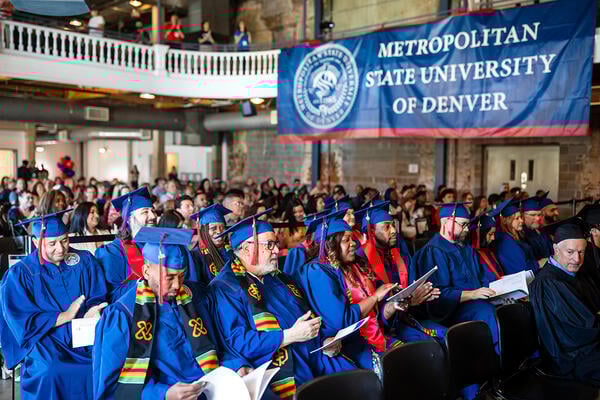
The first Summer Ceremony for Associate’s Degrees on June 22, 2024, in the Tivoli Turnhalle.
Leveraging Tech
Some universities have implemented new reverse transfer policies that capture students while they’re still enrolled, utilizing technology to expedite the process.
The University of Nebraska system, which includes the Lincoln, Omaha and Kearney campuses, implemented an automatically triggered reverse-transfer initiative in 2023. All eligible students need to do is respond to an email.
“Rather than putting the responsibility on the students to do that work—most of whom are not going to do that work—the system thought it would be better to create a mechanism that would automatically notify students when the courses that they’ve taken have gotten to that threshold,” said Amy Goodburn, senior associate vice chancellor at UNL.
To be eligible, students must complete at least 15 credits at a community college and then transfer to the University of Nebraska. The registrar’s office monitors a dashboard and, after confirming a student completed the appropriate number and type of credits for an associate degree, notifies the student. If the student responds to the email, the university processes the reverse transfer with the prior institution to confirm the associate degree.
“We’re trying to take the need for students to be proactive off their backs,” Goodburn said.
The process is not a heavy lift, Goodburn said, and it boosts the community college’s completion rate, making it mutually beneficial.
Still, the uptake remains stubbornly low.
At UNL, February 2025 data showed that 2,500 students were eligible to participate in reverse transfer, but only 10 percent have opted in. A reverse-transfer initiative in Tennessee a decade ago saw similar numbers; 7,500 were eligible, but only 1,755 students chose to participate and 347 degrees were awarded.
“I’m curious about the other 90 percent, like, are they not doing it because they don’t want it on their transcript?” Goodburn said. “Or they’re just not reading their emails, which is often the case? Or is there some other reason?”
The University of Montana is in the early stages of building its own process for the reverse transfer of stopped-out students. The institution has offered an associate of arts degree for years as part of Missoula College, an embedded two-year institution within the university. Now, through the Big Sky Finish initiative, officials will be able to retroactively award degrees to former students.
Brian Reed, the University of Montana’s associate vice president for student success, has been leading the project, convening with stakeholders—including the president, the provost, Missoula College leaders and the registrar’s office—to develop the process. The goal, Reed said, is to address the some college, no degree population while also investing in state goals for economic development.
Big Sky Finish hinges on a partnership with the ed-tech provider EAB, which has created a dashboard connecting various institutional data sets to identify which students are eligible for reverse transfer. The system highlights former students who have 60 credits or more that fulfill a general studies associate degree, as well as stop-outs who are mere credits away from meeting the requirement.
So far, Montana staff have identified just 11 students who are eligible to earn an A.A. degree and 150 more who are a class or two short of the needed credits.
Photo illustration by Justin Morrison/Inside Higher Ed | silverlining56/E+/Getty Images
Putting Degrees to Work
While CORE and similar initiatives are helping students earn a degree of value after leaving higher education, it’s less clear what impact associate degrees are having on students. Is it advancing their careers or getting them re-engaged in college?
About 10 percent of Colorado’s stopped-out students have chosen to re-enroll in higher education to pursue their bachelor’s degree, Fritz said.
For Varkevisser, receiving an A.G.S. degree provided the impetus to re-enroll and work toward a bachelor’s degree. The associate degree also gave her access to a variety of resources for alumni, including discounted tuition rates and career services.
“We recognize that it may not be for everybody to do this as a bachelor’s completion model, but the advantage of having an associate over a high school diploma, I think, helps,” Paccione.
But after students have their degrees, the career benefits and long-term implications for A.G.S. graduates are still murky. Median earnings of full-time, year-round workers with an associate degree are 18 percent higher than those with only a high school diploma, but still 35 percent lower than bachelor’s degree completers, according to the National Center for Education Statistics.
In Colorado, the average high school graduate in their mid-20s will earn about $25,000 per year, whereas a graduate with an associate of general studies degree will earn closer to $34,000 per year, according to 2021 data.
“There was an assumption that maybe an A.G.S. wasn’t really worth much, but the data we had on hand locally said there’s not really much difference financially and employment-wise between the different types of associate degrees,” Fritz said.
“I still don’t really know what all [the A.G.S.] can do for me,” Varkevisser said. “I was never not going to go for it once I got the email and found out it was a real thing, but I don’t know what to do with it necessarily.” She’s considered other forms of employment that require an associate degree, such as a laboratory or X-ray technician, while she finishes her bachelor’s degree in mathematics.
In Montana, there’s a slight wage premium for individuals who hold an associate degree compared to those with only a high school diploma, Reed said. An associate degree also opens doors in some career fields, such as bookkeeping.
The University of Montana is hoping to partner with the city of Missoula to identify small businesses looking for credentialed talent so completers can have a career pathway to transition into .
“I don’t think people are going into six-figure jobs after this,” Reed said. “But it’s creating a step toward something else for these folks. They get another job a little higher up, a little higher up, that prepares them for the next thing.”
But an A.G.S. isn’t a great target for workers and it can’t guarantee further education, MSU Denver’s Schafer noted.
“I hate to say it, but it’s a little bit of, it’s a lovely parting gift,” Schafer said. “Here, you have something that you can now show to the world. But how do I [as an administrator] build you on to the next thing when you’ve already stopped out? Maybe that’s the best hope. Even then, maybe it doesn’t work quite as magically as we want it to.”
I am curious about your take on the amount of money that institutions are spending on marketing …
According to this story, those four schools spent $676 million on marketing in one fiscal year.
If private companies like Coke and Pepsi want to engage in an advertising arms race (a.k.a. the Cola Wars), that is fine because it is private money. If the shareholders don’t like it, they can vote out the board. However, a lot of this marketing money is from public dollars like Pell Grants, federal loans, GI Bill, etc. Public dollars should not be spent on an advertising arms race. Elizabeth Warren was looking into this in the context of OPMs.
It seems like a huge transfer of wealth from taxpayers to Big Tech. The fact that adjuncts who teach online get paid so little is what really gets me upset about this.
No one can unilaterally disarm in an arms race, but it seems like a condition of receiving federal aid could be that no more than X percent of your budget is marketing. This would mean some type of audits by government agencies, which are never fun, and the definition of “marketing” could be disputed. Schools might try to get around it with “content marketing” and other shenanigans, but it still seems like it’s worth a shot.
So many thoughts …
For obvious reasons, I’ve been reflecting a lot lately on my old constitutional law coursework. As long as the Supreme Court holds that money is speech—and the Supreme Court retains enough legitimacy to be taken seriously—I foresee major free speech issues around restricting advertising. If I were a betting man, I’d bet that the court’s legitimacy will have a shorter shelf life than its view on the “marketplace of ideas,” given how aggressively it’s shedding any pretense of respect for precedent.
In the ’90s, a book called The Supreme Court and the Attitudinal Model (affectionately nicknamed SCAM) by Jeffrey Siegel and Harold Spaeth made some waves in political science circles for its claim that justices reasoned backward from the outcome they wanted. At the time, that was considered a shocking claim to make. Now it’s almost banal.
And advertising generally isn’t what it used to be. Growing up, in the age of the media monoculture, ads tended to be corny. The best ones were either disarmingly sweet (Mean Joe Greene’s Coke ad, for example) or funny. They had to be, because they were expensive to air and the three networks had broad audiences. That led to inanity—anyone else remember the talking loaves of bread?—but the range of things that got advertised was relatively narrow and mostly inoffensive.
Now it’s normal to see medicines advertised with machine-gun fire recitations of alarming side effects (“may cause fatal events”) and legal or legal-ish sports betting apps during games. In that context, ads for colleges are almost a relief, even if they sometimes seem excessive. At the last minor league baseball game I attended, three of the outfield billboards were for local colleges. I don’t remember that from earlier years.
While we’re at it, separating institutional marketing from sports budgets at the Division I level would be a real challenge. How many students learn about universities from football? I’m guessing more than most of us would like to admit.
That said, marketing isn’t cheap, and the money comes from somewhere.
In the context of higher ed, separating public money from private money isn’t always clean. When I was at DeVry, the leadership there used to distinguish the taxpaying sector (meaning themselves) from the tax-consuming sector, which included private institutions. That was a bit convenient, as it left out the enormous reliance of most for-profits on federal and state financial aid, but there was a grain of truth to it. Nonprofit private colleges and universities benefit from tax exemptions and student financial aid, as well as (sometimes) research funding. In some states, they even receive direct operating aid. Higher ed is an ecosystem, rather than a system, but the entire ecosystem relies on public money in one form or another. In other words, assuming any actual respect for the law, it’s conceptually possible to attach limits on marketing expenses to the receipt of federal dollars.
The underlying issue the correspondent raises is a serious one. Why do we force public or publicly funded institutions to compete with each other? Why do we underfund them to the point that they have to treat students as means rather than ends? The need for tuition dollars is behind the marketing; what if tuition were less relevant?
Colleges have relatively fixed costs and relatively variable ones. In my more perfect world, public funding would cover the fixed costs and tuition could cover the variable ones. Instead, public funding falls well short of fixed costs, so they have to use variable revenues to cover fixed costs. That means scrambling to appease both prospective students and prospective funders, whether philanthropic or public. Advertising is part of that scrambling. When it works, it benefits the individual institution, but it’s likely negative for the ecosystem as a whole.
Unfortunately, the ideology that assumes the market is always right has become common sense among one and a half of our two political parties. Markets are tools, not gods; regulating them is not heresy. But at this point in our political culture, anything that displeases markets is punished, often with an unnerving sense of righteousness among the punishers. We’ve even developed a new twist on Calvinism—the “prosperity gospel”—to sanctify wealth and to cast the nonwealthy as undeserving. I almost expect the mascot of the next for-profit educational behemoth to be the golden calf.
Yes, I’d very much prefer to spend educational dollars on education, just as I’d rather spend medical dollars on medical care. Under the system we have, though, institutions can either compete or die. Changing that would require a political sea change.
It’s almost enough to make me miss the talking loaves of bread.
We’re two admissions leaders working to reframe how families and institutions think about the gap year. I’m Carol, a former college admissions dean with more than 20 years in higher education, and I’m also a therapist who works with teens. My co-author, Becky Mulholland, is director of first-year admission and operations at the University of Rhode Island. Together, we’re building a new kind of gap year model, one that centers on intention, purpose and career readiness for all.
The gap year concept is overdue for a cultural reset. Most popular options on the market focus on travel, outdoor adventure or service learning, but they rarely emphasize self-exploration in conjunction with career readiness or curiosity about the future of work. The term itself is widely misunderstood and sometimes dismissed. Despite its reputation as a luxury for the privileged, it’s often the families juggling cost, stress and uncertainty who stand to gain the most from a well-supported pause.
For many families, college is the most expensive decision they’ll ever make. Taking time to pause, reflect and plan shouldn’t be seen as risky—it should be seen as wise. At 17 or 18, it’s a lot to ask a young person to know what they want to do with the rest of their life. A 2017 federal data report found that about 30 percent of undergrads who had declared majors changed their major at least once, and about 10 percent changed majors more than once. These shifts often lead to extra courses and sometimes an extra semester or even a year. That’s a lot of wasted money for families who could have benefited from a more intentional pause.
And yet for many parents, the phrase “gap year” still stirs anxiety. They imagine their child lying on a couch for three months, doing nothing, or worse, never learning anything useful and losing all momentum to return to school. The idea feels foreign, risky and hard to explain. They don’t know what to tell their friends or extended family. We push back on that fear and work to normalize the idea of intentional, structured time off. It’s not just for the elite—it needs to be reclaimed as a culturally acceptable norm. That’s why we champion paid, structured earn-while-you-learn pathways such as youth apprenticeships, paid internships, stipend-backed fellowships and employer-sponsored projects that keep income stable while skills grow.
We personally promote the value of intentional pauses when talking with families and prospective students about college, helping them reframe what a year of growth and clarity can mean. We also strongly support programs with built-in pause requirements before graduate school. I’ve read thousands of applications as a dean and witnessed how powerful that year can be when it’s well guided.
Gap years, when framed and supported correctly, can foster self-discovery, emotional growth and direction. But the gap year industry itself also needs to evolve. The industry should move toward models that prioritize intentional career exploration, rooted not only in personal growth and self-awareness but in helping students find a sense of fulfillment in their future careers and lives. If colleges acknowledged the value of these experiences more visibly in their advising models and admissions narratives, they could relieve pressure on families and students and potentially reduce dropout rates and improve long-term outcomes.
We believe it’s time for higher education to actively support and normalize the gap year, not as an elite detour, but as a practical and often necessary path to college and career success. It’s time to give students and their families permission to pause.
Carol Langlois is chief academic officer at ESAI, a generative AI platform for college applicants, and a therapist who specializes in working with teens. She previously served in dean, director and vice provost roles in college admissions.
Becky Mulholland is director of first-year admission and operations at the University of Rhode Island.
Becky and Carol both serve on the Policy Subcommittee of the National Association for College Admission Counseling’s AI in College Admission Special Interest Group.