The U.K. government has been urged to remove barriers in the visa process for researchers in order to capitalize on new U.S. restrictions imposed by Donald Trump.
The U.S. president last weekend announced a $100,000 fee for applicants to the H-1B visa program, making a vital visa route used by skilled foreign workers in the U.S. inaccessible to many.
The U.K. is reportedly considering removing fees for its global talent visa in response. The Campaign for Science and Engineering (CaSE) warned that high visa costs are already a significant barrier but said it is not the only change that needs to be made.
In a new report, CaSE highlights the obstacles presented by the current system, including concerns raised by professionals who handle visa and immigration issues at U.K. research institutions.
It warns that information about who is eligible for the visa route is often ambiguous and hard to navigate. According to the Wellcome Sanger Institute, which contributed to the report, the language around “exceptional talent” can be intimidating for talented applicants, although many institutions also receive a large number of low-quality applications.
“These examples point to a wider issue of confusion and unclear messaging about who is eligible, resulting in missed opportunities and cost inefficiencies,” says the report.
Visa policy is also increasingly complex and can put a significant strain on organizations, according to CaSE.
The Sainsbury Laboratory (TSL), a research organization that specializes in molecular plant-microbe interactions, said visa support now demands a full-time employee in human resources as well as external support costing more than $21,000 per year in legal fees.
“The U.K. visa system is becoming increasingly complex, unclear and time-consuming—especially for research institutes like TSL that depend on international talent.
“Policy changes are poorly communicated, portals outdated and guidance inconsistent, requiring our HR to spend extensive time interpreting information.”
TSL said that without a fair and functional visa system, the U.K. risks reaching a “breaking point in our ability to attract global talent and sustain world-leading research.”
Alicia Greated, executive director of CaSE, said U.K. research faces “major challenges” under the current system. She wants to see the government take action that will improve things for skilled workers and those that employ them.
Greated welcomed reports that the Labour administration was considering reducing visa fees for highly skilled researchers, adding, “If these changes happen, they will put the U.K. in a strong position to compete on the global skills market, especially given the changes in the opposite direction in the U.S.”
However, she said that the removal of indefinite leave to remain, or permanent residency, from individuals already settled in the U.K.—as Reform UK is advocating—would be extremely damaging to U.K. R&D and the wider economy, as well as individuals and their families.
“Policy proposals like this also have a negative impact on the attractiveness of the U.K. as a destination for the world’s brightest and best researchers because people may worry their right to be in the country could be taken away.”
Eight in 10 students rate the quality of education they’re getting as good or excellent, according to the first round of results from Inside Higher Ed’s main annual Student Voice survey of more than 5,000 two- and four-year undergraduates with Generation Lab. That’s up from closer to seven in 10 students in last year’s main Student Voice survey, results that are affirming for higher education at a turbulent economic, technological and political moment.
Still, students point to room for improvement when it comes to their classroom experience—and flag outside issues that are impacting their academic success. Case in point: 42 percent of all students, and 50 percent of first-generation students, cite financial constraints as a top barrier to their success. This can include tuition but also living and other indirect expenses. Balancing outside work with coursework and mental health issues are other commonly cited challenges. Taken as a whole, the findings underscore the need for comprehensive wraparound supports and a focus on high-touch approaches in an ever more high-tech world.
About the Survey
Student Voice is an ongoing survey and reporting series that seeks to elevate the student perspective in institutional student success efforts and in broader conversations about college.
Look out for future reporting on the main annual survey of our 2025–26 Student cycle, Student Voice: Amplified. Future reports will cover cost of attendance, health and wellness, college involvement, career readiness, and the relationship of all those to students’ sense of success. And check out what students have already said about trust—including its relationship to affordability—and about how artificial intelligence is reshaping the college experience.
Some 5,065 students from 260 two- and four-year institutions, public and private nonprofit, responded to this main annual survey about student success, conducted in August. Explore the data from the academic life portion of the survey, captured by our survey partner Generation Lab, here. The margin of error is plus or minus 1 percentage point.
Here’s more on what respondents to our main annual Student Voice survey had to say about academic success.
Students across institution types rate their educational experience highly.
Some 80 percent of students rate the quality of their college education thus far as good (50 percent) or excellent (30 percent), compared to last year’s 73 percent of students who rated it good (46 percent) or excellent (27 percent). This is relatively consistent across student characteristics and institution types—though, like last year, private nonprofit institutions have a slight edge over public ones, especially in terms of perceived excellence: In 2025, 47 percent of private nonprofit students rate their education excellent versus 27 percent of public institution students. This can’t be explained by two-year institutions being included in the public category, as community college students are slightly more likely than four-year students to describe their education as excellent (32 percent versus 29 percent, respectively). On community college excellence, one recent analysis by the Burning Glass Institute found that two-year institutions have dramatically improved their completion rates in recent years due in part to a concerted student success effort.
What about four-year college excellence? The Student Voice survey didn’t define quality specifically, but existing data (including prior Student Voice data) shows that students value connections with faculty. And with private nonprofit institutions having lower average faculty-to-student ratios than publics, one possible explanation is that students at private nonprofits may have extra opportunities to connect with their professors. But as other recent analyses demonstrate, private nonprofit institutions, even highly selective ones, do not have a monopoly on delivering life-changing educational experiences for students. Nearly 500 institutions—including community colleges, public universities, religious colleges and specialized colleges—this year achieved a new “opportunity” designation from the Carnegie Classification of Institutions of Higher Education, for example, signifying both high levels of access and strong economic outcomes for students.
2.Students want fewer high-stakes exams and more relevant course content, indicating this would boost their academic success.
Like last year’s survey, the top classroom-based action that students say would boost their academic success is faculty members limiting high-stakes exams, such as those counting for 40 percent or more of a course grade: 45 percent of students say this would help. Also like last year, the No. 2 action from a longer list of options is professors better connecting what they teach in class to issues outside of class and/or students’ career interests (40 percent). In Inside Higher Ed’s 2025 Survey of College and University Chief Academic Officers, just 20 percent of provosts said their institution has encouraged faulty members to limit high-stakes exams. But artificial intelligence is forcing a broader campus-assessment reckoning—and how to engage students and authentically assess their learning are questions central to those ongoing conversations. Relatedly, 10 percent of Student Voice respondents say promoting AI literacy would most boost their academic success.
3.Most students know how and when to use AI for coursework, but there are knowledge gaps between groups.
Upward of eight in 10 students indicate they know how, when and whether to use generative AI for help with coursework. In 2024’s survey, the plurality of students said this was because their professors had addressed the issue in class. This year, the plurality (41 percent) attributes this knowledge to professors including policies in their syllabi (up from 29 percent last year).
Like last year, relatively few students credit a college- or universitywide policy or other information or training from the broader institution. Across higher education, many institutions have held off on adopting broad AI use policies, instead deferring to faculty autonomy and expertise: Just 14 percent of provosts in Inside Higher Ed’s survey said their institution has adopted comprehensive AI governance policies and/or an AI strategy—though more said it has adopted specific policies for academic integrity, teaching and/or research (45 percent).
While classroom-based approaches are clearly evolving, two-year Student Voice respondents report being unclear on how, when and whether to use AI for coursework at double the rate of four-year peers (20 percent versus 10 percent). Perhaps relatedly, community college provosts were most likely to report significant faculty resistance to AI on their campuses, by institution type, at 49 percent versus 38 percent over all. Another difference: 23 percent of adult learners (25 and older) report being unclear, compared to just 10 percent of 18- to 24-year-olds. Both of these gaps merit further research.
4.Students say their institution’s course delivery methods and scheduling fit their needs—with some caveats.
Asked to what extent their institution offers course delivery methods/modalities that meet their learning needs and schedules, about four in 10 students each say very well or somewhat well. Adult learners (50 percent), community college students (49 percent) and students working 30 or more hours per week (45 percent) are especially likely to say their college is meeting their needs here very well—evidence that many nontraditional learners are finding the flexibility they need to balance college with busy lives.
However, students who say they’ve seriously considered stopping out of college at some point are especially unlikely to say their college is serving them very well here (33 percent). Risk factors for stopping out are varied and complex. But this may be one more reason for institutions to prioritize flexible course options. On the other hand, 48 percent of students who have stopped out for a semester or more but then re-enrolled say they’re being very well served by their current institution in this way.
5.Students’ biggest reported barriers to academic success aren’t academic.
From a long list of possible challenges, students are most likely to say that financial constraints (such as tuition and living expenses), needing to work while attending college, and mental health issues are impeding their academic success. None of these is explicitly academic, underscoring the need for holistic supports in student success efforts. Adult learners (51 percent), students working 30 hours or more per week (52 percent), first-generation students (50 percent) and students who have previously stopped out of college (55 percent) all report financial constraints at elevated rates. Racial differences emerge, as well: Black (46 percent) and Hispanic (49 percent) students are more likely to flag financial constraints as a barrier to academic success than their white (38 percent) and Asian American and Pacific Islander (37 percent) peers.
On mental health, women (37 percent) and nonbinary students (64 percent, n=209) flag this as a barrier at higher rates than men (26 percent). Same for students who have seriously considered stopping out of college relative to those who have not: 41 percent versus 30 percent, respectively.
Some of these issues are interconnected, as well: Other research has found a relationship between basic needs insecurity and mental health challenges that is pronounced among specific student populations, including first-generation and LGBTQIA+ students. Another recent study by the National College Attainment Network found that a majority of two- and four-year colleges cost more than the average student can pay, sometimes by as much as $8,000 a year. And prior Student Voice surveys have found that students link affordability to both their academic performance and to trust in higher education.
6. Colleges are meeting students’ expectations for responding to changing needs and circumstances—with some exceptions.
With so many different factors influencing students’ academic success, how are colleges doing when it comes to responding to students’ needs and changing circumstances, such as with deadline extensions, crisis support and work or family accommodations? Seven in 10 students say their college or university is meeting (57 percent) or exceeding (12 percent) their expectations. Most of the remainder say their institution is falling slightly short of expectations. This is relatively consistent across student groups and institution types—though students who have seriously considered stopping out of college are more likely than those who haven’t to say their institution is falling at least slightly short of their expectations (33 percent versus 19 percent, respectively). This again underscores the importance of comprehensive student support systems.
The Connection Factor
While it’s clear that AI and other outside variables are reshaping the academic experience, one mitigating influence may be human connection.
Jack Baretz, a senior studying math and data science at the University of North Dakota, is currently working with peers to develop an AI-powered tool called Kned that can answer students’ and advisers’ basic academic advising questions (think course sequencing, availability and prerequisites). The idea isn’t to replace advisers but rather counteract high adviser caseloads and turnover and—most importantly—maximize students’ time with their adviser so it’s a meaningful interaction.
“There’s a lot of anxiety kids have at this point in their life, where it’s like, ‘I don’t know what I’m going to do next. What would be a good major to make sure I get a job? I don’t want to be jobless.’ Just those conversations—I think that’s where advisers are most effective and probably most content, helping people,” Baretz said.
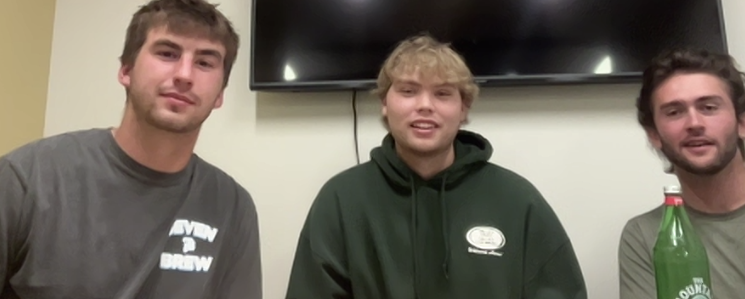
From left: University of North Dakota students and advising chatbot collaborators Michael Gross, Owen Reilly and Jack Baretz.
Zoom
A prior Student Voice survey found that nearly half of students lack key academic guidance. In this year’s survey, 19 percent of students say channeling more resources to academic advising so they can get more help from their adviser would most boost their academic success. Some 28 percent say the same of new and/or clearer program maps and pathways.
This ethos extends to what Kned collaborator Michael Gross, a junior majoring in finance, said keeps him academically engaged: connection. His most motivating online classes, for example, have had breakout rooms for peer-to-peer discussions. Why? “When you have more than one person working on something, you’re way more likely to contribute and do your best work on it, because there’s other people’s grades at stake, too,” he said. “It’s not just yours.”
Gross added, “One thing I would say is for institutions to encourage discussion on college campuses. The main thing that we’re kind of losing, especially with all this technology, is people are becoming so separated from each other. College is meant to be a place where you can engage your social skills and just learn about other people—because this is one of the last times you can be surrounded by so many people your age, and so many people from different walks of life with so many different ideas, too.”
To this point, 19 percent of Student Voice respondents cite social isolation or lack of belonging as a top barrier to their academic success. Tyton Partners’ 2025 “Time for Class” report also found a jump in both instructor and student preference for face-to-classes, “showing renewed demand for classroom connection.” In the same report, nearly half of instructors cited academic anxiety as a top concern among students, and students themselves reported low motivation and weak study habits as persistent barriers to learning.
Terry McGlynn, professor of biology at California State University, Dominguez Hills, and author The Chicago Guide to College Science Teaching, agreed that “learning is inherently a social endeavor.” And educators have for the past five years noticed “it’s a lot harder to get students to interact with one another and to show some vulnerability when experiencing intellectual growth.”
Many have attributed this to the effects of the pandemic, McGlynn said. But if higher education is now “heading into this era of AI in the classroom without reintegrating quality social interactions, I’m worried for us.”
He added, “I hope we develop approaches that bring people together rather than providing expectations that we work in isolation from one another.”
This independent editorial project is produced with the Generation Lab and supported by the Gates Foundation.
A new report from the Center for American Progress and the Thurgood Marshall College Fund shows that historically Black colleges and universities receive a disproportionately low percentage of federal research and development funding.
While HBCUs make up roughly 3 percent of all four-year higher ed institutions, they’ve received less than 3 percent of R&D funding since at least 2010, according to the report. In recent years, between 2018 and 2023, they were awarded less than 1 percent of R&D expenditures.
Some agencies have given HBCUs a relatively high proportion of R&D funding, including the Department of Education, the Small Business Administration and the Department of Agriculture, which has required allotments for land-grant HBCUs. But the two federal agencies that award the most R&D funding annually, the Department of Health and Human Services and the Department of Defense, have doled out especially low shares of those funds to HBCUs; in 2023, they awarded 0.54 percent and 0.40 percent, respectively. Meanwhile, 17 of the 43 federal agencies that supply research funding didn’t give HBCUs any R&D funds at all that year.
Sara Partridge, associate director of higher education policy at CAP and co-author of the report, said both Republicans and Democrats have sought to address inequities in R&D funding, but their efforts have been insufficient.
“In order to support these key drivers of scientific achievement and upward mobility, we need federal policymakers to commit to measurable benchmarks for the share of funds awarded to these institutions,” she said in a press release.
Hook is one of dozens of faculty members who have been punished for their comments about Kirk’s death.
Photo illustration by Inside Higher Ed | LeoPatrizi/E+/Getty Images
A South Dakota district court judge ordered the University of South Dakota on Wednesday to reinstate Michael Hook, a tenured professor of art who was put on leave with an “intent to terminate” after he posted comments on his personal Facebook page about Charlie Kirk.
“The court concludes that Hook spoke as a citizen and his speech was on a matter of public concern,” district court judge Karen Schreier wrote. “Defendants note that Hook’s Facebook page identified himself as a professor at the University of South Dakota … but this alone does not show that a post made on his personal Facebook account is speech that arises from Hook’s duties as a professor.”
Hook is one of dozens of faculty and staff members who have been punished for their comments about Kirk’s death. He was put on leave two days after posting, “Okay. I don’t give a flying fuck about this Kirk person,” on his Facebook page on Sept. 10, the day Kirk was shot and killed in Utah.
“Apparently he was a hate spreading Nazi. I wasn’t paying close enough attention to the idiotic right fringe to even know who he was,” Hook continued. “I’m sorry for his family that he was a hate spreading Nazi and got killed. I’m sure they deserved better. Maybe good people could now enter their lives. But geez, where was all this concern when the politicians in Minnesota were shot? And the school shootings? And Capitol Police? I have no thoughts or prayers for this hate spreading Nazi. A shrug, maybe.”
Hook later deleted the post and posted an apology.
Hook was informed in a letter from Bruce Kelley, dean of the University of South Dakota College of Fine Arts, that in posting the comment on Facebook he’d violated two university policies. The first dealt with “neglect of duty, misconduct, incompetence and abuse of power,” and the second detailed that when employees speak publicly “they should remember that the public may judge their profession and their institution by their utterances. Hence, they should at all times be accurate, show respect for the opinions of others and make every effort to indicate when they are not speaking for the institution.”
As part of the temporary restraining order, Schreier ordered that the university may not proceed with a disciplinary meeting between Hook and university officials scheduled for Sept. 29. The temporary restraining order will remain in effect until a preliminary injunction hearing on Oct. 8.
Forty-seven percent of Americans have “a great deal” or “quite a lot” of confidence in higher education, according to a new poll.
Jumping Rocks/Universal Images Group/Getty Images
Despite the Trump administration’s ongoing attacks on colleges and universities, American confidence in higher education is growing.
According to a poll the Vanderbilt Project on Unity and American Democracy published Thursday, 47 percent of 1,030 Americans surveyed said they have “a great deal” or “quite a lot” of confidence in higher education institutions, with a net positive rating of 33—up 13 percentage points since 2023. Survey respondents reported more confidence in higher education than in the police (44 percent), the medical system (38 percent) and large tech companies (25 percent).
Those findings echo the results of two recent polls—one by New America and another by Gallup and the Lumina Foundation. The latter showed that 42 percent of Americans said they have a “great deal” or “quite a lot” of confidence in higher education, compared to a low of 36 percent in 2024 and 2023.
But like those polls, Vanderbilt’s showed partisan divides.
While 69 percent of Democrats said they were confident in higher education, only 35 percent of Republicans said the same; just 24 percent of respondents who identify with Trump’s Make America Great Again movement expressed confidence. However, the vast majority (78 percent) of people surveyed said a college education is “very” or “somewhat” important for a young person to succeed, including 87 percent of Democrats and 68 percent of Republicans.
“While the conventional wisdom may suggest that support for colleges and universities is low, it’s important to highlight that most Americans view higher education as a net positive for society, and its support has actually increased from the low levels we saw in 2023 and 2024,” Josh Clinton, co-director of the Vanderbilt poll, said in a news release. “Yes, there are real concerns—most people think affordability is a major problem, and many perceive colleges and universities as having a partisan slant—but that’s very different from widespread opposition to the idea of higher education itself.”
Fifty-six percent of people surveyed believe that colleges and universities conduct scientific and medical research that saves lives, but only 14 percent said they remain as affordable as possible. The majority (67 percent) also cited political bias on campuses as a serious problem, though Democrats (54 percent) were less likely to agree than Republicans (79 percent), especially those who identified with the MAGA movement (91 percent).
Nearly three-quarters (71 percent) of respondents said universities should refrain from taking official stances on political issues, including 83 percent of Republicans and 59 percent of Democrats.
The University of Arizona is quietly shutting down its four microcampuses in China at the end of this semester, in response to a government report released earlier this month that criticizes branch campuses of U.S. institutions in China.
The report, by the House Select Committee on the Chinese Communist Party and the Committee on Education and the Workforce, said American college and university branch campuses in China can “facilitate technology transfer and pose national security risks.” It follows a similar report from a year ago that the new report said led to the closure of eight U.S. branch campuses in China.
The report, “Joint Institutes, Divided Loyalties,” highlights programs at 13 institutions deemed to be “high risk”—including one UA microcampus, the Arizona College of Technology at Hebei University of Technology, which awards students a B.S. in applied physics—and calls on the universities to sever those partnerships. (It also highlights a former partnership between UA and the Harbin Institute of Technology, a Chinese university affiliated with the country’s Ministry of Industry and Information Technology, but the university told Inside Higher Ed that partnership ended in 2023.) It’s unclear if any of the other 12 institutions have taken steps toward ending their programs at Chinese institutions.
Though the report only referenced one current UA microcampus, the university said it will close all four of its campuses in China.
“Acknowledging a congressional directive, the University of Arizona immediately terminated its China-based microcampus agreements. We have communicated directly with those affected and are working with enrolled students to help them continue their education,” a university spokesperson told Inside Higher Ed via email.
In total, 2,200 students, 36 faculty and four staff will be impacted by the closures, the spokesperson said. UA will provide funds to help employees relocate back to the U.S.; the university is also working to help students figure out next steps.
The university has a total of 18 microcampuses across the globe—programs that are housed at another university, in which students are taught by a mix of professors from UA and the partner institution and earn degrees from both institutions. The first such program was a bachelor’s program in law at Ocean University of China, in which students study both Chinese and U.S. law.
University officials told Inside Higher Ed in 2017 that the main goals of the microcampuses were to increase the university’s internationalization, provide students with affordable international pathways and earn revenue. They also said they hoped to eventually launch 25 microcampuses worldwide and reach 25,000 students.
In a post on X, the Committee on Education and the Workforce lauded UA’s move.
“@uarizona is making the right decision to end its China-based campus agreements. The CCP uses these programs to steal cutting-edge research for its own military buildup and promote communist ideology,” the post reads. “These programs are a direct threat to U.S. national security. Every American school should follow suit and end agreements with the CCP.”
‘Boom, We Shut Down’
Ken Smith, who leads the environmental science dual-degree program at UA’s microcampus at the Northwest Agriculture and Forestry University in China’s Shaanxi province, said he was informed the program would be shuttering just a week ago.
Now in its fifth year, the program has been incredibly successful, Smith said. It had recently completed a yearlong federal and provincial review process and had received exceptional marks. Student outcomes were also strong, with many going on to top-tier graduate programs in the U.S. and Europe. Others were able to find careers in China, despite environmental science being a low-demand degree in the country, because they held degrees from a well-regarded U.S. university.
“Things were really going super well, and, boom, we shut down,” he said.
Rong Qian, who graduated in the program’s second class this past spring, told Inside Higher Ed he was “shocked” to hear the program was ending. He credited the UA professors for boosting his confidence and inspiring him to apply to graduate school in the U.K., where he is now studying at Imperial College London. He also noted that UA’s reputation has helped him and his classmates get into such good programs.
“I want to express my gratitude for those professors, especially those from [UA] … not only for their patience and time [with] me and my studies, but also for their encouragement, their support and their easygoing characteristics,” he said.
Smith said that current seniors in the program will still be able to graduate with their UA degrees, and he’s working with both UA and NWAFU to try to find a way for the third-year students to finish out their programs as well. However, he’s doubtful that newer students will be able to get a degree from UA; they could study online or come to the U.S. to finish, but he doesn’t think the former option will hold much appeal, while the latter is prohibitively expensive for most.
In the university’s email to students at the affected campuses sent earlier this week, which the university shared with Inside Higher Ed, Jenny Lee, dean of international education, wrote, “The U of A is committed to supporting you in the completion of your degree. We welcome you to join us at our main campus, in Tucson, Arizona, under an extended Study Arizona Program for up to 4 semesters (usually during the junior and senior years). The U of A will follow up soon with further guidance regarding Study Arizona and other possible options for your degree completion pathway.”
The closure of the program is not just a loss for UA, Smith said, but also for the nation as a whole.
“Living in China for the past four years and watching the U.S. news, I think a lot of political figures don’t know much about China … It’s a major modern economic power, a major military power,” he said. “I think it’s in everyone’s best interest that people in the U.S. and people in China understand each other. The kind of program I was involved with was a major educational success, but it was also a diplomatic success. It got the University of Arizona’s name out there. People wanted us there. They enjoyed learning about the American education system, and, unfortunately, now, that’s all over.”
I’ll admit that I use AI. I’ve asked it to help me figure out challenging Excel formulas that otherwise would have taken me 45 minutes and a few tutorials to troubleshoot. I’ve used it to help me analyze or organize massive amounts of information. I’ve even asked it to help me devise a running training program aligning with my goals and fitting within my schedule. AI is a fantastic tool–and that’s the point. It’s a tool, not a replacement for thinking.
As AI tools become more capable, more intuitive, and more integrated into our daily lives, I’ve found myself wondering: Are we growing too dependent on AI to do our thinking for us?
This question isn’t just philosophical. It has real consequences, especially for students and young learners. A recent study published in the journal Societies reports that people who used AI tools consistently showed a decline in critical thinking performance. In fact, “whether someone used AI tools was a bigger predictor of a person’s thinking skills than any other factor, including educational attainment.” That’s a staggering finding because it suggests that using AI might not just be a shortcut. It could be a cognitive detour.
The atrophy of the mind
The term “digital dementia” has been used to describe the deterioration of cognitive abilities as a result of over-reliance on digital devices. It’s a phrase originally associated with excessive screen time and memory decline, but it’s found new relevance in the era of generative AI. When we depend on a machine to generate our thoughts, answer our questions, or write our essays, what happens to the neural pathways that govern our own critical thinking? And will the upcoming era of agentic AI expedite this decline?
Cognitive function, like physical fitness, follows the rule of “use it or lose it.” Just as muscles weaken without regular use, the brain’s ability to evaluate, synthesize, and critique information can atrophy when not exercised. This is especially concerning in the context of education, where young learners are still building those critical neural pathways.
In short: Students need to learn how to think before they delegate that thinking to a machine.
Can you still think critically with AI?
Yes, but only if you’re intentional about it.
AI doesn’t relieve you of the responsibility to think–in many cases, it demands even more critical thinking. AI produces hallucinations, falsifies claims, and can be misleading. If you blindly accept AI’s output, you’re not saving time, you’re surrendering clarity.
Using AI effectively requires discernment. You need to know what you’re asking, evaluate what you’re given, and verify the accuracy of the result. In other words, you need to think before, during, and after using AI.
The “source, please” problem
One of the simplest ways to teach critical thinking is also the most annoying–just ask my teenage daughter. When she presents a fact or claim that she saw online, I respond with some version of: “What’s your source?” It drives her crazy, but it forces her to dig deeper, check assumptions, and distinguish between fact and fiction. It’s an essential habit of mind.
But here’s the thing: AI doesn’t always give you the source. And when it does, sometimes it’s wrong, or the source isn’t reputable. Sometimes it requires a deeper dive (and a few more prompts) to find answers, especially to complicated topics. AI often provides quick, confident answers that fall apart under scrutiny.
So why do we keep relying on it? Why are AI responses allowed to settle arguments, or serve as “truth” for students when the answers may be anything but?
The lure of speed and simplicity
It’s easier. It’s faster. And let’s face it: It feels like thinking. But there’s a difference between getting an answer and understanding it. AI gives us answers. It doesn’t teach us how to ask better questions or how to judge when an answer is incomplete or misleading.
This process of cognitive offloading (where we shift mental effort to a device) can be incredibly efficient. But if we offload too much, too early, we risk weakening the mental muscles needed for sustained critical thinking.
Implications for educators
So, what does this mean for the classroom?
First, educators must be discerning about how they use AI tools. These technologies aren’t going away, and banning them outright is neither realistic nor wise. But they must be introduced with guardrails. Students need explicit instruction on how to think alongside AI, not instead of it.
Second, teachers should emphasize the importance of original thought, iterative questioning, and evidence-based reasoning. Instead of asking students to simply generate answers, ask them to critique AI-generated ones. Challenge them to fact-check, source, revise, and reflect. In doing so, we keep their cognitive skills active and growing.
And finally, for young learners, we may need to draw a harder line. Students who haven’t yet formed the foundational skills of analysis, synthesis, and evaluation shouldn’t be skipping those steps. Just like you wouldn’t hand a calculator to a child who hasn’t yet learned to add, we shouldn’t hand over generative AI tools to students who haven’t learned how to write, question, or reason.
A tool, not a crutch
AI is here to stay. It’s powerful, transformative, and, when used well, can enhance our work and learning. But we must remember that it’s a tool, not a replacement for human thought. The moment we let it think for us is the moment we start to lose the capacity to think for ourselves.
If we want the next generation to be capable, curious, and critically-minded, we must protect and nurture those skills. And that means using AI thoughtfully, sparingly, and always with a healthy dose of skepticism. AI is certainly proving it has staying power, so it’s in all our best interests to learn to adapt. However, let’s adapt with intentionality, and without sacrificing our critical thinking skills or succumbing to any form of digital dementia.
Laura Hakala, Magic EdTech
Laura Hakala is the Director of Online Program Design and Efficacy for Magic EdTech. With nearly two decades of leadership and strategic innovation experience, Laura is a go-to resource for content, problem-solving, and strategic planning. Laura is passionate about DE&I and is a fierce advocate, dedicated to making meaningful changes. When it comes to content management, digital solutions, and forging strategic partnerships, Laura’s expertise shines through. She’s not just shaping the future; she’s paving the way for a more inclusive and impactful tomorrow.
Latest posts by eSchool Media Contributors (see all)
A 2025 survey of 5,000 undergraduates by Inside Higher Ed, supported by Generation Lab, found that the greatest share of students rated their nutrition at college as average (44 percent), with an additional 30 percent describing their nutrition as below average or poor.
A number of colleges and universities are working to teach students proper nutrition habits and equip them to lead healthy lives in and beyond college.
The research: A 2023 literature review found that college students experience a variety of risk factors that make them uniquely positioned to experience food insecurity, including busy schedules and a lack of access to nutritious food.
Several studies found that students who had cooking experience were less likely to face food insecurity, implying that those without cooking or food-preparation skills may be at higher risk for food insecurity, according to the report.
The report suggests colleges can provide cooking and meal-preparation demonstrations to help students gain skills, as well as learn how to prepare low-budget, nutritious meals. One study cited in the literature review suggested adding nutrition education—including food budgeting and recipes—as a feature of first-year seminars.
Inside Higher Ed compiled five examples of nutrition education designed to address student health, food insecurity and malnutrition.
University of Memphis: Grilling Classes
To help teach students how to cook using relevant tools and resources, the University of Memphis staff hosts a lunchtime nutrition class, teaching students how to prepare and grill a personal pizza.
The university charges students $15 to participate in the class, which covers ingredients and lunch foods, providing a low-cost and casual introduction to basic cooking principles.
University of North Dakota: Culinary Corner
At UND, students get the chance to lead their peers in cooking classes. Events are open to all campus members, including faculty and staff, and the hourlong sessions in the wellness center teach students how to prepare simple meals.
In addition, UND has a virtual demonstration library so students can teach themselves how to cook a range of healthful recipes from wherever they are, including honey-glazed salmon, chana masala or acai bowls. Each demonstration video features a student instructor and a recipe card for viewers to follow along.
Lewis College, University of Georgia Cooperative Extension: Fulton Fresh University
This fall Georgia State University students benefited from a free cooking demonstration and nutrition course pilot hosted by two local institutions.
Fulton Fresh University, a partnership between Lewis College and the University of Georgia Cooperative Extension, typically educates seniors or those in low-income communities. But in 2024, the partners tested a new offering for college students who don’t necessarily know how to cook and are more inclined to eat quick meals or takeout, according to a university press release.
The four-week, no-cost course provided students with 10 pounds of produce at each session, in addition to spices and a variety of kitchen tools to keep.
Iowa State University: Culinary Boot Camp
Iowa State University students can participate in a two-credit course, Culinary Boot Camp, which provides nutrition education and culinary skills to promote healthy living.
The course, which has been offered since 2016, covers topics including storing food safely, reducing food waste, converting recipes and shopping efficiently for groceries, among others.
Cornell University: Get Cooking With Cornell Dining
Cornell offers students a chance to learn from the professionals: the campus dining team. Members host events in the Discovery Kitchen in a residence hall on campus, where students can practice preparing plant-based dishes, which they then enjoy.
The goal is to help students learn to make healthy dishes that are both tasty and environmentally friendly.
Do you have a wellness intervention that might help others promote student success? Tell us about it.
Angelo State walked back some provisions of its new anti-LGBTQ+ policies.
Michael Barera/Wikimedia Commons
Directives related to a slate of convoluted and sometimes contradictory new policies prohibiting discussion of transgender topics and identity have left employees at Angelo State University frightened and confused.
As of Monday, conversations and content about transgender identities are still prohibited, but employees are allowed to use students’ preferred names, display rainbow flags in their offices and on their cars, and talk about lesbian, gay, bisexual and queer identities, according to emails from department heads to faculty obtained by Inside Higher Ed.
The changes were clarified to employees after a meeting between the deans, provost and ASU legal counsel. Employees are still seeking other clarifications. For example, students who are already working on papers related to transgender identity are allowed to continue doing so, but it’s unclear whether they could give a final class presentation on the topic.
Only some faculty members at some the university’s colleges have been told about these changes. Others are still responding to the initial policies handed down to employees Friday following a meeting with Angelo State leadership. The policies are stringent and exhaustive: no pride flags, no calling students by the singular “they” or using their preferred names (unless it aligns with their sex assigned at birth), no pronouns in email signatures and no mention of the fact that there are more genders than the two assigned at birth.
None of the policies are formalized in writing, and that is purposeful, said Brian Evans, president of the Texas Conference of the American Association of University Professors. The guidance only changed after faculty brought up questions about the policies, which deans took back to the provost and university counsel. Final details about what is and is not allowed and how the rules will be enforced are still under discussion.
This isn’t unique to my state, but it’s my first time encountering it.
Pennsylvania’s state government runs on a July-to-June fiscal year, which means that it was supposed to have passed a budget for this fiscal year by July 1.
It hasn’t passed one yet, and passage doesn’t look imminent.
This is becoming a problem.
It’s already a problem for our county, which has announced cuts. And it’s increasingly a problem for the college.
Based on previous years, we’ve expected the state allocation to cover a little over 40 percent of the operating budget. (The county’s figure is much lower.) So far this year, it has covered zero percent, for a difference of—let’s see, carry the three—millions.
We have reserves, and they’ve come in handy. But they’re meant to even out cash flow over the course of a year, to cover emergencies and to help with large expenses. They were never intended to supplant the state’s role in the budget. Our CFO recently had to calculate the number of months we could go without the state allocation, which is a number you never want to matter.
For those keeping score at home, reserves at a community college are very different from endowments at universities. Endowments are generated mostly from a combination of donations and investment returns, and they’re meant to “throw off” a certain amount per year to pay for other things. Those other things can be the operating budget, or scholarships, or facilities, as specified. (Endowment funds are a mix of restricted and unrestricted. Restricted funds can only be used for designated purposes; unrestricted funds are more flexible.)
Reserves, by contrast, are generated from operational savings and are meant to provide a bit of buffer. They’re almost always invested very conservatively because they’re meant to be liquid. Endowments can take greater risks because they’re intended to have much longer time horizons. If endowments are like retirement accounts, reserves are closer to savings accounts.
They’re crucial for cash flow because peak revenue times and peak spending times don’t always align. For a college on a traditional calendar, August shows high revenues and low spending, and October shows high spending and low revenues. That’s because students pay tuition in August to take classes in October.
Reserves can create perverse incentives for legislators. A legislator looking to pay for some other line item closer to his heart may see a public college with relatively healthy reserves as a painless target for cutting. But once reserves are spent, they’re spent, and one of the dangers of public-sector math is that even a single year’s cut can become a new baseline. At that point, climbing out of the hole can become a Sisyphean nightmare.
In practice, that means that public colleges have to perform a delicate balance with reserves. Save too much, and you become a tempting target. Save too little, and you may find yourself in a tight spot if something happens.
Right now, something is happening—or not happening, to be exact—with a major impact. The frustrating part is that the something in question is unnecessary. This isn’t the aftermath of a natural disaster; it’s collateral damage from a political standoff. The fact that it leaves us much more vulnerable to, say, a natural disaster doesn’t seem to bother legislators.
So, my request to the elected leaders of Pennsylvania, and to other states in similar spots: Pass a budget! Reserves weren’t meant for this.