Vinson has led the Washington, D.C., HBCU since 2023.
Cheriss May/NurPhoto via Getty Images
Howard University president Ben Vinson III will step down Aug. 31, two years after assuming the role and two weeks after the start of fall classes, university officials announced Friday. Former Howard president Wayne A. I. Frederick will serve as interim president.
“It has been an honor to serve Howard,” Vinson said in a statement. “At this point, I will be taking some time to be with my family and continue my research activities. I look forward to using my experiences as president to continue to serve higher education in the future.”
University officials declined to comment about why Vinson is leaving only two years after he took up the helm. During his tenure, the Washington, D.C.–based HBCU became an R-1 research institution and brought on several high-profile faculty, including journalist Nikole Hannah-Jones, author Ta-Nehisi Coates and historian Ibram X. Kendi. The university also hosted Kamala Harris’s election night watch party.
But the past year has also brought its share of challenges. In May, the Trump administration proposed cutting Howard’s federal funding by $64 million in fiscal year 2026, bringing it back to its 2021 funding level. Over the summer, the administration took heat from students over surprise bills that appeared on their accounts when the university transitioned to a new student financial platform, and some students turned to crowdfunding to pay those bills.
“On behalf of the Howard University Board of Trustees, we extend our sincere gratitude to Dr. Vinson for his service and leadership as president,” board chair Leslie Hale said in a statement. “We extend our very best wishes to him in his future endeavors.”
Frederick, who served as president of Howard from 2014 to 2023, will remain interim president while the board conducts a nationwide search for a permanent replacement.
Higher education stakeholders have noted that math anxiety can hold students back from pursuing some disciplines or major programs, but a new analysis from Gallup finds that young Americans over all place less importance on math skills compared to the general population.
While over half of all Americans rate math skills as “very important” in their work (55 percent) and personal (63 percent) lives, only 38 percent of young people (ages 18 to 24) said math skills are very important in their work life and 37 percent in their personal life, according to a December survey of 5,100 U.S. adults.
The survey highlights generational divisions in how math skills are perceived, with adults older than 55 most likely to see math as very important compared to younger adults, and Gen Z least likely to attribute value to math skills.
To Sheila Tabanli, a mathematics professor at Rutgers University, the low ratings point to a lack of perceived connection between math skills and career development, despite the clear correlation she sees.
Tabanli said it can be hard to convince many Gen Z and Alpha students that math content is necessary for their daily lives, in part because access to information is so convenient and they can perform calculations on their phones or online.
“We need to transition from focusing too much on the concept, the domain, the content—which we do love as math people, otherwise we wouldn’t be doing it for a living—but students don’t see that connection [to employable skills],” Tabanli said.
When asked how important math skills were for the majority of the U.S. workforce, 40 percent of young adults rated having math skills as very important—the lowest rating of nine skills evaluated, including reading, language, technology and leadership, according to Gallup.
Young people also rated the importance of math skills for the general workforce, as compared to their own lives, the lowest of all age cohorts. Adults ages 55 to 64 (71 percent) and 65 and older (68 percent) were most likely to say math is a very important skill for the general workforce.
Most career competencies that colleges and universities teach, such as those by the National Association for Colleges and Employers, focus on broader skills—including critical thinking, leadership, communication and teamwork—as essential for workplace success. Math can teach students how to solve problems and engage with difficult content, which Tabanli argues are just as important for an early-career professional.
One reason a young adult might not rate math skills highly is because many students face undue math anxiety or a skepticism about their own ability to do math, falling into the belief that they’re not “math people,” Tabanli said.
In response, Tabanli believes professors should help students apply computational skills to their daily lives or link content to other classes to encourage students to invest in their math learning. While this may be an additional step for a faculty member to take, Tabanli considers it a disservice to neglect this connection.
Professors can also strive to make themselves and the content more human and approachable by sharing information about their lives, their careers and why they’re passionate about the subject, Tabanli said.
For 67 years, the Department of Education has administered grants to universities to create centers devoted to foreign languages and area studies, a field focused on the study of the culture of a particular area or region. Now, those centers are under fire by the Trump administration, which has not released the funding the grantees expected to receive in July.
The grants support what are known as National Resource Centers, which were originally developed as a national security tool to help the U.S. increase its international expertise in the midst of the Cold War and the aftermath of Soviet Union’s 1957 launch of Sputnik. Since then, their purpose has shifted with the times, now focusing not only on producing scholars but also on community outreach and collaboration with K–12 schools.
The office responsible for administering the grants—International and Foreign Language Education—was dissolved and its entire staff laid off as part of the March reduction in force at the Department of Education. But it seemed IFLE’s programs, which were authorized under Title VI of the Higher Education Act of 1965, would live on; they were moved under the ED’s Office of Higher Education Programs, according to an internal communication shared with Inside Higher Ed at the time.
Since then, funding has come through “in fits and starts,” Halina Goldberg, the director of Indiana University’s Robert F. Byrnes Russian and East European Institute (REEI), told Inside Higher Ed in an email, though ultimately, the center received all its promised funds for fiscal year 2024–25. REEI was part of the first cohort of NRCs and has been continuously funded by the program since then.
But NRC directors, including Goldberg, are concerned the funds for the upcoming year—the final year of the program’s four-year cycle—may not come through, and that the Trump administration may be planning to demolish the program altogether. NRC leaders have received no notice from ED about whether or when the funds are coming, and some say their contacts at the department have expressed uncertainty about the program’s future.
The funding cuts appear to be caused by the Office of Management and Budget; records show that the agency has not approved appropriations for programs formerly housed in IFLE, including the NRC program, as well as the Foreign Language and Area Studies fellowships, which fund scholarships and stipends for undergraduate and graduate students studying these disciplines. In total, about $85 million was appropriated for IFLE programs for FY 2025–26, including $60 million for NRCs and FLAS.
“We’re just kind of in this holding pattern to learn whether our funds are going to be released or not. And there is some time pressure, because if that fiscal year 2025 funding is not allocated by Sept. 30, which is when the fiscal year, the government fiscal year ends, then it’s gone and we’re without funding,” said Kasia Szremski, associate director for the Center for Latin American and Caribbean Studies at the University of Illinois at Urbana-Champaign.
A Discipline in Crisis
NRC grant recipients worry about what the funding freeze and potential elimination of the program will mean for the disciplines of foreign language and area studies, which have already taken a beating in recent years; many colleges have eliminated such programs as cost-saving measures— including West Virginia University, which gutted nearly all of its language programs in 2023. More recently, the University of Chicago has paused admissions to all its humanities Ph.D. programs, including a slew of language programs, for the coming academic year.
Emanuel Rota, a professor in the Department of French and Italian at Urbana-Champaign who leads the university’s European Union Center, said he was already worried about the future of area studies and foreign language education, but “now I’m terribly scared.”
“I think this seems to be, at this point, slightly part of a trend to provincialize the United States in a way that is troubling for the future of this generation of students, who are, at this point, used to learning from other experiences around the world; knowing about ways of teaching, other ways of learning; establishing collaborations early on; and being able to be multicultural and multilinguistic like their peers around the world,” he said. “And all of a sudden they are told, ‘You only speak one language, you only know one culture and you only know your local environment, and you have to live with that.’”
It also comes amid efforts to quash other forms of cultural education and intercultural exchange. OMB also recently cut funding from a number of State Department exchange programs, according to Mark Overmann, executive director of the Alliance for International Exchange, which represents organizations that administer such programs.
Larger entities like the Fulbright program are being spared, he said, but the cuts include critical programming aiming at increasing STEM education access for girls around the world, fostering intercultural exchange with students in the Middle East, bolstering the study of foreign affairs in the U.S. and more.
International students and immigration broadly are also being targeted by the Trump administration, which has recently revoked thousands of student visas and increased barriers for overseas students studying in the U.S.
“I think international exchange programs, mobility, the presence of international students on our campuses have long been something that is supported in a bipartisan way, and that has been played out for decades in tangible ways,” Overmann said. “One would be increases in funding in both Democrat and Republican administrations, as well as Congresses. This is something we have seen transcend party lines and those across the political spectrum see that the mobility of our students, of our young professionals—both Americans going abroad and international students and professionals coming here—is something that supports our national security, our diplomatic interests, our influence around the world and our economy, down to very local levels.”
This isn’t the first time Trump has targeted NRCs. In 2018, during his first administration, ED criticized a Middle Eastern studies consortium at Duke University and the University of North Carolina for delivering programs it alleged had “little or no relevance to Title VI.” The programs under scrutiny included a conference about “Love and Desire in Modern Iran” and another focused on film criticism in the Middle East.
“It was probably a harbinger of what’s happening now,” said Brian Cwiek, a former IFLE program officer who lost his job when the office was dissolved. “I think that’s really where a lot of the same folks became intent on shutting down this same program.”
“Congress should wind down so-called ‘area studies’ programs at universities (Title VI of the HEA), which, although intended to serve American interests, sometimes fund programs that run counter to those interests,” Project 2025 reads. “In the meantime, the next Administration should promulgate a new regulation to require the Secretary of Education to allocate at least 40 percent of funding to international business programs that teach about free markets and economics and require institutions, faculty, and fellowship recipients to certify that they intend to further the stated statutory goals of serving American interests.”
Outreach at Risk
Although funding may still come through before the September cutoff date, some centers are already feeling the pressure.
At the Mario Einaudi Center for International Studies at Cornell University, which is home to two National Resource Centers, Kathi Colen Peck was responsible for administering an NRC-funded program focused on providing faculty development to professors at community colleges in upstate New York. Although the center has funding sources outside of ED, the community college program was almost entirely funded by an NRC grant.
The program involved bringing international speakers—a dance instructor from Benin, for example—to give workshops in community college classrooms, as well as administering a fellowship for community college professors to create curricular projects.
Once it became clear this year’s funding wasn’t going to become available when expected, Peck was laid off and the partnerships with community colleges for the upcoming academic year had to be discontinued.
“The intention of [the outreach program] is really to sort of bridge resources and help the community college faculty have connections to the area studies expertise at, for example, Cornell. They’re able to leverage resources at Cornell where they wouldn’t necessarily have access to that in any other circumstances,” she said. “It’s really about trying to help the community college faculty internationalize their curricula.”
At other campuses, cultural events and educational programs that NRC leaders say are immensely valuable to their communities could be on the chopping block. Hilary V. Finchum-Sung, the executive director of the Association for Asian Studies, said that the University of Michigan’s Korean Studies center, for example, hosts a free Korean film series at an off-campus theater that is open to members of the public. It’s an opportunity for members of the Ann Arbor community to see a film they likely never would otherwise—and to glean something new about a culture that they might be unfamiliar with.
On the flip side, NRC programs can sometimes give immigrants a rare chance to connect with their culture on American soil. Szremski, of UIUC’s Center for Latin American and Caribbean Studies, said the center has partnered with local libraries to hold a Latin American Story Time Program for about 15 years. At these events, they read children’s stories in English and Spanish, but also in other Latin American languages including Portuguese, Guaraní, Q’anjob’al, and Quechua.
“This is particularly important in Champaign and Urbana, because even though we’re in central Illinois, we have a very large and very vibrant Latino community, many of whom are native speakers of Indigenous languages,” she said.
Once, after a Latin American Story Time event, a library worker once told her, an older woman “came up to her in tears because she was a native Guaraní speaker and had never thought [she would] hear her native language again, really, now that she was living in the United States.”
Cwiek noted that some faculty positions may also be at risk without NRC funding; though the grants usually cover only a small portion of a professor’s salary, that portion may be the difference that allows a college to offer certain world languages.
Scholarship Uncertainty
Students are also in imminent danger of losing scholarships due to the funding pause. Graduate students relying on Foreign Language and Area Studies Fellowships to fund their education in the new academic year still don’t know whether they will receive that money. Szremski said on Friday that one incoming fellow recently made the choice to withdraw from UIUC and instead study in Colombia for the upcoming academic year due to funding fears. With UIUC’s academic year beginning this week, others were forced to make the decision about whether to come to campus without knowing if they would receive the scholarships they’d been promised. Across the university’s NRCs, 53 students are awaiting FLAS funds.
Other universities are in a similar position. At Cornell, 18 students will be impacted if the money doesn’t come through, according to Ellen Lust, the director of the Einaudi Center for International Studies and a government professor.
These fellowships provide the cultural awareness, understanding and skills that the U.S. “has relied on to be a world leader. Students who benefited from NRC support have gone on to join the US Foreign Service, engage in international business, and educate new generations of global citizens. They have conducted international collaborations and research that that ultimately benefit Americans,” she wrote in an email to Inside Higher Ed.
While the stipends allocated to undergraduate students are not as sizable as those for graduate students, Szremski said those recipients have told her they may have to take out private loans or start part-time jobs to fill the gap created by the missing FLAS money.
The future of these grants remains unclear. The Senate’s appropriations bill maintains funding for IFLE programs, so even if the funding doesn’t come through this year, the program may be able to resume the following year.
But if the NRC and FLAS programs are shuttered permanently, the effects will “be felt for generations to come,” wrote Lust.
“Our current and future students are the foreign service officers, intelligence analysts and CEOs of the future,” she wrote. “Within a generation, US citizens will be ill-equipped to live, work and lead in a global world. They will be outmatched by those from other countries, who speak multiple languages, understand diverse cultures and have built relationships across borders. Ultimately, these policies weaken the US’ global position and will make America less secure and prosperous.”
Researchers will have to challenge grant terminations in federal claims court.
Photo illustration by Justin Morrison/Inside Higher Ed | SDI Productions/E+/Getty Images
Hope is fading that federally funded researchers whose grants were terminated by the National Institutes of Health earlier this year will be able to resume their work as planned.
On Thursday, the United States Supreme Court ruled 5 to 4 that any legal challenges to the grant terminations should be litigated in the Court of Federal Claims, not the federal district court system they’ve been moving through for months.
It’s the latest twist in federally funded researchers’ legal fight to claw back nearly $800 million in medical research grants—though accounting for the multiyear grants that the NIH is refusing to fulfill puts that figure closer to $2 billion—the NIH terminated for running afoul of the Trump administration’s ideological priorities. Many of the grants funded programs that advanced diversity, equity and inclusion initiatives and research projects focused on topics such as LGBTQ+ health, vaccine hesitancy and racial disparities.
Researchers sued the NIH in April and got a win in June when a federal district court judge in Massachusetts ordered the agency to reinstate the grants immediately. Although the NIH has since reinstated many of those grants, Scott Delaney, an epidemiologist at Harvard University and former lawyer who’s been tracking grant cancellations, told Inside Higher Ed that after Thursday’s ruling those reinstated grants will “almost certainly” be re-terminated. If that happens, “I don’t think they’ll get their money back.”
That’s in part because the Supreme Court said researchers will have to re-file their lawsuits in federal claims court, which generally doesn’t have the power to issue injunctive relief that could keep grant money flowing during the litigation process. And it could take months or even years for the claims court to decide if researchers are owed damages.
“Nobody has that kind of time. The nature of research is that you can’t just stop and restart it many months later,” said Delaney. “Folks have already had to do that once and many aren’t able to—they’ve had to lay off staff and lost contact with study participants. This additional delay probably renders the research unviable going forward.”
Trump ‘Always Wins’
Delaney is among numerous experts and advocates who say the decision is both a blow to the scientific research enterprise and the latest evidence that the Supreme Court is inclined to interpret the law to favor the Trump administration’s whims.
“Make no mistake: This was a decision critical to the future of the nation, and the Supreme Court made the wrong choice,” the Association of American Medical Colleges said in a statement. “History will look upon these mass NIH research grant terminations with shame. The Court has turned a blind eye to this grievous attack on science and medicine, and we call upon Congress to take action to restore the rule of law at NIH.”
Jeremy Berg, who served as director of the National Institute of General Medical Sciences from 2003 to 2011, said in an email to Inside Higher Ed that while “many (but not all) grants from the lawsuits that had been terminated have been reinstated at this point,” the big question the Supreme Court’s ruling raises now “is whether NIH will start to re-terminate them.”
Although a 5-4 majority did agree on Thursday that the district can review NIH’s reasoning for the terminations and kept in place a court order blocking the guidance that prompted the cancellations, Berg said the mixed ruling is “potentially very damaging” because redirecting the case to a different court means “the stay blocking the required reinstatements could go into effect.”
He added that Justice Ketanji Brown Jackson’s dissent sums up his interpretation of the ruling’s implications. “This is Calvinball jurisprudence with a twist,” Jackson wrote. “Calvinball has only one rule: There are no fixed rules. We seem to have two: That one, and this Administration always wins.”
That’s how Samuel Bagenstos, a professor of law and public policy at the University of Michigan and former general counsel to the Department of Health and Human Services, interpreted the decision, too.
“The message the courts sent yesterday is very strong that they are going to let the Trump administration shut down the grants right now and remit grantees to the really uncertain process of going to the Court of Federal Claims and potentially getting damages in the future,” he said in an interview with Inside Higher Ed Friday.
“But that’s really cold comfort for the grantees,” Bagenstos added. “If they can’t get the grants restarted right now, they probably can’t continue their research projects, and the prospect of maybe getting damages in the future doesn’t keep those research projects alive. It’s a bad sign for the entire research community.”
The NIH is far from the only federal agency that has canceled federal research grants that don’t align with the Trump administration’s ideologies. The National Science Foundation, the Education Department and the National Endowment for the Humanities are all facing legal challenges in federal district courts after freezing or canceling grants.
And the Supreme Court’s ruling on the NIH’s terminations has implications for those cases, as well.
“The message seems to be pretty clear that if you have an ongoing grant that’s been terminated and you want to go to court to keep the money flowing, you’re out of luck,” Bagenstos said. “It’s got very bleak implications for all researchers who are depending on continuing the flow of federal grants.”
Religious colleges that require students to sign a faith statement cannot be shut out of a Minnesota program that funds the dual enrollment of high school students in the state’s public and private postsecondary institutions, a federal judge ruled Friday.
U.S. District Judge Nancy Brasel’s ruling overturns a Minnesota law prohibiting Christian colleges that participate in the state’s 40-year-old Postsecondary Enrollment Options program from forcing students to pass a religious test. The state Education Department and LGBTQ+ advocates had sought such legislation for years on the grounds that faith statements discriminate against students who are not Christian, straight or cisgender. It finally passed in 2023, under a Democratic State Legislature.
The families of several high school students seeking to earn credits at two Christian institutions in the state, Crown College and the University of Northwestern, then sued, arguing that the law violated their First Amendment right to religious freedom. The ban on faith statements was suspended while the legal battle played out.
“This dispute requires the court to venture into the delicate constitutional interplay of religion and publicly-funded education,” Judge Brasel said in her 70-page ruling. “In doing so, the court heeds the Supreme Court’s instruction that the First Amendment gives special solicitude to the rights of religious organizations.”
Brasel noted in her ruling that the two Christian colleges have received nearly $40 million to cover the costs of the PSEO program since the 2017–18 academic year; she wrote that the University of Northwestern admits about 70 percent of dual-enrollment applicants. Over all, some 60,000 high school students have benefited from PSEO, The Minneapolis Star Tribune noted.
The Becket Fund for Religious Liberty, which represented the plaintiffs, applauded the decision.
“Minnesota tried to cut off educational opportunities to thousands of high schoolers simply for their faith. That’s not just unlawful—it’s shameful,” said Becket senior counsel Diana Thomson, according to the Associated Press. “This ruling is a win for families who won’t be strong-armed into abandoning their beliefs, and a sharp warning to politicians who target them.”
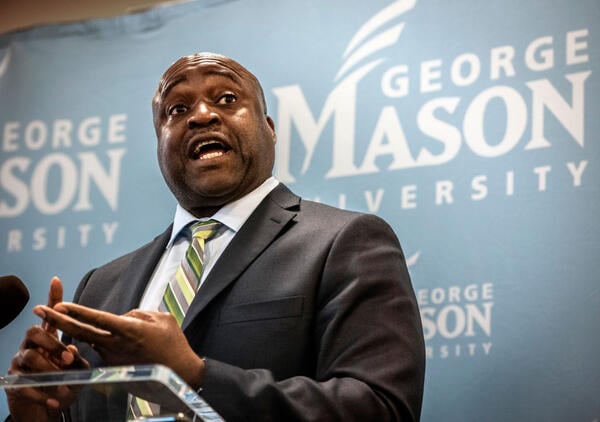
The Department of Education is demanding a personal apology from George Mason president Gregory Washington.
Bill O’Leary/The Washington Post via Getty Images
On Aug. 22, the U.S. Department of Education’s Office for Civil Rights announced that George Mason University, led by President Gregory Washington, violated Title VI of the Civil Rights Act of 1964. The agency demanded an extraordinary remedy—President Washington must issue a personal apology, to be posted “prominently on the University website,” retract statements supporting diversity and abandon practices that even hint at equity-focused hiring. The message to George Mason, where I was a professor of public policy for nearly two decades, is clear: Equity is now presented as a civil rights violation.
Title VI was meant to prevent discrimination, not to penalize institutions for recognizing that diversity matters. With courts allowing the consideration of diversity as one factor among many in holistic decisions, OCR’s stance appears to be a politically motivated shift away from long-standing interpretations—not a clear enforcement of the law. Just last week, a federal judge “struck down two Trump administration actions aimed at eliminating diversity, equity and inclusion programs at the nation’s schools and universities,” the Associated Press reported.
Most alarming in OCR’s proposed resolutions is the demand for a personal apology from the university’s first Black president. Washington, who called for eliminating racist legacies on campus, is now being compelled to apologize for doing just that. This isn’t simply an institutional issue—it’s a deeply symbolic act that resembles public shaming of a leader of color for advocating inclusion. It evokes the disturbing history of targeting minority leaders through law and policy.
This move against Mason is not an isolated incident; it is part of a broader effort to reshape public institutions. Consider the Trump administration’s recent attacks on the Smithsonian Institution. The president criticized the Smithsonian for highlighting slavery’s brutality and diversity in its exhibits, calling the museums “out of control” and “too woke.” He ordered a comprehensive review of Smithsonian content to align it with his vision of “American exceptionalism,” demanding changes to exhibits begin within 120 days.
Here again, ideology replaces impartial curation. A common thread emerges: Whether in higher education or national museums, diversity and sincere historical reflection are viewed not as civic strengths but as transgressions. Institutional autonomy and academic governance are being subordinated to partisan narratives.
Should we dismiss the department’s findings as another part of the culture wars? I worry the consequences are much more serious. If OCR’s interpretation of Title VI holds, even referring to diversity as a priority could trigger federal enforcement. Schools are feel compelled to eliminate inclusive programs, silence voices advocating for equity and adhere to a limited historical perspective—all out of fear of losing funding.
That chilling effect would cripple higher education when it needs vibrancy most. Universities must remain havens of reasoned inquiry, honest history and inclusive excellence. When federal agencies start dictating not only policy but the exact language leaders must use, we enter coercive territory.
GMU’s faculty, students, alums and board members must unite in opposition to OCR’s unjustified demands. The proposed resolution is not genuine compliance; it’s forced capitulation driven by intimidation. Institutions should not be compelled to apologize for standing up for the principles of true equal opportunity.
This moment is a clarion call for universities. Yesterday, it was the University of Pennsylvania and Harvard, dragged through headline-grabbing investigations. It was New College of Florida, where political appointees dismantled DEI programs and faculty governance. It was the University of Virginia, accused by the Department of Justice of defying federal antidiscrimination laws. Today it is Mason. Tomorrow, it could be UCLA, Michigan, Wisconsin or any other institution that values diversity, equity and academic freedom. No campus—public or private, flagship or regional—should assume it is immune.
George Mason should reject the department’s findings and oppose this injustice. Capitulation is not compliance; it’s surrender. If Mason yields, it will damage its credibility and encourage more attacks on higher education nationwide. When universities submit to politically motivated demands disguised as enforcement, they legitimize them and invite more. Silence will be perceived as complicity. Resistance is crucial to protecting the fundamental principles of higher education: autonomy, fairness and the freedom to teach and learn without political interference.
This is not the first time universities have faced pressure to abandon their commitments to equity and truth. In the 1960s, Southern universities used “law and order” to oppose desegregation. In the 1980s and 1990s, Black faculty and administrators pushing for fair representation often faced vilification and political retaliation. Today, the same tactics are being used, only now they are masked in the language of “civil rights enforcement.”
What is happening at Mason is part of that history. Title VI, a law born of the civil rights movement to expand opportunity, is being distorted into a tool to silence leaders of color and dismantle diversity initiatives. President Washington’s commitment to pursuing equity should be celebrated, not criminalized. Twisting Title VI into an instrument of ideological punishment and racial scapegoating should alarm everyone who values a democracy that depends on honest history, inclusive leadership and academic freedom.
And let’s be honest: Coercing a university president to issue a scripted public apology isn’t enforcement—it’s extortion. It’s the same tactic organized crime always uses: Demand submission, humiliate and make an example of one victim to scare others. That has no place in a democracy, much less in higher education.
The struggle now is the same as it was then: whether our universities will stay places of truth, inclusion and independent thought, or whether they will become tools of partisan control. Mason must choose the first. And the rest of us—in Virginia and across the country—must support it.
James Finkelstein is professor emeritus of Public Policy at George Mason University
Ten years ago, on Aug. 24, 2015, Alice Dreger submitted her resignation as a tenured professor at Northwestern University’s Feinberg School of Medicine. Dreger was protesting the censorship of an academic journal at Northwestern called Atrium, for which she had served as guest editor of the 2014 issue with the theme “Bad Girls.” That edition included a controversial essay by disability rights advocate William Peace, who wrote about receiving oral sex from a nurse in the 1970s. Northwestern officials removed Atrium’s online issues for 14 months, restoring access to it only after Dreger announced she was going public about the censorship.
Dreger wasn’t even the first professor to quit in protest over the censorship of Atrium. Kristi Kirschner, a clinical professor of medical humanities and bioethics, resigned in December 2014 because of the repression.
But Northwestern demanded a new editorial board (including a public relations official) to oversee the journal in the future, which Dreger called a “censorship committee.” The faculty editors of Atrium refused to accept administrative control over its content, and it has never published another issue.
Dreger recently wrote about her “disappointment (and that tablespoon of regret) at having accidentally caused the end of Atrium. For the magazine was such a gem.” But, of course, she didn’t cause the end of the journal—Northwestern administrators did by making unacceptable demands for control. The blame for censorship always must belong to the censor for suppressing controversy, and not the censored for causing controversy.
Dreger’s resignation, and the censorship that prompted it, received much less attention than it deserved. This year is also the 10th anniversary of another case at Northwestern that was far more publicized: The Title IX investigation of Laura Kipnis over her essay “Sexual Paranoia Strikes Academe” that examined the case of a Northwestern professor accused of sexually assaulting a graduate student. Two students filed a complaint of retaliation against Kipnis over her writing, and the university cleared her after a lengthy investigation. While Kipnis obviously should never have been investigated for expressing her opinions on a case of campus sexual misconduct, she never suffered any official penalty or censorship.
By contrast, the censorship of Atrium actually did lead to the demise of a respected academic journal (and the loss of the two professors who protested it). But while the Kipnis case fit a very popular narrative of politically correct leftists demanding suppression, the Atrium case exposed the reality on campus: Conservative censorship was more repressive but much less publicized than the trendy complaints about the PC police.
Another example of this at Northwestern occurred in 2016, when political science professor Jackie Stevens was suspended and banned from campus after she complained that an administrator had yelled at her and slammed a door. Without any evidence and in violation of its due process policies, Northwestern officials contended that Stevens posed an immediate violent threat to the campus and forced her to undergo a psychological evaluation (which found no danger) before lifting the suspension and banishment. Stevens had been a harsh critic of the administration and was a leader of the successful faculty effort to prevent a retired general without a Ph.D. from being appointed head of an international studies program.
Looking back at the Dreger resignation a decade ago, it’s hard to feel optimistic, because censorship on campus is even worse today. In the past year, Northwestern University’s actions have been some of the most repressive in the entire history of the institution. In February, Northwestern’s administration adopted the International Holocaust Remembrance Alliance definition of antisemitism, which the Foundation for Individual Rights and Expression has condemned because it “will chill campus speech.”
One little-known example of Northwestern’s censorship is shockingly reminiscent of what happened to Atrium, except that it’s much worse. In February, Northwestern officials took down the entire website of the Gender and Sexuality Resource Center in response to President Donald Trump’s executive order “Ending Illegal Discrimination and Restoring Merit-Based Opportunity.” GSRC director Matt Abtahi didn’t go public about the censorship, but wrote an April 14 email to his staff to explain the removal of the website: “This last month working with the lawyers and senior leadership at NU has been particularly gutting.”
He added, “The use of civil rights law and discrimination policy to advance these kinds of changes is alarming.” When Northwestern officials learned about the email, they immediately suspended Abtahi on April 18 and then fired him on April 29 and banned him from campus. Northwestern finally restored the GSRC website in May but censored all of the LGBTQ+ content. The censorship today is far worse than what happened to Atrium, which was finally restored online without censorship and no one was fired for questioning the repression.
But even more appalling has been Northwestern’s violation of the rights of journalism professor Steven Thrasher. After Thrasher defended a student encampment in spring 2024 to prevent police from arresting protesters, Northwestern’s administration retaliated several months later in the wake of Northwestern president Michael Schill’s testimony before members of Congress who called Thrasher a “goon” and demanded his firing.
Northwestern used its police powers to order Thrasher’s arrest, although the charges were immediately dismissed. In the fall of 2024, Northwestern suspended Thrasher from teaching for two quarters in violation of campus rules and claimed that he had violated professional norms by questioning the concept of “objectivity” in journalism. After a faculty committee cleared Thrasher of any wrongdoing, Northwestern was forced to reinstate him.
However, Thrasher was up for tenure in 2025, and Northwestern denied him tenure. When Thrasher publicly criticized that decision and blamed it on retaliation for his criticism of Israel, Northwestern’s administration promptly banned Thrasher from teaching in the spring quarter and the entire 2025–26 academic year, declaring, “Your public lobbying, mischaracterizations and efforts to encourage pressure from groups complicate and compromise the process of tenure review, decision making, and appeal. Therefore, we are concerned about your presence with students in our community.”
Obviously, criticizing the administration can never be grounds for banning a professor from the classroom for years without due process. Because tenure decisions are secretive, we don’t know if illegitimate, nonacademic judgments affected Thrasher’s case. But we do know that Northwestern’s excuses for twice suspending Thrasher are entirely illegitimate and violate basic norms of academic freedom.
(Full disclosure: I’m a member of the Illinois AAUP’s Committee A on Academic Freedom and Tenure, and we wrote two letters to Northwestern, condemning its initial suspension of Thrasher and its second suspension of Thrasher that denied him the right to teach during his terminal year after being denied tenure.)
Despite the extraordinary repression at Northwestern, where merely speaking out against the administration’s censorship can get you immediately banished, faculty and students are resisting efforts to silence dissent. On April 21, 2025, the entire faculty assembly at Northwestern voted 338 to 83 to support a resolution sponsored by the Northwestern AAUP (led by Jackie Stevens) that called upon the university to defend academic freedom, protect free speech and follow due process. But so far Northwestern refuses to back down from its embrace of censorship.
As Dreger wrote 10 years ago, “An institution in which the faculty are afraid to offend the dean is not an institution where I can in good conscience do my work. Such an institution is not a ‘university,’ in the truest sense of that word.”
Sadly, Dreger’s warning is going unheeded by Northwestern (and many other “universities”) that are part of a growing wave of repression on campus.
John K. Wilson was a 2019–20 fellow with the University of California National Center for Free Speech and Civic Engagement and is the author of eight books, including Patriotic Correctness: Academic Freedom and Its Enemies (Routledge, 2008), and his forthcoming book The Attack on Academia. He can be reached at [email protected], or letters to the editor can be sent to [email protected].
This academic year marks year seven—our last, if all goes well—of paying college tuition for our kids. (TB’s senior year and TG’s first year were the same year.) My brother has just joined the ranks of tuition payers, with his oldest arriving at college a few days ago. We’ve both found ourselves in the increasingly common spot of making too much to get much aid, but too little to reasonably afford tuition without significant aid.
We’re not alone. That gray zone of “theoretically affordable, but not really” has become normal.
If anything, it seems to be expanding. We’re lucky enough that for us, it’s annoying rather than prohibitive. That’s not true for everybody.
People land in the gray zone in any number of ways. Sometimes the FAFSA calculation is simply unrealistic, whether because of fluctuating income, multiple siblings, divorce or the actual cost of living. Need-based aid is usually based on the FAFSA (or the CSS) or income tax return data, each of which is based on formulas that reflect political compromises rather than the cost of living. “Need” is a judgment, and judgments at scale tend to be blunt instruments at best. In practical terms, they pretty much have to be. Sometimes, though, the issue is even worse than the quirks of the FAFSA calculation. To save money, many colleges engage in “gapping,” or offering less aid than even the FAFSA recommends. That makes the gray zone even bigger.
And that’s under the relatively rosy scenario of having two-parent families in which both are citizens, both are employed and nobody has a disability requiring massive economic support. People with disabilities are often subject to unrealistically low savings thresholds before they lose Medicaid coverage; ABLE accounts help, but they go only so far, and relatively few eligible people know that they exist. Undocumented parents may be increasingly unwilling or unable to submit financial information, even if their children are citizens. And divorced and/or mixed families introduce variables that no algorithm will anticipate. (I had personal experience of that in my student days. It wasn’t pretty.) Include any of those in the picture, and the shortfalls of the current system become more dramatic.
I had hoped that the free community college movement would make many of these issues moot. But it fizzled at the federal level, as did most student loan forgiveness. Some states adopted versions of free community college, which is great, but states don’t have the fiscal flexibility that the federal government does. Most states aren’t allowed to run deficits, and public college enrollments are usually countercyclical to the economy, which means demand for college goes up at the same time that state tax revenues go down. Without a mechanism to offset the imbalance, public scholarship programs tend to get shorted when they’re most needed. Worse, even when they’re funded, state programs often include means-testing phase-outs that create gray zones of their own.
With all of those ways into the gray zone, it’s unsurprising that so many people are there. But as an industry, I don’t think we’ve paid enough attention to how people on the ground experience it.
It comes across as insulting. Being told that aid is for other people, but you have to pay what seems like an unreasonable amount, leaves a bad taste.
I’ve had conversations with parents who can’t believe that they’re judged too rich to help. They aren’t happy, and there isn’t much to say to make them happy. I can’t help but think that part of the reason the public hasn’t rallied to our side in response to recent political attacks is that after years of being directly and personally insulted, as they see it, they don’t mind seeing some payback. We can offer structural explanations, but structural explanations don’t help when you’re facing a tuition bill higher than you expected and the institution essentially tells you to suck it up. Heck, when UVA had the gall to raise TB’s tuition for a fully remote year, I was personally offended. Years later, I still grumble at the memory. The causes may be long-term and structural, but the offense is direct and personal.
Answers to the gray zone exist, in big and small ways.
The best big answer, of course, is recognizing the social benefit of education generally and supporting it with enough public funding that tuition becomes an afterthought. Public libraries don’t have the gray zone because they don’t charge for access to books. That’s an excellent model, and it has ample precedent. The challenge there is political.
A small but institutionally actionable answer involves strategic philanthropy. We recently had a donor who specifically wanted to aim scholarship money at students in the gray zone, to ensure that they can finish their programs and get started in their careers. It struck me as a fantastic idea. Yes, it’s hard to scale, and yes, it leaves existing systems intact. But until we can get to a saner political moment, it can make a genuinely positive difference for untold numbers of students. It may even serve as a proof of concept for a larger change.
The main challenge now is to acknowledge the existence of the gray zone and to incorporate that knowledge into policy. The gray zone isn’t just a regrettable imperfection; it’s a direct threat to higher education’s continued existence. It corrodes public support and plays into narratives that make us the bad guys. Every single time a policy includes means-testing, sliding scales, income cutoffs or gapping, we create enemies. We’ve focused so much on immediate economic cost that we’ve lost sight of long-term political cost. I’m much less worried about some scion of the upper middle class getting a free education than I am about folks in the vast middle deciding they’ve had enough and voting for people who will channel their anger at the wrong targets. The cost of that is much higher than simply getting it right in the first place.
From the start, Na’Siah Martin and H’Sanii Blankenship’s July trip to Washington, D.C., was destined to be a riveting stop on the teenagers’ passage to adulthood. There were the scheduled meetings with lawmakers, the monuments, the reflecting pool near where Martin Luther King Jr. broadcast his dream for racial equality 62 summers ago.
For years, the pair have been involved in the Boys and Girls Clubs of the Austin Area, the revered summer and after-school program that was now making it possible for the two blossoming leaders to meet with Texans in Congress and present their game plan for tackling mental health challenges among student-athletes, a struggle both were deeply familiar with.
But two weeks before their arrival on Capitol Hill, President Donald Trump’s administration threw one of many curveballs lobbed during the first months of his second term. The U.S. Department of Education notified state education officials on the last day of June that it would pause the disbursement of nearly $7 billion in funds for teacher development, support for students learning English, and before- and after-school programs predominantly serving low-income families, pending a review of how schools had put the money to use. That notice went out a day before states expected to begin receiving the money.
For Texas, it meant a potential loss of nearly $670 million. For Martin and Blankenship, it potentially meant losing the Boys and Girls Club, a space that has aided their growth as both leaders and individuals. Martin, 18, graduated from Navarro Early College High School in June and has participated in the club since elementary school. Blankenship, a 17-year-old incoming senior at the same school, has participated in the club for about as long as Martin.
The focus of their trip immediately broadened: They now wanted to convince federal lawmakers that cutting the funds would harm Texas kids.
“These programs aren’t just for fun,” Blankenship said. “They actually give us resources, help us grow into adults instead of just coming here and just goofing around and stuff like that. These programs, they help us cope with things we need to cope with.”
The education funding freeze was typical of the Trump administration. In recent months, it has also cut billions of dollars in food assistance and health care for families in poverty; frozenbillions in grants and contracts financially supporting universities; canceled billions for foreign aid and public broadcasting stations; laid off thousands of employees working in critical federal agencies; and sought to overhaul the U.S. immigration landscape through actions like attempting to end birthright citizenship.
Those cuts and changes have often been sweeping and abrupt, disrupting federally funded services and programs serving large swaths of people of color, people with disabilities, low-income families, LGBTQ+ Americans and immigrants. And they have come at the same time the administration has moved to lower taxes for some of America’s wealthiest households.
“We can’t look at just the cuts to education in isolation,” said Weadé James, senior director of K-12 education policy at the Center for American Progress. “I think what we’re witnessing is really the undoing of a lot of progress, and also actions that are really going to keep a lot of families trapped in cyclical and generational poverty.”
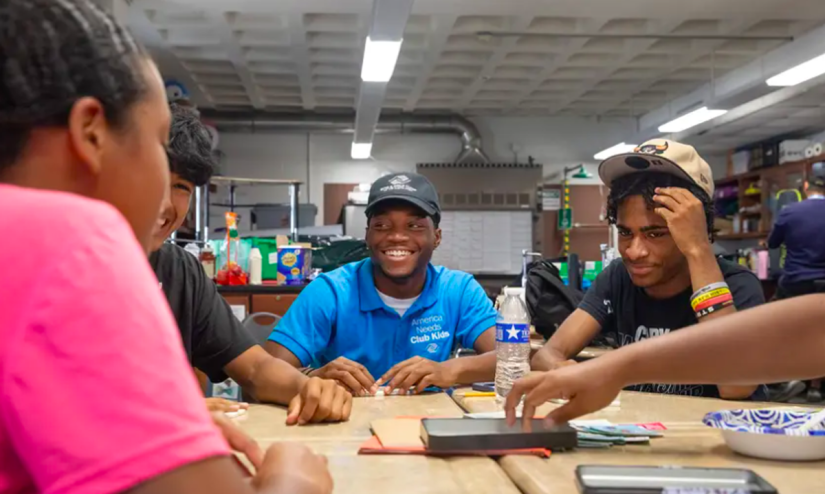
Boys and Girls Club director Jacob Hernandez watches club members play spades at Navarro Early College High School. Credit: Montinique Monroe for The Texas Tribune
Ongoing changes to the country’s educational landscape are only one part of Trump’s larger goals to eliminate what the second-term president has deemed “wasteful” spending and crack down on anything he views as diversity, equity and inclusion initiatives. A large piece of his efforts involve closing the Department of Education and sending “education back to the states,” though most decisions about education and public school funding already happen at the state and local levels.
“Teachers will be unshackled from burdensome regulations and paperwork, empowering them to get back to teaching basic subjects. Taxpayers will no longer be burdened with tens of billions of dollars of waste on progressive social experiments and obsolete programs,” Trump Secretary of Education Linda McMahon said in a statement earlier this year. “K-12 and college students will be relieved of the drudgery caused by administrative burdens—and positioned to achieve success in a future career they love.”
The disarray has resulted in profound consequences for Texas, one of the largest and most diverse states in the nation, home to more than 9,000 school campuses and 5.5 million students — the majority of whom live in low-income households and come from Hispanic and Black families. Public schools serve as a safety net for many of them. They are one of the few places where some children have consistent access to meals, where working-class parents know their kids will be taken care of.
The prospect of federal cuts to school programs triggered a wave of concern across the state. For 44-year-old Clarissa Mendez, it jeopardized the after-school program her two daughters attend while she works as a nurse in Laredo.
“I’m on shaky grounds right now because I don’t know what I’m going to do,” Mendez said last month. “I understand there has to be cuts. I understand the government needs to find out how to save money. But why does it have to affect us and our kids?”
For Gay Hibbitts, a 57-year-old trying to become a certified teacher in rural Throckmorton, the worries began months earlier.
Earlier this year, the federal government cut roughly $400 million from a program that helps teaching candidates like her pay for their education as they gain hands-on classroom experience. That left participating rural districts with one of two options: cover the costs at a time when schools are financially struggling to make ends meet, or get rid of their preparation programs during a teacher shortage.
In both scenarios, Hibbitts said, children would pay the price.
“They’re the main ones that are going to suffer,” she said.
For as long as Martin and Blankenship can remember, they have each helped raise their younger siblings, a responsibility that has been rewarding but stressful. On the one hand, Martin said, her siblings look up to her, and her academic success has motivated them to do well in school. On the other hand, Blankenship said, taking on adult responsibilities at an early age meant missing out on the type of exhilarating childhood experiences many kids desire.
Since joining the Boys and Girls Club, the program has provided them the space to be kids.
They receive tutoring and time to finish homework. They go to live sporting events, watch movies and listen to music — SZA some days, Lauryn Hill on others. They play sports, cards and board games. They can earn scholarships. They find mentorship.
“We’re the future adults, so I feel like if you help us now with programs like this, that make us happy, that give us stress relief, that let us be kids, because we can’t be kids at home, I feel like that’ll equate to happier adults,” Martin said.
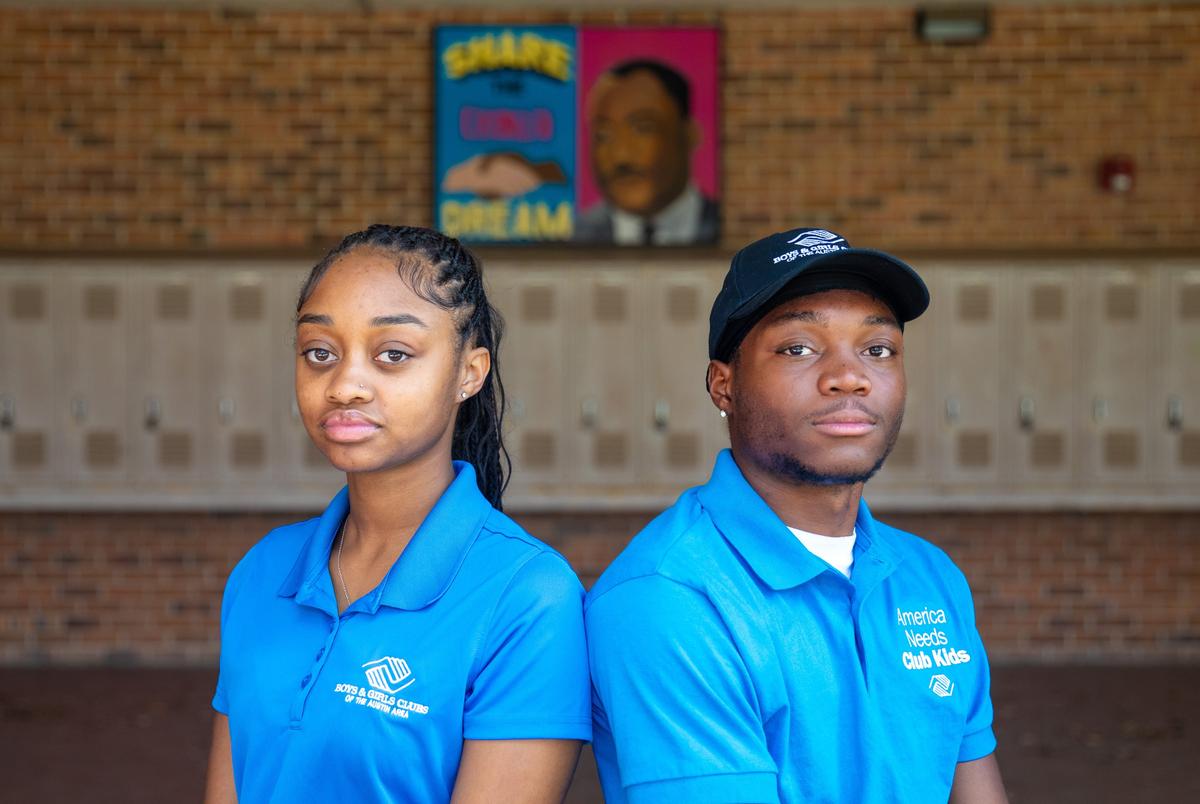
Na’Siah Martin, left, and H’Sanii Blankenship traveled to Washington, D.C., in July and had a chance to discuss with lawmakers the Trump administration’s pause on roughly $7 billion in federal funding, which threatened to shutter the Boys and Girls Club. Credit: Montinique Monroe for The Texas Tribune
Neither Martin nor Blankenship enjoys public speaking. Martin actually fears it. But with the Austin Boys and Girls Club’s future in jeopardy, they decided to lean into the discomfort and use the face time with lawmakers and their staffers to make a case for the after-school program.
The pair and several other clubmates sat down with the staff of Texas Republican Sens. John Cornyn and Ted Cruz. They also met with Rep. Greg Casar, an Austin Democrat. The kids wore blue polo shirts with the words “America Needs Club Kids” etched in white. Martin, rocking a black one-button blazer, led the way.
“I gotta let these people know,” she thought.
Erica Peña is responsible for taking care of about 400 kids as she coordinates Hebbronville Elementary’s summer and after-school programs. Working with an assistant and about 25 paid volunteers, the 37-year-old often stays after hours — sometimes as late as 7 p.m. — depending on when parents can leave work to get there.
Peña breaks the after-school schedule into blocks. The first hour is for tutorials and worksheets, the later hours are usually for more fun activities like arts and crafts, kickball and cooking.
But shortly after the federal education funds were paused, the district notified Peña that it could no longer afford to keep her or the program.
“I cried, to be honest,” Peña said. “I was very upset, because I love my job, I love my students, and a lot of it is about them.”
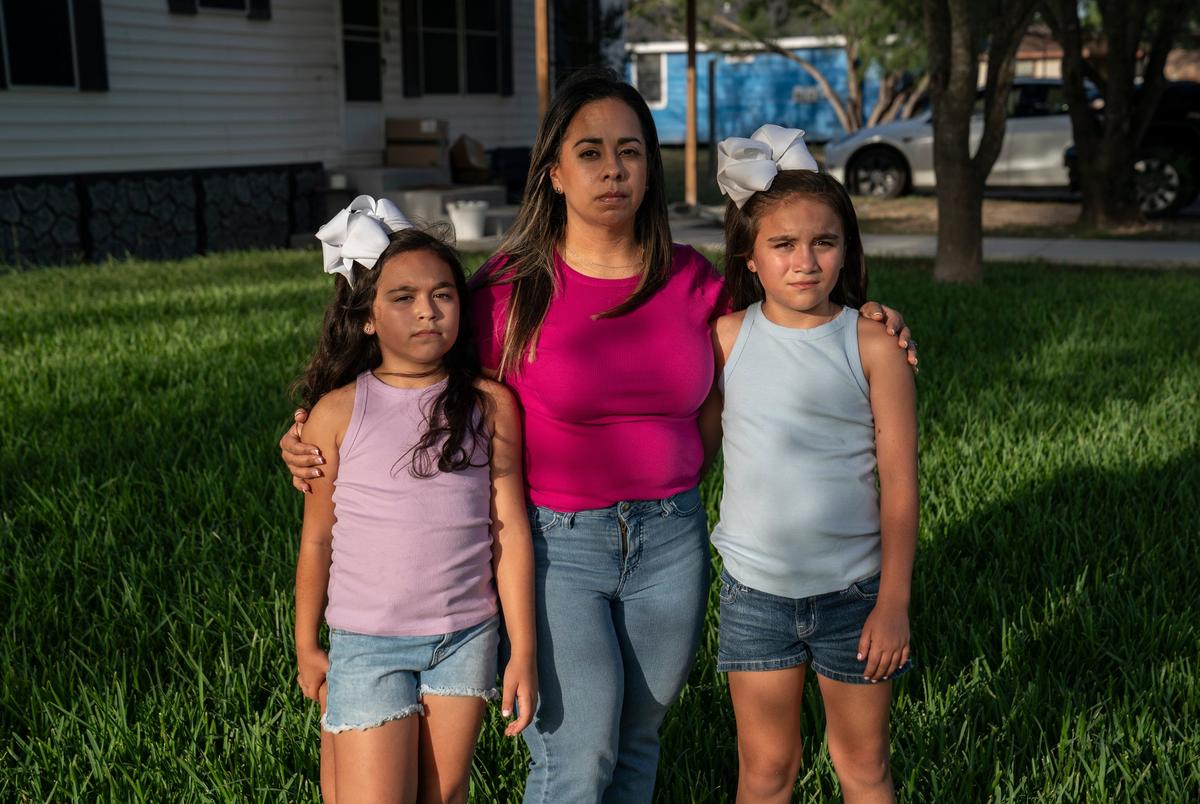
Clarissa Mendez and her daughters Catiana Ester Mendez, left, and Catalaya Avaneh Mendez pose for a photo at their home in Hebbronville on July 30, 2025. Credit: Gabriel V. Cárdenas for The Texas Tribune
Hebbronville, in far South Texas, is home to about 4,300 mostly Hispanic Texans, one-third of whom live below the poverty line. The town has no H-E-B or Walmart. The local health clinic is often busy. The town has a few day care centers, but they can get pricey.
For the average Texas family, child care is financially out of reach. The median annual cost sits at $10,706 a year — or $892 each month. That’s more than one-fourth of the average cost for in-state tuition at a four-year public college, according to the Economic Policy Institute. Access to no-cost options, like the Hebbronville after-school program, has positive effects on student attendance, behavior and learning, multiplestudies have found over the years. Such programs also keep families from having to choose between leaving their children unattended or taking time off work to stay home.
“That has a direct impact on future economic prospects for that entire family,” said Jenna Courtney, CEO of the Texas Partnership for Out of School Time, a youth advocacy organization.
Mendez, the 44-year-old Hebbronville mother with two daughters, commutes about an hour to and from Laredo every weekday to make it to her job as a nurse. She goes in at 9 a.m. and gets out at 5 p.m. Her husband operates heavy equipment and has an unpredictable work schedule.
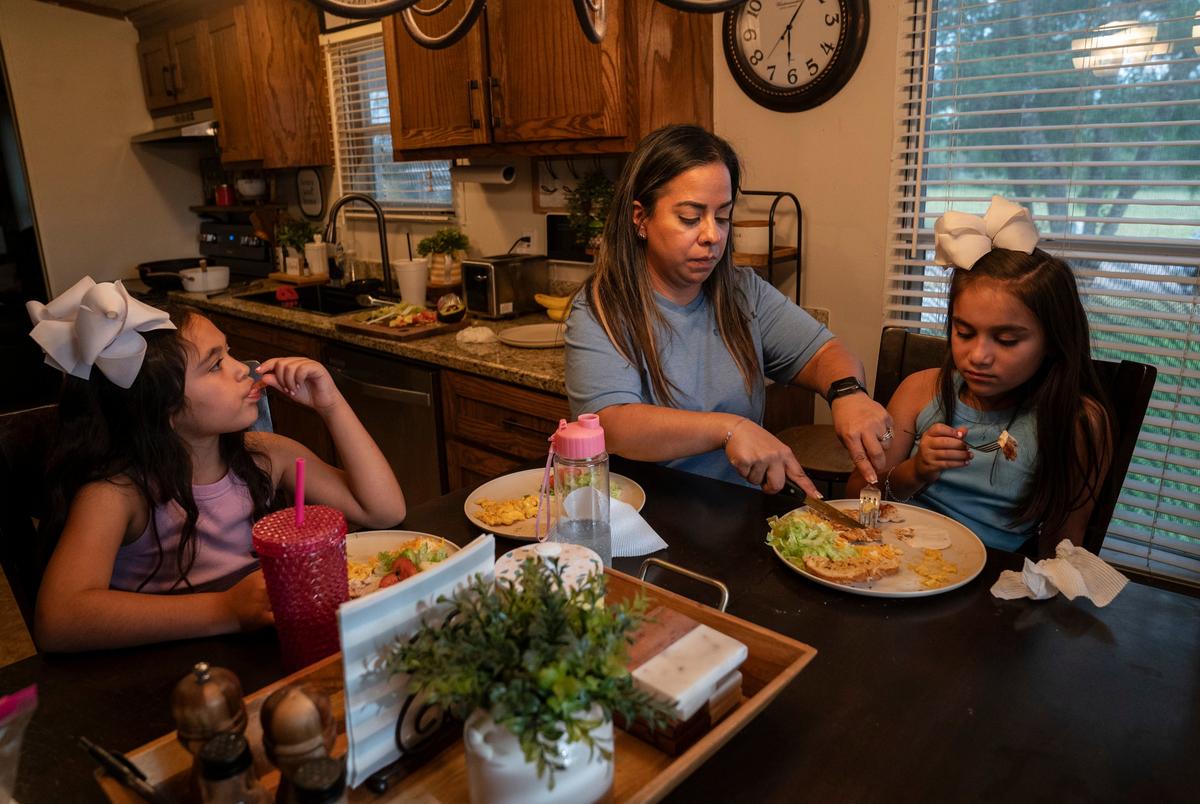
After picking up her daughters, Mendez cooks for them and spends some time with them before she starts working from home for an additional three to four hours. The after-school program Mendez’s daughters attend allows her to save some money on daycare costs. Credit: Gabriel V. Cárdenas for The Texas Tribune
The after-school program “gives me enough time to get to town to pick them up,” she said. But with the district planning to shutter operations, Mendez needed to find care providers who could look after her children until 6-6:30 p.m., when she gets home. She pays about $1,000 a month for that service during the summer when the school program is out of session. It would likely cost her another $800 per month during the academic year.
“That’s a big chunk of our money,” Mendez said.
Without the program, she would need to find a second job.
“We’ll do what we gotta do,” she added. “But I don’t understand.”
Catalaya Avaneh Mendez plays with her sister Catiana Ester Mendez as their mother watches them at her home. The Trump administration recently froze funding that benefits after-school programs, placing financial stress on parents such as the Mendez. They would have to find and pay for daycare for their children if those programs ended. Credit: Gabriel V. Cárdenas for The Texas Tribune
Hibbitts, the 57-year-old from Throckmorton, recently joined a federally funded program that would allow her to support students in her rural hometown between Abilene and Wichita Falls. It places aspiring full-time teachers in classrooms under the supervision of more seasoned teachers and provides financial assistance for their education and living expenses.
In exchange, the district gets to retain educators familiar with the community and eager to teach.
Based on her own experience as a Throckmorton student in the 1970s, Hibbitts knows the monumental role teachers can play in a child’s life.
“They were almost like your second mother,” she said.
Texas has the largest rural population of any state in the country. Of its roughly 5.5 million students, 13% attend class on a rural campus. Those schools often have to educate their students with less: Less access to the internet and technology, less staffing, and less money to pay and retain teachers.
Educator Gay Hibbitts, left, speaks with her mentor, Amy Dick, a secondary social studies teacher, inside a classroom at Throckmorton Collegiate ISD on July 29, 2025. Hibbitts was part of a federally funded educator preparation program serving about 30 participants across 11 rural Texas districts. Credit: Desiree Rios for The Texas Tribune
Texas lawmakers have acknowledged that rural teachers often do not make as much as their urban and suburban counterparts, and that many have left the profession because of a lack of support. Public schools over time have also grown more reliant on hiring unlicensed educators, a trend playing out more profoundly in the rural parts of Texas.
In response, state officials recently passed laws aimed at raising teacher pay, particularly in rural schools, and enhancing teacher preparation programs.
During her first year in the Throckmorton program, Hibbitts learned how to incorporate state learning standards into lesson plans. She learned how to keep students engaged. She helped a child who struggled academically and acted out at the beginning of the school year become a “model student” who thrived in reading by the year’s end.
Then, one Sunday afternoon in April, her superintendent called her.
The Trump administration had abruptly cut the federal dollars that helped schools fund educator preparation initiatives like the one she was participating in. It would affect about 30 people across 11 rural districts in Texas.
Hibbitts was one of them.
Hibbitts participates in a safety training at Throckmorton Collegiate ISD. The funding for Hibbitts’ educator preparation program, which covered her two years of college and training costs, was cut on April 25 under the Trump administration, leaving her uncertain about her future. Credit: Desiree Rios for The Texas Tribune
In Hebbronville, Mendez and Peña each had to confront their own harsh realities. Mendez would have to search for child care in a community with few affordable options. Peña, the after-school program coordinator, would have to find a new job.
In Austin, Martin and Blankenship had trouble picturing life without the Boys and Girls Club.
Club leaders began preparing a memo to notify parents about the funding uncertainty and what it could mean for their kids. Nothing had come of the Republican, Democratic and legal efforts seeking the release of the frozen funds. The Texas kids who spoke with congressional lawmakers and staff at the U.S. Capitol hadn’t heard anything either. When the administration would make a decision about the funds was anyone’s guess.
When Blankenship got the news, he sprinted out of his room in excitement and told his mom. The moment was just as surreal for Martin.
“Knowing that it could have been me, my story, or any other club kids’ story,” Martin said, “it made me happy. But it was like, ‘Dang. I was a part — we were a part of that.’”
Peña, the Hebbronville Elementary program coordinator, was relieved. The mood in her group chat with people from the district’s after-school programs was “pretty ecstatic.” They all cried. Getting the funds meant they no longer had to look for new jobs, and parents like Mendez wouldn’t have to go searching for a place to take care of their kids after school.
Hibbitts is pursuing a bachelor’s degree in general studies with an emphasis in education and a minor in psychology at West Texas A&M. Credit: Desiree Rios for The Texas Tribune
Hibbitts, meanwhile, wasn’t immediately able to bask in the good news, as it did not restore the federal funds for her district’s teacher preparation program. But in early August, her supervisor notified her that the program was officially back up and running for the 2025-26 school year. The news cleared the way for the 57-year-old to graduate at the end of the year and to start teaching full time by the next.
“This has been life changing for somebody of my age, to be able to step up and to step into the world of education,” Hibbitts said. “I’m finishing my dream. And as my kids like to say, ‘Mom, you’re going to be 58 years old walking the stage.’”
Still, she recognizes that so much uncertainty around federal funding means there is no guarantee others will get the same chance.
Uncertainty is what Peña also keeps coming back to.
“It just gets me upset with the administration, because, why? What was the purpose of the freeze? Why did you do that? You’re hurting people, not just adults, but children,” Peña said. “It’s like in a divorce, you don’t want to put the children in the middle. If something were to happen between parents, you never put children in the middle. And by doing that, you put children in the middle.”
This article originally appeared in The Texas Tribune, a member-supported, nonpartisan newsroom informing and engaging Texans on state politics and policy. Learn more at texastribune.org.
Despite the summer heat, Toyia Diab came out to the Summer on the Block at Pulaski Elementary-Middle School to learn what it had to offer the four grandchildren she had in tow.
The family made their way to about a dozen tables snaking around the lawn on the side of the school. Diab listened to staff from the Detroit school district detail all of its resources over the pulsing base of loud music.
Diab’s family was one of many the Detroit Public Schools Community District courted this summer as part of its efforts to retain families and boost enrollment. With the loss of more than 92,000 students in the last 20 years, district officials devote some of the summer break each year to getting word out about what the city’s schools have to offer.
This year, the districtramped up efforts. It sent 40 people to canvas communities and held 19 events to create excitement about the start of school — nearly double that of previous years. It also started new initiatives, such as putting up billboards around the city. In all, the school system budgeted around $3.5 million for marketing this year. School starts Aug. 25.
Though the district has “done a fairly good job” of recruiting new students in previous years, Superintendent Nikolai Vitti told school board members at a meeting earlier this month that the main challenge is keeping them.
As a result, this year the school system also has focused on reenrollment rates. Those numbers have become a metric the district uses to “hold schools accountable,” Vitti said, though he didn’t share how many students the district typically loses during the school year.
“We have emphasized … the need to improve customer service and parent engagement, so that parents feel more welcome,” he said. “And we fight harder to keep students at the schools that they’re at, rather than having more of an attitude of, ‘Well, if you don’t like it here, then you can find another school.’”
Sharlonda Buckman, assistant superintendent of family and community engagement, told Chalkbeat the district has seen a lot of “good signs” for this school year because of the number of people her office reached in the summer.
“It’s noticeable for me, and I’ve been at this for a long time,” she said. “We’ll see what that boils down to, in terms of enrollment.”
This year, Buckman said nearly 5,000 people went to the Summer on the Block events, parties held at schools that both serve as a vehicle to sell families on sending their kids to the district and connect them with free resources.
“As a parent, you have to bring your kids to school every day in order to get the education that they need,” Diab said at the Pulaski back-to-school event. “But then you’ll find some schools, they just don’t have enough resources to keep them interested to come to school, to stay in school.”
All of the district’s summer efforts produced 532 leads on parents interested in enrolling their kids by mid-August. Around 80 of those students completed enrollment, according to the district.
Though initial enrollment numbers are up, officials say, the full impact of the district’s efforts won’t be known until the end of the 2025-26 school year.
Myriad factors have affected enrollment in DPSCD
Boosting student numbers has been among the district’s top priorities for years.
The numbers of students attending schools are crucial for districts in Michigan, where school funding is tied to enrollment.
High student mobility rates, or the rate at which kids move to different homes, contribute to the district’s difficulty in keeping children enrolled. Chronic absenteeism rates also have a direct impact on enrollment.
When DPSCD was created and the school system began being phased out of emergency management in the 2017-18 school year, enrollment shot up to more than 50,800 from 45,700 during the 2016-17 school year.
The district has struggled to move the needle much since, especially after drops during pandemic-era school closures and the years that followed.
At the beginning of this month, there were 50,890 students enrolled in the district, Vitti said at the board meeting.
“We have about 1,400 more students than we did at the end of the year enrolled in DPSCD as of today, and about 500 more as compared to the first day of school,” he said, adding that “ “enrollment is trending in a positive direction.”
Early enrollment numbers for the district are usually higher than official headcounts made in October. The number of students recorded on “Count Day” is used by the state to calculate funding for districts.
Making the case for DPSCD face-to-face
Three days before the Summer on the Block at Pulaski, more than 20 people squeezed into a sun-filled classroom at the Detroit School of Arts.
The group was contracted by the district to canvas homes in areas where attendance is low compared to the number of school-aged children living there.
This summer, the district sent canvassers to more than 78,000 homes to inform families about its schools and programs.
The group at the School of Arts was gathered to get their assignments for the day. They waited to pick up hand-out materials, including fliers listing Summer on the Block dates and pamphlets highlighting programs at application schools.
To get the energy up in the classroom before they headed out, the canvassers stood up to form a circle. Buckman, the assistant superintendent, asked them to share what they heard door-knocking.
“We’re getting a good response in terms of some of those students coming back to the district,” said one woman.
Others expressed residents’ hesitations to open their doors or to give their contact information for the district to follow up with them.
Laura Gomez, who has been canvassing for three years, said through a translator that this summer has been different in southwest Detroit, which is home to many immigrant and newcomer families.
“There are some people that are really happy we’re going out to the houses because that way they don’t have to leave their home because they don’t feel safe,” she said.
After the canvassers broke out into teams, they drove to the areas they were assigned to for the day.
Tanya Shelton and her son, David, arrived in the Crary St. Mary’s neighborhood in the northwest corner of the city.
“We’ll ask them what school district are they in, and if they are interested in DPSCD, we give some information on it,” she said as she made her way down a long block adjacent to the Southfield Freeway.
In her conversations with families, Shelton said the district’s free school lunches piqued their interest. Other canvassers said parents were interested in learning more about the academic interventionists available to students.
Most of the doors Shelton knocked on that day, though, went unanswered. She left the district’s literature at dozens of houses.
Families weigh programming, academics, and transportation in selecting schools
At Pulaski’s Summer on the Block Alexa Franco-Garcia saw more students signing up to attend the school than she has in past years.
“Right now, I have three enrollment packets in my hand, so that means they’ve completed enrollment,” she said during a break from talking with families.
Another three parents left their contact information and said they would return the paperwork the next day.
Considering it was about 30 minutes into the event, that was a strong number, said Franco-Garcia, who works in the Office of Family and Community Engagement.
In her time working in the district, Franco-Garcia has learned what kinds of questions families ask: They want to know about the curriculum, extracurricular activities, and class sizes. They wonder whether their children will be supported in special education and if they will get a bus ride to school.
Most of the sign-ups at the Pulaski event were for kindergartners who were new to the district, Franco-Garcia said.
There were 457 students enrolled in prekindergarten by the beginning of August, according to the district, up about 10 compared to the same time last year.
Diab, the grandmother, brought four kids ages 5 to 12 out to learn more about the school. They heard about the district’s community health hubs, parent academy, and mental health resources.
Teachers from the school gathered around a welcome table ready to answer questions as Principal Tyra R. Smith-Bell floated around talking with parents.
The fresh produce boxes, ice cream truck, free books, and kids’ activities also enticed more than 350 people to come – many more than in previous years, Buckman said.
Linn Flake was the first second-grader of the day to enroll at Pulaski, said Franco-Garcia. It would be his first experience at a neighborhood school, she added.
His mom, Roxanne Flake, chose DPSCD over the charter school Linn went to last year.
“I just wanted a different start,” she said.
The charter school didn’t provide transportation, said Flake, which was an inconvenience because she doesn’t currently have a car. But the Detroit school district offered bus service for Linn to Pulaski, the mother said.
Diab said she had more research to do before her family committed to Pulaski.
“We’re gonna come here and we’re gonna figure everything out – ask questions, all of that stuff, and then if it’s the right fit for them, then we’re gonna put them in,” she said.
Chalkbeat is a nonprofit news site covering educational change in public schools. This story was originally published by Chalkbeat. Sign up for their newsletters at ckbe.at/newsletters.