If you have the opportunity to apply for a job at the University of Michigan’s Center for Academic Innovation, do so. If they offer you the gig, accept.
The two roles that CAI is recruiting for that I want to highlight are:
I asked Suzanne Dove, CAI’s chief education solutions officer, to answer four questions about the roles.
Q: What is the university’s mandate behind these roles? How do they help align with and advance the university’s strategic priorities?
A: Education Solutions is a new team within the University of Michigan’s Center for Academic Innovation, charged with bringing strategic focus and forward momentum to our partnerships with external organizations, both private and public, seeking an innovative educational provider for workforce development.
A growing and robust set of high-value strategic partnerships is an essential component of CAI’s growth strategy in the decade ahead. We are responsible for engaging prospective partners, identifying opportunities and crafting relevant educational solutions in collaboration with other CAI teams and U-M faculty and ensuring a high-quality partner experience. We also provide thought leadership around the shifting workforce-development landscape.
Q: Where do the roles sit within the university structure? How will the hires in these roles engage with other units and leaders across campus?
A: The Center for Academic Innovation is a strategically focused central campus unit at the University of Michigan. We aim to shape the future of learning by unlocking new opportunities for the University of Michigan community and learners, as well as organizations around the world. Our vision is a future in which education connects and empowers learners everywhere to reach their full potential throughout their lives.
The people who join our team in these two new business development roles will play a vital role in connecting CAI to organizations outside the university, understanding and supporting solutions that fulfill these organizations’ evolving workforce and talent development needs, and helping us scale these partnerships in alignment with CAI’s mission. Successful candidates will bring expertise in developing and nurturing strong partnerships with external organizations at regional, national and international levels, as well as the ability to adopt an industry perspective.
Q: What would success look like in one year? Three years? Beyond?
A: Year one is about building the foundations for successful partnerships, both by experimenting with different ways we can serve organizational partners and by taking a systematic approach to deliver, evaluate and learn as we go. We will work together to establish a robust and vibrant pipeline of strategic partner organizations, evaluate their organizational learning needs and determine ways in which our current and future catalog of offerings can serve those needs.
At three years, I expect we will be engaging with a set of strategic external partnerships and have built our understanding of the educational solutions that we’re best positioned to provide. Beyond that, we want to scale these solutions to match the vast needs of workforce trends and transitions around the world.
Q: What kinds of future roles would someone who took either of these positions be prepared for?
A: I am excited for the people we hire as business development specialists because their work will position them at the intersection of building relationships, understanding the dynamic world of workforce learning and building internal processes to allow effective delivery of educational solutions for organizations. The result will be a tangible impact not only on people’s lives but also on the organization’s performance.
I can envision plenty of doors that would open as a result of success in one of these positions, depending on the individual’s interests: HR or talent development leadership; a workforce or economic development agency at the local, state, federal or even global level; or a larger or more complex business development portfolio.
One thing I have noticed about CAI since I joined a few months ago is that there are plenty of opportunities for team members to grow and stretch. If you are an intellectually curious, creative problem solver who leads by listening and collaborating, if you love to take an initial concept and help a team and organization bring it to life, I hope you’ll apply!
Please get in touch if you are conducting a job search at the intersection of learning, technology and organizational change. If your gig is a good fit, featuring your gig on Featured Gigs is free.
Florida State College at Jacksonville has signed an agreement with U.S. Immigration and Customs Enforcement to allow its campus police department to enforce immigration laws.
An ICE database shows the agreement is still pending.
FSCJ joins more than a dozen other public institutions in Florida that struck similar agreements with ICE earlier this year, part of the state’s crackdown on immigration under Republican governor Ron DeSantis.
While police agencies in a number of other states have signed on to participate in the federal government’s immigration enforcement actions, the only campus police forces to join the effort are located in Florida, according to an ICE database that lists partners that have finalized agreements with the federal agency.
College officials previously told the local news outlet Jax Today that they were under the impression that FSCJ’s police department was too small to be considered for an agreement with ICE. However, spokesperson Jill Johnson told Inside Higher Ed by email that is not the case.
“Initially we thought that our police department was not large enough,” Johnson wrote. “This changed last week when we were notified that our officers were in fact eligible to go through the federal training necessary to be able to work with ICE officials, should the need arise.”
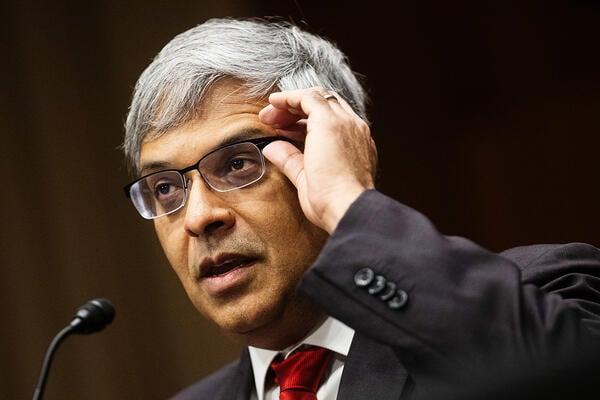
NIH director Jay Bhattacharya said that among other priorities, the agency will focus on artificial intelligence and “ensuring evidence-based health care for children and teenagers identifying as transgender.”
Jim Watson/AFP/Getty Images
The National Institutes of Health’s director ordered employees to “conduct an individualized review of all current and planned research activities,” including active grants and funding opportunity announcements, according to images of a document provided to Inside Higher Ed. The review comes amid concerns that the NIH won’t distribute all of its allocated grant money by the time the federal fiscal year ends Sept. 30, meaning those dollars will return to the U.S. Treasury.
The document images, provided by a source who wished to remain anonymous due to fear of retaliation, show that NIH director Jay Bhattacharya sent the memo Friday and that the review is effective immediately. According to the memo, “relevant NIH personnel” must review grants, funding opportunity announcements, contracts, contract solicitations, applications for new and competing renewal awards, intramural research and research training programs, cooperative agreements, and “other transactions.”
The order is part of a larger memo in which Bhattacharya outlined “select agency priorities” and said projects that don’t align with these priorities may be “restricted, paused, not renewed, or terminated.” The focuses are, among other things, artificial intelligence, “furthering our understanding of autism” and “ensuring evidence-based health care for children and teenagers identifying as transgender.”
In response to a request for an interview about the review and why it’s needed, the NIH press team sent a public statement from Friday, in which Bhattacharya listed the priorities.
Regarding health care for transgender youth, he said, “There are clearly more promising avenues of research that can be taken to improve the health of these populations than to conduct studies that involve the use of puberty suppression, hormone therapy, or surgical intervention.” He says that “by contrast, research that aims to identify and treat the harms these therapies and procedures have potentially caused … and how to best address the needs of these individuals so that they may live long, healthy lives is more promising.”
Bhattacharya’s letter comes after President Trump, earlier this month, ordered senior appointees at federal agencies to annually review discretionary grants “for consistency with agency priorities.”
Joanne Padrón Carney, chief government relations officer for the American Association for the Advancement of Science, said in a statement to Inside Higher Ed that the president’s budget request for fiscal year 2026 already outlined a set priorities for the rest of the current year.
“Switching gears at this stage reinforces confusion, diminishes trust, and increases concerns within the scientific community,” Carney added. “It joins the long list of tactics risking impoundment of congressionally appropriated funds rather than funding biomedical research that is essential for the people’s well-being.”
The Oregon Health & Science University will receive a $2 billion gift from Nike co-founder Phil Knight and his wife, Penny, to support the eponymous Knight Cancer Institute, OHSU announced last week.
It is the largest single donation ever made to a U.S. university-affiliated health center and is intended to promote the integration of cancer diagnostics, treatment and patient care.
The gift will allow the cancer institute to become self-governed within OHSU. It will have its own board of directors under the leadership of Brian Druker, a leukemia researcher who has worked closely with the Knights and who helped develop a drug that vastly improved the life span of patients with chronic myeloid leukemia.
“This gift is an unprecedented investment in the millions of lives burdened with cancer, especially patients and families here in Oregon,” said OHSU president Shereef Elnahal. “It is also a signal of trust in the superlative work that our clinicians, researchers and teammates at the Knight Cancer Institute do every day. Dr. Druker’s vision around a multidisciplinary system of care—focused squarely on making the patient’s experience seamless from the moment they receive a diagnosis—will now become reality. And thanks to the extraordinary generosity of Mr. and Mrs. Knight, Oregon will be the place to do it.”
The Knights have been key benefactors of the cancer institute. In 2013 they vowed to donate $500 million if the university could match the funds within two years—which it did, thanks to $200 million in bonds from the Oregon Legislature, $100 million from Columbia Sportswear chair Gert Boyle and assorted donations from some 10,000 individuals from all 50 states and 15 countries.
Over the past seven months, members of the American Association of University Professors, a 110-year-old organization that is fundamental in defining and protecting academic freedom, have found themselves, their disciplines and their universities on the receiving end of the Trump administration’s unrelenting attack on higher ed.
As Republicans in some states diminish the influence of faculty senates, AAUP state- and campus-level chapters, which often also represent faculty as official unions, have led the criticism of the federal government’s actions. But how is the AAUP planning to fight now—more than half a year into Trump’s return to power, as Washington continues to pressure some of the country’s most powerful universities into making concessions?
Late last week, Inside Higher Ed interviewed Todd Wolfson, whom AAUP members elected as their president in June 2024. A former union leader at Rutgers University, Wolfson denounced the Trump-Vance ticket well before the GOP victory in November. Now, he’s leading the AAUP as it protests, sues and otherwise tussles with Trump.
The following transcript of the interview has been edited for clarity and concision.
Q: We’re now more than six months into Trump’s second administration. What is the current state of academic freedom?
A: It’s being washed over by an administration that has no respect, or even probably understanding, of the concept. We’re seeing massive infringement of academic freedom at the individual level. But then, it’s also the academic freedom of institutions.
In the McCarthy era, the attacks on academic freedom were attacks on individual faculty and demands for loyalty oaths and those sorts of attacks on individuals, not on institutions. So I’d say that, in the current moment, academic freedom is under its most fundamental attack we’ve ever seen, both in its attack on individual academics, but also on institutional autonomy from the federal government, ideological control.
Q: Did you expect the Trump administration to target higher ed this much, or in these ways? What has and hasn’t surprised you?
A: We were raising the alarm about this from before the election. We were very concerned about statements coming out of … the Trump campaign and then JD Vance’s mouth. So we recognized a threat. I mean, if you go back and look at Trump’s campaign video about higher ed, it’s like pure lunacy, right?
And it’s not that this was new—because [of Florida governor] Ron DeSantis—but it was alarming. Even with that, though, I would say that, clearly, we underestimated how dangerous it was. I did not expect a wholesale assault on the sector, squeezing it from every direction. And so, yes, I’m surprised. We were not prepared for how they’ve approached dismantling higher education.
I never expected the Trump administration to take a democracy, or the health of American society, to heart, because they’re grifters and they’re in it for their own personal power and their own personal wealth. But I did not expect that they would be so outlandishly intent on destroying a sector that’s so important to the fundamental values and power of American society.
Q: Yeah, you called then–vice presidential candidate JD Vance a fascist last August. Has he turned out to be one?
A: I would say so.
Vance and Trump and [Christopher] Rufo and Stephen Miller and the ilk that run our government are fascist in a 21st-century variant—not operating within the constructs of our society, [but] trying to rip those constructs down. I think the last six months have borne out my position pretty well.
The ilk that run our government are fascist in a 21st-century variant—not operating within the constructs of our society, [but] trying to rip those constructs down.”
Q: How has the AAUP resisted the Trump administration’s actions, and universities’ apparent responses to those actions?
A: The first and most important is we’re organizing our members, we’re doing a lot of political education with them, we’re thinking together about the problems at the campus level and then the problems at the state and national level, and we’re talking about how we approach it. We’ve grown more than this organization has ever grown in the last six months.
We built out coalition[s]. And so I think the most important [coalition]—but not the only one—is that we have established and coordinated a space called Labor for Higher Ed where all the international unions sit together and work together to come up with a coordinated plan to respond to the Trump administration. That’s never happened before. We have every major union that has higher ed workers sitting at that table.
[Secondly,] we sued the Trump administration on our own six times. With our AFT [American Federation of Teachers] as our [union] affiliate … probably another three or four times.
They’re doing so many things that are so obviously unconstitutional and illegal, and so we’re trying to use the courts to slow them down.
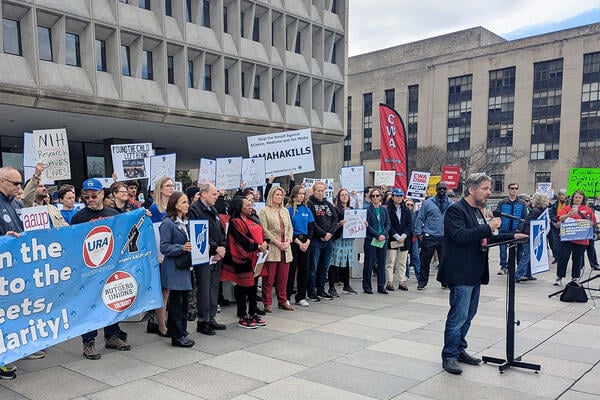
The third [tactic]—and you’ll see more of this, but you’ve probably been watching and seen it throughout the spring of last year—is getting our people into the streets, fighting back, offering a different vision. This has primarily happened in response to the NIH, NSF cuts.
Wolfson (at podium) at a news conference at AAUP headquarters in Washington, D.C.
Ryan Quinn/Inside Higher Ed
The fourth area is that we need to offer … a countervision of higher education to the Trump vision, which is higher education ideologically controlled by the federal government, in its most extreme form, as well as the complete destruction of our biomedical research infrastructure and our research over all.
We’re working on a policy vision that will move us into the midterms … a counterimaginary of higher ed to the imaginary that’s been developed by the Trump administration, by Chris Rufo, one where we’re all Marxist ideologues indoctrinating our students.
The last area is that we’re supporting the development of organizing at the campus level to challenge and hold our administrations accountable, whether supporting the mutual aid defense compact projects that [have] mushroomed across higher ed, or supporting the fights at campus levels around academic freedom and freedom of speech, or any other number of things that we’re doing to support faculty at the campus level, to get their administrations to hold firm and not to bow to the Trump administration’s demands before they even make them.
We had 40,000 members, now we have something like 50,000 members [since Wolfson was elected president last year]. By the end of the calendar year, I’d like to see [60,000]. And that’s dues-paying members.
Q: Has there been an increase in the number of campus chapters or state conferences?
A: Since Trump was elected, I think we’ve grown by at least 40 chapters. Some of those chapters had gone dormant and then renewed and came back to life.
So if we had, when [current AAUP leaders] took office, something like 500 chapters, now there’s something like 550.
Q: Do you have any regrets about tactics or actions your organization has taken so far during the second Trump administration?
A: Certainly, I have regrets. Everyone makes mistakes. I don’t know if this is a regret, [but] I think that our sector is not fully ready to respond to the real threats. Our sector needs to be able to take militant job actions and other sorts of actions as this issue continues to ramp up.
We won’t do that if we don’t have the ability to do it at a scale that makes it powerful and meaningful and effective. And so I think that’s the thing we are working on, and anything we do—and I want to underscore this—would be nonviolent and peaceful.
But, nonetheless, we need to be able to militantly show how concerned we are—not only over our own institutions and our own jobs and our students, but also around higher education and the future of our democracy.
Q: Is what you’re saying is needed is a simultaneous general strike across higher education institutions across the country?
A: If we continue to have a federal government that takes over our cities and puts our cities under martial law and abuses the institutional autonomy of our higher education institutions and does all sorts of things that we all see are undemocratic and dangerous, we need to be prepared not only for a general strike in higher education, but a general strike over all.
I don’t think a higher education general strike is an action that will be effective, because I don’t think that higher education alone has this sort of industrial power to hurt the economy in a way that could force us to try to move through this moment.
If the Trump administration continues on its course … the only force that could respond to that effectively is a labor movement that is willing to withhold its labor, and in a general way.”
But I’m saying if the Trump administration continues on its course—which is a course that’s antidemocratic, that could undermine elections, that could take over cities, that could endanger citizens in the way it did in L.A. and now is doing in D.C., and that is destroying our democracy one piece at a time—that the only force that could respond to that effectively is a labor movement that is willing to withhold its labor, and in a general way.
Q: I was wondering whether you felt that your organization relied a little too much on litigation, or whether protest fell flat.
A: Maybe society writ large in the U.S. is depending too much on courts. I wish we were prepared, as workers in the sector, to take approaches that were more direct than just the courts. But, obviously, we can only be a reflection of the workers in the sector. We cannot, as an institution, push ourselves well beyond where our workers are at.
Q: I think many people would agree that things have gotten worse and worse as the Trump administration has progressed … What does AAUP plan to do differently going forward?
A: There can’t be an expectation that the moment that the Trump administration took office, that … all of the higher ed workers and our students would have been ready and prepared to respond. There is often a lag time between a crisis and the public’s response to that crisis.
We should be critical of ourselves and critical of our tactics and think about how to respond better and move forward better. We see the next 16 months as really important, and that rolls us through the midterms of 2026.
We don’t plan to do this alone. We plan to do this with every higher ed worker, and so that’s why Labor for Higher Ed—this table that represents millions of higher ed workers coming together and working together and coming up with this plan together—is so important. We’re also building an aligned table with our students and student organizations, and also with alumni and alumni organizations. And so we think that if those three forces can come together and fight specifically over higher ed, we can make a real fight.
Wolfson at a rally outside the Health and Human Services Department headquarters.
Ryan Quinn/Inside Higher Ed
But I’ll say this … higher ed workers alone cannot beat back the Trump administration. It needs to be a multisector fight. Federal workers—who are also under attack—we need to build alliance with them. K–12 teachers, health-care workers, immigrant workers, progressive community organizations all need to build an aligned front that is ready to take risks, because if we don’t take those risks, we may look at what we have in 2026 and we might not have clean, fair elections.
I think we have to take that very seriously, and we have to build our power to respond.
[Currently, we need] a real fight around the budget, from now through October, a fight around the budget that demands a fully funded NIH, NSF, NASA, [that] pushes around the destruction of the student loan program [and] fights over the TRIO program … which is a program for first-generation college kids.
From there, we are going to be really working on our campuses, building campus-level campaigns and state-level campaigns around higher education.
The things we want to have in [the national] vision are things like a demand for free public higher education, college for all and an end to adjunctification, an end to student debt, more research funding … and then use that vision to really fight for candidates that lift up our imagination of higher education as we move into the midterms.
We are going to fight in the streets and we’re going to fight politically. This is a political battle, and we need to respond politically in this battle.
Q: How do you fight an enemy that seems to thrive on conflict and to derive strength partly by othering certain groups of people—and, among those groups of people … faculty?
A: Faculty and the press and people of color and women and gay people and trans people and anybody that’s not white, Christian nationalist, in the end, is othered. And then even within the white Christian nationalist community, if you’re not MAGA, or you care about a free press, or care about free inquiry, you’re othered.
That first six months was a freaking whirlwind, and so we were really reactive, we were reacting. The Trump administration set the tone—not just for us, to be clear, obviously [for] the Democratic Party, but the progressive community more generally or any sector under attack.
We have been too reactive to the political environment, and so I think the biggest thing that we need to do is stay on our message and vision.
Now there seems to be some fracturing, maybe over Palestine, in the right-wing echo chamber. But, in general, that echo chamber has operated in lockstep and it’s huge, and we don’t have anything like that. Whatever we do, we’re never going to have the megaphone that they have. But, what I do believe is that we must put out our own proactive vision. It can no longer be “Ron DeSantis is mean, and he’s saying bad things about DEI and we need to stop him,” or “Donald Trump is saying bad things about Harvard,” or “Chris Rufo, can you believe how ridiculous the things he puts out are?”
We can’t be constantly responding to them. We can’t have kids going into hundreds of thousands of dollars of debt to get a college degree, and we need to make sure that we have work with dignity and free inquiry and we need to make sure we have the best research infrastructure in the world.
Q: You mentioned Palestine. What position, what action, if any, does national AAUP need to take on Israel and Palestine at this moment? … I know that you guys already dropped your categorical opposition to academic boycotts before Trump’s election.
A: We believe strongly that no weapons should be sent to Israel, at all. Not defensive or offensive, nothing.
What do we do in the U.S., where antisemitism has been used as a weapon, in many ways, by the Trump administration to bring universities to heel—and many times stripping out, or threatening to strip out, hundreds of millions of research dollars that often affect Jewish faculty members? Versus what our position should be on the conflict in the Middle East?
First and foremost, our job is to safeguard ourselves at home and to set a vision that aligns with what we’re trying to do in the United States. We need to stand up for academic freedom, for freedom of speech, for freedom of assembly for our students so they can protest the war—the genocide, excuse me—that’s taking place in Gaza.
We need to stand up to the weaponization of antisemitism in the Title VI process. And we need to make sure that we defend our members.
We think the Jerusalem Declaration on Antisemitism, which does not get involved with questions of the Israeli state at all, is a much more apt way of defining antisemitism.
The numbers of universities and faculty and university presidents [in Gaza] that have been killed and universities that have been destroyed in this war is mammoth. We are certainly educating our members on this concept of scholasticide.
It seems pretty obvious that they are—but if, in fact, Israel is purposefully destroying the educational infrastructure, both K–12 and higher ed, of Palestine, and of Gaza, that stands against our values of academic freedom. And if that’s the case, and we can unify around that, then we will take a stand and call for an end to the scholasticide.
Q: What will it take, ultimately, to get the Trump administration to relent in its attacks on higher ed?
A: Ultimately, we need a massive movement of higher ed workers and students. But, again, I don’t think that’s enough.
I believe as higher ed goes, so goes democracy. But the converse isn’t absolutely true. Higher ed alone cannot save democracy, but we’re a critical part.
It needs to be a broader societal movement to save our country.
I was absolutely appalled at the anonymous AP Literature and Composition reader’s summary of his time in Salt Lake City. I was even more appalled by his tone, which was condescending, arrogant and unapologetic, and by his sense of superiority. Far be it from me to evaluate how he might be as a teacher (especially if he had a bad night’s sleep, poor lamb), but his emphatic victimhood at the circumstances that accompanied the reading, which he signed up for, was more than off-putting; it was flat out reprehensible.
His attitude, that this whole event is beneath him, is hard to understand. Again, he chose to be there. He blatantly ignored his table leaders, skimmed rather than read essays and, behind the shield of anonymity, celebrated only giving a handful of 5s. He took it as a personal affront when he was asked to follow the rules. I feel especially bad for any AP student who suffered because of the negligence of this dismissive and self-pitying reader.
Worse, he used his entire experience as a microcosm for What’s Wrong With Education Today. The other readers are a part of this excoriation: While he gets up to give himself additional breaks, his colleagues “seem well adapted to the AP regimen, and to regimentation.” He, though, has escaped from Plato’s cave and has come back to tell us all … that the free coffee wasn’t very good.
This, while there are actual problems plaguing the state of college writing, from students uncritically using AI to assignments and essays that aren’t accurately evaluating student learning. With these legitimate concerns, it seems myopic to worry only that he encountered too few essays that contained “something insightful or fluent.” From that small sample, he concludes, “Is this how we’re educating the best and brightest, these college students of the near future? Are the vaunted humanities—assailed for years from without—rotting from within?”
A sharp reader might resist stooping to make such generalizations. A sharp reader might conclude that work written hastily on an unseen topic while myriad other concerns are influencing its writer will rarely be sufficiently fluent. But the author’s preoccupation with these flawed essays reveals something worse: an attitude more concerned with signifying his august tastes than celebrating some of the essays’ successes—which AP readers are explicitly tasked with doing. As many happiness scholars have noted, expressing gratitude is an often-effective way to combat negativity.
If I were the sort of writer who uses few examples to draw overconfident conclusions, I might argue that the anonymous author represents the worst sort of virtue signaler: one who simultaneously laments that the “army of food service workers, mostly Hispanic or Asian,” must serve all the readers, but who also overindulges on the free food (“my waistline expands”). He likewise points out the inequality women professors face (“That fits with the service-heavy load female professors typically shoulder at most universities”) while demeaning his own female table assistant-leader (ignoring her when she asked him to put away his phone). Dare one conclude that he is staring at the mere shadows of true virtue down in his cave of concrete convention center floors and thick black curtains?
Maybe I am overreacting. I have a visceral dislike for the sort of persona he displays here, and it was part of the reason I left higher education after finishing my Ph.D. At most academic conferences, especially in the humanities, where our findings aren’t as obviously helpful to the field as, say, the sciences, postering and self-aggrandizement were pervasive. Seven years ago, I became a high school teacher and now an AP Literature reader, and I’m happy to report that I find myself surrounded more by the optimism of youth than the performative jadedness of some of those in higher education.
I’m sorry the author wears his ennui and disillusionment as a signifier of his superiority. I’m sorry he celebrates his misanthropy alongside his impractically high standards. And it’s a shame that he was so disheartened by this experience, he felt the need to trash it publicly. To what end?
I was not at the author’s table this year. I’m sure my sunny disposition would have made me fodder for his future displeasure. (When he got to his table and saw so many people excited to start reading, he responded, “The enthusiastic vibe can’t help, either.”) But perhaps instead of focusing our energies complaining about the task of wading through essays or the state of writing today, we can embrace the role we have as educators. Few other positions offer that sort of direct influence on such a large number of people.
Hopefully, as we teach our students to write well and insightfully analyze texts, we can also teach them to see the hope that comes with possibility—to see that they can always find something to celebrate, as long as they try to have the right attitude.
Andrew J. Calis is an English teacher at Archbishop Spalding High School in Maryland.
Despite federal attitudes and policies toward international students, demand to study in the U.S. remains high.
Photo illustration by Justin Morrison/Inside Higher Ed | Getty Images
Advocates for international students are raising alarms that federal actions are limiting foreign-born learners’ ability to study in the U.S. But researchers say the trend isn’t an indication of international student interest or demand to study in the U.S.
A late July survey of 300 foreign-born students found 91 percent plan to study in the U.S., despite funding cuts and internal instability in the U.S. The reputation of U.S. institutions also has yet to take a hit, with 99 percent of respondents indicating they still trust the academic quality of U.S. institutions.
That’s not to say students are unaware of or undeterred by changes at the federal level. Fifty-five percent of survey respondents indicated some level of concern about pursuing their degree in the U.S., and 50 percent said they’re less excited about the opportunity now than they were previously. The top reason their sentiment has changed is international tensions or politics (54 percent), followed by worries about political instability in the U.S. (45 percent).
Brian Meagher, vice president at Shorelight, a higher education consulting group focused on international students, said at an Aug. 12 media roundtable that even students caught in the visa backlog haven’t shifted their gaze to other countries yet. Instead, they are deferring to the spring semester. May data from the U.S. Department of State shows 19,000 fewer students received a F-1 or J-1 visa that month compared to May 2024, which experts say is the first sign that a fraction of expected students will be coming to campus this fall.
“Most of them want [to study in] the U.S.—they’re not changing their minds to the U.K. or Canada or Australia,” Meagher said. “We do think there will be a longer-term impact on switching to other country destinations as a result of this.”
Others are taking classes online at their host institution or enrolling in a satellite campus elsewhere in the world for their first term, but those are less popular options, Meagher said.
“In talking with prospective students, I’d say the belief is that this is a temporary changeover at an unfortunate time that may result in missing a fall semester,” Shorelight CEO Tom Dretler said during the roundtable.
Long-Term Challenges Expected
While international students see the changes as a short-term setback, some market predictions forecast significant changes to U.S. higher education enrollment and revenue. At least the lack of visas could impact future applications to U.S. colleges, Dretler said.
Research by Holon IQ, a global intelligence agency, points to the U.S. as a top destination country for international students for decades, but since 2016—roughly the start of the first Trump administration—the country lost 10 percentage points of its share of international students.
Starting in 2016, “the U.S. became perceived by some as less welcoming or safe, did not recruit international students as energetically, and denied a substantial fraction of student visa applications, while governments and university sectors in the other countries acted in concert to grow international student numbers,” according to an August report from Holon IQ.
Modeling by Holon IQ finds that a variety of actions by the federal government, including visa policy changes, a crackdown on universities and new tariffs could create barriers to students in the U.S. as well as a climate of uncertainty for prospective students.
The agency predicts the most likely trajectory is there will be a short-term decline in U.S. international enrollment, with 1.12 million students in 2030, unchanged from 2023 levels. But possible scenarios range from an increase in students of 8.3 percent to a drop of 7.9 percent by 2030.
“I think what’s happening in the U.S. is a point in time as to whether the U.S. will continue to lead and for how long it will continue to remain the global leader for international student mobility and a desired study destination,” said Patrick Brothers, co-CEO of Holon IQ Global Impact Intelligence, during the media roundtable.
Paying the Price
Experts warn that a lack of students on campus could mean billions in lost tuition revenue for years to come.
NAFSA, the association of international educators, reported if the number of new international student enrollment declined between 30 and 40 percent, it would result in a 15 percent drop in overall international enrollment and result in a loss of $7 billion in revenue.
June data from Shorelight found even a 20 percent decline would result in a $1.7 billion annual loss in tuition revenue, or $5 billion over four years.
“We think it’s going to be something that is negative for the U.S. economy, negative from a jobs perspective and also very hurtful to colleges and universities, but not always the one that people think,” Dretler said. Top universities will be able to weather the financial hit, pulling students off their waiting lists, but regional and community colleges will experience greater losses, which could increase tuition rates for middle-class families.
States with high international student enrollment would be hit hardest by the changes. Among the top states for international students—California, New York and Texas—Shorelight anticipates a total loss of $566.6 million and NAFSA projects a loss of $2.39 billion, based on their respective data models.
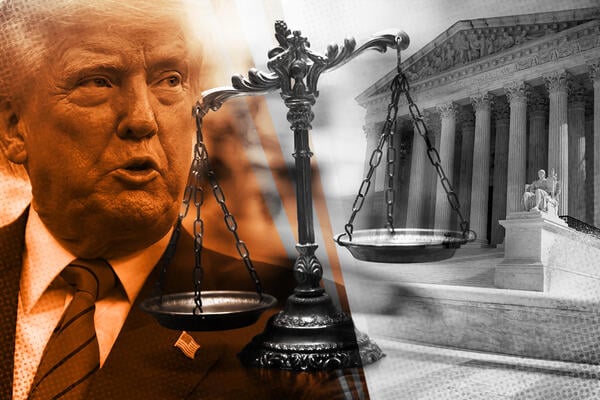
Judge Stephanie Gallagher declared in the Thursday ruling that the Department of Education broke the law when it tried to withhold grant funding from institutions that practiced DEI based on one of the president’s executive orders and a related guidance letter.
In her opinion, Gallagher focused less on the legality of the attempt to ban DEI itself, but rather the process through which the president and secretary of education tried to do so.
“This court takes no view as to whether the policies at issue in this case are good or bad, prudent or foolish, fair or unfair. But, at this stage too, it must closely scrutinize whether the government went about creating and implementing them in the manner the law requires. Here, it did not,” the judge wrote. “By leapfrogging important procedural requirements, the government has unwittingly run headfirst into serious constitutional problems.”
That said, she did explain the ways Trump’s policy violated the Constitution, saying, “The government cannot proclaim that it ‘will no longer tolerate’ speech it dislikes because of its ‘motivating ideology’—that is a ‘blatant’ and ‘egregious’ violation of the First Amendment.”
Gallagher’s decision followed a motion for summary judgment that was filed by the plaintiffs, the American Federation of Teachers and the American Sociological Association, after they won a preliminary injunction that blocked parts of Trump’s anti-DEI policy since April. (Gallagher was appointed by Trump during his first presidency in 2018.)
Since the Education Department’s anti-DEI guidance was enjoined, the Trump administration has made other attempts to block the same academic practices. Most recently, the Department of Justice published a nine-page memo that stated that DEI is unlawful and discriminatory.
Still, AFT president Randi Weingarten viewed the ruling as a “huge win” against Trump’s “draconian attacks on the essence of public education.”
“This decision rightly strikes down the government’s attempt to dictate curriculum, and, in so doing, upholds the purpose and promise inherent in our public schools,” Weingarten said in a news release.
Sitting on the Kentucky border, the Christian Academy of Indiana draws students from 56 different ZIP codes in southern Indiana. Some come from as far as 30 miles away and live in counties without private schools.
Families in those distant communities make the drive every day — sometimes carpooling — because they’re drawn to the school’s environment and extracurriculars, and especially its Christian teaching, said Lorrie Baechtel, director of admissions for the school, which is part of a three-school network in Indiana and Kentucky.
“There are lots of good public school options in Indiana. Families come to our Indiana campus more for that mission,” Baechtel said.
The school’s enrollment has boomed in the last four years, driven in part by the expansion of the Choice Scholarship, Indiana’s signature voucher program. That’s made tuition more affordable, Baechtel said. More than 1,200 students attended in 2024-2025, up from around 700 in 2021-22.
That reflects a statewide trend: Voucher use has surged in recent years as Indiana lawmakers loosened eligibility requirements. In 2026, the program will open to all families, regardless of income.
But the Christian Academy’s ability to attract students from far away tells another story too. Even as vouchers have become more accessible, Indiana’s rural students aren’t using them at the same rate as their urban and suburban peers. That’s in part because one-third of counties don’t have a private school that accepts vouchers within their borders, and distance is a factor in parents’ decisions on school choice.
The result is that students who live closer to an urban center — which typically have one or more voucher-accepting private schools — may use vouchers at rates up to 30 percentage points higher than those for students who live in a neighboring district.
“If there are no schools there for you to attend it’s unlikely it’s going to be all that useful for you,” said Jon Valant, director of the Brown Center on Education Policy at the Brookings Institution.
More than that, public education advocates say splitting state school funding with vouchers leaves less for the rural public schools these students do attend.
“We’re making the policy choice to fund a lot more choices than we used to,” said Chris Lagoni, executive director of the Indiana Small and Rural Schools Association, which represents public schools. “We’re inviting more and more folks to Sunday dinner. It’s a little bit of a bigger meal, but a lot more guests.”
But the state’s Republican lawmakers have dismissed the fears of a hit to public rural schools as a result of vouchers, saying that rural voters support choice and parents want educational options — whether that’s private, charter, or traditional public schools.
Meanwhile, school choice advocates say the latest expansion of the Choice Scholarship, along with a growing preference for smaller learning environments and the rise of voucher-accepting online schools, could mean more private school access for rural areas in the near future.
“I think we’re best when we have a robust ecosystem of private and public options,” said Eric Oglesbee of the Drexel Fund, a nonprofit venture philanthropy organization that funds new private schools in Indiana and throughout the U.S.
Location matters in accessing a private school
Across the state, around 76,000 students received vouchers for the 2024-25 school year — an increase of about 6,000 students from the year before. The program cost the state $497 million last year, and the average voucher recipient came from a household with just over $100,000 in income.
But around one-third of Indiana counties don’t have voucher-accepting private schools within their borders, according to a Chalkbeat analysis of state data, which also shows that voucher use is lower in rural areas than urban ones.
Voucher use can shift dramatically even between nearby areas. For example, around 16% of students who reside in the Madison school district in southern Indiana use vouchers, but that rate drops to as low as 1% in nearby districts that are more rural. Similar trends hold in other areas of the state, like Indianapolis, Evansville, Fort Wayne, and South Bend.
Location matters because driving distance has been shown to be a factor in how parents choose a school.
In a 2024 survey of parent preferences by EdChoice, an Indianapolis-based group that supports vouchers, around half of parents said they would drive a max of 15 minutes for their children “to attend a better school.” Just over a quarter said they would drive no more than 20 minutes, and the final quarter said 30 minutes would be their max.
Concerns about this issue have persisted in the state for years. Alli Aldis of the advocacy group EdChoice pointed to a 2018 report from her organization that called areas of rural Indiana as “schooling deserts.” It estimated that in the 2017-18 school year, around 3% of Indiana students, many in rural counties, lived more than 30 minutes from a charter, magnet, or voucher-accepting private school.
Starting a new school anywhere, but particularly in a rural area, comes with challenges like finding a building, said Oglesbee of the Drexel Fund.
A 2023 Drexel Fund report found that facilities in the state are “inadequate to meet the needs of new entrants to the market.” Though the report notes that real estate is both affordable and available, there are no public sources of facilities funding, and surplus facilities are not available to private schools.
But new laws in Indiana have the potential to change that. House Enrolled Act 1515 established voluntary school facility pilot programs open to both public and private schools to “allow for additional flexibility and creativity in terms of what is considered a school facility,” like colocating with schools, government entities, and community organizations.
Oglesbee said the organization is fielding an explosion of interest from potential new private schools in Indiana, possibly as a latent result of the 2023 expansion to voucher eligibility, which made the program nearly universal.
School succeeds ‘if the community asks for it’
Other challenges to opening a private school include hiring staff and recruiting students, which can be a particular issue in rural areas with both fewer children and licensed teachers, advocates said.
Opening a school also requires a team of people with both education and business experience, Oglesbee said. And they’re more likely to succeed if they have roots in the community they hope to serve.
“I see less of the ‘if you build it, they will come’ idea,” Oglesbee said. “A school is successful if the community asks for it.”
At a recent conservative policy conference, Indiana House Speaker Todd Huston said rural Indiana communities were “super excited” for school choice, and noted that no Republican lawmaker had been beaten in a primary for supporting the policy.
But Indiana voters haven’t voted on school vouchers, and don’t have a legal avenue to overturn the policy, said Chris Lubienski of the Center for Evaluation and Education Policy at Indiana University. Last year, voters in Kentucky and Colorado rejected ballot measures in favor of school choice, while Nebraska voters partially repealed a state-funded scholarship program.
“There’s resistance: ‘Why do I want to have my taxes fund a program I can’t use?’” Lubienski said.
In rural areas, support for school choice may actually mean support for transfers between public school districts, said Lagoni.
Ultimately, the Rural Schools Association believes any school receiving state dollars should be subject to the same expectations of transparency and accountability, Lagoni said.
Asked about concerns that rural students often have difficulty using vouchers, Huston said he expects voucher usage to continue to grow once the program becomes universal in 2026-27.
“We want to make sure our policies align with what works best for families,” Huston said.
Vouchers add to financial stress for rural schools
With more school options in Indiana, downward pressure on local tax revenue, and declining population, rural public schools feel pressure to compete. Sometimes that means closing and consolidating schools.
Vigo County schools recently announced plans to close two rural elementary schools as part of a plan to renovate facilities and offer more programming. The school corporation’s enrollment has declined slightly, due in part to an overall decline in the county’s total population, said spokesperson Katie Shane.
More students who reside in the district are using vouchers, although they’re not the biggest reason for the district’s falling enrollment. While 429 students used vouchers to attend private schools last school year, an increase from 252 the year before, around 870 Vigo students transferred to another public school district in the fall of the 2024-25 school year. That reflects a statewide trend.
Without their nearest public elementary schools, students may have to travel by bus for half an hour or more to the nearest school, according to community members who have started a petition to save one of the two schools marked for closure, Hoosier Prairie Elementary School.
“Hoosier Prairie isn’t just about going to school,” said Shyann Koziatek, an educational assistant at the school who also signed the petition to stop its closure. “Kids love to learn and love the routine we have.”
Rural schools also often function as large area employers and drivers of the economy.
“Schools are often the center and identity of the community, how people view who they are,” Lubienski said. “You go and cheer on your football team, it’s where you put on your school play.”
But private schools can serve the same role, choice advocates say.
“If people have stronger educational options, more choices, that only strengthens the community,” said Aldis of EdChoice.
Chalkbeat is a nonprofit news site covering educational change in public schools. This story was originally published by Chalkbeat. Sign up for their newsletters at ckbe.at/newsletters.
It’s the latest in a series of data privacy incidents affecting L.A. schools, including a high-profile 2022 ransomware attack exposing students’ sensitive mental health records and last year’s collapse of a much-lauded $6 million artificial intelligence chatbot project.
In the news
Students at the center of Trump’s D.C. police takeover: In an unprecedented federal power grab, the Trump administration’s seizure of the D.C. police department and National Guard deployment is designed to target several vulnerable groups — including kids. | NPR
The move comes at a time when crime in the nation’s capital is on the decline. But a deep-dive from June explores how the district’s failure to prevent student absences has contributed to “the biggest youth crime surge in a generation.” | The Washington Post
Here’s what young people have to say about Trump’s D.C. takeover. | NBC 4
City police will roll out a youth-specific curfew Friday in the Navy Yard neighborhood. | Fox 5
A new Ohio law requires school districts to implement basic cybersecurity measures in response to heightened cyberattacks. What the law doesn’t do, however, is provide any money to carry out the new mandate. | WBNS
News in Trump’s immigration crackdown: A federal judge in Minnesota has released from immigration detention a nursing 25-year-old mother, allowing her to return to her children as her case works its way through the court. | The Minnesota Star Tribune
The Trump administration has revived one of its most controversial immigration policies from the president’s first term: Separating families. | The New York Times
Federal immigration officials quizzed an Idaho school resource officer about an unaccompanied migrant student, part of a broader national effort to conduct “welfare checks” on immigrant youth who came to the U.S. without their parents. | InvestigateWest
Leading Oklahoma Republican lawmakers have partnered with the Trump administration in a lawsuit challenging a state law allowing undocumented students to receive in-state college tuition. | InsideHigherEd
Los Angeles community members have organized to create protective perimeters around the city’s campuses after immigration agents reportedly drew their guns on a student outside a high school. | Los Angeles Times
The district announced new bus routes designed to improve student safety while commuting to school during heightened immigration enforcement. | NBC 4
The nonprofit Southwest Key, which for years has been the federal government’s largest provider of shelters for unaccompanied migrant children, has laid off thousands in Texas and Arizona after losing federal grants. The Trump administration dropped a lawsuit in March over allegations the nonprofit subjected migrant children to widespread sexual abuse. | ABC 15
A Texas court blocked the state attorney general’s request to depose and question a nun who leads Catholic Charities of the Rio Grande Valley, one of the largest migrant aid groups in the region. | The Texas Tribune
Sign-up for the School (in)Security newsletter.
Get the most critical news and information about students’ rights, safety and well-being delivered straight to your inbox.
Microphone-equipped sensors installed in school bathrooms to crack down on student vaping could be hacked, researchers revealed, and turned into secret listening devices. | Wired
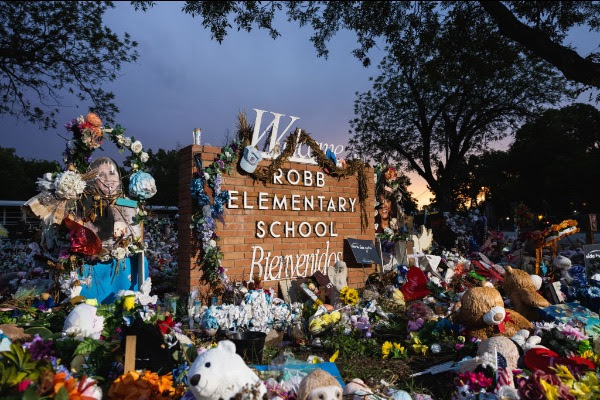
‘These are innocent children, sir’: New video of the delayed police response to the 2022 mass school shooting in Uvalde, Texas, shows the campus police chief attempting to negotiate with the gunman for more than 30 minutes. | The New York Times
Kansas schools have become the latest target in the Trump administration’s campaign against districts that permit transgender students to participate in school athletics. | KCTV
The Loudoun County, Virginia, school board has refused to comply with an Education Department order to end a policy allowing transgender students to use restroom facilities that match their gender identity. | LoudounNow
The Education Department’s Office for Civil Rights has opened an investigation into allegations the Baltimore school district ignored antisemetic harassment by students and educators. | The Baltimore Banner
Lots of drills — little evidence: A congressionally mandated report finds that active shooter drills vary widely across the country — making it difficult to understand their effect on mental and emotional health. | National Academies of Sciences, Engineering, and Medicine
A federal judge has blocked a new Arkansas law requiring that public schools display the Ten Commandments in all classrooms. It’s the second state Ten Commandments law to be halted this year. | Axios
ICYMI: I did a deep-dive into the far-right Christian nationalists behind more than two dozen state Ten Commandments-in-schools bills nationally — each of which are inherently identical. | The 74
Is Texas up next? Civil rights groups will ask a judge on Friday to prevent a similar law from going into effect. | Houston Chronicle