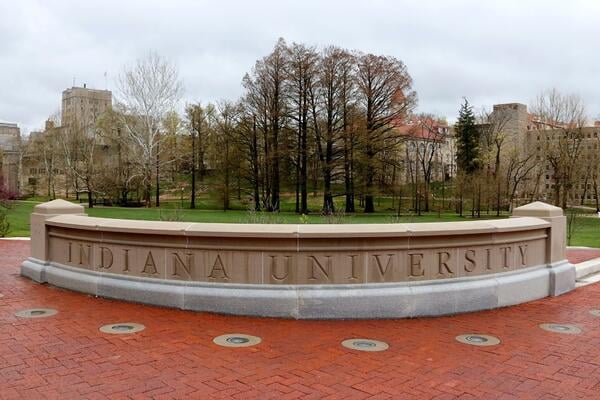
Indiana University’s decision to suspend the print publication of its student newspaper is costing the institution: Alumni are pulling donations in protest. The university ended the Indiana Daily Student’s print edition after firing the paper’s adviser, who refused to comply with administrators’ request to remove news coverage from a homecoming edition of the paper.
University leaders insist they’re not censoring the student paper but moving it to a digital platform in line with a business plan adopted last year to address the paper’s deficits. But alumni aren’t buying it, IndyStarreported. Some are asking what came of donations they made to a fund dedicated to the student publication after the newspaper reported students faced hurdles to spending the money. Other alumni are pulling their donations altogether.
Former journalism student Patricia Esgate canceled $1.5 million in bequests she planned to leave to the university. Alum Ryan Gunterman, executive director of the Indiana High School Press Association and the faculty adviser of Franklin College’s student newspaper, posted on Facebook that he and his wife were ceasing all future donations after giving money to the university and newsroom for over two decades. Toby Cole, a fourth-generation alum of the institution, told IndyStar in an email that his family was ending its monthly contributions and a $300,000 planned gift for scholarships.
“If IU can pay our [football] coach almost $100mm we can fund our IDS,” Cole said in the email. “Problem is ‘they’ don’t want an independent free speaking print newspaper because students actually wield power with it.”
First Amendment advocates are condemning Indiana University’s decision this week to suspend print publication of the Indiana Daily Student, a move that comes after administrators fired its adviser for allegedly rejecting demands to censor the student newspaper.
The Foundation for Individual Rights and Expression called the decision “outrageous,” while officials at the Student Press Law Center cast the move as a classic case of censorship. Editors at the newspaper say they want to work with the university to address the issue but pledged “to resist as long as the university disregards the law.”
“Any other means than court would be preferred,” wrote IDS editors Mia Hilowitz and Andrew Miller in an op-ed Wednesday.
The decision is the latest flare-up between student journalists and institutions. Earlier this year, Purdue University ended its partnership with the student paper, citing “institutional neutrality.” The move also echoes Texas A&M University’s unilateral decision in 2022 to end its student newspaper’s print edition.
The IDS editors first brought attention to the firing of Director of Student Media Jim Rodenbush in a Tuesday op-ed. They accused IU of ousting Rodenbush after he refused to follow directions from administrators to censor a homecoming edition of the newspaper. Administrators reportedly told Rodenbush the newspaper was only to contain information about homecoming and “no traditional front page news coverage.” But when he resisted, and editors at the Indiana Daily Student pressed Media School administrators for clarity, Rodenbush was fired.
A termination letter shared with Inside Higher Ed and signed by Media School dean David Tolchinsky accused Rodenbush of a “lack of leadership” and inability “to work in alignment with the University’s direction for the Student Media Plan,” which he called “unacceptable.” Tolchinsky added that Rodenbush “will not be eligible for rehire at Indiana University.”
The termination letter sent to Jim Rodenbush.
After Rodenbush was ousted, administrators canceled publication of the newspaper, citing a plan adopted last year that outlined a shift for the student newspaper from print to digital platforms.
“In support of the Action Plan, the campus has decided to make this shift effective this week, aligning IU with industry trends and offering experiential opportunities more consistent with digital-first media careers of the future,” Tolchinsky wrote in an email to student editors obtained by Inside Higher Ed.
Indiana administrators deny that the university censored the paper, despite telling the student publication not to publish news. IU officials say that the newspaper retains full editorial control.
Accelerating a Shift
In a statement shared with Inside Higher Ed and attributed only to an IU spokesperson, officials wrote, “Indiana University Bloomington is committed to a vibrant and independent student media ecosystem.” The statement added that the shift from print to digital is geared toward “prioritizing student experiences that are more consistent with today’s digital-first media environment while also addressing a longstanding structural deficit at the Indiana Daily Student.”
Chancellor David Reingold also pointed to the action plan in his statement, noting that “the campus is completing the shift from print to digital effective this week.” He added that the decision “concerns the medium of distribution, not editorial content,” and IU upholds “the right of student journalists to pursue stories freely and without interference.”
Tolchinsky, President Pamela Whitten and members of the Board of Trustees did not respond to requests for comment from Inside Higher Ed. IU did not answer specific questions sent by email.
Although Indiana officials have denied censoring the student newspaper, some officials were concerned about the optics of shutting down coverage, according to the Indiana Daily Student.
When Rodenbush pushed back on the directive to censor the newspaper in a Sept. 25 meeting, Ron McFall, assistant dean of strategy and administration at the Media School, reportedly asked, “How do we frame that, you know, in a way that’s not seen as censorship?”
McFall did not respond to a request for comment from Inside Higher Ed.
‘Textbook Case of Censorship’
Rodenbush told Inside Higher Ed in a phone interview that he was surprised by his firing and open to exploring all legal options. He also cast the happenings at IU not as a business decision but pure censorship.
“This is a textbook case of censorship,” Rodenbush said.
He also disputed the notion that what happened was part of a shift to a digital product. In fact, Rodenbush argued, that shift largely already happened when university administrators decided last year to scale back the publication of the print edition from weekly to seven editions across the spring semester. Those seven printings were special editions, Rodenbush said, given that those “are generally our biggest revenue generators.” Special editions this year have been printed as supplemental sections, or essentially inserts into the regular editions of the paper.
Prior to the fall semester, Rodenbush said, he never heard concerns from administrators about that practice until they objected to publishing the homecoming edition as an insert in the regular newspaper in September. When asked to ban news coverage from the homecoming edition, Rodenbush told Media School administrators, including Tolchinsky, he “wasn’t going to participate in censoring the paper,” which he said led to his firing.
Hilowitz and Miller, the IDS editors, also disputed the notion that the cancellation of the print publication, which was communicated to them by Tolchinsky, was anything but censorship.
“IU decided to fire Jim Rodenbush after he did the right thing by refusing to censor our print edition. That was a deliberate scare tactic toward student journalists and faculty. The same day, the Media School decided to fully cut our physical paper, fully ensuring we couldn’t print news. We’re losing revenue because of that decision,” they wrote in a joint emailed statement.
The duo accused IU of trying to “irrationally justify” censorship as a “business decision.”
Mike Hiestrand, senior legal counsel at the Student Press Law Center, told Inside Higher Ed that IU’s actions amount to content-based censorship and are “a clear violation of the First Amendment.”
Asked to weigh in on IU’s response, Hiestrand commented, “No censor wants to be called a censor,” but “that’s clearly the case.” He added that being told not to publish certain information is “as content-based an action of censorship as you can get.” In an interview at a media conference in Washington, D.C., with hundreds of student journalists and advisers in attendance, Hiestrand said that there has been a sense of shock and outrage from attendees over the situation.
“I think there’s shock that this happened here. We have strong laws that protect against this,” Hiestrand said.
Free Speech Under Fire
The censorship flap comes amid broad criticism of the state of free expression at IU, which FIRE ranked as one of the nation’s worst institutions on campus speech. Of 257 universities, FIRE ranked IU at 255 in its free speech rankings.
IU has seen a flurry of campus speech controversies since Whitten became president in 2021.
“Censoring a student publication after it reported on a university’s dismal record on free speech isn’t just a stunning display of lack of self-awareness, it’s a violation of the First Amendment,” FIRE student press program officer Dominic Coletti said in a statement. “If Indiana University is embarrassed about its terrible showing in the College Free Speech Rankings, it should put down the shovel and start caring more about its students’ constitutional rights than its own image.”
The university’s chapter of the American Association of University Professors urged administrators to reconsider their decisions to fire the adviser and cut the print edition, saying the situation further deteriorates IU’s commitment to free speech.
“In refusing to be cowed by demands to voluntarily abrogate constitutionally protected rights, Director Rodenbush and the Indiana Daily Student have indeed shown themselves out of alignment with a University Administration that has consistently silenced dissenting voices with a seeming disregard for First Amendment protections,” the chapter said in a statement.
This latest controversy is also gaining national attention from big-name donors such as Mark Cuban, the billionaire entrepreneur and IU alum. Cuban, who previously donated money to support the Indiana Daily Student, called out administrators in a post on X.
“Not happy. Censorship isn’t the way,” Cuban wrote Wednesday. “I gave money to [the] IU general fund for the IDS last year, so they could pay everyone and not run a deficit. I gave more than they asked for. I told them I’m happy to help because the IDS is important to kids at IU.”
On August 26, 2025, UT Dallas got the full “Newsies” treatment after administrators banned newspaper racks from campus — the latest escalation in the university’s campaign against an independent student press. The Retrograde, UT Dallas’s independent student newspaper, was born after the school dismantled the official student news outlet, The Mercury, following its coverage of pro-Palestinian protests last year. On Tuesday, Retrograde staffers and a campus theater troupe donned newsboy caps and handed out papers across campus, kicking things off with a town crier (and UT Dallas alumnus) delivering the day’s headlines outside the administration building at 7:30 in the morning.
The following statement can be attributed to FIRE Strategic Campaigns Counsel Amanda Nordstrom.
Student journalists at UT Dallas are taking a stand after the university tried to silence them yet again. Banning newspaper racks is just the latest tactic in a disturbing pattern: censor the coverage, kill the paper, and now, block its distribution. But these students fought back with creativity, resilience, and the truth. FIRE stands with them.
Public universities are bound by the First Amendment. Freedom of the press isn’t a courtesy — it’s a constitutional right. UT Dallas can try to shut down a newspaper, but they can’t stop the news.
Now, after public pressure, UT Dallas claims it has reversed course on its full-fledged ban on campus newsstands. But don’t be fooled. Allowing access to just four distribution points after banning all 43 that existed prior is not a real reversal. It’s viewpoint discrimination wrapped in red tape. That’s not just wrong, it’s unconstitutional. And FIRE isn’t backing down. FIRE will stand with The Retrograde every step of the way, until their right to a free and independent press is no longer up for debate.
Stand with us and tell UT Dallas Vice President for Student Affairs Gene Fitch to end the school’s censorship crusade and fully restore student press freedom on campus.
The Stanford Daily has filed a federal lawsuit against former President Donald Trump, marking a bold legal move from one of the country’s most prominent student newspapers. Editors at the Daily argue that Trump-era immigration policies targeting international students for political speech violated constitutional protections and created a climate of fear on campus.
Student journalists now find themselves confronting the same administration that reshaped higher education financing, gutted transparency, and targeted dissent. Their lawsuit challenges the chilling effect of visa threats against noncitizen students, particularly those who criticize U.S. or Israeli policy. Two international students joined the case anonymously, citing fear of deportation for expressing political views.
Stanford holds one of the largest university endowments in the world, valued between $37 and $40 billion. Despite this immense wealth, hundreds of staff—including research support, technical workers, and student service roles—face termination. The disconnect between administrative austerity and executive influence speaks to a larger crisis in higher education governance.
The Daily’s lawsuit cuts to the core of that crisis. Student reporters are asking not only for legal accountability, but also for transparency around how universities respond to political pressure—and who gets silenced in the process.
HEI’s Commitment to Student-Led Accountability
The Higher Education Inquirer is elevating this story as part of an ongoing effort to highlight courageous journalism from student-run newsrooms. Editorial boards like The Stanford Daily’s are producing investigative work that professional media often overlook. These journalists aren’t waiting for permission. They’re filing FOIA requests, confronting billion-dollar institutions, and—when necessary—taking their cases to court.
HEI will continue amplifying these efforts. Student reporters are already reshaping the media conversation around academic freedom, labor justice, and the political economy of higher education. Their work deserves broader attention and support.
This audio is auto-generated. Please let us know if you have feedback.
Dive Brief:
The Foundation for Individual Rights and Expression on Wednesday sued top Trump administration officials,alleging their attempts to deport student visa holders over speech have violated the constitutional right to free expression and due process.
The free speech advocacy organization filed the lawsuit on behalf of Stanford University’s independent student newspaper and two unnamed plaintiffs who entered the U.S. on student visas. It accuses the Trump administration of illegally deporting those it deems to have “anti-American or anti-Israel” views,creating a “pall of fear” that is “incompatible with American liberty.”
The lawsuit is asking a federal judge to bar U.S. Secretary of State Marco Rubio from making the plaintiffs eligible for deportation and U.S. Homeland Security Secretary Kristi Noem from initiating deportation proceedings based on their speech.
Dive Insight:
Beginning in March, the Trump administration began targeting international students studying at U.S. colleges, including but not limited those who had participated in pro-Palestinian campus protests or published commentary criticizing Israel. The wide-ranging campaign resulted in the federal government revoking at least 800 student visas by April 11.
Later that month, the Trump administration walked back hundreds of the visa revocations amid intense legal scrutiny. But it then published a policy expanding the authority of U.S. Immigration and Customs Enforcement to terminate educational visas.
Evidence of an international student’s failure to comply with the terms of their legal status — not proof or “clear and convincing evidence” — would be enough for ICE to revoke it, according to guidance from law firm Hunton. The new policy did not address the federal government’s practice of terminating students’ visas without notifying them — meaning they may still have their legal status pulled without them or their colleges being informed, the firm added.
Under the administration’s current policies, the plaintiffs face “an ongoing and credible threat” of student visa terminations and deportation proceedings, the lawsuit said.
The Trump administration has cited two provisions of the Immigration and Nationality Act to justify these moves — one that allows Rubio to revoke student visas and another that allows him to determine a noncitizen is eligible for deportation if their statements or associations “compromise a compelling United States foreign policy interest.”
FIRE’s lawsuit alleges these provisions are unconstitutional when used to target free speech rights — which apply to all in the U.S., not just American citizens.
“Secretary Rubio and the Trump administration’s war against noncitizens’ freedom of speech is intended to send an unmistakable message: Watch what you say, or you could be next,” the lawsuit said.
The plaintiffs intend to seek permanent injunctive relief from the U.S. Supreme Court, the only court with the authority to “enjoin or restrain” aspects of the Immigration and Nationality Act.
At The Stanford Daily, student writers who are attending the university on a visa are turning down assignments related to the conflict in the Middle East over concerns their reporting would endanger their immigration status, the lawsuit alleges.
Other such reporters are requesting to have their published articles taken down or are quitting the newspaper altogetherout of fear of deportation.
Beyond the newsroom, international students have also largely stopped talking to the Daily’s staff since March, the lawsuit said. When they do, they often refuse to speak on the record, “particularly when it comes to discussing topics like Israel and Palestine,” it said.
“There’s real fear on campus and it reaches into the newsroom,” Greta Reich, editor-in-chief of the student newspaper, said in a statement. “The Daily is losing the voices of a significant portion of our student population.”
Both of the unnamed plaintiffs entered the U.S. on F-1 student visas, hold no criminal record, and have publicly voiced pro-Palestinian views. But both began self-censoring over “their rational concern about the ongoing danger of deportation for expression Secretary Rubio deems anti-American or anti-Israel,” the lawsuit alleges
One of the plaintiffs had been a member of her university’s chapter of Students for Justice in Palestine and criticized America’s relationship with Israel online. Her work led to her inclusion on Canary Mission, an anonymous website that “publishes the personal information of students, professors and organizations it deems ‘anti-Israel,’” according to the lawsuit.
The lawsuit cited testimony from Peter Hatch, assistant director of ICE’s Homeland Security Investigations department,in which he told lawmakers that “most” of the student protesters DHS asked ICE to investigate came from Canary Mission’s website.
Among its posts, the website had published information on Mahmoud Khalil, Rümeysa Öztürk,and Mohsen Mahdawiprior to the Trump administration detaining and attempting to deport them. All three current and former students have since been released on the orders of federal judges.
Aware of this environment, the plaintiff has “refrained from publishing and voicing her true opinions regarding Palestine and Israel” since March and deleted a social media account “to guard against retaliation for past expression.”
Likewise, the other unnamed plaintiff previously attended pro-Palestinian protests and published both pro-Palestinian and anti-Israel commentary. But he began self-censoring his work over fears of deportation, according to the lawsuit.
He also served as a teaching assistant at his college, and the course’s professor advised him to reconsider his advocacy related to Israel and Palestinians, as it might endanger his immigration status, the complaint said.
“No one should fear a midnight knock on the door for voicing the wrong opinion,” the lawsuit said. But the Trump administration, and Rubio in particular, are working to make free speech “a privilege contingent upon the whims of a federal bureaucrat,” it said.
CLARKSDALE, Miss., Feb. 25, 2025 — After receiving widespread condemnation for obtaining a temporary restraining order that forced Mississippi’s Clarksdale Press Register to take down an editorial critical of the city, Clarksdale’s Board of Mayor and Commissioners voted Monday to drop the lawsuit.
Last week, the Foundation for Individual Rights and Expression first called national attention to the plight of the Press Register after the city sued the small-town Coahoma County newspaper to force it to take down an editorial criticizing local officials. On Friday, FIRE agreed to defend the Press Register, its editor, and parent company in court to have the unconstitutional restraining order lifted.
“The implications of this case go beyond one Mississippi town censoring its paper of record,” said FIRE attorney David Rubin. “If the government can get a court order silencing mere questions about its decisions, the First Amendment rights of all Americans are in jeopardy.”
By Monday, Clarksdale’s Board had convened, voted not to continue with the lawsuit, and filed a notice of voluntary dismissal with the court. That means the city’s suit is over and with it the restraining order preventing the Press Register from publishing its editorial.
“While we are relieved the city has voted to drop its vindictive lawsuit, it doesn’t unring this bell,” Rubin said. “The Press Register is exploring its options to ensure that the city refrains from blatantly unconstitutional censorship in the future.”
The controversy began when the city of Clarksdale held an impromptu meeting on Feb. 4 to discuss sending a resolution asking the state legislature to let it levy a 2% tax on products like tobacco, alcohol, and marijuana. By state law, cities must notify the media when they hold such irregular “special-called meetings,” but the Press Register did not receive any notice.
In response, the Press Register blasted the city in an editorial titled “Secrecy, Deception Erode Public Trust,” and questioned their motive for freezing out the press. “Have commissioners or the mayor gotten kick-back from the community?” the editorial asked. “Until Tuesday we had not heard of any. Maybe they just want a few nights in Jackson to lobby for this idea – at public expense.”
“For over a hundred years, the Press Register has served the people of Clarksdale by speaking the truth and printing the facts,” said Wyatt Emmerich, president of Emmerich Newspapers. “We didn’t earn the community’s trust by backing down to politicians, and we didn’t plan on starting now.”
Rather than taking their licks, the Clarksdale Board of Commissioners made a shocking move by voting to sue the Press Register, its editor and publisher Floyd Ingram, and its parent company Emmerich Newspapers for “libel.” Last Tuesday, Judge Martin granted ex parte – that is, without hearing from the PressRegister – the city’s motion for a temporary restraining order to force it to take down the editorial.
By silencing the Press Register before they could even challenge Clarksdale’s claims, Judge Martin’s ruling represented a clear example of a “prior restraint,” a serious First Amendment violation. Before the government can force the removal of any speech, the First Amendment rightly demands a determination whether it fits into one of the limited categories of unprotected speech or otherwise withstands judicial scrutiny. Otherwise, the government has carte blanche to silence speech in the days, months, or even years it takes to get a final ruling that the speech was actually protected.
Judge Martin’s decision was even more surprising given that Clarksdale’s lawsuit had several obvious and fatal flaws. Most glaringly, the government itself cannot sue citizens for libel. As the Supreme Court reaffirmed in the landmark 1964 case New York Times v. Sullivan, “no court of last resort in this country has ever held, or even suggested, that prosecutions for libel on government have any place in the American system of jurisprudence.”
But even if the Clarksdale commissioners had sued in their personal capacities, Sullivan also established that public officials have to prove not just that a newspaper made an error, but that it did so with “actual malice,” defined as “knowledge that it was false or with reckless disregard of whether it was false.” Clarksdale’s lawsuit didn’t even attempt to prove the Press Register editorial met that standard.
Finally, libel requires a false statement of fact. But the Press Register’s broadside against city officials was an opinion piece that expressed the opinion that there could be unsavory reasons for the city’s lack of candor. The only unique statement of fact expressed in the editorial — that Clarksdale failed to meet the legal obligation to inform the media of its meeting — was confirmed by the city itself in its legal filings.
“If asking whether a politician might be corrupt was libel, virtually every American would be bankrupt,” said FIRE attorney Josh Bleisch. “For good reason, courts have long held that political speech about government officials deserves the widest latitude and the strongest protection under the First Amendment. That’s true from the White House all the way down to your local councilman.”
“If the board had grumbled and gone about their day, this whole brouhaha wouldn’t have traveled far outside our town,” said Emmerich. “But when they tried to censor us, the eyes of the nation were on Clarksdale and millions heard about our editorial. Let this be a lesson: if you try to silence one voice in America, a hundred more will take up the call.”
The Foundation for Individual Rights and Expression (FIRE) is a nonpartisan, nonprofit organization dedicated to defending and sustaining the individual rights of all Americans to free speech and free thought — the most essential qualities of liberty. FIRE educates Americans about the importance of these inalienable rights, promotes a culture of respect for these rights, and provides the means to preserve them.
CONTACT:
Alex Griswold, Communications Campaign Manager, FIRE: 215-717-3473; [email protected]