Tag: nightmare

  • A Christmas present or a nightmare before Christmas? Assessing the Curriculum and Assessment Review

    A Christmas present or a nightmare before Christmas? Assessing the Curriculum and Assessment Review

    • HEPI Director, Nick Hillman, takes a first look at today’s Final Report from the Curriculum and Assessment Review.

    It feels like Christmas has come early for policy nerds. At 6.01am this morning, we finally got sight of Building a world-class curriculum for all, the long-awaited report from the Government’s independent Curriculum and Assessment Review (CAR).

    Overseen by Professor Becky Francis, who is an experienced educational leader and researcher and someone who also has a background in policy, it was commissioned when the Labour Government was facing brighter days back in their first flush.

    The first thing to note about the report is that, in truth, independent reports commissioned by governments are only half independent. For example, the lead reviewer is usually keen to ensure their report lands on fertile soil (and, indeed, is usually chosen because they have some affinity to the people in charge). In addition, independent reviews are supported by established civil servants inside the machine and there is usually a conversation behind the scenes between the independent review team and those closest to ministers as the work progresses. (In higher education, for example, both the Browne and Augar reviews fit this model.) So it is no great surprise that the Government has accepted most of what Becky’s largely evidence-led team has said.

    Yet anyone reading the press coverage of the CAR while it has been underway, or anyone who has seen the front page of today’s Daily Mail, which screams ‘LABOUR DUMBS DOWN SCHOOLS’, may wonder if the report that has landed today is the nightmare before Christmas rather than a welcome festive present. There is lots to like but the document also feels incomplete, especially – for example – for people with an interest in higher education. So it is perhaps best thought of as a present for which the batteries have yet to arrive.

    Nonetheless, this morning I spoke at the always excellent University Admissions Conference hosted annually by the Headmasters’ and Headmistresses’ Conference (HMC) and the Girls’ School Association (GSA) and I could not help wondering aloud whether any new restraints on state-maintained schools might give our leading independent schools, who are much freer to teach what they like, an additional edge – especially as academy schools are already, even before today, having freedoms ripped from them.

    What does the CAR say (and what does it not say)

    But what does the review, which had a team of 11 beneath Becky (including one Vice-Chancellor in Professor Nic Beech and also Jo-Anne Baird from the Oxford University Centre for Educational Assessment) actually say?

    The first thing to note is that it is much better than the Interim Report, which said little, sought to be all things to all people and read like it had been written by one of the better generative AI tools.

    In terms of hard proposals, the Final Report starts and ends with older pupils, those aged 16 to 19, for whom we are told there should be ’a new third pathway at level 3 to sit alongside A-Levels and T Levels.’ If this feels familiar, it is because the Curriculum and Assessment Review’s emerging findings helped shape the recent Post-16 Education and Skills white paper and, more importantly, because there is already such a pathway populated by qualifications like BTECs.

    So there is a sense of reinventing the wheel here, with (to mix my metaphors) politicians putting a new coat of paint on the current system. In many respects, the material on 16-to-19 pupils is the least interesting part of the report – especially as there is next to nothing at all on A-Levels. The review team starkly states, ‘we heard very little concern regarding A Levels in our Call for Evidence and our sector engagement’, so they basically ignore them – in a world of change, A Levels continue to sail steadfastly on.

    As trailed in the newspapers, there is a recommendation for new ‘diagnostic Maths and English tests to be taken in Year 8.’ This would obviously help track progress between the tests taken at the end of primary school (in Year 6) and the public exams taken at age 16. But the idea has already prompted anger from trade unionists, almost guaranteeing that the benefits and downsides will be overegged in the inevitable political rows to come.

    There are also numerous scattergun subject-by-subject recommendations. These are largely sensible (see, for example, the iideas on improving English GCSEs or the section on Science) but also a little unsatisfying. Some of the subject-specific changes are a little trite or inconsequential (like tweaks to the name of individual GCSEs) while others need much more detail than a general review of everything that happens between the ages of 11 and 19 is able to offer. Any material changes will need to be at a wholly different level of detail to what we have got today, and they will be some years away, so may make no difference to anyone already at secondary school.

    Other points to note include that the Review is Gove-ian in its love of exams, which it stresses are a protection against the negatives of AI, over coursework. (I suspect Dennis Sherwood, the campaigner against grading inaccuracy will be incandescent about how the report appears to skate over some of the imperfections of how exams currently operate.) However, despite the support for exams, one of the crunchiest recommendations in the review is the proposal of a 10% reduction in ‘overall GCSE exam volume’, which we are told can happen without any significant downsides, though the tricky details are palmed off to Ofqual and others. 

    The English Baccalaureate and Progress 8

    The one really clear place where Professor Francis’s review team and the Government, who have generally accepted the recommendations, are out of kilter with one another is on Progress 8.

    Progress 8 is a school accountability measure that assesses how much ‘value-added’ progress occurs between primary school (SATs) and GCSEs. It is such a favoured measure that the Government has recently proposed a new Progress 8 measure for universities (which is a mad idea that wrongly assumes universities are just big schools – in reality, it is a defining feature of universities that they set their own curricula and are their own awarding body).

    Becky Francis opposes the EBacc, which is a metric related to, but separate, from Progress 8, yet she wishes to maintain some vestiges of the EBacc within Progress 8. While the EBacc focuses specifically on how many students achieve qualifications in a list of specially favoured subject areas (English Lang and Lit, Maths, Sciences, Geography or History plus a language), the CAR recommends ‘the removal of the EBacc measures but the retention of the EBacc “bucket” in Progress 8 under the new title of “Academic Breadth”.’

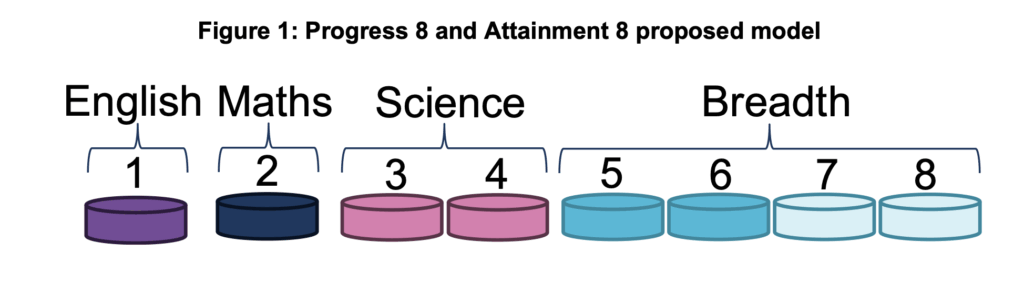
    This is something the Government is not running with, favouring less restrictions on Progress 8 instead, which may or may not reinvigorate some creative subjects. Yes, it is all exceptionally complicated but Schools Week have an excellent guide and the two pictures below (from Government sources) might help: the first shows the status quo on Progress 8 and is what Becky Francis wishes to maintain (though pillars 3, 4 and 5 would be renamed if she got her way); the second shows the Government’s proposal.

    How does it fare?

    Call me simple, but I was always going to judge the Curriculum and Assessment Review partly on the extent to which it tackled specific challenges that we have looked at closely at HEPI In recent years. Here the CAR is a mixed bag. On the positive side of the ledger, the review recommends more financial education, reflecting the polling we conducted to help inform the CAR’s work: when we asked undergraduates how well prepared they felt for higher education, 59% said they felt they should have had more education on finances and budgeting.

    The most obvious problem that the CAR insufficiently addresses is the huge underperformance of boys. This issue usually gets a namecheck in Bridget Phillipson’s interviews but it was entirely ignored in the recent Post-16 white paper; in the CAR, it does at least receive a quick nod and just maybe some of the proposed curriculum changes will benefit boys more than girls. But there is more focus on class and other personal characteristics than sex and in the end the brief acknowledgement of boys’ underperformance does not lead to anything properly focused on the problem.

    This is very strange for we simply cannot fix the inequalities in outcomes until we give the gaps in the attainment of boys and girls the attention they deserve. I am beginning to think I was wrong to be so hopeful that a female Secretary of State was more likely to focus on this issue than a male one (on the grounds that it would be less sensitive politically).

    Another area where we at HEPI have been mildly obsessed is the catastrophic decline in language learning, as tracked for us by the Oxonian Megan Bowler. Here, as with boys, the new review is disappointing. In the section looking at welcome subject-by-subject changes, the recommendations on languages are both relatively tentative and relatively weak. As one linguist emailed me first thing this morning, ‘It is pretty remarkable that the CAR’s decision on languages runs exactly contrary to the best and consistent advice of the key language advisers on the issue’. However, the Government’s response goes a little further and Ministers promise to ‘explore the feasibility of developing a new qualification for languages that enables all pupils to have their achievements acknowledged when they are ready rather than at fixed points.’ We might not want languages always to be treated so differently from other subjects but I am still chalking that up as a win.

    The CAR also ignores entirely one issue that is currently filling some MPs’ postbags – the defunding of the International Baccalaureate (IB). The IB delivers a broad curriculum for sixth-formers, is liked by highly selective universities and tackles the early specialisation which marks out our education system from those in many competitor nations. Back in the heady Blair years, Labour politicians loved the qualification and promised to bring it within touching distance of most young people.

    As HEPI is a higher education body, it also feels incumbent upon me to point out that higher education is largely notable by its absence in the CAR, with universities being mentioned just nine times across the (almost) 200 pages and despite schools and colleges obviously being the main pipeline for new students. It is rather different from the days when universities were regarded as having a key direct role to play in designing what goes on in schools. Indeed, our exam boards tended to originate within universities.

    The odd references to universities that do make it in to the CAR report are not especially illuminating. For example, more selective universities appear as part of the rationale for killing the EBacc ‘the evidence does not suggest that taking the EBacc combination of subjects increases the likelihood that students attend Russell Group universities.’ Universities also appear in the section on bolstering T Levels, with the review proposing ‘The Government should continue to promote awareness and understanding of T Levels to the HE sector.’ But that is about it.

    Incidentally, there is also less in the report on extracurricular activities than the pre-publication press coverage might have led you to believe, even if the Government’s response to the review does focus on improving the offer here.

    Trade-offs

    Becky Francis used to head up the UCL Institute of Education (IoE), which is an institution that has always wrestled with excellence versus opportunity. Years ago, I sat in a learnèd IoE seminar on why university league tables are supposedly pernicious – but I had to walk past multiple banners boasting that the IoE was ‘Number 1’ in the world for studying education to get to the seminar and, while I was in the room, news came through that the IoE was going to cement its reputation and position by merging with UCL.

    Such tension is a reminder that educational changes generally have trade-offs and the Executive Summary of the main CAR document admits: ‘All potential reforms to curriculum and assessment come with trade-offs’. Abolishing the EBacc as the CAR team want and watering down Progress 8 as the Department for Education want, might help some pupils and some disciplines while making the numbers we produce about ourselves look better – though the numbers produced by others about us (at places like the OECD) could come to tell a different story in time.

    In the end, we have to recognise that there are only so many hours in the school day, only so many (ie not enough) teachers and only so much room in pupils’ lives, not to mention huge diversity among pupils, schools and staff, which together ensure there can be no perfect curriculum. More of one subject or more extracurricular activities are likely to mean less of other things because the school day is not infinitely expandable (and there is nothing here to free up teachers’ time or fill in all those teacher vacancies). Yet the school curriculum does need to be revised over time to ensure it remains fit for purpose.

    The question now is whether the CAR report matters. Will we still be talking about it in 20 years time? Can a Government buffeted by all sides, facing a huge fiscal crisis and with a Secretary of State for Education who sometimes seems more focused on political battles (like the recent Deputy Leadership election of the Labour Party) than on engaging with the latest educational evidence really deliver Becky Francis’s vision? Or will the CAR’s proposals wilt as quickly as the last really big proposal for curriculum reform: Rishi Sunak’s British Baccalaureate? In all honesty, I am not certain but there are, in theory at least, four years of this Parliament left whereas Rishi Sunak spent more like four months pushing his idea.

    My parting thought, however, is different. It is that, while the trade-offs in the CAR report partly just represent the facts of life in education, they do not entirely do so. Trade-offs are much trickier to deal with when you are also seeking to root out diversity of provision. And in the end, if there is one thing that marks this Government’s mixed approach to schooling out above all, it is the desire to make all schools more alike, whether that is reducing academy freedoms, micromanaging the rules on school uniforms, defunding the IB, forcing state schools to stop offering classical languages or pushing independent schools to the wall. Would it be better, and also make politicians’ lives easier, if we stopped pretending that the 700,000 kids in each school year group are more like one another than they really are?

    Postscript: While the CAR paper is infinitely more digestible than the interim document, there is still some wonderful eduspeak, my favourite of which is:

    A vocational qualification is aligned to a sector and is usually taught and assessed in an applied way.  A technical qualification meanwhile has a direct alignment with an occupational standard. Despite the name ‘Technical Awards’, these qualifications are therefore vocational rather than technical.

    Source link

  • Navigating the Kafkaesque nightmare of Columbia’s Office of Institutional Equity

    Navigating the Kafkaesque nightmare of Columbia’s Office of Institutional Equity

    Franz Kafka’s masterpiece “The Trial” begins when Josef K discovers that “one morning, without having done anything wrong, he was arrested.”

    What follows is the story of his desperate attempt to navigate a nightmarishly opaque bureaucracy — and the bleak results. Like Josef K, Columbia students awoke one morning to find themselves at the mercy of the university’s new Office of Institutional Equity.

    In recent weeks, the OIE sent dozens of warnings to students telling them they were under investigation for alleged discriminatory harassment simply for engaging in pro-Palestinian advocacy on campus. Individual acts of protected political expression — social media posts, peaceful demonstrations, and op-eds in the student newspaper — were treated as creating a “hostile environment” for criticizing Israel, with accusations framed in expansive interpretations of Title VI of the Civil Rights Act.

    FIRE has since heard from a number of students lost in the maze of Columbia’s cryptic dispatches and confusing accusations, and one thing is clear: the OIE has cast a late-winter chill across campus. 

    These investigations can take months or even years, and leave students in fear of what they can and cannot do or say while they await the results. 

    Take the two Columbia seniors who were notified just months before graduation that they were under investigation and subject to expulsion for allegedly writing a student newspaper article signed by a consortium of pro-Palestinian student groups urging divestment from Israel. One student described the situation as “dystopian” and said she is now reluctant to speak out on the issue again. Even worse, the two students were targeted not because there was any evidence they’d actually authored the article, much less created a hostile environment by doing so, but merely because of their involvement with the pro-Palestinian student group consortium.

    Another student contacted FIRE to report that they were afraid to return to campus because they feared the administration would retaliate against them for their previous advocacy with Students for Justice in Palestine. 

    Moreover, Columbia made national headlines this week when Immigration and Customs Enforcement officers detained former student Mahmoud Khalil, who previously tried to fight the OIE. Though he had already successfully appealed the university’s disciplinary charges against him, federal agents showed up on his doorstep and hauled him off to an ICE detention center based on accusations that he led campus protest activities aligned with Hamas. 

    Trump administration’s reasons for detaining Mahmoud Khalil threaten free speech

    News

    The government arrested and detained Mahmoud Khalil for deportation, and its explanation for doing so threatens the free speech of millions of people.


    Read More

    Khalil reported that just before he was due to graduate this past December, the OIE buried him in allegations relating to social media posts with which he was uninvolved. Furthermore, when he stood up for himself and refused to sign a nondisclosure agreement, the university put a hold on his transcript and threatened to block his graduation — until he hired counsel, and the OIE seemed to temporarily back off. The timing of the ICE raid and the OIE’s investigation into Khalil leaves students and faculty with more questions than answers, especially as he has still not yet been criminally charged for anything and is facing deportation.

    While Columbia’s OIE is charged with addressing claims of unlawful discrimination and harassment, it cannot do so by employing an overly broad definition of harassment that stretches the meaning beyond recognition. Yet the OIE has done exactly that in interpreting Title VI harassment to include protected criticism of Israel, suppressing political activism under the guise of maintaining a “safe” environment by defining speech against another country as possible discriminatory harassment if “directed at or infused with discriminatory comments about persons from, or associated with, that country.” 

    Is it possible for such speech to be part of a pattern of discriminatory harassment? Yes. It’s also possible for it not to be harassment. The way Columbia is treating such speech, though, makes that impossible to discern. 

    The OIE’s needlessly murky investigatory process is also deeply troubling. Students report being left in the dark about the specifics of the charges against them, and being required to sign a nondisclosure agreement in order to see the evidence. In other words, they can’t talk to anyone about their case or get help until after it’s too late and the OIE has already decided their case and potentially sealed their fate. 

    These investigations can take months or even years, and leave students in fear of what they can and cannot do or say while they await the results. When students are forced to endure lengthy investigations that may result in serious sanctions such as suspension and expulsion, it’s obvious that the process, even if it results in a student’s favor, is the punishment. 

    The original title of “The Trial” was Der Prozess, or literally “The Process,” because the true horror Josef was forced to confront was that of a Byzantine and convoluted process custom-built to crush dissent. If nothing else, we can perhaps thank Columbia, like so many schools before it, for bringing classic literature to life.

    Source link

  • Snitch hotlines for ‘offensive’ speech were a nightmare on campus — and now they’re coming to a neighborhood near you

    Snitch hotlines for ‘offensive’ speech were a nightmare on campus — and now they’re coming to a neighborhood near you

    We know the term “Orwellian” gets thrown around a lot these days. But if a government entity dedicated to investigating and even reeducating Americans for protected speech doesn’t deserve the label, nothing does.

    This step towards the Stasi isn’t hypothetical, either. It’s real. The governing bodies in question are called bias reporting systems, and the odds are they’re already chilling free expression on a campus near you. What’s worse, they aren’t staying there — now municipalities and states are using them, too.

    In this explainer, we’ll break down what bias reporting systems are, how they’ve spread beyond campus, and why they’re a threat to free speech.

    What are bias reporting systems?

    If you’ve been on campus in the last decade, you’ve likely heard of bias reporting systems — or, as they’re sometimes called, bias response teams. Their structure and terminology vary, but FIRE defines a campus bias reporting system as any system that provides:

    1. a formal or explicit process for or solicitation of
    2. reports from students, faculty, staff, or the community
    3. concerning offensive conduct or speech that is protected by the First Amendment or principles of expressive or academic freedom.

    Bias reporting systems generally solicit reports of bias against identity characteristics widely found in anti-discrimination laws. Western Washington University, for example, defines a “bias incident” as “language or an action that demonstrates bias against an individual or group of people based on actual or perceived race, color, creed, religion, national origin, sex, gender identity or expression, disability, sexual orientation, age, or veteran status.” Some systems also invite reports of bias against traits like “intellectual perspective,” “political expression,” and “political belief,” or have a catch-all provision for any other allegedly biased speech.

    Many colleges have bias response teams that consist not only of administrators but law enforcement. They often investigate complaints and summon accused students and faculty to meetings.

    The ability to speak freely is core to our democracy. Any system or protocol that stifles or inhibits free expression is antithetical to the principles and ideals of our institutions of higher education and our republic. 

    You might be wondering, “Don’t civil rights laws already cover this sort of thing?” Well, not quite. Bias reporting systems cover way more expressive ground than civil rights laws do, which puts these systems at odds with First Amendment protections. They generally define “bias” in such broad or vague terms that it could be applied to basically anything the complainant doesn’t like, including protected speech. This is doubly so when a school includes that vague and subjective word “hate” as another form of language or behavior worth reporting.

    That’s a problem at public colleges, which are bound by the First Amendment, and also at private colleges that voluntarily adopt First Amendment-like standards. Bias reporting systems completely ignore the fact that “hate speech” has no legal definition, and that unless a given expression clearly falls into one of the clearly-defined categories of unprotected speech, like true threats or incitement to immediate violence, it is almost certainly protected by the First Amendment. This remains so regardless of how anyone might feel about the speech itself.

    Bias Response Team Report 2017

    Reports

    The posture taken by many Bias Response Teams is likely to create profound risks to freedom of expression and academic freedom on campus.


    Read More

    These initiatives incentivize and in many cases encourage people to report each other for disfavored expression. As you can imagine, these systems often lead to unconstitutional infringements on protected student and faculty speech and chill expression on campus.

    For example, after the University of California, San Diego received bias incident reports about a student humor publication that satirized “safe spaces,” administrators asked the university’s lawyer to “think creatively” about how to address the newspaper, which they felt “crosse[d] the ‘free speech’ line.” And at Connecticut College, pro-Palestinian students were reported for flyers mimicking Israeli eviction notices to Palestinians, prompting an investigation by a dean.

    These are just a couple of instances where bias reporting systems have crossed the line. Sadly, there are plenty more, spanning FIRE’s research and commentary going back as far as 2016 — and none of them are good news.

    Sound Orwellian enough for you yet? Wait until you hear how bias reporting systems work off campus.

    Bias reporting systems have graduated from campus into everyday life

    Exporting campus bias reporting systems to wider society is a disastrous idea. No state should be employing de facto speech police. But of course, that hasn’t stopped state and city governments from trying.

    Bias reporting systems have been popping up in one form or another across more than a dozen state and city municipalities in the last four years, usually consisting of an online portal or telephone number where citizens are encouraged to submit reports.

    If you’re thinking this is just like the hate crime hotlines that many states have had for years, there is one important difference: namely, the word “crime.” While the new bias reporting systems will similarly accept reports of criminal acts, they also actively solicit reports of speech and behavior that are not only not crimes, but also First Amendment-protected expression.

    They know this, too.

    Vermont state police protocol, for instance, describes the information it compiles as being on “biased but protected speech.” This raises the obvious question of why the police are concerning themselves with Americans lawfully exercising their fundamental rights, and opens the door to police responses that violate those rights.

    Wherever they’ve popped up, these bias reporting systems have been bad news. Washington Free Beacon journalist Aaron Sibarium’s research has turned up a number of alarming examples. In Oregon, citizens can report “offensive ‘jokes’” and “imitating someone’s cultural norm or practice.”

    Meanwhile, in Maryland, the attorney general’s office states on its website that “people who engage in bias incidents may eventually escalate into criminal behavior,” which is why “Maryland law enforcement agencies are required by law to record and report data on both hate crimes and bias incidents.” But these speculative concerns do not justify the chilling effect bias reporting systems create. Not only do these systems solicit complaints about protected speech, they also cast an alarmingly wide net. It’s hard to believe, for instance, that many “offensive jokes” are reliable signs of future criminal activity.

    At this point you’d be forgiven for thinking that “Orwellian” is an understatement.

    But that’s not the worst of it. In Philadelphia — home of FIRE, the Liberty Bell, and the Constitution — authorities fielding “hate incidents” can now ask for exact addresses and various identifying details about the alleged offending party, including their names. According to Sibarium, city officials will in some cases “contact those accused of bias and request that they attend sensitivity training.”

    You heard that right. If you’re reported for a “non-criminal bias incident” in the city of Philadelphia, the city may request that you take a course meant to teach you the error of your ways. “If it is not a crime, we sometimes contact the offending party and try to do training so that it doesn’t happen again,” Saterria Kersey, a spokeswoman for the Philadelphia Commission on Human Relations, told Sibarium.

    The training is voluntary, but it reflects an unsettling level of government interference in the thoughts and opinions of the public.

    At this point you’d be forgiven for thinking that “Orwellian” is an understatement.

    Bias reporting systems are a threat to free speech on and off campus

    Thankfully, there has been some considerable pushback on bias reporting systems — though not entirely successful. Washington, for example, introduced a bill to create a statewide bias reporting system, but it failed to advance out of the Senate Ways and Means committee. However, a new version of the bill passed in March of 2024, and Washington is now set to establish a bias reporting system this year.

    The threat remains real, and the consequences of these speech-chilling initiatives are further-reaching than it might seem at first glance.

    On campus, the mere existence of bias reporting systems threatens one of the purposes of higher education, if not the purpose: the free exchange of ideas. Some courts have recognized that bias reporting systems may chill protected speech to such a degree that they violate the First Amendment.

    Bias reporting systems fundamentally undermine the First Amendment rights of not just students and faculty, but also ordinary citizens.

    The state-level reporting systems raise similar First Amendment issues — especially when law enforcement is involved. Like their campus counterparts, the state systems use expansive definitions of “bias” and “hate” that could encompass a vast range of protected expression, including speech on social or political issues.

    However, unconstitutionality isn’t the only concern. Even a bias reporting system that stays within constitutional bounds can deter people from freely expressing their thoughts and opinions. If they are afraid that the state will investigate them or place them in a government database just for saying something that offended another person, people will understandably hold their tongues and suppress their own voices. Moreover, the lack of clarity around what some states actually do with the reports they collect is itself chilling.

    The ability to speak freely is core to our democracy. Any system or protocol that stifles or inhibits free expression is antithetical to the principles and ideals of our institutions of higher education and our republic. In both word and deed, bias reporting systems fundamentally undermine these principles — and now seriously threaten the First Amendment rights of not just students and faculty, but also ordinary citizens.

    Source link