The National Institutes of Health is accelerating a Biden-era plan to make its research findings freely and quickly available to the public, the agency announced Wednesday.
The 2024 Public Access Policy was set to take effect Dec. 31, 2025, but will now take effect July 1 of this year. It updates the 2008 Public Access Policy, which allowed for a 12-month delay before research articles were required to be made publicly available. The 2024 policy removed the embargo period so that researchers, students and members of the public have rapid access to these findings, according to the announcement.
NIH director Jay Bhattacharya, who took over last month, said the move is aimed at continuing “to promote maximum transparency” and rebuilding public confidence in scientists, which has waned in recent years.
“Earlier implementation of the Public Access Policy will help increase public confidence in the research we fund while also ensuring that the investments made by taxpayers produce replicable, reproducible, and generalizable results that benefit all Americans,” Bhattacharya said in the memo. “Providing speedy public access to NIH-funded results is just one of the ways we are working to earn back the trust of the American people.”
Although the scientific research community is supportive of the policy itself, some are calling on the NIH to reinstate the original implementation date to give researchers time to effectively comply with this and other new agency regulations.
“This new effective date will impose extra burdens on researchers and their institutions to meet the deadline,” Matt Owens, president of COGR, which represents research institutions, said in a statement Wednesday. “Ironically, at the same time NIH is accelerating implementation of this policy, the agency is adding new burdensome certification and financial reporting requirements for grant recipients. This runs counter to the administration’s efforts to reduce regulations.”
Both the National Science Foundation and the National Institutes of Health are slashing funding support for graduate students and early-career researchers as President Donald Trump continues dramatic federal budget cuts.
On Tuesday, Nature reported the NSF Graduate Research Fellowship Program awarded 1,000 fellowships—fewer than half of the record-setting 2,555 fellowship offers it made in 2023, and the second-smallest number of awards since 2008.
Prior to this year, the fellowship program’s stated goal was to “ensure the quality, vitality, and diversity of the scientific and engineering workforce,” though the Trump administration has since replaced the word “diversity” with “strength.”
Since 1952, the NSF’s fellowship program has funded more than 75,000 master’s and Ph.D. students pursuing science degrees. Fellows receive five years of funding, which includes a $37,000 annual stipend and the cost of tuition. The fellowships are highly competitive; of the more than 13,000 applicants who apply each year, only about 16 percent typically get an award. While the cuts made it even more competitive this year, a record 3,018 applicants also received “honorable mentions,” which don’t come with an award but can boost a CV nonetheless.
Over the past two weeks, the NIH has also canceled numerous institutional and individual training grants, including many that support scientists from underrepresented communities, according to The Transmitter.
The outlet reported that a chemistry professor at the University of Puerto Rico–Río Piedras Campus received a letter from the NIH terminating funding for the Undergraduate Research Training Initiative for Student Enhancement because the award “no longer effectuates agency priorities.”
That justification is now central to a federal lawsuit researchers and advocacy groups filed against the NIH last week, which among other points argues that the Department of Health and Human Services (the NIH’s parent agency) hasn’t yet adopted rules that would allow it to terminate an award for not effectuating agency priorities.
Other terminated NIH training programs, according to The Transmitter, include the Maximizing Access to Research Careers program, which funded undergraduate researchers; the Post-Baccalaureate Research Education Program; the Bridges to the Doctorate program, which trained master’s students; the Initiative for Maximizing Student Development, which supported graduate students; and the Institutional Research and Academic Career Development Award, which aided postdoctoral researchers.
Columbia University was dealt another blow to research funding this week.
DNY59/iStock/Getty Images
The Trump administration has frozen all U.S. National Institutes of Health funding for research grants at Columbia University, Science reported, cutting off the flow of $250 million to the private institution mere weeks after it yielded to sweeping demands related to pro-Palestinian campus protests.
The federal government had already clamped down on $400 million in research funding for Columbia last month. But after the university agreed to enact various reforms the Trump administration demanded to address alleged antisemitism on campus, it appeared a reprieve was in order. Education Secretary Linda McMahon said last month that she believed Columbia was “on the right track” toward final negotiations to unfreeze the research funds.
Instead, the Trump administration has gone in the opposite direction, cutting off even more research funding. According to Science, the NIH froze Columbia’s funding Monday at the direction of the U.S. Department of Health and Human Services. NIH is reportedly not only blocking new funding but also ceasing payments for work on existing projects. In addition, the agency will require prior approval to tap existing disbursements.
“HHS strongly condemns anti-Semitic harassment against Jewish students on college campuses,” a department spokesperson told Inside Higher Ed by email. “In line with President Trump’s mission to combatting discrimination and promoting fairness, HHS is partnering with other federal agencies to conduct a comprehensive review of grants awarded to universities that have failed to protect students from discriminatory behavior. We will not tolerate taxpayer-funded institutions that fail to uphold their duty to safeguard students from harassment.”
Critics assailed the move.
“It’s shocking, but not surprising, as with so many previous developments in this matter,” said Michael Thaddeus, a Columbia math professor and vice president of the institution’s American Association of University Professors chapter. “And it shows that the Trump administration just has an animus against American universities.”
Thaddeus called the actions “so patently unlawful” that litigation against the Trump administration would have a strong chance of success—yet Columbia hasn’t sued. The AAUP and the American Federation of Teachers union, with which the AAUP is affiliated, have filed a lawsuit over the prior $400 million cut.
“If what you’re dealing with is threats from an extortionist, then capitulating to the threats of an extortionist is not a wise move,” Thaddeus said. “What’s happening is not an enforcement action, it’s a political vendetta.”
Reinhold Martin, president of the Columbia AAUP chapter and an architecture professor, said “the defunding of science” reflects a structural pattern: “the movement of public funding out of the nonprofit sector into, eventually, we can fully expect, the for-profit sector. So that’s what this is about.”
A Columbia spokesperson told Inside Higher Ed the university has not yet been notified of the freeze. “At this time, Columbia has not received notice from the NIH about additional cancellations,” the spokesperson said via email. “The University remains in active dialogue with the Federal Government to restore its critical research funding.”
Columbia would not be the first university to learn about the loss of federal funding indirectly. The Trump administration also froze $790 million in federal research funding at Northwestern University earlier this week, which officials learned about via media reports. Cornell University was also dealt a $1 billion blow to its federal funding this week.
Elsewhere in the Ivy League, the Trump administration has frozen $510 million at Brown University, $175 million at the University of Pennsylvania and $210 million at Princeton University. The funding freezes mainly come in response to allegations of antisemitism related to pro-Palestinian campus protests, though federal investigations into the claims are ongoing.
Outside of Columbia, scholars noted that even though the university gave in to Trump’s demands, the administration still seemed unsatisfied.
“The NIH just froze ALL grant funding owed to Columbia University, meaning that the university’s concessions to the Trump administration clearly didn’t go far enough to satisfy the federal government,” Robert Kelchen, a professor of education and head of the Department of Educational Leadership and Policy Studies at the University of Tennessee at Knoxville, wrote in a BlueSky post.
This audio is auto-generated. Please let us know if you have feedback.
Dive Brief:
Researchers, unions and others sued the National Institutes of Health on Wednesday over the agency’s purge of diversity, equity and inclusion-related research activity that has resulted in lost grant funding and career opportunities.
Plaintiffs, including dozens of academic scientists, alleged that the agency’s leaders, starting in February, “upended NIH’s enviable track record of rigor and excellence, launching a reckless and illegal purge to stamp out NIH-funded research that addresses topics and populations that they disfavor.”
They are asking a federal court to block NIH from enforcing its anti-DEI directives both in the short term and permanently and to restore grants to researchers that the agency has cut under the Trump administration.
Dive Insight:
The complaint counts at least 678 research projects that have been terminated by NIH, some of them potentially by the Elon Musk-led Department of Government Efficiency rather than NIH staff.
The recently cut grants amount to over $2.4 billion, the lawsuit noted. Of that, $1.3 billion was already spent on projects “stopped midstream that is now wasted,” and $1.1 billion has been revoked.
Plaintiffs argue that grant terminations “cut across diverse topics that NIH is statutorily required to research,” many of which involve life-threatening diseases. Specifically, they argue that NIH’s actions violate the Administrative Procedures Act and constitutional limits on executive branch authority, and are unconstitutionally vague.
In the lawsuit, filed in U.S. district court in Massachusetts, plaintiffs detailed how their lives, careers and potentially life-saving research have been thrown into turmoil by the NIH’s attack on DEI under President Donald Trump.
Among them is a postdoctoral fellow at the University of New Mexico’s medical school who studies alcohol’s impact on Alzheimer’s risk. The researcher, the first in her family to graduate college, sought a grant created to help promising researchers from underrepresented backgrounds transition to tenure-track faculty positions.
According to the lawsuit, the researcher “satisfies the eligibility criteria for the program and invested months into assembling her application,” but NIH refused to consider it “solely because the program is designed to help diversify the profession.”
Another plaintiff, a Ph.D. candidate at a private California university,had received a high score on a research funding application for a dissertation proposal that would have studied suicide prevention among LGBTQ+ youth experiencing homelessness.
But the candidate learned that new restrictions on LGBTQ-related research meant the NIH would not likely fund the project. The turn of events will harm the researcher’s “ability to progress through their PhD program,” the complaint said.
Others include a University of Michigan social work professor whose research focuses on sexual violence in minority communities. TheNIH has cut at least six grants supporting her research because the agency said it “no longer effectuates agency priorities,” according to the complaint.
Setting the various cuts in motion was internal NIH guidance, most of it revealed by the news media and cited in the complaint, that directed agency staff to terminate and deny DEI-related grant proposals. One memo instructed NIH officials to “completely excise all DEI activities.”
Staff guidance included research topics for grant terminations. One document forbade three research activity topics: China, DEI and transgender issues. A later document, the complaint alleges, effectively banned research grants around vaccine hesitancy and COVID-19.
NIH did not immediately respond to a request for comment Thursday.
The scale of impact by both DEI cuts and other funding chaos at NIH is broad, cutting across much of the higher ed world.The United Auto Workers, one of the plaintiffs, counts tens of thousands of members who depend on NIH grants for their work and training, according to the lawsuit. It also noted 18,000 full-time graduate students who received their primary federal funding support through NIH in 2022.
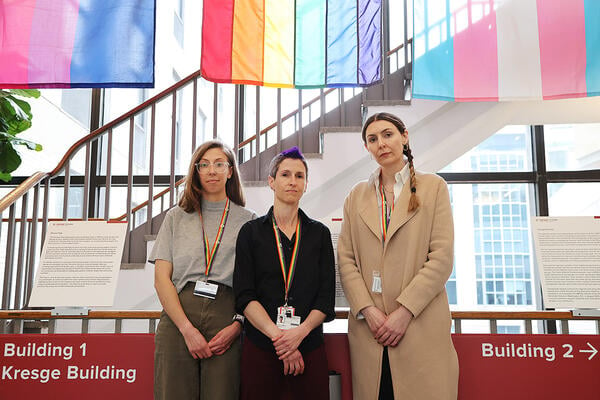
Brittany Charlton (right), a plaintiff in the lawsuit and founding director of the LGBTQ Health Center of Excellence at Harvard University, has lost multiple NIH grants amid the Trump administration’s ideological overhaul of the agency.
Suzanne Kreiter/The Boston Globe/Getty Images
Individual university researchers, a public health advocacy organization and a union representing more than 120,000 higher education workers are suing the National Institutes of Health after the agency terminated more than $2.4 billion in grants it claims support “non-scientific” projects that “no longer” effectuate agency priorities.
“Plaintiffs and their members are facing the loss of jobs, staff, and income. Patients enrolled in NIH studies led by Plaintiffs face abrupt cancellations of treatment in which they have invested months of time with no explanation or plan for how to mitigate the harm,” according to a complaint of the lawsuit filed Wednesday afternoon. “As a result of Defendants’ Directives scientific advancement will be delayed, treatments will go undiscovered, human health will be compromised, and lives will be lost.”
It’s the latest in a mounting series of legal challenges against the Trump administration’s blitz of executive actions aimed at rooting out so-called gender ideology; diversity, equity and inclusion initiatives; and alleged waste, fraud and abuse of taxpayer funds. Some of those lawsuits have already resulted in federal judges ordering injunctions and restoration of canceled grants.
But this is one of the first to directly challenge the NIH’s grant cancellations; more legal challenges are expected.
The lawsuit was filed by the American Public Health Association; the United Automobile, Aerospace and Agricultural Implement Workers and NIH-funded medical researchers from Harvard University; the Universities of Michigan and New Mexico; and the Center for Science in the Public Interest, which have all lost their grants. The American Civil Liberties Union is representing the plaintiffs.
A NIH spokesperson said that the agency doesn’t comment on pending litigation.
‘Erosion of Scientific Freedom’
The plaintiffs want the Massachusetts district court to declare the actions of the NIH “unlawful,” restore funding for at least the plaintiffs’ terminated grants and prevent the agency “from terminating any grants based on allegedly no longer effectuating agency priorities, or withholding review of applications.”
The majority of the terminated grants focused on topics related to vaccine hesitancy, climate change, diversifying the biomedical research workforce, “countries of concern” (including China and South Africa), and the health of women, racial minorities and members of the LGBTQ+ community, according to the lawsuit.
One of the plaintiffs, Brittany Charlton, who is the founding director of Harvard University’s LGBTQ Health Center of Excellence, has had five NIH grants terminated since President Donald Trump took office in January and launched a crusade to root out so-called gender ideology and diversity, equity and inclusion initiatives.
Charlton said in an email to Inside Higher Ed that she’s lost nearly $6 million in NIH grants as a result of the agency’s directives, signifying “a potential end to my academic career.”
But her motivation for signing on to the lawsuit extends beyond concern for her own livelihood.
“This isn’t just a fight for my professional survival but a stand against the erosion of scientific freedom,” Charlton said. “[The grant cancellations set] a worrying precedent where scientific inquiry becomes vulnerable to political rhetoric. The concern here is not merely academic; it affects the very foundation of public health policy and the health of vulnerable communities.”
Another plaintiff, Katie Edwards, a social work professor at the University of Michigan who researches violence prevention in minority communities, has had six NIH grants pulled this year. And a third plaintiff, Nicole Maphis, a first-generation college student and postdoctoral fellow at the University of New Mexico’s School of Medicine who researches the link between alcohol use and Alzheimer’s, is no longer in consideration for an NIH grant designed to help underrepresented researchers become faculty members.
‘Arbitrary and Capricious’
The lawsuit argues that NIH didn’t have the authority to cancel those or any of the other grants the agency claims no longer effectuate agency priorities. That’s because the “no longer effectuates agency priorities” regulatory language the NIH has cited to justify its termination of particular grants won’t go into effect until October.
Additionally, canceling the grants disregards “Congress’s express mandate that NIH fund research to address health equity and health disparities, include diverse populations in its studies, improve efforts to study the health of gender and sexual minorities, and enhance diversity in the bio-medical research profession,” according to the complaint.
The lawsuit also says that the government violated numerous aspects of the Administrative Procedure Act—including a provision prohibiting agency action considered “arbitrary, capricious, an abuse of discretion, or otherwise not in accordance with law”—when it terminated the grants. It further asserts that the agency usurped Congress’s “exclusive power over federal spending” and violated the Fifth Amendment by offering “vague” justifications for terminating grants, including involvement with “transgender issues,” “DEI” or “amorphous equity objectives.”
“Defendants have failed to develop any guidelines, definitions, or explanations to avoid arbitrary and capricious decision-making in determining the parameters of the agency’s prohibitions against research with some connection to DEI, gender, and other topics that fail Defendants’ ideological conformity screen,” the suit alleges.
That leaves grantees “unsure, for example, which areas of study they can pursue, which populations they can focus on as study subjects, what they might argue to appeal grant terminations, and what the demographics of study participants must be” and “makes it impossible to determine how to reconfigure future research to stay within the bounds of NIH’s newest ‘priorities.’”
After months of uncertainty about the future of federally funded research, the National Institutes of Health this month started canceling grants it deemed “nonscientific.”
So far, that includes research into preventing HIV/AIDS; managing depressive symptoms in transgender, nonbinary and gender-diverse patients; intimate partner violence during pregnancy; and how cancer affects impoverished Americans.
In letters canceling the grants, the NIH said those and other research projects “no longer [effectuate] agency priorities.”
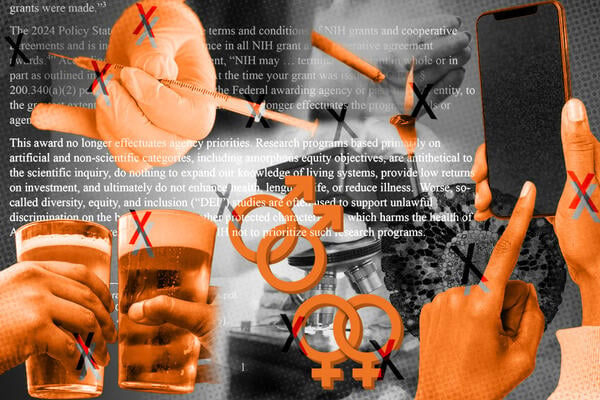
But the world’s largest funder of biomedical research didn’t stop there. The agency went on to tell researchers that “research programs based primarily on artificial and nonscientific categories, including amorphous equity objectives, are antithetical to the scientific inquiry, do nothing to expand our knowledge of living systems, provide low returns on investment, and ultimately do not enhance health, lengthen life, or reduce illness,” according to a March 18 letter sent to the University of Nebraska at Lincoln.
Katie Bogen, a Ph.D. student in the clinical psychology program at UNL, found out via the letter that NIH was canceling the $171,000 grant supporting her dissertation research. She was planning to explore the links between bisexual women’s disclosure of past sexual violence experience to a current romantic partner and subsequent symptoms, including traumatic stress, alcohol use and risk for violence revictimization within their current relationship. She started work on the project last May and was set to start data collection at the end of this month.
The NIH told Bogen and other researchers that “so-called diversity, equity, and inclusion studies are often used to support unlawful discrimination on the basis of race and other protected characteristics, which harms the health of Americans,” and that NIH policy moving forward won’t support such research programs.
“No corrective action is possible” for Bogen’s project, because “the premise of this award is incompatible with agency priorities, and no modification of the project could align the project with agency priorities.”
Last week, Bogen, who told Inside Higher Ed that she was inspired to pursue this topic because she herself is a bisexual woman with a trauma history, posted on TikTok about the termination letter.
Man this is actually very sad. Thinking about all the scientists today who are being told their scholarship isn’t important. It is. Your work matters. Let’s figure out how to move forward as a community of inquiry together.
She received thousands of comments and messages lamenting the loss of her work, with some characterizing the letter’s language as “appalling” and “horrifying.” Another commenter, who identified “as a bi femme who has survived the specific harm you’ve been studying,” told Bogen their “heart is broken” for her and other researchers “and all the folks who could be helped by the studies being defunded.”
Inside Higher Ed interviewed Bogen for more insight into her research and what the NIH’s abrupt cancellation of her and other projects means for public health and the future of scientific discovery.
(This interview has been edited for clarity and style.)
Q: What got you interested in researching intimate partner violence prevention for bisexual women? Why do you believe it’s an important line of scientific inquiry?
A: We know that bisexual women are at an elevated risk of experiencing intimate partner violence and sexual harm. We also know they have higher rates of post-traumatic stress disorder after these experiences compared to other people, and that they have greater and more problematic high-risk alcohol use afterwards. A key part of the process of meaning-making after the experience of violence is disclosure because of ambient bi-negativity. Bisexual people’s disclosure processes are often burdened by anti-bisexual prejudice.
For example, if you’re a bisexual woman who’s experienced violence at the hands of a woman partner, and you disclose that to a man partner that you’re seeing now, that man partner might say, “How much did she really hurt you?” If you’re a bisexual woman who’s now with a woman and you disclose violence perpetrated by a man, your woman partner might say something like, “This is what you get for dating men. We all know better than to date men.”
Katie Bogen is a fifth-year clinical psychology Ph.D. student at the University of Nebraska at Lincoln
So much of the disclosure research on sexual violence victims has been done with formal support providers like police or campus security or therapists, and then informal support providers like friends or parents or siblings. But very little research has documented the exposure process with intimate partners, which seems like a gap, given that intimate partners can then choose to sort of wield that insight or knowledge for good—or for harm.
I want to study how to intervene so that they don’t develop severe post-traumatic stress and problematic drinking. And this is particularly important because problem drinking is a risk factor for revictimization, and so bisexual women have all of these factors working against them that contribute to the cycle of revictimization and chronic victimization over their life span.
Q: Can you describe the process of applying for this NIH grant?
A: In 2022, I had just finished my second year of graduate school when a colleague of mine sent me a funding opportunity from the National Institute on Alcohol Abuse and Alcoholism that had a notice of special interest on the health of bisexual and bisexual-plus people.
We haven’t even been able to recruit our participants and I have none of the data.”
I worked very hard for a year on my application. It was the first grant I wrote as a [principal investigator]. I submitted to NIH, and a kind of miracle happened—I scored a 20 on this grant, which means my very first grant being written up as a PI got funded on the first round of peer review, which is almost unheard-of.
Q: How much of the project had you finished before receiving the termination notice?
A: I started work last May. I’ve hired and trained an entire lab of undergrads.
I’ve already done the literature reviews with the help of my undergraduate team and put together and tested the Qualtrics surveys. We set up backup safety measures in case the online surveys were infiltrated by bots or false respondents. The amount of literature I’ve read and the foundational conference presentations and analysis that I’ve run using other available data sets has been an immense labor.
It has been a productive 10 months. The things that this research has made possible for me—not only as a student and trainee, but as a scientist and as now a mentor helping to train the next generation of scholars—cannot be understated.
But we haven’t even been able to recruit our participants and I have none of the data. We were slated to begin data collection on March 31, and it’s a shame that will no longer happen.
Q: The NIH’s termination letter said your project is “antithetical to scientific inquiry” and “harms the health of Americans.” What was your reaction to that characterization of your work?
A: It hurts to hear that your work isn’t scientific. But it almost made me laugh because it’s so revelatory of the ignorance of folks in positions of power to claim that the work that I’m doing—that my colleagues are doing, that my mentors have taught me to do, that other folks in a field of doing—is ascientific and itself violence.
To me, the language in the letter is an example of DARVO, which is a rhetorical abuse tactic that stands for deny, attack, reverse victim and offender. They’re saying that what I’m doing isn’t scientific, and that they’re actually trying to uphold the standards of science, and by me focusing on these marginalized groups, I’m harming, quote unquote, real or regular Americans.
[The termination letter] almost made me laugh because it’s so revelatory of the ignorance of folks in positions of power to claim that the work that I’m doing … is ascientific and itself violence.”
Q: How does your work benefit society broadly?
A: Even if we take queerness out of the equation in this model, we are still garnering insight and understanding of the mechanism of post-traumatic stress, alcohol use and intimate partner violence for people in general. We’re getting a deeper understanding of how discussing sexual violence with a partner fundamentally changes that relationship, what is perceived as potentially acceptable in that relationship, norms of conflict within that relationship and sexual norms within that relationship.
Being able to investigate questions like this and enact scholarship like this could be a balm to some of the self-blame and shame that survivors are experiencing. And when research like this is able to reach health-care providers, public health improves, people become safer and we’re better able to protect folks from things like intimate partner violence, revictimization and sexual revictimization, which is endemic in our society.
Q: Given that this research grant was a central piece of your plan to complete your dissertation, how does its abrupt cancellation complicate your path toward degree completion?
A: I now have to work with my mentors to generate a new dissertation proposal and send it to my committee and get it reapproved, which means I have to access data sets at my institution that have either already been collected or that are safe from future rounds of cuts like this.
I believe I’m being intimidated [by the NIH] into taking the data that are already available, rather than collecting data with more specificity, which means the accurate data answering these research questions is tampered. I don’t necessarily want to go to a data set that was collected on, for example, masculinity and violence perpetration, and try and string together a similar enough model to pass the proxy of what I wanted. That’s poor scholarship.
It’s something a lot of scholars who are dealing with this crisis are facing now. How does that further marginalize the populations we’re aiming to serve if we’re trying to presume or assume that data on different populations? It creates this ethical and academic quandary.
Q: How might this termination affect your career in the long term?
A: I have a demonstrated record of receiving grant funding on my own, which is a difficult thing to demonstrate when you’re still a trainee or you’re still a student. It makes folks more competitive for postdocs, research-oriented internships or research jobs at bigger research institutions down the line. If I wanted to work at an academic hospital, it shows that I’ll be able to bring in grant funding.
But now I have this really sad line on my CV. I had to write several asterisks that the grant closed early, and I just have to hope that people who are reviewing my CV later know what that means—that the grant closed early, not because of my failure to complete the research, but because we have the infiltration of antiscientific thought in the federal government that forced a number of grants to close early.
It doesn’t stop at political science, psychology or even economics. It has legs and encroaches and creeps into biophysiological sciences and neuropsychology. It leaves no science safe.”
Q: How does your situation speak to any concerns you might have about the broader environment for science in this country right now?
A: We’re in this identity war moment, and it’s not based on anything but people’s own prejudice and bias and a sense of being victimized because they no longer have access to the power they used to. This is an attempt to recollect and to narrow who has that power, which has frightening implications across the board.
It doesn’t stop at political science, psychology or even economics. It has legs and encroaches and creeps into biophysiological sciences and neuropsychology. It leaves no science safe.
The Senate confirmed President Donald Trump’s pick to lead the National Institutes of Health on Tuesday.
Jay Bhattacharya, a Stanford University health economist who gained notoriety for his criticism of the NIH’s handling of the COVID-19 pandemic, secured the confirmation with a 53-to-47 party-line vote, The New York Times reported.
His confirmation as NIH director comes as the agency, which sends billions in funding each year to researchers at more than 2,500 universities, faces dramatic funding cuts and a shake-up of its research priorities. In the two months since Trump took office, the NIH has eliminated some 1,200 staff, effectively paused grant reviews and sent termination letters to many researchers whose NIH-funded projects allegedly conflict with Trump’s orders to eliminate support for diversity, equity and inclusion initiatives and other topics.
The NIH also issued guidance in February that would cap the funding it gives to universities for the indirect costs of research, such as building maintenance, hazardous waste removal and adhering to patient safety protocols. A federal judge blocked that guidance after numerous universities, research and higher education advocacy organizations, and 22 Democratic state attorneys general sued the NIH, arguing that the plan will hurt university budgets, local economies and the pace of scientific discovery.
At a confirmation hearing before the Senate Committee on Health, Education, Labor and Pensions earlier this month, Bhattacharya said that if confirmed, he would “fully commit to making sure that all the scientists at the NIH and the scientists that the NIH supports have the resources they need to meet the mission of the NIH.” However, he offered few specifics on how he’d do that and wouldn’t commit to axing the agency’s plan to cut indirect costs by more than $4 billion.
Several colleges and universities are pausing admissions to some graduate programs, reducing class sizes or rescinding offers to students in an effort to cut costs amid uncertainty in federal funding.
The disruption to graduate school admissions is the latest cost-cutting move for colleges. After the National Institutes of Health proposed cutting reimbursements for costs related to research, several colleges and universities said they would pause hiring and cut spending, Inside Higher Edpreviously reported. (A federal judge has blocked the NIH plan from taking effect for now.)
In recent days, the University of Pittsburgh, the University of Pennsylvania and several other institutions have stopped doctoral admissions, at least temporarily. Some colleges are pausing admissions to some programs such as in the biomedical sciences, Stat Newsreported. At others, the pause is universitywide. The University of Southern California and Vanderbilt University temporarily paused graduate student admissions, though both universities latersaid that they’d ended the pause.
A University of Pittsburgh spokesperson told WESA, a local NPR station, that the university “temporarily paused additional Ph.D. offers of admission until the impacts of that [NIH] cap were better understood … the University is in the process of completing that analysis and expects to be in a position to resume offers soon.”
Meanwhile, the University of Pennsylvania is planning to cut graduate admissions rates, The Daily Pennsylvanianreported, citing an email from the interim dean of the School of Arts and Sciences, Jeffrey Kallberg, who wrote that the cuts were a “necessary cost-saving measure” to adjust to the NIH proposal.
“This is not a step any of us wanted to take,” Kallberg wrote, according to the Daily Penn. “We recognize that graduate students are central to the intellectual life of our school—as researchers, teachers, collaborators, and future scholars. However, we must ensure that we can continue to provide strong support for those students currently in our programs and sustain the school’s core teaching and research activities.”
Tom Kimbis, executive director of the National Postdoctoral Association, wrote in an email to Inside Higher Ed that academic institutions reliant on federal funding “are being forced to make tough decisions to support these researchers in a difficult environment.”
“The decisions in Washington to pause or cease funding for science and research is impacting early-career researchers across a wide range of disciplines,” Kimbis added. “Slowing or stopping their work, on topics from cancer and Alzheimer’s research to social science issues, hurts Americans in all 50 states.”
In the last week, some faculty began tracking the reductions in the biomedical sciences via a shared spreadsheet that includes verified cuts and unverified decisions based on word of mouth and internal emails. Faculty on social media said the cuts will have long-term ramifications for sciences as fewer students enter the field. On TikTok, several students who had applied to grad school shared their dismay at how the funding cuts meant they might have to say goodbye to their career plans and research.
Accepting graduate students, particularly for Ph.D. programs and in the biomedical sciences, requires universities to make a long-term financial commitment, which is more difficult now that the NIH has stopped making new grant awards and is aiming to cut funds. Colleges receive billions from the NIH to support research. If the proposed rate cuts move forward, institutions say they would have to shut down some labs and lay off employees.
“University research and scholarship operate on a time scale of years and decades,” the Rutgers AAUP-AFT chapter wrote in a letter to New Jersey senators Cory Booker and Andy Kim. “Higher education would become impossible in the face of capricious and arbitrary withholding of funding, elimination of entire areas of grant support for critical scientific research, and cancellation of long-held contracts.”
They went on to warn that the threat to funding would diminish the country’s strength as a research superpower. “The best scientists, the best scholars, and the best students will make the rational decision to take their talents elsewhere. Once lost, the historic excellence of United States universities, including world-leading institutions in New Jersey, both public and private, will not be easily regained.”
A federal judge Friday extended a temporary block on the National Institutes of Health’s plan to slash funding for universities’ indirect research costs amid a legal battle over the policy change.
The nationwide block, which U.S. District Judge Angel Kelley put in place Feb. 10 soon after a coalition of state attorneys general, research advocates and individual universities sued the agency, was set to expire Monday. But it will now remain in place until Kelley has time to consider the arguments the plaintiffs and NIH presented at a hearing Friday morning.
It’s unclear when Kelley will rule. But after the two-hour hearing, she said she certainly “has a lot of work to do” to before making a decision.
“This case is not about whether as a policy matter the administration can target waste, fraud and abuse,” Katherine Dirks, an attorney for the Massachusetts attorney general’s office, told the judge during the hearing. “It’s contrary to the regulations which govern how these costs are determined and how these payments are disbursed. If there were an intention on the administration’s part to change the mechanism by which those occur, there’s a process for it—a statutory process and a regulatory process. Neither of those were followed here.”
But the NIH’s legal team said the agency has the right to unilaterally cap reimbursements for costs related to research—such as hazardous waste removal, facilities costs and patient safety—at 15 percent.
“This is not cutting down on grant funding,” said Brian Lea, a lawyer for the NIH, said at Friday’s hearing. “This is about changing the slices of the pie, which falls squarely within the executive’s discretion.”
Counsel for the plaintiffs, however, argued that the policy is unlawful and, if it’s allowed to move forward during a protracted litigation process, will cause “irreparable harm” to university budgets, medical breakthroughs and the patients who may not be able to enroll in clinical trials as a result.
“A clinical trial is for a lot of people a last hope when there’s not an FDA–approved medicine that will treat their condition. Any minute that they’re not enrolled in that trial brings the risk of irreparable harm,” said Adam Unikowsky, an attorney for the plaintiffs. “Part of these institutions’ mission is serving these patients, and this cut will irreparably harm their ability to fulfill that mission.”
Since 1965, institutions have been able to periodically negotiate their reimbursement rates directly with the federal government; university rates average about 28 percent. However, rates can vary widely depending on factors such as geographic cost differences and the type of research, and some institutions receive indirect reimbursement rates of more than 50 percent of their direct grants.
Although the NIH argued in court that indirect costs are “difficult to oversee” as a justification for cutting them, the plaintiffs refuted that claim, pointing to a complex negotiation process and regular audit schedule that’s long been in place to ensure the funds are being used to support NIH research.
In fiscal year 2024, the NIH sent about $26 billion to more than 500 grant recipients connected to colleges—$7 billion of which went to indirect costs.
Saving or Reallocating $4B?
This isn’t Trump’s first attempt to cap indirect costs, which Elon Musk—the unelected billionaire bureaucrat overseeing the newly created Department of Government Efficiency—recently characterized as a “rip-off” on X, the social media site he owns.
In 2017, Congress rebuked President Trump’s attempt to cap indirect costs, and it has written language into every appropriations bill since specifically prohibiting “deviations” from negotiated rates. Given that, Kelley asked the Trump Administration’s legal team, how in his second term, Trump “can unilaterally slash these previously negotiated indirect cost rates which Congress prevented him from doing previously?”
“The money that is saved—it’s not being saved, it’s being reallocated—will be taken from indirect costs and filed into new grants that will be using the same funding formula,” said Lea, who told the judge he was using air quotes around the word saved. “The money is not being pocketed or being shipped somewhere else. It’s being applied back into other research in a way that best fits NIH and what will best serve the public’s health.”
But Lea’s claims that the money will simply be reallocated contradicted the NIH’s own social media post from Feb. 7, which said the plan “will save more than $4B a year effective immediately,” and Kelley asked for an explanation.
In response, Lea said the NIH’s “tweet was at best sort of a misunderstanding of what the guidance does.”
The Department of Health and Human Services, which oversees the NIH, did not immediately respond to Inside Higher Ed’s request for comment on whether it plans to issue a widespread public correction on social media and its other platforms to clarify its policy and inform taxpayers that their plan to cap indirect costs is not intended to save them any money. As of Friday afternoon, the post was still up on X.
Layoffs, Canceled Clinical Trials
But Unikowsky, an attorney for the plaintiffs, said that funneling money away from indirect costs would still harm the nation’s esteemed scientific enterprise, which is grounded in university research.
“Indirect costs are real costs associated with doing research,” said Unikowsky, pointing to the California Institute of Technology as an example. The institute spent $200 million to build a state-of-the-art laboratory and is counting on indirect cost reimbursements from the NIH to help pay off the debt it incurred to construct it.
“There’s going to be a hole in Cal Tech’s research budget” and the “money is going to have to come from somewhere else,” Unikowsky added.
Unikowsky also listed nine different institutions, including the Universities of Florida, Kansas and Oregon, that have said they will have to lay off skilled workers who support medical research, including nurses and technicians, if the cap goes into effect.
Lea, the lawyer for the Trump Administration, countered that destabilizing university budgets doesn’t amount to immediate and permanent harm warranting injunctive relief on the rate caps.
“That’s not an irreparable thing, or else every business that’s in a money pinch could just come in and get an injunction,” he said. “I understand that many institutions would prefer to use endowments and tuition for other purposes, but unless they’re barred from doing so—and the inability to do so would cause some non-monetary harm—that’s not irreparable harm.”
Although Kelley gave no indication on when or how she plans to rule, some university leaders who listened to the hearing came away optimistic that she’ll favor the plaintiff’s arguments.
“We look forward to the judge’s ruling,” said Katherine Newman, provost at the University of California which is one of the universities suing the NIH. “[We] maintain our position that the Administration’s misguided attempt to cut vital NIH funding is not only arbitrary and capricious but will stifle lifesaving biomedical research, hobble U.S. economic competitiveness and ultimately jeopardize the health of Americans who depend on cutting-edge medical science and innovation.”
This audio is auto-generated. Please let us know if you have feedback.
A federal judge extended an emergency restraining order Friday against theNational Institutes of Health, temporarily preventing the agency from making massive cuts to indirect research funding.
The restraining order bars NIH from implementing a 15% cap on indirect cost reimbursement and requires the agency to file regular status reports confirming disbursement of funds.U.S. District Judge Angel Kelley,a Biden appointee, is considering a more permanent injunction against NIH’s plan after nearly two hours of oral arguments Friday.
NIH unveiled the new policy earlier in February. Historically, institutions negotiate their own indirect cost reimbursement rates with the agency, with an average of 27% to 28%. The change was met swiftly with multiple lawsuits, including by higher education groups and 22 state attorneys general. The cases were considered together at the hearing Friday.
Several universities have already frozen hiring and taken other budgetary measures amid the NIH funding uncertainty, despite Kelley’s initial pause on the funding cap.
The funding for indirect costs — also known as facilities and administrative, or F&A, costs — covers a wide array of staffing and infrastructure for research activity.
“Indirect costs are the backbone of IHEs [institutions of higher education] research programs and cover everything from utilities to facilities and equipment maintenance to payroll for faculty and staff to compliance programs, hazardous waste disposal, and more,” 22 state attorneys general said in their original request for a temporary restraining order on NIH. “They quite literally keep the lights on.”
Brian Lea, an attorney for NIH, said at Friday’s hearing that money saved by cutting and capping F&A funding would be “ploughed into” funding for research costs. However, in a Feb. 7 post from the agency on the social media site X, NIH said the funding cap “will save more than $4B a year effective immediately.”
Asked by Kelley about the post, Lea said that it was “at best a misunderstanding” of NIH’s guidance.
Plaintiffs attorneys argued that the F&A cap violates federal laws and regulations, pointing out that Congress passed an appropriations bill during President Donald Trump’s first term that prohibits modifications to NIH’s indirect cost funding.
Lea maintained that NIH’s guidance was compliant with regulations and statutes and within the “broad discretionary power of the executive branch” to allocate funding.
Attorneys for the plaintiffs further argued that an injunction was necessary to prevent “immediate and irreparable” harm, pointing to numerous universities that have detailed how their research, budgets and infrastructure would suffer from the cap. An official at Yale University, for example, said in court papers that the NIH rate cap could threaten the viability of many of its ongoing clinical trials for medical research.
“It is not hyperbole to say that, absent immediate injunctive relief, Plaintiff States’ IHEs will face catastrophic financial consequences, which could result in layoffs and furloughs, research program closures, financial defaults, and disruptions to clinical trials, potentially jeopardizing people’s lives and health,” the attorneys general said in their motion, filed earlier in February.
Lea questioned whether harms such as funding losses were irreparable, suggesting that they could be undone later through private funding or operational adjustments.
As the case winds on, NIH has laid off more than 1,000 employees, according to press reports.