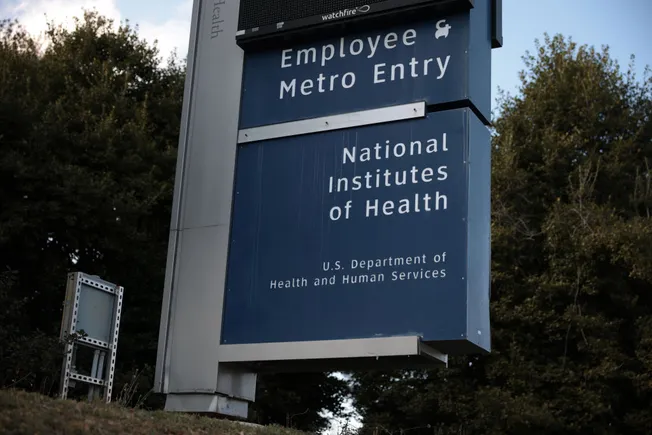
As mass layoffs and suspended grant reviews at National Institutes of Health sow more chaos for the nation’s once-cherished scientific enterprise, a federal judge is set to hear arguments Friday morning on whether to extend a temporary block on the NIH’s attempt to unilaterally cut more than $4 billion for the indirect costs of conducting federally funded research at universities, such as hazardous waste disposal, laboratory space and patient safety.
If the cuts move forward, they will “destroy budgets nationwide,” higher education associations and Democratic attorneys general, along with medical colleges and universities, argued in court filings this week. “But the consequences—imminent, certain, and irreparable—extend far beyond money, including lost human capital, shuttering of research projects and entire facilities, stalling or ending clinical trials, and forgoing advances in medical research, all while ending the Nation’s science leadership.”
The NIH refuted that claim in court filings, arguing that the plaintiffs “do not establish that any irreparable impacts would occur before this case can proceed to the merits.”
Friday’s hearing comes two weeks after the NIH’s Feb. 7 announcement that it will cap indirect research cost rates at 15 percent, which is down from an average rate of 28 percent, though some colleges have negotiated reimbursement rates as high as 69 percent.
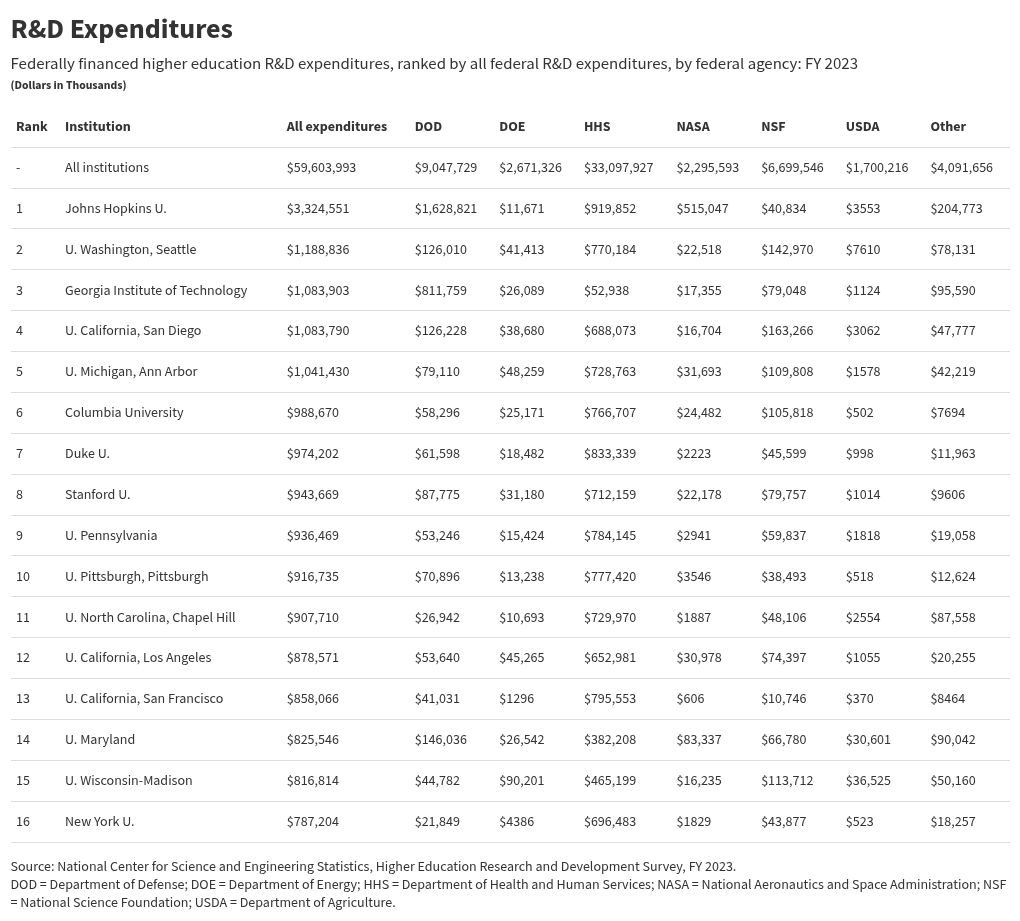
The National Institutes of Health is one of the largest sources of funding for research at the universities and colleges and has supported breakthroughs in medical technology and treatments for diseases like cancer and Alzheimer’s. In fiscal year 2024, the agency sent about $26 billion to more than 500 grant recipients connected to colleges. About $7 billion of that went to the indirect expenses—a source of funding that universities argue is crucial but still doesn’t cover the full cost of conducting research.
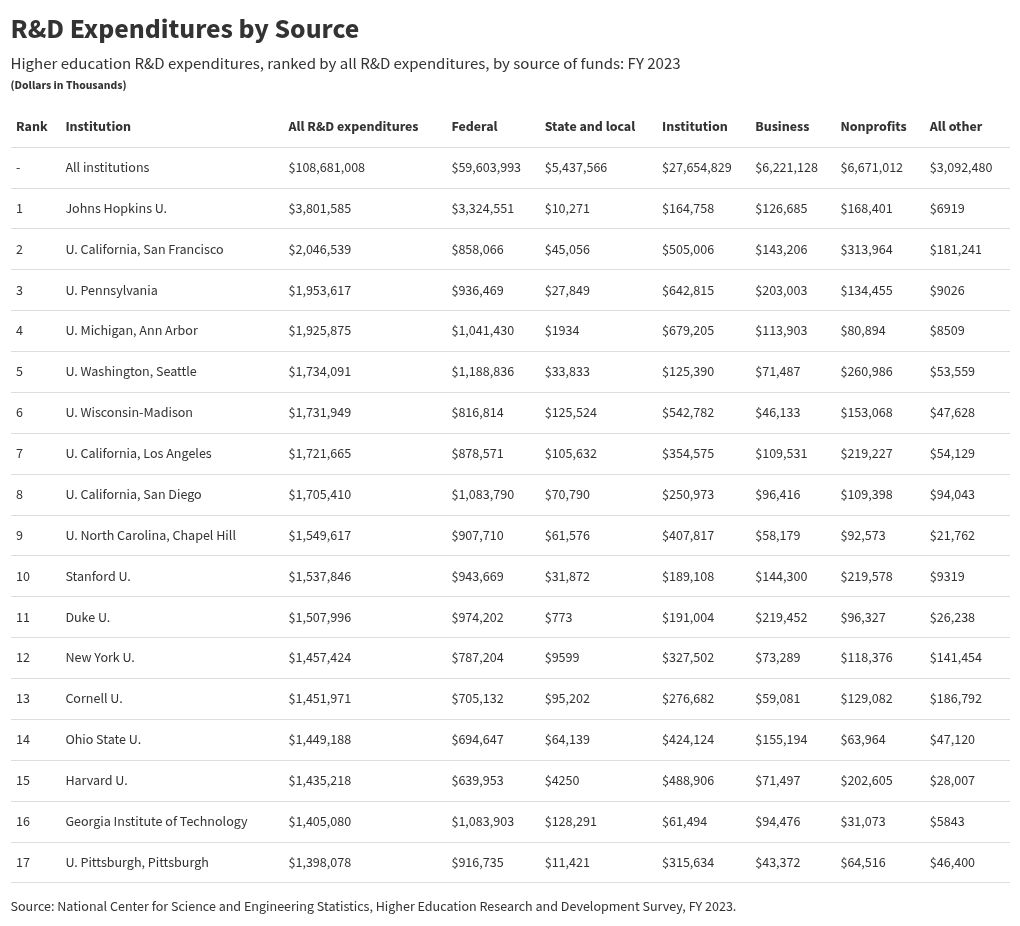
Federal data shows that in fiscal year 2022, universities contributed approximately $25 billion of their own institutional funds to support research, including more than $6.2 billion for the federal government’s share of indirect costs that it did not reimburse.
Nonetheless, Elon Musk, the unelected billionaire bureaucrat President Donald Trump has charged with heading the nascent Department of Government Efficiency, characterized NIH reimbursements for universities for indirect research costs as “a rip-off.” Meanwhile, the academic research community warned that such drastic cuts—which Trump failed to get congressional approval for during his first term—would hamper university budgets, local economies and medical breakthroughs.
Within days of NIH’s directive, a federal judge put the rate cut on hold after 22 state attorneys general sued the agency, joined by numerous higher education research advocacy organizations, including the Association of American Medical Colleges, the Association of American Universities, the Association of Public and Land-grant Universities, and the American Council on Education. Across three separate lawsuits, they argued NIH doesn’t have the authority to unilaterally change the cap and that its guidance was “arbitrary and capricious,” among other points.
Although the nationwide injunction gave colleges a brief reprieve from the cuts, which briefly took effect Feb. 10, university administrators have spent the last two weeks sounding the alarm about the estimated losses and other impacts. Some Republicans in Congress have also opposed the plan, saying it violates language in federal legislation that bars NIH from modifying indirect costs.
‘Irreparable Injury’?
In its motion for the dismissal of the injunction filed on Feb. 14—a day before the NIH fired some 1,000 workers—lawyers for the agency argued that the federal district court “lacks jurisdiction” over the case and only federal claims court should hear the case, because the plaintiffs “are effectively seeking damages for breach of contract—the regulations incorporated into their grant agreements.” They also claimed that the NIH “ran afoul of no statute” and that the plaintiffs “have failed to show that they would suffer an irreparable injury” without a temporary restraining order.
“Where declarants assert that reducing funds is likely to harm research or clinical trials,” the motion said, “they generally do not assert that those harms are imminent as opposed to eventual reductions in their capacity that would occur from sustained diminished funding after a ruling on the merits.”
The motion went on to claim that the NIH’s capping of indirect cost rates seeks to “further its mission of advancing public health in a manner reflecting wise stewardship of the public money entrusted to it,” claiming that indirect costs are “difficult” for NIH to oversee. “To be clear, the Supplemental Guidance will not change NIH’s total grant spending; rather, it simply reallocates that grant spending away from indirect costs and toward the direct funding of research.”
But that’s not how the NIH publicly framed the indirect cost cap in a post on the social media site Musk owns that said the policy change will “save more than $4B a year effective immediately.”
And in a response filed earlier this week, the plaintiffs argued that the NIH’s policy change “bears no rational connection to NIH’s stated goal” in its court filings, because nothing in the NIH’s notice to cap indirect costs “directs more money to direct expenses.” The response also argues that the NIH has not provided adequate evidence to support its assertions that indirect costs are “difficult to oversee” and implored the court to reject the NIH’s attempt to “deprive Congress of its power of the purse.”
Mass Layoffs, Grant Reviews Still Suspended
While the temporary injunction has halted the rate cap for about two weeks, it hasn’t stopped Trump and Musk from destabilizing federal science agencies in other ways. Over the past week, thousands of mostly probationary employees—ranging from top-ranking agency officials to grant administrators who help grantees ensure their projects are compliant with federal regulations—across numerous science agencies, including the NIH, the National Science Foundation and the Centers for Disease Control and Prevention, lost their jobs.
“The majority of what people who work for those agencies do is get the grant money out the door,” said Carrie Wolinetz, a science and health policy consultant who worked for the NIH between 2015 and 2023. “Because the layoffs took place across job categories, any of those critical positions could be affected. It’s hard to imagine that’s not going to have some impact on the ability of those agencies to fulfill its mission of getting those grants out the door.”
And even before the layoffs and indirect cost cap directive, the NIH had already derailed its operations by temporarily pausing communication and grant reviews last month. Although the courts put those orders on hold, Nature reported Thursday that nearly all NIH grant-review meetings remain suspended.
When the reviews finally do resume, the process will likely face even more challenges with fewer agency employees.
“The fewer people, the greater the bottleneck,” Wolinetz said. “Uncertainty itself causes delays. When people are confused, afraid and worried after watching their colleagues being dismissed, all of that just causes a slowing down of the entire system.”
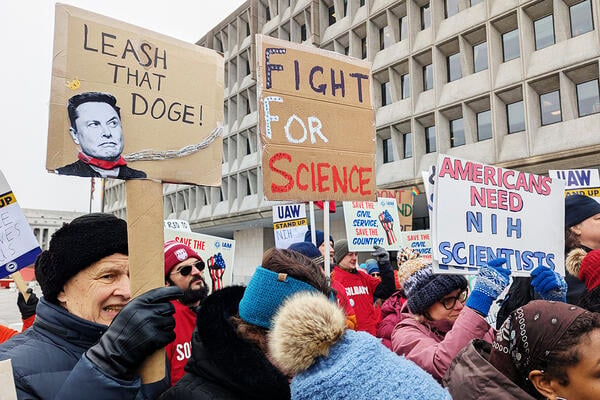
On Wednesday, hundreds of scientists, federal workers and their supporters rallied outside of Department of Health and Human Services headquarters in Washington, D.C., wielding signs with phrases such as “Leash That DOGE,” “Fight for Science” and “America Needs NIH Scientists” and speaking out against cuts to science funding. (The rally was part of a national day of action to oppose the research funding cuts and layoffs.)
Hundreds of protesters gathered in front of HHS headquarters Wednesday.
“It is important that we understand exactly what is at stake right now,” Kailyn Price, a neuroscience doctoral student at George Washington University, told the crowd. “Cutting indirect costs is like telling a football team to do their work with only the players and the coach—no lights for the field, no physical therapist for the players, no water for the showers.”
She said casting indirect costs as an unchecked and unnecessary burden on taxpayers is all part of the government’s plan to turn the American public against scientists and their work.
“They want you to be angry and misinformed, incensed and ignorant,“ Price said. “Trump and his unelected billionaire backers want you to look at the people like us—making $20, $30, $40,000 a year, working late nights through the weekends because we believe that much in the work that we do—as the enemy.”
And the federal workers who remain at the agencies that support university research may not be there for long, either.
“Messaging from the agency is changing on a daily basis. Everyone is internally freaking out,” one still-employed NIH scientist told Inside Higher Ed on the condition of anonymity. “I’m applying for other jobs, and most people are hedging their bets and sending out other applications, assuming they could get let go.”
The chaos at the NIH, including the firings and the potential for billions in funding cuts, means “there just won’t be the same number of scientists coming out of American universities,” the NIH researcher said. “On the bright side, though, there is the rest of the world.”
The cuts “are also adversely affecting important agency functions, such as support for research security at universities,” Toby Smith, senior vice president for government relations and public policy at the AAU, said in an email.
“Cutting key research security offices at the NSF and NIH will make it more difficult for universities and our science agencies to implement new congressionally mandated research security requirements aimed at protecting sensitive information and data from competitors at a crucial time when we are trying to stay at the forefront of global scientific leadership.”