
Tag: normal

  • Higher education postcard: Normal College, Bangor revisited

    Higher education postcard: Normal College, Bangor revisited

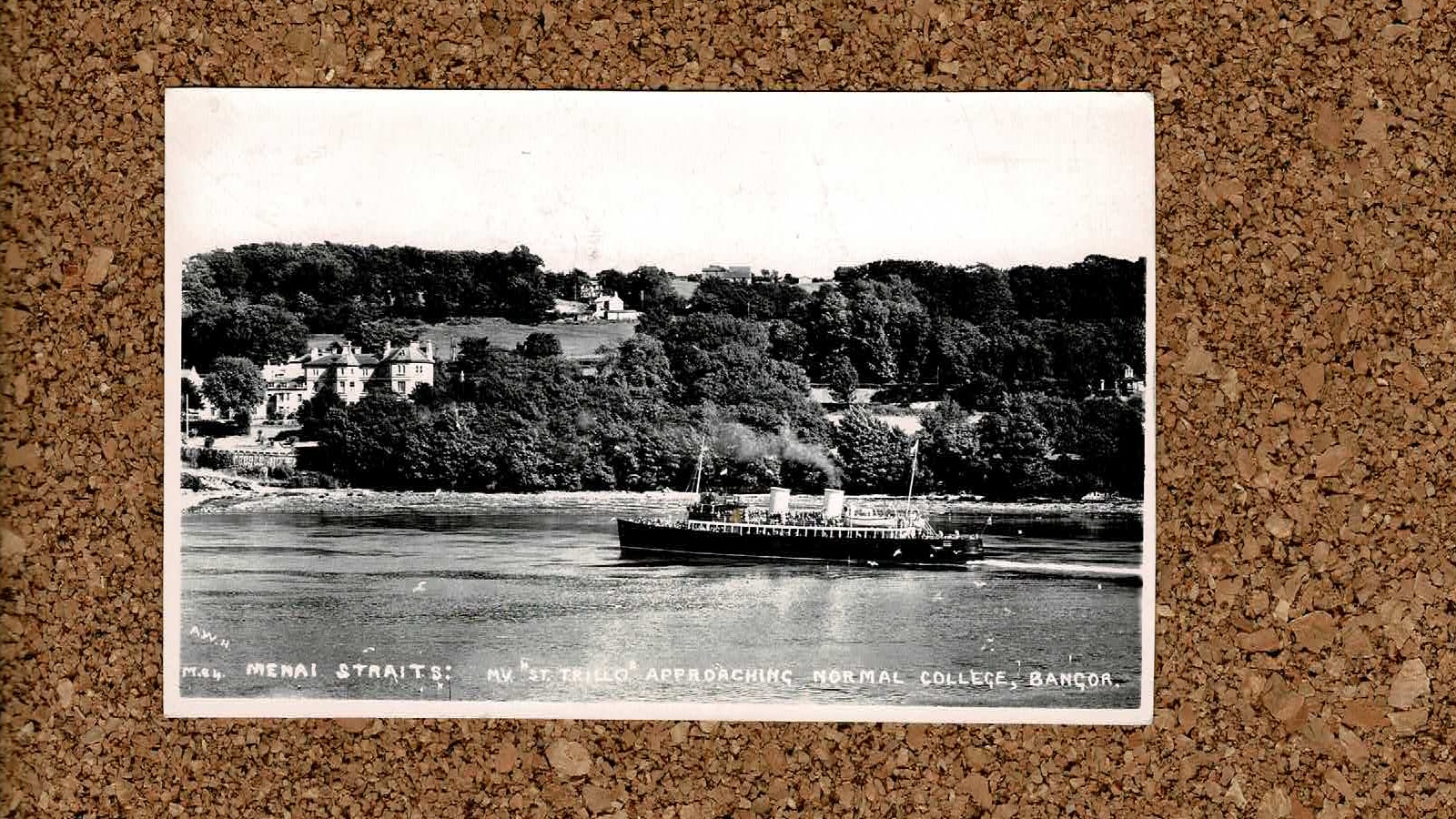
    Greetings from Bangor!

    We’ve visited Normal College before, but I frankly couldn’t resist sharing this postcard, with a very lovely scene, so we’re going back for another look. This time at an occurrence in the college’s early years, and a couple of newspaper snippets.

    As we’ve seen, the college was founded in 1868, through the efforts of Hugh Owen and the British and Foreign Schools Society.

    The Illustrated Times on 14 January 1960 published an engraving and the following text:

    The accompanying Engraving represents the Normal Training College in course of erection at Bangor, the foundation-stone of which was laid by Lord John Russell on the 11th of November last. The ground occupied the building, and overlooking the Menai Straits, was generously given for the purpose by the Hon. E. G. D. Pennant, MP. The institution is for the training and instruction of forty students to act as schoolmasters in the northern division of the principality. Our Illustration is from the design made by Mr. John Barnett, the architect.

    10 November 1890 saw student protest at the college. As the Weekly Times and Echo reported the following Sunday:

    The students at the North Wales Normal College at Bangor, about seventy in number, were on Tuesday summarily expelled for having left the college on Monday night as a protest against the food served. The institution, which is used for the training of Board schoolmasters for schools in North Wales, is now entirely closed, and will remain so till Christmas. The college authorities aver that the food complained of was excellent, and that the revolt arose through the impertinence of one student, who was ordered to leave the table, upon which his companions rose and joined him. As the students declined to appear before the Committee, either by deputation or individually, the only course left to the Committee was to authorise Principal Rowlands to dismiss them pending an enquiry.

    What happened next? Well, a flurry of back and forth in various newspapers, about who called who a liar, and then in January the search for a new principal begins. Are these events connected? We do not know for sure, but it must be a strong suspicion. The Jisc archives hub holds material which suggests that the students were readmitted after 3 days, and an official enquiry launched by the Inspector for Training Colleges. This concluded that the food was fine, but discipline was lax.

    On 5 February 1891 the South Wales Daily News published the following letter:

    Allow me to call the attention of Welsh educationalists in general, and old Bangorians in particular, to the appointment of a new principal for the above college [Normal College, Bangor]. I understand that the ‘enemy’ its doing its utmost to shelve the only man entitled to the post – the honoured vice-principal, Mr John Price. It behoves Old Bangorians to be up and doing – that is, assuming sectarianism is trying to crush Mr Price. More anon, I am &c, Iwan.

    And then in April 1891 the appointment of John Price was announced, after an eight hour committee meeting/interview panel, with hints that the defeated candidate – Mr Keri Evans, a Congregationalist from Carmarthen College – was supported by a number of Calvinistic Methodists, and would surely be heard from again.

    Another time I will try to dig further into this. I may have to learn some theology to do so.

    On 2 July 1914 the North Wales Weekly News published the following report of a cricket match between Llanwrst and Normal College. It was a low scoring match. And, the tea interval being a highlight, clearly not one which gripped the reporter.

    The year before, Normal had beaten Llanwrst, and judging by the scorecard for both games it looks like some sort of time- or over-limited game was being played.

    The boat on the card is the MV St Trillo. This was built in 1936 at the Fairfield shipyard in Glasgow, for the Liverpool & North Wales Steam Ship Co. She was one of three pleasure steamers operated by the company along the north Wales coast; this blog post has details of the kinds of trips she would make. Originally called the St Silio, in 1945 she was renamed the St Trillo. In 1963 her owners folded, and St Trillo was bought by P&A Campbell. She continued to operate in North Wales and also in the Bristol Channel, between Cardiff and Weston-super-Mare. She was scrapped in 1975 in Dublin.

    Here’s the postcard as a jigsaw. I’m sorry that its such a tricky one this week, but as I said, I couldn’t resist the card. The card was posted in September 1958 to Mr and Mrs Budden in Liverpool 11:

    Ronnie and I are here for the day and it is glorious and the boat is packed. We were too late to post these so am writing on the boat. Hope you had a nice week, I phoned twice but guessed you were out. Am going to Pat’s on Friday, so will not be up this week. Will phone, Love Maurice
    Source link

  • 7 insights about chronic absenteeism, a new normal for American schools

    7 insights about chronic absenteeism, a new normal for American schools

    Five years after the start of the pandemic, one of the most surprising ways that school has profoundly, and perhaps permanently, changed is that students aren’t showing up. Here are some insights from a May symposium at the American Enterprise Institute where scholars shared research on the problem of widespread absenteeism.  

    1. Chronic absenteeism has come down a lot from its peak in 2021-22, but it’s still 50 percent higher than it was before the pandemic.

    Roughly speaking, the chronic absenteeism rate nearly doubled after the pandemic, from 15 percent of students in 2018-19 to a peak of almost 29 percent of students in 2021-22. This is the share of students who are missing at least 10 percent, or 18 or more days, of school a year. Chronic absenteeism has dropped by about 2 to 3 percentage points a year since then, but was still at 23.5 percent in 2023-24, according to the most recent AEI data

    Related: Our free weekly newsletter alerts you to what research says about schools and classrooms.

    Chronic absenteeism is more than 50 percent higher than it used to be. There are about 48 million public school students, from kindergarten through 12th grade. Almost 1 in 4 of them, or 11 million students, are missing a lot of school. 

    2. High-income students and high achievers are also skipping school.

    Absenteeism cuts across economic lines. Students from both low- and high-income families are often absent as are high-achieving students. Rates are the highest among students in low-income districts, where 30 percent of students are chronically absent, according to AEI data. But even in low-poverty districts, the chronic absenteeism rate has jumped more than 50 percent from about 10 percent of students to more than 15 percent of students. Similarly, more than 15 percent of students in the highest-achieving school districts (the top third) are chronically absent, up from 10 percent in pre-pandemic years.

    “Chronic absenteeism affects disadvantaged students more often, but the rise in chronic absenteeism was an unfortunate tide where all boats rose,” said Nat Malkus, deputy director of education policy studies at AEI.

    Related: The chronic absenteeism puzzle

    The data show strikingly large differences by race and ethnicity, with 36 percent of Black students, 33 percent of Hispanic students, 22 percent of white students, and 15 percent of Asian students chronically absent. But researchers said once they controlled for income, the racial differences were not so large. In other words, chronic absenteeism rates among Black and white students of the same income are not so disparate. 

    3. Moderate absenteeism is increasing.

    Everyone is missing more school, not just students who are frequently absent. Jacob Kirksey, an associate professor of education policy at Texas Tech University, tracked 8 million students in three states (Texas, North Carolina and Virginia) from 2017 to 2023. Half had “very good” absentee rates under 4 percent in 2019. By 2023, only a third of students were still going to school as regularly. Two-thirds were not.  

    “A lot of students who used to miss no school are now missing a couple days,” said Ethan Hutt, an associate professor at the University of North Carolina at Chapel Hill, who noticed the same phenomenon in the North Carolina data that he studied. “That’s just become the norm.”

    4. Many students say they skip because school is ‘boring.’

    Researchers are interviewing students and families to try to understand why so many kids are skipping school. 

    Kevin Gee, a professor of education at the University of California, Davis, analyzed surveys of elementary, middle and high school students in Rhode Island from 2016 to 2024. He found that more students are reporting missing school for traditionally common reasons: not getting enough sleep and illness. 

    After the pandemic, parents are more likely to keep their kids home from school when they get sick, but that doesn’t explain why absenteeism is this high or why physically healthy kids are also missing so much school.

    Gee found two notable post-pandemic differences among students in Rhode Island. Unfinished homework is less of a reason to skip school today than it used to be, while more elementary school students said they skipped school because “it’s boring.” 

    Researchers at the symposium debated what to do about school being boring. Some thought school lessons need to be more engaging for students who may have shorter attention spans. But others disagreed. “I think it’s OK for school to be boring,” said Liz Cohen, a research fellow at the Johns Hopkins Institute for Education Policy. “We need to adjust expectations that school should be as exciting as ‘Dora the Explorer’ all the time.”

    5. Mental health issues contribute to absenteeism.

    Morgan Polikoff, a professor of education at the University of Southern California, has also analyzed surveys and noticed a “strong connection” between mental health struggles and chronic absenteeism. It was unclear if the increase in mental illness was triggered or exacerbated by the pandemic, or if it reflects anxiety and depression issues that began before the pandemic. 

    He’s interviewing families and teenagers about why they’re absent, and he says he’s seeing high levels of “disengagement” and mental illness. Parents, he said, were often very concerned about their children’s mental health and well-being. 

    “Reading the transcripts of these parents and kids who are chronically absent is really difficult,” said Polikoff. “A lot of these kids have really severe traumas. Lots of very legitimate reasons for missing school. Really chronic disengagement. The school is not serving them well.”

    6. Showing up has become optional.

    Several researchers suggested that there have been profound cultural shifts about the importance of in-person anything. Seth Gershenson, an economist and associate professor of public affairs at American University, suggested that in-person school may seem optional to students in the same way that going to the office feels optional for adults.

    “Social norms about in-person attendance have changed, whether it’s meeting with the doctor or whatever,” said Gershenson, pointing out that even his graduate students are more likely to skip his classes. “We’re going to be absent now for reasons that would not have caused us to be absent in the past.” 

    At the same time, technology has made it easier for students to skip school and make up the work. They can download assignments on Google Classroom or another app, and schedule a video meeting with a classmate or even their teacher to go over what they missed. 

    Related: Tracking student data falls short in combating absenteeism at school

    “It is easier to be absent from school and make up for it,” said USC’s Polikoff. In his interviews, 39 of the 40 families said it was “easy” to make up for being absent. “People like that everything is available online and convenient. And also, there is absolutely no question in my mind that doing that — which is well-intentioned — makes it much easier for people to be absent.” 

    The numbers back that up. Gershenson calculated that before the pandemic, skipping 10 days of school caused a student to lose the equivalent of a month’s worth of learning. Now, the learning loss from this amount of absenteeism is about 10 percent less; instead of losing a month of school, it’s like losing 90 percent of a month. Gershenson said that’s still big enough to matter.

    And students haven’t felt the most severe consequence: failing. Indeed, even as absenteeism has surged, school grades and graduation rates have been rising. Many blame grade inflation and an effort to avoid a high school dropout epidemic.

    7. Today’s absenteeism could mean labor force problems tomorrow.

    Academic harm may not be the most significant consequence of today’s elevated levels of chronic absenteeism. Indeed, researchers calculated that returning to pre-pandemic levels of chronic absenteeism would erase only 7.5 percent of the nation’s pandemic learning losses. There are other more profound (and little understood) reasons for why students are so far behind. 

    More importantly, the experience of attending school regularly doesn’t just improve academic performance, researchers say. It also sets up good habits for the future. “Employers value regular attendance,” said Gershenson. He said employers he has talked to report having trouble finding reliable workers

    “There’s much more than test scores here,” Gershenson said. “This is a valuable personality trait. It’s part of a habit that gets formed early in school. And we’ve definitely lost some of that. And hopefully we can bring it back.”

    Next week, I’ll be writing a follow-up column about how some schools are solving the absenteeism puzzle — at least with some students — and why the old pre-pandemic playbooks for reducing absenteeism aren’t working as well anymore. 

    Contact staff writer Jill Barshay at 212-678-3595, jillbarshay.35 on Signal, or [email protected].

    This story about chronic absenteeism was written by Jill Barshay and produced by The Hechinger Report, a nonprofit, independent news organization focused on inequality and innovation in education. Sign up for Proof Points and other Hechinger newsletters.

    The Hechinger Report provides in-depth, fact-based, unbiased reporting on education that is free to all readers. But that doesn’t mean it’s free to produce. Our work keeps educators and the public informed about pressing issues at schools and on campuses throughout the country. We tell the whole story, even when the details are inconvenient. Help us keep doing that.

    Join us today.

    Source link