

Tag: Offered

  • The 6-7 Craze Offered A Brief Window Into the Hidden World of Children – The 74

    The 6-7 Craze Offered A Brief Window Into the Hidden World of Children – The 74

    Many adults are breathing a sigh of relief as the 6-7 meme fades away as one of the biggest kid-led global fads of 2025.

    In case you managed to miss it, 6-7 is a slang term – spoken aloud as “six seven” – accompanied by an arm gesture that mimics someone weighing something in their hands.

    It has no real meaning, but it spawned countless videos across various platforms and infiltrated schools and homes across the globe. Shouts of “6-7” disrupted classrooms and rained down at sporting events. Think pieces proliferated.

    For the most part, adults responded with mild annoyance and confusion.

    But as media scholars who study children’s culture, we didn’t view the meme with bewilderment or exasperation. Instead, we thought back to our own childhoods on three different continents – and all the secret languages we spoke.

    There was Pig Latin. The cool “S” doodled on countless worksheets and bathroom stalls. Forming an L-shape with our thumb and index finger to insult someone. Remixing the words of hand-clapping games from previous generations.

    6-7 is only the latest example of these long-standing practices – and though the gesture might not mean much to adults, it says a lot about children’s play, their social lives and their desire for power.

    The irresistible allure of 6-7

    You can see this longing for power in classic play like spying on adults and in games like “king of the hill.”

    A typical school day involves a tight schedule of adult-directed activities; kids have little time or space for agency.

    Kids spend much of their days watched and controlled – and will jump at the chance to turn the tables. (H.Armstrong Roberts/ClassicStock via Getty Images)

    But during those in-between times when children are able to stealthily evade adult surveillance – on playgrounds, on the internet and even when stuck at home during the pandemic – children’s culture can thrive. In these spaces, they can make the rules. They set the terms. And if it confuses adults, all the better.

    As 6-7 went viral, teachers complained that random outbursts by their students were interrupting their lessons. Some started avoiding asking any kind of question that might result in an answer of 67. The trend migrated from schools to sports arenas and restaurants: In-N-Out Burger ended up banning the number 67 from their ticket ordering system.

    The meaninglessness of 6-7 made it easy to create a sense of inclusion and exclusion – and to annoy adults, who strained to decipher hidden meanings. In the U.S., siblings and friends dressed as the numbers 6-7 for Halloween. And in Australia, it was rumored that houses with 6-7 in their address were going for astronomical prices.

    Remixing games and rhymes

    Since before World War I, historians have documented children’s use of secret languages like “back slang,” which happens when words are phonetically spoken backwards. And nonsense words and phrases have long proliferated in children’s culture: Recent examples include “booyah,” “skibidi” and “talk to the hand.”

    6-7 also coincides with a long history of children revising, adapting and remixing games and rhymes.

    For example, in our three countries – the U.S., Australia and South Korea – we’ve encountered endless variations of the game of “tag.” Sometimes the chasers pretend to be the dementors from Harry Potter. Other times the chasers have pretended to be the COVID-19 virus. Or we’ll see them incorporate their immediate surroundings, like designating playground equipment as “home” or “safe.”

    Similar games can spread among children around the world. In South Korea, “Mugunghwa kkochi pieotseumnida” – which roughly translates to “The rose of Sharon has bloomed,” a reference to South Korea’s national flower – is similar to the game “Red Light, Green Light” in English-speaking countries. In the game “Hwang-ma!,” South Korean children in the early aughts shouted the word and playfully struck a peer upon seeing a rare, gold-colored car, a game similar to “Punch Buggy” and “Slug Bug” in the U.S. and Australia.

    A group of young children play a game in a field on an autumn day.
    Variations of ‘Red Light, Green Light’ exist around the world.
    Jarek Tuszyński/Wikimedia Commons, CC BY-SA

    Historically, children have reworked rhymes and clapping games to draw on popular culture of the day. “Georgie Best, Superstar,” sung to the tune of “Jesus Christ Superstar,” was a popular chant on U.K. playgrounds in the 1970s that celebrated the legendary soccer player George Best. And a variation of the clapping game “I went to a Chinese Restaurant” included the lyrics “My name is, Elvis Presley, girls are sexy, Sitting on the back seat, drinking Pepsi.”

    Making space for children’s culture

    One reason 6-7 became so popular is the low barrier to entry: Saying “6-7” and doing the accompanying hand movement is easy to pick up and translate into different cultural contexts. The simplicity of the meme allowed young Korean children to repeat the phrase in English. And deaf children have participated by signing the meme.

    Because the social worlds of children now exist across a range of online spaces, 6-7 has been able to seamlessly spread and evolve. On the gaming platform Roblox, for example, children can create avatars that resemble 6-7 and play games that feature the numbers.

    The strange words, nonsensical games and creative play of your childhood might seem ridiculous today. But there’s real value in these hidden worlds.

    With or without access to the internet, children will continue to transform language and games to suit their needs – which, yes, includes getting under the skin of adults.

    A great deal of attention is given to the omnipresence of digital technologies in children’s lives, but we think it’s worth taking a moment to appreciate the way children are using these technologies to innovate and connect in ways both creative and mundane.The Conversation

    Rebekah Willett, Professor in the Information School, University of Wisconsin-Madison; Amanda Levido, Lecturer, Southern Cross University, and Hyeon-Seon Jeong, Professor of Digital Media Education, Gyeongin National University of Education


    Source link

  • Detroit District Offered Gift Cards For Perfect Attendance. 4,936 Kids Earned It – The 74

    Detroit District Offered Gift Cards For Perfect Attendance. 4,936 Kids Earned It – The 74


    Get stories like this delivered straight to your inbox. Sign up for The 74 Newsletter

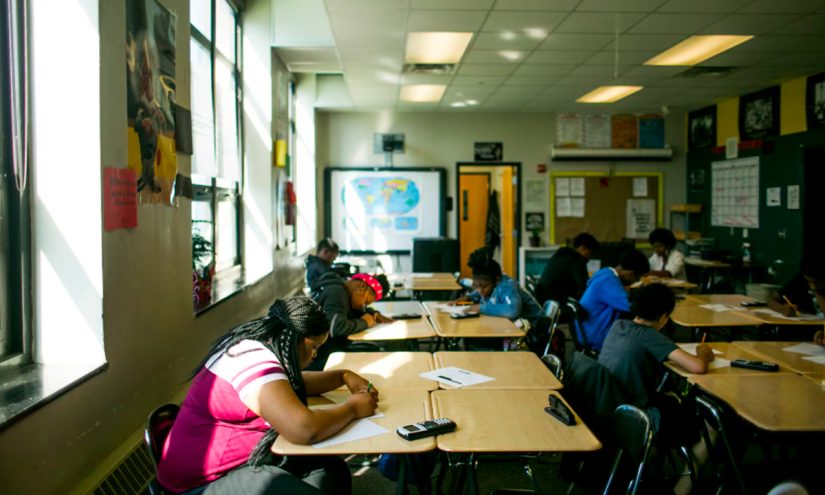
    Nearly 5,000 Detroit high school students have earned at least one $200 incentive for perfect attendance since early January.

    High school students in the Detroit Public Schools Community District can earn $200 gift cards for each two-week period in which they have perfect attendance, from Jan. 6 through March 21.

    There have been two cycles so far for which students have received the gift cards and, in addition to the 4,936 students who had perfect attendance in at least one of two-week periods, 2,028 have had perfect attendance in both cycles, according to data Superintendent Nikolai Vitti shared with Chalkbeat this week.

    The attendance incentive is aimed at improving attendance in the district, where two-thirds of nearly 49,999 students were considered chronically absent during the 2023-24 school year. The incentive is among a number of efforts the district has employed over the years to create an attendance-going culture among students. The district has invested heavily into attendance agents to improve attendance and this school year announced that students with extremely high rates of chronic absenteeism will be held back a grade at the K-8 level and required to repeat classes at the high school level.

    The number of students earning the perfect attendance incentive is a fraction of the nearly 15,000 high school students in the district, leading one school board member to question last week whether the incentive is working. But Vitti said he is encouraged that the program is getting more high school students to class and resulting in a small decrease in the chronic absenteeism rate for high school students. He said the district and board will have to evaluate the program’s success at the end of the school year.

    Chronic absenteeism has been one of the district’s biggest challenges for years. The chronic absenteeism rate has declined, from a high of nearly 80% at the height of the pandemic, when quarantining rules meant many students missed school because of COVID exposure. But last school year’s much lower chronic absenteeism rate of 66% still means it is difficult to have consistency in the classroom and improve academic achievement.

    Students in Michigan are chronically absent when they miss 10%, or 18 days in a 180-day school year. Statewide, 30% of students are considered chronically absent, compared to 23% nationally. A recent education scorecard cited the state’s rate as being a factor in students’ slow academic recovery from the pandemic.

    Here are some of the highlights of the students who’ve received the incentive so far::

    • 3,473 students had perfect attendance during the first cycle.
    • 3,492 students had perfect attendance during the second cycle.
    • About 10% already had perfect attendance.
    • About 4% were considered chronically absent at the time the incentive began.
    • About 16% had missed 10% of the school year at the time the incentive began.
    • About 25% had missed 5-10% of the school year.
    • About 44% had missed 5% or fewer days in the school year.

    At a Detroit school board meeting last week, Vitti said the statistic showing that just 10% of the students who earned the incentive already had perfect attendance is an indication that “this is not just rewarding those that have already been going to school.”

    Board member Monique Bryant questioned what school leaders are doing to promote the incentive to students who haven’t earned it.

    Bryant suggested that data Vitti shared at the meeting showing that chronic absenteeism is down by 5 percentage points for high school students since the incentive began is an illustration that most students aren’t rising to the goal of the incentive.

    Vitti responded that it depends on how you look at the data.

    “Right now, chronic absenteeism at the high school levels improved by five percentage points,” Vitti said. “That means that 700 high school students are not chronically absent where they were last year. I’d also say that at least on the 97th day, our chronic absenteeism at the high school levels is the lowest it’s been since the pandemic.”

    The question for board members to decide at the end of the school year is whether the incentive “is the right investment with other challenges that we have districtwide,” Vitti said. “But I think the data is suggesting it’s working for many students … but not all.”

    Board member Ida Simmons Short urged the district to survey students to learn more about what is preventing them from coming to school.

    The causes of chronic absenteeism are numerous and include physical and mental health reasons, lack of transportation,and lack of affordable housing. Most of them tie back to poverty. Vitti specifically cited transportation, because half of the students in the district don’t attend their neighborhood school and the district doesn’t provide school bus transportation for high school students, who must take city buses to get to school.

    “Sometimes they’re unreliable, they’re late, they’re too far away from where the child lives,” Vitti said.

    Vitti said traditional school bus transportation for high school students “was decimated” under emergency management and it could cost between $50 million and $100 million to bring that level of transportation back.

    Another factor, Vitti said, is that for some students, school isn’t relevant. Middle and high school students, in particular, “struggle to understand, ‘why am I going to school every day? How is this connected to what I’m going to I need to know for life.’”

    Mi’Kah West, a Cass Technical High School student who serves as a student representative on the board, said that when talking to other members of the District Executive Youth Council last week, many said students overall are excited about the incentive.

    One thing that stuck out, she said, was council members saying they heard students in the hallways or on social media saying they were coming to school because they want the money.

    “And, while we don’t want to just say we want to come to school for the money,” West said, “I think it’s important to see that students … may have stayed home because they don’t want to come to school, but they’re willing to come to school now.”

    Lori Higgins is the bureau chief for Chalkbeat Detroit. You can reach her at [email protected].

    Chalkbeat is a nonprofit news site covering educational change in public schools.


    Get stories like these delivered straight to your inbox. Sign up for The 74 Newsletter

    Source link