The following statement can be attributed to FIRE’s Director of Public Advocacy Aaron Terr:
The Department of Justice is reportedly investigating elected officials for criticizing the administration’s immigration enforcement operations. If this is the basis for the investigation, it is blatantly unconstitutional and intolerable in a free society. The right to condemn government action without fear of government punishment is the foundation of the First Amendment.
This would not be the first time the administration has used boundless, imaginary definitions of “obstruction” or “incitement” that have no basis in the law and run headlong into constitutional limits. The few exceptions to the First Amendment are defined by narrow, exacting standards for a reason: to prevent the government from wielding its power to squash dissent.
If criticism of government policy can be rebranded as a crime, then constitutional protections become meaningless and the government becomes unaccountable. That is precisely the danger the First Amendment is meant to prevent, and it is a line no administration may cross.
The loan program would need $30 million for its first year, based on calculations of how much Connecticut students take out in Grad PLUS loans.
Photo illustration by Justin Morrison/Inside Higher Ed | Getty Images | Rawpixel
After President Donald Trump’s One Big Beautiful Bill Act (OBBBA) overhauled federal student loans, college affordability advocates worried that those changes would severely restrict who has access to higher education—especially graduate programs. Now, lawmakers in Connecticut are taking steps to ensure students in the state can continue to afford those degrees.
Rep. Gregg Haddad, a Democrat who co-chairs the Connecticut legislature’s Higher Education Committee, announced a plan last week to create a new state-level student loan program to fill in the gap left by the elimination of Grad PLUS loans, a 20-year-old loan program that helped expand graduate education for middle- and low-income students. The program will be open to any student studying at a graduate program in the state.
Josh Hurlock, deputy director of the Connecticut Higher Education Supplemental Loan Authority (CHESLA), a quasi-public body that administers Connecticut’s state-level student loans, said the organization is hoping to launch the new program in time for students to take out loans for the 2026–2027 academic year.
“The Grad PLUS program historically has had very little credit check, so it’s been accessible to students of all credit qualities,” Hurlock said. “So, with the program going away … we want to make sure that students and schools have financing options available for their graduate students, and students and schools need to know what’s available sooner rather than later as we approach the fall semester.”
The program would require $30 million in funding for its first year, based on calculations that students in Connecticut take out between $90 million and $100 million in Grad PLUS loans annually. (Those already receiving the loans will be grandfathered in.) Two-thirds of that would come from a bond that CHESLA will issue, while the remaining $10 million would have to come from state allocations. Haddad said he is hoping the funds can be drawn from a $500 million emergency reserve the state created in November specifically to offset federal cuts.
Interest rates and borrower fees have not yet been determined, “but we think we can come up with an attractive product and solve this problem for Connecticut students,” Haddad said.
Eliminating Grad PLUS loans is just one of the restrictions on federal student loans included in the OBBBA. The legislation also placed caps on how much borrowers can take out in federal loans for graduate programs and on Parent PLUS loans for dependent undergraduates. Proponents of the limits argued that uncapped federal loans encouraged universities to increase their tuition fees, creating the student debt crisis. But supporters of federal student loan programs argue they opened the door to graduate education and careers in fields like medicine for students who previously would not have had those opportunities.
Grad PLUS loans will officially end and the caps for other federal loans will go into effect in July. Administrators at several institutions with a large number of graduate students told Inside Higher Edthat they’re still working to figure out how to close funding gaps for their students.
Filling in the gap left behind by Grad PLUS loans is especially important because Connecticut, like most U.S. states, struggles with a shortage of workers in certain professions, like nurses and teachers, Haddad said.
“We have a keen interest in making sure that we have a robust pipeline of people who want to enter those professions,” he said. “And we’d like to remove any roadblocks to having them achieve and complete their degrees so that they can get to work providing the services that people need in Connecticut.”
Peter Granville, a fellow at the Century Foundation who researches college affordability, said that it’s wise for states to consider how they can support students in the absence of Grad PLUS funding.
“State leaders know that their economies depend on these students being able to attain degrees in fields like education and nursing,” he said. “States will be worse off if [they] completely depend on private lenders filling gaps that they may or may not be inclined to fill.”
Haddad said that the proposed loan program has been received extremely well by both the public and his fellow lawmakers, whom he is hopeful will support the proposal once their legislative session begins in February.
“I was struck when we had our press conference the other day—the room was filled with nurses and social workers, physical therapists and educators from across the state,” he said. “I think it’s an indication that there’s a real problem we need to fix.”
Colorado officials say money that helps 18,000 low-income families pay for child care could run out by Jan. 31 if federal officials don’t lift the freeze they’ve imposed on funding for several safety net programs in five Democrat-led states.
If that happens, some children could go without care and some parents would have to stay home from work. State lawmakers could cover such a funding gap temporarily, though Colorado is facing a significant budget crunch.
The Trump administration announced the freeze on $10 billion in child care and social services funding for Colorado, California, Illinois, Minnesota, and New York in a press release Monday.
In letters sent to the two Colorado agencies that run the affected programs, federal officials said they have “reason to believe that the State of Colorado is illicitly providing” benefits funded with federal dollars to “illegal aliens.”
The letters didn’t cite evidence for that claim and a spokesperson for the U.S. Department of Health and Human Services didn’t respond to questions from Chalkbeat about why federal officials are concerned about fraud in Colorado.
Spokespeople from both state departments said by email on Tuesday they’re not aware of any federal fraud investigations focused on the programs affected by the funding freeze.
The five-state funding freeze follows a federal crackdown in Minnesota after a right-wing YouTuber posted a video in late December alleging that Minneapolis child care centers run by Somali residents get federal funds but serve no children. It’s not clear why the other four states have gotten the same treatment as Minnesota, but all have Democratic governors who have clashed with President Donald Trump.
In a New Year’s Eve social media post, Trump called Colorado Gov. Jared Polis “the Scumbag Governor” and said Polis and another Colorado official should “rot in hell” for mistreating Tina Peters, a Trump supporter and former Mesa County clerk who’s serving a nine-year prison sentence for orchestrating a plot to breach election systems.
The federal freeze will affect three main funding streams in Colorado that together bring in about $317 million a year. They include $138 million for the Colorado Department of Early Childhood for child care subsidies for low-income families and a few other programs.
The subsidy program, known as the Colorado Child Care Assistance program, helps cover the cost of care for more than 27,000 children so parents can work or take classes. It’s mostly funded by the federal government with smaller contributions from states and counties.
The other two frozen funding streams go to the Colorado Department of Human Services and pay for Temporary Assistance for Needy Families, or TANF, and other programs.
In the letter to the Colorado Department of Early Childhood, federal officials outlined new fiscal requirements the state will have to follow before the funding freeze is lifted. They include attendance documentation — without names or other personal identifiers — for children in the child care subsidy program.
A state fact sheet issued in response to the funding freeze said funding for the child care subsidy program would be depleted by Jan. 31. It also outlined several measures already in place to prevent fraud or waste, including state audits, monthly case reviews by county officials, and efforts to recover funds if improper payments are made.
The state said it is exploring “all options, including legal avenues” to keep the frozen funding flowing.
Six Democratic state lawmakers, most in leadership positions, released a statement Tuesday afternoon calling the funding freeze a callous move that will make life more expensive for working families.
“We stand ready to work with Governor Polis and partners in our federal delegation to resist this lawless effort to freeze funding, and we sincerely hope that our Republican colleagues will put politics aside, get serious about making life in Colorado more affordable, and put families first,” the statement said in part.
The statement was from Speaker of the House Julie McCluskie; Senate President James Coleman; House Majority Leader Monica Duran; Senate Majority Leader Robert Rodriguez; Rep. Emily Sirota; and Sen. Judy Amabile.
Chalkbeat is a nonprofit news site covering educational change in public schools.
Did you use this article in your work?
We’d love to hear how The 74’s reporting is helping educators, researchers, and policymakers. Tell us how
University of Missouri president Mun Choi is pressing local officials about crime rates near the Columbia campus after a student from neighboring Stephens College died Sunday following a downtown shooting, KCUR and the Columbia Missourian reported.
The president’s demand to address the city’s “rampant crime rate” has gathered some support, but critics say that his characterization of the local climate is overexaggerated, pointing to data from the local police department.
The shooting, which also resulted in serious injuries to two others, took place early Saturday morning on the college town’s main street. One individual, not from the city, got into a verbal dispute and then opened fire toward the people he was confronting. The three individuals he hit, however, were bystanders.
In a letter sent the same day as the shooting, Choi called on city and county leaders to bolster the police presence and prosecute crimes to the fullest extent of the law. He also urged them to take down encampments of unhoused individuals, pass a loitering notice and repeal policies that “attract criminals to the region.”
But when asked during a press conference Monday what policies and practices he believes “attract criminals,” the MU president said he had none to cite. Neither the shooter in the Saturday incident nor any of the victims have been identified as unhoused, according to local reporting.
“That is why I am asking [local leaders] to evaluate the processes that we have and the practices,” he explained. “Are we giving the impression to potential criminals that this is a region that doesn’t take crime enforcement as well as the punishment that comes with it seriously?”
Choi later added that students and local business owners have been raising safety concerns about the city’s unhoused population. According to university data, the number of arrests and trespassing violations issued to the unhoused has “gone up dramatically” since 2019, he said.
That is different, however, from what some local police department data shows.
In a Facebook post Monday, the city’s mayor, Barbara Buffaloe, said there have been 58 gunshot incidents since the beginning of the year. That’s down from 105 in the first nine months of 2024.
Columbia Police Department chief Jill Schlude did note in a separate letter, however, that since 2019 more crimes have been concentrated downtown, occurring between midnight and 3 a.m.
“The connection between late-night social activity and violence is clear, and that is where we continue to focus our efforts,” Schlude said.
Regardless of any disputes over the data, multiple government officials—including Gov. Mike Kehoe, several members of the Columbia City Council and Mayor Buffaloe—have voiced support for Choi’s general call to improve safety. Buffaloe has also committed to forming a task force on the matter, and the CPD has outlined plans to increase the police presence downtown.
“Statistics cannot be used solely as a reason for us to move away from what needs to be done in the city of Columbia,” Choi said.
Last year, FIRE launched the Free Speech Dispatch, a regular series covering new and continuing censorship trends and challenges around the world. Our goal is to help readers better understand the global context of free expression. Want to make sure you don’t miss an update? Sign up for our newsletter.
Exhibit on authoritarianism censored by authoritarians
These days, repressive regimes are not content with just censoring their critics within their own borders. They also think they have the authority to determine what the rest of the world can see, hear, and say, which is how we wind up with news like the latest out of Thailand.
In late July, staff from China’s embassy visited the Bangkok Arts and Cultural Centre, along with local city officials to demand the censorship of the exhibition “Constellation of Complicity: Visualising the Global Machinery of Authoritarian Solidarity.” The gallery granted their demands and “removed pieces included Tibetan and Uyghur flags and postcards featuring Chinese President Xi Jinping, as well as a postcard depicting links between China and Israel.” Words including “Hong Kong,” “Tibet,” and “Uyghur” were redacted. But even this was not enough for the Chinese embassy, whose staff returned to seek further redactions and “reminded the gallery to comply with the One China policy.”
In a statement, China’s foreign ministry said Thailand’s quick action to pressure the gallery to censor “shows that the promotion of the fallacies of ‘Tibetan independence,’ ‘East Turkestan Islamic Movement,’ and ‘Hong Kong independence’ has no market internationally and is unpopular.” What it actually shows, though, is that the Chinese government often throws its weight around on the global scale — and gets its way. Authoritarians in the Academy, my new book out this month, documents precisely how China has attempted to enforce this kind of censorship in global higher education.
The co-curators of the show, a married couple, have since fled Thailand, citing fears of retaliation by Thai authorities. They plan to seek asylum in the UK.
Palestine Action, internet speech, and the disastrous Online Safety Act rollout
As I explained in the last Dispatch, UK police are enacting a widespread crackdown on protests surrounding Palestine Action, a group banned under anti-terrorism legislation for damaging military planes in a protest. They’re not just arresting the group’s activists, but also any and all members of the public who express “support” for the group. That even includes a man who held up a sign of a political cartoon — one legally printed and available for sale in a Private Eye edition — that criticized the ban on Palestine Action, as well as an 80-year-old woman who was held for 27 hours for attending a protest.
Pro-Palestinian activists protest outside the Royal Courts of Justice as a judge hears a challenge to the proscription of Palestine Action under the Terrorism Act. (Pete Speller / Shutterstock.com)
These arrests were just drops in the bucket. Police arrested 532 protesters over one weekend this month, with all but 10 being arrested for words or signs “supporting” the banned group. “We have significant resources deployed to this operation,” Metropolitan Police posted on X. “It will take time but we will arrest anyone expressing support for Palestine Action.” Northern Ireland police also warned protesters that they could face prosecution.
That’s not even the only troubling free speech scandal from UK police these past weeks.
Carmen Lau, a Hong Kong activist now living in the UK and still a target of censorship from the Chinese government, says Thames Valley police asked her to sign an agreement that she would “cease any activity that is likely to put you at risk” and “avoid attending” protests to limit the likelihood of overseas repression. Then a magistrate court overturned a gag order placed on a firefighter, suggesting that police officers were attempting to enforce a “police state.” Police raided the home of Robert Moss, a firefighter who won a wrongful termination challenge in 2023, over Facebook comments he’d posted about Staffordshire’s fire department, and then told him he must not only stay silent about leadership of the fire department, but was also not permitted to even discuss the investigation itself.
Meanwhile, overzealous police are far from the only problems facing internet speech in the UK. Looming even larger is the Online Safety Act, now in effect and wreaking havoc on the UK’s internet users and the companies and platforms they engage with online. A useful collection from Reason’s Elizabeth Nolan Brown shows how requirements that sites verify age for material “harmful to children” created some absurd fallout. Age-gated content has included an X post with the famous painting Saturn Devouring His Son, news about Ukraine and Gaza, and a thread about material being restricted under the act.
The Wikimedia Foundation’s challenge to certain regulations of the law failed this month, meaning many of its concerns about the act’s threats to the privacy of Wikipedia’s anonymous editors remain. But now, the message board site 4chan is pushing back, refusing to pay a fine already doled out for its noncompliance with the law. “American businesses do not surrender their First Amendment rights because a foreign bureaucrat sends them an email,” the site’s lawyers wrote in a statement.
And to the UK citizens who understandably are uncomfortable with the burdensome and privacy-threatening process of age-verification just to use the internet, Secretary of State for Science, Innovation and Technology Peter Kyle warns: Don’t look for a workaround. Bizarrely, Kyle claimed adults verifying their age “keeps a child safe,” as if an adult’s VPN use somehow poses a risk to some child, somewhere.
Two women sentenced to a decade for printing anti-Hugo Chávez shirts
In what certainly looks like a case of entrapment, two Venezuelan women who run a T-shirt printing business were recently sentenced to 10 years in prison on charges of incitement to hatred, treason, and terrorism. They had accepted an order to print shirts featuring a photo of a protester destroying a statue of late Venezuelan President Hugo Chávez. The women were initially wary of taking the order — apparently, for good reason — but eventually accepted it from the insistent customer. While delivering the order, they were arrested by police, who also confiscated their equipment and inventory.
It’s not just in Venezuela. More censorship of political speech, protest, and journalism globally:
Ugandan authorities disappeared a student for weeks, and when public outcry finally forced them to explain his whereabouts, he “resurfaced” at a police station and was charged with “offensive communication” for intent “to ridicule, demean and incite hostility against the president” on TikTok.
Moroccan feminist activist Ibtissam Lachgar was arrested this month for posting a photo of herself wearing a shirt with the message, “Allah is Lesbian.” A public prosecutor cited her “offensive expressions towards God” and post “containing an offense to the Islamic religion.”
An Argentine legislator is being prosecuted for social media posts comparing Israel to the Nazi regime and calling it a “genocide state.” In 2020, Argentina adopted the International Holocaust Remembrance Alliance’s definition of antisemitism. (FIRE has repeatedlyexpressedconcerns about codification of the IHRA definition and the likelihood it will censor or chill protected political speech.)
Belarusian authorities arrested dozens of activists and critics who took part in anti-government protests outside Belarus, in countries including the U.S. and UK.
Russian journalist Olga Komleva was sentenced to 12 years on “extremism” charges for her ties to the late Alexei Navalny and for spreading alleged fake news about the Ukraine invasion.
Cities across Canada have withdrawn permits for performances by Sean Feucht, a right-wing Christian singer and vocal supporter of President Trump, with one Montreal church facing a $2,500 fine for going forward with his concert. Montreal mayor Valérie Plante said, “This show runs counter to the values of inclusion, solidarity, and respect that are championed in Montreal. Freedom of expression is one of our fundamental values, but hateful and discriminatory speech is not acceptable in Montreal.”
Indonesian authorities are warning about the country’s regulations on flag desecration and respect for state symbols in response to a trend of citizens posting the Jolly Roger flag from the manga One Piece as a form of protest.
Six journalists, including four with Al Jazeera, were killed by an Israeli airstrike. The Israeli military accused one of the journalists, Anas al-Sharif, of being a Hamas cell leader, but the Committee to Protect Journalists says it “has made no claims that any of the other journalists were terrorists.”
A 34-year-old Thai security guard, originally sentenced to 15 years, will spend seven years in prison for Computer Crimes Act and lese-majeste violations for insulting the monarchy on social media.
A statement from the U.S. and a number of European nations accused Iranian intelligence authorities of widespread plots “to kill, kidnap, and harass people in Europe and North America in clear violation of our sovereignty.”
Chinese officials in eastern Zhejiang province issued warnings to performers about material on gender relations in response to a comedian’s viral set about her abusive husband. “Criticism is obviously fine, but it should be … constructive rather than revolve around gender opposition for the sake of being funny,” the warning read.
Book banning abroad
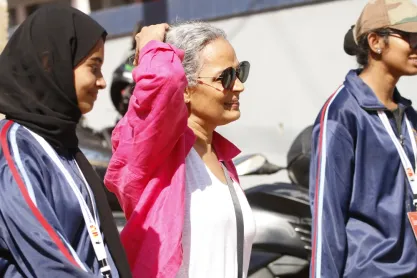
Arundhati Roy walking on village the road at Dwaraka, Kerala, India (Paulose NK / Shutterstock.com)
Under the criminal code of 2023, Indian authorities in Kashmir banned over two dozen books, including those by novelist Arundhati Roy and historian Sumantra Bose. The books allegedly promote “false narratives” and “secessionism.” Selling or even just owning these books can result in prison time.
This ban follows raids by Russian authorities of bookshops carrying titles from a list of 48 banned books, often those with LGBT themes.
Tech and the law
In enforcing its under-16 ban for social media, Australia reversed course and now will include YouTube in the group of platforms subject to the country’s age-gate ban.
French prosecutors are investigating Elon Musk’s X to see if the platform’s algorithm or data extraction policies violated the country’s laws.
Indian media outlets are disappearing past reporting amid “growing pressure from the Indian government to limit reporting critical of its policies.” One journalist told Index on Censorship that “404 journalism” is “becoming a new genre of journalism in India — stories that once were, but are now memory.”
A new law in Kyrgyzstan bans online porn to “protect moral and ethical values” in the country and “requires internet providers to block websites based on decisions by the ministry of culture”
Starting this autumn, Meta will no longer allow political or social issue ads on its apps within the EU, citing “significant operational challenges and legal uncertainties” from the forthcoming Transparency and Targeting of Political Advertising rules.
Qatar approved an amendment to a cybercrime law that criminalizes publishing or circulating images or videos of people in public places without their consent, raising an outcry from press freedom advocates. Offenders can face up to one year in prison and/or a fine of up to 100,000 Qatari riyals (about $27,500).
More suppression in and outside Hong Kong, as Jimmy Lai’s trial nears its end
Readers of the Free Speech Dispatch are likely aware of how grim the situation for free expression in Hong Kong has become in the past few years, and there are no improvements in sight. It even reaches globally. Late last month, officials issued arrest warrants for overseas activists, including those based in the U.S., for alleged national security law violations.
In recent weeks within the city, eight of Hong Kong’s public universities signed an agreement announcing their intent to comply with Xi Jinping’s and mainland China’s governance, another conspicuous sign of academic freedom’s decline in the city. The Hong Kong International Film Festival cut a Taiwanese film from its schedule for failing to receive a “certificate of approval” from the city’s film censors. Then a teenager was arrested by national security police for writing “seditious” words in a public toilet. Police said the messages “provoked hatred, contempt or disaffection against” Hong Kong’s government.
And the trial of Jimmy Lai, the 77-year-old media tycoon and founder of dissenting newspaper Apple Daily, is now reaching its conclusion. Lai, who is in poor health, has pleaded not guilty to charges of conspiracy to collude with foreign forces and conspiracy to publish seditious material in Apple Daily.
In a troubling incident in an already disturbing case, a judge overseeing the case cited speech suppression in the U.S. to justify the prosecution of Lai. “People who were freely expressing their views on Palestine, they were arrested in England… [and] in the US,” Judge Esther Toh said in court last week. “It’s easy to say ‘la-di-da, it’s not illegal,’ but it’s not an absolute. Each country’s government has a different limit on freedom of expression.”
It should be a warning sign to Americans when our government’s actions are cited abroad in favor of, not against, censorship.
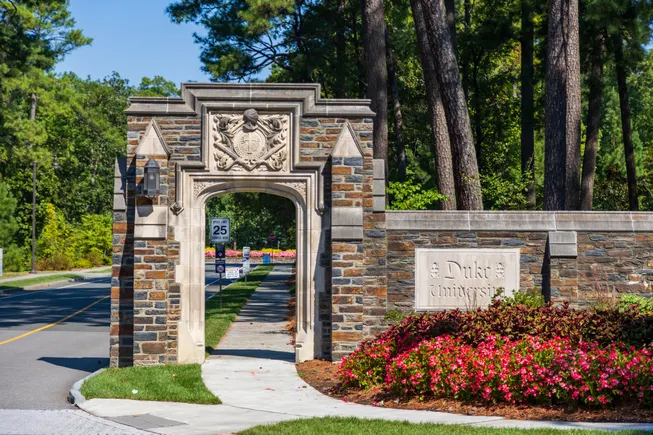
The U.S. Department of Educationannounced Monday that it has opened a civil rights investigationinto Duke University and its law journal, based on allegations that the institution racially discriminates to select the publication’s editors.
Separately, the Education Department and the U.S. Department of Health and Human Services also sent a letter Monday to university officials saying they’re reviewing allegations that Duke’s medical school and Duke Health racially discriminate in their hiring, admissions, financial aid and recruitment practices.
The probes come less than a week after U.S. Education Secretary Linda McMahon said officials hoped that Columbia University’s $221 million settlement with the federal government would be a “template for other universities around the country.”
Dive Insight:
Like with the federal government’s previous Columbia probes, the Education Department has opened an investigation into Duke University to determine whether it has violated Title VI, which prohibits federally funded institutions from discriminating based on race, color or national origin.
The department said its probe is based on recent reporting that Duke Law Journal racially discriminates against students applying to be editors. It comes one month after The Washington Free Beacon,a conservative publication, alleged that Duke Law Journal potentially gave students applying to be editors an edge if they held leadership positions in affinity groups or if they explained how their “membership in an underrepresented group” would help them promote diverse voices.
Duke Law Journal shared this information only with the law school’s affinity groups, according to the Beacon.
The letter from HHS and the Education Department doesn’t provide the source of the allegations of racial discrimination against Duke’s medical school and Duke Health.However, it says Duke Health would be “unfit for any further financial relationship with the federal government” if the federal government determines they are true.
In their letter, officials suggested they want to cut a deal with the university.
“Our Departments have historically recognized Duke’s commitment to medical excellence and would prefer to partner with Duke to uncover and repair these problems, rather than terminate this relationship,” McMahon and HHS Secretary Robert F. Kennedy Jr. wrote.
The two Cabinet secretaries demanded that the university review and reform policies at Duke Health to ensure they don’t include illegal racial preferences, including by making “necessary organizational, leadership, and personnel changes.”
They also asked Duke to establish a Merit and Civil Rights Committee, which would be delegated authority from the university’s board, to conduct the review.
“The Committee must be made up of those members of Duke’s leadership and medical faculty most distinguished in and devoted to genuine excellence in the field of medicine, and the members chosen must satisfy the federal government as to their competence and good faith,” McMahon and Kennedy said in their letter.
McMahon and Kennedy threatened Duke with enforcement actions if the federal government and the Merit and Civil Rights Committee reach an impasse — or if they don’t change the “alleged offending policies” within six months.
Following Columbia’s controversial agreement with the federal government — which also included vast policy changes — law and free speech scholars warned that the Trump administration may attempt to increase their pressure campaigns against other universities to cut deals.
“The Trump administration has made clear that while Columbia is first in line, it intends to reach comparable agreements with other schools — to scale the Columbia shakedown into a broader model of managing universities deemed too woke,”David Pozen, a Columbia law professor, wrote in a blog post. “As has already occurred with law firms, tariffs, and trade policy, regulation by deal is coming to higher education.
FIRE Letter to Trump Administration Officials on Detention of Mahmoud Khalil
March 10, 2025
The Honorable Marco Rubio Secretary of State U.S. Department of State 2201 C St., NW Washington, DC 20520
The Honorable Kristi Noem Secretary of Homeland Security U.S. Department of Homeland Security Office of the Executive Secretary Mail Stop 0525 Washington, DC 20528
The Honorable Pamela Bondi Attorney General U.S. Department of Justice 950 Pennsylvania Ave, NW Washington, DC 20530
Mr. Todd Lyons Acting Director, ICE Leadership U.S. Immigration and Customs Enforcement 500 12th St., SW Washington, DC 20536
Dear Secretary Rubio, Attorney General Bondi, Secretary Noem, and Acting Director Lyons:
On March 8, agents from the Department of Homeland Security arrested Mahmoud Khalil, a lawful permanent resident of the United States who has been involved in activism related to the current conflict in Gaza.[1] According to Mr. Khalil’s attorney, the agents who arrested him initially said his visa had been revoked.[2] Upon being informed that Mr. Khalil is a lawful permanent resident, whose status therefore cannot be revoked by unilateral DHS action, the agents arrested him anyway. When Mr. Khalil’s attorney asked to see a warrant for his arrest, DHS declined to produce one.[3] As of this writing, Mr. Khalil remains in DHS detention.
Mr. Khalil recently received a graduate degree from Columbia University, where he has participated in student protests intended to express opposition to policies of the U.S. and Israeli governments. On March 9, DHS stated that Mr. Khalil’s arrest was made “in support of President Trump’s executive orders prohibiting anti-Semitism,” and that “Khalil led activities aligned to Hamas, a designated terrorist organization.”[4] Secretary Rubio, alluding to Mr. Khalil’s arrest, stated, “We will be revoking the visas and/or green cards of Hamas supporters in America so they can be deported.”[5] On March 10, President Trump remarked on Mr. Khalil’s arrest, noting that the government intends to seek removal of any foreign students who engage in “pro-terrorist, anti-Semitic, anti-American activity.”[6]
Demonstrations occurring on Columbia’s campus since Oct. 7, 2023, have included both constitutionally protected speech and unlawful conduct, but the government has not made clear the factual or legal basis for Mr. Khalil’s arrest. The statements the government has released suggest its decision may be based on his constitutionally protected speech. This lack of clarity is chilling protected expression, as other permanent residents cannot know whether their lawful speech could be deemed to “align to” a terrorist organization and jeopardize their immigration status.
The federal government must not use immigration enforcement to punish and filter out ideas disfavored by the administration. It must also afford due process to anyone facing arrest and detention, and must be clear and transparent about the basis for its actions, to avoid chilling protected speech. To that end, we request answers to the following questions:
What was the specific legal and factual basis for Mr. Khalil’s arrest on March 8?
What is the specific legal and factual basis for Mr. Khalil’s detention?
What is the specific legal and factual basis on which you are seeking revocation of Mr. Khalil’s green card?
Will Mr. Khalil be afforded the due process protections required by U.S. law?
Is it your intention to seek the revocation of lawful immigration status on the basis of speech protected by the First Amendment?[7]
We request a substantive response to this letter no later than close of business on Tuesday, March 11, 2025. Any delay in resolving these questions risks further chilling protected speech.
Sincerely,
Carolyn Iodice Legislative and Policy Director Foundation for Individual Rights and Expression
[7] Note there is no categorical exception to the First Amendment for speech that “aligns to” or even expresses explicit support for a foreign terrorist organization.
Criticism of government and public officials is at the core of First Amendment protections. But the Institute of American Indian Arts in New Mexico is ironically using its anti-bullying policy to browbeat student critics into silence.
Last spring, David McNicholas, senior editor of the Young Warriorstudent magazine, published two student submissions reacting to recent news of the abrupt resignation of Karen Redeye, a beloved student success advisor at IAIA.
The first submission was an anonymous editorial urging students to speak up against IAIA’s “oppression” and accusing Redeye’s supervisors of bullying her to the point that “good people have no choice but to leave or sacrifice their own mental, emotional well-being.” The second submission, also from an anonymous student, was an image of a flyer referencing rumors that Nena Martinez Anaya, the dean of students, misappropriated grant money meant for food aid. The flyer read, “Karen Redeye keeps pantries full[.] Nena Martinez robs them[.] Redeye Redemption[.]”
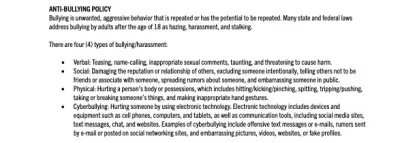
Immediately after the magazine’s publication, IAIA Provost Felipe Colon told McNicholas he was being investigated over complaints that the publication constituted bullying. Specifically, he was told that the “damaging and defamatory content” and “derogatory and unfounded misinformation” violated IAIA’s expansive anti-bullying policy — which bars everything from “teasing, name-calling” and “taunting,” to “telling others not to be friends . . . with someone” and “offensive text messages or emails.”
A third complaint, filed by Lorissa Garcia, interim director of the Student Success Center, echoed the others but added a new accusation. Namely, that in his role as public relations officer for the student government, McNicholas used its Instagram account to “promote and distribute derogatory and unfounded misinformation and rumors” concerning Garcia’s role in Redeye’s resignation.
Garcia based this allegation on the claim that the student government’s account “liked” a student’s post sharing an image of the “Redeye Redemption” flyer.
Colon found McNicholas responsible for bullying, placed him on probation through the end of the 2024–25 school year, suspended him from student housing, and ordered him to issue written public apologies to Garcia and Martinez Anaya — and publish retractions in the Young Warrior and on the student government Instagram account.
Redeye then emailed IAIA President Robert Martin to explain that she had indeed resigned from IAIA due to “maltreatment” and “bullying from direct supervisors.” Despite Redeye corroborating the editorial’s factual assertions, an appeals panel lifted the other sanctions but upheld the probation.
FIRE wrote IAIA last month, urging it to rescind the remaining sanctions and revise its overbroad and vague anti-bullying policy:
The First Amendment protects the freedom of the press to publish vehement criticism of government officials (including college administrators) like that contained in the anonymous editorial submissions printed in the Young Warrior. In fact, such criticism is at the core of the Constitution’s guarantee of expressive rights. . . . As the Supreme Court has explained, “debate on public issues should be uninhibited, robust, and wide-open, and . . . may well include vehement, caustic, and sometimes unpleasantly sharp attacks on government and public officials.”
IAIA cannot ban “teasing” and “offensive text messages” simply by labeling them bullying. In order for so-called “bullying” speech to be punishable, it must rise to the level of actionable harassment — that is, it must discriminate based on protected status and be severe, pervasive, and objectively offensive, among other criteria. An anti-bullying policy expansive enough to cover “taunting” and “telling others not to be friends . . . with someone” is unconstitutional.
But IAIA refused to rescind the sanctions or amend its policy. According to the school, its actions did not violate the First Amendment:
Mr. McNicholas was not disciplined because he published critical commentary about IAIA officials, as you state; he was disciplined for publishing harmful, hurtful, unsubstantiated and damaging statements about the persons and reputations of members of the IAIA community. There is a big difference between critical commentary and the spreading of unsubstantiated and injurious statements claiming illegal activity.
Contrary to IAIA’s assertion, constitutional protection for speech and the press extends to criticism that is “harmful” or “hurtful.” The Supreme Court has been clear: “Criticism of [public officials’] official conduct does not lose its constitutional protection merely because it is effective criticism and hence diminishes their official reputations.”
Nor does the published material lose First Amendment protection simply because it contains unproven claims. Even false or misleading statements are protected unless the expression meets the high standard for unprotected defamation. Here, that means IAIA would need to show that the published claims about Garcia and Martinez were not only false, but that McNicholas published them despite knowing — or with a “high degree of awareness” — they were false.
IAIA cannot do so. Despite throwing around a lot of terms like “misinformation,” “libelous,” “defamation,” and “slander,” IAIA has not offered any evidence to show the allegations are false, let alone that McNicholas knew they were false. Indeed, the available evidence shows he had good reason for believing the truth of the published allegations.
FIRE defends the rights of students and faculty members — no matter their views — at public and private universities and colleges in the United States. If you are a student or a faculty member facing investigation or punishment for your speech, submit your case to FIRE today. If you’re faculty member at a public college or university, call the Faculty Legal Defense Fund 24-hour hotline at 254-500-FLDF (3533). If you’re a college journalist facing censorship or a media law question, call the Student Press Freedom Initiative 24-hour hotline at 717-734-SPFI (7734).