Tag: Ohio

  • The Shutdown Is Over, But Thousands of Kids Are Still Locked Out of Head Start – The 74

    The Shutdown Is Over, But Thousands of Kids Are Still Locked Out of Head Start – The 74


    Get stories like this delivered straight to your inbox. Sign up for The 74 Newsletter

    Nearly 9,000 children across 16 states and Puerto Rico remained locked out of Head Start programming as of Friday evening, according to the National Head Start Association, despite the federal government’s reopening on Wednesday night.

    For some programs, the promise of incoming funding will be enough to restart operations. But many won’t be able to open their doors until they receive their federal dollars, which could take up to two weeks, said Tommy Sheridan, deputy director at the NHSA. 

    Sheridan said the Trump administration understands the urgency and is “moving as fast as they possibly can.”

    That said, this interruption had an opportunity cost, and it’s led to instability for families and providers, he said, adding that the shutdown caused staff to focus on issues they “should not be worried about,” such as fundraising and contingency planning.

    Some providers fear greater delays since the Trump administration shuttered half of the Head Start regional offices earlier this year. 

    “They’re going to be working as hard as they can, but they’re going to be doing it with half the capacity,” said Katie Hamm, former deputy assistant secretary for early childhood development under President Joe Biden.

    And even once the funding comes through, closed centers will need to go through a series of logistical hurdles, including reaching out to families who may have found alternative child care arrangements and calling back furloughed staff, some of whom have found employment elsewhere. 

    “Head Start is not a light switch,” Hamm said. “You can’t just turn it back on.”

    This interruption has also further eroded trust between grantees and the federal government that was already shaky, she added.

    The Administration for Children and Families did not respond to a request for comment on when programs can anticipate communication from the office or their funding.

    Since Nov. 1, approximately 65,000 kids and their families — close to 10% of all of those served by Head Start — have been at risk of losing their seats because their programs had not received their awarded funding during the longest government shutdown in history. The early care and education program delivers a range of resources to low-income families including medical screenings, parenting courses and connections to community resources for job, food and housing assistance. 

    At the peak of the Head Start closures, roughly 10,000 kids across 22 programs lost access to services, according to Sheridan. A number of the remaining programs were able to stay open through private donations, loans, alternative funding streams and staff’s willingness to go without pay.

    Valerie Williams, who runs a Head Start program with two facilities in Appalachian Ohio, was excited to tell parents that classrooms would be reopening soon. Her centers have been closed since Nov. 3, impacting 177 kids and 45 staff, many of whom already live paycheck to paycheck, she said.

    Valerie Williams runs two Head Start centers in Appalachian Ohio, serving 177 kids. (Valerie Williams)

    A number of families were doubly impacted, losing access to Head Start’s resources as well as the Supplemental Nutrition Assistance Program, also known as SNAP, simultaneously. In the days leading up to the closure, Williams and her staff prepared families as best they could, sharing information about resources for food, assistance for utilities and heating and guidance on child care options. 

    On Thursday, Williams wrote to parents via an online portal that she hopes to restart the normal school schedule sometime next week. The post was quickly flooded with comments. 

    “This is super exciting!!” wrote one parent. “Best news in a long time. Carter has been asking every day. Hope to see u guys very soon.”

    “Yayyy,” wrote another. “The kids miss you guys so much!”
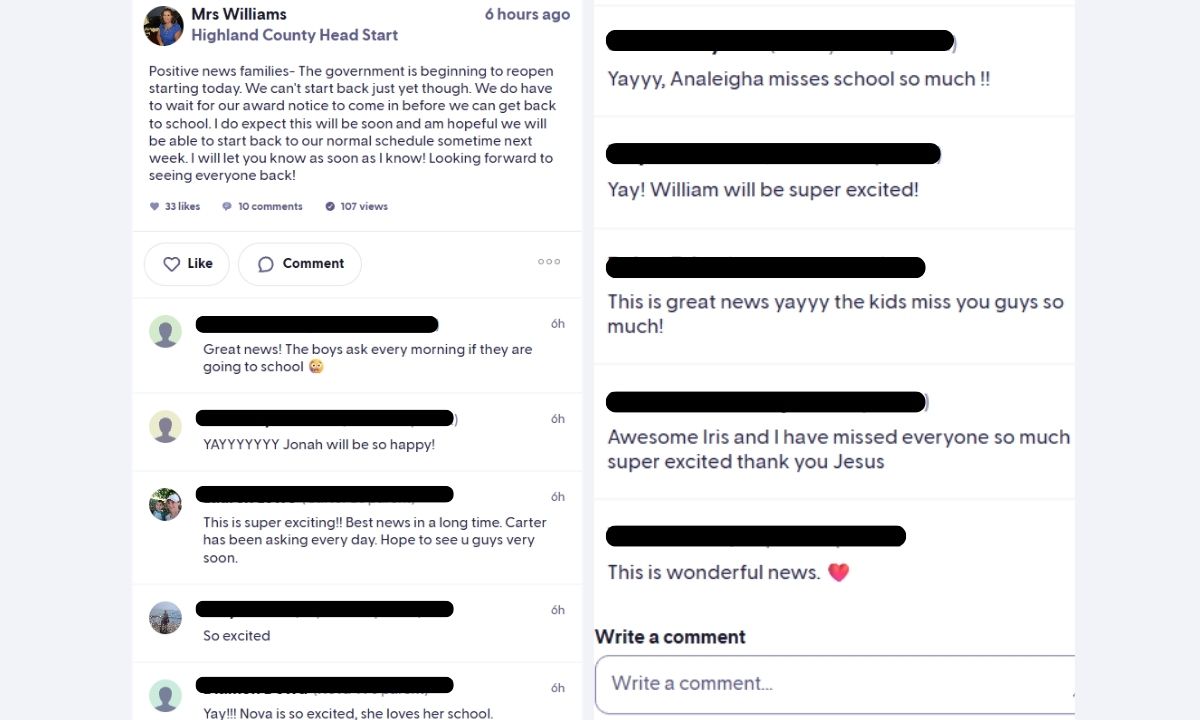
    Valerie Williams, who runs a Head Start program in Appalachian Ohio, was excited to tell parents that classrooms would be reopening soon. (Valerie Williams)

    Still, Williams knows reopening won’t be seamless. Along with program leaders across the country, she’ll need to call back furloughed staff, place food orders and handle a number of other operational challenges.

    And despite the excitement, the transition back may also prove tricky for some kids.

    “I do think that it will feel like starting school again for a lot of our classrooms,” Williams said. “They’ve been out for two weeks … You’re going to work on separation anxiety issues, you’re going to have to get into that routine again and the structure of a classroom environment. So I think that will be a big issue for a lot of our teachers.” 

    As of Friday afternoon, Williams was still awaiting communication from the federal Office of Head Start with information about the anticipated timeline for next steps. 

    “As soon as we get that notice of award, [I want to] start our staff and kids back immediately,” she said. “The very next day.”

    Now that the shutdown has ended, what’s next for Head Start?

    Funding for Head Start is complex. Some 80% comes from federal grants that are released to local providers on a staggered schedule throughout the year. This year, grant recipients with funding deadlines on the first of October and November were left scrambling, as the federal shutdown dragged on.

    The government began to resume operations late Wednesday night after President Donald Trump signed a bill, funding most federal agencies through Jan. 30 and allowing programs that didn’t receive their funding on time, including Head Start, to use forthcoming dollars to backpay expenses incurred over the past month and a half.

    Here’s what Hamm predicts will happen next: The Office of Head Start will recall all staff to resume, including those who were furloughed during the shutdown. The employees will review grant applications, a process which now requires them to flag any language that might be reflective of diversity, equity and inclusion practices. Next, money will be sent along to the remaining regional offices, and eventually dispersed to individual grantees. The NHSA is hopeful that this process will be completed by Thanksgiving for all grantees.

    There are two things the federal government can do to help centers open faster, according to Hamm. First, they could waive a typical protocol that leads to a period of seven days between when a member of Congress is notified that their state will be receiving funding and when the funding actually goes out, Hamm explained. 

    Officials could also notify grantees, in writing, about how much money they’ll get and when it’s expected to come through, so they can begin planning. 

    Unlike SNAP, which received guaranteed funding through the budget year, money for Head Start remains uncertain beyond Jan. 30. While the fear of another shutdown has caused “quite a bit of worry” among the Head Start community, Sheridan said it would likely lead to fewer program disruptions, since it wouldn’t fall at the start of the fiscal year.
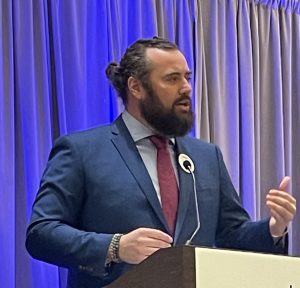
    Tommy Sheridan, deputy director of the National Head Start Association. (Tommy Sheridan)

    To prevent similar chaos moving forward, Democratic Sen. Tammy Baldwin of Wisconsin introduced a bill in the final days of the shutdown that would guarantee uninterrupted service for fiscal year 2026. 

    “The 750,000 children and their families who use Head Start shouldn’t pay the price for Washington dysfunction,” Baldwin, the ranking member of the Senate Appropriations Subcommittee for Labor, Health and Human Services, Education, and Related Agencies, wrote in a statement to The 74.

    Multiple funding threats and deep staffing cuts by the Trump administration over the past year have plunged programs across the country into uncertainty. In the wake of that recent upheaval, a leadership change is also underway. The acting director of the Office of Head Start, Tala Hooban, accepted a new role within the Office of Administration for Children and Families and will be replaced by political appointee Laurie Todd-Smith, according to an email statement from ACF. Todd-Smith currently leads the Office of Early Childhood Development, which oversees the Office of Head Start. 

    Sheridan described this move as anticipated and not particularly concerning, though others were less sure. Joel Ryan, the executive director of the Washington State Association of Head Start, noted that Hooban was a longtime civil servant and strong supporter of the Head Start program. Without her, he fears “there’s nobody internally with any kind of power that will push back,” on future threats to the program.

    Another worry plaguing providers: current funding for Head Start has remained stagnant since the end of 2024, meaning that through at least Jan. 30, programs will be operating under the same budget amid rising costs across the board.

    In previous years, the program’s grant recipients typically got a cost-of-living adjustment, such as the 2.35% bump ($275 million) for fiscal year 2024. In May, a group of almost 200 members of Congress signed a letter to a House Appropriations subcommittee, requesting an adjustment of 3.2% for 2026. A recent statement from NHSA suggested that instead, the proposed Senate bill for next year includes a jump of just 0.6%, or $77 million.

    “If we don’t see a funding increase in line with inflation, that means that Head Start will be facing a cut of that degree,” said Sheridan. “It’s just kind of a quiet cut, or a silent cut.”

    “I think what will end up happening,” said Ryan, “is you’ll end up seeing a massive reduction in the number of kids being served.”


    Did you use this article in your work?

    We’d love to hear how The 74’s reporting is helping educators, researchers, and policymakers. Tell us how


    Source link

  • Homeschooling in Ohio is Seeing Another Recent Surge After Spiking During the Pandemic – The 74

    Homeschooling in Ohio is Seeing Another Recent Surge After Spiking During the Pandemic – The 74


    Get stories like this delivered straight to your inbox. Sign up for The 74 Newsletter

    More Ohio students are being homeschooled now than during the COVID-19 pandemic.

    The number of Ohio students being homeschooled was trending upward pre-pandemic, spiked to about 51,500 students during the COVID-19 pandemic and dipped back down slightly.

    But homeschooling recently saw another surge with about 53,000 homeschooled students during the 2023-24 school year, according to data from the Ohio Department of Education and Workforce.

    The number of homeschooled students in Ohio, according to the Ohio Department of Education and Workforce:

    • 2023-24: 53,051 students
    • 2022-23: 47,468 students
    • 2021-22: 47,491 students
    • 2020-21: 51,502 students
    • 2019-20: 33,328 students
    • 2018-19: 32,887 students
    • 2017-18: 30,923 students

    There were about 3.1 million homeschooled students nationwide in 2021-22 — quite the jump from 2.5 million in spring 2019, according to the National Home Education Research Institute.

    “Homeschooling was already on a slightly slower upward trajectory, and had been for a number of years,” said Douglas J. Pietersma, research associate at National Home Education Research Institute. “What COVID did, from our perspective, is just infused it.”

    He expects the number of homeschooled students to keep growing.

    “It’s not going to put public schools out of business or anything like that, but it’s going to be a slow growth that is certainly going to be measurable over time,” Pietersma said.

    Remote learning during the pandemic made parents become more aware of what was being taught in schools, said Melanie Elsey, Christian Home Educators of Ohio’s legislative liaison.

    “I don’t think that it was a mass exodus from the public or private schools into homeschooling, but for parents who felt like they could accomplish more with one-on-one attention to learning … You can tailor the education to meet the needs of their children,” she said.

    Not everyone who switched to homeschooling stayed after the pandemic, Elsey said.

    “Some of them put their children back in because it was too much of a commitment,” she said. “So I think it was sort of a time period that parents felt comfortable trying something different to see if they could help their children learn more.”

    The modern home education movement sprung out of the 1970s and “skyrocketed” in the 1980s, Pietersma said.

    “People were either upset with the quality of education in general,” he said. “Then another group of people, it was more about the content of education.”

    Today there are many reasons why a family might opt for homeschooling.

    “Obviously, the quality of education is still one of the big issues,” Pietersma said. “Safety issues are a huge thing. People who have had their children in schools where they’ve been bullied or assaulted or had exposure to drugs … given the size of school, it may be not impossible to prevent some of those things.”

    The reason for homeschooling varies and it is not always because a family is not satisfied with their local school district, Elsey said.

    She homeschooled her children, but did not originally think it was for her family. However, she changed her mind after she enjoyed being home with her children through their preschool years.

    “We prayed about it and really felt like it was something that was worthwhile,” Elsey said.

    Jeannine Ramer has homeschooled her four children — two are now in college and two (ages 17 and 13) are currently being homeschooled.

    “Homeschooling has really strengthened our family relationships, my kids are very, very close and supportive of one another, and I think that’s all of the hours spent at home and just really learning together,” said Ramer, who lives in Alliance.

    They were not initially planning on homeschooling their children, but Ramer’s sister-in-law homeschooled her children and encouraged them to think about it as their oldest approached preschool age.

    They decided to try it for a year or two, but found it worked well for their family.

    “We loved it,” Ramer said. “We’ve had the ability to tailor each child’s education to that child.”

    A parent does not need to be a licensed teacher in order to homeschool their children, Elsey said.

    “It’s amazing how well families do because they have access to resources, really, all over the world, when you can get curriculum from anywhere that meets the needs of your students to learn to pursue their interests,” she said.

    Families who decide to homeschool their children enjoy the flexibility, Pietersma said.

    “They can tailor the education that they’re providing to their child in so many ways that an institutional school can’t just because of sheer numbers,” he said. “One teacher in a classroom with 30 students can’t take the lesson plan and tailor it to each of the 30 students.”

    Ramer’s oldest child was interested in printing and design work as a teenager, so they were able to craft his high school education to those areas. Now he is studying industrial and innovative design in college.

    “It just allowed us the ability to foster that,” she said. “There was much more flexibility.”

    Ohio Capital Journal is part of States Newsroom, a nonprofit news network supported by grants and a coalition of donors as a 501c(3) public charity. Ohio Capital Journal maintains editorial independence. Contact Editor David Dewitt for questions: [email protected].


    Get stories like these delivered straight to your inbox. Sign up for The 74 Newsletter

    Source link

  • Ohio enacted a law to regulate online program managers. Here’s what it does.

    Ohio enacted a law to regulate online program managers. Here’s what it does.

    This audio is auto-generated. Please let us know if you have feedback.

    In June, Ohio became the second state to regulate how colleges can use third-party vendors to help launch and operate their online degree programs. 

    Under a new law, both public and private colleges in Ohio must disclose on their websites for their online programs when they are using vendors to help run those offerings. Staff who work for these vendors, known as online program managers, must also identify themselves when talking to students. And it requires colleges to report OPM contracts annually to the state’s higher education chancellor. 

    The law, part of a larger state budget bill, additionally prohibits OPMs from making decisions about or disbursing student financial aid. 

    “Ohio’s law is a step in the right direction,” said Amber Villalobos, a fellow at The Century Foundation, a left-leaning think tank. “It’s great to see transparency laws because students will know who’s running their program, who’s teaching their programs.”

    The new law is the latest sign that states may take on a greater role in regulating OPM contracts, heeding calls by consumer advocates for stronger government oversight. 

    However, Villalobos said Ohio lawmakers could have improved the legislation by barring colleges from entering agreements that give OPMs a cut of tuition revenue for each student they recruit into an online program. Minnesota, the first state to pass a law regulating OPMs in 2024, prohibited its public colleges from striking tuition-share deals with these companies if they provide marketing or recruiting services. 

    U.S. law bars colleges that receive federal funding from giving incentive-based compensation to companies that recruit students into their programs. However, in 2011, federal guidance created an exception for colleges that enter tuition-share agreements with OPMs for recruiting services — but only if they are part of a larger bundle of services, such as curricular design and help with clinical placements. 

    But these deals have led to OPMs using misleading recruitment and marketing practices to enroll students and fill seats, Villalobos said. 

    “When tuition-sharing is used for marketing or recruiting purposes we’ve seen issues like predatory recruitment,” she said. 

    OPMs under scrutiny

    OPMs help colleges quickly set up and market online programs, said Phil Hill, an ed tech consultant. That’s important since launching a successful online program catering to nontraditional working adults can be challenging for colleges that typically enroll 18- to 24-year-olds, Hill said. 

    “It gives them a way to operate in the online space based on what students expect, but do it right away,” Hill said.

    However, OPM contracts have been subject to lawsuits and federal scrutiny in recent years. 

    In Ohio, for instance, legislators passed the new state law following Eastern Gateway Community College’s closure in 2024 after it offered tuition-free online college programs with an OPM. 

    After the college began working with the for-profit company Student Resource Center, its enrollment soared from just 3,182 students in fall 2014 to 45,173 enrollees by the fall 2021, according to federal data. Former employees of the college accused the relationship of turning the college into an education mill, Inside Higher Ed reported at the time

    By early 2022, the rapid enrollment growth and the college’s relationship with the Student Resource Center had attracted the attention of the U.S. Department of Education. 

    The federal agency alleged that year that the college’s free college initiative illegally charged students with Pell Grants more than those without. In response, the Education Department placed the college on Heightened Cash Monitoring 2 status, which forced the institution to pay its students’ federal financial aid out of pocket before seeking reimbursement from the agency. 

    In 2023, Eastern Gateway reached a deal with the Education Department to end its free college program. Its board of trustees voted to shutter the institution the following year.

    Source link

  • Ohio University to cut 11 academic programs to comply with new law

    Ohio University to cut 11 academic programs to comply with new law

    This audio is auto-generated. Please let us know if you have feedback.

    Dive Brief:

    • Ohio University plans to wind down 11 undergraduate programs and merge another 18 to comply with a new state law that sets minimum graduation thresholds. The university said Tuesday it would suspend admission to the programs upon receiving approval from the state higher education department. 
    • Signed in March, Ohio’s sweeping Advance Ohio Higher Education Act gave state colleges just months to determine which programs to cut. The law requires public institutions to eliminate any undergraduate program that issues fewer than five degrees annually over a three-year period.
    • At Ohio University, 36 programs fell below the allowed threshold. Along with the programs it plans to cut and merge, the university said it will request waivers to keep operating another seven.

    Dive Insight:

    With the passage of the new legislation, also known as SB 1, Ohio lawmakers made deep inroads into the academic operations of public colleges, asserting new state controls over decisions historically left to faculty and administrators. 

    The law bans diversity, equity and inclusion training, requires post-tenure review, prohibits full-time faculty from striking and even requires certain questions in student evaluations of professors. 

    SB 1 also created a policy that could wipe out dozens or even hundreds of academic programs if the experience of Ohio’s neighboring state is any gauge. 

    In Indiana, a similar policy with programmatic graduation thresholds — inserted into the most recent state budget bill has already put 75 degree programs on the chopping block. The state’s public colleges also moved to suspend another 101 programs and consolidate 232.

    As in Ohio, Indiana state colleges only had months to review their portfolios for cuts. That created uncertainty for many. 

    “Even tenured faculty are wondering, am I going to have a job in two months?” one faculty governance leader in Indiana told local media, describing “chaos and confusion” on campus. 

    At Ohio University, many programs slated to end have parallel programs that will continue. For example, the university is on track to suspend bachelor’s of arts degrees in chemistry, geological sciences, mathematics and physics, but it will continue offering bachelor’s of science degrees in those topics.

    Students currently enrolled in affected programs will be able to complete their degrees, the university said.

    Meanwhile, the institution is planning curricular changes to merge 18 programs with similar or overlapping degrees, most of them in the visual and performing and liberal arts such as instrumental music and several geography majors. 

    Ohio University requested waivers to keep open seven other programs, even though they fell below the thresholds. The institution said the degrees are unique, have undergone curriculum changes or meet workforce needs, the institution said.

    Earlier this year, the University of Toledo also announced it was suspending admissions to nine programs to comply with SB 1. 

    Some students in Ohio are protesting SB 1’s overall and widespread impacts on campuses in the state. A petition launched by the Ohio Student Association asserts that “students have lost not only programs, centers, and scholarships — but also the sense of community and support that made higher education in Ohio accessible, inclusive, and excellent.”

    The petition urged administrators at state colleges “not to overcomply with SB 1 — to act in the interest of students rather than in fear of the legislature,” adding that “institutional overcompliance furthers a broader political movement that seeks to erase the progress made toward justice in higher education.”

    The group called on campus stakeholders to wear black in protest of the bill and its impacts.

    Source link

  • Ohio State Restricts Decorations in Public Dorm Spaces

    Ohio State Restricts Decorations in Public Dorm Spaces

    Ohio State University has advised resident advisers to restrict all dorm floor and common room decor—as well as welcome programming for incoming students—to “Ohio State spirit themes” to avoid offending or alienating students. That means motifs like “retro video games and SpongeBob” motifs, which one outraged former RA on Reddit said they decorated with, won’t be allowed. 

    The move comes partly in response to SB1, a higher ed law Ohio passed in March that prohibits DEI, requires institutions to “demonstrate intellectual diversity” and mandates institutional neutrality on “controversial” subjects such as climate change, electoral politics, foreign policy, immigration, marriage and abortion.

    “SB1 was certainly a factor, but our goal is to create an open and welcoming environment for all students … including in our residence halls, as we build community throughout our spaces and programming,” Dave Isaacs, OSU communications and media relations manager, said in a statement shared with Inside Higher Ed. “And this was discussed with RAs during their orientation for the position.”

    Move-in activities are also required to be Buckeye-themed, including “necklace making and mug decorating,” the statement said.

    Students took to Reddit to pan the new decorating rules, with one commenter posting, “SB1 and university leadership has sucked the life out of literally everything.”

    “There were no comments supporting Ohio State’s decision,” the student newspaper, The Lantern, noted. “However, one user called on students to protest the state and national government over these decisions, rather than Ohio State’s administration.”

    Source link

  • Child care centers often reject kids with disabilities. Ohio and other states are trying to change that

    Child care centers often reject kids with disabilities. Ohio and other states are trying to change that

    This story about children with disabilities was produced by The Hechinger Report, a nonprofit, independent news organization focused on inequality and innovation in education. Sign up for the Hechinger newsletter.

    COLUMBUS, Ohio — When Selina Likely became director of the Edwards Creative Learning Center six years ago, she knew there was one longstanding practice that she wanted to change. For as long as she had taught at the thriving child care center, it had turned away many children with disabilities such as autism and Down syndrome. The practice was even encoded in the center’s handbook as policy.

    Likely, the parent of a child with a disability, wanted to stop telling families no, but she knew that to do that she and her staff would need more support. “I said, ‘Let’s start getting training and see what we can do.’” 

    Not too long after, her effort received a big boost from a state-funded initiative in Ohio to strengthen child care teachers’ knowledge and confidence in working with young kids with disabilities and developmental delays. That program, Ohio PROMISE, offers free online training for child care workers in everything from the benefits of kids of all abilities learning and playing together to the kinds of classroom materials most helpful to have on hand. It also offers as-needed mentorship and support from trained coaches across the state.  

    Related: Young children have unique needs, and providing the right care can be a challenge. Our free early childhood education newsletter tracks the issues. 

    Child care providers across the country — including large, established centers and tiny home-based programs — struggle to meet the needs of children with disabilities, according to a 2024 report from the U.S. Government Accountability Office. More than a quarter of parents of children with disabilities said they had a lot of difficulty finding appropriate care for their kids. And even those who do find a spot regularly encounter challenges, like having their children excluded from extracurricular activities such as field trips and even academic instruction. 

    “It’s really hard to find child care for this population, we heard that loud and clear,” said Elizabeth Curda, a director on the GAO’s Education, Workforce and Income Security team and a coauthor of the report. Even the most well-resourced centers report that they struggle to meet the needs of children with disabilities, according to Curda. 

    There’s a lot of desire at the grassroots level to change that. Ohio PROMISE and a few other recent initiatives provide models for how to expand the capacity — and the will — of child care centers to serve the more than 2 million U.S. children age 5 or below who have a disability or developmental delay.

    Cards on the walls at Edwards Creative Learning Center display the signs for different letters so students — whether nonverbal or not — can all learn sign language. Credit: Sarah Carr/The Hechinger Report

    In Vermont, for instance, officials hope to soon unveil a free, on-demand training program aimed at helping child care teachers have more inclusive classrooms. And officials in Ohio’s Summit County, home to Akron, report growing interest from other counties in creating programs based on Summit’s more than decade-old model that provides in-person training for child care operators in inclusion of children with disabilities. 

    “We’re helping to create child care centers that feel they can handle whatever comes their way, especially when it comes to significant behavior concerns,” said Yolanda Mahoney, the early childhood center support supervisor for Summit County’s disabilities board.

    The federal government until recently encouraged the creation of such models. In 2023, the federal Department of Education and Department of Health and Human Services issued a joint statement urging states to take steps to support inclusion in early childhood settings, including strengthening training and accountability. 

    Also, a year-old provision of the Child Care and Development Fund, the primary federal funding source for child care, requires that states increase the availability of child care for children with disabilities as a prerequisite for receiving funds. (However, 43 states have received waivers allowing them to delay implementation of that provision.) 

    Under the current president, federal momentum on the issue has largely stalled. While the administration of President Donald Trump hasn’t directly attacked inclusion in the context of special education, the president has criticized the term more broadly — especially when it comes to diversity, equity and inclusion. That can create uncertainty and a chilling effect on advocates of inclusion efforts of all kinds.   

    Funding for some inclusion efforts is also in jeopardy. States rely on Medicaid, which faces nearly $1 trillion in cuts over the next decade, to pay for early intervention programs for children birth to age 3 with developmental delays and disabilities. Trump has also proposed eliminating Preschool Development Grants, which states such as Vermont and Illinois have used to expand support of young children with disabilities. 

    That means over the next few years, progress on inclusion in child care settings could hinge largely on state and local investment. It helps that there’s a “real desire” among providers to enroll more children with disabilities, said Kristen Jones, an assistant director on the GAO’s education, workforce and income security team, who also worked on the report. “But there’s also a concern that currently they can’t do that in a safe way” because of a lack of training and resources.

    Related: For kids with disabilities, child care options are worse than ever

    In Ohio, the idea for Ohio PROMISE came after an appeal in 2022 from Republican Gov. Mike DeWine. He reported that families were coming to him saying they couldn’t find child care for their kids with disabilities. 

    “He said, ‘Come to me with ideas to solve that problem,’” recalled Wendy Grove, a senior adviser in the Ohio Department of Children and Youth who spearheaded development of the program.

    Grove and her colleagues had already been working on a related effort. In 2020, Ohio won a federal grant that included help exploring how well — or not — children with disabilities were being included in child care and early education settings. DeWine liked the idea Grove’s team presented of morphing that work into a state-led effort to strengthen training and support for child care teachers. They also proposed more direct support to families, including the extension of child care vouchers to families with incomes above the poverty level, with a higher reimbursement rate for children with disabilities. 

    The training, which debuted about two years ago, is provided in three levels. Jada Cutchall, a preschool teacher at Imaginative Beginnings, an early learning center just outside of Toledo, recently completed the third tier, which for her included customized coaching. Cutchall’s coach helped her create communication tools for a largely nonverbal student, she said, including a board with pictures children can point to if, for example, they want to go to the bathroom or try a different playground activity. 

    As a result, Cutchall said, she has watched kids with disabilities, including those with speech impairments and autism, engage much more directly with their classmates. “They have the courage to ask their peers to play with them — or at least not distance themselves as much as they usually would,” she said. All of the children in the classroom have benefited, she added, noting that kids without disabilities have taken an interest in learning sign language, strengthening their own communication skills and fostering empathy. 

    Child care programs where one teacher and one administrator have completed some of the training earn a special designation from the state, which may eventually be tied to the opportunity to get extra funding to serve children with disabilities. In Ohio PROMISE’s first year, 1,001 child care centers — about 10 percent of the total number in Ohio — earned that designation, according to Grove.

    For the last six years, Selina Likely has overseen the Edwards Creative Learning Center, where she’s steadily tried to enroll more children with disabilities and developmental delays. Credit: Sarah Carr/The Hechinger Report

    The effort costs a little over $1 million in state dollars each year, with most of that paying for several regional support personnel who work directly with centers as mentors and advisers. Over the last two years, Ohio has seen a 38 percent increase in the number of children in publicly funded centers who qualify for the higher voucher reimbursement rate for children with disabilities, which can be double the size of the standard voucher.

    Grove hopes that ultimately the effort plays a role in narrowing a critical and stubborn gap in the state: about 27 percent of children without disabilities show readiness on state standards for kindergarten; only 14 percent of children with disabilities do. Since so few disabilities exhibited at that age are related to intellectual or cognitive functioning, “we shouldn’t see that gap,” said Grove. “There’s no real reason.”  

    One goal of the new efforts is to reduce the number of young children with disabilities who are expelled from or pushed out of care. Those children are frequently asked to leave for behaviors related to their disability, the GAO report found.

    Several years ago, a child care center in Columbus expelled Meagan Severance’s 18-month-old son for biting a staff member. The boy has several special needs, including some related to attention deficit hyperactivity disorder. Severance brought him to Edwards Creative Learning Center, where not too long after Selina Likely shifted into the role of director. The boy also bit a staff member there — not uncommon behavior for toddlers, especially those with sensory sensitivities and communication challenges. 

    Likely was determined to work with the child, not expel him. “They put in time and effort,” said Severance. “The response wasn’t, ‘He bit someone, he’s gone.’” 

    Likely empathized. Decades earlier, her own daughter had been expelled from a child care center in her hometown of Mansfield, Ohio, for biting.

    “I was so angry and mad at the time — how are you going to kick out a 1-year-old?” she said. The center director didn’t think at all about how to help her child, Likely recalled, instead asking Likely what might be happening at home to make the child want to bite. She said she got no notice or grace period to find a new placement. “That left me in a disheartened place,” she said. “I was like, ‘I still have to go to work.”

    Seventeen years old at the time, she was inspired by the injustice of the situation to quit her job in a factory and apply to be an assistant in a child care program. She’s been in the industry ever since, gradually trying to make more space for children like her daughter, who was later diagnosed with autism.  

    Meagan Severance, a parent and teacher at the Edwards center, has worked in recent years to make her classroom more inclusive for children with all different abilities. Credit: Sarah Carr/The Hechinger Report

    As director, Likely displays the nameplate “chaos coordinator” on her desk. And she’s taken the stance that the center should at least try to work with every kid. She and some of her teachers have completed the first two tiers of the Ohio PROMISE training, as well as some related sessions available from the state. Likely estimates that about 10 percent of the children in her center have a diagnosed disability or developmental delay.

    Liasun Meadows, whose son has Down syndrome, chose Edwards several years ago for her then 1-year-old over another program better known for its work with children with disabilities. She has not been disappointed.

    Parents of kids with disabilities watch their children like a hawk, she said. “There are certain things you notice that you don’t expect others to notice, but they do at Edwards. They’ve been growing and learning alongside him.”  

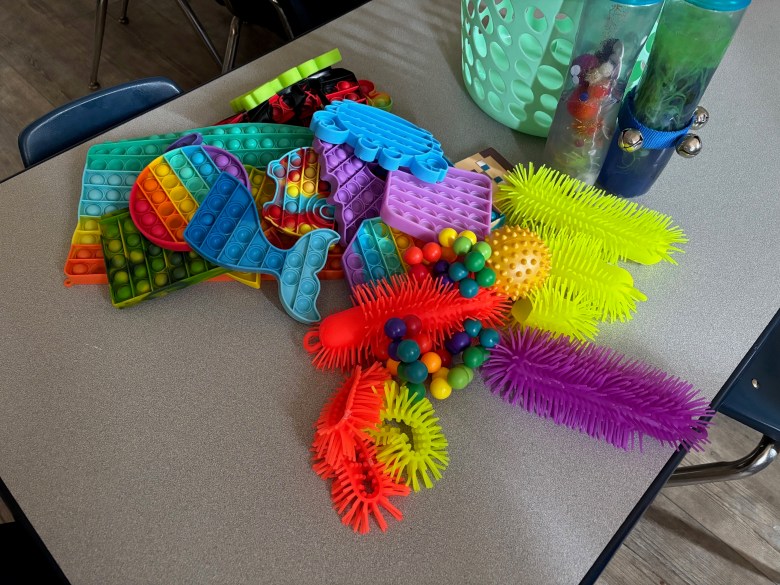
    Severance, whose son is now 8, works at the center these days, leading the 3-year-old room, which includes two children who are largely nonverbal. She’s made the classroom more inclusive, adding fidget toys for children with sensory issues, rearranging the classroom to create calming areas, providing communication books to nonverbal children so they can more easily express needs and wants, and teaching everyone some sign language. 

    “For a while there was segregation in the classroom” between the kids with disabilities and those without, Severance said. But that’s lessened with the changes. “Inclusion has been good for the kids who are verbal — and nonverbal,” she said.

    Related: Where do kids with disabilities go for child care?  

    As in Ohio, state officials in Vermont turned to online training to help ensure young children with disabilities aren’t denied quality care. The state should soon debut the first parts of a new training program, focusing on outreach to child care administrators and support for neurodivergent children. The state wanted to focus on center leaders first because “directors that are comfortable with inclusion lead programs that are comfortable with inclusion,” said Dawn Rouse, the director of statewide systems in Vermont’s Child Development Division.   

    One tool for supporting and calming children with sensory issues is keeping a healthy supply of fidget toys and Pop-Its on hand. Credit: Sarah Carr/The Hechinger Report

    Vermont also pumped millions of dollars into a separate program, known as the Special Accommodations Grant, that supports young children with disabilities. Since 2009 the state has set aside $300,000 a year that child care centers can tap to provide services for individual children with disabilities. It might help buy specialized equipment for a child with cerebral palsy, for instance, or be used to hire a full- or part-time aide.

    The $300,000 has been maxed out every year, Rouse said. And after the pandemic, the need — and the number of applications — surged.

    As a result, the state allocated some federal American Rescue Plan and Preschool Development Grant dollars to increase spending on the program by about sevenfold — to between $2 million and $2.5 million annually — an amount Rouse still describes as a “Band-Aid.” Without access to the grants, “we see a lot of children being asked to leave programs,” Rouse said. “That’s not good for any child, but for children with specialized developmental needs it’s particularly bad.” 

    Over time, Likely hopes, her Ohio center can play a small role in reducing that instability, although the center hasn’t yet been able to work with all such children it wants to. Likely recalls one toddler with a severe disability who climbed up anything he could. There wasn’t enough money to pay for what the child really needed: a full-time aide. “It’s hard when you know you’ve tried but still have to say no,” she said. “That breaks my heart more than anything.” 

    On one June morning, the center’s teachers acknowledged and celebrated several milestones in its work on inclusion, big and small. One child in the 3-year-old classroom with fine and gross motor challenges was drinking independently from a bottle. The preschool classroom held its first graduation ceremony, translated partly into sign language. All of the kids, no matter their challenges, were set to go on field trips to Dairy Queen and the zoo.

    Likely dreams of someday running a center where about half of the children have a disability or delay. It may be years off, she said, but as with the milestones she sees scores of children at the center reach every day, “There’s a way — if there’s a will.” 

    Sarah Carr is a fellow at New America, focused on reporting on early childhood issues. 

    Contact contributing editor Sarah Carr at [email protected].   

    This story about children with disabilities was produced by The Hechinger Report, a nonprofit, independent news organization focused on inequality and innovation in education. Sign up for the Hechinger newsletter.

    The Hechinger Report provides in-depth, fact-based, unbiased reporting on education that is free to all readers. But that doesn’t mean it’s free to produce. Our work keeps educators and the public informed about pressing issues at schools and on campuses throughout the country. We tell the whole story, even when the details are inconvenient. Help us keep doing that.

    Join us today.

    Source link

  • Ohio District Awarded CoSN Trusted Learning Environment Mini Seal for Student Data Privacy Practices

    Ohio District Awarded CoSN Trusted Learning Environment Mini Seal for Student Data Privacy Practices

    Washington, D.C.    CoSN today awarded Delaware Area Career Center in Delaware, Ohio, the Trusted Learning Environment (TLE) Mini Seal in the Business Practice. The CoSN TLE Seal is a national distinction awarded to school districts implementing rigorous privacy policies and practices to help protect student information. Delaware Area Career Center is the sixth school district in Ohio to earn a TLE Seal or TLE Mini Seal. To date, TLE Seal recipients have improved privacy protections for over 1.2 million students.

    The CoSN TLE Seal program requires that school systems uphold high standards for protecting student data privacy across five key practice areas: Leadership, Business, Data Security, Professional Development and Classroom. The TLE Mini Seal program enables school districts nationwide to build toward earning the full TLE Seal by addressing privacy requirements in one or more practice areas at a time. All TLE Seal and Mini Seal applicants receive feedback and guidance to help them improve their student data privacy programs.

    “CoSN is committed to supporting districts as they address the complex demands of student data privacy. We’re proud to see Delaware Area Career Center take meaningful steps to strengthen its privacy practices and to see the continued growth of the TLE Seal program in Ohio,” said Keith Krueger, CEO, CoSN.

    “Earning the TLE Mini Seal is a tremendous acknowledgement of the work we’ve done to uphold high standards in safeguarding student data. This achievement inspires confidence in our community and connects us through a shared commitment to privacy, transparency and security at every level,” said Rory Gaydos, Director of Information Technology, Delaware Area Career Center.

    The CoSN TLE Seal is the only privacy framework designed specifically for school systems. Earning the TLE Seal requires that school systems have taken measurable steps to implement, maintain and improve organization-wide student data privacy practices. All TLE Seal recipients are required to demonstrate that improvement through a reapplication process every two years.

    To learn more about the TLE Seal program, visit www.cosn.org/trusted.

    About CoSN CoSN, the world-class professional association for K-12 EdTech leaders, stands at the forefront of education innovation. We are driven by a mission to equip current and aspiring K-12 education technology leaders, their teams, and school districts with the community, knowledge, and professional development they need to cultivate engaging learning environments. Our vision is rooted in a future where every learner reaches their unique potential, guided by our community. CoSN represents over 13 million students and continues to grow as a powerful and influential voice in K-12 education. www.cosn.org

    About the CoSN Trusted Learning Environment Seal Program The CoSN Trusted Learning Environment (TLE) Seal Program is the nation’s only data privacy framework for school systems, focused on building a culture of trust and transparency. The TLE Seal was developed by CoSN in collaboration with a diverse group of 28 school system leaders nationwide and with support from AASA, The School Superintendents Association, the Association of School Business Officials International (ASBO) and ASCD. School systems that meet the program requirements will earn the TLE Seal, signifying their commitment to student data privacy to their community. TLE Seal recipients also commit to continuous examination and demonstrable future advancement of their privacy practices. www.cosn.org/trusted

    About Delaware Area Career Center Delaware Area Career Center provides unique elective courses to high school students in Delaware County and surrounding areas. We work in partnership with partner high schools to enhance academic education with hands-on instruction that is focused on each individual student’s area of interest. DACC students still graduate from their home high school, but they do so with additional college credits, industry credentials, and valuable experiences. www.delawareareacc.org

    Connect With Us

    Facebook,Twitter, LinkedIn

    eSchool News Staff
    Latest posts by eSchool News Staff (see all)

    Source link

  • Ohio and Kentucky Ban DEI, Reduce Tenure Protections

    Ohio and Kentucky Ban DEI, Reduce Tenure Protections

    Republican-controlled legislatures in two bordering states, Ohio and Kentucky, have now passed laws requiring post-tenure review policies at public universities and banning diversity, equity and inclusion offices, along with other DEI activities.

    Many faculty and some Democratic leaders say the new laws threaten academic freedom and undermine tenure. In Ohio, lawmakers passed the sweeping higher education legislation, which has been in the works for a few years, over protests from faculty and students. The Ohio Student Association, for instance, said the bill would kill higher education in the state. Meanwhile, in Kentucky, Republican lawmakers rushed legislation through the process in order to successfully override their Democratic governor’s veto and put their higher education changes into law.

    Ohio and Kentucky join Arkansas, Utah and Wyoming this year as states where Republicans have passed laws targeting DEI and/or promoting alternative “intellectual diversity.” Even if the Trump administration’s ongoing nationwide attacks on DEI founder, these laws lock in restrictions on DEI in these states, preventing institutions from reversing course on diversity program rollbacks.

    Much of the new laws in Ohio and Kentucky echo the DEI bans that the other states have enacted, but Ohio’s legislation goes further than Kentucky’s, allowing immediate “for cause post-tenure reviews,” banning strikes for a large group of faculty and much more.

    Ohio governor Mike DeWine, a Republican, signed into law Friday a version of higher education legislation that’s been debated for the last two years but had failed to pass despite Republican majorities in the capitol. Senate Bill 1, the evolution of the failed legislation, combined numerous postsecondary changes that GOP legislators have sought to enact in other states.

    Among many other things, the new law bans full-time faculty from striking. It prohibits DEI offices, DEI in job descriptions and DEI in scholarships, without defining what DEI is. It requires institutions to “demonstrate intellectual diversity” in a range of areas, including course approval, general education requirements, common reading programs and faculty annual reviews. It also requires four-year institutions to publicly post online the syllabi for undergraduate courses, including the names of the instructors and “any required or recommended readings.” Community colleges must post more general syllabi.

    SB 1 also mandates a version of institutional neutrality, requiring colleges and universities to declare they “will not endorse or oppose, as an institution, any controversial belief or policy, except on matters that directly impact the institution’s funding or mission of discovery, improvement, and dissemination of knowledge.” The “controversial” beliefs and policies that institutions are required to stay silent on include any that are “the subject of political controversy, including issues such as climate policies, electoral politics, foreign policy, diversity, equity, and inclusion programs, immigration policy, marriage, or abortion.” (Ohio colleges and universities do retain the right to endorse Congress when it goes to war.)

    The law further requires all institutions to establish post-tenure review policies—which could lead to firing tenured faculty. The legislation bans unions from using their collective bargaining rights to negotiate over these policies. And SB 1 allows certain administrators to launch “an immediate and for cause post-tenure review at any time for a faculty member who has a documented and sustained record of significant underperformance” outside their regular annual performance evaluations.

    “This bill eliminates tenure,” said Sara Kilpatrick, executive director of the Ohio Conference of the American Association of University Professors. “If certain administrators can call for post-tenure review at any time and fire a faculty member without due process, that is not real tenure, that is tenure in name only.”

    Pointing to a provision for an appeals process, Republican state senator Jerry Cirino, who filed SB 1, said, “They’re lying about that” and “once again, the AAUP is misrepresenting the facts.”

    He added that the bill is “very pro–higher education.”

    “I’m not going to fall for these false narratives that the left is trying to put out there mischaracterizing this bill,” Cirino said.

    The Ohio governor’s office didn’t respond to Inside Higher Ed’s requests for comment Monday about why DeWine signed this bill into law.

    In Kentucky, the Democratic governor didn’t go along with the legislature, vetoing an anti-DEI bill. But Republicans overrode Gov. Andy Beshear.

    Bucking Beshear

    Kentucky’s House Bill 4 bans what that legislation defines as DEI offices, employees and training in public colleges and universities, as well as the use of affirmative action in hiring and in deciding scholarships and vendor selection. It also affects curricula by barring institutions from requiring courses whose “primary purpose is to indoctrinate participants with a discriminatory concept.”

    The new law generally defines a “discriminatory concept” as one that “justifies or promotes differential treatment or benefits” for people based on “religion, race, sex, color or national origin.” It broadly characterizes DEI as promoting a discriminatory concept. And it defines “indoctrinate” as imbuing or attempting to “imbue another individual with an opinion, point of view or principle without consideration of any alternative.”

    Additionally, under the new law, the Council on Postsecondary Education, which oversees Kentucky’s public colleges and universities, can’t approve new degrees or certificates that require courses or trainings primarily intended to “indoctrinate” with discriminatory concepts. And it encourages the council to eliminate current academic programs that contain such requirements.

    Beshear vetoed House Bill 4 on March 19 and defended diversity programs, adding that the legislation attempts to “control how universities and colleges meet the needs of their students and prepare them for their future.”

    “Acting like racism and discrimination no longer exist or that hundreds of years of inequality have been somehow overcome and there is a level playing field is disingenuous,” Beshear added. “History may look at this time and this bill as part of the anti–civil rights or pro-discrimination movement. Kentucky should not be a part of that movement.”

    On Thursday, the Kentucky House voted 79 to 19 to override this veto, and the Senate voted 32 to 6.

    Beshear also vetoed another bill, House Bill 424, which required institutions to evaluate president and faculty “productivity” at least once every four years using a board-approved process. Presidents or faculty who fail performance and productivity metrics could lose their jobs, under the bill. Beshear wrote in his veto message that the legislation “threatens academic freedom.”

    “In a time of increased federal encroachment into the public education, this bill will limit employment protections of our postsecondary institution teachers” and the state’s “ability to hire the best people,” he wrote. Lawmakers overrode him with an 80-to-20 House vote and a 29-to-9 Senate vote.

    Amy Reid, Freedom to Learn senior manager at PEN America, a free speech and academic freedom advocacy group, said in an email that the new Ohio and Kentucky laws “are not only significant blows to public higher education, but also reflect a galling disregard for the voters, educators and students in these states.”

    “Ohioans were massively organized in their opposition to SB 1, with hundreds of citizens coming to the capital to testify against the bill,” Reid said. “The legislature ignored them and so did Governor DeWine.” She said there was also “strong opposition across Kentucky” to the new laws there.

    But Tom Young, chairman of the Ohio House Workforce and Higher Education Committee, said he had heard support for the legislation from students and faculty who were concerned about speaking up. He said DEI had become “a tool for dividing people,” and most opposition to SB 1 that he heard regarded its anti-strike and post-tenure review provisions.

    “I don’t believe that any of these professors are concerned about the classroom,” Young said of faculty upset about the new law.

    Source link

  • Ohio University puts Black alumni reunion weekend on hold

    Ohio University puts Black alumni reunion weekend on hold

    Ohio University has postponed its annual Black alumni reunion weekend while it reviews the event in light of the Office for Civil Rights’ Feb. 14 Dear Colleague letter, which declared illegal virtually all race-based activities at public institutions.  

    While the Black alumni reunion “has always been open to all individuals who have an interest in the event,” read a statement from the university, “based on OCR’s recent guidance related to Title VI compliance, some of the programming historically included in the event may need to be reimagined. The University is obligated to follow OCR’s guidance in order to protect our access to critical federal funding, including students’ continued access to federal financial aid.”

    The statement also cited the impact of “proposed State of Ohio legislation,” without specifically mentioning SB 1, a bill the Senate has passed that calls for the elimination of DEI statements, offices and trainings.

    “Without question, should this bill pass the House in its current form and be signed into law by the Governor, it will bring changes for all of us,” university president Lori Stewart Gonzalez wrote in an earlier message to the campus community. “However, to define today the specific changes we might make would preempt the legislative process on a bill that is not finalized.”

    Still, all signature events planned for Black alumni reunion weekend, which was scheduled for April 10–13 in Athens, were canceled.

    “While this is difficult news to share, we remain committed to honoring the legacy and accomplishments of Ohio University’s Black alumni,” said planning committee co-chairs Terry Frazier and Jillian Causey in the statement. “We will continue working with the University to develop a plan that aligns with evolving federal and state guidelines while preserving the significance of this gathering.”

    Source link