
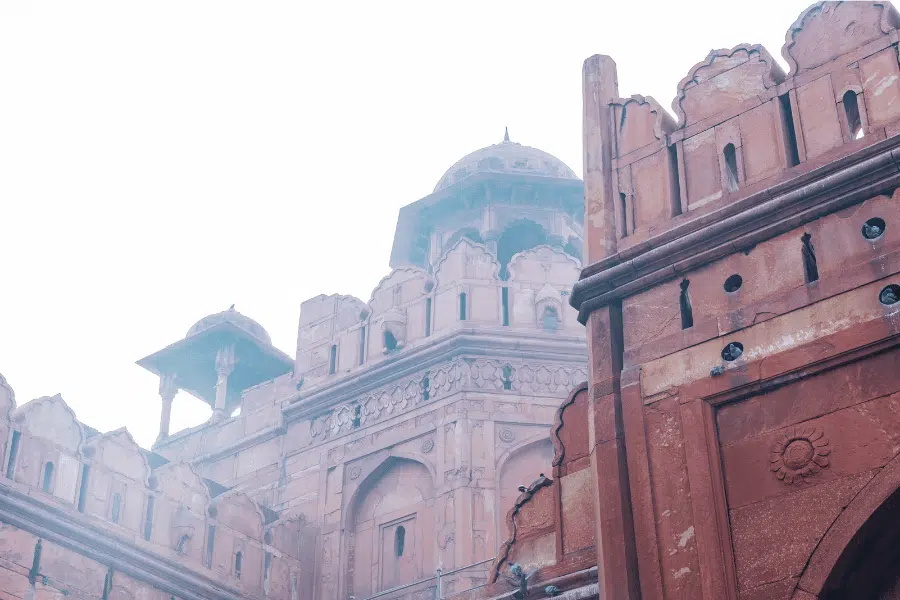
The city of Delhi, capital of India, promises to be a place that lives simultaneously in the present and past. Delhi contains seven cities within it, layered one over the other through centuries of rule, conquest and reinvention. But its future depends on whether its people and government can stave off a new invader: the dust and particulate matter caused by pollution.
Delhi in the present is a story of traffic-clogged roads, glass-and-steel high-rises and a cosmopolitan population of nearly 22 million people.
The past lingers in stone and marble, in monuments such as the Red Fort, Jama Masjid and Humayun’s Tomb. In Purani Dilli, or Old Delhi — the last great Mughal capital of Shah Jahan, known as Shahjahanabad — some of the world’s finest heritage structures sit amid dense markets, homes and roads.
Yet the people who live in this city of so much history struggle to breathe and the buildings and monuments that have withstood hundreds of years of turmoil are now being attacked by the dust particles in the pollution generated from industrial plants and cars.
From October to February, Delhi’s average Air Quality Index (AQI) routinely crosses 400 — well into the “severe” category. At some monitoring stations, it has spiked above 1,000, levels considered hazardous even for short exposure.
Smoke on sandstone
The reasons behind this pollution are complex and cumulative. An analysis by the Centre of Science and Environment, a public research organization in Delhi, has repeatedly found that vehicular emissions contribute from 20 to 40% of the pollution over the last decade. Before 2020, PM2.5 — fine particulate matter that is a major pollutant — had been decreasing but since then has increased.
In addition, the seasonal stubble burning in neighbouring states releases massive quantities of smoke and fly ash, which creates wind funnels into the city. Construction dust, coal-based power generation and the widespread use of solid fuels add further layers to an already toxic mix.
This pollution does not stop at human lungs. It settles on stone, reacts chemically with moisture and slowly eats away at Delhi’s monuments. Sulphur dioxide and nitrogen oxides in the air combine with rain and humidity to form acidic compounds. These interact with building materials — particularly sandstone and limestone — causing surface erosion, salt crystallisation and structural weakening.
A June 2025 scientific study, an Indo-Italian collaboration, documented one of the clearest signs of this damage: the formation of a thick black crust on parts of the Red Fort.
This is the same monument from which the Indian Prime Minister addresses the nation every year on Independence Day in August. The monument is of both cultural and political significance and modern pollutants are challenging its heritage.
Restoring the Red Fort
The crust on the Red Fort is largely composed of gypsum (calcium sulphate), formed when sulphur compounds from pollution react with calcium-based components on stone surfaces. The study found that these crusts trap moisture and pollutants, eventually flaking off and pulling original stone material with them.
Eleonora Balliana, a conservation scientist trained in stone restoration and chemistry, was part of the research collaboration that examined these processes.
“In comparison to European levels, the area of New Delhi has high levels of pollution based on the recorded environmental data available by the local air quality monitoring stations,” she said during her field visits to Delhi. “The levels of sulphur next to particulate [PM2.5, PM10, etc.] compounds were extremely high. It is not surprising that black crusts form so quickly here.”
Balliana notes that Delhi’s monuments are particularly vulnerable because many are built with sedimentary stones like red sandstone.
“These stones are layered, almost like an onion,” she explained. “Water and pollutants penetrate easily between layers, salts crystallise underneath and eventually the stone begins to peel and fall.”
Protecting the Taj Mahal
Rob Inkpen, an independent consultant who specializes in conservation of historical sites, said that the dangers of deterioration of the Red Fort was established back in 2007 when it was first deemed a UNESCO World Heritage Site. At the time, the International Council on Monuments and Sites, a non-governmental organisation working to conserve and protect cultural heritage sites around the world, highlighted the need for a comprehensive conservation management plan for it.
India’s most famous monument offers a cautionary parallel. The Taj Mahal, built by Shah Jahan as a mausoleum for his wife Mumtaz Mahal, began turning visibly yellow in the early 2000s. Pollution from nearby industries, traffic and the polluted Yamuna River was identified as the culprit.
To protect the Taj, the government created the Taj Trapezium Zone, a restricted area around the monument where polluting industries are banned and vehicle movement is regulated.
Has it worked? Partially. More needs to be done, several experts say.
Globally, heritage sites are also showing signs of stress, though in different ways. In Europe, climate-driven moisture, heatwaves and freeze–thaw cycles have degraded stone and wood structures.
Germany and Denmark, for instance, have experimented with traffic restrictions, buffer zones and continuous maintenance regimes. However, as Balliana points out, solutions that work in Europe cannot simply be copied in India.
“The scale, the climate and the pollution load are completely different,” she said.
Climate change makes conservation a challenge.
Climate change compounds these challenges. A major 2025 global study found that nearly 80% of UNESCO World Heritage sites already experience damaging climate stress from heat and moisture extremes.
In Asia, including India, a significant share of sites face dual stress from stone and wood materials, driven by intense rainfall events, rising temperatures and swings in humidity.
Experts, including Inkpen and Balliana, agree that regular maintenance, scientific monitoring, reducing traffic around heritage zones, expanding green buffers and implementing broader air-quality reforms are all necessary.
“The science is solid, the monitoring exists, but the real issue is whether the surrounding environment is being made any less hostile to the monument,” Inkpen said.
Balliana is clear about priorities. “Climate change is worrying, but in Delhi, pollution is more severe right now,” she said.
Heavy rains and heat accelerate decay, but it is air pollution that drives the rapid formation of black crusts and chemical corrosion.
Delhi’s monuments have survived empires, invasions and centuries of change. For Inkpen, whether these monuments can survive the modern combination of pollution and climate stress may depend on the city’s ability to clean its air.
“Dividing a complex problem into manageable ‘chunks’ that you can answer with specific methods is not unusual,” Inkpen said. “And often, overarching answers are achieved once they are integrated.”
Questions to consider:
1. In what different ways are World Heritage Sites showing signs of stress around the world?
2. Why might conservation solutions that work in Europe not work in India?
3. What historic sites have you been to and what condition were they in?