Dear Presidents, Chancellors and OTHER Temporary Custodians of My Properties:
Greetings from the Family—I mean, the Administration. You’ve been running a nice little operation there: world-class labs, libraries, free-thinking faculty, students from all over the globe who still believe in the marketplace of ideas, all asking dangerous questions like “Why?” and “What is your evidence?”
It’s over.
As the founder of a MAJOR university, I’m here to say this: We’re gonna do things my way now.
First Order of Business: You Need My Protection
As you know, I’m a SUCESSFUL international businessman. I offer certain countries—let’s call them “friends”—deals: They pay me a modest consideration, or maybe a big, beautiful luxury jet, and I won’t slap them with tariffs to make their economy bleed out. I offer the same generous arrangement to higher ed.
Take Crooked Columbia and Brownnosing Brown—smart enough to come to the table, hand over the dough and watch my charges vanish like magic. Funding? Flowing again … for now.
High and mighty Harvard’s still holding out, though, thinking they can win a staring contest. Let’s just say their next accreditation visit is gonna be … comprehensive.
UCLA? Aka Useless College for Leftist Agendas. Rumor is my friends in D.C. have started looking real close at their books. Would be a shame if we had to start collecting on that billion the hard way.
The rest of you RADICAL LUNATIC LEFT, listen up:
Investigations into your crimes against America, like “allowing students to protest” or “letting faculty disagree with the government,” can disappear overnight … for a price.
Call it a FAVOR from a friendly accreditor.
But remember, what I giveth I can take awayeth.
I don’t do promises; I do BUSINESS. And it’s business time.
Apple, Intel, NVIDIA jump when I say jump. Universities? Child’s play.
Some say I’m an ANTISEMITISM SOCIAL JUSTICE WARRIOR on campus and sure, I like the Jews. I’ll take the compliment, right alongside credit for sprucing up big, beautiful Confederate statues.
My war on hate? Let’s just say it has … range. And if a few very fine people happen to be nearby, standing back and standing by, waiting for the signal to help CLARIFY my position, well, that’s just business.
We Don’t Need Stuck-Up Elites Who Think They’re So Smart
That NASTY WOMAN at the Bureau of Labor Statistics? The one who brought me cooked-up job numbers I didn’t like? FIRED.
That Georgia political hack who couldn’t find enough votes? ENEMY OF THE PEOPLE!
Judges who cross me? Death threats from my cyber goons have them looking over their shoulders.
Your degree, your Nobel Prize, your teaching awards—SAD! I’ve built towers with my name in gold, hosted the No. 1 reality show on television, and put my face on steaks, sneakers and Bitcoin.
So you publish in that fake Ranger Rick Nature magazine. I don’t care if your lab just cured cancer; if your research questions don’t support my worldview, your grant is pulled and your lab reassigned to our friend of the family on the board, Mikey, who’s very confident about his opinion on quantum biology.
IRB? More like, “I’m Rich, Buddy.”
Loyalty—to ME—is the only credential that matters.
WOKE Faculty Hiring and Student Admissions: GONE-ZO
MARXIST MANIACS who lack American values and good Christian sensibilities have no business shaping our young peoples’ minds. Cover letters with Bible verses or Lee Greenwood lyrics will receive special consideration.
After I cut more big, beautiful deals with my AI buddies, the bots will weed out candidate files with the words “inclusive excellence” or “diversifying the pipeline.”
No more “global citizen” snowflake CRAP. In fact, pretty soon, it’s gonna be all AI at the podium—no critical thinking, no unions, no problem.
International students are allowed, but only RICH ones, with no subversive ideas, like democracy, on their social media feeds. No students from the shithole countries—you know the list. (Come to think of it, I don’t like any country, so being from one of our so-called allies won’t help either.)
NO “underrepresented” anything. ONLY OVERREPRESENTED. Racial disadvantage, adversity, “lived experience” or some “community-based” qualifications? FORGET ABOUT IT.
We’re running a university, not a sob story contest!
You want to admit a Latina who speaks three languages and started her own nonprofit? Great—as long as all three languages are English and she’s truly FEMALE.
And while we’re at it, ban “optional” diversity statements. The only statement that matters is your pledge of allegiance. To me.
Academic Freedom, Suckers!
You thought academic freedom meant hiring the best scholars, encouraging debate and letting a thousand ideas bloom.
HILARIOUS!
From now on, FREEDOM means freedom to offer academic programs that look just like the ones we had in 1952, when America was great (minus the jazz) and McCarthy knew what higher education should look like.
It took Viktor 10 YEARS to bring his universities to heel. I’m doing it in six MONTHS, results like nobody’s ever seen before.
“woMEN’s” studies? GONE.
African American literature course? Replaced with Great Books by Even Greater White Men.
Faculty scholarship on critical race theory, gender equity or, God forbid, climate science, will get an automatic tenure-denial stamp. Come to think of it, tenure? What’s that? More like Permanent Welfare for America-Hating Communists.
Just watch what you publish, pal. I can make tenure go away real fast, the same way I disappeared USAID.
My good friend VICE CHANCELLOR Rufo will replace it with rolling one-year contracts, renewable upon click-through loyalty oath training modules.
Also, just a heads-up. Any course material still using the outdated term “Gulf of Mexico” will be flagged in our next surveillance round. My top patriot and loyal adviser, Stephen, suggests: “The Gulf of AMERICA FIRST.” And you so-called political scientists, get your facts right on who won the 2020 election. You’d best update those course materials, nice and clean, and nobody’s sabbatical turns into an extended stay at Alligator Alcatraz.
Capishe? I don’t want to have to slam any more heads together.
It’s time you got the picture, EGGHEADS: Knowledge isn’t power. Power is power.
Thank you for your attention to this matter!
Your Don
P.S. I’ll let you keep your football program. You’re welcome.
Jennifer Lundquist is a professor of sociology at the University of Massachusetts Amherst. Her satirical observations in this essay are hers alone and not intended to represent the views of her employer.
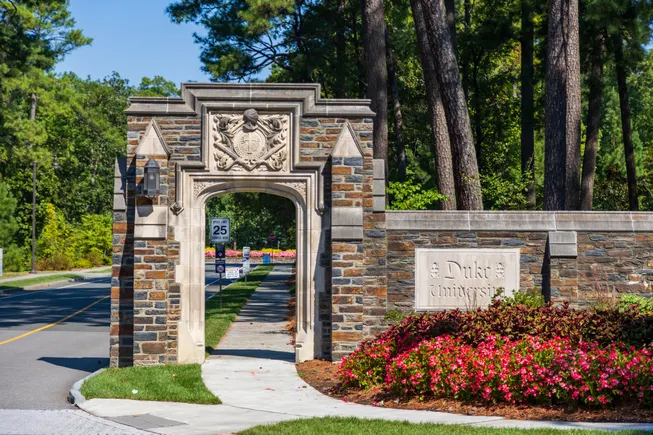
The U.S. Department of Educationannounced Monday that it has opened a civil rights investigationinto Duke University and its law journal, based on allegations that the institution racially discriminates to select the publication’s editors.
Separately, the Education Department and the U.S. Department of Health and Human Services also sent a letter Monday to university officials saying they’re reviewing allegations that Duke’s medical school and Duke Health racially discriminate in their hiring, admissions, financial aid and recruitment practices.
The probes come less than a week after U.S. Education Secretary Linda McMahon said officials hoped that Columbia University’s $221 million settlement with the federal government would be a “template for other universities around the country.”
Dive Insight:
Like with the federal government’s previous Columbia probes, the Education Department has opened an investigation into Duke University to determine whether it has violated Title VI, which prohibits federally funded institutions from discriminating based on race, color or national origin.
The department said its probe is based on recent reporting that Duke Law Journal racially discriminates against students applying to be editors. It comes one month after The Washington Free Beacon,a conservative publication, alleged that Duke Law Journal potentially gave students applying to be editors an edge if they held leadership positions in affinity groups or if they explained how their “membership in an underrepresented group” would help them promote diverse voices.
Duke Law Journal shared this information only with the law school’s affinity groups, according to the Beacon.
The letter from HHS and the Education Department doesn’t provide the source of the allegations of racial discrimination against Duke’s medical school and Duke Health.However, it says Duke Health would be “unfit for any further financial relationship with the federal government” if the federal government determines they are true.
In their letter, officials suggested they want to cut a deal with the university.
“Our Departments have historically recognized Duke’s commitment to medical excellence and would prefer to partner with Duke to uncover and repair these problems, rather than terminate this relationship,” McMahon and HHS Secretary Robert F. Kennedy Jr. wrote.
The two Cabinet secretaries demanded that the university review and reform policies at Duke Health to ensure they don’t include illegal racial preferences, including by making “necessary organizational, leadership, and personnel changes.”
They also asked Duke to establish a Merit and Civil Rights Committee, which would be delegated authority from the university’s board, to conduct the review.
“The Committee must be made up of those members of Duke’s leadership and medical faculty most distinguished in and devoted to genuine excellence in the field of medicine, and the members chosen must satisfy the federal government as to their competence and good faith,” McMahon and Kennedy said in their letter.
McMahon and Kennedy threatened Duke with enforcement actions if the federal government and the Merit and Civil Rights Committee reach an impasse — or if they don’t change the “alleged offending policies” within six months.
Following Columbia’s controversial agreement with the federal government — which also included vast policy changes — law and free speech scholars warned that the Trump administration may attempt to increase their pressure campaigns against other universities to cut deals.
“The Trump administration has made clear that while Columbia is first in line, it intends to reach comparable agreements with other schools — to scale the Columbia shakedown into a broader model of managing universities deemed too woke,”David Pozen, a Columbia law professor, wrote in a blog post. “As has already occurred with law firms, tariffs, and trade policy, regulation by deal is coming to higher education.
More than 400,000 K-12 educators across the country will get free training in AI through a $23 million partnership between a major teachers union and leading tech companies that is designed to close gaps in the use of technology and provide a national model for AI-integrated curriculum.
The new National Academy for AI Instruction will be based in the downtown Manhattan headquarters of the United Federation of Teachers, the New York City affiliate of the American Federation of Teachers, and provide workshops, online courses, and hands-on training sessions. This hub-based model of teacher training was inspired by work of unions like the United Brotherhood of Carpenters that have created similar training centers with industry partners, according to AFT President Randi Weingarten.
“Teachers are facing huge challenges, which include navigating AI wisely, ethically and safely,” Weingarten said at a press conference Tuesday announcing the initiative. “The question was whether we would be chasing it or whether we would be trying to harness it.”
The initiative involves the AFT, UFT, OpenAI, Microsoft, and Anthropic.
“We are actually ensuring that kids have, that teachers have, what they need to deal with the economy of today and tomorrow,” Weingarten said.
The academy will be based in a city where the school system initially banned the use of AI in the classroom, claiming it would interfere with the development of critical thinking skills. A few months later, then-New York City schools Chancellor David Banks did an about-face, pledging to help schools smartly incorporate the technology. He said New York City schools would embrace the potential of AI to drive individualized learning. But concrete plans have been limited.
Vincent Plato, New York City Public Schools K-8 educator and UFT Teacher Center director, said the advent of AI reminds him of when teachers first started using word processors.
“We are watching educators transform the way people use technology for work in real time, but with AI it’s on another unbelievable level because it’s just so much more powerful,” he said in a press release announcing the new partnership. “It can be a thought partner when they’re working by themselves, whether that’s late-night lesson planning, looking at student data or filing any types of reports — a tool that’s going to be transformative for teachers and students alike.”
Teachers who frequently use AI tools report saving 5.9 hours a week, according to a national survey conducted by the Walton Family Foundation in cooperation with Gallup. These tools are most likely to be used to support instructional planning, such as creating worksheets or modifying material to meet students’ needs. Half of the teachers surveyed stated that they believe AI will reduce teacher workloads.
“Teachers are not only gaining back valuable time, they are also reporting that AI is helping to strengthen the quality of their work,” Stephanie Marken, senior partner for U.S. research at Gallup, said in a press release. “However, a clear gap in AI adoption remains. Schools need to provide the tools, training, and support to make effective AI use possible for every teacher.”
While nearly half of school districts surveyed by the research corporation RAND have reported training teachers in utilizing AI-powered tools by fall 2024, high-poverty districts are still lagging behind their low poverty counterparts. District leaders across the nation report a scarcity of external experts and resources to provide quality AI training to teachers.
OpenAI, a founding partner of the National Academy for AI Instruction, will contribute $10 million over the next five years. The tech company will provide educators and course developers with technical support to integrate AI into classrooms as well as software applications to build custom, classroom-specific tools.
Tech companies would benefit from this partnership by “co-creating” and improving their products based on feedback and insights from educators, said Gerry Petrella, Microsoft general manager, U.S. public policy, who hopes the initiative will align the needs of educators with the work of developers.
In a sense, the teachers are training AI products just as much as they are being trained, according to Kathleen Day, a lecturer at Johns Hopkins Carey Business School. Day emphasized that through this partnership, AI companies would gain access to constant input from educators so they could continually strengthen their models and products.
“Who’s training who?” Day said. “They’re basically saying, we’ll show you how this technology works, and you tell us how you would use it. When you tell us how you would use it, that is a wealth of information.”
Additionally, Trevor Griffey, a lecturer in labor studies at the University of California Los Angeles, warned the New York Times that tech firms could use these deals to market AI tools to students and expand their customer base.
This initiative to expand AI access and training for educators was likened to New Deal efforts in the 1930s to expand equal access to electricity by Chris Lehane, OpenAI’s chief global affairs officer. By working with teachers and expanding AI training, Lehane hopes the initiative will “democratize” access to AI.
“There’s no better place to do that work than in the classroom,” he said at the Tuesday press conference.
Chalkbeat is a nonprofit news site covering educational change in public schools.
Like many Wonkhe readers, I’ve been lucky enough this year to support a young person weighing up their post-18 options.
If you are the person in someone’s life that “really understands universities” it does often fall to you to sift through the vagaries of our recruitment and application process. Just what are “predicted grades” and why are they different from what someone got in their mocks? Why can you only apply to five courses on UCAS? Why, for that matter, does it cost money to apply via UCAS? Why are league tables so silly? Is there really a “Discover Uni”?
The new aspect for me this year has been the world of the open day. On a succession of unseasonably rainy weekends I’ve been finding my way around campuses, under strict instructions not to mention who I work for or wear any Wonkhe merch (“so embarrassing!”) and speaking to academics and support staff about undergraduate entry in 2026.
Performativity
I’d love to say it has all brought back memories of my own open day adventures many years ago – in all honesty it has not. I never visited the university I ended up studying at prior to securing a place, my memory of the others is more of the cities and towns than the campuses and corridors.
And that’s kind of the thing. If you are visiting an open day you are asking about third year options and work placements, but the decision that is being made is more along the lines of what it would be like to live and study in a place. The most successful open days I have seen this year have leaned into this – what would a lecture be like? How would you get from where you live to where you study? What else would I be doing outside of my studies? Where might I get a job?
Academic staff – be they course leaders making a presentation or just generally making themselves available to chat, have often seemed terrified to speak to young applicants and their escorts. I’ve heard an awful lot about course revalidations and QAA Subject Benchmark Statements (yes really!), and while this is clearly great for me I can’t really see anyone else getting much out of it. When you sign up to “the talk” on your subject of choice what I would expect to get is a sense of enthusiasm about the subject and an openness to engage with others who have an interest: we can perhaps assume that anyone who wants to will have read about the course structure on the internet (or even, at one university, in an actual honest-to-god paper prospectus).
My go-to approach for speaking to shy academics is to ask about their personal research interests – all the best conversations we’ve had have been around the particular interests of my prospective student and those of the academics. I feel like it would be good to work some of this into the more formal aspects of the day.
The feel
Applicants and their adults have often asked about practical “feel” based stuff – there’s been a lot of questions raised about assessment strategies and exams versus essays and presentations. The interest in post-degree employment is very real – and there is a trend towards listing industry partners (when done best it has offered tangible examples of how students would experience these partnerships).
There’s also the inevitable question of entry requirements. Just about everywhere I’ve been has taken pains to reassure that there may be a place even if the grades aren’t quite there next summer – staff at all kinds of providers are actively promoting clearing entry.
If you are not involving current students in open days you should be (and if you are, be sure to pay them – as you should everyone involved – for what is a very hard day’s work). Speaking to somebody only a few years older than you, who is living the life you are trying on for size, is what really seems to light applicants up. And the more informal the conversation the better it seems – interpolations in course presentations are good, a student-led tour is better, seeing students demonstrate the skills they have learned was excellent, and a sly joke shared in the student accommodation viewing is pretty much the best of all.
Vibes
Applicants are very good at picking up the overall mood of the day. If people act like the event has arrived suddenly on campus, and nobody is really clear what is going on, you can pick it up a mile off. And this year keeping the positive mood is not easy if you know the scale and direction of staff and funding cuts coming your way: it is very hard to “sell” an applicant on a course if you know it will have less options and less resources than it did this year.
Likewise, basic hygiene factors stand out a mile (and I don’t just mean the halls of residence bathrooms…). If we’re sat having a coffee in the SU – something we always tried to do as a way of getting a sense of what campus life is like – it does rather stand out when there was supposed to be food available but it has all gone, or if all the posters seem to be for events that happened in 2023. I mean, posters are infinitely preferable (if the LGBT+Soc ran Chappell Roan bingo for pride day I am one hundred per cent there for it!) to glossy pictures and sidewinders wheeled out for the day, but maybe check if they are recent?
Likewise, if visitors will be parking on campus some kind of an advanced plan would help – and if you have student services folks sitting at tables make sure there are actual people at the tables to talk to throughout the day.
It’s the little moments. We were surprised to meet a vice chancellor that was clearly and obviously proud of their university, and who had signed up to do a series of rolling introductory talks. The question I got from next to me (“how often would I meet the vice chancellor as a regular student?”) was interesting – all though frankly I was more exercised about the fact that I’d seen the vice chancellor present a golden slide promoting a “TEF Gold in student experience” with the overall silver noted in tiny writing at the bottom.
The awards and the league table placings really come across as noise – I didn’t see any applicant looking remotely impressed, although some were interested in graduate destinations and links to employers.
An open day is an audition. An applicant is trying on the idea of being a student at your university – the best way to respond (and I’ve seen this done really well) is to set out just how great the student experience actually is: the TEF components are perhaps less impressive than what actual students say and the intangible “feel” of the campus. Students spend a lot of time asking “where do I go now?” – applicants have pretty much the same question.
Good call. A well-run open house can be one of the most powerful tools in your enrollment and engagement strategy. Whether you’re welcoming new elementary parents, high school prospects, or college hopefuls, this is your chance to make an unforgettable first impression. An open house in school is important because it helps build a sense of community, foster parent involvement, and drive enrollment.
But a memorable open house doesn’t happen by accident. It requires careful planning, creative ideas, and attention to detail. From initial promotions to day-of execution and follow-up, every step counts.
So, how do you make it count?
Let’s walk through ten practical (and proven) tips to take your school’s open house from good… to exceptional.
Struggling to stand out in a crowded market?
Boost enrollment with tailored open house strategies!
1. Start Planning Early And Promote Like a Pro
Here’s the truth: If no one shows up, nothing else matters.
That’s why promotion is the first step, and it’s a big one. First, get clear on your goals. Are you looking to boost applications? Showcase new facilities? Strengthen relationships with current families? Your goals will shape everything from the schedule to who you invite.
How do you prepare for an open house at school? Start by setting clear goals and selecting a date that works for your audience. Plan the schedule, secure staff and student volunteers, and prepare promotional materials. Promote the event across multiple channels (website, email, social media), tidy up the campus, and organize signage, welcome tables, and printed resources to ensure a smooth, welcoming experience.
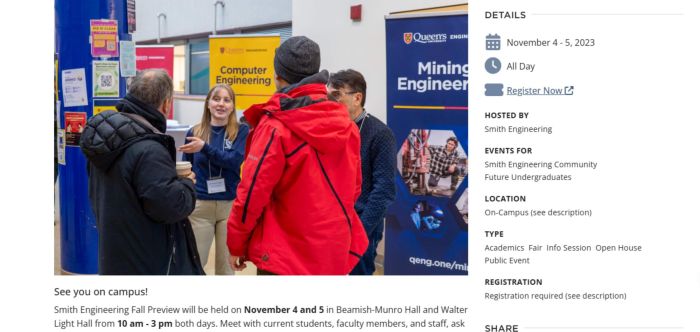
Example: Queen’s University (Canada) demonstrated advanced planning by creating a dedicated “Fall Preview” Open House webpage months ahead. The page provided key details (date, schedule, location) and prominently featured a call-to-action for prospective students to register, ensuring maximum visibility and early sign-ups.
Then, plan your outreach. Don’t wait until the last minute. Get your date on the calendar months in advance, and begin promoting it strategically across various online channels:
A dedicated landing page on your school’s website (with RSVP).
A short email series to build awareness and excitement.
Countdown posts, teaser videos, and stories on social media.
Text reminders or personal phone calls to those most likely to attend.
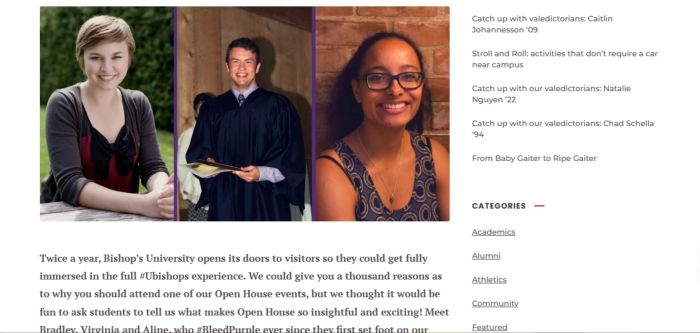
Example: Bishop’s University (Canada) boosted promotion by publishing a blog post prior to their Open House that walked readers through what to expect at the event. This preview-style post generated excitement and informed prospective students and parents about the Open House experience in detail.
Still want more attendees? Consider offering a virtual option. Whether it’s a livestream, a digital campus tour, or a short webinar, giving families more than one way to experience your school expands your reach.
2. Make Arrival Smooth and the Welcome Unforgettable
Let’s face it, no one enjoys showing up somewhere and feeling lost.
That’s why the moment guests arrive at your open house, the experience should feel seamless and friendly.
Start with signage. Make sure every guest knows exactly where to park and where to go. Have greeters ready: staff, student leaders, or enthusiastic parent volunteers. A welcome table with a map, a friendly smile, and a short overview of what’s ahead can work wonders.
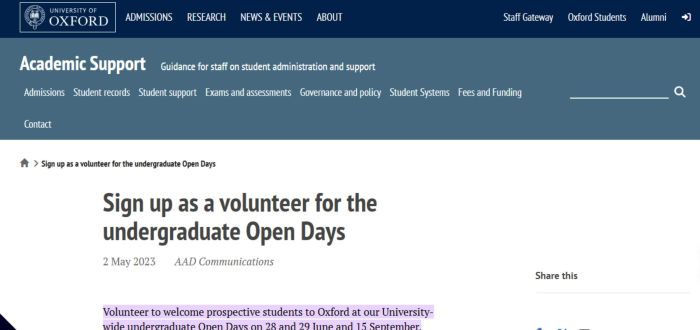
Example: University of Oxford (UK): For its 2023 undergraduate Open Days, Oxford enlisted staff volunteers as greeters and guides. These volunteers welcomed visitors, helped with directions around campus, and served as friendly points of contact at entrances and info tables, ensuring guests felt comfortable and never lost.
Don’t stop there. Decorate with banners, student art, or a slideshow of school activities. Create a warm and exciting vibe the moment families step inside. You’re not just showing them the campus, you’re showing them the community they could be a part of.
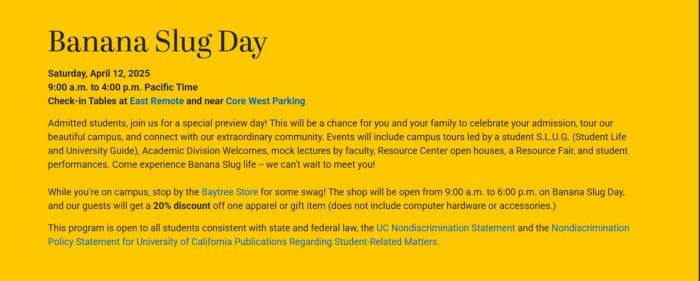
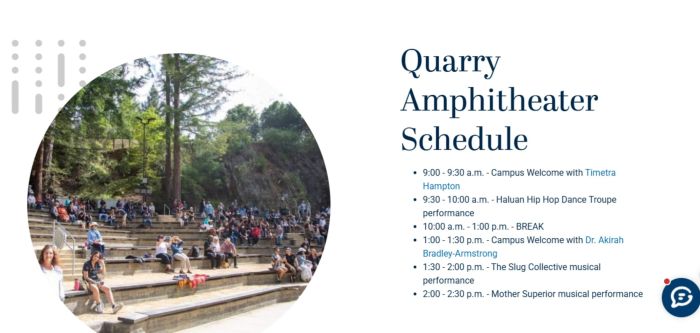
Example: UC Santa Cruz (USA): At its “Banana Slug Day” admitted-students open house in 2025, UC Santa Cruz set up check-in tables at key parking areas and deployed student guides (the “S.L.U.G.” ambassadors) throughout campus. Visitors were greeted at these welcome points and guided by the student ambassadors, making navigation easy and the arrival experience warm and organized.
3. Spotlight the People Who Make Your School Special
The facilities are nice. Programs are great. But what really wins hearts?
Your people.
That’s why teachers, support staff, coaches, and counselors need to be front and center during the open house. Make sure they’re not just present but prepared. Equip them with key talking points and FAQs so they feel confident answering questions and reinforcing your school’s values.
What should teachers do for open house? Teachers should prepare a welcoming classroom with student work on display, provide a brief overview of their curriculum, and have handouts with contact information and expectations. During the event, they should greet families warmly, answer general questions, and encourage follow-up meetings for individual concerns.
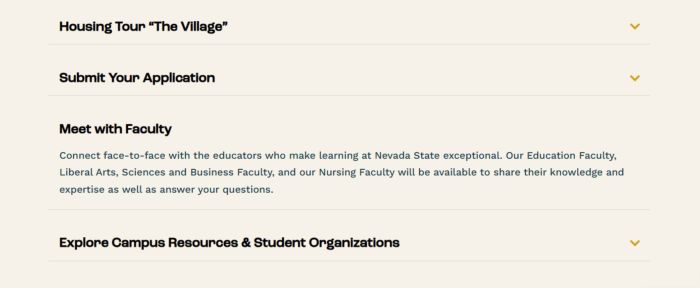
Example: During Nevada State’s Open House, faculty participation was a centerpiece. The event agenda included “Meet with Faculty” sessions where professors from various departments (Education, Liberal Arts & Sciences, Nursing, etc.) were on hand to chat and answer questions. This gave visitors a chance to connect face-to-face with the educators and get a feel for the academic community.
Encourage classroom displays that show what day-to-day learning looks like. And while teachers should be warm and approachable, remind them this isn’t the time for parent-teacher conferences. Keep it general, upbeat, and informative.
Want to go the extra mile? Kick off the event with a welcome from your school leader, followed by a quick intro to the key staff attendees. Let families know who’s who, and who they can talk to about specific interests like arts, athletics, or academics.
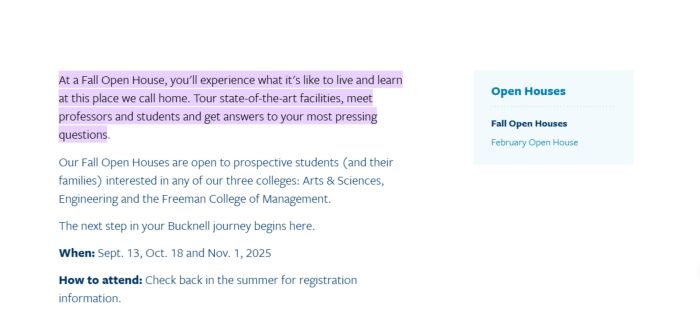
Example: Bucknell’s Fall Open House actively involved faculty and staff in mingling with prospects. Visitors could tour facilities and meet professors and current students to ask questions about programs and campus life, rather than only hearing formal presentations. This personal professor-student engagement at Open House helped put a human face on the university’s academics.
Your current students and parents are your school’s best spokespeople. Hearing about the school’s strengths from an administrator or teacher is valuable, but hearing it from a peer can be even more persuasive. In marketing terms, it’s social proof, and it carries a lot of weight. In fact, one study found that 93% of people trust recommendations from friends and family, while only 38% trust advertising.
Applying this to an open house, a prospective student is likely to trust the words of a current student, and parents will trust the perspectives of other parents, more than any brochure or formal presentation.
That’s why student ambassadors and parent advocates are some of your most valuable open house lead generation assets.
Hand-pick current students who represent the best of your school; friendly, positive, and articulate. Let them lead tours, greet visitors, or share their experience during a short panel. Their enthusiasm is contagious. As one education marketing expert put it, hearing directly from current students and parents can be one of the most powerful ways to engage prospective families.
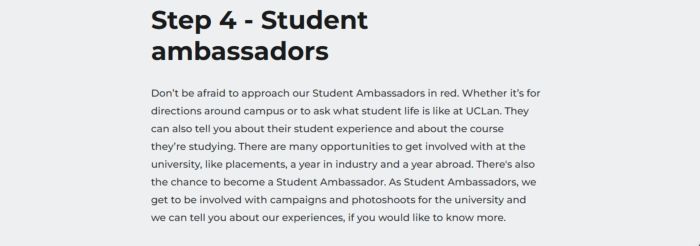
Example: University of Central Lancashire (UK) : At UCLan’s Open Days, current students act as official ambassadors (identifiable in special red attire). These student ambassadors welcome visitors at entrances, give campus directions, and share honest insights about student life and their courses. Attendees are encouraged to approach them with any questions, making the experience peer-guided and relatable.
Similarly, invite a few involved parents to chat with prospective families. Their personal stories, why they chose the school, how their child has grown, carry a weight that even the best marketing can’t match.
You’re not just saying, “We’re great.” You’re showing it.
5. Make the Event Fun, Interactive, and Memorable
Let’s be honest: No one wants to sit through a two-hour lecture.
So here’s your mission: Turn your open house into an experience.
How do you make an open house at school fun? Incorporate interactive elements like hands-on activities, themed scavenger hunts, live demonstrations, or student performances. Offer refreshments, set up a photo booth, and keep presentations short and engaging. The goal is to create an energetic, memorable experience that showcases school spirit.
Instead of a long presentation, create a rotating itinerary. Let families move through classrooms, labs, and activity spaces at their own pace. Throw in a scavenger hunt or “passport” that gets stamped at each stop. Offer a prize at the end for completing the journey.
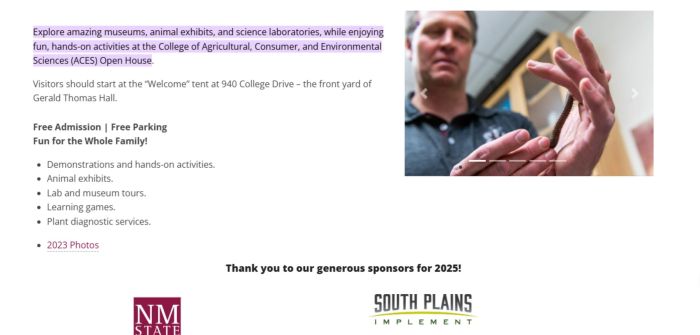
Example: New Mexico State (USA): The College of ACES Open House 2025 at NMSU was designed as a family-friendly, interactive event. Visitors could roam through animal exhibits, science labs and museums with hands-on demonstrations and learning games at each stop. From petting zoo stations to chemistry experiments, attendees of all ages were invited to actively engage, making the Open House both educational and fun.
What else works? Hands-on demos. Let students try a science experiment, play with robots, sample the art room, or participate in a music warm-up. The more your visitors can do, not just see, the more they’ll remember.
Don’t forget the snacks. Coffee, cookies, or treats from the culinary class add comfort and create natural mingling moments. Bonus points if they’re decorated with school colors or logos.
And yes, music, performances, or even a visit from your mascot can energize the space and give families that “wow” moment.
Example: UC Santa Cruz (USA): The Banana Slug Day Open House combined campus exploration with fun activities. Prospective students and families joined student-led tours, watched student performances, visited a resource fair, and even sat in on mock mini-lectures by faculty. These interactive elements (plus chances to snag some UC Santa Cruz swag at the bookstore) turned the day into an immersive campus experience rather than a passive info session.
You’ve got a lot to say, but that doesn’t mean you should say it all at once.
Keep any formal presentations concise and dynamic. Ten to fifteen minutes max is ideal. Focus on the core message: What makes your school stand out? What are the values driving your mission?
Break up speeches with visuals; videos, photos, and student voices make everything more relatable. If you can, include a current student or alum to co-present. Their stories add authenticity and emotion.
Whatever you do, rehearse in advance. A confident, polished delivery makes all the difference.
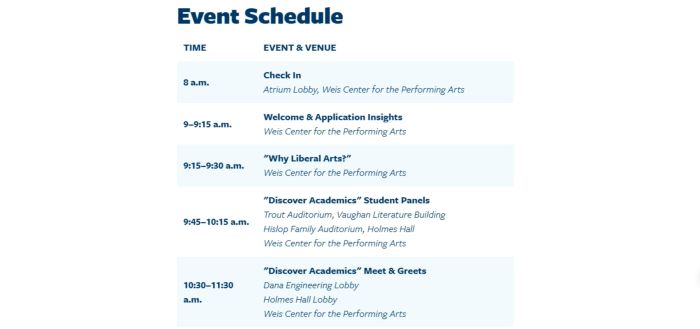
Example: Bucknell keeps Open House presentations brief and purposeful. Its Fall Open House schedule is broken into short sessions: for example, a 15-minute welcome and admissions overview followed by a 15-minute “Why Liberal Arts?” talk. Instead of long lectures, Bucknell offers multiple bite-sized talks and student panels, which keep visitors engaged and allow them to sample various topics without fatigue.
Before the event, ask registrants about their interests: academics, sports, arts, etc. Use this intel to tailor their visit. Match them with the right teacher, program head, or club coordinator. Let them know you were expecting them.
Even on the fly, personalization is powerful. Train ambassadors and staff to ask questions and respond accordingly: “You’re interested in robotics? You’ve got to meet Mr. Jackson. Let me introduce you.”
Name tags, interest-specific packets, or a simple, “Hi Sarah, we’re so glad you’re here,” can go a long way in helping families feel seen.
And yes, be mindful of accessibility needs, language support, and dietary restrictions. Every thoughtful detail adds up.
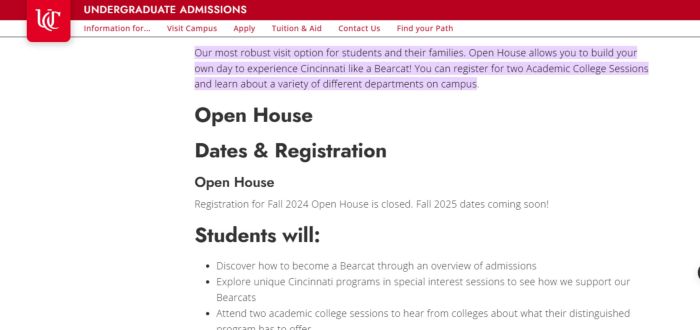
Example: University of Cincinnati (USA): Cincinnati’s Open House model allows each guest to “build your own day.” Attendees register for the specific academic sessions and special topics that interest them most. For example, a student could choose two different college info sessions (say, Engineering and Business) and several niche interest workshops. The itinerary is flexible – with options like honors program talks, campus tours, residence hall tours, etc. – so each visitor crafts a personalized schedule aligned with their goals.
Before families leave, hand them something to take home, whether that’s a branded folder with your materials, a printed photo from a photo booth, or even just a small keepsake like a sticker or magnet.
More importantly, give them the info they need to take the next step. Include your admissions contact, an FAQ sheet, key dates, and a personalized thank-you letter from the principal.
A friendly goodbye, a handshake, and a “We hope to see you again soon” can seal the deal emotionally. People remember how you made them feel. Make it good.
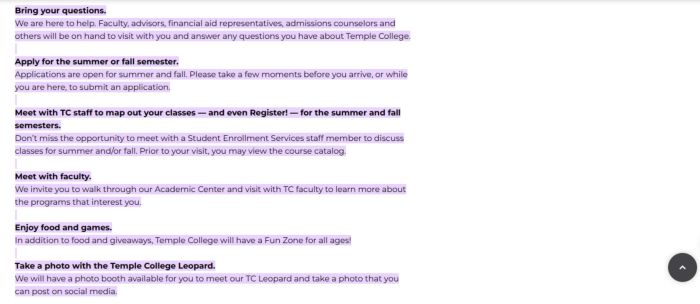
Example: Temple College (USA): This community college makes sure guests leave with smiles (and photos). At its Open House, Temple College set up a fun photo booth with their mascot, “TC Leopard.” Students and families could snap pictures with the mascot – a keepsake to post on social media – and even win prizes. This lighthearted closing activity gave attendees a lasting memory and positive vibe to associate with the school.
Send a thank-you email the next day. Personalize it if you can. Include links to the application page, upcoming deadlines, and photos from the event. Invite further questions and make it easy to get in touch.
If a family asks about something specific, say, learning support or scholarship details, make sure someone follows up with a personalized message.
Want to keep the momentum going? Enroll attendees in a short email series spotlighting your programs, alumni, or events. Nurturing that relationship can turn a visitor into an applicant.
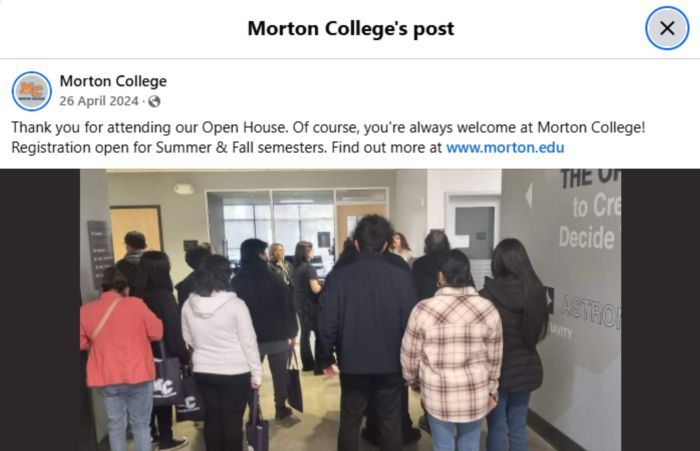
Example: Morton College (USA): After the Open House, Morton College immediately followed up with attendees and the broader community on social media. They posted a thank-you message to everyone who came, reinforcing that visitors are always welcome on campus. Importantly, the message included a next-step call-to-action, a reminder that registration was open for upcoming semesters, nudging interested students to take the next practical step toward enrollment.
10. Debrief, Reflect, and Get Ready to Do It Even Better Next Time
One last tip, and it’s a game changer.
After the event, take time to evaluate. Meet with your team and ask: What worked? What didn’t? What feedback did families share?
Review your numbers: RSVPs, attendance, applications started. Be sure to look for patterns. Did most families come from a certain neighborhood? Were particular sessions packed while others lagged?
Use this insight to adjust your strategy for next time. Update your checklists. Refine your flow. Keep evolving.
Oh, and don’t forget to celebrate your wins. Share event highlights in a post or newsletter. Thank your team. Show appreciation.
Final Thoughts
An open house is more than just an event, it’s an invitation.It’s your chance to say, “Here’s who we are. Here’s why we care. Here’s how your family fits in.”
When you plan with intention, create moments of connection, and follow through with heart, your open house becomes more than a tour. It becomes a story families want to be part of.
So get planning, and get ready to make your next open house your best one yet.
Would you like to receive tailored open house school ideas for your institution?
Contact Higher Education Marketing for more information.
Struggling to stand out in a crowded market?
Boost enrollment with tailored open house strategies!
Frequently Asked Questions
Question: How do you prepare for an open house at school?
Answer: Start by setting clear goals and selecting a date that works for your audience. Plan the schedule, secure staff and student volunteers, and prepare promotional materials. Promote the event across multiple channels (website, email, social media), tidy up the campus, and organize signage, welcome tables, and printed resources to ensure a smooth, welcoming experience.
Question: What should teachers do for open house?
Answer: Teachers should prepare a welcoming classroom with student work on display, provide a brief overview of their curriculum, and have handouts with contact information and expectations. During the event, they should greet families warmly, answer general questions, and encourage follow-up meetings for individual concerns.
Question: How do you make an open house at school fun?
Answer: Incorporate interactive elements like hands-on activities, themed scavenger hunts, live demonstrations, or student performances. Offer refreshments, set up a photo booth, and keep presentations short and engaging. The goal is to create an energetic, memorable experience that showcases school spirit.
The University of California National Center for Free Speech and Civic Engagement launched in 2017, at a time when students were shouting down conservative speakers on campus, raising questions about what role the First Amendment did—and should—play in higher education.
Just eight years later, things have only gotten more complicated—first in the aftermath of an explosive protest movement against Israel’s war in Gaza and then in the wake of the Trump administration’s censorship across all areas of academe.
Amid the chaos, the center and its fellows—researchers from a breadth of disciplines who work on projects related to open expression and civic engagement—continue to educate universities about the First Amendment and investigate the day’s most pressing free speech issues.
Its executive director, Michelle Deutchman, who worked as an attorney for the Anti-Defamation League for 14 years before joining the center, stopped by the Inside Higher Ed office in Washington, D.C., last week to discuss the federal government’s attacks on free expression in higher education. The interview has been edited for length and clarity.
1.What are your biggest concerns with regard to the Trump administration and free speech and open expression in higher ed right now?
Well, sadly, there’s kind of a long list. I think, from my vantage point, one of the greatest concerns is seeing students, and particularly international students, being, basically, taken away on what appears to be the basis of viewpoints and opinions that they might have shared, either in the form of protest or, in one case, an op-ed. That really flies in the face of exactly what the First Amendment is supposed to protect against, especially in a public institution, which is that it’s supposed to be a restraint on government. In fact, what we’re seeing right now is the government stepping over the line of what is permitted, and that is definitely creating, I think, a chilling effect, not just for international students, but for students across the board, whether they’re protesting or not.
I also think that the specter of investigations on campuses—this list of 60 campuses [being investigated for alleged antisemitism], this idea that if you’re on a campus that’s potentially going to be under investigation—might impact what you say in class, outside of class, how you teach, everything that’s fundamental to the academy.
2.What are some of the most common questions you’re getting about what is going on?
Deutchman has led UC’s National Center for Free Speech and Civic Engagement for eight years.
Laurel Hungerford
I don’t get as many questions as you would think, because I don’t give legal advice, and right now, what a lot of people want is legal advice. But I think one of the things that I’m struggling with is, how do you talk about open expression and dialogue in a moment when it’s largely being suppressed on campuses? One of the questions that people have been asking is what to say to students about the risk factors in terms of being very vocal with your opinions, and how should administrators address that—both wanting to, of course, encourage them to use their voices, but also wanting to be transparent about what the risks might be.
There’s just a lot of other, bigger questions that are just about, what does this mean in general for higher education? Is this like an existential moment? What about the coercive use of money? A lot of questions of: Can the government do that? And I think it’s a really challenging situation where the answer is: Not sure that they should be doing it, but they are. So, how do we handle that sort of in-between space while we wait for the law to catch up to what’s going on on the ground?
3.There’s been a lot of emphasis on civic dialogue education as one antidote to tensions around political speech on campus. Do you feel like this moment is sort of setting those efforts back at all?
I don’t want to say they’re setting them back. I worry a little that they might be getting set aside. And that’s a concern that I’ve had, really, since after Oct. 7, where we saw so much time and energy go into the basics about the First Amendment and about time, place and manner, and about whether or not to use law enforcement, that there became a big focus on the enforcement regulations as opposed to sort of education. I think now, so much energy is being put into how to defend higher education against this assault that I worry that efforts that focus on how we teach not just students but all members of higher education communities to engage with one another and listen to one another and build the muscle of civic dialogue—I worry that there isn’t enough bandwidth to pay attention to that, and setting it aside, I think, is to the detriment of everyone at this moment.
4. How is Trump’s cutting of grants his administration deems related to diversity, equity and/or inclusion connected to the government’s other attacks on speech?
I think that the cutting of those kinds of grants is just another attempt at government censorship of speech. Expression and speech are the cornerstones of the creation and transmission of knowledge. So, I think that it you’re stopping grants about certain topics, topics that are either being researched or topics that are being taught, that is something that falls sort of in the viewpoint discrimination area and really runs afoul of the Constitution. We’ve certainly seen some successes in court cases and injunctions, but I think part of the problem is the gap between when an executive order is signed and when an injunction happens, the chilling effect that happens across the university, and this idea that I don’t know that you can unring certain bells.
5. Though many are calling the Trump administration’s attacks unprecedented in many ways, there have been other moments in history when free speech on college campuses has been under assault. What do those moments teach us about what is happening today?
I wish I could tell you that I am a historian, but I’m a lawyer, so I don’t necessarily have that historical perspective. Certainly, I think people say that this is the greatest threat to academic freedom and to the autonomy of the university since McCarthyism. It’s hard to know how, then, to take that information and do something with it, right? I mean, the hopeful take is: Well, we made it through that, even though it was a dark time.
I mean, look, I’m a [University of California, Berkeley] Cal Bear. UC had people do loyalty oaths; it was not a good moment, and look where we are now. I think that is sort of the optimistic hope.
I think the less optimistic [perspective] is that, in some ways, what we’re experiencing is much more far-reaching, and we will just have to wait and see what happens.
COLUMBIA — Hundreds of 4-year-olds across South Carolina are on waitlists to access state-funded preschool programs, even though there are thousands of open seats, according to a report presented Monday to the state Education Oversight Committee.
The state funds a dual system of full-day kindergarten for 4-year-olds deemed “at risk.” Students are eligible under state law if they qualify for Medicaid or free or reduced-price meals, or if they are homeless, in foster care or show developmental delays. Many public school districts use local property tax dollars to expand that eligibility.
The state Department of Education oversees programs in public schools, while First Steps, a separate state agency, oversees state-funded classes in approved private schools and child care centers.
As of November, 400 4-year-olds were waiting for spots to open up to enroll at their local public school. At the same time, First Steps 4K reported more than 2,300 open seats, often in the same counties as the districts with the longest waitlists, according to the report.
“It’s just a matter of finding an open seat for a child on a waitlist or finding an eligible child for the open seat,” said Jenny May, a committee researcher who presented the report.
Because 4K is a one-year program, students who are on the waitlist are unlikely to end up in a preschool program before starting kindergarten. Children need at least 120 days of preschool to prepare, so even if a slot happens to open up toward the end of the school year, they will start kindergarten less ready than other 5-year-olds, according to the study.
It’s not clear why some 4-year-olds are on a waiting list for a public school when vacancies exist in private programs, May said.
In some cases, the issue could be that another preschool program isn’t available nearby. The four counties with the longest waitlists — Lexington, Anderson, Berkeley and Newberry — all have at least one First Steps 4K program with availability, according to the report. However, that doesn’t account for potential cross-county drives.
Other parents may not know that other options are available, May said. Having a person designated to help direct parents to other preschool options, such as the nearest First Steps 4K program with open seats, could help reduce that waitlist, May said.
“It’s likely that if we had a more efficient process, we could serve most of the 400 kids on a waitlist on one of the First Steps seats,” May said.
The state already has several websites meant to help parents figure out what programs they’re eligible for and how to enroll. Palmetto Pre-K, launched in 2020, tells parents whether they’re eligible for state-funded preschool programs. First Five SC does the same but includes all early childhood programs with federal or state funding.
But having a person parents can call, or who can reach out to families with children on waitlists, could help reach some parents who might not know about the websites or have other concerns, the study suggests. That person, who the committee dubbed a 4K navigator, could then talk parents through the differences in programs, find available seats and answer any other questions parents might have, researchers said.
First Steps 4K has a similar program, in which applicants are directed to a central phone line or website that helps parents find the right fit for their child. That has helped prevent First Steps from having its own waitlist, May said. The 4K navigators, who the study suggested trying out in areas with the largest waitlists first, would have a broader knowledge of pre-K programs, the report said.
If a school district has a persistent waitlist of more than 20 students, that suggests the population has risen in that area, and state officials should consider giving the district more funding to create enough slots for those students, the report suggested.
The waitlisted students represent less than 1% of students who are eligible for the program but not enrolled. More than 18,000 4-year-olds, or about 55% of all eligible, are living in poverty but not enrolled in a 4K program, according to the report.
That’s a decrease from the 2022-2024 school year, when 60% of eligible students were not enrolled in districts. Still, it’s not enough, May said.
Even if every student on a waitlist enrolled in one of the available spots, programs would have space left over to take on at least 1,900 more students, according to the report. That suggests there are barriers other than program space keeping parents from enrolling their students in state-funded preschool, May said.
In many cases, the problem might be that parents don’t know about 4K programs or their benefits, May said. The state should put more funding and effort into outreach to help those students, the report suggests.
Data shows preschool programs are highly beneficial, helping students learn skills in reading, math and socialization, studies have found. According to the report, at-risk students who attended a state-funded pre-K program were more likely to be prepared for school than their counterparts who didn’t, according to the report.
“So, we want those students who are eligible and not served to be able to access it, and we definitely want those students who are on a waitlist to be able to access the program,” said Dana Yow, executive director of the committee.
SC Daily Gazette is part of States Newsroom, a nonprofit news network supported by grants and a coalition of donors as a 501c(3) public charity. SC Daily Gazette maintains editorial independence. Contact Editor Seanna Adcox for questions: [email protected].
The institution revealed its ambition to open the campus in December, when it launched an Indian hub in New Delhi to support the institute’s admissions, recruitment, and partnerships in the region.
Approval for the £1 billion expenditure on the campus was announced at the London Stock Exchange on April 9 at the 13th UK-India Economic and Financial Dialogue (EFD).
GIFT City (Gujarat International Finance Tec-City) is a business district in the Indian state of Gujarat.
“We are delighted that approval has been given to commence the set-up process for Coventry University GIFT City and know that many students will benefit from the high-quality education we can offer over the years to come,” said John Latham CBE, vice-chancellor of Coventry University and Group.
Competition among international universities has risen significantly in the region, with more UK universities keen on expanding into GIFT City. In January, The University of Surrey unveiled plans to open a campus in the city, as did Queen’s University Belfast.
We… know that many students will benefit from the high-quality education we can offer over the years to come John Latham, Coventry University
Coventry’s new India campus is offering postgraduate programs such as international business management and business and finance. The university plans to add further courses in the near future.
Alison Barrett, director of India at the British Council said: “It emphasises our shared commitment to the internationalisation of education, as highlighted in the National Education Policy 2020. Thousands of students will benefit from the high-quality education that the university can offer in the years to come.”
The campus building is set open its doors this month.
For the last few years, many colleges and universities across the country have experienced firsthand attacks on higher education through state legislation targeting diversity, equity and inclusion initiatives. Since 2023, about 120 anti-DEI bills have been introduced across 29 states, and 15 of them have become law.
These proposed bills and enacted legislation have largely been met with silence from university leaders. But over the past month, as attacks on diversity, equity and inclusion policies rose to the federal level via multiple executive orders and a Dear Colleague letter from the Department of Education, a broad coalition—professional associations in higher education, labor organizations, civil rights groups and elected officials—has filed numerous federal lawsuits challenging their constitutionality, including at least four suits involving educational organizations as plaintiffs. By taking legal action and securing a preliminary injunction against two of the executive orders, these coalitions are breaking the silence of recent years to send a clear message about the legality and harmful consequences of these policy changes for higher education and society.
As scholars who examine how the law shapes educational policy and organizations, we have closely studied the consequences of anti-DEI bills on faculty members who engage in the very topics implicated by these laws. We’ve learned that these bills restrict research and teaching protected by academic freedom before they’re even enacted. Unintentionally or not, silence from institutional leaders contributes to the suppression.
To counter this climate of suppression and protect the robust exchange of ideas and open inquiry, we must embrace coalitions like the ones behind the federal lawsuits and urge higher education leaders to unite and speak out to uphold institutional missions and safeguard our democracy.
Why Silence Does Not Work—and Makes Matters Worse
In our recently published study, we interviewed 32 faculty members whose research or teaching focused on race at two public institutions in different Republican-controlled states with proposed anti-DEI, anti–critical race theory and anti-tenure bills. Even before these bills took effect—and despite exemptions for research and teaching—we found that many faculty members pre-emptively altered their work in response to the external interference.
Some removed diversity-related course readings or avoided certain terms like “intersectionality” in their teaching. Others, like Kourtney, a Black tenured faculty member, hesitated to share their research publicly, fearing harassment if it got into the wrong hands. Kourtney described how previously she would disseminate her research widely to make an impact. But now, out of fear, she was more reserved and cautious when sharing her work as to not get “on the radar [of] anyone that could potentially try to stop” her research.
We also learned that the actions—or lack thereof—of university leaders shaped faculty members’ responses. University leaders’ silence amplified the pressures proposed legislation created. Danielle, a Black tenured faculty member, explained how silence from institutional leaders made “everything harder” and “sent a really loud and clear message” of “not supporting me.” The “glaring silence,” as participants called it, from senior leaders and college deans heightened uncertainty and anxiety, leaving many faculty members feeling isolated and solely responsible for protecting their rights under academic freedom.
Yet not all university leaders were silent. Some faculty members in our study had supportive college deans and department chairs who conveyed affirmative internal messages. These participants reported that such messages helped them feel supported, empowered and confident in continuing their teaching and research without compromise. Wilson and Michelle both expressed that messages from their deans, messages that emphasized valuing faculty expertise and a commitment to scholarship addressing inequities, made them “feel at the college level like you’re protected” and reinforced their belief in “having academic freedom to be able to teach.”
It is understandable that leaders hesitate to speak out, given the risk of losing state funding or their jobs. In fact, many faculty members we spoke to, like Megan, understood the challenging circumstances and empathized with their college deans. Megan recalled her college dean saying, “We don’t agree with [the bill], but let’s wait it out. Trying to … draw attention will be worse. Let’s keep our head down.” However, their silence also created a critical void. Cruz, a Latino tenured faculty member, explained how “not saying anything is just as bad, because then the only conclusion that the faculty take … is ‘we’re on our own out here.’”
As a result, many faculty members of color undertook additional administrative work and legislative advocacy efforts as private citizens to be able to carry on with their research and teaching, making it increasingly difficult for them to advance their careers. Cruz shared how all this additional work and advocacy was “time that they’re not doing scholarship, that they’re not writing grants, that they’re not updating their classes.” For some, the frustration and exhaustion became so overwhelming that they chose to leave their institutions, or higher education entirely.
Why Coalitions Are Needed to Break the Silence
Our findings also revealed that support from coalitions of civil rights groups, advocacy organizations and professional associations like the American Association of University Professors helped some faculty members to resist the pressure to change their teaching or research. These groups organized teach-ins virtually or on campus, provided legislative analysis via one-pagers and facilitated legislative organizing efforts.
Eliot, a white tenured faculty member, described how these coalitions helped foster “some unity,” making “a real difference psychologically” by ensuring members no longer felt isolated but instead felt that “we’re in this together.” By building collective capacity, these coalitions empowered faculty members to defend academic freedom and push back against a climate of suppression—particularly as most participants in our study received little to no guidance or support from university leaders.
Now, faculty members across the country—many of whom are only beginning to face these challenges—find themselves overwhelmed with uncertainty and fear, pressured to pre-emptively censor their work. However, we’re starting to see the emergence of the coalitions needed to disrupt this climate of suppression.
The recent lawsuits mark an important step in the defense of robust expression of ideas and open inquiry, but they are just the beginning. Effectively challenging this suppression requires a united front of policy and advocacy organizations, civil rights groups, unions, professional associations, and institutional leaders. Leaders are better positioned to advocate for higher education and respond to emerging threats when working within a coalition, such as Education for All, which has been providing training sessions and strategic guidance to help institutions safeguard their student success programs.
These coalitions provide crucial support on the ground to help faculty members, administrators and students continue their work while the legal battles unfold. And they can help break institutional silence by offering timely, research-driven guidance on state legislation, executive orders and other emerging state and federal threats—many of which pressure education professionals to unnecessarily restrict or abandon core principles and programs in higher education.
Jackie Pedota, Ph.D., is a postdoctoral associate at the University of Texas at Austin. Her research examines topics within higher education at the intersection of race, power and organizational change, revealing how organizational dynamics and sociopolitical contexts perpetuate inequities for minoritized campus communities.
Liliana M. Garces, J.D., Ed.D., is the Ken McIntyre Professor for Excellence in School Leadership at the University of Texas at Austin. Her research examines how law and education policy interact to shape access and opportunity in higher education.
Open universities have long symbolised a radical departure from the exclusivity of conventional universities. Conceived as institutions of access, intellectual emancipation, and social transformation, they promised to disrupt rigid academic hierarchies and democratise knowledge. Yet, as higher education is increasingly reshaped by market logics, can open universities still claim to be engines of social progress, or have they become institutions that now reproduce the very inequalities they sought to dismantle?
This question is not merely academic; it is profoundly political. Across the globe, democratic institutions are under siege, and the erosion of democracy is no longer an abstraction – it is unfolding in real time (cfEIU, 2024; Jones, 2025). The rise of far-right ideologies, resurgent racism, intensified attacks on women’s and LGBTQ+ rights, and the erosion of protections for migrants and marginalised communities all point to a crisis of democracy that cannot be separated from the crisis of education (Giroux, 2025). As Giroux (1984) argues, education is never neutral; it can operate as both a potential site for fostering critical consciousness and resistance and a mechanism for reproducing systems of social control and domination. Similarly, Butler (2005) reminds us that the very categories of who counts as human, who is deemed grievable, and whose knowledge is legitimised are deeply political struggles.
Open universities, once heralded as radical interventions in knowledge production, now find themselves entangled in these struggles. Increasingly, they are forced to reconcile their egalitarian aspirations with the ruthless pressures of neoliberalism and market-driven reforms. The challenge they face is no less than existential: to what extent can they uphold their role as spaces of intellectual and social transformation, or will they become further absorbed into the logics of commodification and control?
My article (Filippakou, 2025) in Policy Reviews in Higher Education, ‘Two ideologies of openness: a comparative analysis of the Open Universities in the UK and Greece’,foregrounds a crucial but often overlooked dimension: the ideological battles that have shaped open universities over time. The UK Open University (OU) and the Hellenic Open University (HOU) exemplify two distinct yet converging trajectories. The UK OU, founded in the 1960s as part of a broader post-war commitment to social mobility, was a political project – an experiment in making university education available to those long excluded from elite institutions. The HOU, by contrast, emerged in the late 1990s within the European Union’s push for a knowledge economy, where lifelong learning was increasingly framed primarily in terms of workforce development. While both institutions embraced ‘openness’ as a defining principle, the meaning of that openness has shifted – from an egalitarian vision of education as a public good to a model struggling to reconcile social inclusion with neoliberal imperatives.
A key insight of this analysis is that open universities do not merely widen participation; they reflect deeper contestations over the purpose of higher education itself. The UK OU’s early success inspired similar models worldwide, but today, relentless marketisation – rising tuition fees, budget cuts, and the growing encroachment of corporate interests – threatens to erode its founding ethos.
Meanwhile, the HOU was shaped by a European policy landscape that framed openness not merely as intellectual emancipation but as economic necessity. Both cases illustrate the paradox of open universities: they continue to expand access, yet their structural constraints increasingly align them with the logic of precarity, credentialism, and market-driven efficiency.
This struggle over education is central to the survival of democracy. Arendt (1961, 2005) warned that democracy is not self-sustaining; it depends on an informed citizenry capable of judgment, debate, and resistance. Higher education, in this sense, is not simply about skills or employability – it is about cultivating the capacity to think critically, to challenge authority, and to hold power to account (Giroux, 2019). Open universities were once at the forefront of this democratic mission. But as universities in general, and open universities in particular, become increasingly instrumentalised – shaped by political forces intent on suppressing dissent, commodifying learning, and hollowing out universities’ transformative potential – their role in sustaining democratic publics is under threat.
The real question, then, is not simply whether open universities remain ‘open’ but how they define and enact this openness. To what extent do they serve as institutions of intellectual and civic transformation, or have they primarily been reduced to flexible degree factories, catering to market demands under the guise of accessibility? By comparing the UK and Greek experiences, this article aims to challenge readers to rethink the ideological stakes of openness in higher education today. The implications extend far beyond open universities themselves. The broader appeal of this analysis lies in its relevance to anyone interested in universities as sites of social change. Open universities are not just alternatives to conventional universities – they represent larger struggles over knowledge, democracy, and economic power. The creeping normalisation of authoritarian politics, the suppression of academic freedom, and the assault on marginalised voices in public discourse demand that we reclaim higher education as a site of resistance.
Can open universities reclaim their radical promise? If higher education is to resist the encroachment of neoliberalism and reactionary politics, we must actively defend institutions that prioritise intellectual freedom, civic literacy, and higher education for the public good. The future of open universities – and higher education itself – depends not only on institutional policies but on whether scholars, educators, and students collectively resist these forces. The battle for openness is not just about access; it is about the kind of society we choose to build – for ourselves and the generations to come.
Ourania Filippakou is a Professor of Education at Brunel University of London. Her research interrogates the politics of higher education, examining universities as contested spaces where power, inequality, and resistance intersect. Rooted in critical traditions, she explores how higher education can foster social justice, equity, and transformative change.