Public debate often treats the future of work as if it were an external force. In reality it is shaped by decisions made early in life. Human capital is formed long before individuals enter the labor market. Once those foundations are set, later interventions have limited effect.
Foundations matter more than we admit
International evidence is consistent. Children who reach secondary school without secure literacy and numeracy face reduced prospects in every dimension. They are less likely to complete higher education, less likely to shift between sectors and less likely to command wage growth. Early mastery is not a marginal advantage. It sets the trajectory of adult life.
Such mastery seldom emerges on its own. It is often supported by a tutor or advisor who brings structure, continuity and interpretation. Their role is not to supply more content but to make learning coherent.
Context now outweighs content
Young people confront an abundance of information yet little clarity. They choose subjects without understanding how sectors are evolving. A student who enjoys mathematics might pursue data science, finance, engineering or modelling for the energy transition. One drawn to design might fit in product development, user experience, digital media or creative technology. The link between classroom and career is rarely obvious.
Guidance from someone with lived experience can close this gap. It helps students recognise how technology alters professional practice and how new industries emerge from the convergence of skills.
Hybrid skills have become the baseline
Employers now prioritise a combination of analytical reasoning, creative problem solving, communication and digital fluency. These attributes underpin mobility in an economy shaped by automation and AI. They cannot be taught within a single discipline. They must be developed deliberately, ideally from early adolescence and strengthened through work exposure.
Failure to cultivate such skills leaves individuals vulnerable to technological change. Success creates resilience across multiple career cycles.
Families are preparing for uncertainty, not a single profession
Parents increasingly recognise that traditional assurances are weakening. Admission to a reputable university no longer guarantees a durable career. Degrees hold value, but only when paired with adaptability. The prudent response is to plan for volatility.
Every student should finish school with a clear framework for the decade ahead. This should include a strengths profile, an understanding of key industries, a realistic view of AI’s impact and a route into early professional experience. Such preparation is not aspirational. It is necessary.
The policy implication
Societies that wish to remain competitive must invest in human capital from the earliest years. Schools and universities cannot meet this need alone. Young people require advisors who understand both how learning develops and how labor markets shift. Treating this guidance as optional will leave nations and individuals exposed.
Those who act early will shape their own economic future. Those who delay will face outcomes shaped by others.
Many high school seniors are now focusing on what they will do once they graduate – or how they don’t at all know what is to come.
Families trying to guide and support these students at the juncture of a major life transition likely also feel nervous about the open-ended possibilities, from starting at a standard four-year college to not attending college at all.
Here are four tips to help make deciding what comes after high school a little easier for everyone involved:
1. Shadow someone with a job you might want
I have worked with many college students who are interested in a particular career path, but are not familiar with the job’s day-to-day workings.
A parent, teacher or another adult in this student’s life could connect them with someone they shadow at work, even for a day, so the student can better understand what the job entails.
High school students may also find that interviewing someone who works in a particular field is another helpful way to narrow down career path options, or finalize their college decisions.
Full-time students can pay anywhere from about US$4,000 for in-state tuition at a public state school per semester to just shy of $50,000 per semester at a private college or university. The average annual cost of tuition alone at a public college or university in 2025 is $10,340, while the average cost of a private school is $39,307.
Tuition continues to rise, though the rate of growth has slowed in the past few years.
About 56% of 2024 college graduates had taken out loans to pay for college.
Concerns about affording college often come up with clients who are deciding on whether or not to get a degree. Research has shown that financial stress and debt load are leading to an increase in students dropping out of college.
It can be helpful for some students to look at tuition costs and project what their monthly student loan payments would be like after graduation, given the expected salary range in particular careers. Financial planning could also help students consider the benefits and drawbacks of public, private, community colleges or vocational schools.
Even with planning, there is no guarantee that students will be able to get a job in their desired field, or quickly earn what they hope to make. No matter how prepared students might be, they should recognize that there are still factors outside their control.
3. Normalize other kinds of schools
I have found that some students feel they should go to a four-year college right after they graduate because it is what their families expect. Some students and parents see a four-year college as more prestigious than a two-year program, and believe it is more valuable in terms of long-term career growth.
That isn’t the right fit for everyone, though.
Enrollment at trade-focused schools increased almost 20% from the spring of 2020 through 2025, and now comprises 19.4% of public two-year college enrollment.
Going to a trade school or seeking a two-year associate’s degree can put students on a direct path to get a job in a technical area, such as becoming a registered nurse or electrician.
But there are also reasons for students to think carefully about trade schools.
Still, it is important for students to consider which path is personally best for them.
Research has shown that job satisfaction has a positive impact on mental health, and having a longer history with a career field leads to higher levels of job satisfaction.
4. Consider a gap year before shutting down the idea
One strategy that high school graduates have used in recent years is taking a year off between high school and college in order to better determine what is the right fit for a student. Approximately 2% to 3% of high school graduates take a gap year – typically before going on to enroll in college.
Some young people may travel during a gap year, volunteer, or get a job in their hometown.
Whatever the reason students take gap years, I have seen that the time off can be beneficial in certain situations. Taking a year off before starting college has also been shown to lead to better academic performance in college.
In an Aug. 14 email, Bucknell University provost Wendy Sternberg notified the university community that Bucknell University Press would cease to exist at the end of the academic year. Without consulting BUP’s faculty editorial board, which oversees the press and falls under the auspices of the provost’s office, or Bucknell’s faculty or staff at large, the decision was rendered a fait accompli that blindsided the local Bucknell community as well as past, present and prospective BUP authors, editors and contributors.
As might be inferred, the decision to close a university press has wide-ranging implications for not only the home institution and its reputation within the academic community but for the pursuit of intellectualism and critical inquiry in academia and beyond.
As Sternberg wrote, the university was compelled to close BUP to refocus “university resources on our student-centered mission.” The email moreover claims that BUP’s “primary mission supports the scholarly community, and not Bucknell undergraduates.”
This rationale misunderstands the actual work of university presses, which have long trained students for careers in editing and publishing in academic presses, trade publishers and beyond—as noted by testimonials from Bucknell alumni published by The H-Net Book Channel. It likewise does not see our undergraduates as part of the scholarly community—a head-scratching implication given that Bucknell obtained the Carnegie classification system’s new Research Colleges and Universities designation this year because of its research activity, especially undergraduate research. Even more, it brazenly disregards the reality that faculty research informs classroom teaching.
In the more than three months that have passed since Sternberg’s notice of closure, Bucknell University administrators, especially Sternberg and President John Bravman, have been flooded with personal letters and emails cautioning against this myopic decision. Peter M. Berkery Jr., executive director of the Association of University Presses, wrote to the administration in August extending an offer to collaborate on a press review. This offer has gone ignored. Berkery also noted in his letter that a number of universities that have announced their intent to close their presses in recent years ended up reversing course. (Notable reversals include the University of Akron Press, the University of Missouri Press and Stanford University Press, where the university administration threatened to withdraw the press’s $1.7 million annual subsidy before backing away from the plan.)
Berkery added that “in still more cases—including Amherst College, Lever Press, West Point, University of Vermont, the University of Wyoming—institutions of higher education serving a wide remit of students and fields launched new university presses and university imprints, finding that this initiative served their students, faculty, and wider communities in direct and invaluable ways.”
Bucknell administration, however, has remained steadfast in its determination to close BUP and impervious to outcry from the academic community and even alumni. In November, Bucknell faculty approved a motion, presented by myself and three other members of the faculty editorial board, that proposes to evaluate BUP’s future through channels of shared governance that were not previously consulted—even flouted. It calls for the establishment of an ad hoc committee, peopled by Sternberg, the BUP director and several faculty representatives, charged with “determin[ing] a future for the Bucknell University Press that balances fiscal concerns with intellectual and academic values.” The motion stipulates that the committee will present its findings at the February faculty meeting. Of course, the bindingness of these findings remains suspect, as does the future of shared governance nationwide.
Towards the conclusion of Sternberg’s August notice, she wrote, “It is important to note that the door remains open to alternative paths forward for the Bucknell Press at this time. I believe there is great potential for the press to be reimagined in a way that supports undergraduate education — perhaps one that promotes scholarly accomplishments of Bucknell students and faculty and that offers professional preparation for students who seek a career in the publishing world. The academic planning process that is unfolding over this academic year will provide a venue for considering such possibilities.”
While BUP already does these things (as alumni and faculty attest), and this reimagining seems to again misunderstand the premise and goals of a university press, the motion approved by the faculty seeks to make good on Sternberg’s claim to envisage “alternative paths forward” to keep BUP’s doors open, even if such a statement is merely administrative lip service.
Though the prospective closure of BUP may appear a blip on the radar of a fast-changing landscape of higher education, it is yet another warning bell signaling the erosions of shared governance on campuses nationwide. Indeed, the American Association of University Professors’ Policy Documents and Reports (colloquially known as the Redbook) details how the “business-ification” of the university has caused ruptures within shared governance that have ultimately alienated faculty and pitted administrators versus faculty in what may appear a power vacuum: “The involvement of faculty in governance is not a grab for power, special pleading, or partisanship, but action in the best interests of the academic institutions themselves.”
Shared governance, the Redbook continues, promises to be a “potential force for fairness and equity for parties that are too often assumed to be at odds.” But fairness and equity can only be achieved at places like Bucknell if shared governance is preserved and stakeholders are consulted and considered in good faith.
Even more, as the motion passed by the faculty makes clear, while some may believe a university press to be a bespoke ornament, BUP has long been integral to the service and scholarship completed by Bucknell faculty and deeply connected to the institution’s intellectual history. And this is to say nothing of the ways that BUP has dedicated itself to supporting the intellectual and creative careers of academics around the globe for the last 60 years. In a moment in time marked by the determination to unravel both shared governance and academic freedom on college campuses, BUP can’t help but seem part of a larger zeitgeist of academia’s uncertain, seismic shifting.
Yet there’s something distinct about the Bucknell situation in that it is entirely self-inflicted. Bucknell is not buckling under pressure from the federal government; neither has it been singled out for an ultimatum/gilded carrot (depending on how one sees it) like those extended under the Trump administration’s “Compact for Academic Excellence in Higher Education.” It has not suffered higher taxes on its endowment, nor the retraction of large-scale federal funding. The austerity mentality hawked by the administration is one based on a larger trend in which humanistic and social scientific inquiry is deprivileged and the ethos of the liberal arts abandoned, even at those places that seek to brand themselves as such. BUP has become the sacrificial lamb that was meant to succumb to its slaughter silently.
If BUP had represented an insolvent or derelict agent on campus or within the academic community, perhaps the publicity arising from its intended closure would not set about such shock waves. However, that is not the case. Instead, the intention to shutter BUP is a thermometer, if not a klaxon (to mix metaphors), that lays bare a reality in which university presses and the intellectual enterprises they champion are repeatedly under threat. We must not acquiesce to these demanded erasures.
Jeremy Chow is the National Endowment for the Humanities Chair in the Humanities and associate professor of English at Bucknell University and chair of the Bucknell University Press faculty editorial board.
In early November, following extensive debate by the RISE negotiated rule-making committee, the U.S. Department of Education proposed a definition of “professional degree” for federal student aid that could deter talented students from pursuing health-care careers. The proposed rule, stemming from the One Big Beautiful Bill Act, would leave students in many fields critical for our future health-care workforce subject to a $20,500-per-year federal student loan cap.
Physician assistant/associate programs stand to be strongly affected. These programs are intensive, highly structured and clinically immersive. Students complete rigorous professional-level coursework while rotating through multiple clinical sites to gain hands-on experience. Unlike in many graduate programs, PA students cannot work during their studies, as clinical rotations are full-time and often require travel across multiple locations. Within this context, federal student aid is not optional; it is the lifeline that allows students to stay in their programs and complete the training they have worked for years to achieve. Without it, some students will have no choice but to abandon the profession entirely.
The financial gap under the department’s proposal is striking. Tuition alone —not including expenses like housing, food and other needs—for PA programs often exceeds $90,000 for the duration of the program due to the unique costs associated with health professional education, such as simulation technology and clinical placement expenses. Under the department’s proposal, federal student aid would only cover a fraction of this amount. For students without access to private resources, the gap will likely be insurmountable.
These challenges are not hypothetical. A student accepted into a PA program may face a choice to take on crippling private debt or leave the career track entirely. Students in nurse practitioner, physical therapy and occupational therapy programs face the same reality. Each of these programs combines intense academic and clinical requirements, preparing graduates for immediate entry into practice. Federal policy must recognize this reality if it hopes to support the next generation of health-care professionals.
The consequences extend far beyond individual students. PA students, along with other health professions students, are essential to addressing workforce shortages, especially in rural and underserved areas. Every student forced to forgo pursuing a PA program due to financial barriers represents a future provider absent from the health-care system. At a time when demand for care is rising, federal policy that fails to recognize these students risks worsening shortages and limiting access to care for patients who need it most.
The Department of Education has the opportunity to correct this in the final rule. Explicitly including PA students, along with nurse practitioners, physical therapists, occupational therapists and other professions that meet the statutory criteria for professional degrees would ensure that aid reaches students fully committed to intensive, licensure-preparing programs. Recognition will reduce financial stress, allow students to focus on becoming high-quality health-care providers and maintain the pipeline of skilled professionals critical to patient care.
Including PA and other health professions students in the department’s final rule is both necessary and prudent. It allows students to complete programs they cannot otherwise afford, protects the future health-care workforce and ensures that communities continue to have access to vital services. The Department of Education can achieve clarity, fairness and meaningful impact by explicitly recognizing these professional students.
Sara Fletcher is chief executive officer of the PA Education Association.
Faculty writing has never been more crucial. In an era of heightened competition for grants, promotion pressures and demands for public engagement, writing is the vehicle through which faculty share their expertise, secure funding and advance their careers. Research shows that successful academic writers aren’t necessarily better writers—they’re better-supported writers. They have systems, communities and resources that support their productivity and help sustain engagement with writing as their needs change across their roles, responsibilities and careers.
Faculty writers are seeking support for their writing. Where do they go when they need it? Many are unsure.
Support for faculty writing on campus is often decentralized or may vary from year to year, making it difficult to find or accessible only to those with the advantage of an informed mentor. Support for faculty writing might be offered in any number of campus locations: centers for teaching and learning, provosts’ offices, offices for faculty advancement, writing centers or academic support centers, research centers for grant writing, graduate student support centers, or individual departments. Writing support may be outsourced through institutional memberships to organizations such as the NCFDD or the Textbook and Academic Authors Association, which offers webinars, writing programs and templates for downloading.
Department chairs and campus administrators may want to support faculty writers but aren’t sure where to begin. Or if there is a problem, it’s considered an individual faculty problem and not one that calls for a campus response.
Perhaps there’s an underlying assumption that faculty should already know how to write and shouldn’t need support to meet basic job expectations, like publishing a certain number of articles before tenure. Establishing a faculty writing space or central resource hub might be seen as suggesting they need remedial help—much like the stigma writing centers face as places where “bad” students are sent.
Yet today’s faculty are expected to write across more genres than ever before: grant proposals, peer-reviewed articles, public-facing pieces, social media content and policy briefs. Each involves different skills and audiences. The faculty member who can craft a compelling journal article may struggle with a foundation proposal or an op-ed. Writing support isn’t remedial—it’s strategic professional development.
The current moment also presents unique challenges. Post-pandemic isolation has disrupted the informal networks that previously supported faculty writing. Budget constraints mean fewer resources for individual faculty development, making shared writing support more essential. New faculty arrive on campus without the professional development resources or mentor networks that previous generations took for granted, while midcareer faculty face mounting pressure to produce more with less support.
We can do better in our support of faculty writers. If you want to help, here are ways to do better, or to get started.
Gather resources. Even though writing support might be available, it may not be widely known, or up-to-date, and it may be dispersed across many different units or offices on campus. Create a centralized web page gathering information for all campus resources for faculty writing. The entity that hosts the site will be different for each campus. For some, it’s the provost’s office. For others, it’s a writing or teaching center. List the resources—where faculty can go for support—and help faculty navigate the resources by providing descriptions (not just links), categories (i.e., “find a writing group”) and contact information. Collaborate with faculty to curate a list of recommended books, podcasts and writing spaces they have found helpful.
Make faculty writing visible. What if faculty writing support were as central to campus as student writing support? A teaching center could include a workshop on writing about teaching; the provost’s office or campus research center could offer workshops on developing institutional review board protocols. Consider reserving dedicated spaces for faculty to gather and write (such as a faculty writing room) or schedule specific writing times/days in a university writing center or campus coffee shop. Give them a name (Writing Wednesdays, Motivating Mondays). Writers can plan for these meet-ups and write in the company of others, in public rather than isolated in individual offices.
Organize a virtual workshop watch session and follow-up discussions. Gather faculty for a workshop watch session. After the workshop, help participants continue to discuss what they learned and how they’ll apply it through group check-ins or follow-up meetings. Try NCFDD’s core curriculum webinar “Every Semester Needs a Plan,” The Professor Is In’s “Art of Productivity,” or join a London Writers’ Salon Writers’ Hour, and talk about everyone’s work after the writing session.
Identify a faculty cohort to support for a year. Supporting all faculty writers with diluted support is often ineffective. Instead, focus on associate professors one year, new faculty writers the next and clinical faculty writers the next. Help them connect and be resources for each other throughout the year through writing retreats and writing groups. Build a campus writing community one cohort at a time.
Collaborate with campus partners. Combine campus resources to support writers. Could the library offer a meeting space? Two departments co-convene a writing group? Campus units could take turns hosting a daylong writing space once a month, helping writers learn about different spaces and writers across campus.
Start a writing support library. This can be virtual or in a central location on campus. Partner with the library to keep track of which books are in circulation or in high demand. Consider developing a workshop or writing group around in-demand books.
Ask faculty what they need and listen and respond. If we don’t ask faculty what they need, we won’t know. What some faculty need now may be different than what they needed last fall.
Support connectors. Every campus has them—the person or department that is a go-to for troubleshooting faculty questions and connecting them to writing resources. Amplify their reach, and support the faculty relationships and networks they’ve already established. Support the person or people who will curate that library, update the resource list, collaborate with campus partners and serve as a faculty writer point of contact.
What’s next? Start by mapping what already exists on your campus. Create one central hub where faculty can find all writing-related resources. Make faculty writing as visible and supported as student writing. It’s OK to start small: Try one of these strategies we’ve shared and notice what happens. And remember—supporting faculty writers isn’t about fixing deficiencies. It’s about recognizing that writing is central to faculty success and deserves the same institutional attention we give to other essential job functions. Faculty are an invaluable resource in our campus ecosystems. Let’s lower the barrier to them finding the support they need to write well. When they thrive, so do our institutions.
Jennifer Ahern-Dodson is an associate professor of the practice in writing studies at Duke University, where she directs the Faculty Write Program.
Christine Tulley is a professor of English at the University of Findlay and president of Defend, Publish & Lead, a faculty development organization.
If you are a leader, chances are you will find yourself in a lame-duck position at some point. When I announced that, after 16 years as chancellor, I would be stepping down to decompress and explore new opportunities, I thought I would be prepared. I was not. Then the calls from colleagues across industries started coming in—not to congratulate me, but to talk about the struggle of being a lame-duck leader. Their stories, filled with familiar struggles and strategies, closely mirrored my own journey. This article aims to help you navigate that transition in ways that benefit both you and your campus or organization.
The first thing to remember is that you are a lame duck the minute you announce your departure. Most leaders believe they will have the same standing in the institution until they walk out the door for the last time. Nope. It doesn’t matter how long you have been at your institution, how important you are or how much you are loved on and off campus: The process of transition has begun. After a flurry of contacts expressing gratitude and inquiring about what is next, the phone will ring a little less each day, substantive email traffic will drop and the work calendar will free up unless you force it not to (not something I would advise). People who used to drop everything when you needed them will take a little longer to get back to you. You may find fewer consultations on day-to-day operations and even fewer on questions pertaining to the future. This trend will accelerate as new leadership becomes more defined. This is normal. Don’t take it personally.
The second thing to remember is that if you have been at your institution for any length of time, you are likely going through a grieving process. This is the end of an important era, one in which your time and thoughts were consumed by your campus. You are going to go through some version of the five stages of grief without realizing it. You may find yourself preparing future strategic plans (denial), overreacting to comments or actions focused on the future (anger), or rushing to implement last-minute initiatives that will solidify or advance your legacy (bargaining). You may start to feel like everything you have done is being overshadowed by a campus focusing in on the excitement of a new era while leaving you behind (depression). Realizing that these stages are affecting your thoughts, moods and actions is important. The faster you can get to the fifth stage, acceptance, the better able you will be to help your campus transition in positive ways and gain a healthier attitude for yourself. However, it is important to remember that the stages of grief are neither distinct nor linear and you can be experiencing more than one at the same time.
From my own experience and those relayed to me by others, the following tips can help you get to the acceptance stage and achieve some level of peace of mind more quickly.
Focus on the needs of your faculty, staff and students. Helping to meet the needs of your employees can give you purpose in a world that suddenly has become confusing. They are also grieving, but their reality is different than yours. You’re leaving. They are staying and facing uncertainty in the future. They’re worried about the impact of this transition on their careers, jobs, colleagues and families. Their focus needs to be on the future. As the leader, your public demeanor can either add to their stress or help reduce it. Be positive, upbeat and supportive. Spend some time trying to understand the goals of people on campus and help position them for future success. I found my role became more of an adviser or mentor and less about being the boss, which had the added benefit of allowing me to engage in conversations about the future without feeling as though I had to control or direct it.
Reflect on the good you’ve done and stop worrying about what will happen when you leave. I’ve seen too many leaders, including myself, spend their last days worrying about what the next administration will do to their legacy projects or trying to find a way to determine the institution’s future direction. One greatly respected leader I worked for spent the last year of his administration developing a strategic plan that was DOANL (dead on arrival of the next leader). While the intent was good, the exercise wasted a lot of people’s time, limited thinking about new possibilities and even negatively positioned a few people who became inextricably linked to the “old” ideas of the last president instead of being ready to build on the ideas of the new one.
One of my employees was retiring just as budget cuts threatened the successful initiative she had spent 10 years implementing. On her last day, I asked her how she was doing. Her response was “I can’t control what happens to the project. It might end tomorrow. I know that I’ve had a positive impact on tens of thousands of students and teachers over the past 10 years, and I feel good about that.” That is a healthy attitude that I have tried to adopt as my own. Feel good about what you’ve done because that is what you can control. What happens next is not going to be up to you.
Check your ego at the door. Let’s face it. Experiencing “your people” turning toward someone new, talking excitedly about a future without you in it or expressing a desire to end something you started will hurt a bit. You may even find criticisms of your leadership in some of these conversations. No leader is perfect, and we all make decisions that upset some of our employees. That is part of the job. However, you will be particularly sensitive during your transition time. Don’t overreact, your lame duck–ness! Take a breath and think about whether your ego is driving your reaction. If it is, step back. Keep focused on what is in the best interest of the people who will remain after you walk out the door.
As you get closer to the end date, particularly when the new leader is named and begins the process of transitioning into office, you may find yourself fading into the background. Some egos can’t take it and their owners begin strutting their feathers around demanding attention. Others head for the shadows and disappear completely. Neither helps your campus, nor your mental state. In the beginning of my transition, I struggled to cut down the time I spent working on campus business, but I soon realized that I was filling the time with projects that would likely be DOANL. Once I realized I was working for my ego and not for the future of the campus, I cut back, rediscovered weekends and evenings, spent some time enjoying the exploration of future opportunities, and felt my mood improve. Balance your involvement. Don’t abandon, but don’t overreach.
Embrace the next leader. In the end, it doesn’t matter if your successor is your long-standing archnemesis from grade school, the most annoying person you have ever met or your best friend: It is your responsibility to position the next leader for success. Be honest, but positive and supportive. Build up your successor’s strengths and positive attributes to the campus. Reach out to whoever is taking the leadership wheel and ask how you can help with the transition. Advise where appropriate, try not to judge and remember what would have been helpful to you when you arrived at the institution. At a certain point the best thing you can do is get out of the way. The worst thing you can do is create more stress and tension for the campus community by undermining or opposing your successor.
Pay attention to yourself. You are a leader. You are used to keeping your emotions in check so you can focus on what is best for your campus and community. When you are asked how you are doing, you answer positively no matter how you feel and then turn the question around to focus on the inquirer. You may have convinced yourself you are feeling great, but if you are a lame duck, that probably isn’t the case, and how you are feeling may become apparent at odd times. Pay attention to those odd moments, because they’ll likely reveal what phases of the grieving process you are in.
One of my odd moments came a few hours before my farewell dinner, which at my suggestion was a roast (fitting, given my personality). As I was getting ready, I felt sick, my pulse was racing and my blood pressure was alarmingly high. My concerned spouse commented that the event was a significant and emotional one and, by talking with her I realized that I was still in denial. Though I had been working on transitioning others, I still hadn’t come to terms with the fact that I was leaving my job forever. The farewell event was an undeniable sign that my identity and life as the chancellor were ending. Once I realized why I was stressed, my anxiety went down and we were able to enjoy an incredibly fun and heartwarming evening.
Conclusion
The tips mentioned above can help you maintain focus as a positive and productive leader during your lame-duck phase, allowing you to effectively navigate the complex emotions associated with leaving your campus role. It’s essential to recognize that the grieving process is not a linear sequence of emotions but rather a fluid experience in which feelings ebb and flow. By regularly checking in with yourself and acknowledging your emotions while striving to make a positive impact on the campus, you can end your tenure with the appreciation of a community that is well prepared for the future. And as you waddle out the door for the last time as a lame duck, you’ll find yourself striding confidently with enthusiasm and optimism into your next chapter in life.
Kevin Snider retired as chancellor emeritus from Pennsylvania State University New Kensington after 16 years on Dec. 31, 2024.
It may sound perverse to say so. Our profession is under attack, our students are reading less, jobs are scarce and the humanities are first on the chopping block. But precisely because the outlook is dire, this is also a moment of clarity and possibility. The campaign against higher education, the AI gold rush and the dismantling of our public schools have made the stakes of humanistic teaching unmistakable. For those of us with the privilege of relative job security, there has never been a more urgent—or more opportune—time to do what we were trained to do.
I am an English professor, so let me first address my own. Colleagues, this is the moment to make the affirmative case for our existence. This is our chance to demonstrate the worth of person-to-person pedagogy; to speak the language of knowledge formation and the pursuit of truth; to reinvigorate the canon while developing new methods for the study of ethnic, postcolonial, feminist, queer and minority literatures and cultural texts; to stand for the value of human intelligence. Now is when we seize the mantle and opportunity of “English” as a both a privileged signifier and a sign of humility as we fight alongside our colleagues in the non-Western languages and literatures who are even more endangered than we are— and for our students, without whom we have no future.
I’m not being Pollyannaish. Between Trump 1 and Trump 2 sit the tumultuous COVID years, which means U.S. universities have been reeling, under direct attacks and pressures, for a decade. I started my first job in 2016, so that is the entirety of the time that I have worked as an academic. I spent six years in public universities in purple-red states, where austerity was the name of the game—and then I moved to Texas.
Now, we face a new onslaught: the supposedly unstoppable and inevitable rise of generative AI—a deliberately misleading misnomer for the climate-destroying linguistic probability machines that can automate and simulate numerous high-level tasks, but stop short of demonstrating human levels of intelligence, consciousness and imagination. “The ultimate unaccountability machine,” as Audrey Watters puts it.
Actually, I think our jobs just got a whole lot easier, because our purpose is sharper than ever. Where others see AI as the end of our profession, I see a clarifying opportunity to recommit to who we are. No LLM can reproduce the deep reading, careful dialogue and shared meaning-making of the humanities classroom. We college professors stand alongside primary and secondary school teachers who have already faced decades of deprofessionalization, deskilling and disrespect.
Counter to what university administrators and mainstream pundits seem to believe, students are not clamoring to use AI tools. Tech companies are aggressively pushing them. All over the country, school districts and universities are partnering with companies like Microsoft and OpenAI for fear of being left behind. My own institution has partnered with Google. Earlier this semester, “Google product experts” came to campus to instruct our students on how to “supercharge [their] creativity” and “boost [their] productivity” using Gemini and NotebookLM tools. Faculty have been invited to join AI-focused learning communities and enroll in trainings and workshops (or even a whole online class) on integrating AI tools into our teaching; funds have been allotted for new grant programs in AI exploration and course development.
I didn’t spend seven years earning a doctorate to learn how to teach from Google product experts. And my students didn’t come to university to learn how to learn from Google product experts, either. Those folks have their work, motivations and areas of expertise. We have ours, and it is past time to defend them. We are keepers of canon and critique, of traditions and interventions, of discipline-specific discourses and a robust legacy of public engagement. The whole point of education is to hand over what we know to the next generation, not to chase fads alongside the students we are meant to equip with enduring skills. It is our job to strengthen minds, to resist what Rebecca Solnit calls the “technological invasion of consciousness, community, and culture.”
Many of us have been trying to do this for some time, but it’s hard to swim against the tides. In 2024, I finally banned all electronics from my English literature classes. I realized that sensitivity to accessibility need not prevent us from exercising simple common sense. We know that students learn more and better when they take notes by hand, annotate texts and read in hard copy. Because my students do not have access to free printing, and because a university librarian told me that “we only go from print to digital, not the other way around,” I printed copies of every reading for every student. With the words on paper before them, they retained more, they made eye contact, they took marginal notes, they really responded to each other’s interpretations of the texts.
My children attend Texas public schools in the particularly embattled Houston Independent School District, so I have seen firsthand the app-ification of education. Log in to the middle school student platform—which some “innovator” had the audacity to name “Clever”—and you’ll get a page with more than three dozen apps. Not just the usual suspects like Khan Academy and Epic, but also ABC-CLIO, Accelerate Learning, Active Classroom, Amplify, Britannica, BrainPOP, Canva, Carnegie Learning, CK-12 Foundation, Digital Theatre Plus, Discover Magazine, Edgenuity, Edmentum, eSebco, everfi, Gale Databases, Gizmos, IPC, i-Ready, iScience, IXL, JASON Learning, Language! Live, Learning Ally Audiobook, MackinVIA, McGraw Hill, myPLTW, Newsela, Raise, Read to Achieve, Savvas EasyBridge, STEMscopes, Summit K12, TeachingBooks, Vocabulary.com, World Book Online, Zearn …
As both a professor and a parent, I have decided to intervene directly. Last year, I started leading a reading group for my 12-year-old daughter and a group of her classmates. They call it a book club. Really, it’s a seminar. Once a month, they convene around our dining table for 90 minutes, paperbacks in hand, to engage in close reading and analysis. They do all the stuff we English professors want our college students to do: They examine specific passages, which illuminate broader themes; they draw connections to other books we’ve read; they ask questions about the historical context; they make motivated references to current social, cultural and political issues; they plumb the space between their individual readings and the author’s intentions.
No phones, no computers, no apps. We have books (and snacks). And conversation. After each meeting, my daughter and I debrief. About four months in, she said, “You know, a lot of the previous meetings I felt like we were each just giving our own takes. But this time, I feel like we arrived at a new understanding of the book by talking about it together.” The club members had challenged and pushed each other’s interpretations, and together exposed facets of the text they wouldn’t have seen alone.
The literature classroom is a space of collaborative meaning-making—one of the last remaining potentially tech-free spaces out there. A precious space, that we need to renew and defend, not give up to the anti-intellectual mob and not transform at the behest of tech oligarchs. We have an opportunity here to stand up for who we are, for the mission of humanistic education, in affirmative, unapologetic terms—while finding ways to build new alliances and enact solidarity beyond the walls of our college classrooms.
This moment is clarifying, motivating, energizing. It’s time to remember what we already know.
Two decades ago, Uncle Sam offered a helping hand for college graduates who desired careers that required advanced degrees by establishing a loan program known as Grad PLUS. That hand has now been withdrawn. Also known as Direct PLUS loans, this program allowed students to borrow beyond the $20,500 limit available through direct unsubsidized loans to cover their full cost of attendance. With the One Big Beautiful Bill Act signed into law last summer, Grad PLUS loans will no longer be an option for prospective graduate students after July 2026.
The question of whether colleges and universities raise their tuition prices as the availability of federal aid increases has been a hotly debated topic for more than four decades, with contradictory findings. One recent study found that institutions increased their tuition prices after the creation of Grad PLUS, and determined that the funds did not increase access (or completion) for graduate education in general or for underrepresented groups in particular. These findings echo previous studies that also support a positive relationship between government aid and college prices. In contrast, other studies and analyses at the undergraduate level, as well as for graduate business, medical and law programs, have found little evidence of nonprofit institutions increasing tuition in relation to government subsidies. (The for-profit sector is another story.)
In any case, the elimination of Grad PLUS is a new reality that incoming graduate students will have to face. Now, students in master’s and doctoral programs will only be able to borrow up to $20,500 annually (with a maximum of $100,000). Students in professional degree programs, like law and medicine, will have a higher cap of $50,000 annually (up to $200,000 total). Additionally, the maximum amount students can borrow from the federal government for their undergraduate and graduate studies combined is $257,500. Students who borrow beyond any of these limits annually will have to turn to private loans to finance the remaining costs, which are less accessible for low-income students (who have less credit) and often come with higher interest rates.
The specific impact of these new limits on students is not yet known, but if we look at data for borrowers from previous years, we see potential impacts. In 2019–20, approximately 38 percent of all graduate borrowers borrowed beyond these caps, according to an analysis by Jobs for the Future. When disaggregated by degree type, 41 percent of graduate borrowers pursuing master’s degrees, 37 percent pursuing Ph.D. degrees and 25 percent pursuing professional degrees borrowed beyond the loan caps set by OBBBA.
A recent analysis published by American University’s Postsecondary Education & Economics Research Center shows potential impacts not just by graduate degree type but also by specific field of study. For professional degrees (with the higher loan cap), more than half of borrowers for chiropractic, medicine, osteopathy and dentistry programs borrowed more than $200,000 for their degrees in recent years. Among the master’s programs reviewed, half or more of borrowers in programs including audiology/speech pathology, public health, nursing and school and mental health counseling, to name a few, borrowed beyond the new limits.
Based on these analyses, it is clear that many prospective graduate students will be impacted by the new loan caps, at least in the short term. The rationale for these loan caps is that graduate programs will lower their costs to make graduate education more affordable, although it is doubtful that colleges will decrease the costs of graduate programs within just a year. It should be noted that many students do not borrow at all to obtain their degrees. In 2019–20, approximately 40 percent of full-time domestic students enrolled in master’s degrees did not borrow.
For programs that attract students from high-income backgrounds (usually selective elite institutions), what incentive is there to decrease costs if enough students can pay out of pocket? For instance, between 2014 and 2019, medical school matriculants from high-income backgrounds (over $200,000) increased substantially. The number of students attending law schools from wealthy backgrounds has also increased in the past couple of decades, particularly at selective elite institutions. Graduate education, at least at elite schools, has become less accessible for many low-income students.
Without financial support, options for low-income students will become even more limited. These students will largely be relegated to less selective public universities, and the more elite private schools will become even less economically diverse than they already are. Financial aid offices will become the de facto second admissions office. Using Massachusetts as an example, our analysis found that the annual cost of attendance exceeded the annual loan limit of $50,000 in the case of every accredited law and medical school in the state, with the gap between the cost of attendance and the limit ranging from about $5,600 in the case of the lone public law school (the University of Massachusetts at Dartmouth), and $33,000 in the case of the only public medical school option (University of Massachusetts Chan), to as high as $71,000 for Harvard Law School and $64,000 for Harvard Medical School.
Amounts calculated based on current advertised rates for first-time (entering), full-time students enrolled in daytime, nine-month and on-campus programs.
Amounts calculated based on advertised rates for first-time (entering), full-time students enrolled in daytime, 10-month and on-campus programs.
This simple analysis, of course, does not take into account any institutional grants or scholarships students may be awarded, but those funds vary by institutional budgets.
What happens when a deserving medical school applicant gains admission and a financial aid offer, only to realize that they still have a balance of $40,000 after institutional and federal aid is applied? For students to turn to private lenders, they will likely need either good credit and a substantial income or a cosigner, which may not be an option for many students from underresourced backgrounds. Almost 93 percent of private student loans given last year had a cosigner. Almost 51 percent of individuals from low/moderate incomes have limited or poor to fair credit. Even if they are lucky to be offered loans, the interest rates will likely be much higher.
With Washington Out, States May Have to Intervene
With the recent federal cuts to Medicaid likely to lead to decreases in state funding for postsecondary education, states may be hesitant to award funds to support students pursuing graduate education—but there are frameworks to help states determine which graduate programs deserve state funding and which type of funding to provide students. Third Way recently produced a framework that categorizes programs by personal return on investment and social value. One possible solution would be to offer accessible loans and state subsidies based on how a state places certain programs in this model.
For programs that lead to high ROI and social value—for example, dentistry—states that are facing a shortage of dentists could offer accessible (and lower than market rate) loans in exchange for working in certain geographic areas in that state. Providing low-interest loans instead of grants would make sense for this category because dentists are more likely to have high enough earnings (postresidency) that they can repay their loans. Certain localities have set up zero-interest loans for students pursuing specific industries, such as a San Diego County program for aspiring behavioral health professionals (a type of pay-it-forward program).
Some states, such as Pennsylvania, do have loan repayment programs for certain health occupations in exchange for working in specific areas of their states. Offering this solution without providing accessible loans will only benefit students who come from wealthier families, as they are more likely to have good enough credit or relationships with creditworthy cosigners to access private loans in the first place.
For programs that are high in social value but low in personal ROI, such as teaching or social work, if a state determines this is an area of need, they can offer grants to lower the cost of attending these programs and minimize the amount of loans students will have to take out, in exchange for service in these fields for a specific period of time. Offering accessible, low-interest loans to students pursuing these careers could still be an option, but should be secondary, or supplemental to, grants.
In line with recommendations from a jointly authored report from the American Enterprise Institute, EducationCounsel and the Century Foundation, states can offer grants to graduate students who demonstrate financial need, in addition to targeted grant aid for certain programs. Already, certain states, such as Maryland, New Mexico, Virginia and Washington, offer grant aid to graduate students in specific fields or based on financial need. Massachusetts also offers a tuition waiver to incentivize students to enroll in graduate programs at its public universities.
Unfortunately, I was unable to find a single repository of state aid specifically for graduate students from various states. The closest I could find was a report released by the National Association of State Student Grant and Aid Programs for the 2023–24 academic year with data on state-funded expenditures for both undergraduate and graduate student aid. The report shows that only a handful of states allocated more than a million dollars to need-based graduate aid (Arizona, Colorado, Maryland, Minnesota, New Jersey, Texas and Virginia), but does not specify for which programs, nor does it detail how aid is awarded and to which institutions.
The Education Finance Council also maintains a list of nonprofit loan providers in different states that offer lower-interest or more accessible loans, many of which are state-administered, such as the Massachusetts Educational Financing Authority. States that already administer conditional loans, scholarships, grants or loan forgiveness programs at the undergraduate level should consider expanding these programs to high- demand industries that require postbaccalaureate credentials if they have not already.
What Can Institutions Do?
Institutions are the closest to students, and they can play a role as well. Beyond offering need-based grants/scholarships to lower the cost of attendance, institutions can also guide students in the lending process, such as by publishing preferred lenders on financial aid websites. These lenders should have a good reputation with borrowers and offer low interest rates. Examples of institutions that advertise preferred lenders include Baylor University, the University of Iowa and the University of Central Missouri.
Institutions with more financial resources can either directly partner with lenders to offer lower fixed interest rates through risk sharing or provide loans themselves. Harvard Law School makes loans available to graduate students through a partnership with the Harvard Federal Credit Union. Some private loan providers looking to get into the graduate lending space are now in conversations with institutions about developing new risk-sharing models.
Many occupations that typically require graduate degrees, such as teaching, nursing and medicine, will face steep shortages in the coming years. States should align aid programs with current and future workforce shortages, determine which graduate programs will exceed federal loan caps and by how much, offer targeted grants for high-social-value but low-earning fields where costs exceed caps, and provide below-market or zero-interest (and accessible) loans for high-social-value, high-earning fields.
Institutions must act urgently by partnering with accessible, ethical lenders; increasing need-based aid for students who need it most; and protecting students from predatory options. At the very least, institutions can advertise the upcoming student loan changes on their websites. With OBBBA loan caps, Washington is stepping back. Will states and institutions be able to step forward and lead the way in preserving access and promoting economic mobility? Only 2026 will tell.
Josh Farris is research and policy specialist and Derrick Young Jr. is cofounder and executive director at Leadership Brainery, a nonprofit organization focused on improving access to graduate education for students from limited-access backgrounds.
Chronic absenteeism is a longstanding problem that has surged to troubling levels. Recent data show that in 20 states, more than 30% of students are chronically absent, about twice the rate seen before the pandemic. Absenteeism is a multifaceted problem, and the reasons students stop showing up aren’t always academic. Sometimes it’s because they don’t feel connected to their school, or they are not engaged in the curriculum. Other times, they face adversity outside the classroom. While the problem is complicated, it’s easy to overlook one of its simplest, most effective solutions: What if the key to keeping students is a performance stage, a music room or an art studio — a creative outlet to shine?
Despite decades of research, arts education is still treated as a “nice-to-have” when education budgets allow. From 2015 to 2019, the NAMM Foundation conducted a four-year study across 1,700 New York City public schools serving over 1.1 million students. They found that schools offering music and arts programming had lower rates of chronic absenteeism and higher overall school-day attendance than those that didn’t. Similarly, a comparison of cohort data over seven years found that dropout rates fell from 30% to just 6% among students participating in consistent arts programming.
Clearly, the arts are a powerful tool for academic engagement, resilience and, most importantly, graduation. For example, after tracking more than 22,000 students for 12 years, the National Dropout Prevention Center found that those with high levels of involvement in the arts were five times more likely to graduate from high school than those with low involvement.
But while over 90% of Americans feel the arts are important for education, only 66% of students participate, and access remains uneven. Charter schools, the fastest-growing segment of public education, have the lowest availability of arts courses: Just 37% of public charter high schools offer arts instruction. Students in charter schools, military families and homeschool programs are too often the ones with the fewest opportunities to engage with the arts, despite needing them most.
This is an issue that the Cathedral Arts Project in Jacksonville, Florida, is trying to solve.
In partnership with and with funding from the Florida Department of Education, our program piloted a year-long arts education initiative during the 2024-25 school year, reaching more than 400 students in charter schools, homeschools, military families and crisis care. Our teaching artists visited classrooms weekly, providing instruction in dance, music, visual arts and theater. Throughout the year, students in kindergarten through high school found joy, confidence and connection through creative learning. Homeschool students brought history to life through art projects, children from military families found comfort and stability during times of deployment and young people in crisis discovered new ways to express themselves and heal. Each moment affirmed the power of the arts to help children imagine what’s possible.
To better understand the impact of this work, we partnered with the Florida Data Science for Social Good program at the University of North Florida to analyze reports and survey evaluations collected from 88% of program participants. Here’s what we found:
Students grew not only in artistic skill, but also in self-confidence, teamwork, problem-solving and engagement. After completing the program, over 86% of students said they “like to finish what they start” and “can do things even when they are hard” — a key indicator of persistence, which is a strong predictor of long-term academic success. Students rated themselves highly in statements like, “I am good at performance.”
Families noticed, too. In the age of screens, nearly three-quarters reported that their child had increased in-person social interaction since beginning arts programming and had improved emotional control at home. Nearly one-third saw noticeable gains in creative problem-solving and persistence through challenges.
According to the State of Educational Opportunity in America survey conducted by 50CAN, parents view the arts as a meaningful contributor to their child’s learning, and they want more of it. In Florida, where families have been given the power of school choice, they’re increasingly seeking out programs that inspire creative thinking and meaningful engagement while promoting academic success. But finding them isn’t always easy. When funding allows, traditional public schools may offer band or visual arts, but these options are often unavailable to families choosing alternative education options for their children.
Now in its second year, our program fills this critical gap by working directly with school choice families across northeast Florida, bringing structured arts instruction to students who otherwise wouldn’t have access.
What makes the arts such an effective intervention? It’s structure, expression and connection. When students learn through the creative process, they navigate frustration, build resilience and find joy in persistence. These are not soft skills — they’re essential for survival, and increasingly important in today’s workplaces.
Arts education is a necessary investment in student achievement. It’s time for other states to treat it that way and follow Florida’s lead.
Did you use this article in your work?
We’d love to hear how The 74’s reporting is helping educators, researchers, and policymakers. Tell us how
In September, The 74 published Robert Pondiscio’s opinion piece discussing how people without strong reading skills lack what it takes “to effectively weigh competing claims” and “can’t reconcile conflicts, judge evidence or detect bias.” He adds, “They may read the words, but they can’t test the arguments.”
To make his case, Pondiscio relies on the skill level needed to achieve a proficient score or better on National Assessment of Educational Progress, a level that only 30% of tested students reached on 2024’s Grade 8 reading exam. Only 16% of Black students and 19% of Hispanics were proficient or more.
Yet naysayers argue that the NAEP standard is simply set too high and that NAEP’s sobering messages are inaccurate. There is no crisis, according to these naysayers.
So, who is right?
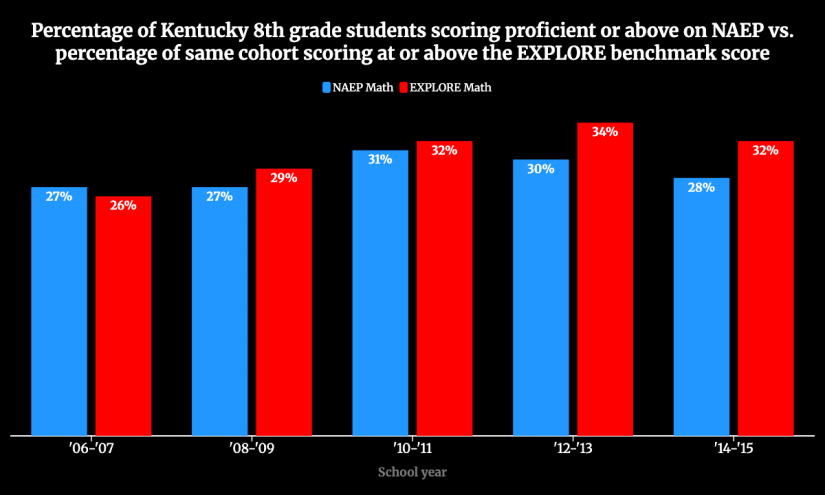
Well, research on testing performance of eighth graders from Kentucky indicates that it’s Pondiscio, not the naysayers, who has the right message about the NAEP proficiency score. And, Kentucky’s data show this holds true not just for NAEP reading, but for NAEP math, as well.
Kentucky offered a unique study opportunity. Starting in 2006, the Bluegrass State began testing all students in several grades with exams developed by the ACT, Inc. These tests include the ACT college entrance exam, which was administered to all 11th grade public school students, and the EXPLORE test, which was given to all of Kentucky’s public school eighth graders.
Both the ACT and EXPLORE featured something unusual: “Readiness Benchmark” scores which ACT, Inc. developed by comparing its test scores to actual college freshman grades years later. Students reaching the benchmark scores for reading or math had at least a 75% chance to later earn a “C” or better in related college freshman courses.
So, how did the comparisons between Kentucky’s benchmark score performance and the NAEP work out?
Analysis found close agreement between the NAEP proficiency rates and the share of the same cohorts of students reaching EXPLORE’s readiness benchmarks.
For example, in Grade 8 reading, EXPLORE benchmark performance and NAEP proficiency rates for the same cohorts of students never varied by more than four percentage points for testing in 2008-09, 2010-11, 2012-13 or 2014-15.
The same, close agreement was found in the comparison of NAEP grade 8 math proficiency rates to the EXPLORE math benchmark percentages.
EXPLORE to NAEP results were also examined separately for white, Black and learning-disabled students. Regardless of the student group, the EXPLORE’s readiness benchmark percentages and NAEP’s proficient or above statistics agreed closely.
Doing an analysis with Kentucky’s ACT college entrance results test was a bit more challenging because NAEP doesn’t provide state test data for high school grades. However, it is possible to compare each student cohort’s Grade 8 NAEP performance to that cohort’s ACT benchmark score results posted four years later when they graduated from high school. Data for graduating classes in 2017, 2019 and 2021 uniformly show close agreement for overall average scores, as well as for separate student group scores.
It’s worth noting that all NAEP scores have statistical sampling errors. After those plus and minus errors are considered, the agreements between the NAEP and the EXPLORE and ACT test results look even better.
The bottom line is: Close agreement between NAEP proficiency rates and ACT benchmark score results for Kentucky suggests that NAEP proficiency levels are highly relevant indicators of critical educational performance. Those claiming NAEP’s proficiency standard is set too high are incorrect.
That leaves us with the realization that overall performance of public school students in Kentucky and nationwide is very concerning. Many students do not have the reading and math skills needed to navigate modern life. Instead of simply rejecting the troubling results of the latest round of NAEP, education leaders need to double down on building key skills among all students.
Did you use this article in your work?
We’d love to hear how The 74’s reporting is helping educators, researchers, and policymakers. Tell us how