Tag: opportunity

  • An opportunity to reframe the DEI debate (opinion)

    An opportunity to reframe the DEI debate (opinion)

    The U.S. Department of Education’s Office for Civil Rights issued a Dear Colleague letter on Friday that instructs college leaders to eliminate any campus activities that directly or indirectly treat students differentially on the basis of race. Others will rightly push back on the logic of the department’s stated justifications, the absurdity of its timing and the accuracy of its examples, but I want to suggest that campus leaders can also take this as an opportunity to enact real change on behalf of all students.

    This is a moment for campus leaders to reframe the terms of the current debate over the legitimacy of special diversity, equity and inclusion programs by doing the long-needed work of truly decentering whiteness as the normative identity and experience within so many campus curricula and co-curricular programs.

    If we are to truly serve our students regardless of race, and if—as the department’s letter states—we have to put an end to even the subtle ways racial preferences and privileges are attached to seemingly race-blind policies, then watch out. Most campuses have a lot of work to do, and much of it is not going to be to the liking of those who believe that it is DEI programs that make an otherwise level playing field an unfair one.

    What the Dear Colleague letter fails to mention is that the proliferation of DEI activities on campuses came about as a more or less conservative compromise position as the population grew more diverse and as students demanded greater access. In treating Black and other minoritized students as “special,” such programs meet the needs of these students in supplementary ways rather than by ensuring that the core curriculum and student life experience are equally useful, meaningful and available to all. If the department insists that we put an end to all DEI programming, then it will also have to support efforts to ensure that whiteness is not smuggled in as the norm or standard.

    Early in my teaching career, I saw the ways that DEI programs could be used to reinforce white centrality rather than challenge it. Student demands for a more representative and accurate curriculum were met with resistance by senior faculty uninterested in expanding their own spheres of knowledge. Special courses in “women’s history” or “Black studies” became the compromise position. Rather than revising the canon to reflect the needs of a curious student body, rather than incorporating new scholarship into the university’s core, rather than interrogating the biases and histories of the curriculum, new courses and departments were created while the original ones were left intact. This détente (you teach yours and I teach mine) became the model.

    Many of the special programs that the Dear Colleague letter seems to have in mind follow this pattern. They keep in place a curriculum and campus culture firmly centered around the interests and perspectives of white students while offering alternatives on the side. If compromise via DEI activities is no longer an option, then a better solution will have to be found. The diversity of the student body is a fact that will still require a reckoning. Decades of scholarship reveal the many ways whiteness is encoded in supposedly neutral policies and programs, and this will not be magically erased. For many colleges, achieving a campus where white students are not unintentionally given extra opportunities based on their race will require radical change.

    My guess is that the department knows this on some level. Otherwise, why is race rather than sex or religion targeted? A sex-neutral campus would have to do away with single-sex housing and sex-segregated sororities and fraternities. A religiously neutral campus could no longer privilege Christian holidays or values.

    We should absolutely fight against the many overt inaccuracies of the Dear Colleague letter. And we should fight against both overt and covert expressions of racism and white supremacy. But we need not fight on behalf of compromise solutions to the very real problems that inspired our current DEI campus environment. Instead, we can use this unexpected opportunity to pick up where we left off and ensure that every program, every aspect of the curriculum, every student service is designed with the needs of our very diverse student body in mind. We can stop treating the experiences and needs of white students as the default or the neutral.

    What would our institutions look like if normative whiteness were no longer at the center and the need for many of the special DEI alternatives were made moot? Let’s find out.

    Marjorie Hass is president of the Council of Independent Colleges.

    Source link

  • Excluding Level 7 modules from the LLE is a huge, missed opportunity

    Excluding Level 7 modules from the LLE is a huge, missed opportunity

    Ahead of a House of Lords debate on the topic of lifelong learning later this week, today’s blog features two posts on the topic.

    Elsewhere on the site, Professor Harriet Dunbar-Morris, Pro Vice-Chancellor Academic and Provost at The University of Buckingham, highlights what is, in her view, a critical flaw in the LLE: the unfair funding gap facing students on accelerated two-year degree programmes, despite their clear benefits for employability and skills development. You can read that piece here.

    And below, Dr. Michelle Morgan explores the gaps in the Government’s Lifelong Learning Entitlement (LLE), questioning why postgraduate taught courses have been left out and what this means for students, universities, and businesses.

    So the Government has announced that the Lifelong Learning Entitlement (LLE) will come into effect in September 2026.

    The government is arguing that the LLE will allow people to develop new skills and gain new qualifications at a time that is right for them. The LLE will focus on:

    • full courses at level 4 to 6, such as degrees, technical qualifications, and designated distance learning and online courses
    • modules of high-value technical courses at levels 4 to 5.

    It is argued that it will help drive sustained economic growth, break down barriers to opportunity broaden access to high-quality, flexible education and training, and support greater learner mobility between institutions.

    However, yet again the sector’s postgraduate taught (PGT) provision has been ignored. By excluding this level of study, the ambitions of the Government will not be as great as they could be, and it is a huge, missed opportunity for higher education and this is why.

    The first problem: Declining PGT participation of UK-domiciled students

    In the past 10 years, the higher education sector has increasingly relied on international master’s students to fund itself.  EU and non-EU PGT students are nearly all undertaking master’s degrees, whereas for UK-domiciled students, a master’s degree only constitutes around 55% of those on PGT courses. Taught courses include master’s, postgraduate certificates, diplomas, and institutional credits and postgraduate certificates in education.

    For Master’s participation, 2019/20 was a pivotal year as non-EU participation surpassed UK-domiciled for the first time. In each year since 2021/22, UK-domiciled Master’s enrolments have declined (see Table 1). Although we do not have Higher Education Statistics Agency (HESA) return data to view for 2022/23 and 2023/24, there is a strong sense across the sector that we will see a decline in master’s participation, especially among international students.

    Source: Who’s studying in HE? | HESA

    The decline is the same pattern that occurred leading up to 2010/11. The only reason why master’s participation continued to increase then was due to non-EU enrolments. The response by the Government to re-energise the UK-domiciled market after the Higher Funding Council for England’s (HEFCE, which was then the regulator) Phase 1 and 2 of the Postgraduate Support Scheme was to bring in the Postgraduate Loan. As soon as this happened, you could hear an audible sigh of relief across the sector, and there was an attitude of ‘that will solve the problem so let’s just focus on growing the master’s market’. The sector did not consider the demand for master’s qualifications by business and industry, especially small and medium enterprises (SMEs).

    Employer demand for Master’s graduates

    There are disciplines where a master’s is required for career progression such as professional accreditation. However, as the 11 University Postgraduate Experience Project found, which was one of 20 projects funded as part of the HEFCE Phase 1 Postgraduate Support Scheme, many SMEs did not need master’s graduates. Most useful to them was for higher education to provide short courses and modules that provided their staff with advanced skills in key areas such as Business and IT and emerging ones such as Generative AI. According to the Department for Business and Trade’s report on Business population estimates for the UK and regions in 2024, there were 5.6 million UK businesses in 2024 of which 5.5 million were SMEs, accounting for 99.8% of all businesses. By ignoring the needs of business and industry, we are losing an opportunity to engage with a critical market.

    Funding and repayment

    As soon as the Postgraduate Loan was introduced, most universities immediately raised their fees. The aim of the £10,000 loan was to cover fees and some maintenance. Although the loan for September 2024 English starters is now £12,471, for many this will not come close to covering their costs. What is also not factored into any discussion is that someone who has both an undergraduate and a postgraduate loan must pay them back concurrently. This equates to 9% for the undergraduate loan and 6% for the postgraduate, or 15% of someone’s salary on top of tax, National Insurance and any other employee-related costs. Although employers’ national insurance contributions are increasing next year, if there is any tax or National Insurance increase for the individual next year, this will further reduce their disposable income.

    The Postgraduate Loan also differs between UK countries. In England, the loan does not cover stand-alone postgraduate certificates and diplomas, unlike in Scotland, where non-master’s postgraduate taught course participation is 56% compared to 44% in England. If they were included, then maybe the LLE as it stands would not be quite as restricted. The English loan system is not agile enough to support engagement in short or non-master’s courses, and English universities plan their finances for master’s enrolments and anticipated completions. A student should not have to register and enrol on a master’s if they only want or need to do a postgraduate certificate or diploma. If an individual needs a master’s for professional accreditation, this will not stop them from doing a master’s. In fact, we may see an increase in integrated degrees being undertaken where a master’s is incorporated into the undergraduate degree as a result.

    Additionally, we have just had the announcement that undergraduate loans are slightly increasing, but no announcement has been made for postgraduate loans. The current system hinders engagement. It also adopts a deficit model approach, as these qualifications are deemed exit qualifications if someone fails to achieve the Master’s.

    Ability to participate in master’s study

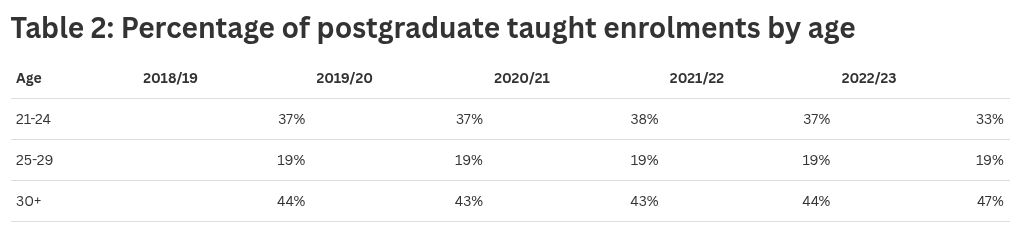
    What is also overlooked in discussions are the debt levels of undergraduate alumni and how this could explain the decreasing number of UK-domiciled 21-24-year-old participants. The majority of PGT enrolments are for the age group of 30 years and over.

    table visualization

    Source: Who’s studying in HE? | HESA

    When the Postgraduate Loan was introduced in 2016, only one cohort had graduated under the £9,000 a year fee regime introduced in 2012.  We now have 10 cohorts who graduated under that regime. It is maybe not a surprise therefore that the largest group investing in postgraduate taught study are those with the smallest amount of undergraduate debt.

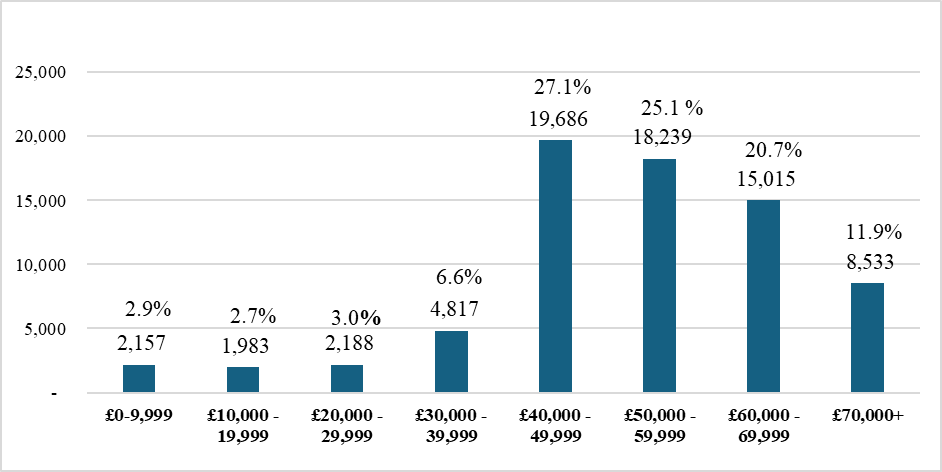
    Last year, I got the results of a Freedom of Information request from the Student Loan Company regarding the debt levels for English-domiciled recipients entering postgraduate Master’s study in 2021/22 (see Figure 1). Of the 72,618, 74.8% had debt in excess of £40,000 and 11.9% over £70,000. This debt will include any repeated years as well as longer length undergraduate courses such as integrated degrees with placements. With the recent announcement that fee levels will rise by £285 to £9,535 in 2025/26, this will increase individual debt.

    Figure 1: Debt levels of 72,618 English-domiciled master’s students who also have an undergraduate loan (fee and maintenance) in 2021/22 only 

    The recent Times and Sunday Times showed how parental financial support differs by student groups and universities. The universities where parents pay the most – up to £30,000 – are mainly Russell Groups. And when you explore postgraduate taught participation by ethnicity,  66% are White. How will the factors highlighted above enable widening participation at the postgraduate level which delivers advanced skills, competencies and knowledge?

    We need a rethink

    The LLE that will be introduced will not super-proof the pipeline for longevity of postgraduate taught study nor provide the advanced skills that are accessible, meaningful and needed for the individual, society or business and industry.

    So we need to start thinking now about the long-term implications of student debt, and social and economic needs so we can develop policy, strategy and practice. To do this though, the sector needs to start thinking about how we can reimagine and do things differently, Government needs to listen to key stakeholders, and we must proactively work together and not against one another.

    Source link

  • Department of Education Issues Report on Diversity and Opportunity in Higher Education – CUPA-HR

    Department of Education Issues Report on Diversity and Opportunity in Higher Education – CUPA-HR

    by CUPA-HR | October 18, 2023

    On September 28, 2023, the Department of Education released a report titled “Strategies for Increasing Diversity and Opportunity in Higher Education.” The report was issued in response to the Supreme Court’s June 2023 ruling against affirmative action in college admissions and it outlines ways institutions and states can adapt to prioritize improved accessibility to educational opportunities for underserved students.

    The Report

    In an introductory message for the report, Secretary of Education Matthew Cardona emphasized the enduring commitment to equal opportunity and student body diversity in higher education on behalf of his department and the president’s administration. While condemning the Supreme Court’s decision on affirmative action, Cardona pledged the Department of Education’s and the Biden administration’s support in promoting inclusivity and equity and stimulating long-term prosperity.

    The Department of Education’s report centers around four areas that the administration believes institutions should consider when working to promote diversity and opportunity on campus: student recruitment, admissions, financial aid and student retention. The report focuses mostly on promoting diversity, equity and inclusion (DEI) initiatives in these areas to ensure underserved students have an equitable opportunity to be admitted into and succeed in postsecondary programs.

    Relevant to higher education HR, the report discusses the need for improved training of admissions officers and other employees to ensure consistent, equitable evaluations of applicants.

    Moving Forward

    Prior to the release of the Supreme Court’s affirmative action decision, stakeholders also raised concerns regarding the impact such a decision could have on hiring and employment decisions as well as programs or initiatives focused on creating diverse and inclusive workplaces that align with institutional values. The decision to strike down race-based affirmative action in admissions practices could leave employers open to future legal challenges regarding their hiring decisions and other diversity programs.

    CUPA-HR endorses efforts to promote inclusive communities on campuses across the nation. The government relations team continues to track developments impacting these efforts and will inform members of updates as they become available.


    Source link

  • Workforce Innovation and Opportunity Act Reauthorization Prospects for the 118th Congress – CUPA-HR

    Workforce Innovation and Opportunity Act Reauthorization Prospects for the 118th Congress – CUPA-HR

    by CUPA-HR | February 15, 2023

    In the 118th Congress, bills will likely be introduced to reauthorize the Workforce Innovation and Opportunity Act (WIOA), which includes programs used by community colleges and other higher education institutions pursuing their own workforce development agendas. Passed in July 2014, the WIOA is the primary federal law to increase access to and coordination between workforce development and other related programs. This blog post provides context on what the WIOA accomplishes and highlights recent attempts to reauthorize the law.

    Background

    There are four major components to the WIOA:

    • Title I includes programs related to workforce development activities and authorizes three formula grants through federally-funded, state- and locally-administered delivery systems that are administered by the Department of Labor.
    • Title II enacts the Adult Education and Family Literacy Act (AEFLA), which authorizes programs for adult education up to the secondary level, as well as English training, and is administered by the Department of Education.
    • Title III amends the Wagner-Peyser Act, which authorizes the Employment Service formula grant program that is essential to the WIOA for planning and accountability purposes.
    • Title IV amends the Rehabilitation Act of 1973 and provides funding to state agencies to support employment-related services to individuals with disabilities, among other smaller programs.

    The WIOA originally funded its programs from fiscal year 2015 to fiscal year 2020 after most WIOA programs went into effect July 2015. Appropriations authorization for the WIOA was set to expire after fiscal year 2020, but Congress has extended authorization through the annual appropriations process since fiscal year 2021. Despite the extended authorization, Congress has tasked itself with producing a reauthorization of the WIOA that will extend appropriations for another five or more years and help modernize its workforce development programs. We will likely see reauthorization legislation in the House and/or Senate before the current term ends in 2025.

    WIOA Reauthorization Attempt in the 117th Congress

    In the 117th Congress, House Education and Labor Committee Chair Bobby Scott (D-VA) and 17 committee Democrats introduced the Workforce Innovation and Opportunity Act of 2022 (H.R. 7309, “WIOA reauthorization bill”) and sent it to the House floor for a vote. According to a Congressional Research Service (CRS) report on H.R. 7309, the bill “would retain the general structure and systems established by the WIOA” and would “authorize appropriations for fiscal years 2023 through 2028, increasing funding for existing systems and establishing several new programs.” The CRS report specifies that the WIOA reauthorization bill focused mostly on amending Title I of the law.

    On May 17, 2022, the House passed the WIOA reauthorization bill and sent it to the Senate where the bill stalled in the Senate Help, Education, Labor and Pensions (HELP) Committee until the 117th Congress adjourned. The WIOA reauthorization bill passed the House among mostly partisan lines with 216 Democrats and four Republicans voting in favor of the bill and 196 Republicans voting against it.

    House Republicans criticized Scott and other Democrats on the Education and Labor Committee for failing to collaborate with Republicans to create a bipartisan bill prior to its introduction and during the committee markup. Prior to its final House vote, Education and Labor Committee Ranking Member Virginia Foxx (R-NC) spoke out against the bill on the House floor stating that the Democrats’ bill did not create a workforce development system that prepares workers for in-demand skills.

    Potential for WIOA Reauthorization Attempts in the 118th Congress

    Given a divided House and Senate, both chambers will have to work together to pass any meaningful legislation for a WIOA reauthorization. Democrats and Republicans may be incentivized to produce a consensus WIOA reauthorization bill to address the record labor shortages and resulting open positions that employers are struggling to fill across the country. With Foxx now serving as the chair of the House Education and the Workforce Committee and her interest in WIOA reauthorization during the last Congress, we believe she and other House Republicans will introduce a new bill, though it’s unknown whether they’ll be able to come to an agreement with Democrats in both the House and Senate to finalize and pass a new reauthorization bill.

    Without knowing how or when Congress will consider WIOA reauthorization, we are more certain of members who may be House champions of such a bill. In addition to Full Committee Chair Foxx and Ranking Member Scott, House Higher Education and Workforce Development Subcommittee leaders Burgess Owens (R-UT) and Frederica Wilson (D-FL) will be involved in WIOA reauthorization bills that are introduced in this Congress. Less certain is where new Senate HELP leaders Bernie Sanders (I-VT) and Bill Cassidy (R-LA) will stand on this particular issue given the Senate’s lack of action in the last Congress and each senator’s new ascension to top leadership positions of the HELP Committee.

    CUPA-HR will monitor WIOA reauthorization bills this Congress and keep members apprised of any new developments.


    Source link