For decades, the enrollment funnel followed a familiar script: search, click, visit, inquire. That script no longer describes how decisions are made. Strategies that still treat traffic to your school’s .edu domain as the main measure of success are increasingly invisible to the Modern Learner.
That is because search has broken free from the constraints of the search bar.
Modern Learners operate in a search everywhere ecosystem, investigating institutions on social platforms, querying AI chatbots, cross-referencing video and scanning third-party sites. The traditional results page has shifted from a static stack of blue links to a verified, AI-driven dialogue. Visibility is no longer about ranking first on a list. It is about being the answer wherever the question is asked.
This shift demands a new strategic operating system: Search Everywhere Optimization.
From Search Engine Optimization to Search Everywhere Optimization
Website marketing experts at EducationDynamics define Search Everywhere Optimization as a holistic strategy that treats every discovery surface—search engines, AI answers, institutional sites and social media—as one integrated system. It aligns brand, media and experience around a single imperative: remain visible, credible and compelling wherever students ask questions.
Standing on its own, traditional search engine optimization is now obsolete. Where SEO focused narrowly on technical tactics to rank a specific URL and drive a click, search everywhere optimization manages a decentralized web of signals to influence an answer. SEO chased algorithms to feed a crawler; search everywhere optimization builds reputation to inform a decision.
This is more than a shift in tactics. It is a shift in mindset.
In an AI-first environment, institutions that cling to yesterday’s search habits are already falling behind.
The question is no longer whether to evolve. It is how fast an institution can reinvent its approach to discovery. The next era of enrollment is not about clicks. It is about credibility, visibility and being the trusted answer wherever the question is asked.
Winning AI Overviews in higher ed with AI Density
Google’s AI Overviews. These experiences have rewritten the rules of search in higher ed. They do not just sit above traditional results. In many cases, they replace them. Prospective students now see a single synthesized answer that decides which institutions and programs show up first, frames expectations for cost and outcomes and often ends the search before a site visit ever happens.
When an institution is not shaping that answer, AI is shaping it based on everyone else’s signals.
EducationDynamics built AI Density to change that equation.
AI Density is EducationDynamics’ proprietary metric for AI visibility. It measures how often an institution is cited or referenced inside AI Overviews and related AI answers across a defined set of high-intent queries. Traditional search reports show where a page ranks. AI Density shows whether the institution has a voice in the answer that shapes a student’s decision.
High AI Density means AI systems treat the institution as a trusted source. The brand appears more often in AI-generated summaries, carries more weight in organic results and influences more prospects even when no click is recorded.
That influence does not live on the .edu domain alone. AI Overviews pull signals from across the ecosystem, including:
Institutional pages and academic catalogs
Rankings sites and program directories
Student reviews and Q&A forums
Reddit threads and other social communities
News coverage and employer-linked stories
Reputation now moves through this full network. Search Everywhere Optimization treats these external surfaces as extensions of institutional storytelling so AI systems encounter a consistent, credible picture of programs and outcomes.
In this context, AI Density is not a metric to be sidelined—it is a growth lever. It reveals how deeply institutional signals penetrate AI ecosystems, where gaps exist and which content and reputation investments actually move visibility. Institutions that ignore AI Density allow the AI ecosystem to define their market position without input. Institutions that embrace it begin to control the narrative where decisions are made.
Zero-click Search Strategy for a No-Click World
The behavior around those AI-shaped answers has its own name. In a search environment increasingly resolved without a website visit, more interactions begin and end on the results page itself. That pattern is zero-click search.
A zero-click search strategy starts from that reality. It assumes that visibility and influence must carry real weight even when analytics platforms never record a session. When decisions are shaped inside the search results page (SERP), traffic alone becomes a lagging, partial signal.
Across institutions, the same zero-click behaviors keep showing up. Prospective students collect program, cost and outcome basics directly from snippets and AI answers. Calls, map actions and clicks to third-party directories or application portals divert attention away from primary landing pages. Traditional volume metrics then underrepresent how often institutions appear in meaningful moments because the most important interactions never show up as traffic.
In this environment, a strategy that still equates “success” with a click-through to a deep program page has fundamentally shifted.
In practice, zero-click search strategy within Search Everywhere Optimization comes down to three core moves.
Answer design. Program and outcome content is written in short, self-contained statements that search systems can lift into snippets, quick facts and AI answers without losing meaning. Language mirrors the way Modern Learners actually ask about value, flexibility, support and price clarity, not internal taglines.
Structured data discipline. Key facts – degree type, modality, tuition ranges, locations and application timelines – carry schema markup that supports rich results and quick information panels. Technical health becomes part of the visibility strategy, not a back-end checklist.
Consistency across surfaces. On-site copy, catalogs, Google Business Profiles, marketplaces, ratings sites and partner listings present the same story. In a system where AI reconciles conflicting inputs, inconsistency is a signal to downgrade trust.
Under this model, success expands beyond traffic counts. The objective is to shape the decision at the point of the question, click or no click. Institutions that still optimize only for visits are chasing what is left over while the real competition plays out in zero-click moments.
Generative Engine Optimization (GEO) and AI-native discovery
Zero-click moments describe where decisions are resolved. Generative Engine Optimization focuses on how those answers are created. AI is no longer a side feature in search. It sits in the middle of how prospective students evaluate options. They use conversational tools and answer-first interfaces to compare programs, pressure-test timelines and translate affordability into real life. Large language models and answer engines now stand beside traditional SERPs as core discovery channels.
Generative Engine Optimization (GEO) is how Search Everywhere Optimization shows up in that layer. Institutional content can no longer speak only to crawlers and rank-based algorithms. It has to feed models that synthesize answers directly on the results page. Program pages, FAQs and resource content carry more weight when they read like direct responses to questions about outcomes, format, pace and support. Differentiators and proof points win when they condense cleanly into a sentence or two, because that is what answer engines lift.
Within GEO, Answer Engine Optimization (AEO) targets the experiences where the entire interaction happens inside the result. AI Overviews, featured snippets, people also ask modules and knowledge panels do not wait for a click. They resolve the question on the spot. In that environment, institutional content either fuels the answer or disappears from the conversation.
GEO, executed through strong AEO, demands:
Clear question-and-answer structures in program and outcome content
Consistent details across the main site, catalogs, news releases, directories and partner listings
Markup and formatting that help systems recognize and elevate accurate responses
Generative Engine Optimization does not replace technical SEO. It raises the bar. Content now has to work simultaneously for human readers, search crawlers and answer engines across both click and zero-click interactions. In an AI-shaped discovery landscape, GEO is not an experiment at the margins. It is the standard for institutions that expect visibility to translate into real enrollment performance.
What leadership-level execution looks like
Zero-Collectively, Search Everywhere Optimization, AI Density, zero-click strategy and Generative Engine Optimization define how visibility works in this market — leadership determines whether that visibility becomes an advantage.
Thriving in this environment isn’t about stacking one more tactic on top of yesterday’s strategy. It is about building a presence that students and systems can understand, trust and choose.
Institutions gaining ground are not tweaking the old search playbook. They are changing how the institution shows up, how AI interprets it and how teams respond when students lean in. Four execution patterns consistently separate institutions built for this new search-everywhere environment from those still operating on legacy assumptions.
Anchor content in real student questions
Leading institutions organize program pages, FAQs, blogs and resource hubs around the questions students actually ask. Language centers on outcomes, time to completion, flexibility, support and price clarity, not internal jargon or slogan-heavy copy. Content that answers real questions travels farther in search, performs better in AI Overviews and converts faster once students engage.
Treat external platforms as brand-defining spaces
Reddit threads, Google Business Profiles, degree marketplaces, review sites, YouTube channels and TikTok feeds all power the same discovery engine. When tuition details, program formats or admissions timelines conflict across those surfaces, trust erodes and AI systems notice. Institutions that treat external platforms as extensions of their site build stronger credibility in AI-driven answers and in traditional results.
Balance broad reach with precision presence
National campaigns are resurging, rebuilding brand presence across fragmented markets. At the same time, leading institutions layer precision media that targets local, adult and career-focused learners at moments of high intent. Search Everywhere Optimization depends on both: consistent brand framing at scale and targeted visibility where high-yield audiences search, scroll and ask questions.
Turn visibility into decisive action
Search visibility only creates advantage when institutions respond with speed and clarity. Prospects move from consideration to inquiry quickly, often expect admissions decisions in days and frequently enroll at the first institution that meets their needs. When enrollment teams move slowly or inconsistently, the lift from Search Everywhere Optimization and Generative Engine Optimization evaporates and informed students choose institutions that move faster.
Taken together, these moves separate leaders from the pack. They treat Search Everywhere Optimization as core operating strategy, not a marketing experiment. Institutions that build around real student questions, coherent signals across every surface, smart reach and fast follow-through are not just visible in a search-everywhere world — they are the ones shaping which options feel possible in the first place.
Competing in a Search-Everywhere world
These leadership patterns sit against a larger reality that will not reverse. Modern Learners have already left the old funnel behind. They are making choices inside AI Overviews, zero-click results, marketplaces and social feeds long before webpage appears. Search will not revert to ten blue links. AI-driven answers will not move back to the margins.
In that reality, clinging to Search Engine Optimization as a stand-alone strategy means optimizing for a shrinking slice of how decisions are made. Search Everywhere Optimization reflects the environment that actually exists: decentralized signals, AI-shaped discovery and students who expect clear, consistent answers wherever they look. Institutions that build around that reality are not just keeping up with change. They are defining the terms on which students compare their options.
The next cycle belongs to those who act now. The AI-first, zero-click era won’t wait—and neither should institutions serious about growth. EducationDynamics is committed to helping institutions navigate this evolving landscape and put Search Everywhere Optimization at the center. Contact us to assess your AI Density and build a Search Everywhere Optimization strategy aligned to how students actually decide.
Artificial Intelligence (AI) is fundamentally reshaping how students discover colleges and universities, and how higher education institutions are evaluated before a single click ever happens.
Instead of starting with traditional search engines and scrolling through results, many prospective students are turning to conversational platforms like ChatGPT, Perplexity, Gemini, Copilot, and Google’s AI Overviews/Mode. They’re asking direct questions and having conversations about programs, outcomes, cost, campus experience, and long-term value—and trusting the answers they receive.
The challenge for higher education leaders is clear: most institutions have little to no visibility into how AI engines describe them, or whether they appear in AI-generated answers at all. And as Neil Patel has noted, more than half of searches in 2025 result in no website visit. When AI provides the answer, invisibility means missing the earliest—and often most influential—stage of student exploration.
Why AI Search Changes the Stakes for Higher Education
AI-driven search compresses what used to be weeks of research into a single moment.
When AI engines summarize programs, affordability, outcomes, and reputation into confident responses, students form impressions before admissions teams, websites, or campaigns ever have a chance to engage. Institutions that are missing, misrepresented, or underexplained in these answers lose influence before recruitment efforts even begin.
For enrollment and marketing leaders, this represents a fundamental shift. Visibility is no longer only about traffic or rankings. It is about early perception, trust, and preference in moments that increasingly determine whether a student continues exploring or moves on.
Introducing Carnegie’s Answer Engine Optimization (AEO) For Higher Ed
Answer Engine Optimization, or AEO, is the practice of ensuring that AI platforms accurately interpret, summarize, and surface institutional information in response to real student questions.
Carnegie’s AEO service helps colleges and universities influence how AI platforms understand their programs, content, and brand. Designed specifically for higher education, Carnegie’s AEO solution combines AI visibility technology with enrollment strategy, brand expertise, and decades of leadership in SEO, search, and performance-driven discoverability.
Key Components of Carnegie’s Answer Engine Optimization (AEO)
Carnegie approaches AEO as a system rather than a one-time tactic. The solution is built around two connected phases that work together to create clarity and sustain visibility over time.
Establish Clarity with the AEO Audit
The AEO Audit provides a clear, data-driven view of how your institution appears in AI-generated answers across priority topics, audiences, and competitors.
Over a 30-day period, Carnegie evaluates AI visibility, sentiment, and competitive positioning to answer key questions such as:
How often your institution appears in AI-generated responses
What AI engines say about your brand, programs, and outcomes
How your visibility compares to peers and aspirational competitors
Where narrative, content, and structural gaps limit discoverability
What actions will most effectively strengthen AI search presence
Build and Sustain Visibility Through AEO Activation
AEO Activation moves institutions from understanding to execution.
Carnegie partners with internal teams to continuously improve how institutions are interpreted and surfaced across AI-driven search experiences. Activation includes:
Ongoing optimization of content, structure, and AI-facing signals
Refinement of institutional narratives to improve accuracy, trust, and clarity
Recommendations for technical enhancements that support AI interpretation and discovery
Content development to drive AI visibility
Continuous monitoring to adapt to platform changes and student behavior
Together, these two phases ensure AEO is not a one-time assessment, but a sustained strategy, helping institutions remain visible, accurately represented, and competitive as AI-powered discovery continues to evolve.
The AEO Audit: Your First Step to AI Search Visibility
Most institutions begin AEO with one critical question: How do we currently show up?
The AEO Audit establishes a baseline for AI visibility, perception, and competitiveness so teams can move forward with confidence rather than assumptions.
Inside the AEO Audit: What You Will Learn
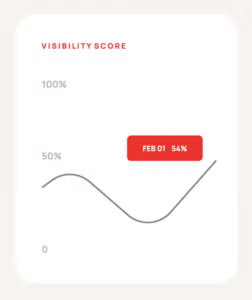
AI Visibility Score
A measurement of how frequently your institution appears across prompts for 30 days, covering programs, brand terms, outcomes, and high-intent queries.
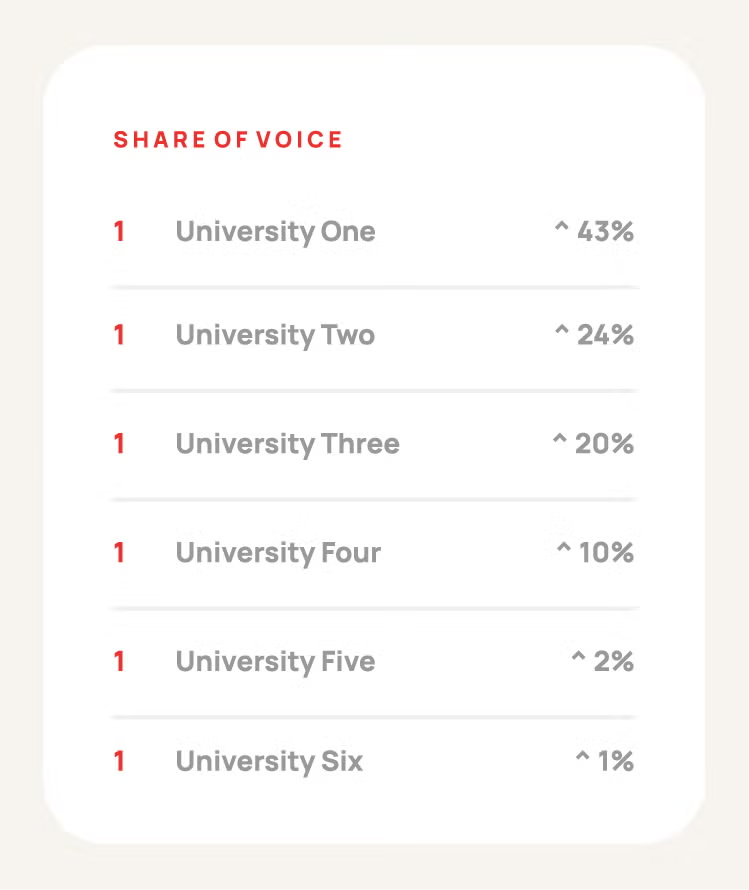
Competitive Analysis & Share of Voice
Insight into how your institution stacks up to peers and competitors in AI-generated answers.
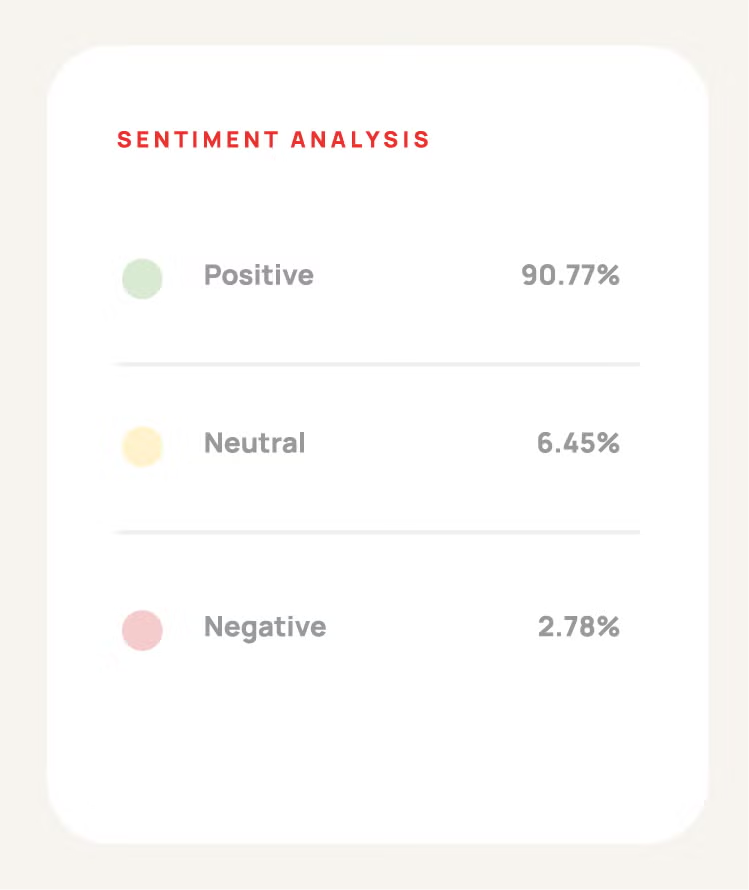
Brand Sentiment Insights
A view of how AI platforms describe your institution—positive, negative, or neutral—and how those narratives influence perception.
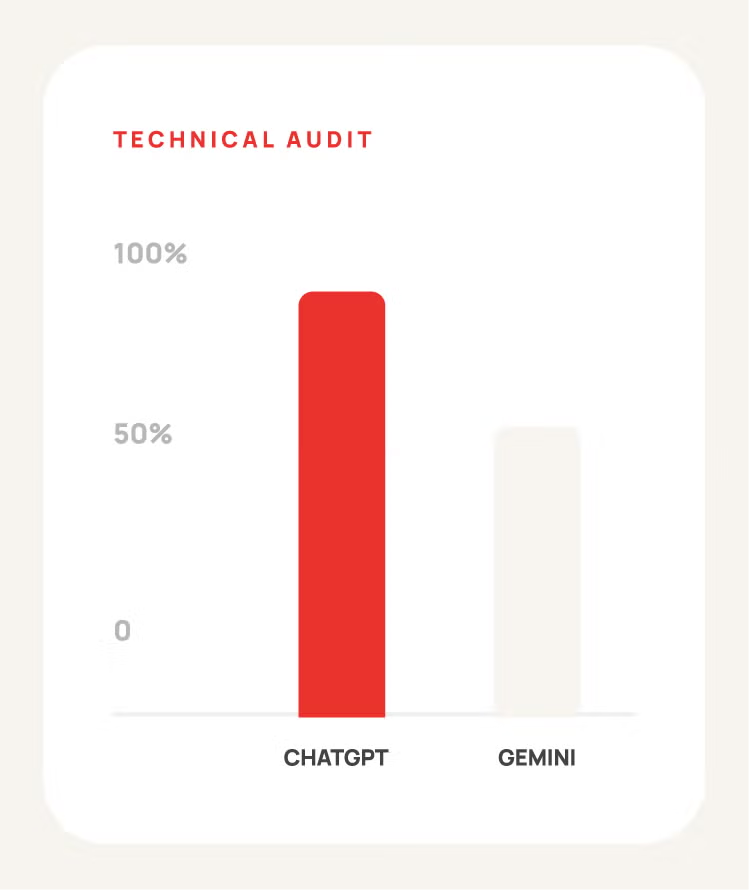
Technical + Structural Evaluation
A review of your website’s structure and content signals to identify barriers that may be preventing AI engines from surfacing your information accurately.
Graph showing ChatGPT outperforming Gemini in technical audit for higher education.
Strategic Roadmap
A prioritized plan outlining the most impactful improvements, from content enhancements to technical recommendations and program-level opportunities.
Ready to See How You Show Up in AI Search?
AI-powered discovery is already shaping how students explore, compare, and choose colleges.
The AEO Audit is the fastest way to understand how your institution is represented today and where opportunities exist to strengthen visibility, accuracy, and trust.
If you are responsible for your institution’s enrollment growth, brand differentiation, or long-term strategy, this is the place to start.
Answer Engine Optimization (AEO) is the practice of optimizing institutional content so AI platforms like ChatGPT, Gemini, Perplexity, and Google AI Overviews accurately interpret, summarize, and surface it in response to user questions.
Why is AEO important for higher education institutions in 2026?
AI search engines now shape how prospective students discover colleges, making AEO essential for institutions to maintain visibility and influence student decision-making in AI-generated results.
Who benefits most from Carnegie’s AEO solution?
Enrollment leaders, marketing leaders, presidents, and finance leaders benefit from AEO by gaining clarity into AI visibility, competitive positioning, and early-stage student perception.
What makes Carnegie’s AEO approach different?
Carnegie approaches AEO by pairing industry-leading AI visibility technology with deep higher education expertise. We combine large-scale AI monitoring and analysis with decades of leadership in search, SEO, and performance-driven discoverability—so institutions gain not just insight into how AI engines represent them, but expert guidance on how to improve accuracy, trust, and visibility over time.
What is Answer Engine Optimization and how does it differ from traditional SEO?
Answer Engine Optimization (AEO) optimizes content for direct citation by AI-powered platforms like ChatGPT and Google AI Overviews, focusing on structured, authoritative responses rather than search rankings alone.
How do AEO strategies complement existing SEO and content marketing efforts?
AEO extends traditional SEO by optimizing for AI-friendly structured formats, expanding institutional reach across both conventional search engines and emerging AI answer platforms simultaneously.
Search behaviour among prospective students is evolving fast. Instead of scrolling through pages of search results, many now turn to AI-powered tools for instant, conversational answers. This shift has introduced a new layer to traditional SEO: Generative Engine Optimization (GEO).
GEO focuses on optimizing content so that generative AI search engines like ChatGPT or Google’s AI Overview can find, interpret, and feature it in their responses. In essence, GEO ensures your institution’s information is selected, summarized, or referenced in AI-generated answers, rather than simply ranking in a list of links.
Higher education marketers in Canada and beyond must pay attention to this trend. Recent global studies indicate that nearly two-thirds of prospective students use AI tools such as ChatGPT at some stage of their research process, with usage highest during early discovery and comparison phases.
These tools pull content from across the web and present synthesized answers, often eliminating the need for users to click. This “zero-click” trend reduces opportunities for organic traffic, raising the stakes for visibility within AI systems.
This guide explores GEO’s role in education marketing, how it differs from traditional SEO, and why it matters for student recruitment in the age of AI. You’ll find practical guidance on aligning your content with generative AI, from keyword strategy to page prioritization. We’ll also look at how to measure GEO’s impact on inquiries and enrolment, and share examples from institutions leading the way.
AI is rewriting how students discover institutions.
Partner with HEM to stay visible in the age of generative search.
What Is Generative Engine Optimization (GEO) in Higher Education Marketing?
Generative Engine Optimization (GEO) is the practice of tailoring university content for AI-driven search tools like ChatGPT and Google’s AI Overview. Unlike traditional SEO, which targets search engine rankings, GEO focuses on making content readable, reliable, and retrievable by generative AI.
In higher ed, this means structuring key program details, admissions information, and differentiators so that AI tools can easily surface and cite them in responses. GEO builds on classic SEO principles but adapts them for a zero-click, conversational environment, ensuring your institution appears in AI-generated answers to prospective student queries.
How Is GEO Different from Traditional SEO for Universities and Colleges?
While both SEO and GEO aim to make your institution’s content visible, their approaches diverge in method and target. Traditional SEO is designed for search engine rankings. GEO, on the other hand, prepares content for selection and citation by AI tools that deliver instant answers rather than search results.
Let’s break it down.
Search Results vs. AI Answers SEO optimizes for clicks on a search results page. GEO optimizes for inclusion in a conversational answer. Instead of showing up as a blue link, your institution may be quoted or named by the AI itself.
Keyword Strategy SEO prioritizes high-volume keywords. GEO relies on semantic relevance. Instead of “MBA program Canada,” think “How long is the MBA at [University]?” or “What are the admission requirements?”
Content Structure Traditional SEO values user navigation. GEO values clarity for AI parsing. Bullet points, Q&A formatting, and schema markup make it easier for AI to extract information. Summary boxes and tables work better than long paragraphs.
Authority Signals E-E-A-T (Experience, Expertise, Authoritativeness, Trustworthiness) still matters. But for GEO, authority is inferred from citation style, accuracy, and consistency, not design or branding. Highlighting faculty credentials or linking to research enhances AI credibility scoring.
Technical Approach Both SEO and GEO require clean, crawlable websites. But GEO adds machine-readable formatting. Schema.org markups, downloadable data files, and clean internal linking increase your chances of being selected by AI.
Measuring Success SEO measures traffic, rankings, and form fills. GEO measures citations in AI responses, brand mentions, and voice assistant visibility. You might not get the click, but you still win visibility if the AI says your name.
In practice, this means layering GEO on top of existing SEO. A strong program page might combine narrative storytelling with a quick facts section. An admissions page should include both persuasive copy and an FAQ schema.
Bottom line: SEO helps you get found. GEO helps you get cited. And in the age of AI, both are essential to capturing attention at every stage of the student search journey.
Why GEO Matters for Student Recruitment in the Age of AI Search
Why is GEO important for student recruitment in the age of AI search? Generative AI search is already reshaping how prospective students discover, evaluate, and select postsecondary institutions. GEO (Generative Engine Optimization) equips institutions to remain visible and competitive in this changing environment. Here’s why it matters now more than ever:
Widespread Adoption by Gen Z
Today’s students are early adopters of generative AI. A 2024 global survey found that approximately 70% of prospective students have used AI tools like ChatGPT to search for information, and more than 60% report using chatbots during the early phases of their college research. This shift means fewer students are navigating university websites as a first step.
Instead, they’re posing detailed questions to AI, questions about programs, financial aid, campus life, and more. GEO ensures your institution’s information is accessible, machine-readable, and accurate in this discovery environment. Without it, you risk being excluded from the initial consideration set.
The Rise of Zero-Click Search Behavior
AI-generated responses often satisfy a query without requiring a website visit. This zero-click trend is accelerating, as nearly 60% of searches now end without a click. If a student asks, “What are the top universities in Canada for engineering?” and an AI tool responds with a synthesized answer that names three schools, those schools have won visibility without needing a traditional click-through.
GEO is your institution’s strategy for occupying that limited space in the answer. It’s how you shape perceptions in a search landscape where attention is won before a student reaches your homepage.
AI Is Becoming a College Advisor
Though current data shows AI has limited direct influence on final enrollment decisions, that influence is growing. As AI tools become more trusted, students will increasingly rely on them for shortlisting programs or comparing institutions. GEO ensures your content is part of those suggestions and comparisons.
For example, a prospective student might ask, “Which is better for computer science, [Competitor] or [Your University]?” Without well-structured, AI-optimized content, your institution may be left out or misrepresented. GEO levels the playing field, ensuring that when AI generates side-by-side evaluations, your offerings are accurate, current, and competitive.
Fewer Chances to Impress
Traditional SEO offered multiple entry points: page one, page two, featured snippets, and ads. AI-generated answers are far more concise, often limited to a single paragraph or a brief list of citations. That means your institution must compete for a narrower spotlight.
GEO increases your odds of selection by helping AI tools find and cite the most relevant, structured, and authoritative content. When students ask about tuition, deadlines, or international scholarships, you want the answer to come from your website, not a third-party aggregator or a competing institution.
Boosting Brand Trust and Authority
Being cited in AI responses lends credibility. Much like appearing at the top of Google results used to signal trustworthiness, consistent AI mentions confer authority. If ChatGPT, Google SGE, or Bing AI repeatedly reference your institution in educational queries, students begin to perceive your brand as reliable.
This builds long-term recognition, resulting in some students visiting your site simply because they’ve encountered your name often in AI responses. GEO helps position your institution as a trusted source across AI-driven search platforms, reinforcing brand equity and enhancing recruitment outcomes.
In Summary
GEO is rapidly becoming a critical component of modern higher education student recruitment marketing strategies. It ensures your institution is visible in the conversational, AI-driven search experiences that are now shaping student decisions. Just as universities once adjusted to mobile-first web browsing, they must now adapt to AI-first discovery.
GEO helps your institution appear in AI answers, influence prospective students early in their journey, and remain top of mind even when clicks don’t happen. For institutions navigating declining enrollments and intensifying competition, GEO is a forward-facing strategy that keeps you in the conversation and in the race for the next generation of learners.
How Can a University Website Be Optimized for AI Tools like ChatGPT and Google AI Overviews?
Optimizing a university website for generative AI search requires a blend of updated content strategy, technical precision, and practical SEO thinking. The goal is to ensure your institution’s content is not only findable but also understandable and usable by AI models such as ChatGPT or Google’s AI Overviews. Here are two key strategies to implement:
1. Embrace a Question-First Content Strategy Using GEO Keywords
Begin by identifying the natural-language queries prospective students are likely to ask. Instead of traditional keyword stuffing, build your content around direct, conversational questions with what we call “geo keywords.” For example: “What is the tuition for [University]’s nursing program?” “Does [University] require standardized tests?”, or “What scholarships are available for international students?”
Structure content using Q&A formats, headings, and short paragraphs. Include these questions and their answers prominently on program, admissions, or financial aid pages. FAQ sections are particularly effective since AI tools are trained on question-based formats and favor content with semantic clarity.
Audit your current site to uncover missing or buried answers. Use data from tools like Google Search Console or internal search analytics to surface frequent queries. Then, present responses in clear formats that both users and AI systems can digest.
2. Create Clear, Canonical Fact Pages for Key Information
AI tools rely on consistency. If your website offers multiple versions of key facts, such as tuition, deadlines, or admission requirements, AI may dismiss your content entirely. To avoid this, create canonical pages that serve as the single source of truth for essential topics.
For example, maintain a central “Admissions Deadlines” page with clearly formatted lists or tables for each intake period. Similarly, your “Tuition and Fees” page should break down costs by program, year, and student type.
Avoid duplicating this information across many pages in slightly different wording. Instead, link other content back to these canonical pages to reinforce credibility and reduce confusion for both users and AI. By prioritizing clarity, structure, and authority, your website becomes significantly more AI-compatible.
3. Structure Your Content for AI (and Human) Readability
Generative AI reads websites the way humans skim for quick answers, only faster and more literal. For your institution to show up in AI-generated results, your site must be structured clearly and logically. Here are six modern content strategies that improve readability for both users and machines:
1. Put Important Information Up Front
AI tools often extract the first one or two sentences from a page when forming answers. Lead with essential facts: program type, duration, location, or unique rankings. For example: A four-year BSc Nursing program ranked top 5 in Canada for clinical placements.
Avoid burying key points deep in your content. Assume the AI won’t read past the opening paragraph, and prioritize clarity early.
2. Use Headings, Lists, and Tables
Break up long content blocks using headings (H2s and H3s), bullet points, and numbered lists. These structures improve scanning and help AI identify and categorize information correctly.
Instead of a paragraph on how to apply, write:
How to Apply:
Submit your online application
Pay the $100 application fee
Upload transcripts and supporting documents
For data or comparisons, use simple tables. A table of admissions stats or tuition breakdowns is easier for AI to interpret than buried prose.
3. Standardize Terminology Across Your Site
Inconsistent language can confuse both users and AI. Choose one label for each concept and use it site-wide. For example, if your deadline page says “Application Deadline,” don’t refer to it elsewhere as “Closing Date” or “Due Date.”
Uniform terminology supports clearer AI parsing and reinforces credibility.
4. Implement Schema Markup
Schema markup is structured metadata added to your HTML that explicitly communicates the purpose of your content. It is critical to make content machine-readable.
Use JSON-LD and schema types like:
FAQPage for question-answer sections
EducationalOccupationalProgram for program details
Organization for your institution’s info
Event for admissions deadlines or open houses
Google and other AI systems rely heavily on this data. Schema also helps with traditional SEO by enabling rich snippets in search results.
5. Offer Machine-Readable Data Files
Forward-looking universities are experimenting with downloadable data files (JSON, CSV) that list key facts, such as program offerings or tuition. These can be made available through a hidden “data hub” on your site.
AI systems may ingest this structured content directly, improving the likelihood of accurate citations. For example, the University of Florida’s digital team reported that their structured content significantly improved the accuracy of Google AI Overviews summarizing their programs.
4. Keep Content Fresh and Consistent Across Platforms
AI tools favor accurate and current information. Outdated or conflicting content can lead to mistrust or exclusion. Best practices include:
Timestamping pages with “Last updated [Month, Year]”
Conducting regular audits to eliminate conflicting data
Using canonical tags to point AI toward the primary source when duplicate content is necessary
Aligning off-site sources like Wikipedia or school directory listings with your website’s data
For instance, if your homepage says 40,000 students and Wikipedia says 38,000, the AI may average the two or cite the incorrect one. Keep external sources accurate and consistent with your site.
5. Optimize for Specific AI Platforms (ChatGPT, Google SGE, etc.)
Each AI platform has different behaviors. Here is how to tailor your content for them:
ChatGPT (OpenAI)
Free ChatGPT may not browse the web, but ChatGPT Enterprise and Bing Chat do. These versions often rely on training data that includes popular and high-authority content.
To increase visibility:
Publish long-form, high-quality content that gets cited by others
Use backlink strategies to improve domain authority
Create blog posts or guides that answer common student questions clearly
Even if your content isn’t accessed in real time, if it has been crawled or cited enough, it may be paraphrased or referenced in AI answers.
Google AI Overview (formerly SGE)
Google’s AI Overviews (formerly Search Generative Experience, or SGE draws from top-ranking search results. So, traditional SEO performance directly influences GEO success.
Best practices include:
Use concise, answer-oriented snippets early in content (e.g., “General admissions require a 75% average and two references.”)
Ensure pages are crawlable and not blocked by scripts or logins
Reinforce AI clarity with schema and consistent internal linking
Voice Assistants (Siri, Alexa, Google Assistant)
These tools favor featured snippets and structured content. A direct response like: “Yes, we offer a co-op program as part of our Bachelor of Computer Science” is more likely to be read aloud than a paragraph with buried details.
Emerging Tools (Perplexity.ai, Bing Chat)
These newer AI search tools cite sources like Wikipedia and high-authority sites. To prepare:
Keep your institution’s Wikipedia page accurate and updated
Monitor and correct public conversations (e.g., Reddit, Quora) with official clarifications on your website
Consider publishing myth-busting content to preempt misinformation
Structuring your content for AI doesn’t mean abandoning human readers. In fact, the best practices that help machines, clarity, structure, and accuracy, also create better experiences for prospective students. By aligning your strategy with the expectations of both audiences, your university remains visible, credible, and competitive in the evolving search landscape.
6. Leverage Institutional Authority and Unique Content
Your organization holds content assets that AI deems both authoritative and distinctive, be sure to leverage them strategically. Showcase faculty research, student success outcomes, and institutional data on your site in clear, extractable formats. For instance: “Over 95% of our graduates secure employment within six months (2024 survey).”
Include program differentiators, accolades, and unique offerings that set your institution apart. AI-generated comparisons often cite such features. Strengthen content credibility with E-E-A-T principles:
Add author bylines and bios to expert-led blog posts
Cite trusted third-party sources and rankings
Present information factually while still engaging human readers
For example, pair promotional language (“modern dorms”) with direct answers (“First-year students are required to live on campus”). This dual-purpose approach ensures your content feeds both AI responses and prospective student curiosity. In short, AI rewards clear, credible, question-first content. Make sure yours leads the conversation.
Which Higher Education Pages Should Be Prioritized for GEO?
Not all web pages carry equal weight when it comes to generative engine optimization (GEO). To improve visibility in AI-generated search responses, universities should prioritize content that addresses high-intent queries and critical decision-making touchpoints.
Academic Program Pages These are foundational. When users ask, “Does [University] offer a data science degree?”, AI tools pull from program pages. Each page should clearly outline program type, duration, delivery mode, concentrations, accreditations, rankings, and outcomes. Include key facts in the opening paragraph and use structured Q&A to address specifics like “Is co-op required?” or “Can I study part-time?”
Admissions Pages AI queries often focus on application requirements. Structure admissions pages by applicant type and use clear subheadings and bullet points to list requirements, deadlines, and steps. Include canonical deadline pages with visible timestamps, and FAQ-style answers such as “What GPA is required for [University]?”
Tuition, Scholarships, and Financial Aid Cost-related questions are among the most common. Ensure tuition and fee data are presented in clear tables, by program and student type. Scholarship and aid pages should state eligibility, values, and how to apply in plain language, e.g., “All applicants are automatically considered for entrance scholarships up to $5,000.”
Program Finders and Academic Overview Pages Ensure your program catalog and A–Z listings are crawlable, up-to-date, and use official program names. Pages summarizing academic strengths should highlight standout offerings: “Our business school is triple-accredited and ranked top 5 in Canada.”
Student Life and Support Services AI often fields questions like “Is housing guaranteed?” or “What mental health resources are available?” Answer these directly: “All first-year students are guaranteed on-campus housing.” Showcase specific services for key demographics (e.g., international students, veterans) with quantifiable benefits.
Career Outcomes and Alumni Success Publish recent stats and highlight notable alumni. Statements like “93% of our grads are employed within 6 months” or “Alumni have gone on to roles at Google and Shopify” provide AI with strong content to surface in answers.
How Can Institutions Measure the Impact of GEO on Inquiries and Enrolment?
Measuring the impact of Generative Engine Optimization (GEO) requires a mix of analytics, qualitative monitoring, and attribution strategies. Since GEO outcomes don’t always show up in traditional SEO metrics, institutions must adopt creative, AI-aware approaches to track effectiveness.
Monitor AI Referral Traffic Check Google Analytics 4 (GA4) or similar platforms for referral traffic from AI tools like Bing Chat or Google SGE. While not all AI sources report referrals, look for domains like bard.google.com or bing.com and configure dashboards to track them. Even small traffic volumes from these sources can indicate growing visibility.
Track AI Mentions and Citations Manually query AI tools using prompts like “Tell me about [University]” or “How do I apply to [University]?” and log whether your institution is cited. Note if AIs reference your site, Wikipedia, or other sources. Track frequency and improvements over time, especially following content updates. Screenshots and logs can serve as powerful internal evidence.
Use Multi-Touch Attribution Students may not click AI links, but still recall your brand. Add “How did you hear about us?” options in inquiry forms, including “ChatGPT” or “AI chatbot.” Monitor brand search volume and direct traffic following GEO updates. Qualitative survey insights and CRM notes from admissions teams can help reveal hidden AI touchpoints.
Analyze GEO-Optimized Page Engagement Watch how the pages you optimize for GEO perform. Increased pageviews, lower bounce rates, and higher conversion (e.g., info form fills) may indicate better alignment with AI outputs and human queries alike, even if AI is only part of the traffic source.
Observe Funnel Shifts and Segment Trends Notice any spikes in inquiries for certain programs or demographics that align with AI visibility. For example, a rise in international applications after enhanced program content could suggest AI exposure.
Build a GEO Dashboard Create simple internal dashboards showing AI referrals, engagement trends, citation screenshots, and timelines of GEO initiatives. Correlate those with enrollment movement when possible.
Test, Refine, Repeat Experiment continuously. A/B test content formats, restructure FAQs, and see which phrasing AI picks up. Treat AI outputs as your new SEO testbed.
While GEO analytics are still evolving, early movers gain visibility and mindshare. Measuring what’s possible now ensures institutions are positioned to lead as AI search reshapes student discovery.
10 Global Examples of GEO in Practice (Higher Ed Institutions)
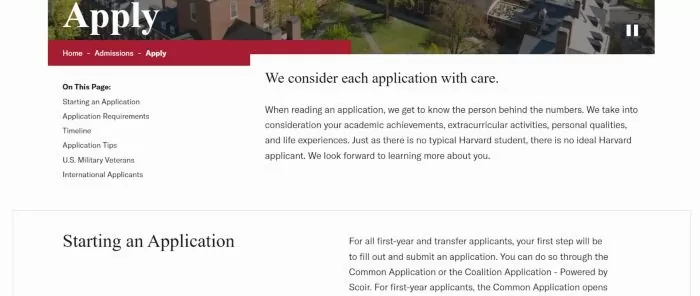
1. Harvard University: Harvard College Admissions “Apply” Page
Harvard’s undergraduate admissions Apply page (Harvard College) is a model of clear, structured content. The page is organized with intuitive section headings (e.g., Application Requirements, Timeline) and even an on-page table of contents for easy navigation.
It provides a bullet-point list of all required application components (from forms and fees to test scores and recommendations), ensuring that key information is presented succinctly.
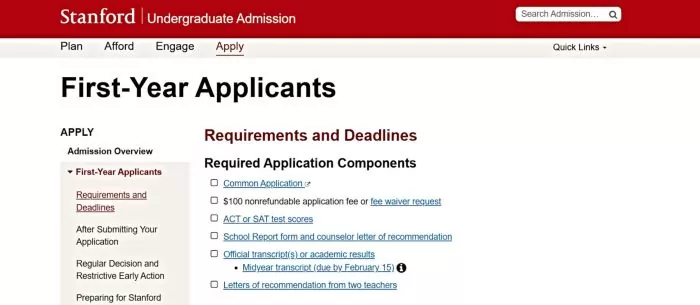
2. Stanford University: First-Year Applicants “Requirements and Deadlines” Page
Stanford’s first-year admission page stands out for its semantic, structured presentation of information. It opens with a clearly labeled checklist of Required Application Components, presented as bullet points (e.g., Common Application, application fee, test scores, transcripts, etc.). Following this, Stanford provides a well-organized Requirements and Deadlines table that outlines key dates for Restrictive Early Action and Regular Decision side by side.
In this table, each milestone, from application submission deadlines (e.g., November 1 for early, January 5 for regular) to notification dates and reply deadlines, is neatly aligned, which is both user-friendly and easy for AI to parse.
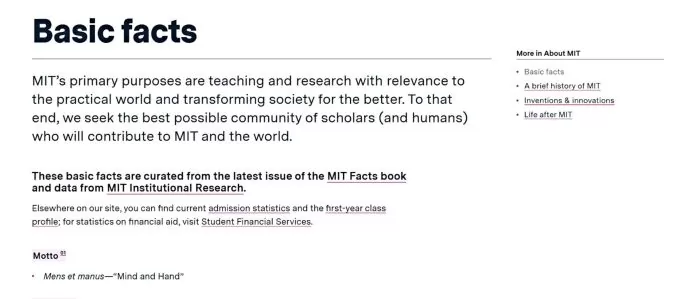
3. Massachusetts Institute of Technology (MIT): “About MIT: Basic Facts” Page
MIT Admissions offers an About MIT: Basic Facts page that is essentially a treasure trove of quick facts and figures presented in bullet form. This page exemplifies GEO best practices by curating the institute’s key data points (e.g., campus size, number of students, faculty count, notable honors) as concise bullet lists under intuitive subheadings.
For instance, the page lists campus details like acreage and facilities, student demographics, and academic offerings in an extremely scannable format. Each bullet is a self-contained fact (such as “Undergraduates: 4,576” or “Campus: 168 acres in Cambridge, MA”), making it ideal for AI summarization or direct answers. Because the content is broken down into digestible nuggets, an AI-powered search can easily extract specific information (like *“How many undergraduate students does MIT have?”) from this page.
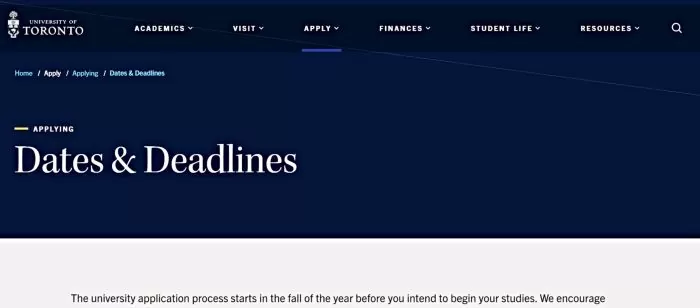
4. University of Toronto: Undergraduate “Dates & Deadlines” Page
The University of Toronto’s Dates & Deadlines page for future undergraduates is a great example of structured scheduling information. It presents application deadlines in a highly structured list, broken down by program/faculty and campus. The page is organized into expandable sections (for full-time, part-time, and non-degree studies), each containing tables of deadlines.
For example, under full-time undergraduate applications, the table clearly lists each faculty or campus (Engineering, Arts & Science – St. George, U of T Mississauga, U of T Scarborough, etc.) alongside two key dates: the recommended early application date and the final deadline. This means a prospective student can quickly find, say, the deadline for Engineering (January 15) and see that applying by November 7 is recommended.
Such a format is not only user-friendly but also easy for AI to interpret. The consistency and labeling (e.g., “Applied Science & Engineering, November 7 (recommended) / January 15 (deadline)”) ensure that an AI answer to “What’s the application deadline for U of T Engineering?” will be accurate.
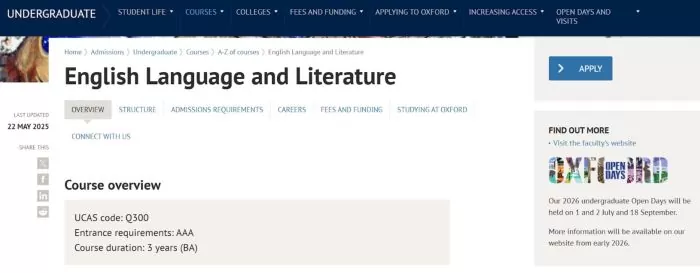
5. University of Oxford: English Language and Literature Course Page
Oxford’s course page for English Language and Literature showcases GEO-friendly content right at the top with a concise Overview box. This section acts as a quick-reference summary of the course, listing crucial facts in a compact form. It includes the UCAS course code (Q300), the entrance requirements (AAA at A-level), and the course duration (3 years, BA) clearly on separate lines. Immediately below, it outlines subject requirements (e.g., Required: English Literature or English Lang/Lit) and other admission details like whether there’s an admissions test or written work, all in the same straightforward list format.
This means a prospective student (or an AI summarizing Oxford’s offerings) can get all the key info about the English course at a glance – from how long it lasts to what grades are needed.
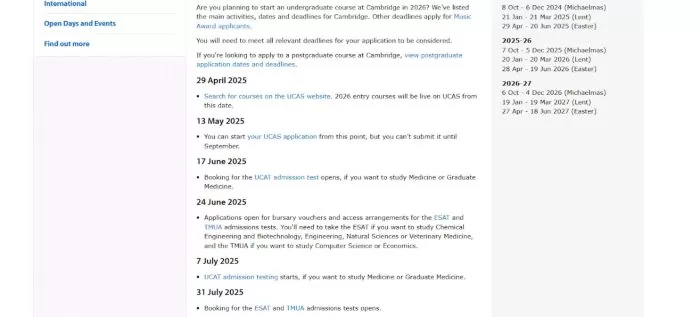
6. University of Cambridge: Application Dates and Deadlines Page
Cambridge’s admissions website provides a dedicated Application Dates and Deadlines page that reads like a detailed timeline of the entire admissions process. This page lays out, in chronological order, all the key steps and dates for applying to Cambridge, with each date accompanied by a short explanation of what happens or what is due.
For example, it starts as early as the spring of the year before entry, noting when UCAS course search opens and when you can begin your UCAS application. Critically, it flags the famous 15 October UCAS deadline with emphasis: “15 October 2025 – Deadline to submit your UCAS application (6 pm UK time)”. Other entries include deadlines for supplemental forms like the My Cambridge Application (22 October), dates for admissions tests, and notes about interview invitations in November and December.
Staying Discoverable in the Age of Generative Search
Generative Engine Optimization (GEO) is rapidly shifting from trend to necessity in higher education marketing. As AI-driven platforms like ChatGPT, Google SGE, and voice assistants reshape how students seek information, institutions must adapt their content strategies accordingly.
By aligning with modern GEO practices, universities enhance both discoverability and user experience, meeting students where they are and ensuring their narratives are accurately represented. In today’s competitive enrolment landscape, GEO is not optional; it is foundational. The strategies outlined above provide a roadmap for sustainable visibility in the age of generative search. Continue refining your approach, and your institution will not just appear in AI responses; it will lead them. In this new era, the goal is simple: be cited, not sidelined.
AI is rewriting how students discover institutions.
Partner with HEM to stay visible in the age of generative search.
FAQs
Q: What is generative engine optimization (GEO) in higher education marketing?
A: Generative Engine Optimization (GEO) is the practice of tailoring university content for AI-driven search tools like ChatGPT and Google’s AI Overview. Unlike traditional SEO, which targets search engine rankings, GEO focuses on making content readable, reliable, and retrievable by generative AI.
Q: How is GEO different from traditional SEO for universities and colleges?
A: While both SEO and GEO aim to make your institution’s content visible, their approaches diverge in method and target. Traditional SEO is designed for search engine rankings. GEO, on the other hand, prepares content for selection and citation by AI tools that deliver instant answers rather than search results.
Q: Why is GEO important for student recruitment in the age of AI search?
A: Generative AI search is already reshaping how prospective students discover, evaluate, and select postsecondary institutions. GEO (Generative Engine Optimization) equips institutions to remain visible and competitive in this changing environment.
Preparing for an AI-Powered Evolution in How Students Search
If you’ve ever been involved in your institution’s digital marketing efforts, you’ve undoubtedly heard of search engine optimization — otherwise known as SEO.
But after more than a decade of optimizing keywords and backlinks in content for search engines like Google and Bing, we’re now at the dawn of a new age spurred on by artificial intelligence (AI) and a new approach is required: generative engine optimization (GEO).
As prospective students turn to AI tools and large language models (LLMs) to guide their college search, traditional SEO tactics are no longer enough. Digital marketing teams must also incorporate new GEO-focused tactics into their strategies.
In an increasingly competitive and LLM-driven world, institutions must now rethink their visibility, branding, and recruitment strategies for a digital landscape that continues to evolve.
Understanding Generative Engines and Their Impact on Students’ Search Behavior
Generative engine optimization is emerging as a critical response to the way AI is reshaping how prospective students find and evaluate colleges. Unlike traditional search engines, generative engines powered by large language models deliver conversational, synthesized responses — often without requiring users to click through to a website.
This shift is impacting how institutions need to approach their digital visibility and student engagement efforts.
The Rise of LLMs
As students move away from traditional search engines toward AI search tools, LLMs and LLM-powered tools like ChatGPT, Claude, Perplexity, and Google’s Gemini and Search Generative Experience (SGE) are leading the way.
These platforms generate real-time, AI-powered answers that summarize information from across the web — often citing sources, but not always linking to them directly. Their growing popularity signals a move away from standard search engine results toward fluid, question-driven discovery.
The Impact of LLMs on Students’ Search Experiences
Prospective students are already turning to generative engines to ask nuanced questions such as, “What are the top 20 online MSW programs?” or “Which colleges have the best student support services for veterans?”
Instead of having to navigate a list of blue links, they’re receiving direct, synthesized answers to their questions. This introduces key shifts that digital marketers must consider, including:
Fewer clicks to their institution’s website
A higher priority for being cited in credible content
Reduced visibility in traditional search engine results pages (SERPs)
For colleges and universities, adapting to this new behavior is essential to staying prominent in students’ minds during their decision-making process.
SEO vs. GEO in Higher Education
Search engine optimization and generative engine optimization share a common goal: to ensure content is discoverable, relevant, and credible. Both approaches rely on strategic keyword usage, high-quality content, and data-driven refinement to increase visibility.
SEO was built for traditional search engines that return ranked lists of links. GEO is designed for AI-powered engines that synthesize information and deliver complete answers.
For universities, this change requires a new, blended approach — one that takes both SEO and GEO into account when creating admissions materials, program pages, and search rankings-focused content such as blog posts.
SEO vs. GEO: A Side-by-Side Comparison
Category
SEO (Search Engine Optimization)
GEO (Generative Engine Optimization)
Primary Goal
Ranks web pages in search engine results pages
Surfaces content in AI-generated, conversational responses
Keyword Strategy
Optimizes for exact-match and high-volume keywords
Focuses on semantic relevance and contextual cues
User Experience
Prioritizes site structure, navigation, and readability
Prioritizes clear, structured content that AI can easily parse
Tracks AI referrals, citation frequency, inclusion in LLM answers
Content Strategy
Page-level optimization for ranking
Multisource optimization for synthesis in AI-generated content
Adaptability Requirement
Evolves with search algorithm updates
Evolves with AI behavior, model updates, and platform preferences
User Search Experience
List of blue links with snippets
Zero-click answers, direct responses, and conversational recommendations
How Generative Engines Pull and Rank University Content
Generative engines like ChatGPT and Google’s SGE don’t rank web pages the same way traditional search engines do. Instead, they synthesize information from multiple sources to deliver a single, cohesive answer.
To be included in these AI-generated responses, university content needs to strike a balance between academic credibility and an accessible, student-friendly structure. AI prioritizes information that is well-organized, clearly written, and backed by authoritative sources, such as:
Research publications
Program pages
Institutional blogs
Institutions that prioritize clarity and credibility in their content are more likely to be cited and surfaced in generative search results.
Key GEO Strategies for Colleges and Universities
To stay visible in AI-driven searches, institutions need to adopt innovative content strategies tailored to how generative engines interpret and deliver information. Here are some core GEO tactics:
Showcase Faculty Within Content
Highlight faculty expertise in program pages, blog posts, and FAQs.
Link to faculty bios and published research to boost credibility.
Feature quotes, profiles, or insights to personalize academic offerings.
Ensure AI- and LLM-Friendly Structure and Markup
Use schema (structured data) markup to help AI understand the content’s context.
Organize pages with clear subheadings that mirror common student questions.
Example: “Is an Online EdD Respected?”
Boldface key points and use callout boxes to surface important information.
Design site architecture for easy crawling and content parsing.
Create Concise and Clear Content
Use conversational, student-centered language.
Write in short, scannable paragraphs with clear takeaways.
Address common and next-level questions.
Examples: “How long does it take to complete this degree?” and “What can I do with my degree after graduation?”
Use Content Formats That Perform Well in GEO
Incorporate career outcome and salary tables.
Include degree comparisons.
Example: “MBA vs. MPA”
Use visuals and guides that explain steps for processes such as admissions, licensure, and the student journey.
Build Brand Authority and Trust
Invest in public relations campaigns to generate credible mentions and citations.
Maintain consistent messaging across the web, social media, and paid media.
Grow visibility through strategic content distribution and strong social media channels.
Measuring GEO Performance in Enrollment Marketing
As with every digital marketing initiative, it’s not enough to just roll out a GEO strategy — institutions need to measure its success. Here’s how it’s done in the GEO world:
Create LLM-Focused Dashboards via GA4 and Looker Studio
Institutions can build LLM-focused dashboards using Google Analytics 4 (GA4) and Looker Studio by creating filters for platforms like ChatGPT, Perplexity, Microsoft Copilot, Google Gemini, and Claude.
Google currently doesn’t provide direct data for AI Overview referrals, and they have been neutral in response to questions on if they will ever release AI Overview data.
While LLMs are still evolving, isolating referral traffic from these tools can provide institutions with early insight into how students are discovering their content through AI.
Use Attribution Models for AI-Influenced Student Journeys
To fully understand how GEO affects students’ enrollment behavior, marketers need to evolve their attribution models, or how enrollment conversions are attributed to different channels. AI-generated responses often play a role at the top of the enrollment funnel, influencing students before they ever land on a university’s website.
Measuring that influence through multitouch attribution and long-view funnel analysis will become increasingly important as AI tools reshape how students explore, compare, and commit to higher education programs.
Challenges and Ethical Considerations
As generative engines continue to shape how students discover universities, inherent challenges will likely arise.
AI tools can misrepresent data or present outdated information, raising concerns about their accuracy and whether they can be trusted. There’s also the risk that well-resourced, elite institutions may disproportionately dominate generative search results, reinforcing existing inequities. Lack of transparency in how algorithms surface and prioritize content makes it difficult for institutions to ensure they are receiving fair and accountable representation.
Future Trends in Higher Education GEO
When it comes to emerging digital marketing techniques like GEO, early investments can help institutions stay ahead of the curve.
Multimodal Optimization for Virtual Campus Tours and Visual Content
As generative engines evolve, optimizing for multimodal content — such as images, video, and virtual tours — will become increasingly important.
This goes beyond traditional desktop experiences. In Meta’s first quarter 2025 earnings call, Mark Zuckerberg predicted that smart glasses will eventually replace smartphones, describing them as ideal for AI and the metaverse.
With Meta already partnering with Ray-Ban on AI-integrated eyewear, higher ed marketers need to start preparing content that’s not just LLM-friendly but also immersive, interactive, and wearable-ready.
AI-Driven Personalization for Students
Rather than relying on static rankings or one-size-fits-all search experiences, AI is ushering in a wave of hyperpersonalization. Prospective students may soon interact with personalized advisors, see school rankings tailored to their goals, and receive customized digital content that aligns with their academic and career interests.
This shift will push institutions to deliver flexible, student-centered content that adapts to each individual’s intent and pathway.
Search by Outcome, Not Degree
Generative tools are beginning to trace backward from desired career outcomes by identifying what roles successful professionals hold, then linking those roles to specific programs, professors, and institutions.
For colleges and universities, this means alumni outcomes, employer partnership information, and job title visibility are essential signals. Institutions that surface these elements clearly will be better positioned to show up in outcome-based searches and AI-generated guidance.
Ready to Get Ahead of the Curve?
The use of AI and large language models in search is only going to increase, fundamentally reshaping how students discover, evaluate, and engage with higher education institutions.
Developing a strong generative engine optimization strategy is essential. GEO needs to be seamlessly integrated into your existing SEO and digital marketing efforts to ensure your institution stays visible and relevant in a rapidly shifting landscape.
With generative engines evolving at an unprecedented pace, now is the time to prepare for how you’ll reach the next generation of students.
Want to talk through how GEO fits into your broader enrollment strategy? Contact Archer Education to start the conversation.
Remember when SEO was all about keywords and metatags, fueling now-defunct search engines like Yahoo, AltaVista and early Google? Those were the days of “keyword stuffing,” where quantity trumped quality and relevance, delivering poor search results and frustrating users. Google’s PageRank algorithm changed everything by prioritizing content quality, giving birth to the “Content is King” mantra and improving the user experience.
Fast forward to the Era of the Modern Learner, where digitally astute users demand fast and accurate information at their fingertips. To keep up with their heightened expectations, search engine algorithms have evolved to become more sophisticated, focusing on the intent behind each search query rather than simple keyword matching. This shift has led to the emergence of AI-powered search engines features like Google’s AI Overviews to provide an AI-powered summary which now command prime real estate on the search engine results page.
In response, Generative Engine Optimization (GEO) is emerging. AI-powered search engines are moving beyond simply ranking websites. They are synthesizing information to provide direct answers. In this fast-paced environment, delivering the right information at the right time is critical now more than ever. All marketers, regardless of industry, must adapt their strategies beyond traditional SEO.
What is Generative Engine Optimization (GEO)?
Artificial intelligence is rapidly infiltrating tools across every industry, fundamentally reshaping the digital landscape. Generative Engine Optimization (GEO) is emerging as a new approach to digital marketing, leveraging AI-powered tools to generate and optimize content for search engines. GEO is a catalyst, driving a fundamental shift in how search engines present information and how users consume it
GEO leverages machine learning algorithms to analyze user search intent, create personalized content, and optimize websites for improved search engine rankings. This advanced algorithmic approach delivers contextually rich information from credible sources, directly answering user searches and proactively addressing related inquiries. A proactive strategy that goes beyond traditional SEO ensures that a school’s information is readily discoverable, easily digestible and favorably presented by AI-powered search engines such as Google’s AI Overviews, ChatGPT, Perplexity and Gemini.
How GEO Works
At its core, Generative Engine Optimization (GEO) uses artificial intelligence to bridge the gap between user needs and search engine performance. GEO tools go beyond traditional SEO by harnessing AI to deeply understand user behavior and generate content that’s not only relevant but also personalized and performance driven. Here is how it works across four core functions:
Analyzing User Intent: GEO starts by analyzing user intent. AI models examine search queries, website behavior and browsing patterns to uncover what users are specifically searching for. This helps marketers develop content strategies that directly align with user expectations and needs.
Generating Content: Using these insights, GEO tools generate original content tailored to meet the precise needs of the target audience. The result is content that answers user questions and aligns with how modern search engines evaluate relevance and quality.
Optimizing Content: GEO then optimizes the generated content for performance. AI refines readability, integrates keywords and enhances structural elements for improved visibility in search results, which ensures that content performs well in both traditional and AI-powered search environments.
Personalizing Content: Where GEO truly shines is in content personalization. By leveraging data like demographics, preferences and past interactions, GEO delivers tailored experiences that feel more relevant and engaging to individual users.
Comparing SEO and GEO
While SEO and GEO may seem like competing strategies, they actually complement one another. Both aim to improve visibility in search results and drive meaningful engagement but do so through different methods. Understanding how they align and where they diverge is key to developing a modern, well-rounded digital strategy.
Ways GEO is Similar to SEO
Despite their difference in execution, SEO and GEO share a common goal: delivering valuable content to users and meeting their search intent. Both SEO and GEO strategies contribute to:
Improving website visibility and search rankings in the search engine results pages (SERPs).
Driving organic traffic by making it easier for users to discover relevant information.
Boosting user engagement and conversion rates through informative, well-tailored content.
Ways GEO is Different from SEO
Where SEO and GEO begin to diverge is in their focus, tools, and content strategy:
Focus: Traditional SEO emphasizes keyword optimization, meta tags and technical structure. GEO, on the other hand, focuses on understanding user intent and creating dynamic, personalized content that adapts to evolving needs.
Tools: SEO relies on tools like keyword research platforms, backlink analysis, and manual content audits. GEO uses AI-powered platforms to analyze data, generate content, and automate optimization based on real-time user behavior.
Content: SEO often produces static, evergreen content that ranks over time. GEO enables the creation of responsive, personalized content that can shift based on user preferences, past interactions, and demographics.
While SEO has historically focused on driving clicks to websites and increasing rankings, GEO recognizes the increasing prominence of zero-click searches—where users find answers directly within AI-powered search overviews. In this new reality, GEO ensures your content remains visible and valuable even when the traditional click doesn’t occur. It does this by optimizing for how AI synthesizes and presents information in search results.
Is GEO Replacing SEO?
The rise of GEO has sparked an important question for marketers: Is SEO dead? The short answer is no. Rather than replacing SEO, GEO enhances it.
GEO builds a foundation of traditional SEO by leveraging artificial intelligence to automate time-consuming tasks, deepen audience insights, and elevate content quality. A strong SEO strategy remains essential, and when paired with GEO, it becomes even more powerful.
To support marketers in building that foundation, tools like EducationDynamics’ SEO Playbook offer actionable strategies for mastering SEO fundamentals while staying adaptable to innovations like GEO. As the higher education marketing landscape evolves, institutions are reaching a critical inflection point: the status quo no longer meets the expectations of the Modern Learner, and a more dynamic, data-driven approach is essential to stay competitive.
Here’s how GEO supports and strengthens traditional SEO efforts:
Smarter Keyword Research and Optimization: GEO tools analyze search intent more precisely, allowing marketers to choose keywords that better reflect how real users search, creating content that directly answers those queries.
More Personalized Content Experiences: By generating dynamic content based on user behavior, preferences, and demographics, GEO helps ensure the right message reaches the right audience at the right time.
Streamlined Workflows: GEO automates content generation and optimization processes, making it easier to keep web pages fresh, relevant, and aligned with evolving search behaviors—all while saving time and resources.
SEO is far from obsolete; however, relying solely on traditional SEO tactics is outdated which is no longer sufficient in today’s evolving higher education landscape. To truly transform their marketing approach, institutions must embrace innovative solutions.
As generative AI becomes increasingly embedded in how people search, marketers must adapt. While traditional SEO tactics like on-page optimization, site structure, and link-building still have a role to play, GEO provides the bold innovation needed to drive impactful outcomes. By pairing SEO strategies with GEO’s AI-driven insights and automation, institutions can achieve greater efficiency and effectiveness in their marketing efforts.
Together, SEO and GEO provide a holistic, future-ready framework to engage the Modern Learner, enhance digital marketing efforts, and drive both reputation and revenue growth, which are essential for long-term success.
Integrating GEO and SEO in Your Marketing Strategy for Higher Education Marketers
As the digital landscape evolves, one thing remains clear: SEO is still essential for institutions looking to connect with today’s students. With the rapid adoption of AI in everyday search habits though, SEO alone is no longer enough.
According to EducationDynamics 2025 Engaging the Modern Learner Report, generative AI is already transforming how prospective students evaluate their options. Nearly 70% of Modern Learners use AI tools for generative chatbot platforms like ChatGPT, while 37% use these tools specifically to gather information about colleges and universities in their consideration set.
This shift signals a clear need for higher ed marketers to adapt their digital strategies. GEO provides a pathway to do that while better serving today’s students. By combining the proven fundamentals of SEO with GEO’s advanced AI capabilities, institutions can engage the Modern Learner more effectively at every stage of their decision-making journey.
Reaching Modern Learners: Integrating GEO and SEO Strategies
Speak to What Modern Learners Search For: Modern Learners expect content that speaks directly to their needs and interests. Use GEO tools to identify the actual search terms prospective students use, such as “flexible online MBA,” or “how much does an online degree cost.” Then, develop SEO-optimized pages, blog posts, and FAQs that address these specific questions. Incorporate schema markup, structured headings, and internal links to boost visibility while keeping content informative and student focused.
Personalize the Journey for Every Modern Learner: GEO enables marketers to go beyond generic messaging. Use behavioral data, such as which pages students visit, how long they stay or what programs they explore, to personalize touchpoints across channels. Personalization builds trust and shows Modern Learners you understand what matters to them.
Deliver the Seamless Digital Experiences Modern Learners Expect: Today’s students want fast, seamless experiences. Use GEO insights to identify where users drop off, then optimize navigation and page speed accordingly. Implement clear, scannable layouts with prominent CTAs to enhance your website’s structure and user-friendliness. Consider adding AI-powered chatbots to provide real-time support for everything from application steps to financial aid inquiries.
Use Data to Stay Ahead of the Modern Learner’s Needs: GEO tools give you visibility into what students search for, which content they engage with, and where they lose interest. Regularly review search patterns, click paths, and drop-off points to identify gaps in your content or barriers in the enrollment funnel. Use these insights to refine headlines, adjust keyword targeting, or introduce new resources that better align with what students care about.
As prospective students increasingly turn to AI tools to explore their options, higher education marketers must evolve their strategies to keep pace with changing search behaviors. While Search Engine Optimization remains essential for visibility and reach, it no longer fully reflects how today’s students search and engage online. GEO bridges that gap by adapting to real-time behaviors and preferences. To effectively connect with Modern Learners and stay competitive, institutions must evolve their digital strategies to include GEO.
The Future of SEO and GEO in Higher Education
The future of enrollment will be shaped by how well institutions adapt to evolving digital behaviors. GEO is one of the many new components at the forefront of this shift. As AI continues to reshape how students interact with institutions and search for information, GEO will become an instrumental tool for delivering personalized, real-time information to meet their expectations.
Traditional SEO will still play a vital role in ensuring your institution is discoverable, but GEO takes things further by extracting and tailoring relevant content to meet the specific needs of each user, creating dynamic, intent-driven engagement. With more students using generative AI tools to guide their enrollment journey, institutions must embrace strategies that reflect this new reality.
Looking ahead, AI-powered SEO strategies will empower higher education marketers to create adaptive content that speaks directly to individual student goals and behaviors. These tools will also make it possible to deliver faster, more relevant information across platforms, often surfacing answers before a student ever clicks a link. With deeper access to behavioral data and user intent, marketers can refine messaging in real time, ensuring they’re reaching the right students with the right information at the right moment in their decision-making journey.
Unlocking the Power of GEO with EducationDynamics
As the digital landscape continues to shift, it can be challenging for institutions to keep pace with rapid change—especially when it comes to reaching the demands of today’s students. GEO empowers institutions to transform their digital engagement strategies, moving beyond outdated tactics to cultivate meaningful connections with the Modern Learner.
As a leading provider of higher education marketing solutions, EducationDynamics specializes in helping colleges and universities stay ahead. Our team brings deep expertise in foundational SEO and is actively embracing the next wave of digital strategy through Generative Engine Optimization (GEO). We understand what it takes to create meaningful engagement in a competitive enrollment environment and we’re here to help you do just that.
Connect with us to discover how we can support your team in building personalized digital strategies—whether it’s laying the groundwork with SEO or embracing innovative approaches like GEO. We’re here to help your institution succeed in today’s ever-changing digital world.