This audio is auto-generated. Please let us know if you have feedback.
A federal judge is standing by his June decision requiring the U.S. Department of Education torestore its Office for Civil Rights “to the status-quo” so it can “carry out its statutory functions.” The order, which prevents the department from laying off OCR employees, comes despite a U.S. Supreme Court emergency order in a separate case allowing the agency to move forward with mass layoffs across the department.
The case challenging the gutting of OCR, which included the shuttering of seven out of 12 regional OCR offices, was brought by two students who “faced severe discrimination and harassment in school and were depending on the OCR to resolve their complaints so that they could attend public school,” said Judge Myong Joun in his Aug. 13 decision.
The Education Department appealed Joun’s ruling Thursday to the U.S. First Circuit Court of Appeals, asking the court to allow the department to move forward with its OCR closures.
The court battle prolongs the administrative leave of OCR employees that began in March, after the department laid off more than 1,300 staff across the entire Education Department. President Donald Trump and U.S. Education Secretary Linda McMahon pushed the layoffs as a way to “end bureaucratic bloat” and downsize the federal government, including its expenses.
However, according to American Federation of Government Employees Local 252, the union representing a majority of the laid-off Education Department employees, the federal government has been paying around $7 million a month just for employees to sit idle on administrative leave.
The employees’ administrative leave that began in March originally ended with their termination on June 9. However, court cases blocking the department’s gutting have prolonged their employment.
According to the numbers released by the agency last year, OCR received a record number of complaints against K-12 and higher education institutions in 2023, the most recent year for which numbers are available, surpassing a previous all-time high set in 2022.
This audio is auto-generated. Please let us know if you have feedback.
A federal judge is standing by his June decision requiring the U.S. Department of Education torestore the Office for Civil Rights “to the status-quo” so it can “carry out its statutory functions.” The order, which prevents the department from laying off OCR employees, comes despite a U.S. Supreme Court emergency order in a separate case allowing the agency to move forward with mass layoffs across the department.
The case challenging the gutting of OCR, which included the shuttering of seven out of 12 regional OCR offices, was brought by two students who “faced severe discrimination and harassment in school and were depending on the OCR to resolve their complaints so that they could attend public school,” said Judge Myong Joun in his Aug. 13 decision.
The Education Department appealed Joun’s ruling Thursday to the U.S. First Circuit Court of Appeals, asking the court to allow the department to move forward with its OCR closures.
The court battle prolongs the administrative leave of OCR employees that began in March, after the department laid off more than 1,300 staff across the entire Education Department. President Donald Trump and U.S. Education Secretary Linda McMahon pushed the layoffs as a way to “end bureaucratic bloat” and downsize the federal government, including its expenses.
However, according to American Federation of Government Employees Local 252, the union representing a majority of the laid-off Education Department employees, the federal government has been paying around $7 million a month just for employees to sit idle on administrative leave.
The employees’ administrative leave that began in March originally ended with their termination on June 9. However, court cases blocking the department’s gutting have prolonged their employment.
According to the numbers released by the agency last year, OCR received a record number of complaints against K-12 and higher education institutions in 2023, the most recent year for which numbers are available, surpassing a previous all-time high set in 2022.
This audio is auto-generated. Please let us know if you have feedback.
Dive Brief:
The American Council on Education and other major higher education associations are urging the U.S. Supreme Court to preserve a lower court’s ruling that ordered the National Institutes of Health to reinstate funding for hundreds of canceled grants.
In June, a federal judge vacated NIH directives to nix grant funding for research related to diversity, equity and inclusion. The Trump administration quickly appealed the decision and asked the Supreme Court in July to pause the lower court’s order while an appeals court considers the case.
Eight higher ed groups — including ACE, the Association of American Universities and the Association of American Medical Colleges — argued in legal filings Friday that allowing NIH to cancel the grants again would destabilize the nation’s biomedical research and waste government funding on projects forced to stop midstream.
Dive Insight:
President Donald Trump signed several executive orders shortly after beginning his second term that prompted the NIH cancellations. One ordered federal agencies to terminate all “equity-related” grants “to the maximum extent allowed by law,” and another directed them to end federal funding for “gender ideology,” which the administration defined as the idea that gender exists on a spectrum.
Civil rights groups have noted that anti-LGBT groups use the term “gender ideology” to cast being transgender as a political movement rather than a fundamental identity.And the American Medical Association has said that “trans and non-binary gender identities are normal variations of human identity and expression.”
The Trump administration canceled vast sums of scientific research funding following those orders. In NIH’s case, the agency often informed researchers of the terminations by saying their work “no longer effectuates agency priorities.”
The moves quickly drew legal challenges.
Researchers and unions argued in an April lawsuit that the move was “a reckless and illegal purge to stamp out NIH-funded research that addresses topics and populations that they disfavor.” A coalition of states also filed a lawsuit that month challenging the terminations.
U.S. District Judge William Young agreed with their arguments, ordering NIH in June to restore the plaintiff’s canceled grants. According to a Monday press release from ACE, the order impacted roughly 1,200 grants —though that is only a fraction of the awards that the agency has terminated.
Since the order only covered the plaintiffs’ grants, ACE and other higher ed groups have also asked NIH Director Jay Bhattacharya, in a July 29 letter, to reinstate the other awards canceled under the anti-DEI directives — “in the spirit of fairness and consistency.”
The Trump administration has appealed Young’s decision. So far, federal officials have asked both Young and the appellate court to block the order to reinstate the grants while the appeals process plays out. Both rejected that request.
Then last month, the Trump administration took it to the Supreme Court.
The higher education groups noted in their legal filings that grant applications undergo rigorous scientific review before NIH accepts them.
“In recent months, however, the Executive Branch has jettisoned NIH’s scientific decisionmaking via agencywide directives that mandated the termination en masse of NIH grants deemed related to disfavored political topics,” their Friday filing argued.
If those terminations are allowed to stand during the appeals process, critical medical research into diseases like Alzheimer’s and diabetes will be ground to a halt, they said. The groups noted some researchers have had to abandon projects halfway through and lay off staff and students with knowledge of the work.
The Trump administration, meanwhile, has argued to the Supreme Court that Young didn’t have jurisdiction to order NIH to reinstate the grants, arguing instead that the matter should proceed in the Court of Federal Claims. In its emergency request, it pointed to the Supreme Court’s April ruling that allowed the U.S. Department of Education to maintain a freeze on $65 million in canceled grant funding for teacher training.
In that ruling, the court’s unsigned majority opinion said the government likely wouldn’t be able to recover the funding once disbursed and added that the grant recipients would not “suffer irreparable harm” if a lower court’s order to reinstate the grants was put on hold during the appeals process.
The Trump administration urged the Supreme Court to make a similar ruling in the NIH case.
The Trump administration threw its hat in the ring Thursday amid growing debates over how best to manage compensation for college athletes, issuing an executive order titled Saving College Sports.
It comes just over 24 hours after House Republicans in two separate committees advanced legislation concerning the same topic.
“The future of college sports is under unprecedented threat,” the order stated. “A national solution is urgently needed to prevent this situation from deteriorating beyond repair and to protect non-revenue sports, including many women’s sports, that comprise the backbone of intercollegiate athletics, drive American superiority at the Olympics … and catalyze hundreds of thousands of student-athletes to fuel American success in myriad ways.”
Ever since legal challenges and new state laws drove the National Collegiate Athletic Association to allow student-athletes to profit off their own name, image and likeness in 2021, America has entered a new era that many refer to as the wild west of college sports.
Lawmakers have long scrutinized this unregulated market, arguing that it allows the wealthiest colleges to buy the best players. But a recent settlement, finalized in June, granted colleges the power to directly pay their athletes, elevating the dispute to a new level. Many fear that disproportionate revenue-sharing among the most watched sports, namely men’s football and basketball, will hurt women’s athletics and Olympic sports including soccer and track and field.
By directing colleges to preserve and expand scholarships for those sports and provide the maximum number of roster spots permitted under NCAA rules, the Trump administration hopes to prevent such a monopolization.
The order also disallows third-party, pay-for-play compensation that has become common among the wealthiest institutions and booster clubs, and mandates that any revenue-sharing permitted between universities and collegiate athletes should be implemented in a manner that protects women’s and nonrevenue sports.
Many sports law experts are skeptical about the order, suggesting it’s unlikely to move the needle and might create new legal challenges instead.
However, Representative Tim Walberg, a Michigan Republican and chair of the Education and Workforce Committee, thanked the president for his commitment to supporting student-athletes and strengthening college athletics.
“The SCORE Act, led by our three committees, will complement the President’s executive order,” Walberg said. “We look forward to working with all of our colleagues in Congress to build a stronger and more durable college sports environment.”
This audio is auto-generated. Please let us know if you have feedback.
Since President Donald Trump retook office, the U.S. Department of Education has launched investigations into several high-profile colleges over their compliance with Section 117,a decades-old law that was largely ignored until 2018.
The law — part of the reauthorization of the Higher Education Actin 1986 — requires colleges that receive federal financial assistance to disclose contracts and gifts from foreign sources worth $250,000 or more in a year to the U.S. Department of Education.
In late April, Trump signed an executive order charging U.S. Education Secretary Linda McMahon to work with other executive agencies, including the U.S. Department of Justice, to open investigations and enforce Section 117.The order also explicitly ties compliance with Section 117 to eligibility for federal grant funding and directs McMahon to require colleges to disclose more specific details about their foreign gifts and contracts.
However, complying with the law is difficult and time-consuming for colleges given the challenges they face collecting the needed data and uploading it to the Education Department’s system, according to higher education experts. That means universities must take steps to ensure they are complying, such as dedicating a staff member to meet the law’s requirements, they said.
Failing to properly do so could put colleges in the crosshairs of the Trump administration and potentially cause them to miss out on federal grants, as higher education experts speculate the executive order will be used as another tool to target institutions’ funding.
“The Trump administration has it out for American higher education, particularly those they have branded elite institutions,” said Jeremy Bauer-Wolf,investigations manager on the higher education program at New America, a left-leaning think tank. “Section 117 is another cudgel for them.”
The history of Section 117
After Section 117 was enacted nearly 40 years ago over concerns about foreign donations to colleges, it was never really implemented by the Education Department and went largely ignored, said Sarah Spreitzer, vice president and chief of staff for government relations at the American Council on Education. People just stopped thinking about the issue and didn’t pay attention to it, she said.
However, concerns in Congress grew in 2018 when then-Federal Bureau of Investigations Director Christopher Wray testifiedbefore a Senate panel that China was exploiting the open research and development environment in the U.S. and universities were naive to the threat.
Proactively monitoring Section 117 and investigating disclosures was seen at the time as a way to “mitigate malign and undue foreign influence,” a Congressional Research Service report released this past February stated.
Following the hearing, the first Trump administration “really started making a show of Section 117,” said Bauer-Wolf.
Between 2019 and2021, the Trump administration opened investigations into prominent institutions such as Harvard University, Georgetown University,Cornell University, the Massachusetts Institute of Technology and Yale University. The administration was more focused on enforcing compliance through investigations than working with colleges to help them understand what the law required, said Spreitzer.
That had a “chilling impact on our institutions,” said Spreitzer. Colleges had a lot of questions about Section 117 reporting that went unanswered because they “were worried that if they called the Department of Education, they would be hit with an investigation.”
The investigations led colleges to report $6.5 billion in “previously undisclosed foreign funds,” according to Trump’s executive order.
When the Biden administration took over, Education Department officials moved enforcement of Section 117 from the Office of the General Counsel to Federal Student Aid. The Biden Education Department also closed several investigations launched under the Trump administration, and it did not open any new ones.
Trump, in his executive order, alleged the Biden administration “undid” the investigatory work completed during his first term. But those investigations had been going on for several years, so it’s unclear whether those probes should or should not have been closed, said Spreitzer.
Today’s enforcement landscape
Since retaking office, the Trump administration has opened Section 117 investigations into several colleges, including the University of Pennsylvania and the University of California, Berkeley, and it has reopened a probe into Harvard University. The Education Department said it needed to verify whether Harvard was complying with the law and with a December 2024 agreement that ended an investigation launched in February 2020 during Trump’s first term.
In the agreement, Harvard said it would submit amended disclosure reports for gifts and contracts received between 2014-2019. But when reopening the investigation, the Education Department said it believed Harvard made inaccurate disclosures, including for the amended reports.
“Unfortunately, our review indicated that Harvard has not been fully transparent or complete in its disclosures, which is both unacceptable and unlawful,” U.S. Education Secretary Linda McMahon said when announcing the latest probe in April.
As part of its new investigation, the administration asked Harvard for information regarding foreign students who were expelled, including the research they conducted, and “all temporary researchers, scholars, students and faculty who are from or affiliated with foreign governments.”
It also asked Penn, among a host of other things, for all tax records since 2017. In addition, the department requested the names of contractors or staff who assisted international students or were involved in the university’s regulatory compliance with the federal Foreign Government Talent Recruitment Program — referring to foreign governments’ initiatives to recruit science and technology students and professionals.
“They are asking broader questions that go beyond the scope of Section 117,” said Spreitzer.
The threat of penalties, meanwhile, is all too real for universities on various fronts. The Trump administration has tried to compel universities to roll back their diversity, equity and inclusion efforts and has paused or terminated federal grants to universities such as Harvard,Princeton University, Northwestern University and Cornell University as it investigates antisemitism and civil rights allegations on their campuses.
Bauer-Wolf said he fears the Section 117 executive order will be used as another “political tool, almost as a shortcut to yanking colleges’ funding.”
“It will be another avenue that the administration can claim that colleges are not following the law, when in fact, this is a law I don’t think anyone had any recognition or compliance with,” he said.
“I really think there are legitimate uses for Section 117,” said Bauer-Wolf, adding that it’s unfortunate the Trump administration and Republicans have “chosen to politicize it — instead of actually trying to find policy that could protect American interests and campuses.”
The new executive order also ties compliance with Section 117 to the False Claims Act — a federal law that penalizes people who knowingly submit false claims to the government.
It’s not clear how the Education Department will use the False Claims Act to enforce Section 117 against individual college officials or professors, said Matthew Kennison, a partner at Kelley Drye, a law firm that represents clients in government Investigations and enforcement proceedings.
But the prospect that the False Claims Act liability could be tied to Section 117 reporting “creates risks to institutions due to its ambiguity and potential broad reach,” said Anne Pifer, managing director of research at consulting firm Huron, which provides risk management and compliance services to higher ed institutions.
“While there is a high degree of uncertainty on the details of enforcement, institutions should expect increased oversight and scrutiny,” Pifer said.
Navigating the landscape
To comply with Section 117 requirements, colleges should follow the Education Department’s published guidance and other resources and, when necessary, seek more specific advice from the department, said Kennison.
But reporting foreign gifts and contracts to the federal government is difficult and time-consuming, said Spreitzer.
An FSA reporting portal allows institutions to upload their Section 117 disclosures. Yet, according to Spreitzer, there’s no way for an institution to upload a spreadsheet listing all of their gifts and contracts.
“They have to go in and enter each gift or contract individually,” said Spreitzer. “For a large institution, it can take several days.”
Then, if an institution makes a mistake, there’s no phone number to call at the Education Department, said Spreitzer. The Biden administration set up an email address, but it’s unclear if it is being closely monitored or responded to in a timely manner, she said.
“It will be another avenue that the administration can claim that colleges are not following the law.”
Jeremy Bauer-Wolf
Investigations manager, New America
An Education Department official disputed Spreitzer’s characterization. Several full-time career staffers continuously monitor the email and respond to institutions’ questions regarding Section 117 reports and reporting issues, the department official said.
Julie Hartman, an Education Department spokesperson, added in an email that the first Trump administration created the reporting portal in 2020 after years of “inadequate disclosures.” The Biden administration did not open any new Section 117 investigations, nor did it update the reporting website’s capabilities, she said.
“The Trump-McMahon Education Department is committed to reinvigorating Section 117 enforcement, including by improving the reporting portal in the coming months,” Hartman said.
A lot of large research institutions have carefully considered how to conduct their Section 117 reporting, Spreitzer said. But it requires “a whole campus effort to be aware of this requirement and to make sure you’re reporting that information twice per year,” Spreitzer said. She worries about the smaller, under-resourced institutions.
Those smaller institutions should designate a single point of contact to conduct the needed due diligence and make decisions on foreign sources that should be reported, Pifer said. And someone should be responsible for consolidating data sources and preparing and verifying the institution’s report, she said.
“Identifying a single point of conduct can minimize the need to train multiple offices on conducting complex reviews and help ensure data integrity,” Pifer said.
Such gifts or contracts are often found in university offices overseeing advancement and alumni relations, research, administration, procurement, bursars, and global affairs, Pifer added. Colleges should create a standard operating procedure or policy to identify and validate the sources of such gifts and contracts, and they should regularly review their gift acceptance and naming policies, she said.
But that work requires buy-in from the key stakeholders involved in collecting that data, she said.
“It is essential for institutions to establish sound practices and methodologies that will be robust and defensible in audits or investigations,” Pifer said.
Compliance through investigations?
The landscape for Section 117 compliance may only get tougher for colleges. The House recently passed a bill, called the Deterrent Act, that would add new reporting requirements to Section 117 and reduce the reporting threshold for foreign gifts and contracts from $250,000 to $50,000.
The bill would also require institutions to get a waiver before entering into a contract with a country “of concern,” which includes China and Russia.They would also have to report all gifts from countries of concern.
Currently before the Senate’s education committee, the bill would also introduce penalties for noncompliance, ranging from fines of $50,000 to losing federal financial aid.
Numerous higher education organizations have opposed the measure. including ACE, arguing it would significantly impede critical research activities and duplicate interagency efforts. The organizations, in a March 25 letter to House leaders, added the Education Department’s expanded data collection was “problematic” and wouldn’t ensure that “actual national security or foreign malign influence threats” are addressed.
“It is essential for institutions to establish sound practices and methodologies that will be robust and defensible in audits or investigations.”
Anne Pifer
Managing director of research, Huron
Brandy Shufutinsky, director of the education and national security program at the Foundation for Defense of Democracies, a conservative research institute, suggested that nonmonetary penalties be considered for colleges that don’t comply with Section 117.
For instance, they could be blocked from granting degrees, have their accreditation reviewed or see their nonprofit status be rolled back. Shufutinsky also recommended implementing a lower reporting threshold and being specific on which departments, professors or centers receive foreign funds and for what purpose.
Trump’s executive order on Section 117 is needed because “foreign funding in the US education system can contribute to foreign influence at those universities,” Shufutinsky said.
Still, the Trump administration’s focus on launching Section 117 investigations, instead of helping institutions with compliance, will make it harder for institutions to ask the Education Department whether they are actually reporting something correctly, said Spreitzer.
“The Trump administration seems to be again, trying to drive compliance through investigations,” said Spreitzer. “I think that chills our campuses from actually asking questions.”
Disclosure: Jeremy Bauer-Wolf was a reporter on Higher Ed Dive from 2019 to 2023.
This audio is auto-generated. Please let us know if you have feedback.
Dive Brief:
Harvard University argued Thursday that the Trump administration may attempt to use “creative relabeling” to circumnavigate a court order blocking its attempt to end the institution’s ability to enroll international students.
U.S. District Judge Allison Burroughs has twice blocked attempts by the federal government to halt all international students from attending Harvard through temporary orders. Now, Harvard and the Trump administration are clashing over what a more permanent preliminary injunction should look like.
In legal filings, the Ivy League institution called on the court to approve its own proposal, which would place more restrictions on the Trump administration and require it to provide a status report detailing its compliance with the pending preliminary injunction.“Given the government’s pattern of behavior thus far and the chaos it has inflicted, this surety is more than warranted,” it said.
Dive Insight:
In late May, the U.S. Department of Homeland Security revoked Harvard’s ability to enroll international students by terminating its Student and Exchange Visitor Program certification.The agency alleged that the university had permitted a “toxic campus climate” to flourish by accommodating “anti-American, pro-terrorist agitators.”
The loss of SEVP certification — required to host international students — would have devastating impacts on both Harvard and its international students.
In the 2024-25 academic year, nearly 6,800 foreign students attended Harvard,according to institutional data. They made up 27.2% of the university’s total student body.
The day after the SEVP revocation, Harvard sued the federal government, arguing that the Trump administration acted abruptly and without “rational explanation.”
Burroughs granted Harvard’s request for a temporary restraining order to block DHS’ decision later that day, ruling the university would undergo “immediate and irreparable injury” if the ban was enforced before she could hear from both parties.
After the judge issued the order, the federal government formally notified Harvard of its intent to revoke the university’s SEVP certification on May 28, according to court documents.
The notification alleged in part that Harvard failed to sufficiently fulfill a federal information request about its international studentsand gave the university 30 days to rebut the allegations.
The next day, Burroughs ruled that she would issue a preliminary injunction in the case and directed Harvard and the Trump administration to negotiate the terms of the order.
The Trump administration then tried another tactic. President Donald Trump signed a proclamation in early June ordering top federal officials to stop all international students heading to Harvard from entering the country.
The university updated its lawsuit and asked Burroughs also to block the proclamation, arguing it is tantamount to a “government vendetta against Harvard.” Burroughs issued a temporary restraining order on June 5 against Trump’s proclamation and extended the block on the SEVP revocation.
Now, Harvard and the Trump administration are fighting out the specifics of that injunction in court.
In legal filings Thursday, Harvard said its proposed preliminary injunction is “tailored to preserve the status quo” while its lawsuit proceeds.
But the Trump administration is pushing back on multiple aspects. One disputed passage would prohibit the federal government from restricting Harvard’s ability to sponsor student visas outside of the attempted SEVP revocation, the university said.
If DHS again tries to revoke Harvard’s DHS certification, another part of the proposed order would delay the decision by 30 days. The timeframe would give Harvard time to seek another injunction, it argued.
“Requiring Harvard to rush to the courthouse for a third time, and requiring the Court to take up these issues on an emergency basis yet again to prevent predictable harms — the inevitable result of the government’s approach — is inefficient, ineffective, and unnecessary,” it said.
The federal government also pushed back on a proposal that would require it to promptly demonstrate how it intends to comply with the court order once approved.
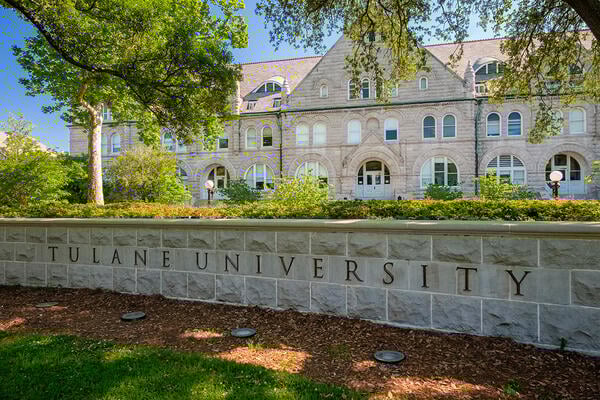
An environmental researcher at Tulane University resigned Wednesday after accusing campus officials, reportedly under pressure from Gov. Jeff Landry, of issuing a “gag order” that prevented her from publicly discussing her work, which focused on racial disparities in the petrochemical workforce.
“Scholarly publications, not gag orders, are the currency of academia,” Kimberly Terrell, the now-former director of community engagement at Tulane’s Environmental Law Clinic, wrote in her resignation letter. “There is always room for informed debate. But Tulane leaders have chosen to abandon the principles of knowledge, education, and the greater good in pursuit of their own narrow agenda.”
Terrell’s resignation comes amid wider efforts by the Trump administration and its allies to control the types of research—including projects related to environmental justice—academics are permitted to pursue and punish campus protesters for espousing messages the president and other public officials disagree with.
“It started with the pro-Palestinian activism on our campus and others across the country. It’s emboldened a lot of political leaders to feel they can make inroads by silencing faculty in other areas,” Michelle Lacey, a math professor and president of Tulane’s chapter of the American Association of University Professors, told Inside Higher Ed. “That was the catalyst for creating a climate where university administrators are very nervous, especially now as we see the government pulling funding for areas of research they don’t like.”
Last spring, Landry praised Tulane president Michael Fitts and university police for removing students who were protesting Israel’s attacks on Gaza. Soon after, the Legislature passed a provision creating harsher punishments for protesters who disrupt traffic, which Landry later signed into law.
Landry, a Republican aligned with Trump, has a history of trying to exert control over the state’s public higher education institutions.
Last summer, he enacted a law that allows him to directly appoint board chairs at the state’s public colleges and universities. And in November, following Trump’s election, Landry publicly called on officials at Louisiana State University to punish a law professor who allegedly made brief comments in class about students who voted for the president.
Landry’s office denied to the Associated Press (which first reported on Terrell’s resignation) that it pressured Tulane to silence research from the law clinic. Michael Strecker, a Tulane spokesperson, also told the outlet that the university “is fully committed to academic freedom and the strong pedagogical value of law clinics” and declined to comment on “personnel matters.”
Strecker added in a statement that Tulane administrators have been working with the law school’s leadership on how the law clinics could better support the university’s education mission.
“Debates about how best to operate law clinics’ teaching mission have occurred nationally and at Tulane for years—this is nothing new,” Strecker said. “This effort includes most recently input from an independent, third-party review.”
But Terrell’s account of the events that led to her resignation call the universities’ academic freedom commitments into question, while also implying that Landry—and powerful industry groups—wield some influence over private higher education institutions in the state.
And it’s not something Tulane, a private university in New Orleans, should tolerate, Lacey said.
Kimberly Terrell
“The academic freedom of all university researchers must be unequivocally defended at both public and private institutions,” Lacey wrote in a statement. “This includes the right to conduct and disseminate research that may be unfavorably viewed by government officials or corporate entities. Political demands to stifle controversial research are an affront to the advancement of knowledge and open exchange of ideas, as is the voluntary compliance with such requests by university leadership.”
The latest controversy at Tulane stems from a paper Terrell published April 9 in the peer-reviewed journal Ecological Economics. Her research found that while Black people in Louisiana are underrepresented in the state’s petrochemical workforce, they are overexposed to toxic pollutants the industry releases into an area of the state between New Orleans and Baton Rouge known as “Cancer Alley.”
But according to emails obtained by Inside Higher Ed and other outlets, Fitts worried that publicizing Terrell’s research and the clinic’s other work, which includes legal advocacy, could jeopardize funding for the university’s $600 million plan to redevelop New Orleans’ historic Charity Hospital into residential and commercial spaces as part of a broader downtown expansion plan.
As Terrell explained in her resignation letter, Fitts and other top Tulane executives were at Louisiana’s state capitol on April 16 lobbying for the project when “someone accused the university of being anti–chemical industry” and cited her study, which was receiving media attention after it was published the week prior. According to Terrell, “the story that came down to me through the chain of command was that Governor Landry threatened to veto any bill with funding for Tulane’s Charity project unless Fitts did something about the Environmental Law Clinic.”
‘Complete Gag Order’
After that, Terrell says, she was “placed under a complete gag order,” which the emails appear to confirm.
“Effective immediately all external communications that are not client-based—that is, directly related to representation—must be pre-approved by me,” Marcilynn Burke, dean of Tulane’s law school, wrote in an April 25 email to law clinic staff. “Such communications include press releases, interviews, videos, social media postings, etc. Please err on the side of over-inclusion as we work to define the boundaries through experience.”
A week later, on May 4, Burke wrote another email to clinic staff explaining that “elected officials and major donors have cited the clinic as an impediment to them lending their support to the university generally and this project specifically,” referring to Fitts’s plans to redevelop the old hospital. Terrell wrote that when she pleaded her case to Provost Robin Forman, “he refused to acknowledge my right to freely conduct and disseminate research” and also “let slip that my job description was likely going to be rewritten.”
Terrell described the entire law clinic as being “under siege” and said she would rather leave her position “than have my work used as an excuse for President Fitts to dismantle the Tulane Environmental Law Clinic.”
Other academics, free speech experts and environmental justice advocates also believe Tulane’s moves to silence Terrell’s work amounts to an attack on academic freedom with implications beyond the campus.
“The administration of Tulane University, far from standing up for academic freedom, is participating in the effort to suppress free inquiry and the pursuit of knowledge by scientific methods,” Michael Ash, an economics and public policy professor at the University of Massachusetts, said in a statement. “Any effort to reduce academic freedom for Dr. Terrell either by changing her job classification or by redefining whether the protection applies is a blatant and un-American attempt to suppress the type of free inquiry that has made this country great.”
Joy Banner, co-founder and co-director of the Descendants Project, a community organization that works in Cancer Alley, added that the Tulane Environmental Law Clinic is a vital public health resource.
Without the clinic, “it would be far more difficult to show the racially discriminatory practices of the industry, from preferential hiring practices to a pattern of concentrating pollution in majority Black neighborhoods,” she said in a statement. “President Fitts must commit to protecting it at all costs.”
A federal judge in Massachusetts has issued a preliminary injunction halting President Donald Trump’s executive order to dismantle the U.S. Department of Education, dealing a significant blow to the administration’s efforts to eliminate the federal agency.
District Court Judge Myong J. Joun on last Thursday blocked Trump and Education Secretary Linda McMahon from carrying out the executive order and ordered the administration to reinstate approximately 1,300 Education Department employees who were terminated in March as part of a sweeping reduction-in-force.
The ruling comes in response to consolidated lawsuits filed by a coalition of 20 states, the District of Columbia, educator unions, and school districts challenging the administration’s moves to shrink and eventually close the department.
When Trump took office in January, the Education Department employed 4,133 workers. The reduction-in-force announced March 11 terminated more than 1,300 positions, while nearly 600 additional employees chose to resign or retire, leaving roughly 2,180 remaining staff—approximately half the department’s original size.
In his ruling, Judge Joun wrote that “a department without enough employees to perform statutorily mandated functions is not a department at all,” adding that the court “cannot be asked to cover its eyes while the Department’s employees are continuously fired and units are transferred out until the Department becomes a shell of itself.”
The judge also prohibited Trump from transferring management of the federal student loan portfolio and special needs programs to other federal agencies, as the president had pledged to do from the Oval Office.
Judge Joun determined that the Trump administration likely violated the separation of powers by taking actions that conflicted with congressional mandates. He noted the administration had failed to demonstrate that the staff reductions actually improved efficiency, writing that “the record is replete with evidence of the opposite.”
The plaintiffs argued that the department could no longer fulfill critical duties, including managing the $1.6 trillion federal student loan portfolio serving roughly 43 million borrowers and ensuring colleges comply with federal funding requirements.
The American Association of University Professors (AAUP), which joined the legal challenge alongside other educator groups, praised the ruling as a crucial victory for higher education access.
“The AAUP is thrilled that District Judge Joun has blocked Trump’s illegal attempt to gut the Department of Education and lay off half of its workforce,” said AAUP President Dr. Todd Wolfson. “Eliminating the ED would hurt everyday Americans, severely limit access to education, eviscerate funding for HBCUs and TCUs while benefiting partisan politicians and private corporations looking to extract profit from our nation’s higher education system.”
American Federation of Teachers President Randi Weingarten called the decision “a first step to reverse this war on knowledge and the undermining of broad-based opportunity.”
The Education Department’s deputy assistant secretary for communications, Madi Biedermann, criticized the ruling in a statement, calling Judge Joun a “far-left Judge” who “dramatically overstepped his authority” and vowed to “immediately challenge this on an emergency basis.”
The case, Somerville Public Schools v. Trump, represents the consolidation of two separate lawsuits filed in March. Democracy Forward is representing the coalition of plaintiffs, which includes the AAUP, Somerville Public School Committee, Easthampton School District, Massachusetts AFT, AFSCME Council 93, and the Service Employees International Union.
The ruling temporarily halts one of the Trump administration’s most ambitious efforts to reshape federal education policy, though the legal battle is expected to continue as the administration pursues its appeal.
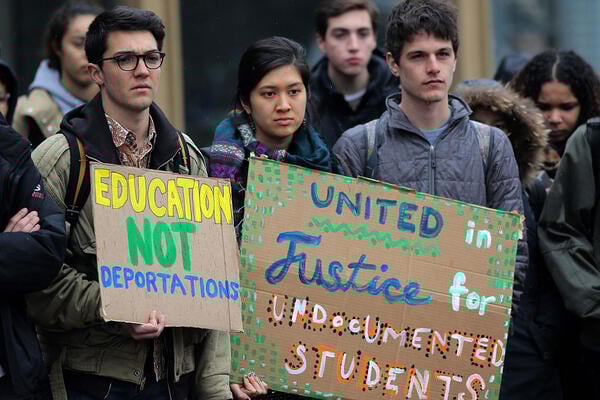
Immigrant rights advocates are urging state and higher ed leaders not to make any hasty changes to their in-state tuition policies after President Trump issued an executive order on Monday threatening to crack down on sanctuary cities and localities with laws that benefit undocumented immigrants.
The blow to undocumented students, who in nearly half the country pay in-state tuition, is tucked into an executive order focused mostly on pressuring state and local officials to abandon their cities’ sanctuary status and cooperate with federal immigration authorities. The order demands federal officials make lists of “sanctuary jurisdictions” and the federal funds that could be suspended or cut if they don’t change course. The order also commands them to take “appropriate action” to stop the enforcement of state and local laws and practices “favoring aliens over any groups of American citizens,” including in-state tuition benefits to undocumented students “but not to out-of-state Americans.”
The move has the potential to affect 24 states and Washington, D.C., which allow in-state tuition for local students with or without citizenship. (Florida previously allowed undocumented students to pay in-state tuition rates but ended its decade-old, historically bipartisan policy in February.) Undocumented students and supporters have long touted these policies as a way to make college more affordable for those who can’t access federal financial aid but who grew up in the states and plan to work in their local communities after they graduate.
“What immigrant, international and refugee students bring is needed talent, skills and contributions,” said Miriam Feldblum, executive director of the Presidents’ Alliance on Higher Education and Immigration. “In-state tuition increases the number of a state’s residents who are college educated, who are able to contribute far more to the state’s economy and to their communities than if they did not have a college education.”
Gaby Pacheco, president and CEO of TheDream.US, a scholarship provider for undocumented students, said many of these students come from low-income backgrounds and couldn’t afford college otherwise.
Her organization is currently scrambling to help undocumented students in Florida pay for the remainder of their credits and graduate before they have to pay much higher out-of-state tuition rates. In some cases, that means helping them transfer to more affordable institutions.
For many, “it’s just impossible for them to be able to come up with that money,” she said.
She’s encouraging state and institutional leaders to avoid “panicking” or “making abrupt policy changes” in response to the executive order.
Other executive orders have “created so much panic and unnecessary movement from colleges, universities, states, that it was more hurtful than anything,” she said. The administration is putting forward a “belief” that charging undocumented students in-state tuition rates is unlawful, but “that belief is legally dubious.”
Deciphering the Executive Order
Immigrants’ advocates and legal scholars say the meaning of the executive order is somewhat hazy. For example, it’s unclear what it means for federal officials to “take appropriate action” to prevent in-state tuition policies from being enforced.
The order also doesn’t directly say states or institutions with such laws will lose any federal funding, noted Ahilan Arulanantham, professor from practice at the UCLA School of Law and co-director of the law school’s Center for Immigration Law and Policy.
Still, the order’s threatening tone toward sanctuary cities’ federal funds could be “a window into where this fight could go if the federal government wants to expend significant political capital on this issue,” Arulanantham said. Congress, for example, could decide to pass a law to cut federal funds from universities that offer undocumented students in-state tuition—a proposal outlined in Project 2025. But the executive order itself doesn’t explicitly take away federal dollars from anyone or have the power to do so, he said.
“If I were a local government or state government official, I probably wouldn’t sue tomorrow over this,” Arulanantham said. “I would wait to see if this is actually going to have any teeth, or if it’s just like a press release.”
Pacheco similarly described the order as “warning” states of the administration’s posture toward these policies. At the same time, she believes it’s important to plan ahead in case Trump takes the issue further.
“They’re trying to tell states, ‘We believe that you providing certain benefits for undocumented students is against the law,’” she said. “We’ve known this forever—these states are not violating the law.”
The order suggests that in-state tuition for undocumented students “may violate” a federal statutory provision that says undocumented people can’t receive higher ed benefits unless citizens are also eligible. But in-state tuition policies are designed to serve citizens living in these states, as well. For example, under California’s Assembly Bill 540, any nonresident who spent three years in California high schools is eligible for in-state tuition. That policy also benefits citizens who grew up in the state who may have left for any reason and returned.
These types of in-state tuition policies, including California’s, have faced legal challenges in the past, “but all the challenges have failed, said Kevin Johnson, dean of the UC Davis School of Law. He described the executive order as “vaguely worded,” while the state laws, by contrast, are “very clear.”
The legal argument is that undocumented students are “just being treated equally as all other residents of the state,” he said. “The idea is that they’re residents, which means they’re taxpayers—maybe it’s sales tax, maybe state income tax, federal income tax—whatever it is, they should be treated like other residents and not discriminated against because of their immigration status.”
What Happens Next
Arulanantham worries that despite their strong legal foundation, states and higher ed institutions may rush to end in-state tuition benefits for undocumented students out of fear.
“That’s actually almost certainly the primary purpose of this order”: to spur “pre-emptive discrimination because [institutions] think they have to or they think it’s safer to,” he said.
Feldblum noted that, prior to the executive order, some state lawmakers were already starting to shift on the issue, perhaps “to align themselves with the federal government.”
While some states have recently doubled down on such policies, proposing new legislation to expand in-state tuition eligibility, others have also moved to curtail them. Following in Florida’s footsteps, lawmakers in other states, including Kansas, Kentucky and Texas, are considering legislation to prohibit in-state tuition for undocumented students. Texas was the first to allow undocumented students to pay in-state tuition rates in 2001, joined by California that same year.
“This is not coming in a vacuum … We have to take this seriously and substantively, consider the kinds of actions we need to take to defend in-state tuition—including, if needed, legal action,” Feldblum said. “And then also make sure we’re placing equal emphasis on supporting and communicating with potentially impacted students so that they know their education is important and that they’re important.”
The Trump administration is elevating AI programs in K-12 education
The human edge in the AI era
Report details uneven AI use among teachers, principals
For more news on AI in education, visit eSN’s Digital Learning hub
A new executive order signed by President Trump takes aim at AI policies in K-12 education by “fostering interest and expertise in artificial intelligence (AI) technology from an early age to maintain America’s global dominance in this technological revolution for future generations.”
More News from eSchool News
A “patchwork of apps” in schools often leads to app fatigue, frustrating parents and educators who have to use multiple apps weekly, or even daily, according to new research from Cornerstone Communications, LTD. and Edsby.
Simply put, AI can do a lot–it can personalize learning, help students expand on ideas for assignments, and reduce time spent on administrative tasks, freeing up educators to spend more time on instruction.
A recent survey found that 88 percent of U.S. parents believe AI is essential to their children’s education, but most aren’t even sure whether the technology is being used in their child’s classroom.
As AI becomes more widespread in education, more than half of high school students (56 percent) polled think it can go a long way in reducing math anxiety, a new global survey shows.
Teachers often seem to have eyes in the back of their heads. They respond to a murmured question in a class full of conversation. They can tell if someone’s skipping class a floor away by reading faces in the room.
While digital literacy has become an aspirational cornerstone of modern education, the exponential growth of data-driven decision-making across industries reveals critical gaps that demand a stronger focus on data literacy.
Teaching K-12 coding without computers may seem like a daunting task, but it can be a powerful way to introduce students to the fundamental concepts of computer science and problem-solving without the distraction of technology.
The most effective way for students to learn career-ready skills in fields such as advanced manufacturing and robotics is by applying these skills in the context of authentic projects and real-world scenarios.
In the Future of Jobs 2025 report, the World Economic Forum predicts that 60 percent of jobs will require upskilling or retraining, or they’ll be threatened. The skills we have today may not keep us secure for long.
Middle and high school counselors juggle overwhelming caseloads, expanded mental health duties, and additional administrative burdens–all of which limit their ability to provide individualized support for students.