The American Historical Association says that President Trump’s executive order targeting the Smithsonian Institution “egregiously misrepresents the work” of the organization and “completely misconstrues the nature of historical work.”
In the executive order issued late last week, Trump criticized what he saw as “a concerted and widespread effort to rewrite our Nation’s history” that replaces “objective facts with a distorted narrative driven by ideology rather than truth.”
The order cites an exhibit at the American Art Museum that examines the “role of sculpture in understanding and constructing the concept of race in the United States,” according to the museum’s website. The order also notes that the “National Museum of African American History and Culture has proclaimed that ‘hard work,’ ‘individualism,’ and ‘the nuclear family’ are aspects of ‘White culture.’”
The order, titled “Restoring Truth And Sanity To American History,” puts Vice President JD Vance in charge of ensuring that Smithsonian museums, research centers and the National Zoo don’t put on exhibits or programs that “degrade shared American values, divide Americans based on race.”
The AHA defended the work of historians in the statement released Monday, adding that “historians explore the past to understand how our nation has evolved.”
“Our goal is neither criticism nor celebration; it is to understand—to increase our knowledge of—the past in ways that can help Americans to shape the future,” said the statement, which has been signed by 16 other organizations. “By providing a history with the integrity necessary to enable all Americans to be all they can possibly be, the Smithsonian is fulfilling its duty to all of us.”
“Global law firms have for years played an outsized role in undermining the judicial process and in the destruction of bedrock American principles.” —Executive Order (3-14-25)
“Law firms refuse to represent Trump opponents in the wake of his attacks” — The Washington Post (3-25-25)
The wolf is at the door.
Those who do not yet realize this may be forgiven for perhaps two reasons: They do not know the wolf is ravenous, and they do not know the door is ajar.
To get but a whiff of this, just read Brad Karp’s March 23 memo to his colleagues at the Paul Weiss firm, from which the title of this edition of FAN gets its title.
Also this, from MSNBC legal correspondent Lisa Rubin:
[The attacks on law firms] began with Trump issuing executive actions punishing three firms — Covington & Burling, which did not react; Perkins Coie, which fought back and won a partial temporary restraining order; and Paul Weiss, which ultimately capitulated to a deal announced last Thursday, the terms of which are still a matter of some debate. But the president has now directed Attorney General Pam Bondi, in a memo issued Friday night, to seek sanctions “against attorneys and law firms who engage in frivolous, unreasonable, and vexatious litigation against the United States.”
Now back to the Paul, Weiss controversy.
A little background at the outset to help set the retributive stage: According to Wikipedia, Karp “is a bundler for Democratic Party presidential candidates . . . having raised sums for the presidential campaigns of Kamala Harris, Cory Booker, Joe Biden, Amy Klobuchar, and others.”
In other words, if Trump was out for political retribution, Karp was a perfect target. And then consider this: One of Karp’s former partners was Mark Pomerantz, author of “People vs. Donald Trump: An Inside Account,” which details the attempt to prosecute former president Donald Trump, written by one of the lawyers who worked on the case and who resigned in protest when Manhattan’s district attorney refused to act.
And now on to the Executive Order from March 14, “Addressing Risks from Paul Weiss.” Excerpts below:
In 2022, Paul Weiss hired unethical attorney Mark Pomerantz, who had previously left Paul Weiss to join the Manhattan District Attorney’s office solely to manufacture a prosecution against me and who, according to his co-workers, unethically led witnesses in ways designed to implicate me. After being unable to convince even Manhattan District Attorney Alvin Bragg that a fraud case was feasible, Pomerantz engaged in a media campaign to gin up support for this unwarranted prosecution.
Additionally, Paul Weiss discriminates against its own employees on the basis of race and other categories prohibited by civil rights laws. Paul Weiss, along with nearly every other large, influential, or industry leading law firm, makes decisions around ‘targets’ based on race and sex.
My Administration is committed to ending such unlawful discrimination perpetrated in the name of “diversity, equity, and inclusion” policies and ensuring that Federal benefits support the laws and policies of the United States, including those laws and policies promoting our national security and respecting the democratic process.
Now, the Weiss law firm’s memo in response, from Brad Karp:
Brad Karp
Only several days ago, our firm faced an existential crisis. The executive order could easily have destroyed our firm. It brought the full weight of the government down on our firm, our people, and our clients. In particular, it threatened our clients with the loss of their government contracts, and the loss of access to the government, if they continued to use the firm as their lawyers. And in an obvious effort to target all of you as well as the firm, it raised the specter that the government would not hire our employees.
We were hopeful that the legal industry would rally to our side, even though it had not done so in response to executive orders targeting other firms. We had tried to persuade other firms to come out in public support of Covington and Perkins Coie. And we waited for firms to support us in the wake of the President’s executive order targeting Paul, Weiss. Disappointingly, far from support, we learned that certain other firms were seeking to exploit our vulnerabilities by aggressively soliciting our clients and recruiting our attorneys.
We initially prepared to challenge the executive order in court, and a team of Paul, Weiss attorneys prepared a lawsuit in the finest traditions of the firm. But it became clear that, even if we were successful in initially enjoining the executive order in litigation, it would not solve the fundamental problem, which was that clients perceived our firm as being persona non grata with the Administration. We could prevent the executive order from taking effect, but we couldn’t erase it. Clients had told us that they were not going to be able to stay with us, even though they wanted to. It was very likely that our firm would not be able to survive a protracted dispute with the Administration.
Commentary:
President Donald Trump’s crackdown on lawyers is having a chilling effect on his opponents’ ability to defend themselves or challenge his actions in court, according to people who say they are struggling to find legal representation as a result of his challenges.
[Such executive orders and pressured settlements set] an ominous precedent for future presidents to exploit. . . . [H]ow can a lawyer who is considering representing a politically controversial client know that she will not be targeted the next time control of the White House changes hands? The safest course of action will be to avoid representing clients of any political salience, right or left, even if their cause is just.
Related
Constitutional scholars on the Trump Administration’s threats against Columbia University
We write as constitutional scholars — some liberal and some conservative — who seek to defend academic freedom and the First Amendment in the wake of the federal government’s recent treatment of Columbia University.
The First Amendment protects speech many of us find wrongheaded or deeply offensive, including anti-Israel advocacy and even antisemitic advocacy. The government may not threaten funding cuts as a tool to pressure recipients into suppressing such viewpoints. This is especially so for universities, which should be committed to respecting free speech.
At the same time, the First Amendment of course doesn’t protect antisemitic violence, true threats of violence, or certain kinds of speech that may properly be labeled ‘harassment.’ Title VI rightly requires universities to protect their students and other community members from such behavior. But the lines between legally unprotected harassment on the one hand and protected speech on the other are notoriously difficult to draw and are often fact-specific. In part because of that, any sanctions imposed on universities for Title VI violations must follow that statute’s well-established procedural rules, which help make clear what speech is sanctionable and what speech is constitutionally protected.
Yet the administration’s March 7 cancellation of $400 million in federal funding to Columbia University did not adhere to such procedural safeguards. Neither did its March 13 ultimatum stipulating that Columbia make numerous changes to its academic policies — including the demand that, within one week, it “provide a full plan” to place an entire “department under academic receivership for a minimum of five years” — as “a precondition for formal negotiations regarding Columbia University’s continued financial relationship with the United States government.”
Signatories
Steven G. Calabresi Clayton J. and Henry R. Barber Professor of Law, Northwestern Law School
Erwin Chemerinsky Dean and Jesse H. Choper Distinguished Professor of Law, Berkeley Law School
David Cole Hon. George J. Mitchell Professor in Law and Public Policy, Georgetown University Law Center
Michael C. Dorf Robert S. Stevens Professor of Law, Cornell Law School
Richard Epstein Laurence A. Tisch Professor of Law, NYU School of Law
Owen Fiss Sterling Professor Emeritus of Law, Yale Law School
Aziz Huq Frank and Bernice J. Greenberg Professor of Law, University of Chicago Law School
Pamela Karlan Kenneth and Harle Montgomery Professor of Public Interest Law, Stanford Law School
Randall Kennedy Michael R. Klein Professor of Law, Harvard Law School
Genevieve Lakier Professor of Law, Herbert and Marjorie Fried Teaching Scholar, University of Chicago Law School
Michael McConnell Richard and Frances Mallery Professor of Law, Stanford Law School
Michael Paulsen Distinguished University Chair and Professor, St. Thomas Law School
Robert Post Sterling Professor of Law, Yale Law School
David Rabban Dahr Jamail, Randall Hage Jamail, and Robert Lee Jamail Regents Chair in Law, University of Texas Law School
Geoffrey R. Stone Edward H. Levi Distinguished Service Professor of Law, University of Chicago Law School
Nadine Strossen John Marshall Harlan II Professor of Law Emerita, New York Law School
Eugene Volokh Thomas M. Siebel Senior Fellow, Hoover Institution, Stanford University
Keith Whittington David Boies Professor of Law, Yale Law School
SCOTUS denies review in case urging that Sullivan be overruled
Wynn v. Associated Press (issue: Whether this Court should overturn Sullivan’s actual-malice standard or, at a minimum, overrule Curtis Publishing Co.’s expansion of it to public figures)
On the Trump administration targeting campuses
The United States is home to the best collection of research universities in the world. Those universities have contributed tremendously to America’s prosperity, health, and security. They are magnets for outstanding talent from throughout the country and around the world. The Trump administration’s recent attack on Columbia University puts all of that at risk, presenting the greatest threat to American universities since the Red Scare of the 1950s. Every American should be concerned.
Until recently, it was a little-known program to help Black and Latino students pursue business degrees.
But in January, conservative strategist Christopher Rufo flagged the program known as The PhD Project in social media posts that caught the attention of Republican politicians. The program is now at the center of a Trump administration campaign to root out diversity, equity and inclusion programs in higher education.
The U.S. Education Department last week said it was investigating dozens of universities for alleged racial discrimination, citing ties to the nonprofit organization. That followed a warning a month earlier that schools could lose federal money over “race-based preferences” in admissions, scholarships or any aspect of student life.
The investigations left some school leaders startled and confused, wondering what prompted the inquiries. Many scrambled to distance themselves from The PhD Project, which has aimed to help diversify the business world and higher education faculty.
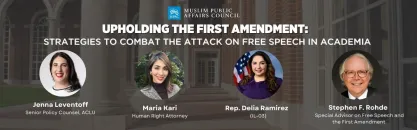
Zoom webinar on strategies to combat attacks on free speech in academia
Thursday, March 27, 2025, 1:00 – 2:00 PM ET
As efforts to silence dissent grow more aggressive, the immediate and long-term threats to our constitutional freedoms — especially in educational institutions — cannot be ignored.
This virtual panel will bring together top legal minds and policy experts to examine how these actions affect student activists, journalists, and marginalized communities. Together, we’ll explore the legal strategies needed to safeguard First Amendment rights and resist the erosion of civil liberties.
Featured Panelists: Maria Kari, Human Rights Attorney Rep. Delia Ramirez (IL-03) Jenna Leventoff, Senior Policy Counsel, ACLU Stephen F. Rohde, MPAC Special Advisor on Free Speech and the First Amendment Whether you’re a student, educator, advocate, or supporter of civil rights, this is a conversation you won’t want to miss.
➡️ Register today and join us in defending the values that define our democracy.
Whittington on diversity statements and college hiring
Keith Whittington
The University of California is the godfather of the use of so-called diversity statements in faculty hiring. I have a piece forthcoming at the Nebraska Law Review arguing that such diversity statement requirements for general faculty hiring at state universities violate the First Amendment and violate academic freedom principles everywhere. It seems quite likely that in practice such diversity statement requirements are also used to facilitate illegal racial discrimination in faculty hiring.
The University of California system’s board of regents has now put an end to the use of such diversity statements at those schools. This is a truly remarkable development. Not unreasonably, this decision is being put in the context of the Trump administration’s extraordinary attack on Columbia University, a move that I think is both lawless and itself a threat to academic freedom. But there’s no question that it got the attention of university leaders across the country, and if it encourages some of them to rededicate themselves to their core institutional mission and its central values then at least some good will come of it. So silver linings and all that.
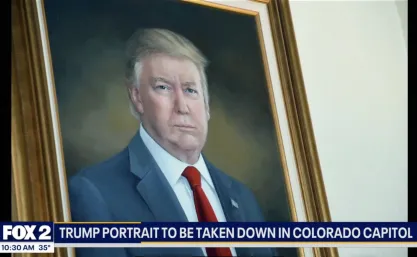
Trump rails against portrait at the Colorado Capitol
Institute for Free Speech files brief in campaign disclosure-fee case
The case is Sullivan v. Texas Ethics Commission. The issue in the case is whether — and if so, under what circumstances — the First Amendment permits the government to require ordinary citizens to register and pay a fee to communicate with their government representatives.
Amicus brief here. Counsel of record: Alan Gura. The Institute’s brief argues that the 1954 precedent of United States v. Harriss no longer reflects modern First Amendment jurisprudence and fails to protect the right to speak anonymously about matters of public policy.
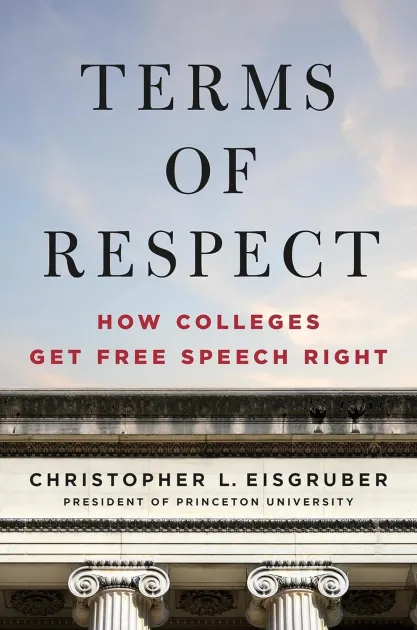
Forthcoming book by Princeton’s president on campus free speech
The president of Princeton, a constitutional scholar, reveals how colleges are getting free speech on campuses right and how they can do better to nurture civil discourse and foster mutual respect
Conversations about higher education teem with accusations that American colleges and universities are betraying free speech, indoctrinating students with left-wing dogma, and censoring civil discussions. But these complaints are badly misguided.
In Terms of Respect, constitutional scholar and Princeton University president Christopher L. Eisgruber argues that colleges and universities are largely getting free speech right. Today’s students engage in vigorous discussions on sensitive topics and embrace both the opportunity to learn and the right to protest. Like past generations, they value free speech, but, like all of us, they sometimes misunderstand what it requires. Ultimately, the polarization and turmoil visible on many campuses reflect an American civic crisis that affects universities along with the rest of society. But colleges, Eisgruber argues, can help to promote civil discussion in this raucous, angry world — and they can show us how to embrace free speech without sacrificing ideals of equality, diversity, and respect.
Urgent and original, Terms of Respect is an ardent defense of our universities, and a hopeful vision for navigating the challenges that free speech provokes for us all.
Forthcoming scholarly article on AI and the First Amendment
This paper challenges the assumption that courts should grant outputs from large generative AI models, such as GPT-4 and Gemini, First Amendment protections. We argue that because these models lack intentionality, their outputs do not constitute speech as understood in the context of established legal precedent, so there can be no speech to protect. Furthermore, if the model outputs are not speech, users cannot claim a First Amendment right to receive the outputs.
We also argue that extending First Amendment rights to AI models would not serve the fundamental purposes of free speech, such as promoting a marketplace of ideas, facilitating self-governance, or fostering self-expression. In fact, granting First Amendment protections to AI models would be detrimental to society because it would hinder the government’s ability to regulate these powerful technologies effectively, potentially leading to the unchecked spread of misinformation and other harms.
2024-2025 SCOTUS term: Free expression and related cases
Cases decided
Villarreal v. Alaniz(Petition granted. Judgment vacated and case remanded for further consideration in light of Gonzalez v. Trevino, 602 U. S. ___ (2024) (per curiam))
Murphy v. Schmitt (“The petition for a writ of certiorari is granted. The judgment is vacated, and the case is remanded to the United States Court of Appeals for the Eighth Circuit for further consideration in light of Gonzalez v. Trevino, 602 U. S. ___ (2024) (per curiam).”)
TikTok Inc. and ByteDance Ltd v. Garland (The challenged provisions of the Protecting Americans from Foreign Adversary Controlled Applications Act do not violate petitioners’ First Amendment rights.)
Review granted
Pending petitions
Petitions denied
Free speech related
Thompson v. United States (decided: 3-21-25/ 9-0 w special concurrences by Alito and Jackson) (interpretation of 18 U. S. C. §1014 re “false statements”)
This article is part of First Amendment News, an editorially independent publication edited by Ronald K. L. Collins and hosted by FIRE as part of our mission to educate the public about First Amendment issues. The opinions expressed are those of the article’s author(s) and may not reflect the opinions of FIRE or Mr. Collins.
President
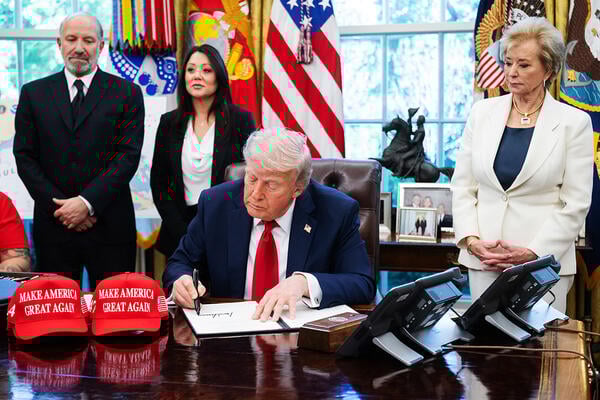
Donald Trump signed an executive order Thursday instructing Secretary
of Education Linda McMahon to start dismantling her agency, although it
cannot be formally shut down without congressional approval. Since
returning to office in January, Trump has already slashed the Education
Department’s workforce in half and cut $600 million in grants. Education
journalist Jennifer Berkshire says despite Trump’s claims that he is
merely returning power and resources to the states, his moves were
previewed in Project 2025. “The goal is not to continue to spend the
same amount of money but just in a different way; it’s ultimately to
phase out spending … and make it more difficult and more expensive for
kids to go to college,” Berkshire says. She is co-author of the book The
Education Wars: A Citizen’s Guide and Defense Manual and host of the
education podcast Have You Heard.
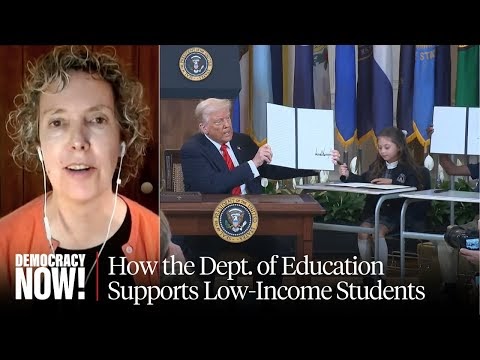
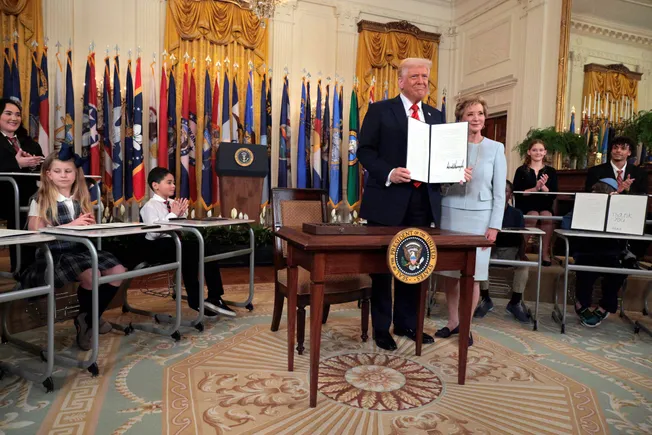
President Donald Trump has signed a much anticipated executive order that he said is designed to close the U.S. Department of Education.
The order Trump signed Thursday tells Education Secretary Linda McMahon to “take all necessary steps to facilitate the closure of the Department of Education and return authority over education to the States and local communities” to the “maximum extent appropriate and permitted by law.” At the same time, the order says McMahon should ensure “the effective and uninterrupted delivery of services, programs, and benefits on which Americans rely.”
Despite polling to the contrary, Trump said in his speech Thursday that closing the department is a popular idea that would save money and help American students catch up to other countries. He also said his order would ensure that other federal agencies take over major programs now housed at the Education Department, like those for students from low-income backgrounds and students with disabilities.
“Beyond these core necessities, my administration will take all lawful steps to shut down the department,” Trump said. “We’re going to shut it down, and shut it down as quickly as possible. It’s doing us no good. We want to return our students to the states.”
The executive order represents a symbolic achievement for Trump, who for years has expressed a desire to close the department. Yet the president has already radically transformed the department without relying on such an order. McMahon announced massive layoffs and buyouts earlier this month that cut the department’s staff nearly in half.
Beyond the rhetoric, it’s unclear how exactly the order will impact the department’s work or existence.
The order does not directly change the department’s annual budget from Congress. And federal law dictates many of the Education Department’s main functions–changing those would require congressional approval that could be very hard to secure.
Still, Trump’s move to dramatically slash the department’s staff could impact its capacity and productivity, even if officially its functions remain in place.
At her confirmation hearing, McMahon promised to work with Congress on a reorganization plan. Project 2025, a prominent blueprint for conservative governance from the Heritage Foundation released before Trump’s second term, says that along with closing the Education Department, the federal government should move the department’s education civil rights enforcement to the Department of Justice, while the collection of education data should move to the U.S. Census Bureau.
In a statement on Thursday, McMahon said closing the Education Department does not mean cutting off funds from those who depend on them.
“We will continue to support K-12 students, students with special needs, college student borrowers, and others who rely on essential programs,” she wrote. “We’re going to follow the law and eliminate the bureaucracy responsibly by working with Congress and state leaders to ensure a lawful and orderly transition.”
The executive order notes that the Education Department does not educate any students, and points to low test scores on an important national assessment as evidence that federal spending is not helping students.
“Closing the Department of Education would provide children and their families the opportunity to escape a system that is failing them,” the order says.
Trump order is triumph for department’s foes
The Republican governors of Florida, Texas, Iowa, Indiana, Ohio, Louisiana, Tennessee, Idaho, and Nebraska were present during the signing ceremony. Trump said they “badly” wanted the federal government to give their states more control over education.
The Education Department administers billions of dollars in federal assistance through programs such as Title I, which benefits high-poverty schools, and the Individuals with Disabilities Education Act, or IDEA, which offsets the cost of special education services.
The department also administers financial aid for college students, shares information about best practices with states and school districts, and enforces civil rights laws. And it oversees the school accountability system, which identifies persistently low-performing schools to extra support.
States and school districts already make most education decisions, from teacher pay to curriculum choices.
Conservatives have wanted to get rid of the U.S. Department of Education since it was created by President Jimmy Carter and Congress in 1979, and Trump talked about doing so in his first administration. But those efforts never gained traction.
Conservatives say that for decades the department has failed to adequately address low academic performance. They also see the department as generally hostile to their political and ideological perspectives.
The executive order says that McMahon must ensure that “any program or activity receiving Federal assistance terminate illegal discrimination obscured under the label ‘diversity, equity, and inclusion’ or similar terms and programs promoting gender ideology,” a reference to policies intended to make schools more welcoming for students of color and LGBTQ students.
They say they’re already seeing impacts from layoffs, which hit the Office for Civil Rights, Federal Student Aid, and the Institute of Education Sciences particularly hard.
The Education Department already was one of the smallest cabinet-level departments, with around 4,100 employees, before the layoffs. With buyouts and layoffs, the department now employs just under 2,200 people.
Chalkbeat is a nonprofit news site covering educational change in public schools.
On March 20, President Trump signed an executive order titled “Improving Education Outcomes by Empowering Parents, States, and Communities.” The order directs the secretary of education to “take all necessary steps to facilitate the closure of the Department of Education and return authority over education to the States and local communities while ensuring the effective and uninterrupted delivery of services, programs, and benefits on which Americans rely.”
The order additionally states that the secretary of education “shall ensure that the allocation of any Federal Department of Education funds is subject to rigorous compliance with Federal law and Administration policy.” According to the order, this includes compliance with federal requirements to terminate “illegal discrimination obscured under the label ‘diversity, equity, and inclusion’” and to terminate programs that promote gender ideology.
With respect to higher education, the executive order asserts that closure of the ED “would drastically improve program implementation.” It specifically discusses ED’s role in managing the federal student loan debt portfolio, and it claims that ED “is not a bank, and it must return bank functions to an entity equipped to serve America’s students.”
It is still unknown how Secretary McMahon will execute this order. Despite Trump’s clear intentions to close ED, Congress would still need to pass legislation to officially dissolve the department. It remains to be seen whether McMahon and the Trump administration will move ED’s subagencies and their functions to other federal agencies as speculated.
More information is needed from ED to understand how this order will be implemented. CUPA-HR will continue to monitor for additional news and guidance from ED as it relates to the order.
This audio is auto-generated. Please let us know if you have feedback.
President Donald Trump on Thursday afternoon ordered U.S. Secretary of Education Linda McMahon to “take all necessary steps to facilitate the closure of the Department of Education,” marking the boldest push from the president to shut down the agency since its establishment under the Carter administration over four decades ago.
Trump also said prior to the signing that he intends to disperse the department’s core functions — such as Pell Grants, Title I funding, and providing funding and resources for students with disabilities — to other parts of the government.
“They’re going to be preserved in full and redistributed to various other agencies and departments that will take very good care of them,” he said. “My administration will take all lawful steps to shut down the department. We’re going to shut it down and shut it down as quickly as possible.”
The layoffs preceding the Thursday order impacted nearly 1,300 workers in addition to the nearly 600 employees who accepted “buyouts.”
Trump has repeatedly and forcefully threatened to shut down the department since his first term in the White House, citing what he has called the agency’s “bloated budget” and a need to return education control to the states. His push to dismantle the department is in line with the 2024 Republican agenda, which included closing the department to “let the States run our educational system as it should be run.”
In a Thursday speech, just prior to signing the order, Trump also cited low student test scores as reason to close the department.
“After 45 years, the United States spends more money in education by far than any other country, and spends, likewise, by far, more money per pupil than any country,” he said. “But yet we rank near the bottom of the list in terms of success. That’s where we are — like it or not — and we’ve been there for a long time.”
Abolishing the 45-year-old agency altogether, however, requires a Senate supermajority of 60 votes. A similar proposal from conservatives in the House failed in 2023 when 60 House Republicans joined Democrats to defeat the measure.
Given the current closely divided Congress, many have considered it a longshot that lawmakers would approve the department’s demise.
However, in his Thursday speech, Trump said he hopes Democrats would be onboard if the legislation to officially close the department eventually comes before Congressional lawmakers.
What will be impacted?
Although the administration technically needs Congressional action to close the department, the Thursday order tells McMahon to push its closures “to the maximum extent appropriate and permitted by law.”
The agency is responsible for a slew of programs key to school and college operations, including conducting federal civil rights investigations, overseeing federal student financial aid, and enforcing regulations on Title IX and other education laws. It is in charge of large programs that schools depend on, like Title I, which sends aid to low-income school districts, and the Individuals with Disabilities Education Act that supports special education services.
Following the layoffs earlier this month, the department claimed its key functions, including overseeing COVID-19 pandemic relief, wouldn’t be impacted.
“Closing the Department does not mean cutting off funds from those who depend on them — we will continue to support K-12 students, students with special needs, college student borrowers, and others who rely on essential programs,” said McMahon in a statement praising the executive order on Thursday.
However, former employees and education policy experts have warned that a department functioning on only half its former manpower could lead to a decline in oversight, guidance and student protections while creating systemic “chaos.”
“Eliminating it would roll back decades of progress, leaving countless children behind in an education system that has historically failed the most marginalized,” said Keri Rodrigues, president of National Parents Union, in a Thursday statement responding to the order. “Without federal oversight, states will have free rein to lower standards, siphon funds from public schools, and dismantle hard-won civil rights protections.”
Educators have also warned that gutting the department would eventually lead to an increase in class sizes and reduce special education services for students with disabilities.
McMahon disagreed.
“Teachers will be unshackled from burdensome regulations and paperwork, empowering them to get back to teaching basic subjects,” she said in the statement. “Taxpayers will no longer be burdened with tens of billions of dollars of waste on progressive social experiments and obsolete programs,” she added.
Order follows McMahon’s ‘final mission’
During her Feb. 13 Senate confirmation hearing, McMahon did not commit to closing the Education Department and acknowledged that closure of the entire Education Department would need congressional approval. The White House echoed those sentiments on Thursday, just prior to the order’s signing.
McMahon also said programs established by federal statute, such as Title I for low-income schools and services to students with disabilities under the Individuals with Disabilities Education Act, would need to continue with or without an Education Department. But some federal education statutes are specific about certain offices’ responsibilities within the Education Department.
Still, on McMahon’s first day on the job last month, she publicly said she was planning for the “historic overhaul” of the department as its “final mission.”
“This review of our programs is long overdue,” she wrote in a letter posted by the department that same night, supporting what she called “elimination of bureaucratic bloat here at the Department of Education — a momentous final mission — quickly and responsibly.” McMahon and Trump have touted giving education decision-making power back to the states and parents.
However, “This is not about cutting bureaucracy — it’s about gutting the protections that safeguard our children’s education,” Rodrigues said in her statement.
Democratic lawmakers have also resisted the department’s recent cuts and have already pushed back against the order that followed it today.
“President Trump’s executive order to dismantle the Department of Education (ED) and ‘return education to the states’ will be challenged in the Courts,” said Rep. Bobby Scott, D-Va., ranking member on the House Committee on Education and the Workforce.
Sen. Patty Murray of Washington, along with two other Democratic lawmakers, also demanded answers from the agency in a 10-page letter sent Monday, asking McMahon and Institute of Education Sciences Acting Director Matthew Soldner how the agency intends to fulfill its statutory obligations with a reduced staff.
Others are celebrating the historic order.
“With the federal government stepping back, the potential for new, transformative education models has never been greater,” said Jeanne Allen, founder and CEO of the Center for Education Reform, in a statement on Wednesday night in anticipation of today’s order. “As every great innovator knows – whether in education, business, or technology – government interference stifles progress and disruptive innovations accelerate it.”
Many Republican lawmakers are also on board with gutting the agency.
“The key to improving education is empowering parents and students and reducing the role of Washington bureaucrats,” said House Committee on Education and the Workforce Chair Tim Walberg, R-Mi., in a Thursday statement. Walberg cited the Biden administration’s decisions during the pandemic, slowed student performance in the wake of the crisis, and its LGTBQ+ inclusive policies as some reasons to cut the department.
“Bottom line, the Department of Education has failed to deliver results for America’s students and today’s actions by the Trump administration will help ensure our nation’s youth are put first.”
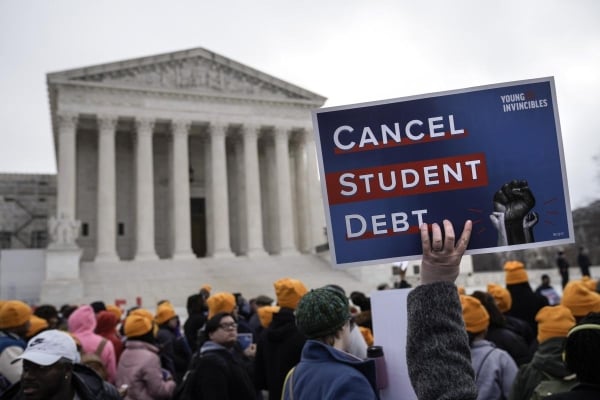
Despite a public push to cancel student debt among civil servants, only a small number of Public Service Loan Forgiveness applications were approved by the first Trump administration.
Drew Angerer/Getty Images
In his latest executive action, President Donald Trump directed the Education Department to limit eligibility for the Public Service Loan Forgiveness program.
The order, issued late Friday evening, would require the Education Department to go through a complex and lengthy process known as negotiated rule making, so the directive doesn’t change anything immediately. And Education Secretary Linda McMahon pledged at her confirmation hearing that PSLF will not be eliminated completely, as “that’s the law.” However, the changes could lead to the denial of student loan forgiveness for thousands of nonprofit employees.
The administration argued the order was a necessary step to “restore the program” and end the subsidization of “illegal activities” such as “illegal immigration, human smuggling, child trafficking, pervasive damage to public property, and disruption of the public order.”
But Democrats and debt relief and consumer protection advocates say it’s another attempt to weaponize the federal government and block funds from reaching public servants in fields the president disagrees with.
“Don’t be fooled, today’s executive order is blatantly illegal,” Mike Pierce, executive director of the Student Borrower Protection Center, said in a statement Friday. “It is an attack on working families everywhere and will have a chilling effect on our public service workforce doing the work every day to support our local communities.”
Congress created the PSLF program in 2007 with bipartisan support under former president George W. Bush. It was designed to incentivize Americans to work in public service, by promising student loan forgiveness to federal, state, local or tribal government staff members; civilians working in the military; and the employees of certain nonprofit organizations after they make 10 years of qualifying payments on an approved federal loan repayment plan.
Historically, recognized nonprofits have included emergency management and crime-reduction services, public interest and civil rights legal groups, and institutions of public health and education. More than two million borrowers are eligible for the program, according to December data from the Education Department, the Associated Press reported.
But gaining access to the program’s benefits hasn’t always been easy. In 2019, during the first Trump administration, the American Federation of Teachers sued then–education secretary Betsy DeVos, alleging “gross mismanagement” of the program. Data showed that of the roughly 76,000 applications submitted between 2017 and the filing of the lawsuit, only about 1 percent had been approved.
Now, under the new stipulations, fewer borrowers could see relief, advocates said.
“The PSLF Program has misdirected tax dollars into activist organizations that not only fail to serve the public interest, but actually harm our national security and American values, sometimes through criminal means,” the order says. “The Secretary of Education shall propose revisions … that ensure the definition of ‘public service’ excludes organizations that engage in activities that have a substantial illegal purpose.”
According to the order, activities that would disqualify a nonprofit include: aiding or abetting violations of federal immigration laws, supporting terrorism, engaging in violence for the purpose of obstructing federal policy, the chemical and surgical castration or mutilation of children “or the trafficking of children to so-called transgender sanctuary States for purposes of emancipation from their lawful parents,” and aiding and abetting illegal discrimination.
Although the president didn’t say so directly, experts interpret the order as yet another attempt to discourage activism and chill efforts Trump disagrees with, such as diversity, equity and inclusion; LGBTQ+ advocacy; pro bono defense for undocumented immigrants; and Palestinian statehood.
Representative Tim Walberg, a Republican from Michigan and chair of the House Committee on Education and the Workforce, praised the president’s intentions in a statement, saying President Trump is protecting Jewish students from “the hatred they’ve been enduring” on college campuses.
“Federal dollars shouldn’t fund antisemitism,” he said. “President Trump is stepping up by preventing these activists from receiving windfalls in forgiveness benefits footed by taxpayers.”
Senator Patty Murray, a Democrat from Washington and former chair of the Health, Education, Labor and Pensions Committee, says Trump is “holding resources owed to hardworking Americans hostage.”
“President Trump is once again trying to use his office to force his extreme political views on the American people by choking off promised relief for people who’ve served our country in ways he disagrees with,” she said. “It is as outrageous as it is un-American.”
But the Trump administration says the order is about more than just preventing “subsidized wrongdoing.” In his view, it’s also a matter of limiting “perverse incentives” for higher education institutions.
Rather than alleviating worker shortages, the president said, PSLF encourages colleges and universities to increase the cost of tuition and load students in “low-need majors” with “unsustainable” debt.
To that, debt-relief advocates like the Student Debt Crisis Center say, “Public service workers are the backbone of this country.”
“This executive order is both illegal and deeply troubling for all nonprofit workers,” SDCC president Natalia Abrams said in a statement. “Relentless political attacks on education and existing programs are not just policy decisions—they disrupt the lives and financial stability of Americans with student debt and their families. This must stop.”
A draft executive order obtained Thursday by Inside Higher Ed directs the newly confirmed education secretary, Linda McMahon, to “take all necessary steps” to return authority over education to the states and facilitate closure of the Department of Education “to the maximum extent appropriate and permitted by law.”
If signed, the order—which has been rumored for weeks but is not yet official—would be the first step in carrying out the president’s controversial campaign promise to abolish the 45-year-old department, which he believes is unconstitutional and has grown too large.
Several media outlets reported Wednesday night that Trump would sign the order as soon as Thursday, but shortly after the news circulated, White House press secretary Karoline Leavitt posted on X, “President Trump is NOT signing an Executive Order on the Department of Education today” and called the reports “fake news.”
Still, the reports set off a wave of comments from advocates and analysts. Liberals warned that shutting down the Education Department would be devastating for families and students, while conservatives backed Trump’s plan and said the draft order was key to cleaning up the agency.
McMahon, who took office Monday and will spearhead the closure effort, is supportive of overhauling the agency. She told department staff earlier this week to prepare for a “momentous final mission” to eliminate “bureaucratic bloat” and return education to the states.
Although vague, the secretary’s memo and the draft executive order give policy experts some idea of what could come next.
At the very least, they expect to see a major reduction in staff and a diminished federal role in education; some of that work is already underway. The agency has slashed millions in contracts and grants as well as fired dozens of employees. A larger reduction in force is also in the works, fueling concerns among department staff.
“There is probably not going to be anything in [the order] that isn’t already happening, largely,” said Kelly McManus, vice president of higher education at Arnold Ventures, a philanthropic group. “The secretary’s final mission was clear … so I’m not particularly worked up about the EO specifically, because I don’t think it’s going to fundamentally change that.”
Abolishing the department would require an act of Congress, which McManus said the draft order appears to acknowledge. She and other experts say any effort to close the department will be lengthy and complicated.
“This is not a flip-on, flip-off situation here,” she said. “Practically, there will have to be a process … You cannot shut the doors tomorrow and be done.”
The 416-word draft order gives little detail as to what the “steps” of dismantling the department are or what would happen to certain congressionally mandated programs such as the Pell Grant, the student loan system or the Individuals With Disabilities Education Act. However, the document does say that any funds allocated by the department should comply with federal law, including Trump’s previous orders on diversity, equity and inclusion and transgender athletes—both of which have been caught up in court.
Neither Trump nor McMahon has so far offered any plan outlining how closing the department would work, though some conservative plans recommend moving the Office for Federal Student Aid to the Treasury and sending the Office for Civil Rights to the Justice Department.
More than 4,000 people currently work for the department, which was created in 1979 and now has a $80 billion discretionary budget. Each year, the agency issues about $100 billion in student loans and doles out more than $30 billion in Pell Grants.
Shutting down the department isn’t popular with voters, recent surveys have found. One recent opinion poll found that 61 percent of all respondents “somewhat” or “strongly” opposed the idea of eliminating the department. Another showed that up to 72 percent either opposed the plan or weren’t sure how they felt. That number was 49 percent among Republicans.
Minimizing a D.C. ‘Footprint’
Trump has signaled for months, if not years, that he wants to shut down the Education Department, and many analysts have already taken a position on the issue.
To Michael Brickman, an adjunct fellow at the conservative think tank the American Enterprise Institute, nothing about the draft was a surprise. Like McManus, he noted that much of what the order directs McMahon to do is already underway.
Brickman expects the next steps will focus on finding new and “better” ways to maintain the department’s core functions as required under law with “less funding, less staff and possibly in conjunction with other agencies.”
“I don’t think anybody’s talking about cutting major programs,” he said, referencing financial aid services like the Pell Grant and disability protection acts like IDEA. “So the question will be, what is required under law? What can Congress change? And how can the department streamline things to minimize the footprint in D.C.?”
Shutting down the Education Department likely would be disruptive for colleges and students, advocates say.
J. David Ake/Getty Images
McManus stressed that it will be important to protect these core functions, especially the ones related to higher ed, saying it doesn’t make sense to send them back to the states.
“What is most important is that those core statutory functions have the people, capacity and expertise to be able to do effective oversight of how taxpayer dollars are being spent,” she said. “We are significantly less concerned about where those people sit, as long as there is the ability to safeguard taxpayer investments and to make sure that programs that are statutorily required and that have had long bipartisan support, like Pell Grants, are being effectively implemented.”
In Brickman’s view, some of the department’s regulatory operations, like analyzing and creating reports on grant or contract applicants and managing third-party accreditors, are simply “make-work.” By hiring hundreds of staff members to execute these tasks, he said, the department pulls tax dollars from local governments and then forces those same communities to spend more writing grant proposals to get it back.
“There’s just a lot of work and churn that evidence shows does not lead to improved student outcomes,” he said.
But when asked what the Trump administration has done to convince stakeholders he not only intends to tear down the department but also build it back up again, Brickman didn’t directly answer the question. Instead, he referenced actions of the Biden administration.
“The Biden administration broke the entire Federal Student Aid system on purpose … They were trying to illegally turn the trillion-plus-dollar portfolio from a loan program into a grant program,” he said. “That is not what the Trump administration is doing. The Trump administration has tried to improve these programs and make them actually work again.”
Although what Biden did was “unfortunate,” Brickman said, it also creates an opportunity.
“This mess isn’t being created; it’s being responded to,” he said. “I hope institutions that may be predisposed to oppose anything coming from the Trump administration will welcome this as the end of a failed experiment that just put more restrictions on teaching and learning.”
Democrats Push Back
Meanwhile, Democratic lawmakers, student advocacy groups, civil rights organizations and left-leaning think tanks warn that Trump has no intention of rebuilding, only dismantling. The American Federation of Teachers, a key higher ed union, said the order is a government attempt to “abdicate its responsibility to all children, students and working families.”
Randi Weingarten, the union’s president, recognized in a statement Wednesday night that there are certainly ways the department could be more efficient, but she implied that’s not Trump’s goal.
“No one likes bureaucracy, and everyone’s in favor of more efficiency, so let’s find ways to accomplish that,” she said. “But don’t use a ‘war on woke’ to attack the children living in poverty and the children with disabilities, in order to pay for vouchers and tax cuts for billionaires.”
Senate Democrats criticized the pending executive order to abolish the Department of Education as a press conference Thursday.
Tom Williams/CQ-Roll Call Inc. via Getty Images
Senator Patty Murray, a Democrat from Washington State, blasted the Trump administration’s plans at a press conference Thursday. She said that Trump and his unelected government efficiency czar Elon Musk “don’t know what it’s like to count on their local public school having the resources to get their kids a great education … And they don’t care to learn why. They want to break the department, break our government, and enrich themselves.”
To the American Association of University Professors, “dismantling the Department of Education would hasten us into a new dark age.”
Former Biden under secretary James Kvaal told Inside Higher Ed that the draft order should dispel any notion that Trump is not trying to shut down the department. But at the same time, he said, the GOP administration’s approach to doing so has been “schizophrenic” and “inconsistent.”
“It can’t be true that students of color and with disabilities will have their civil rights protected, but also the federal government is not going to be involved in those decisions,” he said.
But at the same time, Kvaal and others note that, ultimately, the Trump administration lacks the legal authority to actually close the Department of Education, making full abolishment more complicated than the president suggests.
Shuttering the agency would require 60 votes in the Senate as well as a majority in the House, as the department’s existence is written into statute. And with a 53-seat majority in the Senate, Republicans don’t currently have the votes unless some Democrats back the plan.
“[The Republicans] don’t have the votes to close the department, and they already plan to enforce their plans on DEI, so it’s not clear what the EO adds to that,” Kvaal said. “It’ll get sorted out in the courts.”
Katherine Knott and Liam Knox contributed to this report.
President Donald Trump is planning to sign an executive order directing Education Secretary Linda McMahon to “take all necessary steps” to close the agency, The Wall Street Journal and other media outlets reported.
The president’s order—scheduled to be signed at 2 p.m. in the Oval Office—is the first step in carrying out his controversial campaign promise to abolish the 45-year-old department. A draft of the order provided to Inside Higher Ed criticizes the department for spending “more than $1 trillion without producing virtually any improvement in student reading and mathematics scores.” Trump’s press secretary called reports about the order “fake news.”
Education advocates have already shown staunch opposition to the executive action. The American Federation of Teachers, a key higher ed union, was one of the first groups to pipe up when the news broke Wednesday evening, calling the order a government attempt to “abdicate its responsibility to all children, students and working families.”
“The Department of Education, and the laws it is supposed to execute, has one major purpose: to level the playing field and fill opportunity gaps to help every child in America succeed,” union president Randi Weingarten said in a statement. “No one likes bureaucracy, and everyone’s in favor of more efficiency, so let’s find ways to accomplish that. But don’t use a ‘war on woke’ to attack the children living in poverty and the children with disabilities, in order to pay for vouchers and tax cuts for billionaires.”
The president and his allies have promoted the idea of dismantling the agency since the early days of his 2024 campaign, saying the department has grown too big and interferes in matters best left to local and state authorities. They also argue the agency’s existence violates the Constitution (because the document doesn’t mention education) and is a prime example of federal bloat and excess.
Read More on Trump’s Plans to Break Up the Department
Such an order has been rumored for weeks, and higher education officials have been nervously waiting for the shoe to drop since McMahon was confirmed by the Senate Monday afternoon. But the secretary backed plans to break up or diminish the department at her confirmation last month, and shortly after taking office, she wrote to agency staff about their “momentous final mission,” which includes overhauling the agency and eliminating “bureaucratic bloat.” She never did directly use the words “dismantle” or “abolish” but pledged to “send education back to the states.”
“As I’ve learned many times throughout my career, disruption leads to innovation and gets results,” she wrote. “We must start thinking about our final mission at the department as an overhaul—a last chance to restore the culture of liberty and excellence that made American education great.”
Eliminating the Education Department and sending key programs such as the Office for Civil Rights to other agencies was a key part of the conservative blueprint Project 2025’s plans to reshape education policy in America. But recent public opinion polls have foundsupport for keeping the agency.
One survey conducted by the progressive think tank Data for Progress, on behalf of the Student Borrower Protection Center, a left-wing advocacy group, showed that 61 percent of all respondents “somewhat” or “strongly” opposed the idea of eliminating the department. Another poll from Morning Consult, a data-driven insights company, showed that a large chunk of voters—41 percent—actually want to increase funding to the department.
The order doesn’t mean the department will close tomorrow or even this month, as it calls for the secretary to create a plan to wind down operations. McMahon also told senators during her confirmation that only Congress can shut down the agency altogether.
Higher Ed Officials Brace for Impact
As talks about the department’s demise ramped up in recent weeks, lawmakers, student advocacy groups, civil rights organizations and left-leaning think tanks warned how destructive dismantling the department could be.
Democrats in the House started pushing back on the idea as early as Feb. 10, when they walked directly up to the department’s front doors and demanded a meeting with then–acting education secretary Denise Carter. Denied entry, they argued the department’s existence is key to supporting students with disabilities and making higher education accessible to all.
That same week, several key senators wrote a letter to the department outlining their “serious concerns” about its actions.
“We will not stand by and allow the impact that dismantling the Department of Education would have on the nation’s students, parents, borrowers, educators, and communities,” the lawmakers wrote.
Derrick Johnson, president of the National Association for the Advancement of Colored People, put out a statement expressing similar concerns for students of color just minutes after McMahon was confirmed. The NAACP played a key role in the landmark 1954 Supreme Court case Brown v. Board of Education, which outlawed racial segregation in public schools, and has been a longtime advocate for equality and opportunity in education. He said that protecting the Department of Education is critical, since the agency not only funds public schools, but “enforces essential civil rights laws.”
“This is an agency we cannot afford to dismantle,” he said.
On Tuesday morning, EdTrust, a nonprofit policy and advocacy group, said America has reached “a dangerous turning point for public education.”
“Simply put: If we are truly to reach America’s ‘Golden Age,’ we need to build a better, stronger Department of Education, not tear it down altogether,” the organization wrote in a statement.
Kevin Carey, vice president of education at New America, a left-leaning think tank, said in a statement that eliminating the department is a “deeply unpopular idea,” citing the organization’s own new polling data.
The survey found that over all only 26 percent of adults support the department’s closure. And though the Trump administration says it is carrying out the will of the people who elected him to office, barely half of Republicans want closure. Even fewer members of the GOP support the specific consequences of shuttering the department, like moving federal financial aid to an agency with no experience overseeing the program.
“This is all part of the standard authoritarian playbook for would-be dictators engaged in tearing down democratic institutions,” Carey wrote. Dismantling the department would be “a nihilistic act of civic vandalism, carried out by ideological zealots.”
Gathering Congressional Support
But Carey and others also note that, ultimately, the Trump administration lacks the legal authority to actually close the Department of Education, making full abolishment more complicated than the president suggests.
Shuttering the agency would require 60 votes in the Senate as well as a majority in the House, as the department’s existence is written into statute. And with a 53-seat majority in the Senate, Republicans don’t currently have the votes unless some Democrats back the plan.
Still, Trump has continued to promote the concept, and red states across the country have backed it. Although the president has not disclosed specific details on how he would try to overcome the political and legal hurdles, higher education policy experts predict he’s likely to leave the skeleton of the department standing while gutting the agency of everything but its statutorily protected duties.
Conservative groups, most notably the Heritage Foundation, have suggested redistributing responsibilities by moving programs to other agencies. For example, the federal student loan system could be moved to the Treasury, and the Office for Civil Rights could be moved to the Department of Justice.
Critics of the idea say that such proposals need more specifics that spell out how exactly the plan would work, what programs would stay, which ones would go away and what agencies would take over the department’s responsibilities.
However, higher ed policy experts from the Cato Institute, a libertarian think tank, say getting rid of the department is “a good idea.” They describe the department as “unconstitutional,” given education is mentioned nowhere in the specific, enumerated powers given to the federal government, and call it “ineffective,” “incompetent,” “expensive” and “unnecessary.”
The founding fathers chose to exclude dominion over education from the Constitution “because education was believed best left in the hands of parents and civil society—the families and communities closest to the children—and certainly not in a distant national government,” Neal McCluskey, director of Cato’s Center for Educational Freedom, wrote in a policy handbook. “Nearly 60 years of experience with major and, until very recently, constantly expanding federal meddling in K-12 education have proved them right.”
This audio is auto-generated. Please let us know if you have feedback.
Dive Brief:
Diversity, equity, inclusion and accessibility best practices are not illegal, said Massachusetts Attorney General Andrea Joy Campbell and Illinois AG Kwame Raoul, in a multi-state DEIA at work guidance.
In the Feb. 13 letter, the AGs said the federal government lacks the power to issue executive orders that prohibit “otherwise lawful activities in the private sector or mandates the wholesale removal of these policies and practices within private organizations, including those that receive federal contracts and grants.”
The AGs of Arizona, California, Connecticut, Delaware, Hawaii, Maine, Maryland, Minnesota, Nevada, New Jersey, New York, Oregon, Rhode Island and Vermont joined in issuing the guidance.
Dive Insight:
The letter came as a response to constituent concerns about the continued viability of DEIA, the AGs said, mainly in light of President Donald Trump’s executive orders.
The primary EO in question, “Ending Illegal Discrimination and Restoring Merit-Based Opportunity,” includes a directive that “order[s] all agencies to enforce our longstanding civil-rights laws and to combat illegal private-sector DEI preferences, mandates, policies, programs, and activities.”
The executive order alleges that colleges, along with other organizations, have “adopted and actively use dangerous, demeaning, and immoral race- and sex-based preferences under the guise of so-called … ‘diversity, equity, inclusion, and accessibility.’”
Campbell and Raoul said the order “conflates unlawful preferences in hiring and promotion with sound and lawful best practices for promoting diversity, equity, inclusion, and accessibility in the workforce.”
While the judge did not prevent the U.S. Department of Justice from proceeding with its investigation of private-sector DEI programs, Judge Adam Abelson held that the plaintiffs would likely succeed with their First and Fifth amendment claims, as well as claims alleging violations of the separation of powers clause.
Prior to the most recent guidance, Democrat attorney generals have made it their priority to speak up about DEI: Last summer, the AGs defended the American Bar Association’s diversity requirements for law schools.
More recently, the Democrat AGs said that the U.S. is “on the brink of dictatorship” due to Trump’s executive orders challenging the scope of the Constitution.
A key takeaway for HR? “Properly developed and implemented initiatives aimed at ensuring that diverse perspectives are included in the workplace help prevent unlawful discrimination,” the AGs said.