The U.S. Department of Education recently released a draft proposal of regulatory language that outlines how short-term programs could become — and remain — eligible for the newly created Workforce Pell Grants.
The Workforce Pell program will allow students in programs as short as eight weeks to receive Pell Grants. It was created as part of the massive spending and tax package that Republicans passed this summer and takes effect in July 2026.
The Education Department released the draft proposal ahead of negotiations next week to hash out the regulatory language governing how the program will operate.
In a process known as negotiated rulemaking, stakeholders representing different groups affected by the regulations are to meet Monday to begin discussing the policy details of the Workforce Pell program. Participants include students, employers and college officials.
If they reach consensus on regulatory language, the Education Department will have to use that when formally proposing regulations for Workforce Pell. If the stakeholders don’t reach consensus, the agency will be free to write its own regulations.
The draft proposal outlines the steps state officials will have to take for workforce programs to begin qualifying for Workforce Pell Grants and what student outcome metrics they would need to hit to remain eligible for the grants.
How would programs get approved for Workforce Pell?
The massive budget bill expands Pell Grants to certain workforce-training programs lasting between eight to 15 weeks.For programs to be eligible, governors must consult with state boards to determine if they prepare students to enroll in a related certificate or degree program, meet employers’ hiring needs, and provide training for high-skill, high-wage or in-demand occupations, among other requirements.
Under the Education Department’s draft proposal, each state’s governor would work with its workforce development board to establish which occupations are considered high-skill, high-wage or in-demand and publicly share how the state made those determinations.Governors would also have to seek feedback from employers to develop a written policy for determining whether programs meet local hiring needs.
As established in the spending bill, short-term programs must then receive approval from the Education Department’s secretary before they can qualify for Workforce Pell. Under the statute, programs have to exist for at least one year before they can get approval.
The Education Department’s proposal adds that the secretary wouldn’t be able to approve a program until “one year after the Governor determines that the program met all applicable requirements.”
This means that “all programs would need to wait an additional year before becoming eligible, even if they had already existed for more than a year,” according to a Thursday analysis of the draft from James Hermes, associate vice president of government relations at the American Association of Community Colleges.
AACC plans to work with negotiators to push for that provision to be changed, Hermes said.
How will programs maintain eligibility?
Under the Education Department’s draft language, programs would need to maintain a job placement rate of 70% to remain eligible during the first two years of the Workforce Pell program. But after the 2027-28 award year, they would need 70% of their graduates to specifically land jobs in fields for which they’re being trained, according to the proposal.
During each award year for Workforce Pell, the statute bars programs from posting tuition and fee prices that are higher than the “value-added” earnings of their students. It calculates that difference by subtracting 150% of the federal poverty line from the median earnings of students who completed their program three years prior.
To make that calculation, the Education Department proposed first checking whether that cohort contains at least 50 students. If not, it would look back up to two more years to see if the program meets that benchmark. If the program still misses that threshold, it will look back one more year to achieve a cohort of 30 students.
If looking back those additional years doesn’t yield data from at least 30 students, the Education Department would not complete the “value-added” calculation, according to the draft. However, the agency’s proposal doesn’t address how that would impact a program’s eligibility for Workforce Pell.
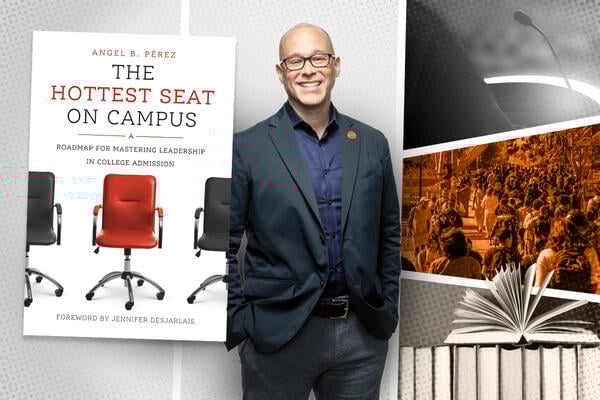
More than two years after the Supreme Court ruled that colleges and universities could no longer consider race in admissions decisions, the Trump administration has launched a crusade to ensure institutions are abiding by that decision. Government officials have demanded colleges submit detailed data on the racial makeup of their admitted students, cast suspicion on so-called proxies for race in the admissions process and required some universities to reform their admissions practices—without specifying what, exactly, needed changing. (The administration has also used the decision as justification to call for the cancellation of other diversity, equity and inclusion initiatives, from scholarships to student lounges.)
Then again, according to Angel Pérez, a longtime admissions dean and the CEO of the National Association for College Admission Counseling, it’s never not a trying time to be an admissions dean.
Hence the title of his forthcoming book, The Hottest Seat on Campus (Harvard Education Press), which he admits freely to have borrowed, albeit subconsciously, from a 2014 Chronicle of Higher Education feature. Admissions deans are incredibly visible, he said in a recent interview with Inside Higher Ed; their failures and successes are known to all—and have consequences well beyond their own offices.
Now, as these leaders grapple with the new challenges the Trump administration has brought—and as the first day of NACAC’s annual conference kicks off in Columbus, Ohio—Pérez hopes his book, which is built upon interviews with dozens of admissions leaders from across the country, will prove an important resource for others struggling to navigate the hot seat. Inside Higher Ed spoke with him over the phone about his advice for admissions deans and the changing landscape of higher education.
The interview has been edited for length and clarity.
Q: I wanted to start off by asking about your personal story. What made you interested in holding an admissions role yourself?
A: I think my story is actually very typical of most people who go into the admissions profession. I still call myself an accidental admissions dean—this is not what I was supposed to be doing for a living.
So many people go into the admissions profession by actually being involved on their college campus, as was I. I was involved in student activities, I was a residence hall director, I dabbled in tour guiding. The dean of students at Skidmore [College], Dean Joe Tolliver, who has now retired but is still very active in student affairs, said to me, “You’d be really great in higher education. You should consider a job in higher education.” And to be honest, I didn’t think that those were real jobs, on a college campus. So, I didn’t take it very seriously until someone in the admissions office, Roslyn Estrada, said to me, “Angel, there’s going to be an opening in the admissions office. You should apply. You’d be really good.”
And eventually I said yes to applying because I thought I would go and do that for one year until I found a real job. And many, many years later, here I am, and [I am] delighted that I took that calling.
So, it was really the taps on the shoulders. But I will say—it’s one of the reasons I’ve written the book—that I think we need to change that paradigm and I think we need to change that pathway. I want to create much more intentional pathways into the profession and I want to create much more intentional pathways into leadership.
Q: What would that look like? Do you guys have any initiatives currently underway that are trying to create more intentional pathways?
A: [NACAC has] launched a program called NEXT, where we work with admissions counselors who are one to three years in to basically help them understand what growth in the profession can look like, what a pathway can look like.
The second thing is that, thanks to the support of Strada Education Foundation, we are actually going to be launching a brand new dean’s fellowship, starting in 2026. This is in order to support brand-new deans who are moving into these chairs and cultivate them into leadership. In the book, in the spirit of me being the accidental dean, I write about the fact that one day I was the director of admissions, and the next day, my boss retired and said to me, “The president would like to speak to you.” And then, all of a sudden, I was the vice president for enrollment, and my job was so fundamentally different. That happens to so many people—it’s kind of like sink or swim. What we want to do at NACAC in the future is create much more intentional leadership growth for deans.
One thing that I aspire to do—we’re not there yet; I’m still looking for the funding—is actually to create a program where those tour guides on college campuses and student interviewers, I would like to actually create a NACAC fellowship for them to learn about what it’s like to go into the profession, to give them a mentor as they’re applying for their first job out of college, into the admissions profession, and then make them a part of the NACAC community.
Q: I enjoyed the section of the book where you were talking about admissions deans as storytellers. Could you describe how that storyteller role differs from others on campus and also how effective storytelling translates to outcomes for the admissions office?
A: I always have believed that that admissions deans are chief storytellers of an institution. The reason I say that is because they have such a large constituency. They’re not just telling stories on their campus; they’re also telling the story of the institution outside of campus, right? They’re talking to high school counselors. They’re talking to students. They’re talking to people like you, for example, in the media who are trying to understand the complex admissions world that we have built.
What I have seen in my experience is that so many admissions deans fail in the role because they did not embrace the role of storytelling. A big part of their job is to actually educate the community about the challenges of enrollment, to educate the community about the fact that enrollment is all about trade-offs; in the environment that we’re living in, everybody’s not going to get what they want on campus.
A: These are really the messages that I took away from the teams that I interviewed. One is, during both of those crises—but I would argue any crisis—the importance of communication. I mean, we were just talking about storytelling, right? The importance of bringing your staff along, your constituents, making sure that people are feeling informed, even during incredible uncertainty. We’re living that again right now, so the book is very timely.
I think the other thing that stands out for me—something that, again, was highlighted through these amazing deans I interviewed in the book—is the importance of building teams and making sure that you rely on those team members and not carry the weight of leading in crisis by yourself. I think the leaders who crashed and burned during COVID, during the FAFSA debacle and during all of the different crises that we face, these are individuals who try to do it all by themselves. The reality of the matter is none of us can do it by ourselves. If you can put together a really diverse team who thinks differently, who complements each other in different diverse ways, you’re going to be set up for a lot more success. And obviously empowering them is going to be a big part of that as well.
Q: On a similar note, this book was written before the series of crises that we’re going through with the Trump administration’s attacks on higher education. Is there any piece of advice you would add to the book if you could about navigating this current moment?
A: I think so much of the advice [in the book] actually is very much translatable to what’s happening today. The difference is, the level of change is coming so much faster than ever before, even faster than COVID, even faster than FAFSA, because every day the Trump administration could say something that fundamentally upends how we do our work. I think that’s what’s different.
So if I could have a whole other chapter in the book, I would actually focus on how to lead in an era of uncertainty, and the skill sets that you need, personal and professional, to actually navigate change that’s coming faster than ever.
One of the quotes [that] I use in every presentation I do right now is from Justin Trudeau, and this quote just blows me away. He said it at the World Economic Forum: “The pace of change has never been this fast and it will never be this slow again.” To me, that is our new reality. And so I think I would focus a lot on, how do you keep organizations stable when the news cycle is changing every single day?
The other thing that I would focus on is actually how to be unresponsive. What I mean by that is oftentimes we’re so wired to jump at the crisis of the day. One of the things the dean said to me really recently last week was “You know what? Every time news comes out now, I just sit and I wait, because it might be different tomorrow.” And so there’s also this skill set that I think people need to build of not overreacting when the news cycle is breaking every single day. It’s tough. We’re living in tough times.
Q: If you could go back in time to when you were first starting in admissions, what is one piece of advice that you would give yourself, either from the book or just off the dome?
A: I think I would say to myself, “Enjoy this moment.” And the reason I would say that is because so many young admissions counselors are so eager to rise in the ranks very quickly. As you saw in the book, I talk about it: The faster you rise up the ranks, it becomes a lot messier and murkier and sometimes painful. As a dean, there were many more days that I longed for the simplicity of being on the road, recruiting students, spending my days in high schools and then going back home and reading applications from kids all over the world. It was such a beautiful job with not a ton of pressure.
But then, obviously, I was an eager beaver, and I climbed the ranks actually very quickly; I became a dean in my early 30s. I now wish that I had said to myself, “Slow down, enjoy this moment, and don’t be too quick to rise, because those pressures are going to be very, very different.”
Timely college completion has benefits for both the student and the institution. Learners who graduate on time—within two or four years, depending on the degree program—hold less debt and have greater earnings potential because they’re able to enter the workforce sooner.
National data reveals that only 17 percent of students at public two-year colleges complete a degree in two years, and 40 percent of students at public four-year institutions graduate on time. While a variety of personal challenges can limit students’ timely completion, institutional processes can also have an impact. According to the course scheduling software provider Ad Astra’s 2024 Benchmark Report, which included data from 1.3 million students, 26 percent of program requirement courses were not offered during the terms indicated in pathway guidance, leaving students without a clear road map to completion.
A new resource from Ad Astra and Complete College America identifies ways institutions can reconsider class scheduling to maximize opportunities for student completion.
What’s the need: Students report a need for additional support in scheduling and charting academic pathways; a 2024 Student Voice survey by Inside Higher Ed and Generation Lab found that 26 percent of respondents want their college to create or clarify academic program pathways. An additional 28 percent want their institution to introduce online platforms to help them plan out degree progress.
Nontraditional students, including adult learners, parenting students and working students, are more likely to face scheduling challenges that can also impede their progress. A 2024 survey of online learners (who are primarily older, working and caregiving students) found that 68 percent of respondents considered time to degree completion a top factor in selecting their program and institution.
But making the switch to a better system isn’t exactly a cakewalk for higher ed institutions, and establishing strong top-down policies can create its own hurdles. “Because leadership changes in organizations and institutions, because we get more and more students enrolling and registering, we still have to continue to reiterate this message about how important academic scheduling is,” said Complete College America president Yolanda Watson Spiva. “But we’re happy to do it because it still remains one of the best levers for helping students to persist and complete college.”
Becoming a student-centered institution with predictable and flexible scheduling also benefits the institution because it means continuous enrollment, Watson Spiva said
“Whether it’s Uber or Amazon, all these things are meant to make life easier, and yet for some reason, in higher ed, we haven’t caught up to that, that convenience is a major factor” in improving student enrollment and retention, Watson Spiva said. “Until we change our mindset in terms of embracing students as agents of change and having agency in and of themselves, I think we’re going to continue to grapple with this pervasive issue.”
The new report is a playbook of sorts to help institutions prepare to make change, said Ad Astra’s president, Sarah Collins. “This is one of the next big things that institutions really need to get their arms around, I think, because it’s so culturally difficult and very big, very hairy and scary,” Collins said.
How to make change: For institutions that want to do better and overhaul current practices, Ad Astra’s report provides starting points that administrators can consider, including:
Assessing the institution’s readiness for change, including current scheduling practices, faculty concerns and priorities, as well as the institution’s context, such as previous efforts and resource constraints. Administrators should identify existing inefficiencies, as well as resources and staff capacity, to implement and sustain change.
Being aware that making adjustments requires more than technical training; it also demands capabilities to engage in change leadership practices and sustained support to ensure changes are embedded into the institutional culture.
Celebrating and recognizing positive changes. Data and storytelling can measure impact as well as affirm how practices make a difference in student success.
Evaluating the organizational structure of the institution is one key piece, Collins said, because colleges tend to be designed around a strategy rather than a student. Institutions should also prioritize data collection and distribution, because that’s a frequent sticking point in change-management practices.
“Making sure that the data tells a story, convincing people to believe the data, making sure that the things you’re trying to measure are the things that actually matter and they actually map to the bigger thing you’re trying to accomplish,” Collins explained.
Additionally, prioritizing the student voice in conversations about course scheduling can ensure that the institution is centered on learners’ needs. “It should not just be the traditional-age student,” Watson Spiva said. “It should also include post-traditional students—working learners, parenting learners—because their scheduling needs are going to be very, very diverse.”
The Senate Committee on Finance is proposing to raise the endowment tax on private colleges and universities, but not to the extent the recently passed bill in the House calls for, according to a draft plan released Monday.
The less dramatic excise tax tops out at 8 percent for the wealthiest institutions, compared to 21 percent in the House plan, but the Senate’s proposal keeps the House’s tiered rate structure, with some colleges paying more depending on the value of their endowment per student. The current rate for affected institutions is 1.4 percent.
Institutional lobbyists and college presidents have warned that the sharp increase in the House plan would hurt their ability to provide need-based aid and be debilitating for some low-income students. Although the Senate’s iteration offers some relief, it’s not as much as they hoped for.
“The Senate version of the so-called endowment tax is better, but it’s still bad and harmful tax policy,” said Steven Bloom, assistant vice president of government relations at the American Council on Education. “They’re going to take money that would likely have been devoted to financial aid and research and other academic purposes on campus, and they’re going to send it to Washington, where it’s used largely for purposes unrelated to higher education.”
The Senate committee’s plan, like the House proposal, also still exempts religious colleges and requires colleges to take international students out of the total roll call when calculating the endowment’s value per student. If passed, this stipulation would increase the tax rate significantly for institutions like Columbia University that have 20 percent or more foreign students.
The finance committee legislation, which also includes cuts to Medicaid that could put pressure on states’ budgets, is part of a broader package of bills that would make significant changes to higher education policy and cut spending and taxes in order to pay for President Donald Trump’s priorities, which include increased deportations and tax cuts for the wealthy. The House version of the reconciliation bill known as the One Big Beautiful Bill Act passed by a one-vote margin last month. Senators are aiming to pass their version by July 4 and only need 51 votes thanks to the reconciliation process, as opposed to the traditional 60 votes.
Unlike the House proposal, colleges that don’t accept federal financial aid would be exempt from the tax entirely. Hillsdale College president Larry Arnn blasted the House plan in an op-ed last month as an attack on the institution’s independence. (Hillsdale doesn’t participate in the federal financial aid system.)
“The resources entrusted to Hillsdale College are not drawn from the public treasury,” Arnn wrote. “They are given freely by those who believe in our mission. To tax these gifts is to tax philanthropy itself—to burden those who would lift burdens. It is to weaken those who do good precisely because they are free to do it. It weakens them and strengthens the federal government, reversing the order intended by our Founders.”
Hillsdale wasn’t the only college that pushed back on the rate increase. In recent weeks, private institutions big and small have pitched their own alternatives to Congress.
Some of the largest and wealthiest research institutions that would be affected by the tax—such as Harvard, Stanford and Princeton Universities—pledged to spend 5 percent of their endowment’s value annually in exchange for a much lower 2.4 percent endowment tax rate, The Wall Street Journalreported. Bloom agreed that if the tax is to increase, he would like to see some kind of incentive introduced, like financial aid spending thresholds, to mitigate the tax rate.
“They’ve created no incentive for schools to behave in ways that we believe that they would want schools to behave,” he said.
Other institutions suggested that the tax rate should be based on what percentage of endowment revenue an institution spends each year on student financial aid or how many students enrolled come from a low-income background and receive the federal Pell Grant.
A coalition of 24 smaller institutions, including Grinnell and Davidson Colleges, which would be hit hardest by the House endowment tax, proposed adjusting the excise rate based on the number of students enrolled. Colleges with fewer than 5,000 students have a different economic model than an institution with 30,000, they said.
Grinnell president Anne Harris, who spent part of the last week educating lawmakers about the harm of the increased endowment tax, said Monday evening that the Senate plan still disproportionately burdens smaller institutions. She noted that her institution will likely still face the maximum 8 percent tax.
“I deeply appreciate all the work that’s gone on and clearly all the consideration that has informed what we’re seeing this afternoon, but having said that, the current proposal still disproportionately burdens small colleges,” Harris said. “You’re going to find a school like Grinnell College with 1,700 students, a small college in a rural setting, bearing a much greater burden of this tax than a research institution in a large city.”
She could only speculate that senators stuck with a tiered structure for simplicity, but added that “the simple fix” would be to make a stipulation that places all small private colleges in the lowest bracket and maintain the current 1.4 percent tax rate.
Harris is hopeful that there will still be further opportunities for compromise and said she will continue to advocate for small liberal arts institutions like her own. But in the meantime, her executive team will also continue to plan out all the possible scenarios to figure out the best course of action to protect student aid if the bill passes as it currently stands.
“All responsible options that provide the most money for financial aid and mission fulfillment are on the table as part of our scenario planning with the board,” she said.
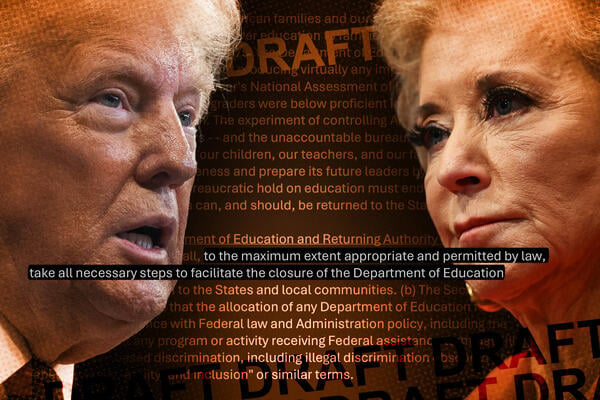
A draft executive order obtained Thursday by Inside Higher Ed directs the newly confirmed education secretary, Linda McMahon, to “take all necessary steps” to return authority over education to the states and facilitate closure of the Department of Education “to the maximum extent appropriate and permitted by law.”
If signed, the order—which has been rumored for weeks but is not yet official—would be the first step in carrying out the president’s controversial campaign promise to abolish the 45-year-old department, which he believes is unconstitutional and has grown too large.
Several media outlets reported Wednesday night that Trump would sign the order as soon as Thursday, but shortly after the news circulated, White House press secretary Karoline Leavitt posted on X, “President Trump is NOT signing an Executive Order on the Department of Education today” and called the reports “fake news.”
Still, the reports set off a wave of comments from advocates and analysts. Liberals warned that shutting down the Education Department would be devastating for families and students, while conservatives backed Trump’s plan and said the draft order was key to cleaning up the agency.
McMahon, who took office Monday and will spearhead the closure effort, is supportive of overhauling the agency. She told department staff earlier this week to prepare for a “momentous final mission” to eliminate “bureaucratic bloat” and return education to the states.
Although vague, the secretary’s memo and the draft executive order give policy experts some idea of what could come next.
At the very least, they expect to see a major reduction in staff and a diminished federal role in education; some of that work is already underway. The agency has slashed millions in contracts and grants as well as fired dozens of employees. A larger reduction in force is also in the works, fueling concerns among department staff.
“There is probably not going to be anything in [the order] that isn’t already happening, largely,” said Kelly McManus, vice president of higher education at Arnold Ventures, a philanthropic group. “The secretary’s final mission was clear … so I’m not particularly worked up about the EO specifically, because I don’t think it’s going to fundamentally change that.”
Abolishing the department would require an act of Congress, which McManus said the draft order appears to acknowledge. She and other experts say any effort to close the department will be lengthy and complicated.
“This is not a flip-on, flip-off situation here,” she said. “Practically, there will have to be a process … You cannot shut the doors tomorrow and be done.”
The 416-word draft order gives little detail as to what the “steps” of dismantling the department are or what would happen to certain congressionally mandated programs such as the Pell Grant, the student loan system or the Individuals With Disabilities Education Act. However, the document does say that any funds allocated by the department should comply with federal law, including Trump’s previous orders on diversity, equity and inclusion and transgender athletes—both of which have been caught up in court.
Neither Trump nor McMahon has so far offered any plan outlining how closing the department would work, though some conservative plans recommend moving the Office for Federal Student Aid to the Treasury and sending the Office for Civil Rights to the Justice Department.
More than 4,000 people currently work for the department, which was created in 1979 and now has a $80 billion discretionary budget. Each year, the agency issues about $100 billion in student loans and doles out more than $30 billion in Pell Grants.
Shutting down the department isn’t popular with voters, recent surveys have found. One recent opinion poll found that 61 percent of all respondents “somewhat” or “strongly” opposed the idea of eliminating the department. Another showed that up to 72 percent either opposed the plan or weren’t sure how they felt. That number was 49 percent among Republicans.
Minimizing a D.C. ‘Footprint’
Trump has signaled for months, if not years, that he wants to shut down the Education Department, and many analysts have already taken a position on the issue.
To Michael Brickman, an adjunct fellow at the conservative think tank the American Enterprise Institute, nothing about the draft was a surprise. Like McManus, he noted that much of what the order directs McMahon to do is already underway.
Brickman expects the next steps will focus on finding new and “better” ways to maintain the department’s core functions as required under law with “less funding, less staff and possibly in conjunction with other agencies.”
“I don’t think anybody’s talking about cutting major programs,” he said, referencing financial aid services like the Pell Grant and disability protection acts like IDEA. “So the question will be, what is required under law? What can Congress change? And how can the department streamline things to minimize the footprint in D.C.?”
Shutting down the Education Department likely would be disruptive for colleges and students, advocates say.
J. David Ake/Getty Images
McManus stressed that it will be important to protect these core functions, especially the ones related to higher ed, saying it doesn’t make sense to send them back to the states.
“What is most important is that those core statutory functions have the people, capacity and expertise to be able to do effective oversight of how taxpayer dollars are being spent,” she said. “We are significantly less concerned about where those people sit, as long as there is the ability to safeguard taxpayer investments and to make sure that programs that are statutorily required and that have had long bipartisan support, like Pell Grants, are being effectively implemented.”
In Brickman’s view, some of the department’s regulatory operations, like analyzing and creating reports on grant or contract applicants and managing third-party accreditors, are simply “make-work.” By hiring hundreds of staff members to execute these tasks, he said, the department pulls tax dollars from local governments and then forces those same communities to spend more writing grant proposals to get it back.
“There’s just a lot of work and churn that evidence shows does not lead to improved student outcomes,” he said.
But when asked what the Trump administration has done to convince stakeholders he not only intends to tear down the department but also build it back up again, Brickman didn’t directly answer the question. Instead, he referenced actions of the Biden administration.
“The Biden administration broke the entire Federal Student Aid system on purpose … They were trying to illegally turn the trillion-plus-dollar portfolio from a loan program into a grant program,” he said. “That is not what the Trump administration is doing. The Trump administration has tried to improve these programs and make them actually work again.”
Although what Biden did was “unfortunate,” Brickman said, it also creates an opportunity.
“This mess isn’t being created; it’s being responded to,” he said. “I hope institutions that may be predisposed to oppose anything coming from the Trump administration will welcome this as the end of a failed experiment that just put more restrictions on teaching and learning.”
Democrats Push Back
Meanwhile, Democratic lawmakers, student advocacy groups, civil rights organizations and left-leaning think tanks warn that Trump has no intention of rebuilding, only dismantling. The American Federation of Teachers, a key higher ed union, said the order is a government attempt to “abdicate its responsibility to all children, students and working families.”
Randi Weingarten, the union’s president, recognized in a statement Wednesday night that there are certainly ways the department could be more efficient, but she implied that’s not Trump’s goal.
“No one likes bureaucracy, and everyone’s in favor of more efficiency, so let’s find ways to accomplish that,” she said. “But don’t use a ‘war on woke’ to attack the children living in poverty and the children with disabilities, in order to pay for vouchers and tax cuts for billionaires.”
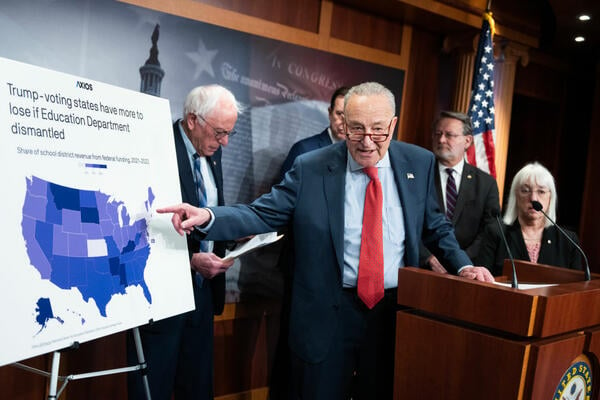
Senate Democrats criticized the pending executive order to abolish the Department of Education as a press conference Thursday.
Tom Williams/CQ-Roll Call Inc. via Getty Images
Senator Patty Murray, a Democrat from Washington State, blasted the Trump administration’s plans at a press conference Thursday. She said that Trump and his unelected government efficiency czar Elon Musk “don’t know what it’s like to count on their local public school having the resources to get their kids a great education … And they don’t care to learn why. They want to break the department, break our government, and enrich themselves.”
To the American Association of University Professors, “dismantling the Department of Education would hasten us into a new dark age.”
Former Biden under secretary James Kvaal told Inside Higher Ed that the draft order should dispel any notion that Trump is not trying to shut down the department. But at the same time, he said, the GOP administration’s approach to doing so has been “schizophrenic” and “inconsistent.”
“It can’t be true that students of color and with disabilities will have their civil rights protected, but also the federal government is not going to be involved in those decisions,” he said.
But at the same time, Kvaal and others note that, ultimately, the Trump administration lacks the legal authority to actually close the Department of Education, making full abolishment more complicated than the president suggests.
Shuttering the agency would require 60 votes in the Senate as well as a majority in the House, as the department’s existence is written into statute. And with a 53-seat majority in the Senate, Republicans don’t currently have the votes unless some Democrats back the plan.
“[The Republicans] don’t have the votes to close the department, and they already plan to enforce their plans on DEI, so it’s not clear what the EO adds to that,” Kvaal said. “It’ll get sorted out in the courts.”
Katherine Knott and Liam Knox contributed to this report.