Tag: Pacific

  • NCCE on the Road: Takeaways from TechFest Events across the Pacific Northwest

    NCCE on the Road: Takeaways from TechFest Events across the Pacific Northwest

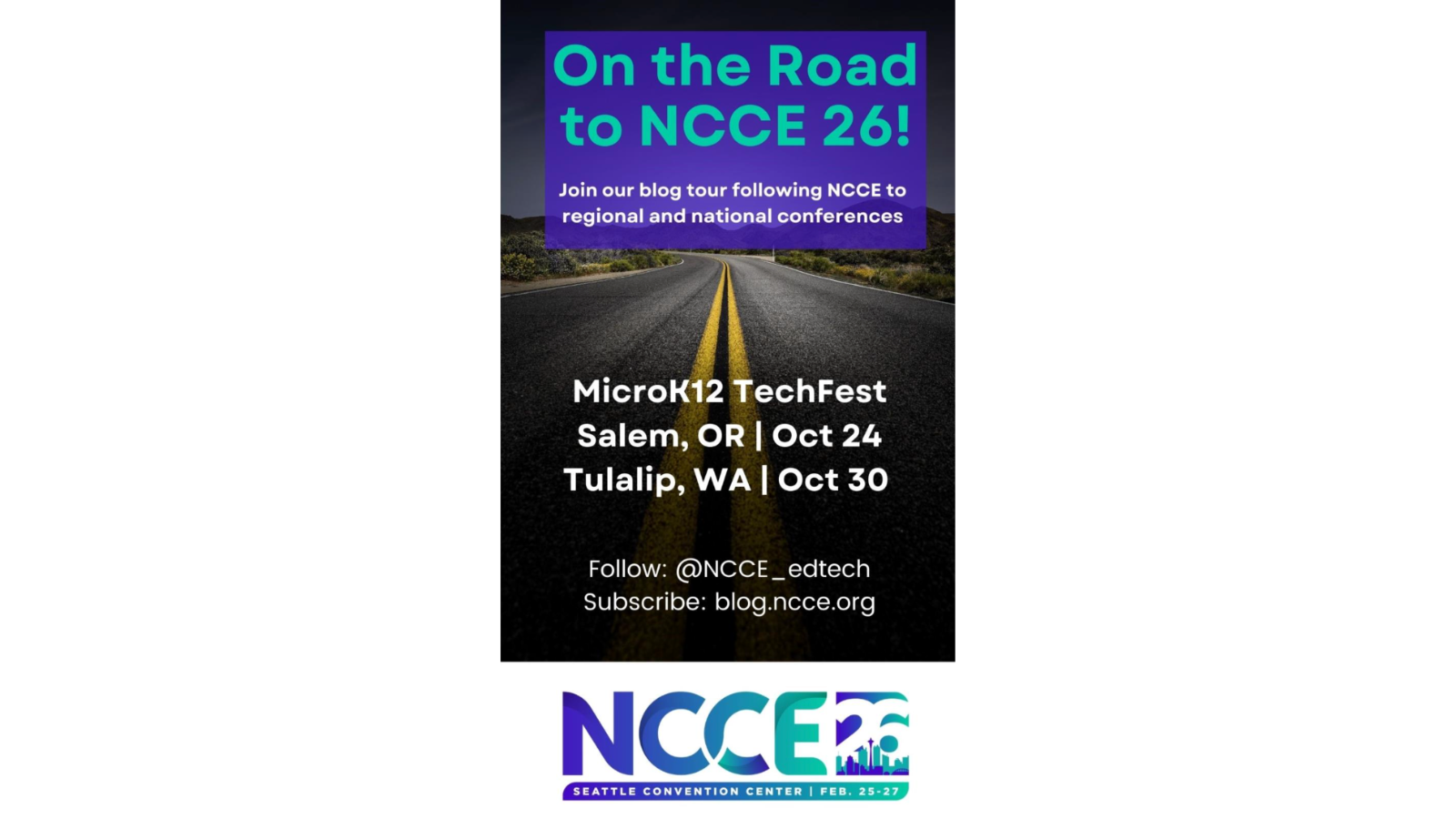
    We are excited to share that NCCE recently attended MicroK12’s 2025 TechFest, a series of education technology conferences for school district administrators. These events, including TechFest South in Salem, Oregon, and TechFest North in Tulalip, Washington, provided crucial platforms for NCCE to share professional learning from our members, NCCE board leadership, NCCE professional learning specialists and NCCE Regional Leaders. 

    Focus on AI and Learning Transformation 

    A primary focus across both conferences was the transformative role of Artificial Intelligence in education. NCCE explored frameworks for viewing this shift with Justin Huntley, Eugene School District and NCCE regional leader, who presented a session titled “Voices, Choices, & AI” at MicroK12’s TechFest South in Salem, Oregon. His session explores how educators can utilize digital tools and Artificial Intelligence (AI) to achieve several key learning objectives: 

    • Amplify student voice.  
    • Support unique learning paths
    • Spark authentic engagement

    Cheryl McClure, NCCE Professional Learning Specialist, presented a session titled “Coding 4 Climate” at MicroK12’s TechFest North in Tulalip, WA. This session focuses on integrating computer science and climate literacy by demonstrating how to use the Coding for Climate Action curriculum. The curriculum engages middle schoolers in STEM by having them: 

    • Use block coding with Micro:bit
    • Design natural hazard alerts
    • Simultaneously build CS, climate literacy, and problem-solving skills

    A group of people posing for a photo

AI-generated content may be incorrect.A selfie of two women

AI-generated content may be incorrect.

    “Being able to attend both TechFest North in Washington and TechFest South in Oregon means we can connect directly with our regional members and hear what is happening to districts in our region so we can be better prepared to provide professional learning solutions in real time,” stated Bobby Myers, NCCE COO. 

    Sally Bouvia, NCCE Marketing Coordinator, is passionate about traveling and supporting educational conferences while sharing all the exciting updates that NCCE brings to the world of Ed Tech, all the while growing and developing connections in the NCCE community. 

    If you have a conference you’d like NCCE to support, please let us know by contacting us at https://ncce.org/contact/ . For more information, visit our website at www.ncce.org

    Source link

  • Willamette University and Pacific University seek to merge

    Willamette University and Pacific University seek to merge

    This audio is auto-generated. Please let us know if you have feedback.

    Dive Brief:

    • Willamette University and Pacific University are looking to merge after their leaders signed a letter of intent to negotiate a definitive agreement, the Oregon institutions announced Thursday.
    • Under the plan, the two private nonprofits would operate as a single institution under a shared administrative structure but maintain “their character, identities, and historic campuses.” They would also run separate academic and athletics programs and set their own admissions requirements.
    • Willamette and Pacific officials expect to announce details about the operational and structural changes under the merger in the coming months. During that time, their leadership teams plan to enter into a definitive agreement and begin seeking regulatory approval.

    Dive Insight:

    The two institutions “provisionally” expect to call the combined college the University of the Northwest, according to Thursday’s announcement. It would be the largest private university in Oregon, with a combined student body of about 6,000. 

    “Together we’re looking to create pathways and opportunities for students that would be difficult for either institution to do alone,” Willamette President Steve Thorsett said in a statement. As a merged institution, the universities could “offer broader academic programs, enhanced resources, and have the flexibility to build and innovate in the future,” Thorsett said.

    Pacific is the larger of the two institutions. In fall 2023, the university enrolled 3,479 students, a 2.9% decline from a decade prior, according to federal data. 

    Willamette enrolled 2,112 students in fall 2023, down 26% from a decade prior. The university’s enrollment reached a four-decade low during the pandemic, though it has steadily recovered since.

    The loss of students has hit Willamette’s budget hard. Roughly half of the university’s revenue comes from net tuition and fees, and it has reported multimillion-dollar deficits from fiscal years 2016 to 2024.

    Meanwhile, Pacific, another tuition-reliant institution, has posted positive net income each year over the same period.

    Both institutions are accredited by the Northwest Commission on Colleges and Universities, which would need to sign off on their merger.

    Federal and state regulators would also need to approve the proposed merger. 

    One top state official gave Willamette and Pacific an early show of support Thursday.

    “At a time when increased investment and innovation in all sectors of higher education is crucial for our state’s economic future, I appreciate the bold approach Willamette and Pacific are taking to meet the moment,” Ben Cannon, executive director of Oregon’s Higher Education Coordinating Commission, said in a statement. “We look forward to supporting their work to expand access to higher education for all Oregonians.”

    Each institution’s undergraduate colleges will remain separate. That includes Willamette’s art school, which it established following its acquisition of the Pacific Northwest College of Art in 2021. PNCA became Willamette’s fourth college and retained its name, faculty and Portland campus.

    “Pacific and Willamette are both deeply rooted in Oregon’s history and have educated thousands of leaders who have helped make the Pacific Northwest synonymous with innovation and excellence,” Thorsett said in a statement.

    Willamette was founded in 1842 as a school for the children of settlers. It became “Wallamet University” in 1853 before adopting the current spelling of its name in 1870. The university established Oregon’s first law school and medical school.

    Pacific, similarly founded as a school for children in 1849, awarded its first bachelor’s degree in 1863.

    Source link

  • Willamette and Pacific Universities Plan Merger

    Willamette and Pacific Universities Plan Merger

    Pacific University and Willamette University have signed a letter of intent to merge, pending approval, which would create the largest private institution in Oregon if the deal is finalized.

    Together the two institutions have a collective study body of about 6,000 students.

    “If finalized and approved, this merger would be a defining moment for private higher education in the region. Pacific and Willamette are both deeply rooted in Oregon’s history and have educated thousands of leaders who have helped make the Pacific Northwest synonymous with innovation and excellence,” Willamette president Steve Thorsett said in a news release. 

    Pacific president Jenny Coyle emphasized a shared “commitment to addressing the region’s most pressing workforce needs while preserving the personalized, mission-driven education that defines both of our institutions” and the opportunity to leverage “our collective strengths.”

    The combined entity would be known as the University of the Northwest.

    The two institutions plan to operate under a shared administrative structure but maintain their respective campuses, admissions requirements, academic programs and athletic teams. Their main campuses are located roughly an hour apart; Willamette is in Salem and Pacific in Forest Grove. Willamette also has a campus in Portland that houses an art college.

    The merger will require approval from regulatory bodies, including the Department of Education.

    Source link