Tag: Pandemic

  • Homeschooling in Ohio is Seeing Another Recent Surge After Spiking During the Pandemic – The 74

    Homeschooling in Ohio is Seeing Another Recent Surge After Spiking During the Pandemic – The 74


    Get stories like this delivered straight to your inbox. Sign up for The 74 Newsletter

    More Ohio students are being homeschooled now than during the COVID-19 pandemic.

    The number of Ohio students being homeschooled was trending upward pre-pandemic, spiked to about 51,500 students during the COVID-19 pandemic and dipped back down slightly.

    But homeschooling recently saw another surge with about 53,000 homeschooled students during the 2023-24 school year, according to data from the Ohio Department of Education and Workforce.

    The number of homeschooled students in Ohio, according to the Ohio Department of Education and Workforce:

    • 2023-24: 53,051 students
    • 2022-23: 47,468 students
    • 2021-22: 47,491 students
    • 2020-21: 51,502 students
    • 2019-20: 33,328 students
    • 2018-19: 32,887 students
    • 2017-18: 30,923 students

    There were about 3.1 million homeschooled students nationwide in 2021-22 — quite the jump from 2.5 million in spring 2019, according to the National Home Education Research Institute.

    “Homeschooling was already on a slightly slower upward trajectory, and had been for a number of years,” said Douglas J. Pietersma, research associate at National Home Education Research Institute. “What COVID did, from our perspective, is just infused it.”

    He expects the number of homeschooled students to keep growing.

    “It’s not going to put public schools out of business or anything like that, but it’s going to be a slow growth that is certainly going to be measurable over time,” Pietersma said.

    Remote learning during the pandemic made parents become more aware of what was being taught in schools, said Melanie Elsey, Christian Home Educators of Ohio’s legislative liaison.

    “I don’t think that it was a mass exodus from the public or private schools into homeschooling, but for parents who felt like they could accomplish more with one-on-one attention to learning … You can tailor the education to meet the needs of their children,” she said.

    Not everyone who switched to homeschooling stayed after the pandemic, Elsey said.

    “Some of them put their children back in because it was too much of a commitment,” she said. “So I think it was sort of a time period that parents felt comfortable trying something different to see if they could help their children learn more.”

    The modern home education movement sprung out of the 1970s and “skyrocketed” in the 1980s, Pietersma said.

    “People were either upset with the quality of education in general,” he said. “Then another group of people, it was more about the content of education.”

    Today there are many reasons why a family might opt for homeschooling.

    “Obviously, the quality of education is still one of the big issues,” Pietersma said. “Safety issues are a huge thing. People who have had their children in schools where they’ve been bullied or assaulted or had exposure to drugs … given the size of school, it may be not impossible to prevent some of those things.”

    The reason for homeschooling varies and it is not always because a family is not satisfied with their local school district, Elsey said.

    She homeschooled her children, but did not originally think it was for her family. However, she changed her mind after she enjoyed being home with her children through their preschool years.

    “We prayed about it and really felt like it was something that was worthwhile,” Elsey said.

    Jeannine Ramer has homeschooled her four children — two are now in college and two (ages 17 and 13) are currently being homeschooled.

    “Homeschooling has really strengthened our family relationships, my kids are very, very close and supportive of one another, and I think that’s all of the hours spent at home and just really learning together,” said Ramer, who lives in Alliance.

    They were not initially planning on homeschooling their children, but Ramer’s sister-in-law homeschooled her children and encouraged them to think about it as their oldest approached preschool age.

    They decided to try it for a year or two, but found it worked well for their family.

    “We loved it,” Ramer said. “We’ve had the ability to tailor each child’s education to that child.”

    A parent does not need to be a licensed teacher in order to homeschool their children, Elsey said.

    “It’s amazing how well families do because they have access to resources, really, all over the world, when you can get curriculum from anywhere that meets the needs of your students to learn to pursue their interests,” she said.

    Families who decide to homeschool their children enjoy the flexibility, Pietersma said.

    “They can tailor the education that they’re providing to their child in so many ways that an institutional school can’t just because of sheer numbers,” he said. “One teacher in a classroom with 30 students can’t take the lesson plan and tailor it to each of the 30 students.”

    Ramer’s oldest child was interested in printing and design work as a teenager, so they were able to craft his high school education to those areas. Now he is studying industrial and innovative design in college.

    “It just allowed us the ability to foster that,” she said. “There was much more flexibility.”

    Ohio Capital Journal is part of States Newsroom, a nonprofit news network supported by grants and a coalition of donors as a 501c(3) public charity. Ohio Capital Journal maintains editorial independence. Contact Editor David Dewitt for questions: [email protected].


    Get stories like these delivered straight to your inbox. Sign up for The 74 Newsletter

    Source link

  • A gender gap in STEM widened during the pandemic. Schools are trying to make up lost ground

    A gender gap in STEM widened during the pandemic. Schools are trying to make up lost ground

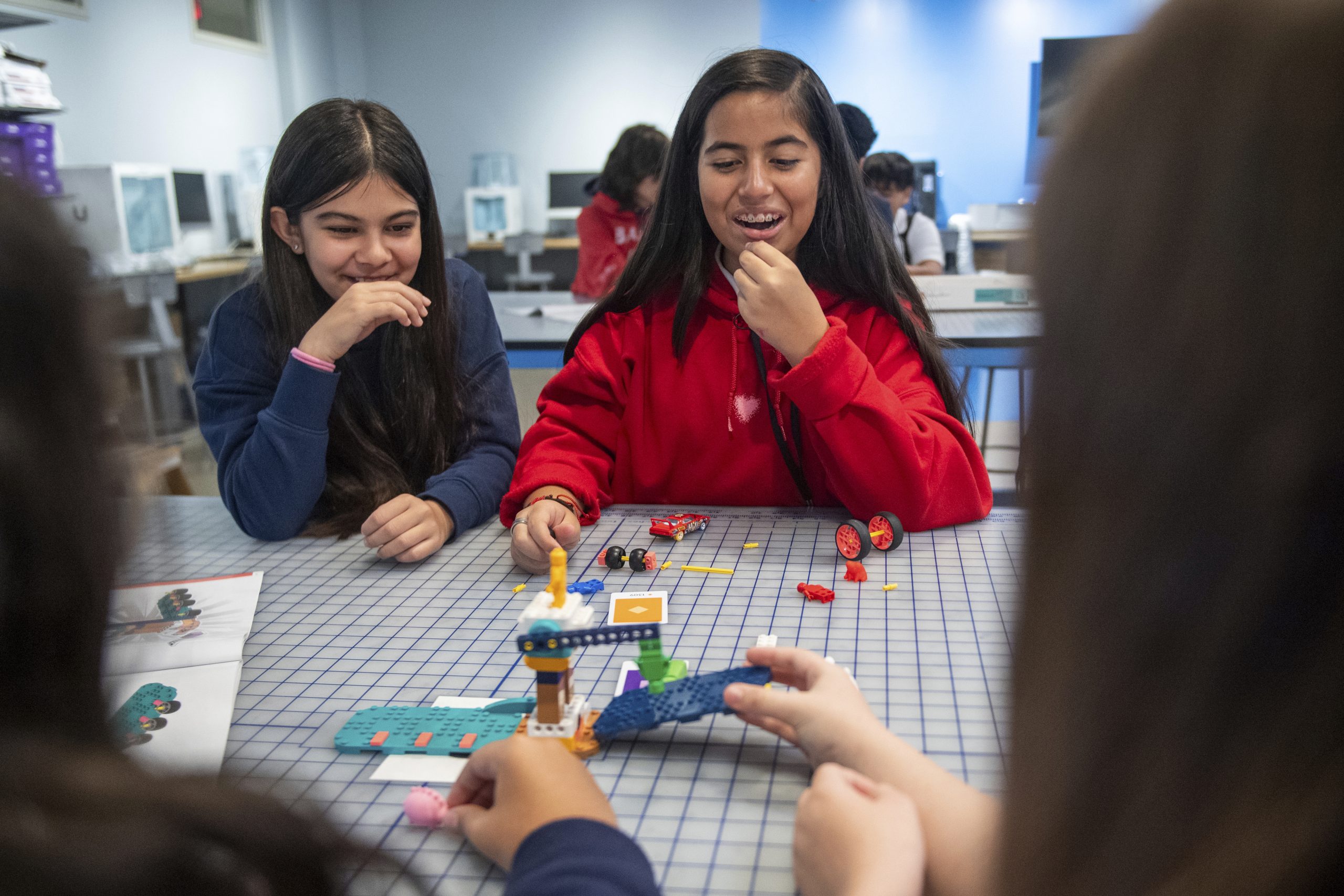
    IRVING, Texas — Crowded around a workshop table, four girls at de Zavala Middle School puzzled over a Lego machine they had built. As they flashed a purple card in front of a light sensor, nothing happened. 

    The teacher at the Dallas-area school had emphasized that in the building process, there are no such thing as mistakes. Only iterations. So the girls dug back into the box of blocks and pulled out an orange card. They held it over the sensor and the machine kicked into motion. 

    “Oh! Oh, it reacts differently to different colors,” said sixth grader Sofia Cruz.

    In de Zavala’s first year as a choice school focused on science, technology, engineering and math, the school recruited a sixth grade class that’s half girls. School leaders are hoping the girls will stick with STEM fields. In de Zavala’s higher grades — whose students joined before it was a STEM school — some elective STEM classes have just one girl enrolled. 

    Efforts to close the gap between boys and girls in STEM classes are picking up after losing steam nationwide during the chaos of the Covid pandemic. Schools have extensive work ahead to make up for the ground girls lost, in both interest and performance.

    In the years leading up to the pandemic, the gender gap nearly closed. But within a few years, girls lost all the ground they had gained in math test scores over the previous decade, according to an Associated Press analysis. While boys’ scores also suffered during Covid, they have recovered faster than girls, widening the gender gap.

    As learning went online, special programs to engage girls lapsed — and schools were slow to restart them. Zoom school also emphasized rote learning, a technique based on repetition that some experts believe may favor boys, instead of teaching students to solve problems in different ways, which may benefit girls. 

    Old practices and biases likely reemerged during the pandemic, said Michelle Stie, a vice president at the National Math and Science Initiative.

    “Let’s just call it what it is,” Stie said. “When society is disrupted, you fall back into bad patterns.”

    Related: A lot goes on in classrooms from kindergarten to high school. Keep up with our free weekly newsletter on K-12 education.

    In most school districts in the 2008-09 school year, boys had higher average math scores on standardized tests than girls, according to AP’s analysis, which looked at scores across 15 years in over 5,000 school districts. It was based on average test scores for third through eighth graders in 33 states, compiled by the Educational Opportunity Project at Stanford University. 

    A decade later, girls had not only caught up, they were ahead: Slightly more than half of districts had higher math averages for girls.

    Within a few years of the pandemic, the parity disappeared. In 2023-24, boys on average outscored girls in math in nearly 9 out of 10 districts.

    A separate study by NWEA, an education research company, found gaps between boys and girls in science and math on national assessments went from being practically non-existent in 2019 to favoring boys around 2022.

    Studies have indicated girls reported higher levels of anxiety and depression during the pandemic, plus more caretaking burdens than boys, but the dip in academic performance did not appear outside STEM. Girls outperformed boys in reading in nearly every district nationwide before the pandemic and continued to do so afterward.

    “It wasn’t something like Covid happened and girls just fell apart,” said Megan Kuhfeld, one of the authors of the NWEA study. 

    Related: These districts are bucking the national math slump 

    In the years leading up to the pandemic, teaching practices shifted to deemphasize speed, competition and rote memorization. Through new curriculum standards, schools moved toward research-backed methods that emphasized how to think flexibly to solve problems and how to tackle numeric problems conceptually.

    Educators also promoted participation in STEM subjects and programs that boosted girls’ confidence, including extracurriculars that emphasized hands-on learning and connected abstract concepts to real-life applications. 

    When STEM courses had large male enrollment, Superintendent Kenny Rodrequez noticed girls losing interest as boys dominated classroom discussions at his schools in Grandview C-4 District outside Kansas City. Girls were significantly more engaged after the district moved some of its introductory hands-on STEM curriculum to the lower grade levels and balanced classes by gender, he said.

    When schools closed for the pandemic, the district had to focus on making remote learning work. When in-person classes resumed, some of the teachers had left, and new ones had to be trained in the curriculum, Rodrequez said. 

    “Whenever there’s crisis, we go back to what we knew,” Rodrequez said. 

    Related: One state tried algebra for all eighth graders. It hasn’t gone well

    Despite shifts in societal perceptions, a bias against girls persists in science and math subjects, according to teachers, administrators and advocates. It becomes a message girls can internalize about their own abilities, they say, even at a very young age. 

    In his third grade classroom in Washington, D.C., teacher Raphael Bonhomme starts the year with an exercise where students break down what makes up their identity. Rarely do the girls describe themselves as good at math. Already, some say they are “not a math person.” 

    “I’m like, you’re 8 years old,” he said. “What are you talking about, ‘I’m not a math person?’” 

    Girls also may have been more sensitive to changes in instructional methods spurred by the pandemic, said Janine Remillard, a math education professor at the University of Pennsylvania. Research has found girls tend to prefer learning things that are connected to real-life examples, while boys generally do better in a competitive environment. 

    “What teachers told me during Covid is the first thing to go were all of these sense-making processes,” she said. 

    Related: OPINION: Everyone can be a math person but first we have to make math instruction more inclusive 

    At de Zavala Middle School in Irving, the STEM program is part of a push that aims to build curiosity, resilience and problem-solving across subjects.

    Coming out of the pandemic, Irving schools had to make a renewed investment in training for teachers, said Erin O’Connor, a STEM and innovation specialist there.

    The district last year also piloted a new science curriculum from Lego Education. The lesson involving the machine at de Zavala, for example, had students learn about kinetic energy. Fifth graders learned about genetics by building dinosaurs and their offspring with Lego blocks, identifying shared traits. 

    “It is just rebuilding the culture of, we want to build critical thinkers and problem solvers,” O’Connor said.

    Teacher Tenisha Willis recently led second graders at Irving’s Townley Elementary School through building a machine that would push blocks into a container. She knelt next to three girls who were struggling.

    They tried to add a plank to the wheeled body of the machine, but the blocks didn’t move enough. One girl grew frustrated, but Willis was patient. She asked what else they could try, whether they could flip some parts around. The girls ran the machine again. This time, it worked.

    “Sometimes we can’t give up,” Willis said. “Sometimes we already have a solution. We just have to adjust it a little bit.” 

    Lurye reported from Philadelphia. Todd Feathers contributed reporting from New York. 

    The Associated Press’ education coverage receives financial support from multiple private foundations. AP is solely responsible for all content. Find AP’s standards for working with philanthropies, a list of supporters and funded coverage areas at AP.org.

    The Hechinger Report provides in-depth, fact-based, unbiased reporting on education that is free to all readers. But that doesn’t mean it’s free to produce. Our work keeps educators and the public informed about pressing issues at schools and on campuses throughout the country. We tell the whole story, even when the details are inconvenient. Help us keep doing that.

    Join us today.

    Source link

  • Tutoring was supposed to save American kids after the pandemic. The results? ‘Sobering’

    Tutoring was supposed to save American kids after the pandemic. The results? ‘Sobering’

    Rigorous research rarely shows that any teaching approach produces large and consistent benefits for students. But tutoring seemed to be a rare exception. Before the pandemic, almost 100 studies pointed to impressive math or reading gains for students who were paired with a tutor at least three times a week and used a proven curriculum or set of lesson plans. 

    Some students gained an extra year’s worth of learning — far greater than the benefit of smaller classes, summer school or a fantastic teacher. These were rigorous randomized controlled trials, akin to the way that drugs or vaccines are tested, comparing test scores of tutored students against those who weren’t. The expense, sometimes surpassing $4,000 a year per student, seemed worth it for what researchers called high-dosage tutoring.

    On the strength of that evidence, the Biden administration urged schools to invest their pandemic recovery funds in intensive tutoring to help students catch up academically. Forty-six percent of public schools heeded that call, according to a 2024 federal survey, though it’s unclear exactly how much of the $190 billion in pandemic recovery funds have been spent on high-dosage tutoring and how many students received it. 

    Related: Our free weekly newsletter alerts you to what research says about schools and classrooms.

    Even with ample money, schools immediately reported problems in ramping up high-quality tutoring for so many students. In 2024, researchers documented either tiny or no academic benefits from large-scale tutoring efforts in Nashville, Tennessee, and Washington, D.C.

    New evidence from the 2023-24 school year reinforces those results. Researchers are rigorously studying large-scale tutoring efforts around the nation and testing whether effective tutoring can be done more cheaply. A dozen researchers studied more than 20,000 students in Miami; Chicago; Atlanta; Winston-Salem and Greensboro, North Carolina; Greenville, South Carolina; schools throughout New Mexico, and a California charter school network. This was also a randomized controlled study in which 9,000 students were randomly assigned to get tutoring and compared with 11,000 students who didn’t get that extra help.

    Their preliminary results were “sobering,” according to a June report by the University of Chicago Education Lab and MDRC, a research organization.

    The researchers found that tutoring during the 2023-24 school year produced only one or two months’ worth of extra learning in reading or math — a tiny fraction of what the pre-pandemic research had produced. Each minute of tutoring that students received appeared to be as effective as in the pre-pandemic research, but students weren’t getting enough minutes of tutoring altogether. “Overall we still see that the dosage students are getting falls far short of what would be needed to fully realize the promise of high-dosage tutoring,” the report said.

    Monica Bhatt, a researcher at the University of Chicago Education Lab and one of the report’s authors, said schools struggled to set up large tutoring programs. “The problem is the logistics of getting it delivered,” said Bhatt. Effective high-dosage tutoring involves big changes to bell schedules and classroom space, along with the challenge of hiring and training tutors. Educators need to make it a priority for it to happen, Bhatt said.

    Related: Students aren’t benefiting much from tutoring, one new study shows

    Some of the earlier, pre-pandemic tutoring studies involved large numbers of students, too, but those tutoring programs were carefully designed and implemented, often with researchers involved. In most cases, they were ideal setups. There was much greater variability in the quality of post-pandemic programs.

    “For those of us that run experiments, one of the deep sources of frustration is that what you end up with is not what you tested and wanted to see,” said Philip Oreopoulos, an economist at the University of Toronto, whose 2020 review of tutoring evidence influenced policymakers. Oreopoulos was also an author of the June report.

    “After you spend lots of people’s money and lots of time and effort, things don’t always go the way you hope. There’s a lot of fires to put out at the beginning or throughout because teachers or tutors aren’t doing what you want, or the hiring isn’t going well,” Oreopoulos said.

    Another reason for the lackluster results could be that schools offered a lot of extra help to everyone after the pandemic, even to students who didn’t receive tutoring. In the pre-pandemic research, students in the “business as usual” control group often received no extra help at all, making the difference between tutoring and no tutoring far more stark. After the pandemic, students — tutored and non-tutored alike — had extra math and reading periods, sometimes called “labs” for review and practice work. More than three-quarters of the 20,000 students in this June analysis had access to computer-assisted instruction in math or reading, possibly muting the effects of tutoring.

    Related: Tutoring may not significantly improve attendance

    The report did find that cheaper tutoring programs appeared to be just as effective (or ineffective) as the more expensive ones, an indication that the cheaper models are worth further testing. The cheaper models averaged $1,200 per student and had tutors working with eight students at a time, similar to small group instruction, often combining online practice work with human attention. The more expensive models averaged $2,000 per student and had tutors working with three to four students at once. By contrast, many of the pre-pandemic tutoring programs involved smaller 1-to-1 or 2-to-1 student-to-tutor ratios.

    Despite the disappointing results, researchers said that educators shouldn’t give up. “High-dosage tutoring is still a district or state’s best bet to improve student learning, given that the learning impact per minute of tutoring is largely robust,” the report concludes. The task now is to figure out how to improve implementation and increase the hours that students are receiving. “Our recommendation for the field is to focus on increasing dosage — and, thereby learning gains,” Bhatt said.

    That doesn’t mean that schools need to invest more in tutoring and saturate schools with effective tutors. That’s not realistic with the end of federal pandemic recovery funds.  

    Instead of tutoring for the masses, Bhatt said researchers are turning their attention to targeting a limited amount of tutoring to the right students. “We are focused on understanding which tutoring models work for which kinds of students.” 

    Contact staff writer Jill Barshay at 212-678-3595, jillbarshay.35 on Signal, or [email protected].

    This story about tutoring effectiveness was written by Jill Barshay and produced by The Hechinger Report, a nonprofit, independent news organization focused on inequality and innovation in education. Sign up for Proof Points and other Hechinger newsletters.

    The Hechinger Report provides in-depth, fact-based, unbiased reporting on education that is free to all readers. But that doesn’t mean it’s free to produce. Our work keeps educators and the public informed about pressing issues at schools and on campuses throughout the country. We tell the whole story, even when the details are inconvenient. Help us keep doing that.

    Join us today.

    Source link

  • How the humanities got us through the pandemic (opinion)

    How the humanities got us through the pandemic (opinion)

    For a moment, best-selling novelist Julia Alvarez sounded abashed. She was being interviewed by National Public Radio’s Scott Simon on April 4, 2020, about her new novel, Afterlife.

    “I’ve got to say this, too, Scott, it feels kind of weird to be talking about my novel, and somehow promoting it, at a time like this,” she explained. “I feel like it just doesn’t quite feel right, because, you know, it’s not business as usual.”

    “But you know,” Simon responded, “reading your novel this week gave me great pleasure. I think there’s no reason for you to feel that there’s something unusual in this. You’ve created a splendid work of art that can give comfort to people now, and I’m glad you can talk about it. I think people need to hear that, too.”

    This brief exchange almost perfectly encapsulates the public insecurity many felt about discussing the value of the humanities in a moment of global medical calamity. To discuss fiction, poetry, painting and music under the shadow of mass death threatened to make discussants appear dilettantish at best, and insensitive snobs at worst.

    But that perception did not match reality during the COVID-19 pandemic. We all read books, found new music to enjoy, watched TV and streaming movies, and communicated widely about how the humanities provided succor and catharsis during a time of enormous emotional stress. Our social media feeds and group texts throughout 2020 and 2021 were filled with recommendations to others about the movies, books and music we enjoyed.

    But today, those conversations are largely forgotten. Public discourse around the COVID-19 pandemic now revolves around public health decision-making, scientific arguments about vaccines and the origins of the virus, and other debatable propositions. Remembrance of what actually happened—that is, our daily habits and activities under lockdown—is rarely chronicled in detail. Everyone wants to move on.

    Yet such intentional amnesia obscures the ways the humanities got us through those difficult months.

    The truth is the humanities—that is, the use of creativity and imagination, in questioning the human condition—remained absolutely central to our collective survival. The evidence, though difficult to measure in quantitative metrics, exists in the atmospheric ways that humanities media continually provided relief and distraction when scientific answers were still unknown and we all felt threatened by an unknown future.

    With the fifth anniversary of the start of the COVID-19 pandemic upon us, we are undoubtedly going to hear much about Operation Warp Speed, the Wuhan Institute of Virology and other scientific and medical legacies.

    We’ll hear much less about the humanities and the role they played.

    The problem is we’re loath to label Netflix, YouTube, podcasts and other technological marvels as humanities media. Instead, we talk about how new technologies distract, mislead and misinform us. We do not remember how we reached for them in the search for comfort in a time of true existential crisis, and the vital role they played in social cohesion.

    There’s been a lot written about the crisis in the humanities. There’s been far less written about the humanities during a crisis. And that’s a mistake, because as we move further past 2020–2021, we will all likely forget when the power and vitality of the creative arts helped keep us grounded, sane, curious and, if necessary, distracted.

    The very invisibility today of what occurred then needs to be illuminated. Even at the time—as evidenced by Julia Alvarez’s reservations about talking about her novel—it seemed almost embarrassing to celebrate witty scenes from Broadway plays, to choreograph interpretative dances or jot down lines of poetic observation. Yet moments of sublime, thoughtful, philosophical and engaging artistry arose everywhere.

    How many people today recall the brilliant daily updates provided by Dr. Craig Smith, the chief of surgery at Columbia University Irving Medical Center? Smith continually quoted Emily Dickinson, Mark Twain, Rudyard Kipling, Bertrand Russell, T. S. Eliot and others for inspiration in his daily updates. The Wall Street Journal labeled Smith “the pandemic’s most powerful writer” while noting the “elegant, almost poetic” prose of his daily dispatches. Smith often relied on poetry to express the inexpressible, and many Americans eagerly read his work—not just to be informed, but to also be comforted emotionally. Smith understood the enormity of the existential confrontation that faced every American in 2020, and so employed his knowledge of the humanities to help others comprehend the incomprehensible. His artistry as a writer provided an enormous public service.

    That’s precisely what Scott Simon was telling Julia Alvarez. She had nothing to apologize for, and, in fact, her artistic achievement in an unprecedented era of doubt, anxiety and uncertainty was a gift that would be gratefully received and appreciated.

    A major problem with the humanities is that so much of its success will always remain invisible to the audiences that consume it. We are primed to take for granted the artistic process, now that AI can mimic it. History videos and podcasts remain available anytime, and ebooks can be downloaded so easily. We can see the Mona Lisa at any moment. Many of the world’s greatest artworks, and the most beautiful song performances, can be found instantly. It’s a miracle unimaginable to earlier generations, but it also paradoxically devalues the time, effort and creativity that inspired such beauty.

    Debates about how to make the humanities more visible and relevant arise often. Some argue that the humanities should emphasize the analytics and metrics concerning job development and career preparation, or comparative salary growth over the course of a career. Others counsel the embrace of new avenues of promotion and marketing. But the first step needs to be simple recognition. We must make immediately clear—without obfuscatory language or elevated rhetoric—the impact of the humanities in the present and in the near past.

    When the pandemic threatened the stability of the world, the answers people sought were primarily medical and scientific. But intertwined with anger and impatience in that moment was a yearning for meaning far more spiritual than empirical. As our regular routines of time and space became unsettled, and communication and interactivity more ambiguous, the need to explore the essence of what it means to be human naturally arose. People became creative, trying out new baking recipes, teaching themselves to play guitar or piano, or drawing sketches or drafting poetry. This was not simple escapism—it was engagement with our imaginations.

    We also wondered about the future of humankind. We might not have called our ruminations, prayers, thoughtfulness, curiosity and questioning “philosophy,” but that’s what we were practicing. Those moments got many of us through when daily anxiety threatened existential desperation.

    That the humanities sustained us through the pandemic is undeniable. The evidence is everywhere: We just need to see it, remember it and celebrate it. When a global primal moment of fear exploded—seemingly out of nowhere—to take control over our lives, it was fiction, movies, poetry, art, philosophy and music that moved us forward into the future. It was not solely the vaccines.

    That’s history. And now it’s memory, too. The key question is whether humanities scholars understand these great achievements and will make them more widely known.

    Michael J. Socolow is a professor in the Department of Communication and Journalism at the University of Maine and formerly served as director of U Maine’s McGillicuddy Humanities Center from 2020 to 2022.

    Source link

  • Higher Education Pay Increases in 2023 Exceeded Inflation for the First Time Since the Pandemic – CUPA-HR

    Higher Education Pay Increases in 2023 Exceeded Inflation for the First Time Since the Pandemic – CUPA-HR

    by CUPA-HR | March 27, 2024

    New research from CUPA-HR has found that median pay increases for most higher education employees in 2023-24 continued the upward trend seen last year (and exceeded the inflation rate for the first time since 2019-20). However, the findings also show that most higher ed employees are still being paid less than they were in 2019-20 in inflation-adjusted dollars.

    The largest gap between pre-pandemic inflation-adjusted salaries and current salaries is for tenure-track faculty (earning 9.7% less), followed by non-tenure-track teaching faculty (earning 8.2% less). The smallest gap is for staff (earning only 0.3% less).

    Other key findings from an analysis of CUPA-HR’s higher ed workforce salary survey data from 2016-17 to 2023-24 include:

    • Non-tenure-track teaching faculty received their highest raise in the past eight years.
    • Staff (generally non-exempt employees) received the highest increase in pay in comparison to other employee types. This was true last year as well.
    • Tenure-track faculty continued to receive the lowest pay increases (and were the only group of employees whose raise did not surpass inflation).

    Across higher ed, employees are still being paid less than they were in 2019-20 (pre-pandemic) in inflation-adjusted dollars. Tenure-track faculty are the group with the largest gap between median salaries in 2019-20 adjusted to 2023-24 dollars and actual median salaries in 2023-24, earning 9.7% less. This is followed by non-tenure-track teaching faculty (earning 8.2% less). The smallest gap is for staff (earning only 0.3% less).

    High inflation has only exacerbated the gaps in pay increases faculty (particularly tenure-track faculty) experience in relation to other higher ed employees. Further, even though most higher ed employee groups received raises that beat inflation in 2023-24, these raises did not reverse the erosion of higher ed employee purchasing power that has been occurring since 2019-20.

    Explore this data and more in CUPA-HR’s newest interactive graphic.

    CUPA-HR Research

    CUPA-HR is the recognized authority on compensation surveys for higher education, with its workforce surveys designed by higher ed HR professionals for higher ed HR professionals and other campus leaders.


    Source link

  • Event Planning, Institutional Research, Museum, and Tutor Positions See Significant Growth in the Wake of the Pandemic – CUPA-HR

    Event Planning, Institutional Research, Museum, and Tutor Positions See Significant Growth in the Wake of the Pandemic – CUPA-HR

    by CUPA-HR | August 10, 2022

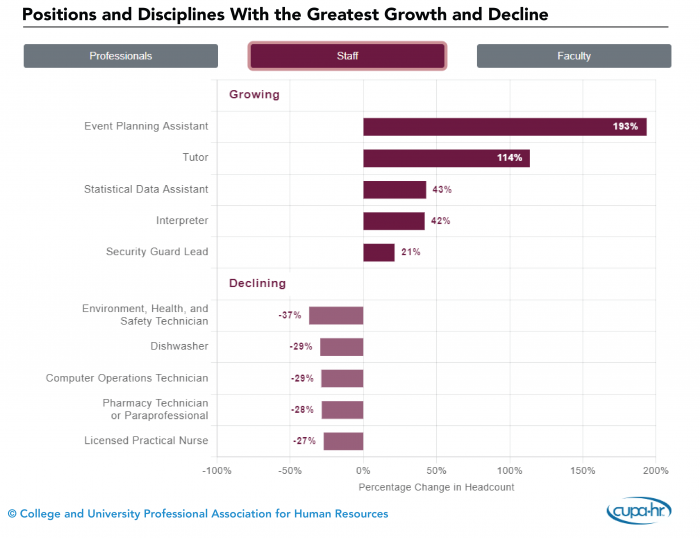
    According to data recently released by CUPA-HR, the higher ed workforce positions that saw the greatest growth from 2020-21 to 2021-22 were event planning assistant (up 193%), institutional research analyst (up 161%), head of campus museum (up 120%) and tutor (up 114%). These increases reflect an increase in the number of people hired to fill existing or newly created positions since 2020-21.

    The positions that saw the greatest decline in number of employees were environment, health and safety technician (down 37%), head of campus learning resources center (down 36%), online instruction operations manager (down 32%) and dishwasher (down 29%). These decreases reflect a decrease in the number of people in these positions since 2020-21, either because the institution has reduced the number of available positions or because those positions have unfilled vacancies.

    A new interactive graphic from CUPA-HR shows the Positions and Disciplines With the Highest Growth and Decline for higher ed professionals, staff and tenure-track faculty.

    The Ongoing Impact of COVID-19

    In many cases, the growth and decline in these positions over the past year reflect the impact of the COVID-19 recession that began in the spring of 2020. Like so many employers, institutions have experienced the effects of the Great Resignation and the subsequent challenges of talent recruitment amid the growing availability of remote and flexible work options.

    Other factors may also be at work. The return to in-person events, the growing demand for data to inform institutional decision-making, and the continued interest in honoring the cultural histories of institutions may have increased demand for the positions that saw the greatest increases. Also, as the high school graduates most impacted by the pandemic’s disruption of classroom learning make their way to college, more tutors may be needed to help them bridge anticipated gaps.

    Smaller Shifts in Faculty

    Overall, tenure-track faculty saw much smaller increases and declines in the years analyzed. Disciplines with the highest growth were Library Science (up 8.4%), Liberal Arts and Sciences (up 7.0%), and Area, Ethnic, Cultural, Gender and Group Studies (up 2.3%). Disciplines with the greatest declines were Communications Technologies (down 22%), Agriculture (down 9%) and Engineering Technologies and Technicians (down 6.4%).

    More About the Results

    The data for these results came from CUPA-HR’s annual Professionals in Higher Education Survey, Staff in Higher Education Survey and Faculty in Higher Education Survey. Analyses included more than 600 institutions that participated in each survey in both years of the comparison. For additional details, see the interactive graphic in the Research Center. These data and more are available through CUPA-HR’s DataOnDemand subscription service.


    Source link

  • How Did Your Local Grocery Store Pivot During the Pandemic?

    How Did Your Local Grocery Store Pivot During the Pandemic?

    One of my favorite grocery stores is H-E-B. Seriously, after our major grocery store in Carthage, Texas (a very rural area in East Texas) left a sizable gap in the strip center between Wal-Mart and Eckerd’s (CVS Pharmacy), we were pleased when H-E-B moved into the grocery store space that was vacant for 10+ years. It opened in the late 1990s and the city has shown their love for H-E-B since that time. It greatly contributes to the health of the region.

    One of my cousins works for H-E-B and she absolutely loves the company. Even when she travels, she is all about visiting the nearest H-E-B store. Talk about H-E-B-based travel, that is her favorite thing!

    H-E-B, like other stores, had to pivot during the pandemic. In fact, our local H-E-B store in Carthage, Texas was very proactive in implementing measures to keep their team members and shoppers safe. They enabled only a certain amount of people to enter the store at one time, etc.

    Earlier this month, I saw this amazing webinar focused on how the H-E-B organization reflected on how they changed procedures during the pandemic and other aspects of their store.

    So, take a BIG bite of this webinar and reflect in the comment box below about how your local grocery stores pivoted (or did not pivot) during the pandemic.

    Thanks for visiting! 

    Sincerely,

    Dr. Jennifer T. Edwards
    Professor of Communication

    Executive Director of the Texas Social Media Research Institute & Rural Communication Institute

    ***

    Check out my book – Retaining College Students Using Technology: A Guidebook for Student Affairs and Academic Affairs Professionals.

    Remember to order copies for your team as well!

    Source link