

Over the summer, Statistics Canda put out a few papers on higher education and immigration which got zero press but nevertheless are interesting enough that I thought you might all want to hear about them. Below are my précis:
The first paper, Recent trends in immigration from Canada to the United States by Feng Hou, Milly Yang and Yao Lu, is a very general look at outbound migration to the United States, looking specifically at the characteristics of Canadian citizens who applying for labour certification in the United States in 2015 and in 2024. I found the three top-line results all somewhat surprising.
- The number of US certification applicants declined by just over 25% between 2015 and 2024.
- Outbound migration to the US by Canadians is predominantly a “new” Canadian thing. In 2015, Canadian citizens born outside Canada made up 54% of those seeking certification, and by 2024 that proportion had increased to nearly 60%.
- Among Canadians seeking US certification in 2015, 41% had a master’s or doctoral degree. In 2024, that proportion had fallen to 31%.
In other words, brain drain to the US changed significantly over the space of a decade: fewer Canadians headed south, and among those who did, declining proportions were Canadian-born or held advance degrees. All somewhat surprising.
The second paper, Fields of study and occupations of immigrants who were international students in Canada before immigration by Youjin Choi and Li Xu, divides out two recent cohorts (2011-15 and 2016-21) of immigrants and starts to tease out various aspects of their current status in Canada. Here the key findings were:
- In the 2011-15 period, 13% of all immigrants were former international students. By the 2016-21 period, that number had risen to 23%.
- About a third of immigrants who were students in Canada say their highest degree was taken outside Canada. It’s a bit difficult to parse this. It may mean, for instance, that they obtained a bachelor’s degree in Canada, went to another country for their master’s degree and came back; it may also mean that they took a master’s degree abroad and took some kind of short post-graduate certificate here.
- A little over a third of all immigrants who studied in Canada have a STEM degree, a proportion that increased a tiny bit over time. This is higher than for the Canadian-born population, but not hugely different from that of immigrants who did not study here.
- A little under half of all former international STEM students in the immigrant pool were working in a STEM field, but this is strongly correlated with the level of education. Among sub-Bachelor’s graduates this proportion was a little over 20%, while among those with a Master’s degree or higher it was over 50%. This is significantly higher than it is for Canadian-born post-secondary graduates. In non-STEM fields, the relationship is reversed (i.e. Canadian-born graduates are more likely to be working in an aligned field).
In other words, former international students are a rising proportion of all immigrants, a high proportion are STEM graduates, and a high proportion of them go on to work in STEM fields. All signs that policy is pushing results in the intended direction.
The final paper, Retention of science, technology, engineering, mathematics and computer science graduates in Canada by Youjin Choi and Feng Hou, follows three cohorts of both domestic and international student graduates to see whether they stayed in the country (technically, it measures the proportion of graduates who file tax returns in Canada, which is a pretty good proxy for residency). The results are summed up in one incredibly ugly chart (seriously, why is StatsCan dataviz so awful?), which I reproduce below:
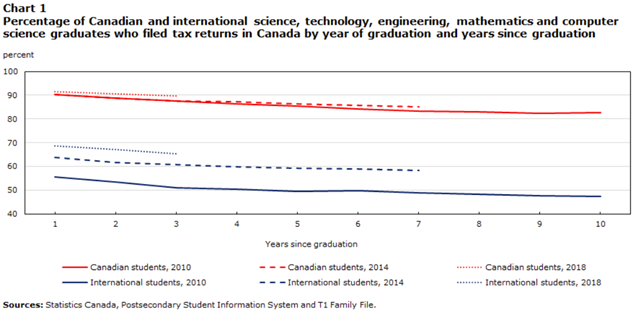
So, in the chart the Y-axis is the percentage of STEM graduates who stay in Canada (measured by the proxy of tax filing) and the X-axis is years since graduation. Since they are following three different cohorts of graduates, the lines don’t all extend to the same length (the earliest cohort could be followed for ten years, the middle for seven and the most recent for just three). The red set of lines represents outcomes for Canadian-born students and the blue set of lines does the same for international students.
So, the trivial things this graph shows are that: i) both Canadian and international students leave Canada but ii) international students do so more frequently and iii) leaving the country is something that happens gradually over time. The interesting thing it shows, though, is that the most recent cohort (class of 2018) of STEM graduates are more likely to stay than earlier ones, and that this is especially true for international students: the retention rate of international graduates from the class of 2018 was almost fifteen percentage points higher than for the class of 2015.
Was it a more welcoming economy? Maybe. But you’d have to think that our system of offering international students a path to citizenship had something to do with it too.
Two other nuggets in the paper:
- Canadian-born STEM graduates are slightly more likely to leave than non-STEM graduates (it’s not a huge difference, just a percentage point or two) while among international student graduates, those from STEM programs are substantially less likely to leave than those from non-STEM fields (a fifteen-point gap or more).
- Regardless of where they are from, and regardless of what they studied, graduates from “highly-ranked” universities (no definition given, unfortunately) were more likely to leave Canada, presumably because degree prestige confers a certain degree of mobility.
You are now fully up to date on the latest data on domestic and international graduates and their immigration pathways. Enjoy your day.