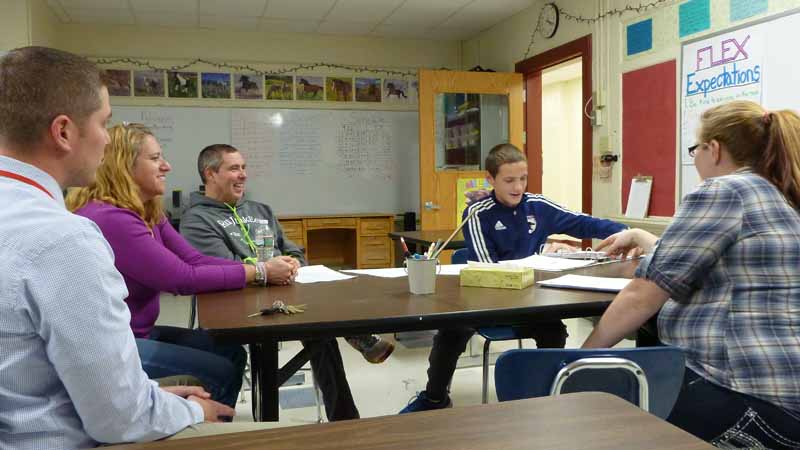
Across the country, Black fathers are too often seen as a threat when they speak up and advocate for their children. And it’s not just in courtrooms and on sidewalks — it’s happening in classrooms, daycares and schools.
I’ve spent my career in education and equity leadership, and I know this is part of a larger, troubling pattern. When Black parents — especially men — assert themselves in spaces not designed for them, they are too often perceived as “aggressive.”
Their advocacy is sometimes interpreted as “rude,” and their presence is framed as disruption rather than partnership, something that has played out in my own experience as a proud Black father of three.
This isn’t about one parent or teacher or even one moment. It’s about what happens when systems designed to support children carry embedded racial assumptions.
I’ll never forget picking my kids up from daycare during a lice outbreak. My wife and I had no experience dealing with lice, and I asked a few questions — just trying to understand what to expect. Instead of getting reassurance or guidance, I was met with suspicion, even subtle blame.
Or the time I raised a safety concern about an emotional child in my son’s class who had a pattern of throwing chairs. Rather than treating my concern as legitimate, it was brushed off — as if I were overreacting.
In both cases, my presence and voice weren’t welcomed. They were managed.
In a society in which Black men are still fighting to be seen as full participants in their children’s lives, we cannot ignore the role that bias plays in shaping who gets welcomed, who gets questioned and who gets believed. Daycares, schools, courts and society at large must actively affirm and restore the voices of Black fathers, rather than dismiss them.
Too often, Black men are portrayed as threats or criminals — rather than as nurturers and protectors. These images become mentally entrenched, shaping public attitudes and institutional responses. This persistent framing contributes to a cultural blind spot that brings confusion to the presence of Black fathers and negatively affects how they are treated in schools, courts and communities.
Despite this anti-Black bias, Black fathers defy stereotypes every day. Black dads, on average, are actually more involved in daily caregiving than fathers of other racial backgrounds, the National Health Statistics Reports from the Centers for Disease Control and Prevention notes. Yet media representation has not caught up with this reality.
As a student pursuing a doctorate in education leadership and policy, I study how identity shapes access to opportunity. And I know that bias against Black men starts early — when we are boys. A 2016 Yale Child Study Center report found that preschool teachers, regardless of race, were more likely to monitor Black boys for misbehavior — even when no misbehavior was apparent.
And in Indiana, studies highlight that nearly four out of every five Black children in the state will be investigated for suspected maltreatment.
These are not just statistical disparities — they’re stories of fractured trust between families and the institutions meant to serve them.
I have explored the concept of “mega-threats” introduced by researchers Angelica Leigh and Shimul Melwani — high-profile, identity-relevant events that trigger lasting psychological stress for people who share that identity. Though typically used to describe major public tragedies, these threats can be individual and personal, too. When a Black father sees himself reduced to a stereotype — his parenting undercut, his words distorted — it becomes an embodied threat, one that lingers and works to fulfill the myth that Black fathers are absent. These corrosive interactions run counter to the heroic influence and legacy that Black men have within their communities as warm demanders — men who emphatically build relationships and uphold high expectations.
If we want to support children, we must support their families. That means ensuring that early childhood professionals are trained not just in child development but in cultural competence and anti-bias practices. It means separating assumptions from observations when writing reports.
And it means reflecting on how language like “rude” or “aggressive” can carry racial undertones that reinforce long-standing stereotypes.
In my work as an educator, leader and former coach, I’ve partnered with countless families across race and class lines. What all parents want — especially those from marginalized communities — is the assurance that when they show up, they’ll be heard, not judged. That their questions will be met with respect, not suspicion.
If we truly believe in family engagement, we must be honest about the ways our systems still punish the very people we say we want more of. Black fathers are showing up.
The question is: are we ready to see them clearly?
Craig Jordan is an educator and doctoral student at Vanderbilt University’s Peabody College. A native of Gary, Indiana, he writes about equity, identity and systemic change in education. His work has been featured in IndyStar and Yahoo News.
This story about Black fathers was produced by The Hechinger Report, a nonprofit, independent news organization focused on inequality and innovation in education. Sign up for Hechinger’s weekly newsletter.
The Hechinger Report provides in-depth, fact-based, unbiased reporting on education that is free to all readers. But that doesn’t mean it’s free to produce. Our work keeps educators and the public informed about pressing issues at schools and on campuses throughout the country. We tell the whole story, even when the details are inconvenient. Help us keep doing that.
Six out of 10 parents hope their child will attend college, according to a new survey by Gallup and the Lumina Foundation.
The survey, conducted in June, comes out at a time when the value of a college degree is the subject of public debate.
“We hear all this skepticism of higher education,” said Courtney Brown, vice president of impact and planning for the Lumina Foundation, which advocates for opportunities for learning beyond high school available to all. “We hear the narrative that people don’t value it.”
Just last month, the results of a Gallup poll showed that confidence in higher education among Americans has been falling over the last decade.
But the results of actually asking what parents want for their own children, Brown said, are striking. This is the first survey that Gallup has specifically asked parents for their views on the topic.
“When it comes down to it, it’s pretty clear that parents hope their children get a college degree,” Brown said.
Brown has found that parents’ biggest concerns about higher education tend to be the cost, whether it leads to a job, or increasingly, whether it is political.
This may explain why community colleges were a popular option among parents who responded. Community colleges tend to have a much lower sticker price than four-year colleges, and there is a greater emphasis on job credentials. Roughly 1 out of 5 parents of varying backgrounds said that they would like to see their child enroll at a community college.
But there were some notable differences in the survey among parents, depending on their own level of education, but especially their political orientation.
The strongest narratives against higher education come from the Republican Party. That is reflected in the responses, Brown noted.
Greater differences emerged around whether students should enroll in a four-year college immediately after high school; 58% of college graduates and 53% of Democrats preferred sending their children straight to a four-year college, compared to 27% of Republicans and 30% of parents without a college degree.
Republicans are more likely to say that their children should go straight into the workforce or job training or certification, followed by independents and those without a college degree. Other options include taking time off or joining the military.
But overall, 4 out of 10 parents want to see their child attend a four-year college or university, making it the most popular option by far. This is something that comes up repeatedly in surveys about higher education.
“We see that people value four-year [degrees],” Brown said. “We see that people have trouble accessing it and have some concerns about the system, but they do greatly value it.”
The survey also measured the preferences of non-parents. It asked respondents to think about a child in their life, whether a nephew or niece, grandchild or family friend under 18 who has not graduated from high school. Responses were remarkably similar: 55% said they wanted this child to attend either a four-year or two-year college, compared to 59% of parents.
HEPI Director, Nick Hillman OBE, takes a look at why today’s landmark report on student maintenancefrom HEPI, TechnologyOne and the Centre for Research in Social Policyat Loughborough Universityis so important.
Later today, HEPI will be hosting a free webinar with UCAS on this year’s admissions round – see here for details and to register for a free place.
A recent Wonkhe article by Will Yates of Public First noted, ‘It really was not that long ago that maintenance grants were the norm and student life was cheap and cheerful.’ We probably all know what he means.
When I went to the University of Manchester 35 years ago, I had no tuition fees and got to collect a grant cheque even though my parents were in secure middle-class jobs. Since then, life has become harder financially for students. Costs have gone up and grants have disappeared (in England). Meanwhile, the student body has diversified to include more people from disadvantaged backgrounds.
As if battling with the impact of COVID on their secondary schooling was not enough, today’s students face big financial obstacles. During my nine years as a Trustee of the University of Manchester (which sadly came to an end last month), I regularly ascended those same stairs I used to climb to collect my physical grant cheque in order to attend Board meetings at which we would discuss student poverty and its impact.
Will Yates’s conclusion needs qualifying of course. Just as it is true that there are today many poor pensioners alongside all the well-off ones who have cleaned up thanks to intergenerational inequities, so there have always been some students who struggled to survive on the maintenance support they received. I recently stumbled across the following exchange in Hansard from 1969, for example, on whether parents were making up the income of their student offspring in the way they have long been supposed to:
Mrs. Shirley Williams:I appreciate that students who do not receive the full parental contribution often suffer hardship. My Department recently wrote to local education authorities asking them to ensure that parents were made aware of the importance of making up the student’s grant. But I do not think it would be desirable or practicable to impose a legal obligation on parents to make their contributions. (Source: Hansard, 30 January 1969)
Plus ça change… Aside from the reference to local education authorities (which no longer have a role in student maintenance), the answer could have come from pretty much any one of the last seven decades.
These issues are topical in part because the threshold at which parents are expected to start contributing to their adult student offspring’s living costs has not increased for over 15 years – it was set at £25,000 for England by Gordon Brown (six Prime Ministers ago…). So parents in English households on just over £25,000 a year are expected to cough up – the situation is even worse elsewhere (just over £19,000 in Northern Ireland).
The recent HEPI / Advance HE Student Academic Experience Surveyshows over two-thirds of full-time undergraduates now do paid work during term time, and often at a dangerous number of hours (‘dangerous’ in the sense of impacting their academic work). So what has changed is the proportion of students who feel wickedly under-resourced financially.
The biggest lie told about students today is that they are pathetic ‘snowflakes’ who melt on contact with real life; in fact, when financially challenged, they tend to confront the problem head on by going out and finding paid work. Norman Tebbit would have been proud.
While my generation of students were debating or politicking or going to gigs, today’s students are more often serving those who do have the money to go out. In the UPP Foundation / Public First research that Will Yates was writing about, the students said they thought ‘it was them (rather than the university, the government, the OfS or any other body) who took responsibility for ensuring that they could afford to study and socialise.’
In my view, one of the very best projects we do at HEPI is the HEPI / TechnologyOne Minimum Income Standard. This is completely different to the student money surveys that ask students what their income is and how they spend it. Those are useful but only up to a point because what if the income is not enough? Knowing I have X pounds and spend X pounds is only of modest value if I actually need 2X pounds in order to afford the bus to campus, join my favourite student society and buy personal healthcare items (on this, see HEPI’s recent report by Rose Stephenson on menstruation and learning).
So the Minimum Income Standard starts with a blank sheet of paper plus a tried-and-tested methodology developed by the Centre for Research in Social Policy at Loughborough University to consider how much students really need to live with dignity – the calculation is not for a plush lifestyle nor a monastic one, but rather for a fairly basic-but-safe one and is based on the extensive experience of the research team as well as detailed focus groups with multiple students around the UK.
This year, the second such study dwells upon first-year students in Purpose-Built Student Accommodation (university halls and privately-owned student accommodation blocks). So it supplements last year’s study of second and third-years in shared ‘off-street’ housing. (In my view, it should really be called ‘on-street’ housing as it tends to be on normal residential streets, but I digress.)
While TechnologyOne have generously funded this vitally important work, I must stress that neither they nor HEPI have had any editorial control over the core central numbers, which are entirely Loughborough’s work and based on what students have told them. HEPI’s input has included feeding in supplementary figures for accommodation costs , with the help of Student Crowd and Students, and thinking through the possible policy consequences of the research.
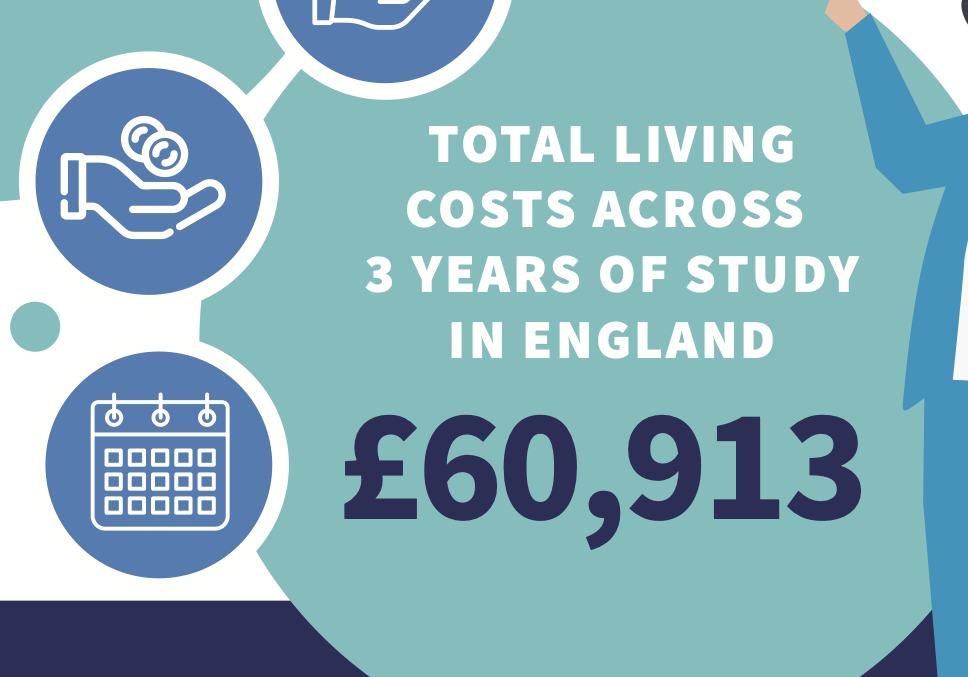
The top-level finding is that first-year students living in halls need £418 a week – over £20,000 a year and double the maximum maintenance support package in England. Even if a student (in England, living away from home and studying outside London) is in receipt of the maximum maintenance loan, they need to work 20 hours a week throughout the year to earn enough money to hit the Minimum Income Standard. Remember, these are people on full-time courses. As a society, we are now expecting people to do full-time study and half-time paid work and then we wonder why young students struggle to feel a sense of belonging to their institution…
People should look carefully at the methodology and conclusions to see if they agree with them. As a think tank, our job is to make people think; we can identify the main challenges and propose solutions but we are not a lobby group, so we would never claim we have all the answers. There may be elements of the Minimum Income Standard for Students that people want to pore over, challenge and improve.
Some of the issues people may want to consider on the back of the MISS include:
As the report makes clear, student life is generally a temporary phase that lasts no more than three or four years. So is it reasonable to apply the same methodology as is used for defining the basic minimum income for someone in work or in retirement? It is valid, in my view, because three years still represents a substantial proportion of a young person’s life up to that point and undergraduate study is often the first period of real independence for people – plus some other phases of life for which the minimum income methodology has been applied are also not always very long term. For example, someone on a ‘living wage’ is likely to hope to rise above it in due course as they gain experience. Besides, in one sense, no phase of life is permanent.
A second important question is whether letting students define their own minimum standard of living via focus groups will always tend towards larger monetary sums. The Minimum Income Standard for Students assumes students are likely to have gym membership, a short UK holiday and other costs (like wireless headphones, a modest alcohol budget and food for takeaways) that some people may deem to be non-essentials or at least not things that should be subsidised by taxpayer-funded income-contingent student loans (though, on the other hand, we only include very small sums for study-related costs). The MISS also includes some costs than some people might deem relevant only to a minority of students (such as paying to store items between terms). But the MISS is about having enough money for every student to live reasonably, with dignity and safety; it is not designed to be a ‘bare minimum’ or to represent the lifestyle of an ascetic. This is one of a number of reasons, further explored below, why we studiously avoid ever saying we think the Government should automatically set the maximum maintenance package at exactly (or even roughly) the level of the MISS. Moreover, students are not spendthrift – one interesting change this year compared to last, for example, is that they no longer deem a TV Licence as a must-have item so it has been removed from the calculation.
What we call a ‘minimum’ is also an ’average’; some cities are notably more expensive than others – London aside, we generally ignore this in the calculation and so the MISS might look too high or too low depending on where someone is studying and their own personal circumstances. For example, this means some of the freebies – such as prescriptions and bus travel – enjoyed by many Scottish students are ignored.
Should we be looking to reduce costs by giving applicants and students better information? A modest amount of the first-year premium (the extra costs that first-years seem to accrue) comes from being unused to budgeting and feeding themselves. The MISS for first-year students even includes a small additional sum for the first 12 weeks while students settle down and get used to things like eating up food before it goes off. Would better information of the students are crying out for fix at least some of the need for this? Similarly, would better information on the different consequences of different accommodation preferences shape better decisions, which in turn could shape the supply of student accommodation, and lead to a reduction in the MISS?
One particular policy challenge is explaining how any extra student maintenance support that could be offered now or later is likely to be spent in practice. Ministers will be less likely to give students improved maintenance packages if they think they will be entirely swallowed up by higher rent levels. One real challenge here, as so often, is that student accommodation tends to fall through the cracks in Whitehall, so it is not always clear who should be approached for these conversations.
Above all, HEPI is a policy body so for us the key question is always: what are the possible policy ramifications? On this, and notwithstanding the important fact that the report gives a clear indication of a preferred direction of travel, we are still working them out.
For example, the report concludes that the maximum maintenance package is only half of what students need to live. It clearly needs to be higher and available to more people. It would be absurd (literally absurd) to think parents could easily fill in the gap from their take-home pay unless they are on very good salaries indeed. It is similarly absurd, however, to think the Government can easily fill the whole gap, given the fiscal situation and the much larger number of students than in the past.
So what level of paid employment is it reasonable to assume students might do (and in holidays or term-time or both)? Or should students opt for a more basic standard of living (no en suite perhaps or more shared rooms, as in the United States)? Or should more students live at home as commuter students but at the cost of experiencing a full traditional student experience? These are difficult questions and, again, the answers will be different in different cases. Nonetheless, we welcome all thoughts in response.
As I sometimes say when speaking in schools, if and when it comes to my own children going to higher education, I will tell them three things:
good social spaces are more important than things like en suite facilities – if you are living a full student lifestyle, you may spend less time in your room than you originally expected;
taking a temporary full-time job in the holidays is generally preferable to doing a high number of hours of paid employment during term time, if you’re lucky enough to have the choice; and
in general, it tends to be better not to be a commuter student, unless there are specific individual reasons for being one.
Yet like most parents, I will also have to accept they will take what I say with a large pinch of salt and then find their own way.
(Note: This is the second piece in a two-part series on absenteeism in schools. Read the first part, on seven insights from researchers.)
Chronic absenteeism, when students miss 10 percent or more of the school year, is 50 percent higher across the nation than before the pandemic. Researchers say it’s difficult for schools to address the problem because it is both so intense,with students missing huge chunks of the school year, and so extensive, affecting both rich and poor students and even high achievers.And the reasons vary widely, from asthma and bullying to transportation problems and the feeling that school is boring.
“It’s hard to know where and when to target resources,” said Sam Hollon, a data analyst at the American Enterprise Institute, which hosted a symposium on the problem in May. “Who do you help when every student potentially can be a candidate for help?”
Related: Our free weekly newsletter alerts you to what research says about schools and classrooms.
The Trump administration’s immigration enforcement is exacerbating the problem. A June draft paper by Stanford University professor Thomas Dee calculated that recent raids coincided with a 22 percent increase in daily student absences with particularly large increases in absenteeism among the youngest students.
Talking about the problem isn’t enough. Researchers say they want to study more schools that are making headway. It remains unclear if there are broadly applicablefixesor if each school or eveneach student needs individual solutions. Some underlying root causes for skipping school are more complex than others, requiring psychotherapy or housing assistance, which schools can’t provide alone. Here are a few examples of how very different communities are tackling the problem.
Providence: Bus stops and weekend food bags
Principal W. Jackson Reilly of Nathanael Greene Middle School in Providence, Rhode Island, said that when he arrived in April 2023, half of his 900 students in grades six to eight were chronically absent, up from 30 percent of students before the pandemic. Thirty percent of his teachers were also chronically absent. Achievement scores were in the state’s bottom 1 percent.
Reilly managed to slash his chronic absenteeism rate in half to 25 percent this past 2024-25 year. That’s still high. One in four students missed more than 18 days of school a year. But, it’s better.
He began by identifying 150 kids who were just over the threshold for chronic absenteeism, those who missed between 18 and 35 days, hoping that these kids would be easier to lure back to school than those who were more disengaged. Reilly and a group of administrators and guidance counselors each took 10 to 15 students and showed their families how much school they had missed and how low their grades were. His team asked, “What do you need in order for your kid to be coming to school?’”
The two most common replies: transportation and food.
Many students lived only a mile away, too close to school to qualify for bus service. Yet the walk deterred many, especially if it was raining or snowing. Yellow buses often passed these children’s homes as they were transporting children who lived farther out, and Reilly convinced the district to add stops for these chronically absent children.
Ninety percent of his students come from families who are poor enough to qualify for the federal free or reduced-price lunch program and 80 percent are Hispanic. Although many children were fed breakfast and lunch at school, their families admitted that their kids would get so hungry over the weekend that they didn’t want to wake up and come to school on Mondays. Reilly partnered with a food pantry and sent bags of meat and pasta home with students on Fridays.
Individual attention also helped. At the start of each school day, Reilly and his team check in with their assigned students. Kids who show up get five “green bucks” to spend on snacks and prizes. Administrators call the homes of those who didn’t come to school. “If they did not answer the phone, we’d make a home visit,” said Reilly.
The most dramatic overhaul was scheduling. Reilly scrapped individual schedules for students and assigned four teachers to every 104 students. The kids now move in pods of 26 that take all their classes together, rotating through the same four teachers throughout the day. The classrooms are right near each other, creating a smaller community within the school.
“It’s all about relationship building,” said Reilly. When students look forward to seeing their classmates and teachers, he said, they’re more motivated to come to school.
Researchers say fostering relationships is effective. Hedy Chang, executive director of Attendance Works, a nonprofit organization that advises schools on how to boost attendance rates, said it’s still a battle to persuade some school leaders (and school board members) that making school a more welcoming place is more productive than punishing kids and families for skipping school.*
Reilly said his school now posts the lowest student and teacher chronic absenteeism rates in Providence. And he said his school is the highest performing middle school in the city and among the highest statewide in reading.
New York City: Catching the butterflies
A cluster of New York City high schools are taking a more data-driven approach, guided by New Visions, a consulting organization that supports 71 city high schools.
After some experimentation, New Visions staff saw strong improvement in attendance in one subgroup of students who were on the cusp of missing 10 percent of school days, but had not yet crossed the chronic absenteeism threshold. These are students who might miss a day or two every week or every other week but were relatively engaged at school. Jonathan Green, a New Visions school improvement coach who is spearheading this effort, calls them “butterflies.” “They would flutter in and out every week,” he said.
Green suggested that someone at school meet weekly with these butterflies and show them their attendance data, set goals for the coming week and explain how their attendance was leading to better grades. The intervention took two to five minutes. “There were marked changes in attendance,” said Green.
New Visions built a website where school administrators could print out two-page documents for each student so the data, including monthly attendance and tardiness, appeared in an easy-to-digest format. The quick meetings took place for eight to 10 weeks during the final grading period for the semester. “That’s when there’s the most opportunity to turn those potentially failing grades into passing grades,” said Green. “We were finding these sweet spots within the school calendar to do this very high resource, high-energy intensive weekly check-in. It’s not something that anyone can easily scale across a school.”
Staff had to figure out the bell schedule for each child and intercept them between classes. One succeeded in holding their entire caseload of students below the chronic absenteeism threshold. Not everyone thought it was a good idea: Some school administrators questioned why so much effort should go into students who weren’t yet chronically absent rather than students in greater trouble.
The dramatic results help answer that question. Among schools in the Bronx that volunteered to participate in the butterfly intervention, chronic absenteeism rates dropped 15 percentage points from 47 percent in 2021 to 32 percent in 2025, still high. But other Bronx high schools in the New Visions network that didn’t try this butterfly intervention still had a chronic absenteeism rate of 46 percent.
Green said this solution wouldn’t work for other high schoolers. Some have trouble organizing their study time, he said, and need more intensive help from teachers. “Two- to five-minute check-ins aren’t going to help them,” said Green.
Indianapolis: Biscuits and gravy
The leader of an Indiana charter school told me he used a system of rewards and punishments that reduced the chronic absenteeism rate among his kindergarten through eighth graders from 64 percent in 2021-22 to 10 percent in 2024-25.
Jordan Habayeb, the chief operating officer of Adelante Schools, said he used federal funds for the school breakfast and lunch program to create a made-from-scratch restaurant-style cafeteria. “Fun fact: On homemade biscuit and gravy days, we saw the lowest rates of tardies,” he said.
Researchers recommend avoiding punishment because it doesn’t bring students back to school. But Habayeb said he adheres strictly to state law that requires schools to report 10 absences to the state Department of Child Services and to file a report with the county prosecutor. Habayeb told me his school accounted for a fifth of truancy referrals to the county prosecutor.
The school created an automated warning system after five absences rather than waiting for the critical 10-day loss. And Habayeb said he dispatched the safety and attendance officer in a van to have “real conversations with families rather than being buried in paperwork.” Meanwhile, students who did show up received a constant stream of rewards, from locker decorations to T-shirts.
Parent education was also important. During mandatory family orientations, the school illustrated how regular attendance matters for even young children. “We shared what a child might miss during a three-day stretch in a unit on ‘Charlotte’s Web’ — showing how easily a student could leave with a completely different understanding of the book,” said Habayeb. “This helped shift perspectives and brought urgency to the issue.”
Kansas City: Candy and notes
School leaders in Kansas City, Kansas, shared some tips that have worked for them during a webinar earlier this month hosted by Attendance Works. One elementary school reduced its chronic absenteeism from 55 percent in 2021 to 38 percent in 2024 by assigning all 300 students to an adult in the building, encouraging them to build an “authentic” relationship. Teachers were given a list of ideas but were free to do what seemed natural. One teacher left candy and notes on their assigned students’ desks. A preschoolerproudly pasted his note, which said he was a “genius,” on the front door of his house. “The smiles kids have on their faces are amazing,” said Zaneta Boles, the principal of Silver City Elementary School.
When students do miss school, Boles said educators try to take a “non-blaming approach” so that families are more likely to divulge what is going on. That helps the school refer them to other community agencies for assistance.
Albuquerque: A shining example regroups
Alamosa Elementary School in Albuquerque, New Mexico, was once a shining example of a school that persuaded more families to send their kids to class. Chronic absenteeism fell as low as 1 in 4 students in 2018, when The Hechinger Report wrote about the school.
But Alamosa has not been immune from the surge of absenteeism that has plagued schools around the nation. Chronic absenteeism spiked to 64 percent of students during the 2021-22 school year, when Covid variants were still circulating. And it remained shockingly high with 38 percent of students missing more than 10 percent of the 2024-25 school year — exactly matching the 50 percent increase in chronic absenteeism across the country since 2019.
“We were on a roll. Then life happened,” said Daphne Strader, Albuquerque Public Schools’ director of coordinated school health, who works to reduce absenteeism.
Strader said Alamosa and other Albuquerque schools have made some successful changes to how they’re tackling the problem. But the volume of absenteeism remains overwhelming. “There’s so many kids who have needs,” Strader said. “We need more staff on board.”
Strader said attendance interventions had been “too siloed” and they’re focusing more on the “whole child.” She’s encouraging schools to integrate attendance efforts with other initiatives to boost academic achievement and improve student behavior. “Students are hungry, they’re dysregulated, they don’t have grit,” said Strader, and all of these issues are contributing to absenteeism. But she also concedes that some students have more severe needs, and it’s unclear who in the system can address them.
Her biggest advice for schools is to focus on relationships. “Relationships drive everything,” said Strader. “One of the major consequences of the pandemic was the isolation. If I feel a sense of belonging, I’m more likely to come to school.”
*Clarification: This sentence was modified to make clear the Attendance Worksexecutive director did not say all school leaders oppose the idea of eliminating punishments for absenteeism.
The Hechinger Report provides in-depth, fact-based, unbiased reporting on education that is free to all readers. But that doesn’t mean it’s free to produce. Our work keeps educators and the public informed about pressing issues at schools and on campuses throughout the country. We tell the whole story, even when the details are inconvenient. Help us keep doing that.
This audio is auto-generated. Please let us know if you have feedback.
At LEAP Academy University School — a K-12 public charter school in Camden, N.J. — parents are required to volunteer at the school for 40 hours over the academic year.
School officials say volunteer engagement builds strong home-school connections and helps LEAP — which stands for Leadership, Education and Partnership — better understand and respond to parents’ needs. Parents, meanwhile, say volunteering gives them more voice and authority in school activities and helps build trust among the school community.
“The child sees that the parent trusts the school, and the parent is learning from the school and getting resources from the school,” says Cheree Coleman, a parent of rising 8th and 9th graders. “So now the student looks at the school like, ‘This is family. This is a place that I can go if I can’t get help from my parents or, you know, other resources.’ It’s stability.”
The school works with families to try to ensure the 40-hour requirement is not burdensome. Maria Cruz, director of LEAP’s Parent Engagement Center, says school leaders work with each family to find ways for them to help out within their own schedules or situations. Students’ relatives can also contribute to the families’ volunteer hours.
Volunteer hours can be gained by participating in any event at the 1,560-student school, including reading to students, planning special events, fundraising, attending parent workshops, serving on committees, sending emails to school groups, or any other activity that supports school efforts.
Cruz adds that while the school tracks the volunteer hours, no student would lose their spot if their family failed to meet the 40 hours.
“We work with them” to fill the hours, Cruz says. “We don’t tell them that the volunteer hours are mandatory. The word ‘mandatory’ is kind of like a negative term for them, so we don’t use it. We talk to them, let them know that the reason why we’re doing the volunteer hours is so they can be engaged in the school.”
The school, founded in 1997, has a long history of parent engagement, says Stephanie Weaver-Rogers, LEAP’s chief operation officer. “We opened based on parent needs so parents have always been integral and we are very focused on having parents involved in every aspect of the school.”
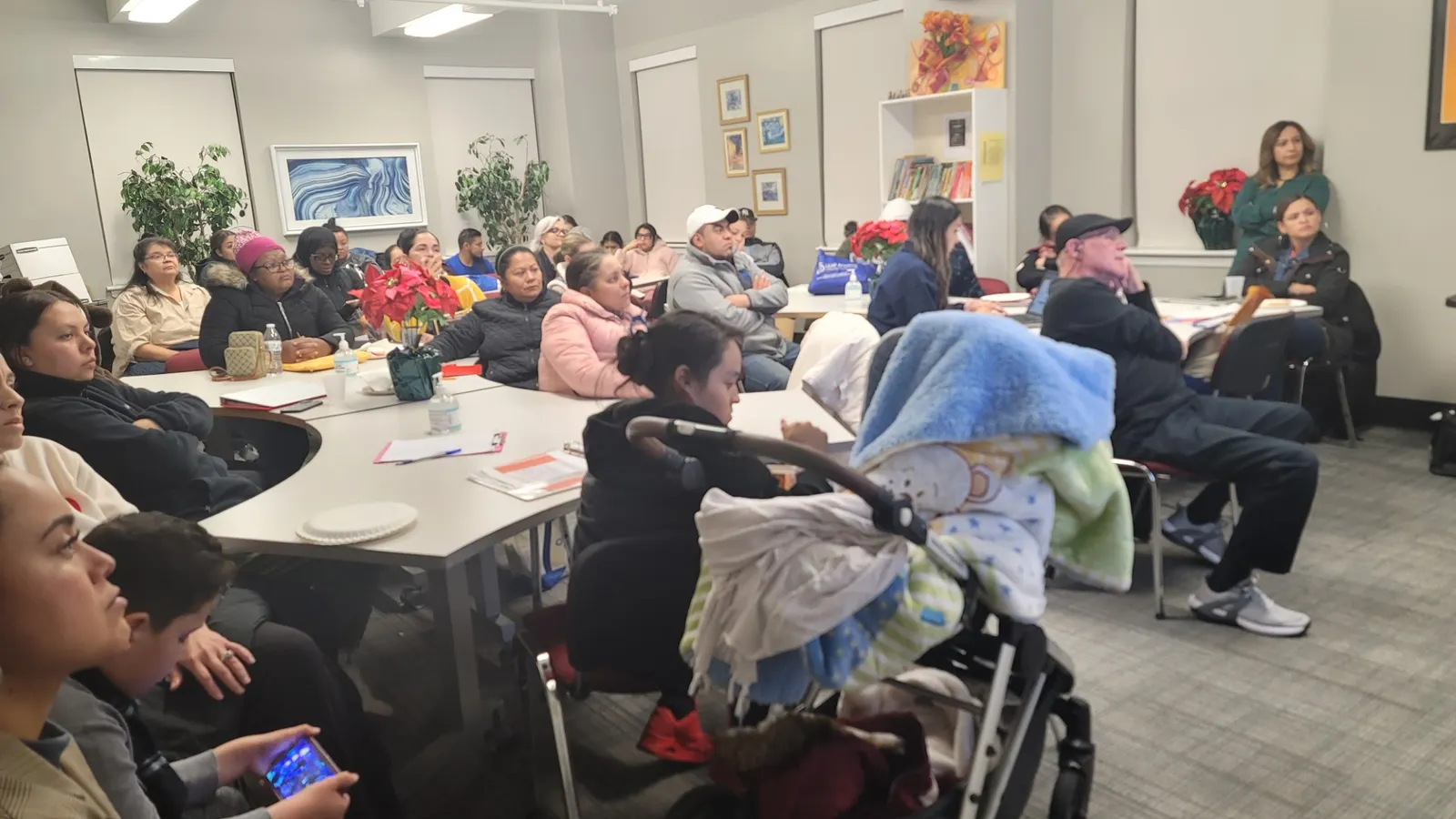
Parents attend a workshop on special education topics at LEAP Academy University School in Camden, N.J. in May 2025.
Permission granted by LEAP Academy University School
Educating students and parents
In addition to volunteering, the school engages parents through workshops specifically for them. Held weekly at the school, these optional parent workshops offer learning on a variety of topics and skills, such as homeownership, English language, employment, nutrition and technology.
Along with the free classes, parents get dinner, child care and parking also at no charge, Cruz says. She and other school staff work to recruit experts in the community — including other parents — to lead the classes.
The skills-based classes help parents “move forward” in their lives “and also help them better themselves for their children,” Weaver-Rogers says.
To further parent engagement efforts, the school encourages parents to apply for open positions, but Cruz noted that hires are made based on skills, experience and job fit. Currently, approximately 10-15% of LEAP staff are parents of current or former students.
Having parents on staff has several benefits, Weaver-Rogers said. It can give parents “a step up economically.” Plus, students behave better knowing their parents or their friends’ parents are in the building.
“It’s an all-around win,” Weaver-Rogers says.
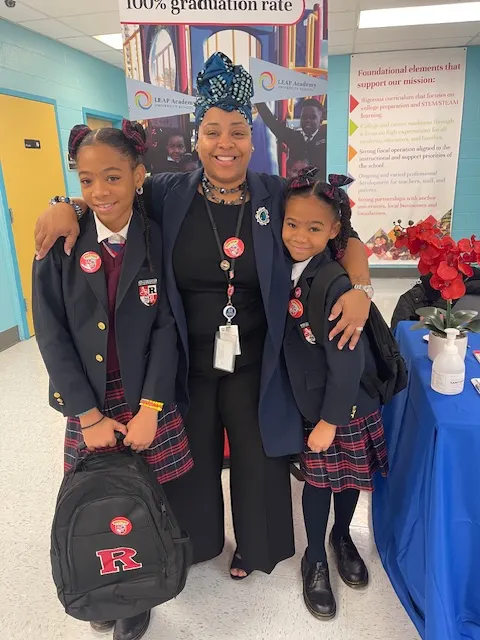
Cheree Coleman and her daughters Cy’Lah Coleman (left) and Ca’Layla Coleman attend a school ceremony on May 29, 2024, at LEAP Academy University School in Camden, N.J.
Permission granted by Cheree Coleman
Coleman, who worked at the school as a parent ambassador for three years, adds, “What I love the most when it comes to the parent engagement with LEAP Academy is the fact that they don’t just educate the student, they educate the parents as well.”
Being engaged in the community
The home-school connections at LEAP don’t end at graduation. The school, which has four buildings within two blocks, makes efforts to stay in touch with and support alumni through job awareness efforts, networking opportunities and resources for struggling families.
Coleman says LEAP staff and families have also supported students and families in need at other schools in the community.
The school opens its doors to the public for certain school events and celebrations — for instance, with community organizations and government service providers setting up information tables, Cruz says.
Hector Nieves, a member of the school’s board of trustees and chair of the parent affairs committee, says parents are encouraged to bring friends, neighbors and family to some school get-togethers, especially those held outside to accommodate larger crowds. “We have music. We have all kinds of games for the kids. There’s dancing,” he says.
Cruz added that this “all are welcome” approach helps the school recruit new students, too.
The whole school community participates in LEAP Academy University School’s holiday fundraiser, last held Dec. 5-14, 2024, at the school in Camden, N.J.
Permission granted by LEAP Academy University School
Additionally, LEAP’s partnership with Rutgers University provides support to families for their children from birth through postsecondary education. LEAP is located along Camden’s “Education Corridor,” which includes campuses for Rutgers University-Camden and Rowan University. Both Rutgers and Rowan provide dual enrollment, early college access and other learning opportunities for LEAP students.
Nieves, who had three children graduate from LEAP — including one who now teaches English at the school — says the holistic approach of serving students and families has empowered the school community over the years and helped families improve their financial situations.
“I believe that somehow, whether they came and worked here, we gave them classes, we helped them along, all of a sudden, I see this growth,” says Nieves. “I believe we had a lot to do with that.”
Forty percent of parents prefer their child attend a four-year college after high school.
Despite public skepticism about the value of a college degree, the majority of parents still want their kids to pursue more education after high school, according to a report from Gallup and the Lumina Foundation published today.
During the first two weeks of June, researchers surveyed more than 2,000 adults—including 554 parents of children under 18—about what they thought their own children or the children in their lives should do after high school. Though there was some variation depending on political party affiliation and level of educational attainment, three-quarters of parents over all say they want their children to continue their education.
“Even in this moment of skepticism around higher ed, the pull of college is still powerful for families,” Courtney Brown, Lumina’s vice president of impact and planning, told Inside Higher Ed. “The distinction is between their critiques of the system and their personal aspirations. They see there are some cracks in the system—that it’s not always affordable—and they want to make sure that if they’re going to pay for college that their child is going to see a return on investment.”
Parents had a clear preference for the type of institution their child should attend, with 40 percent of respondents indicating that their first choice would be a four-year university.
That aligns with robust data on the ROI of different degree types showing that people with bachelor’s degrees have far higher lifetime earnings and are half as likely to be unemployed than their peers with only a high school diploma.
However, not every family is convinced that a four-year degree is the best option for their child.
Another 19 percent of the parents surveyed by Gallup and Lumina said they’d prefer a two-year college and 16 percent a job training or certification program. Just 24 percent said they’d prefer their child forgo higher education altogether after high school and instead take a gap year (13 percent) join the military (5 percent) or immediately join the workforce (6 percent).
Differences in party affiliation also shaped which type of institution parents believe their kids should attend after high school. More than half (53 percent) of Democratic parents said they’d prefer their child go to a four-year college, while just a quarter of Republicans said the same; 21 percent of Republican parents said they’d prefer their child enroll at a two-year college after high school, and 22 percent said they’d prefer a job training or certificate program.
“Across the board, everyone believes you need more education after high school. But what we’re seeing now is Republicans wanting a quicker payoff for their education, and often a certification or a two-year degree leads directly to a job where they’re using those skills,” Brown said. “But that can be shortsighted when a job ends and a [worker] needs to get upskilled or reskilled.”
A four-year college education was also the preferred choice for parents with and without a college degree, though there was a considerable gap. While 58 percent of college graduates said a four-year program was their top choice for their child, only 30 percent of non–college graduates said the same.
“Parents still see that a four-year degree is the dream. It’s the degree that opens the most opportunity to getting paid more,” Brown said. “People that have gone to college see that it has paid off, whereas people who haven’t had that opportunity may feel closed out from and are uncertain that it’s going to lead to the money and jobs they’re looking for.”
The survey also asked adults without a child under 18 the same questions about what they would want a child they know—such as a nephew, niece, grandchild or family friend—to pursue after high school.
Similar to the parents surveyed, 32 percent of nonparents said they’d like to see the young people in their lives pursue a four-year degree, while 23 percent favored a two-year program and another 23 percent favored job training or a certificate program.
Last August, Republican Rep. Gino Bulso looked out at a room filled with dozens of fellow state lawmakers as he touted new legislation he had just helped become a reality in Tennessee. Under the law, a fetal ultrasound or a video of a computer-animated fetus developing in the womb had become mandatory viewing for students in the state’s sex education classes.
Bulso was there at the request of the event’s host, anti-abortion advocacy nonprofit Live Action. The group had gathered legislators from across the country to provide them “with the policy information and persuasion strategies they need to end abortion,” according to its annual report.
Bulso’s panel, “The Agenda for Life in Schools and Beyond,” focused on how he had successfully shepherded his bill into becoming the second so-called fetal development education law in the country.
When lawmakers returned to their home states after the Live Action event, The Hechinger Report found, at least 10 of them sponsored bills similar to Bulso’s, in some cases proposing that students as young as third grade watch fetal development videos. Another legislator who introduced such a bill had sent his chief of staff and wife to the event. And the volume of legislation stemming from the gathering may be higher: Live Action keeps its list of attendees private, though many lawmakers posted about the event on social media or were featured in Live Action’s promotional materials.
Since 2023, when North Dakota became the first state to pass fetal development education legislation, anti-abortion lawmakers in more than 20 additional states have proposed such bills; 6 of those states, including Bulso’s, have passed them. As a result, this fall, nearly 4 million children will attend school in a state that requires them to watch a video or ultrasound of a fetus in the womb during sex education classes. And this year, legislators in four states tried to go even further: Their proposals would have required students to view depictions of abortions, including computer-animated videos.
After the fall of Roe v. Wade in 2022, public schools have become an increasingly important battleground in the fight over abortion rights. Even though 12 states now ban abortion in all circumstances, the number of procedures has increased nationwide since the Supreme Court’s decision to overturn Roe.Public support for abortion rights has also risen. Many anti-abortion advocates hope that getting their message in front of students can help them win the hearts and minds of young people and change these trends in the long run.
While critics, including medical professionals and some parents, say that the fetal development education materials being introduced to schools are manipulative and little more than propaganda, Live Action and other groups that produce them maintain they are medically accurate and unbiased. Experts in sex education and abortion policy say a related problem is the dearth of sex education in schools — students, on average, receive only about six hours during their high school years — that creates a vacuum for anti-abortion groups to move into.
“They’re attempting to reach children at an age where I would assume most haven’t been exposed to issues of an abortion,” says Alisa Von Hagel, a political science professor at University of Wisconsin-Superior who has studied the strategies of the anti-abortion movement. “They’re attempting to be the first to imprint this quote, unquote ‘knowledge’ or opinion about these issues.”
During a debate earlier this year in the Arkansas Senate, Republican Sen. Alan Clark referred to his state’s proposal as “one of the most important pro-life bills that’s ever come before us.” He also said, “It will shape the minds of kids from now on.”
The proposal would have required showing a video created by Live Action to students starting in sixth grade. In the video, titled “Meet Baby Olivia,” a narrator tells the viewer that life begins at conception and says the fetus, named Baby Olivia, begins playing and exploring as early as 11 weeks.
In an annual report, Live Action noted that its “Meet Baby Olivia” video caused a “37-point shift towards the pro-life perspective among viewers.” The organization also highlighted the impact its materials can have on kids, in particular, to help “instill a reverence for life as children at impressionable ages develop their world view.”
Tennessee state Rep. Gino Bulso sponsored the nation’s second fetal development education law. He credits the anti-abortion group Live Action with helping him get it passed. Credit: George Walker IV/AP Images
Both Bulso and Noah Brandt, Live Action’s vice president of communications, have said the only goals of Baby Olivia and fetal development education are to teach and inform students — but they also expected it to leave an impression. “It is intuitive that, after watching that, people would be less likely to support abortion on demand,” Brandt said.
Live Action’s work to connect with students is also part of playbooks for other anti-abortion organizations. Take Heartbeat International, for example, a group that supports clinics known as “crisis pregnancy centers,” which provide limited medical care and encourage people not to have abortions. Heartbeat also offers in-person and online training, including one program on how to “Change the Nation with Pro-life Education,” featuring specific tactics for working with public schools. One speaker at Heartbeat’s 2023 national conference described performing an ultrasound on a pregnant woman in front of public school students to “plant a seed of life.”
Before creating “Meet Baby Olivia,” Live Action was best known for anti-abortion campaigns and undercover stings against Planned Parenthood, and largely worked outside of policymaking. But as the organization has grown in recent years, it has begun to coordinate directly with legislators.
Live Action held its inaugural lawmaker summit in 2022, two months after Roe was overturned. The following spring, North Dakota passed a fetal development education law, the nation’s first.
Many proposed fetal development education bills mention the video “Meet Baby Olivia” by name. Critics say that the video is designed to manipulate the viewer’s emotions, while its creator, Live Action, says it is accurate. Credit: Live Action
By 2024, the summit had doubled in size to host 70 lawmakers at a four-star hotel in Chapel Hill, North Carolina. Lawmakers attended panel discussions titled “Saving Our Children and Helping Their Mothers” and “Communications and Persuasion: Winning the Messaging War.” Live Action also screened its abortion videos, including “Meet Baby Olivia.”
On his panel, Bulso walked through every step of creating Tennessee’s law, from filing the bill to committee deliberations to its eventual passage. He gave Live Action credit for providing him with resources to help make the case that “Meet Baby Olivia” was scientifically accurate.
Most of the proposed fetal development education bills don’t prescribe a specific video, but many suggest the Baby Olivia video. Two bills in Texas do mention alternatives: A 1983 film by PBS’s NOVA called “The Miracle of Life” and a video produced by the St. John Paul II Life Center, a crisis pregnancy center.
Said Brandt, it’s up to “lawmakers, school board members, teachers, that kind of thing, to try to make prudential judgments about, ‘Is the actual resource I’m using a good resource to accomplish the goal that I’ve been tasked to accomplish?’”
“Meet Baby Olivia” in particular, has been sharply criticized by medical experts since Live Action released the video in 2021. Many doctors have raised concerns about its language and portrayal of the timeline of fetal development. Parents and students in Fargo, North Dakota, used arguments such as these to convince the school district to use a different video to meet the state law.
“The Baby Olivia video is designed to manipulate students’ emotions rather than to share objective facts about embryonic and fetal development,” Nisha Verma, senior advisor of reproductive health policy and advocacy for the American College of Obstetricians and Gynecologists, said in a statement. “The video attempts to advance anti-abortion policies such as fetal personhood and uses non-scientific language about conception, pregnancy, embryos, and fetuses to evoke an emotional response.”
Live Action maintains the video is medically accurate — and has its own roster of anti-abortion doctors who endorse it, including a handful who collaborated with the organization on the video’s creation.
The approval of some medical professionals was part of the appeal of “Meet Baby Olivia” and another Live Action video series called “What Is Abortion?” for New Hampshire Rep. John Sellers, another Republican who attended the group’s lawmaker summit. The series shows a computer rendering of three different points in the pregnancy process.
Since 2023, getting fetal development education into public schools has been a priority for the anti-abortion group, Live Action. Credit: Live Action
In January, Sellers filed two bills to make Live Action’s videos required viewing for New Hampshire students — including college students in the case of “Meet Baby Olivia.” Both bills, however, faced opposition: Nearly 700 residents officially recorded their objection with the state or submitted testimony opposing the fetal development bill, and 1,080 registered their opposition to the abortion video legislation. By comparison, the number of residents who registered in favor was 23 and 30, respectively.
Many of those who submitted written testimony called the bill an attempt to indoctrinate students; Sellers maintained the legislation was nonpolitical. “We’re just trying to get the information out to the kids so they’re educated,” he said in an interview. “I don’t know how you indoctrinate somebody with the truth of the development of life … or the truth that these are the types of procedures of abortions. I can’t see that being indoctrination.”
Sellers said further that he hoped education could help people “make a better decision of, ‘Should I get an abortion or not?’”
Several people who opposed Sellers’ bills agreed that the videos contained some factual information and that topics such as fetal development and abortion could be useful to learn about in schools, but it was the presentation of the information — and that it came from an anti-abortion group — that worried them, they explained.
“My biggest concern is that it’s set up to come from a moralistic and fear-based place as opposed to a medical or wellness model,” said Stephanie Vazzano, a therapist who lives in New Hampshire who submitted written testimony opposing the abortion video bill. “They do have some facts. When you watch them you can be really seduced by those facts … but then these other things get slipped in.”
During the hearing for his bills, Sellers repeatedly said he was open to other abortion videos being shown but didn’t know of any. This lack of alternativeshas allowed Live Action to succeed in getting into schools so far, said Mary Ziegler, a law professor at University of California-Davis and author of several books on the history of abortion debates. “Part of what they’ve exposed is that there are gaps in the way we’ve done sex education,” she points out. “There’s truth in the sense that sex education programs across the board, including those favored by progressives, don’t have enough information about pregnancy, childbirth, abortion or fetal development.”
In many ways, Live Action’s efforts — as well as those of Heartbeat International and other organizations working to reach K-12 students — are a response to groups that run comprehensive sex education programs. Five states require comprehensive sex education, and individual districts in other states also provide it. These programs typically cover an array of topics including contraception, gender identity, consent, and options if one becomes pregnant. Planned Parenthood offers such a program to schools and has become the single-largest provider of sex ed nationwide.
“I’m sympathetic if someone says we wouldn’t want any organization that has any point of view creating any materials for our public school system,” Brandt of Live Action said. “But I would just say that’s not the reality that’s happening across the country. It’s tough to find curriculum that is from a group that no one would oppose.”
Even some anti-abortion Republicans have drawn a line at directly promoting the use of Live Action materials in public schools. Among them is Arkansas Sen. Breanne Davis, who led the opposition to a bill that specifically called for “Meet Baby Olivia” to be shown in schools. She raised concerns about requiring content from “a political advocacy group.” Davis said in an interview, “That’s just out of bounds for what we should be putting into law.”
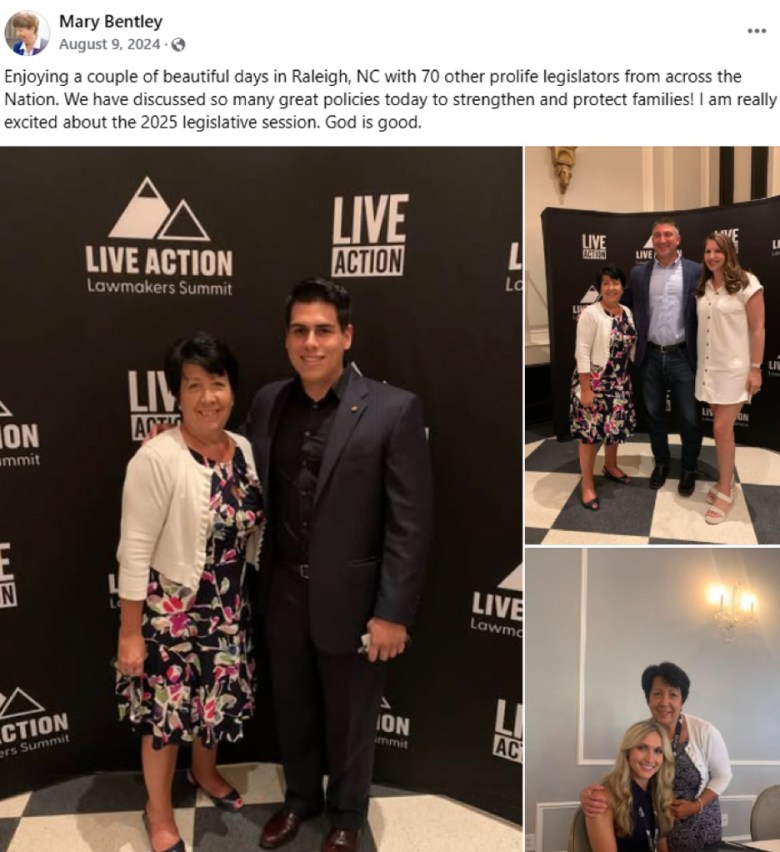
At least 11 state legislators who attended Live Action’s Lawmaker Summit, including Arkansas Rep. Mary Bentley, introduced fetal development legislation during the 2025 legislative session. Credit: Facebook
In hearings, Arkansas representative and bill sponsor Mary Bentley argued it would be easier and better for school districts to be told which video to use rather than have to make that determination themselves. She remains staunchly in support of the Baby Olivia video: “I think it’s so good to help kids understand the process of fetal development,” she said. “I just assumed that it would get the support that we needed in the most pro-life state in the nation.”
Davis proposed a competing bill, one that would require the Arkansas department of education to adopt standards for age-appropriate fetal development education, including showing an ultrasound, in the future. No video would be required, but districts could still show one, such as “Meet Baby Olivia,” if they chose to.
In the end, Bentley’s bill died and Davis’s legislation was signed into law in April.
For Brandt, of Live Action, the law falls short of what he considers the “gold standard” of fetal development education, but “We’re happy that they passed some version of it,” he said. “That is definitely better than nothing, and maybe can even be improved upon in the future.”
Contact investigations editor Sarah Butrymowicz at [email protected] or on Signal: @sbutry.04.
The Hechinger Report provides in-depth, fact-based, unbiased reporting on education that is free to all readers. But that doesn’t mean it’s free to produce. Our work keeps educators and the public informed about pressing issues at schools and on campuses throughout the country. We tell the whole story, even when the details are inconvenient. Help us keep doing that.
More Californians are using paid family leave benefits to care for a child after a new state law that increased payments for parents went into effect in January, according to new state data.
Claims in the first two quarters this year were up about 16%, compared with the same time period last year, according to data provided to LAist from the California Employment Development Department.
Anne Chapuis, public information officer for EDD, said several factors contributed to the uptick.
“The January 2025 benefit rate adjustment has led to higher benefit amounts for eligible customers. Also, we typically see a higher seasonal number of claims submitted near the end of each calendar year,” Chapuis said in an email.
While claims tend to tick up at the beginning of every calendar year, the uptick in the first quarter of 2025 was nearly 25% higher than the same period last year.
Before this year’s change, most workers got up to 60% of their income when they took time off to care for a new baby. Now, many workers can get up to 90% of their wages.
The changes stemmed from legislation in 2022 that aimed to allow more families to be able to take leave, especially low-income workers. Prior analysis showed that higher-income workers were using paid family leave benefits at much higher rates than workers making less than $20,000 a year.
For those making under $20,000, claims were up about 2%, while claims for those making under $60,000 were up 17%.
How paid family leave works
Currently, moms and dads can get up to eight weeks of paid family leave to bond with a new child. That’s in addition to the paid time off pregnant people get before and after giving birth to a child.
The paid family leave program in California is funded through the State Disability Insurance program, which covers about 18 million employees in the state. Workers pay into this fund with 1.2% taken out of their paychecks (it usually shows up on paystubs as “CASDI”).
Workers who make less than $63,000 a year can get up to 90% pay — workers who make above that get 70%.
After decades of trying, conservatives this year succeeded in creating the first national school voucher program.
The Republican megabill that President Donald Trump signed into law in July will establish new tax credit scholarships for families to use at private schools, including religious ones — a long-held goal of school privatization advocates who argue parents should get taxpayer support if they want to opt out of their neighborhood school.
Under the “big, beautiful bill,” donors can receive dollar-for-dollar tax credits of up to $1,700 for contributions to scholarship-granting nonprofits. Those groups then distribute the money to families seeking help paying for private school, tutoring and other educational expenses.
The program, while significant, is less expansive than in earlier drafts of the legislation. Previous versions gave donors larger tax credits — a match up to $5,000 or 10 percent of their income, whichever is greater — and mandated that all states participate rather than allowing them to opt in.
Here are 10 things to know about the program. If you have other questions or there’s more you’d like to know, write to us: [email protected].
When does it start?
Jan. 1, 2027. Families have until then to research where they might want to spend a scholarship — and if the school in mind even plans to accept one. Taxpayers who want to contribute to support the scholarships can do so beginning in late 2026.
How will the scholarships work?
The law opens the door to churches, universities, education nonprofits, rotary clubs and potentially even public schools (more on that below) to accept and distribute donations for the program. These “scholarship-granting organizations,” or SGOs, can keep up to 10 percent of the donations for administrative costs.
In some states with existing scholarship programs, families apply with a third-party contractor that works with eligible schools and selects students for awards. Other states allow religious groups and other nonprofits to create and manage their own scholarship funds. The federal bill gives states wide flexibility to make those sorts of decisions about how the program is administered, experts say.
Who’s eligible for the scholarships?
To qualify, students need to check these boxes: They must be eligible to attend a public school, their state must opt in to the program, and their families must earn no more than three times the area median income — a threshold that would include households with incomes nearing $500,000 in some parts of the United States.
Students who already attend private school qualify, since they are eligible for public school, even if they don’t attend one. The scholarships also may cover home-schoolers. (Keep reading for more on that.)
How much money will families receive?
While the bill set a $1,700 cap on how much individual donors can contribute through their taxes, it’s unclear whether it limits how much an individual student could collect in scholarships.
In theory, a student could apply for several scholarships. An SGO might also offer a scholarship that reimburses a family for all costs associated with attending their preferred school. In states that already offer similar school choice programs, a student might be able to collect scholarships from both the new program and the existing state program. Still, the average cost of private school tuition is roughly $13,000, so even students who combine several scholarships may not receive enough to cover the full cost of attending.
The Treasury Department is expected to issue regulations on the program, and we may not know these kinds of details until it does.
Quite a lot. The legislation suggests that families could use the money not only to help pay for private school tuition, but also for room and board, services for students with disabilities, transportation, tutoring, and school supplies like books, computers and uniforms.
The rules may depend on the individual state and its definition of an “eligible school.” In some states, home schooling might qualify students for the scholarships, but in other states it might not, said Robert Enlow, president of EdChoice, a pro-school choice group.
It’s also possible that public schools could charge scholarship students — as some do with home-schoolers — for services like tutoring, special education or advanced courses.
So students can use the money at public schools? How would that work?
Yes, potentially. In some states, schools already charge activity or participation fees for non-enrolled students who want to join clubs and sports. Marguerite Roza, director of the Edunomics Lab at Georgetown University, said some states may write their own rules that allow schools to extend the menu of services they could charge for.
Meanwhile, most school districts — roughly 4 in 5 — already partner with foundations that raise money to help students with transportation, school supplies and basic needs. Both Enlow and Roza said they expected nonprofits and districts to partner on finding ways to tap the federal scholarship dollars as well.
“Imagine you could have a public school foundation going out and helping with transportation and books and computers and tutors and all sorts of stuff, right?” Enlow said. “The potential is huge.”
Will all private schools accept the scholarships?
No, private schools are not required to accept the scholarships, and many states that offer school choice don’t require private schools to participate. Private schools generally can accept or reject a student for any reason, whether they have a scholarship or not.
In Arizona, for example, the tax credit program provided scholarships to students at 348 schools last year. More than 400 private schools operated in the state as of 2022.
Roughly 21 states — including Arizona, Georgia and Montana — offer their own tax credit scholarships, according to the group EdChoice, so it’s expected they would opt into the federal program. Conservative lawmakers in North Carolina already introduced a bill to allow families there to take part in the federal scholarships.
If public schools can benefit too, even Democratic governors may consider joining the program, said Roza.
“Ultimately if the state can open this to summer camp and tutoring, obviously there would be a lot of pressure to unlock so much money with this,” she said.
How much will the scholarships cost the government?
It depends on how many taxpayers claim the credit.
While an earlier version of the bill would have capped the tax credits at $10 billion a year, the final legislation contains no such limit — so the exact amount in lost revenue won’t be known until much later. That said, an analysis by the nonpartisan Joint Committee on Taxation found that the legislation would cost the Treasury up to $4 billion per year.
Others think the cost will be higher. The Institute on Taxation and Economic Policy, a left-leaning research group, placed its projection closer to $51 billion, while Roza estimated the cost at $28 billion per year. Still, she hesitated to count that as a direct loss to K-12 funding. “It’s new money in the sense that it doesn’t go into or out of the federal pie,” Roza said.
What’s been the reaction to the plan?
Critics, including teachers unions and many education experts, have been quick to raise alarms about the voucher program, arguing that it’s a handout for wealthy families and will harm public schools by reducing funding for them.
“It’s the centerpiece of the Great American Heist — a privatization scheme wrapped in tax policy,” Denise Forte, president of the left-leaning nonprofit EdTrust, said at a hearing before the Senate Democratic Caucus in July.
Advocates for the separation of church and state worry about the program channeling money from government coffers to religious schools, while disability advocates note that private schools are not required to serve students with disabilities.
Some supporters of school vouchers, meanwhile, wish the legislation had gone further.
“This is a very positive program for taxpayers in America. You can help families get better education and claim a tax credit for it,” said EdChoice’s Enlow. “It’s going to benefit middle- and low-income families.” But he added, “It’s not as generous as we would like, which is universal.”
Others are focused now on encouraging states to participate in the program. “The fight doesn’t end with the passing of the bill,” said Sydney Altfield, national director of Teach Coalition, which advocates for Jewish schools to get access to government funding. “States must opt into the program.”
Contact staff writer Neal Morton at 212-678-8247, on Signal at nealmorton.99, or via email at [email protected].
The Hechinger Report provides in-depth, fact-based, unbiased reporting on education that is free to all readers. But that doesn’t mean it’s free to produce. Our work keeps educators and the public informed about pressing issues at schools and on campuses throughout the country. We tell the whole story, even when the details are inconvenient. Help us keep doing that.
Two years ago, I bought each of the teachers at Hamilton Elementary in San Diego’s City Heights neighborhood a blue chair. I told them to put it in the back of their classrooms, and that if a parent or caregiver wanted to visit to see how their children are learning — no matter what the reason — that this would be a dedicated space for them.
I may have earned some exaggerated eye-rolls from educators that day. After all, I can appreciate the disruption to learning that classroom visitors can sometimes cause, especially among excitable elementary schoolers.
But school is our home, and it is our responsibility to invite families into our home and welcome them. And this was a necessary olive branch, my way of saying to families: “From here on out, things are going to be different.”
And they were. They also can be different at other schools, because the benefits of family engagement go well beyond student achievement.
Research has long shown that when parents and caregivers are involved and engaged with their children’s education — whether that’s by attending parent-teacher conferences or participating in school events — student achievement, motivation and social-emotional well-being increase.
Parent involvement with reading activities has a positive impact on reading achievement, language comprehension, expressive language skills and level of attention in the classroom, according to the National Literacy Trust.
Research also shows that educators enjoy increased job satisfaction and are more likely to keep teaching at the school, families enjoy stronger relationships with their children and feel less isolated, and even school districts themselves become better places to live and raise children.
None of this was the case when we returned to normalcy following Covid. Just 13 percent of students were reading on grade level, and 37 percent were chronically absent. I knew right away that before we even attempted to tackle academics, we needed to engage families and make them feel deeply connected and committed to the community I envisioned building here.
Today, 45 percent of students are reading at grade-level, and chronic absenteeism, at 12 percent on the most recent official numbers, is down to 10 percent in our own tracking, with a goal of pushing it down to 8 percent in 2025-26.
But it wasn’t easy given the distrust that had boiled over during the pandemic, with families skeptical of our ability to effectively support their children and school staff feeling defensive and exhausted.
It was clear to me that families weren’t excited to send their kids to school, didn’t feel informed about what was happening on our campus and, moreover, didn’t feel comfortable — let alone capable — of communicating their needs to us.
Complicating matters further was the need to share information across many languages other than English, which can make relationship-building and communicating expectations difficult.
Roughly half of our students are English learners, and while the majority of their families are Spanish-speakers, there are growing populations of students whose first languages are Haitian-Creole, Pashto and Vietnamese.
The first thing I did was establish open communication with parents using ClassDojo, a mobile app that gives families an easy, intuitive central access point to our teachers and staff, automatically translates all messages into parents’ native languages and allows us to share stories about what is happening in school.
It became an easy way to build trust and collaboration between families and staff.
Creating that type of visibility was key to breaking down walls between us. And in those early days, we didn’t post about literacy, math or anything related to academics. Instead, we focused solely on attendance and getting families to come inside the school as much as possible.
We focused on relationship-building activities and joyful learning. We hosted after-school art classes and monthly family Fridays, when families could come to school to engage in a fun activity.
We organized a Halloween costume drive with candy and fun games for kids; we hosted a Read Across America event where we passed out Play-Doh; and we organized other low-stakes events at school, rooted in building a partnership between home and school.
Again, our goal wasn’t learning during these meet-ups. It was all in service of building trust and creating meaningful relationships with students and their families.
Once we had the foundation in place, we added a focus on academics — though we rooted that learning in family engagement, too. For example, our schoolwide focus last year was phonics, so we sent activities home for families to complete with their children that were tied specifically to concepts the students needed reinforced, based on their individual assessments, like long vowel patterns and sight words.
These activities were taught by the students and their teachers to family members during conferences.
Beyond helping students, the exercise challenged a false narrative so many families had assumed — that they either didn’t know enough about what was happening in school to help, weren’t confident enough to help or didn’t have enough time.
Today, the atmosphere at Hamilton feels radically different than when I first walked through the doors. When we first started hosting Family Fridays, about 10 family members and their children showed up.
Now, we have roughly 200 caregivers at every meet-up. Families run most of the community-based initiatives at the school — from a boutique where families can shop among donated clothes twice a month, to a food distribution center, to a book club, English classes and a monthly meet-up where families can socialize.
When district leaders visit, they’re always impressed by the participation. I tell them, if you care about family engagement, it has to be so deeply embedded into the system that people don’t have a choice but to do it.
That’s why I’m constantly thinking about how to center family engagement in staff meetings, in attendance meetings, in literacy and math plans, in behavioral and counseling plans and in meetings about school procedures and budgets.
It’s a strategy that not only involves families but also supports academic achievement and student well-being. For me, family engagement is the ultimate strategy for academics.
Sometimes in the K-12 world we keep outreach and academics separate, but in reality, engagement is the key that unlocks our ability to hit academic goals and create a joyful school community.
The Hechinger Report provides in-depth, fact-based, unbiased reporting on education that is free to all readers. But that doesn’t mean it’s free to produce. Our work keeps educators and the public informed about pressing issues at schools and on campuses throughout the country. We tell the whole story, even when the details are inconvenient. Help us keep doing that.