Tag: parks

  • Rosa Parks’ Story Didn’t End in Montgomery. These Students Are Proof of That. – The 74

    Rosa Parks’ Story Didn’t End in Montgomery. These Students Are Proof of That. – The 74


    Get stories like this delivered straight to your inbox. Sign up for The 74 Newsletter

    This story was originally reported by Ebony JJ Curry of The 19th. Meet Ebony and read more of their reporting on gender, politics and policy.

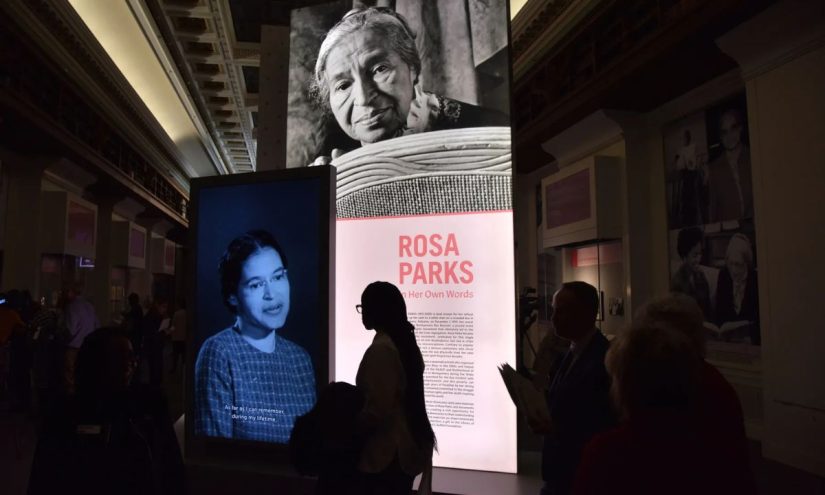
    Seventy years have passed since Rosa Parks refused to surrender her seat on a Montgomery bus, and yet the country still tries to shrink her into that single moment — a tired seamstress who’d simply had enough.

    Detroit, the city where she chose to continue her life, insists on remembering her differently. Not as an icon frozen in time, but as a Black woman whose lifelong organizing stretched from sexual violence cases in rural Alabama to open housing fights on Detroit’s west side.

    That fuller story  — truth beyond the myth — is exactly what the Rosa Parks Scholarship Foundation has fought to tell for 45 years.

    The Rosa Parks Scholarship Foundation (RPSF) has awarded more than $3 million in scholarships to more than 2,250 high school seniors since its founding by The Detroit News and the Detroit Public Schools (DPS) in 1980.

    “Most people actually don’t know the story of Rosa Parks,” said Dr. Danielle McGuire, RPSF board member, historian and author of “At the Dark End of the Street”, whose research permanently shifted how historians write about Parks and the civil rights movement. “She’s so much more interesting, so much more radical, and so much more involved in all kinds of things that we forget about. We keep her stuck on the bus in Montgomery in 1955.”

    According to Kim Trent, a  Detroit civic leader and former board president, the foundation, created through a racial discrimination lawsuit settlement involving Stroh’s Brewing Company, became one of the rare instances where federal accountability for racism produced long-term investment in Black futures.

    A judge, DPS and The Detroit News agreed the money should honor Parks — who was living in Detroit and working for Rep. John Conyers at the time — by funding scholarships for Michigan students devoted to service and social change.

    It is a statewide program, reaching students from Detroit to Grand Rapids to rural school districts where scholarship dollars often determine whether higher education is possible at all.

    That framing makes her legacy active, not ceremonial.

    “As part of her family, I feel grateful to be able to work together with my fellow board members to keep fighting for more opportunities to continue to provide scholarships,” said Erica Thedford, Parks’ great-niece and a foundation trustee. “I think Auntie Rosa would be extremely proud of what the Foundation has been able to achieve.”

    The numbers tell one story — more than 1,000 scholars, millions awarded, forty $2,500 scholarships each year — and the essays tell another. Applicants must identify a modern social issue and explain how they would confront it using principles Parks embodied: discipline, non-negotiable dignity, community before self.

    “Reading the essays of the students who apply is a great reminder that each person doing one act, no matter how small, creates a stronger network of love and kindness,” Thedford said. “Some of these students come from extreme hardship and still find the time and resources to volunteer at food banks, shelters… Some even take it upon themselves to be the organizer of ways to help the less fortunate at their schools.”

    The award is one-time, not renewable, yet its impact stretches across decades.

    “Once you become a Rosa Parks Scholarship Foundation recipient, you are a Rosa Parks Scholar for life,” Thedford said. “These students are now part of a network of people who root for each other, and that kind of support system is important.”

    Trent knows that firsthand: She was a Parks Scholar herself when she graduated from Cass Tech High School.

    “I received the scholarship in 1987,” she said. “Ironically, not only did I get it, but my best friend… also received the same scholarship. And then her son got the scholarship like 30 years later.”

    Trent said the scholarship’s origin mirrors Parks’ life — created in response to injustice and sustained through community action.

    “It’s one of those rare occasions where something beautiful grew out of an instance of racism and oppression,” Trent said.

    Over the years, some Parks Scholars attended community college. Others enrolled at flagship universities. All had to articulate how their education would serve a community beyond themselves.

    Some, like Emmy-winning actor Courtney B. Vance, who’s from Highland Park, Michigan, went on to shape national culture. Others are now attorneys, educators and nonprofit leaders across the state.

    “What gets lost in what she did is the reason she did it,” Trent added. “It wasn’t just so she could sit on a bus. It was because she was trying to open up opportunity for people who had been denied opportunity.”

    That is the heartbeat of the foundation’s lineage.

    Parks was not simply resisting segregation. She was rejecting the entire machinery that kept Black women from safety, education and economic autonomy.

    McGuire’s research highlights how Rosa Parks was investigating sexual violence cases long before #MeToo, defending Black girls like Recy Taylor, whose voices were dismissed in courtrooms and newspapers. She worked alongside the NAACP on equity cases. When she left Alabama under threat of death and moved to Detroit, she became the neighbor who knew everyone’s children, the church member who attended every meeting, the woman who collected information and names and needs.

    “She was the person in the neighborhood who knew all the kids, who worked in almost every community organization you can imagine, to make life better for her people,” McGuire said. “The scholarship foundation is an example of that — just one of many.”

    Every year, nearly 400 applicants encounter that fuller history — the Parks who fought for open housing in Detroit, who believed in Black self-determination, who, as McGuire notes, “never stopped fighting for equality and justice for people who didn’t have a voice that was being heard.”

    That is not accidental. It is by design.

    “We ask our applicants to become familiar with Rosa Parks and the tactics and strategies she used to make changes in her community and how they will do the same,” McGuire said. “I think it gives them hope. It links them to a tradition and a history of hope and change.”

    This anniversary of Parks’ arrest arrives as school boards strip Black history from K-12 classrooms and as scholarship programs for marginalized students come under attack. Thedford sees the foundation’s work as a refusal.

    “During this time, when we are hearing of funding being pulled from schools and programs that are needed to serve our youth, the Foundation is able to continue its provision of funds,” she said.

    McGuire is blunt about what that represents:

    “No matter how hard people try to cancel the past, the past is very much alive,” she said. “Rosa Parks’ history gives us so much honesty about America… and studying her is paramount to getting through any difficult time.”

    Seventy years later, the lesson remains unchanged: Rosa Parks did not fight for a place to sit, she fought for the generations who would rise. Today, those students are still applying, still studying her strategies, still refusing to yield.

    This story was originally published on The 19th.


    Did you use this article in your work?

    We’d love to hear how The 74’s reporting is helping educators, researchers, and policymakers. Tell us how
    Source link

  • Free speech advocates rally to support FIRE’s federal appeal to defend advocacy in public parks

    Free speech advocates rally to support FIRE’s federal appeal to defend advocacy in public parks

    Protesting in public parks is as American as apple pie. It’s at the heart of our First Amendment — and one of our nation’s most time-honored principles. That right does not disappear merely because a private entity operates the public park on the government’s behalf. 

    That’s why FIRE and the Law and Religion Clinic at the University of Texas School of Law are appealing a district court ruling that weakens this First Amendment right. And we are proud to be backed by a broad coalition of prominent organizations as “friends of the court.” 

    Here’s what happened. Several years ago, animal welfare advocates Daraius Dubash and Dr. Faraz Harsini took to Houston’s largest public park to raise awareness about the harms of industrialized farming. For Dubash, this activism is rooted in his Vedantic Hindu faith, which compels him to promote the teaching of ahimsa, or nonviolence. To communicate their message, Dubash and Harsini serve as co-organizers for an international nonprofit animal-rights group. Their signature event involves volunteers showing muted documentary footage of farming practices to passersby, while others remain available to answer questions.

    Dubash and Harsini’s right to peacefully advocate on this issue in a public park is beyond dispute. But on three separate occasions, the public park’s private management ordered them to leave. The fourth time, park management had Houston police arrest Dubash for criminal trespass and banned them both from showing their video footage in the park in the future. Why? Because the park’s private managers and city police deemed their message “offensive.”

    With the help of FIRE and the Law and Religion Clinic, Dubash and Harsini filed suit in 2023 against the City of Houston, the park management corporation, its then-president, and the arresting officers. But in September, 2024, the U.S. District Court for the Southern District of Texas dismissed their claims, ruling that none of the defendants were responsible for violating Dubash and Harsini’s constitutional rights in a public park. 

    We disagree. 

    FIRE and the Clinic appealed to the Fifth Circuit, arguing that the ruling effectively lets the government bypass the First Amendment by delegating the management of public spaces to private organizations. And the court’s limited interpretation of governmental liability would make it nearly impossible for anyone to challenge violation of their constitutional rights by municipalities or law enforcement. 

    Last week, 12 prominent organizations from across the ideological spectrum filed nine amicus curiae briefs in support of Dubash and Harsini:

     The ACLU of Texas argues the park management company was acting as a state actor and public-private partnerships “cannot serve as an end run around the First Amendment.” The brief also argues the district court erred by failing to hold the arresting officers accountable based on their “mistaken belief” that the park was private. As the brief explains, probable-cause findings must be based on “objective facts and circumstances rather than subjective beliefs.”

    Young America’s Foundation, Hamilton Lincoln Law Institute, and Advancing American Freedom explain that Houston cannot bypass its duty to protect free speech in its public spaces by granting oversight authority to a private third party. The brief also emphasizes the sweeping implications of the district court’s decision, including in the academic context where state universities are increasingly attempting to evade First Amendment protections by outsourcing park management to nominally private entities like student governments.

    Liberty Justice Center argues the district court’s decision “blurs the line between state and private actors,” allowing Houston to “contract out of its constitutional obligations.” We could not agree more.

     The Center for American Liberty, in a brief submitted through Reeves Law LLC, argues that maintaining a public park is a traditional and exclusive government function, with public parks serving “as public forums for the expression of speech,” whether or not they are managed by a private entity.

     The National Press Photographers Association, in a brief submitted through the First Amendment Clinic at Southern Methodist University Dedman School of Law, explains how the district court’s ruling “threatens the sanctity of the spaces where speech is deserving of the highest protection.”

     Law Enforcement Action Partnership and the National Police Accountability Project explain that accountability for law enforcement officers and municipalities is crucial to preserving public confidence in the police and the government, and that failing to hold police officers accountable “undermines public trust in law enforcement.” The brief also argues that municipalities should know their police officers “need training and guidance to appropriately respond” to peaceful expressive activity, and failing to provide that training is sufficient to establish municipal liability.

    Protect the First Foundation, in a brief submitted through the Religious Freedom Clinic at Harvard Law School and Schaerr Jaffe LLP, highlights that Dubash was motivated to proselytize nonviolence by his deeply held religious beliefs, and describes the long history and tradition of public proselytization, from the persecution of religious minorities in the colonies through the legal protections established by First Amendment jurisprudence.

    The Hindu American Foundation, in a brief submitted through Jackson Walker LLP, explains that Dubash’s religious motivation to advocate for nonviolence towards animals is consistent with Hindu teachings. The brief also argues that his “arrest, detention, and the ongoing prohibition on his method of proselytizing” do not pass constitutional muster.

    The American Hindu Coalition, in a brief submitted through the Free Exercise Clinic at Yale Law School, emphasizes the history of public parks and streets as centers of religious activity, how marginalized faiths rely on these spaces to exercise their faith, and that Dubash’s activism is rooted in his religious beliefs.

    Our clients and their counsel are grateful for the support of this impressive and diverse amicus coalition. This case will play a critical role in protecting the rights of other protesters and religious minorities to engage in protected expression as guaranteed under the First Amendment.

    Source link

  • One day after FIRE lawsuit, Congress passes changes to filming permits in national parks

    One day after FIRE lawsuit, Congress passes changes to filming permits in national parks

    On Wednesday, FIRE and the National Press Photographers Association filed lawsuit challenging the arbitrary and unconstitutional laws that require Americans to apply for a permit and pay costly fees before exercising their right to film in national parks. The very next day, the U.S. Senate passed a bill addressing these same issues. The bill now goes to President Biden, who is expected to sign it in a huge victory for filmmakers — and for the First Amendment.

    Currently, filmmakers must obtain a permit and pay a fee if they intend to later profit from their footage in national parks, even if they are using the same handheld camera or phone that a tourist would use. Permits are routinely denied for arbitrary and unpredictable reasons, making it difficult for people like documentary filmmakers, press photographers, and wedding videographers to earn a living. Under the EXPLORE Act, that changes. 


    WATCH VIDEO

    The EXPLORE Act, championed in the Senate by West Virginia Democrat Joe Manchin and Wyoming Republican John Barrasso, does several things to fix the constitutional problems with the permit scheme that FIRE is challenging. First, so long as the filming takes place where the public is allowed, doesn’t impact other visitors or damage parks resources, and involves five or fewer people, no permit is required. Second, no permit is required simply because the filmmaker intends to make a profit. Third, no permit is needed to film activities that are already allowed in the park. And fourth, the EXPLORE Act makes clear that when the National Park Service has already approved an event like a wedding to take place in a national park, no additional permit is needed to film or photograph the special occasion.

    After filing, FIRE and NPPA took the story to the media and to Capitol Hill. FIRE looks forward to seeing this bill become law.

    Source link

  • LAWSUIT: Videographers sue to overturn National Parks Service arbitrary permit scheme

    LAWSUIT: Videographers sue to overturn National Parks Service arbitrary permit scheme

    JACKSON HOLE, Wy. Dec. 18, 2024 — Picture three people standing next to each other in Yellowstone National Park. One’s an ordinary tourist, one’s a news reporter, and the third’s a documentary filmmaker. They’re all filming Old Faithful, using the exact same iPhone, and without disturbing anyone around them.

    Under federal law, the tourist and the reporter are doing nothing wrong. But the documentarian could face heavy fines — even jail time.

    That’s why the Foundation for Individual Rights and Expression today filed a lawsuit on behalf of nature and sports photographers and filmmakers Alexander Rienzie and Connor Burkesmith. FIRE’s suit aims to overturn the National Park Service’s onerous, arbitrary, and unconstitutional permit-and-fee scheme that charges Americans for the right to film in public spaces.

    “The national parks belong to the American public,” said FIRE Chief Counsel Bob Corn-Revere. “If you have a right to be there, you have a right to film there. The federal government can’t tax Americans to exercise their constitutional rights.”

    Joining FIRE’s lawsuit as co-counsel and co-plaintiffs is the National Press Photographers Association, which represents thousands of visual journalists, including Alex and Connor. Although the NPS exempts filming for “news-gathering” from its permit scheme, the NPPA has for years argued that the law imposes an unfair burden on photographers and filmographers, who can’t always know ahead of time who they plan to sell their work to, or even if they plan to sell it at all.

    “For decades, the National Press Photographers Association has been working to support the rights of visual journalists and other photographers to document the beauty of our natural resources and the people who visit and care for them in our national parks,” said NPPA President Carey Wagner. “It is unfortunate that the actions and policies of the National Park Service have never fully respected the First Amendment rights of photographers, and it’s even more disappointing that it has become necessary to take the Park Service to court in order to resolve our members’ concerns. NPPA is enormously grateful to FIRE for taking on this case on behalf of all photographers.”

    Alex and Connor wanted to film in Grand Teton National Park in September to document an attempt by an athlete to break the record for the fastest climb up the Grand Teton. They planned to have only two or three people, using small handheld cameras and tripods, on the 16-mile route for the shoot. In fact, to keep up with the fast pace of the speedrun, they would carry less gear than the typical climber going up the mountain.


    But under current law, whether a filmmaker needs a permit to film in a national park doesn’t depend on the amount of gear they bring or how disruptive filming might be. The only thing that matters is whether their purpose is “commercial.” The rule could apply to filming a big blockbuster movie near the Grand Canyon (where the scale of the project might justify a permit requirement), but also to a small-time YouTuber who posts a video of their jog through the National Mall.

    “Congress wanted to keep big Hollywood productions from taking over the parks and keeping others from enjoying their natural beauty,” said FIRE attorney Daniel Ortner. “But the current law wasn’t written for a world where anyone with a smartphone has a film studio in their pocket.”

    Alex and Connor knew they might use the footage to produce a documentary film, so they filed for a permit and explained how small their impact would be. But NPS employees have wide and unquestioned discretion under the law to deny permits. NPS denied the permit on the grounds that it could turn the speedrun into a “competitive event”— and pocketed the non-refundable $325 application fee.

    “Independent filmmakers don’t have the resources of the big production companies,” said Connor. “It’s a gut punch every time we throw down hundreds of dollars, only to be denied permits for reasons that are vague, arbitrary, and unfair. As someone who needs to film outdoor sports where they happen, it’s a threat to my livelihood.”

    COURTESY PHOTOS OF ALEX AND CONNOR FOR MEDIA USE

    Alex and Connor were forced to choose between risking prosecution, or letting a potentially historic event go undocumented. For dedicated documentarians like themselves, it was an easy choice: They filmed without the permit in September.

    “In the entire time we were up there, we didn’t get in the way of anyone else’s enjoyment of Grand Teton,” said Alex. “To us, the Grand is a very special mountain that we’ve spent countless hours exploring.”

    An NPS spokesperson later announced they had determined that Alex and Connor’s actions didn’t meet all the criteria for charges—but if their work had been featured “in a commercial or a catalog or something like that,” it would be “less of a gray area.” Far from settling the issue, the NPS statement effectively signaled that Alex and Connor could still face charges if they ever sell or use their footage.

    FIRE and the NPPA are seeking an injunction in the United States District Court for the District of Wyoming to prevent that outcome, and to put a permanent end to a system where individual park employees can deny Americans their First Amendment rights on a whim.

    “I chose this line of work because I love the national parks,” said Connor. “Photographers and videographers are the best advocates the parks have; the more people see and understand their unique value, the stronger their desire to protect them. It’s time for the Park Service to stop throwing up roadblocks and work with us, not against us.”


    The Foundation for Individual Rights and Expression (FIRE) is a nonpartisan, nonprofit organization dedicated to defending and sustaining the individual rights of all Americans to free speech and free thought — the most essential qualities of liberty. FIRE educates Americans about the importance of these inalienable rights, promotes a culture of respect for these rights, and provides the means to preserve them.

    CONTACT:

    Alex Griswold, Communications Campaign Manager, FIRE: 215-717-3473; [email protected]

    Source link